



Want to go tubeless? Here are all your options in tyres.
Tubeless tyres are gradually gaining popularity as more riders become convinced that their improved ride and increased resistance to punctures are worth the cost of new wheels and tyres and the sometimes problematic fitting process. If you’re about to make the switch, here’s a look at your tyre options.
When tubeless tyres for road wheels first appeared you had very few choices. Hutchinson made tyres, Shimano and Stan’s NoTubes made wheels and conversion kits and, er, that was it. Now almost all tyre makers offer tubeless options, and even long-time hold-outs Michelin and Continental are on board.
Read more: How to fit a tubeless tyre
Read more: Road tubeless: everything you need to know — including how to convert
Tubeless tyre manufacturers
- Bontrager
- Continental
- Challenge
- Donnelly
- Ere Research
- Giant
- Goodyear
- Hutchinson
- IRC
- Kenda
- Maxxis
- Mavic
- Michelin
- Panaracer
- Pirelli
- Rene Herse
- Ritchey
- Schwalbe
- Specialized
- Teravail
- Veloflex
- Vittoria
- WTB
- Zipp
Bontrager
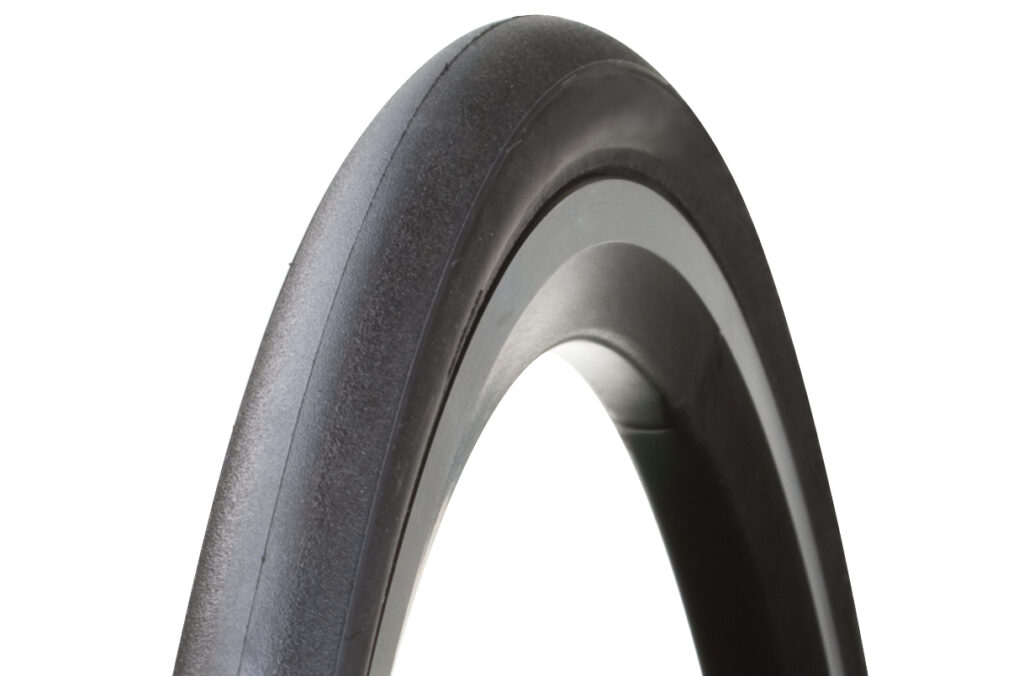
Bontrager offers a range of three tyres badged Tubeless Ready, which means what you need to get them working is sealant and either Bontrager’s special rim strips if you have Bontrager wheels, or other tubeless compatible wheels and valves. In ascending order of raciness, they’re the AW2, R2 and R3. We’ve tested and liked the latter as part of the Bontrager Road TLR Upgrade Kit.
| Tyre | Claimed weight | Price |
|---|---|---|
| Bontrager GR2 TLR Team Issue Gravel | 440g (40mm) | £40.00 |
| Bontrager GR1 TLR Team Issue Gravel | 430g (40mm) | £46.24 |
| Bontrager R2 TLR | 235g (25mm) | £29.99 |
| Bontrager R3 TLR | 200g (25mm) | £38.49 |
| Bontrager CX0 TLR | 395g (33mm) | £41.62 |
| Bontrager CX3 TLR | 405g (33mm) | £38.15 |
| Bontrager LT2 TLR | 395g (32mm), 475g (38mm) | £42.49 |
| Bontrager AW2 | 360g (26mm) | £27.99 |
Continental
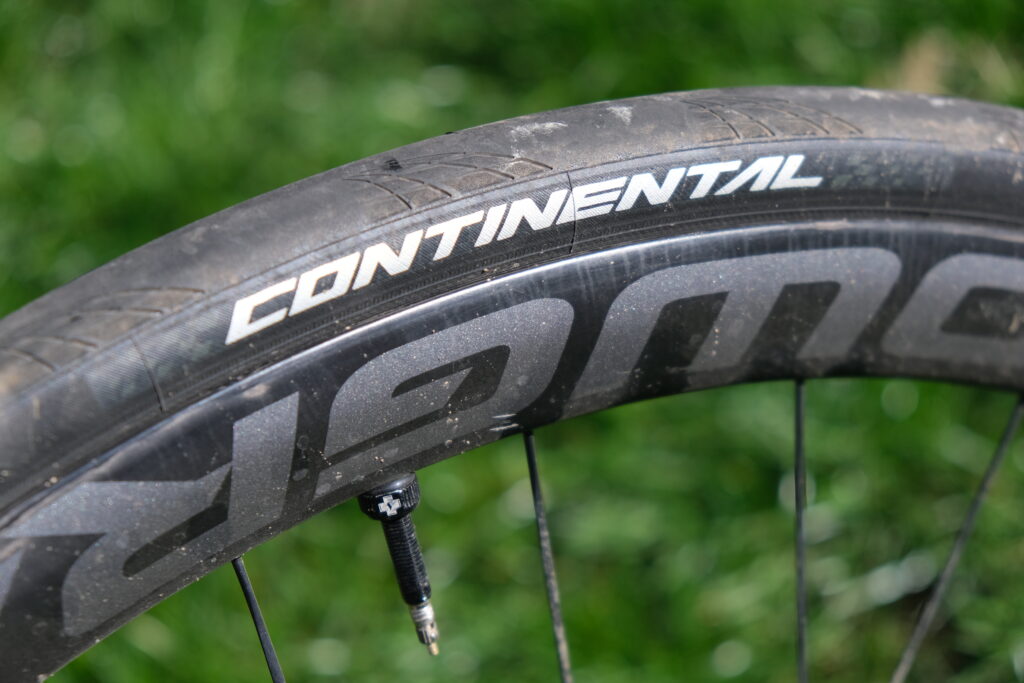
Conti was one of the last two major tyre makers to hold out against tubeless, but late in 2018 announced a new tyre, the Grand Prix 5000, to succeed the much-loved Grand Prix 4000S II, and as well as regular clinchers there are tubeless versions too.
And they were worth the wait. The Grand Prix 5000 tubeless tyre takes everything that is improved with this latest generation tyre and adds tubeless compatibility for improved puncture resistance. They’re relatively painless to set up and provide excellent performance in all conditions with low rolling resistance, good grip and durability.
| Tyre | Claimed weight | Price |
|---|---|---|
| Continental Terra Trail | 440g (650B), 460g (700C) | £50.00 |
| Continental Terra Speed | 390g (650B 35mm), 400g (650B 40mm), 400g (700C 35mm), 420g (700C 40mm) | £38.00 |
| Continental Grand Prix 5000 TL | 300g (25mm), 340g (28mm), 380g (32mm), 290g (650B) | £47.99 |
Challenge
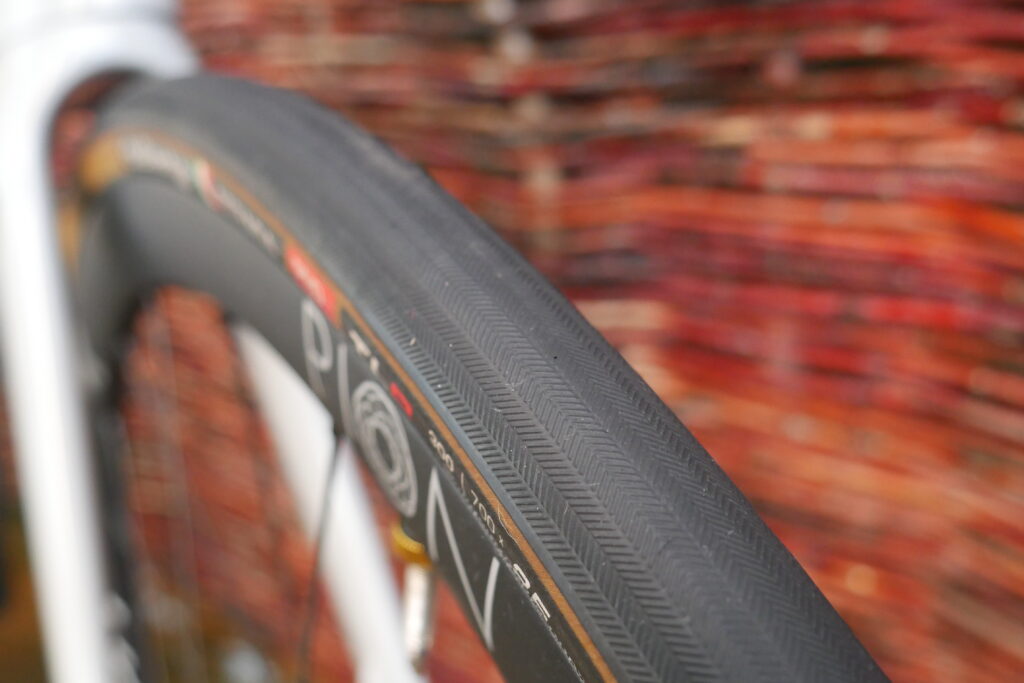
Renowned for their fast, supple hand-made road tyres, Challenge has added tubeless tyres to its range. HTLR tyres are handmade, while VTLR are a more conventional vulcanised construction.
| Tyre | Claimed weight | Price |
|---|---|---|
| Challenge Strada Pro HTLR | 205g (25mm) | £56.00 |
| Challenge Strada VTLR | 205g (25mm) | £49.00 |
| Challenge Paris-Roubaix Pro HTLR | 215g (27mm) | £59.00 |
| Challenge Paris-Roubaix VTLR | 215g (27mm) | £50.00 |
| Challenge Strada Bianca Pro HTLR | 355g (33mm), 375g (36mm) | £68.00 |
| Challenge Strada Bianca VTLR | 355g (33mm), 375g (36mm) | £38.00 |
| Challenge Strada Bianca VTLR 650B | NA | NA |
| Challenge Chicane CX VTLR | NA | £39.00 |
| Challenge Grifo CX VTLR | 330g (33mm) | £41.49 |
| Challenge Limus CX | NA | £43.49 |
| Challenge Almanzo Pro HTLR | 385g (33mm) | £60.00 |
| Challenge Gravel Grinder Pro HTLR | 365g (33mm), 375g (38mm), 375g (42mm) | £60.00 |
| Challenge Gravel Grinder VTLR | 365g (33mm), 375g (38mm), 375g (42mm) | £36.99 – £44.99 |
| Challenge Gravel Grinder VTLR 650B | NA | NA |
Donnelly
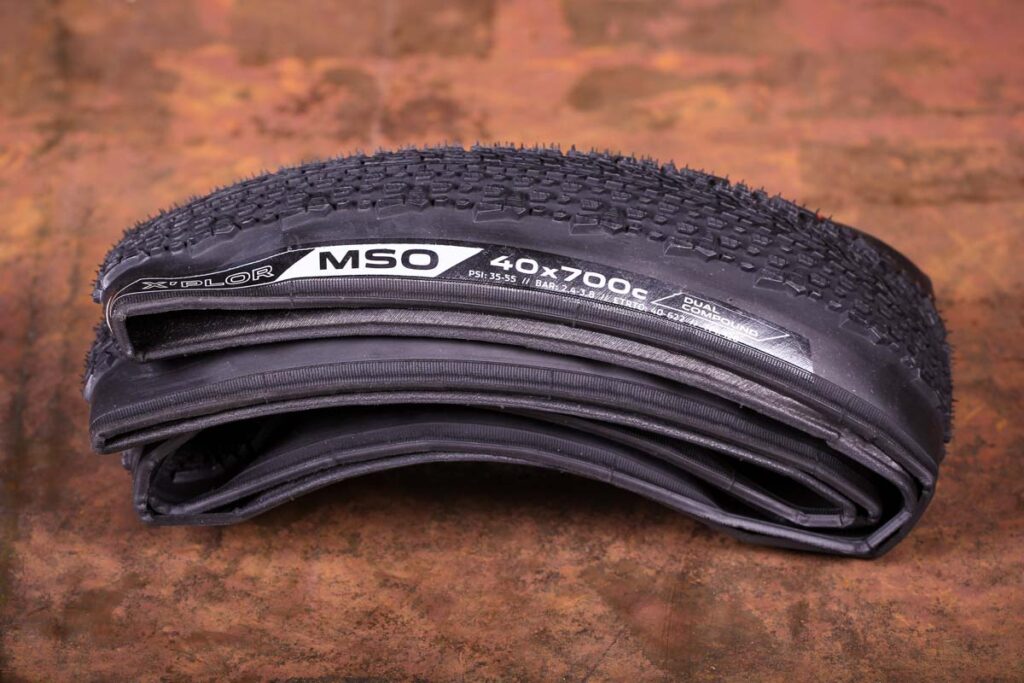
Donnelly is the new name for the tyres formerly known as Clement, after Clement brand owner Pirelli decided to return to the tyre sector. Donnelly specialises in cyclocross tyres—all the 33mm tyres in the range are for cyclocross—but has a decent selection of fat rubber for gravel and bad roads too.
Check out importer 2Pure’s eBay outlet for Donnelly bargains.
| Tyre | Claimed weight | Price |
|---|---|---|
| Donnelly BOS 700C | 456g (33mm) | £40.00 |
| Donnelly MXP 650B | 430g (33mm) | £31.99 |
| Donnelly MXP 700C | 446g (33mm) | £47.50 |
| Donnelly PDX 700C | 426g (33mm) | £42.50 |
| Donnelly Strada USH 650B | 472g (36mm), 536g (42mm), 644g (50mm) | £65.00 |
| Donnelly Strada USH 700C | 338g (32mm), 562 (40mm) | £45.00 |
| Donnelly X’Plor MSO 650B | 532g (42mm), 670g (50mm) | £66.00/pr |
| Donnelly X’Plor MSO 700C | 420g (30mm), 532g (40mm), 794g (50mm) | £48.75 |
| Donnelly EMP 650B | 558g (47mm) | NA |
| Donnelly EMP 700C | 484g (38mm), 618g (45mm) | £65.00 |
| Donnelly X’Plor CDG 700C | 420g (30mm) | £57.00/pr |
Ere Research
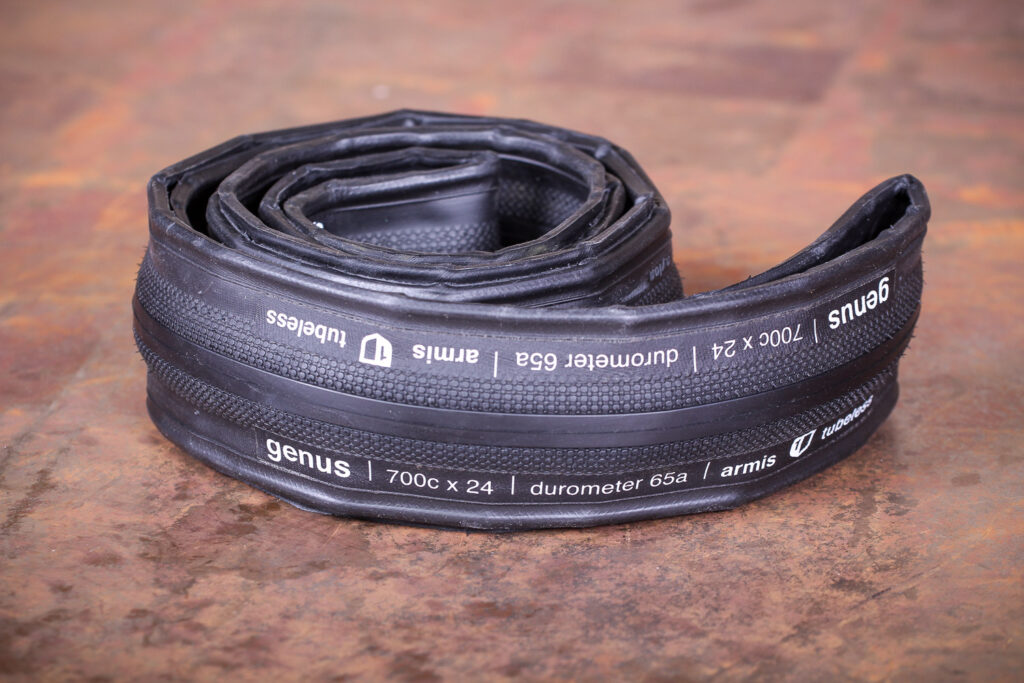
Ere Research CEO Piet van der Velde has almost three decades in the bike industry, most recently as product director of saddle maker Selle Italia before founding Ere Research in 2017. The company launched with an extensive range of tyres, with tubeless versions of almost all models, and some — the Tempus tyres for time trials — only available in a tubeless format.
| Tyre | Claimed weight | Price |
|---|---|---|
| Ere Research Genus | 235g (24mm) 242g (26mm) 268g (28mm) | £56.99 |
| Ere Research Omnia | 248g (24mm) 255g (26mm) 283g (28mm) 308g (30mm) | ~£55.00 |
| Ere Research Tenaci | 360g (30mm) 394g (32mm) 408g (36mm) n/a (40mm) | £56.99 |
| Ere Research Pontus | 255g (24mm) 276g (26mm) | ~£55.00 |
| Ere Research Tempus | 255g (26mm) 291g (28mm) | ~£45.00 |
Giant

The world’s biggest bike manufacturer has switched to tubeless tyres and wheels on large swathe of its recent models. Giant has come up with a range that covers a full range of applications from racing to messing about in the dirt.
Giant’s high-end component brand, Cadex, also offers two models of tubeless tyres, though the endurance-focused Classics aren’t yet available in the UK.
| Tyre | Claimed weight | Price |
|---|---|---|
| Cadex Race Tubeless | 255g (23mm), 270g (25mm), 325g (28mm) | £64.99 |
| Cadex Classics Tubeless | 290g (25mm), 315g (28mm), 345g (32mm) | £64.99 |
| Giant Gavia Course 1 | 375g (25mm), 395g (28mm) | £35.99 |
| Giant Gavia Fondo 0 | 330g (28mm), 370g (32mm) | £41.99 |
| Giant Gavia Fondo 1 | 395g (28mm), 445g (32mm) | £39.99 |
| Giant Gavia Race 1 | 255g (25mm) | £33.97 |
| Giant Gavia Race 0 | 307g (25mm) | £39.99 |
| Giant Gavia AC 0 | 278g (25mm), 302g (28mm) | £49.99 |
| Giant Gavia AC 1 | 330g (25mm), 373g (28mm) | £39.99 |
| Giant Gavia AC 2 | 411g (25mm), 441g (28mm) | £29.99 |
| Giant Crosscut Tour 2 | 553g (30mm) | £29.69 |
| Giant Crosscut AT 2 | 673g (38mm) | £29.69 |
| Giant Crosscut Gravel 2 | 573g (40mm), 705g (45mm), 725g (50mm) | £29.69 |
| Giant Crosscut Metro | 607g (32mm), 635g (35mm) | £29.99 |
Goodyear
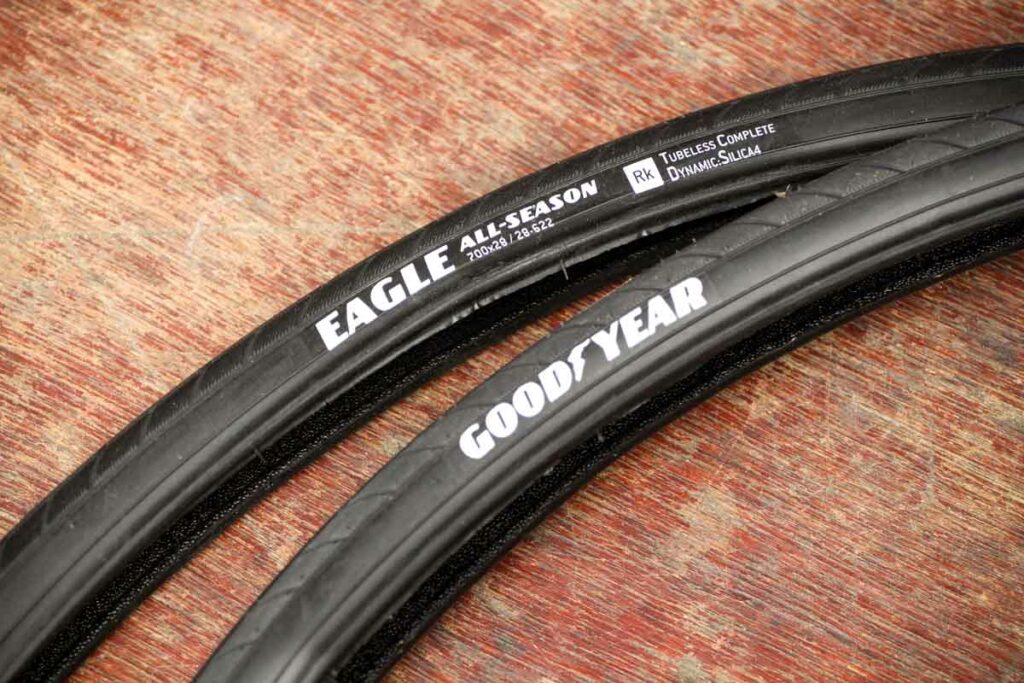
Goodyear announced a return to bicycle tyres in 2018 with a range that includes what the company describes as ‘Tubeless Complete’ tyres, which have “tubeless specific bead and casings, allowing for easy installation and superior air retention”. With a tyre carcass that’s impenetrable to sealant but not airtight, Tubeless Complete is a sort of halfway house between Road Tubeless, which has an air-retaining coat of butyl rubber on the inside of the tyre and Tubeless Ready, which has a standard tyre carcass. Goodyear recommends the use of sealant to make sure the bead properly seals against the rim, and says sealant won’t seep through the Tubeless Complete carcass so it will still all be there when you need it to fix a puncture.
In August 2020 Goodyear announced an expansion of the range of road tyres with the Eagle F1 Supersport and Vector 4 Seasons bike tyres. To keep things nice and confusing, the names are shared with Goodyear’s car tyre range, so that’s what Google finds when you go searching for them. A report has been lodged with the Royal Society for the Prevention of Cruelty to Bicycle Product Journalists.
| Tyre | Claimed weight | Price |
|---|---|---|
| Goodyear Eagle F1 | 275g (25mm), 300g (28mm), 320g (30mm), 340g (32mm) | £50.00 |
| Goodyear Eagle F1 Supersport | 255g (25mm), 280g (28mm) | £50.00 |
| Goodyear Vector 4 Seasons | 290g (25mm), 325g (28mm), 350g (30mm), 360g (32mm) | £47.00 |
| Goodyear Eagle All Season | 300g (25mm), 316g (28mm), 326g (30mm), 377g (32mm) | £50.99 |
| Goodyear Transit Speed | 565g (35mm), 626g (40mm), 769g (50mm) | £39.99 |
| Goodyear Transit Tour | 722g (650B x 50mm), 565g (35mm), 626g (40mm), 769g (50mm) | £NA |
| Goodyear County | 526g (Premium 35mm), 441g (Ultimate 35mm) | £50.00 – £60.00 |
| Goodyear Connector | 542g (Premium 40mm), 463g (Ultimate 40mm) | £40.00 |
Hutchinson
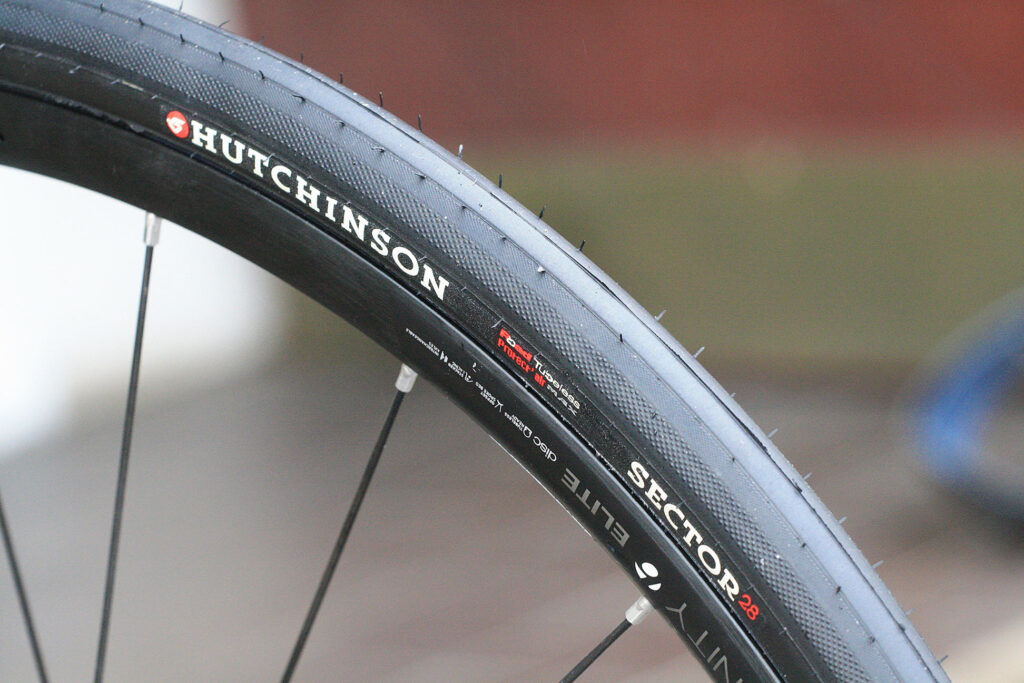
Hutchinson launched tubeless tyres for road bikes back in 2006, so it’s no surprise the French tyre maker has a fairly big range. While most tyre makers have gone down the Tubeless Ready route with lightweight tyres that need sealant to keep the air in, Hutchinson also makes tyres to the original Road Tubeless spec, sealed with a coating of rubber inside the tyre.
Hutchinson’s flagship tubeless tyre is the Fusion 5, which is available in a number of variants. There are Tubeless Ready versions that need sealant, and Road Tubeless versions that, on paper, don’t need sealant, but that everyone uses sealant with anyway just to be safe. Both Road Tubeless and Tubeless Ready versions are available in Galactik, Performance and All Season variants.
Galactik is the lightest version, intended for racing; Performance is the all-rounder with a slightly thicker tread and All Season is more durable, with a thicker tread and grooves to allegedly disperse water in wet conditions. Road Tubeless Fusion 5s come in 23mm and 25mm widths, Tubeless Ready in 25mm, plus 28mm in Performance and All Season.
All Fusion 5s use Hutchinson’s ElevenStorm rubber which provides very low rolling resistance and buckets of grip. Tubeless Ready versions have Hutchinson’s Hardskin bead-to-bead protection to reduce cuts and punctures. Galactik Road Tubeless tyres have a light reinforcement under the tread, while Performance and All Season Road Tubeless tyres get extra protection in the form of a Kevlar band.
| Tyre | Claimed weight | Price |
|---|---|---|
| Hutchinson Fusion 5 Tubeless Ready All Season | 260g (25mm) | £34.00 |
| Hutchinson Fusion 5 Tubeless Ready Performance | 255g (25mm) | £33.50 |
| Hutchinson Fusion 5 Tubeless Ready Galactik | 240g (25mm) | £42.00 |
| Hutchinson Fusion 5 Road Tubeless All Season | 325g (25mm) | £39.99 |
| Hutchinson Fusion 5 Road Tubeless Performance | 315g (25mm) | NA |
| Hutchinson Fusion 5 Road Tubeless Galactik | 285g (25mm) | £69.00 |
| Hutchinson Fusion 3 Road Tubeless | 300g (25mm) | £34.99 |
| Hutchinson Intensive 2 Road Tubeless | 315g (25mm) | £31.99 |
| Hutchinson Sector 28 Tubeless Ready | 295g (28mm) | £44.95 |
| Hutchinson Overide 700C | 425g (38mm) | £29.95 – £31.95 |
| Hutchinson Touareg | 490g (40mm), 550g (45mm) | £29.99 – £32.99 |
IRC
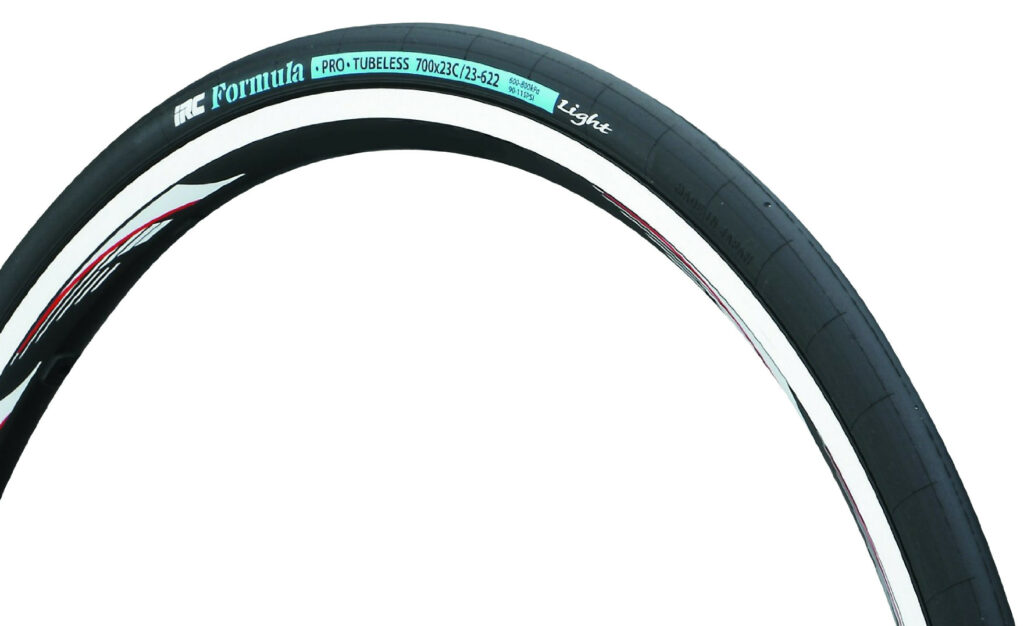
IRC makes several tubeless or tubeless ready tyres, but they’re very rare in the UK; we’ve only been able to find one source. That’s a pity as IRC has been pushing road tubeless technology to make tyres lighter and faster. The Pro Tubeless tyres have internal coating based on latex rubber rather than synthetic butyl. That makes for lower rolling resistance, just as a regular clincher tyre is faster with a latex inner tube than a butyl one.
| Tyre | Claimed weight | Price |
|---|---|---|
| IRC Formula S-Light TLR | 220g (25mm), 250g (28mm), 275g (30mm) | £57.00 |
| IRC Formula Pro Tubeless Light | 285g (25mm) | £62.00 |
| IRC Formula Pro Tubeless RBCC | 270g (25mm), 315g (28mm), 330g (30mm) | £57.00 |
| IRC Roadlite Tubeless | 340g (25mm) | £46.99 |
| IRC Formula Pro X-guard Tubeless | 300g/340g/370g (25mm/28mm/30mm) | £57.00 |
| IRC Serac CX Mud Tubeless | 380g/435g (32mm/32mm X-Guard) | £57.00 |
| IRC Serac CX Sand Tubeless | 380g/435g (32mm/32mm X-Guard) | £57.00 |
| IRC Marbella Tubeless X-Guard | 330g (28mm) | £57.00 |
| IRC Boken | 470g (36mm), 490g (40mm) | £52.00 |
Kenda
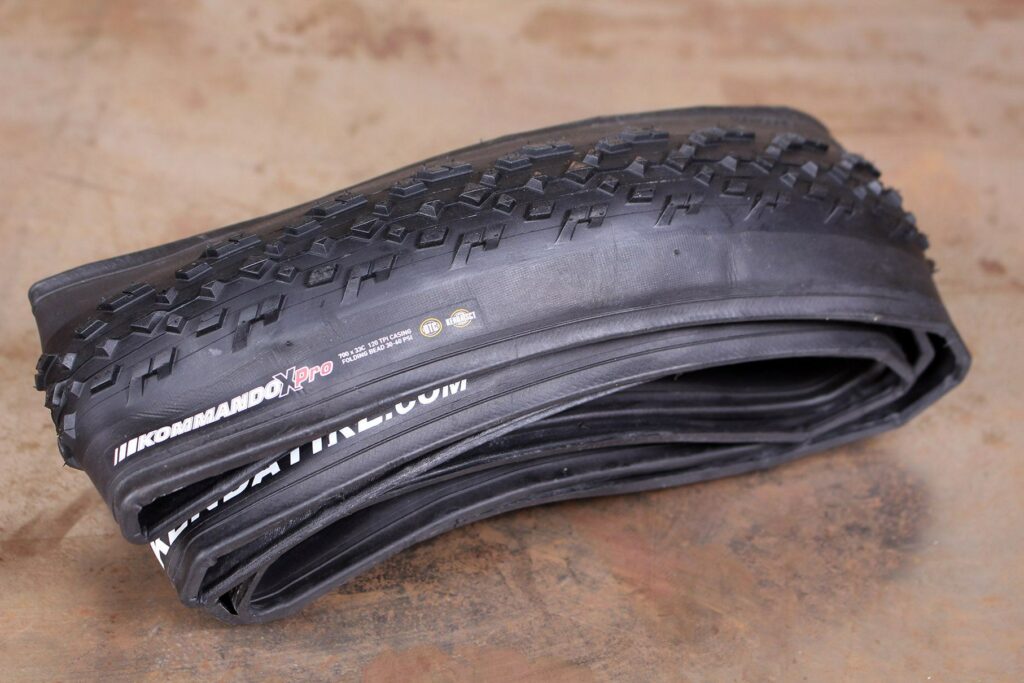
Kenda’s line of tubeless-ready tyres focuses on gravel and cyclocross tyres, with just one road tyre, the Valkyrie. They’re designated KSCT, for Kenda Sealant-Compatible Tyre. Some models seem to be quite hard to find in the UK, but we’ve been broadly impressed by the Kenda gravel tyres we’ve tested.
Find a Kenda dealer
| Tyre | Claimed weight | Price |
|---|---|---|
| Kenda Alluvium Pro | 558g (45mm), 495g (40mm) | £33.99 |
| Kenda Flintridge Pro | 515g (40mm) 481 (35mm) | £36.99 |
| Kenda Cholla Pro | 428g (33mm) | £27.49 |
| Kenda Happy Medium Pro | 435g (32mm) 496g (35mm) 556g (42mm) | £31.99 |
| Kenda Small Block Eight Pro | 427g (37mm) 404g (32mm) | NA |
| Kenda Slant Six Pro | 522g (32mm) 591g (45mm) | NA |
| Kenda Kommando X Pro | 364g (32mm) | £35.78 |
| Kenda Valkyrie Pro | 234g (23mm) 252g (25mm) 283g (28mm) 327g (30mm) | £32.57 |
Maxxis

Maxxis is known for mountain bike tyres, but also offers tubeless-ready road tyres in a wide range of sizes and applications, plus a tubeless tyre that doesn’t need sealant.
| Tyre | Claimed weight | Price |
|---|---|---|
| Maxxis Padrone TR | 250g (23mm), 260g (25mm), 300g (28mm) | £39.99 |
| Maxxis High Road | 297g (25mm) | £30.00 |
| Maxxis Radiale TL | 280g (22mm), 305g (24mm) | £75.12 |
| Maxxis Re-Fuse TR | 390g (32mm), 520g (40mm) | £40.99 |
| Maxxis Re-Fuse TR | 610g (50mm) | £43.99 |
| Maxxis Rambler SS TR | 380g (38mm/120tpi), 415g (38mm/60tpi), 375g (40mm/120tpi), 420g (40mm/60tpi) | £49.99 |
| Maxxis Rambler EXO TR | 603g (50mm) | £44.99 |
Mavic

Mavic jumped into the road tubeless sector with both boots in summer 2017, announcing a new standard — Road UST — and a big range of wheels. The accompanying tyre offerings are a bit thin at the moment — the Yksion Pro UST in 25mm and 28mm widths — but Mavic clearly anticipates other manufacturers adopting the standard when it’s been ratified by the relevant international bodies.
Mavic still offers its all-purpose/gravel tyre in the old Road Tubeless standard, the 30mm Yksion Elite Allroad.
| Tyre | Claimed weight | Price |
|---|---|---|
| Mavic Yksion Elite AllRoad | 330g (30mm) | £49.00 |
| Mavic Yksion Pro UST 2 | 281g (25mm), 297g (28mm) | £39.81 |
Michelin
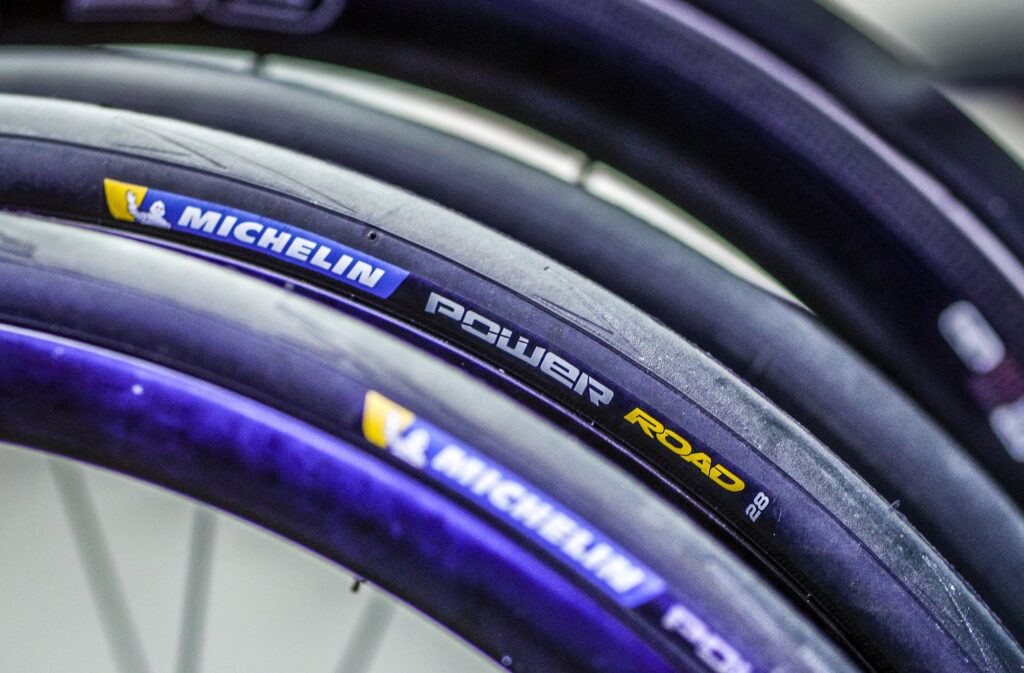
Michelin briefly partnered with Mavic to develop tubeless road tyres back in the mid-2000s, but both companies abandoned the project shortly afterwards. Having decided not to be the first maker of tubeless road tyres, Michelin has come in as the tubeless lanterne rouge, announcing a tubeless version of the new Power Road tyre in October 2019.
| Tyre | Claimed weight | Price |
|---|---|---|
| Michelin Power Road (32mm)(28mm) | NA | £46.00 |
| Michelin Power Cyclocross Mud | 360g | £32.99 |
| Michelin Power Jet TLR | 380g | £32.20 |
| Michelin Power Gravel | 360g (33mm), 467g (40mm) | £30.21 |
Panaracer
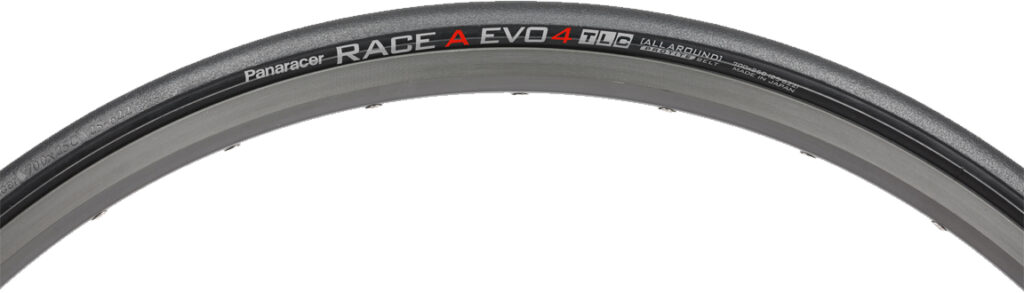
Panaracer joined the tubeless fray with the Race A Evo 3 Tubeless, and has just replaced it with the Race A Evo 4 Tubeless. The Japanese tyre maker has developed a brand new bead which it claims allows the tyre to be inflated using just a hand pump and claims this tyre increases puncture resistance by 24% compared to the previous Evo 2 tyre, thanks to a new Protite puncture proof material. The tread compound is also claimed to improve cornering performance.
| Tyre | Claimed weight | Price |
|---|---|---|
| Panaracer GravelKing Slick Tread | 310g (32mm), 330g (38mm) | £31.00 – £44.99 |
| Panaracer GravelKing SK | 320g (32mm), 380g (35mm), 430g (40mm), 480g (43mm), | £32.99 |
| Panaracer Race A Evo 4 | 210g (25mm) | £56.16 |
| Panaracer GravelKing AC | 300g (33mm), 360g (35mm) | £32.00 |
| Panaracer GravelKing Plus | 353g (35mm) | £42.00 |
Pirelli
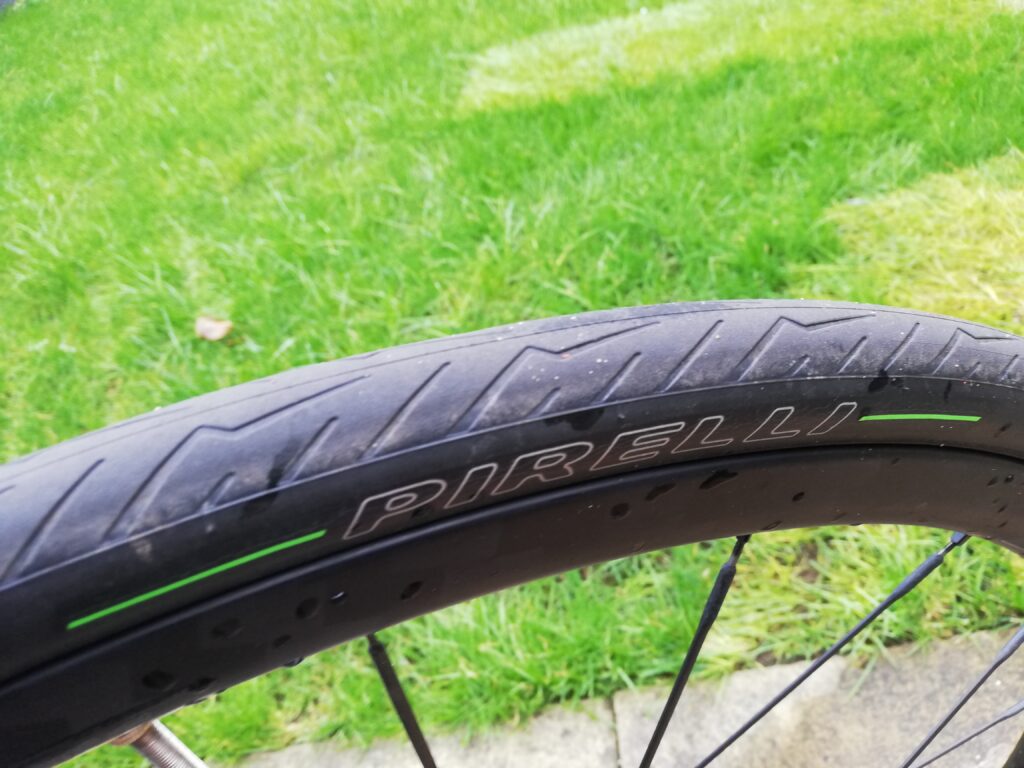
After returning to bicycle tyres with the P Zero clincher series, Pirelli has recently added tubeless-ready rubber to the range. Our Stu Kerton was impressed, calling the Cinturato “a very good tyre, especially during these winter months, offering plenty of cold and wet weather grip while also providing loads of puncture proofing. The small cost to the rolling resistance is worth it for the durability too.”
Read our review of the Pirelli Cinturato
| Tyre | Claimed weight | Price |
|---|---|---|
| Pirelli P Zero Race TLR SL | 236g (26mm) | £55.00 |
| Pirelli Cinturato TLR | 290g (26mm), 320g (28mm), 350g (32mm), 390g (35mm) | £46.00 |
| Pirelli P Zero Race TLR | 245g (24mm), 270g (26mm), 295g (28mm), 320g (30mm) | £49.99 |
Rene Herse
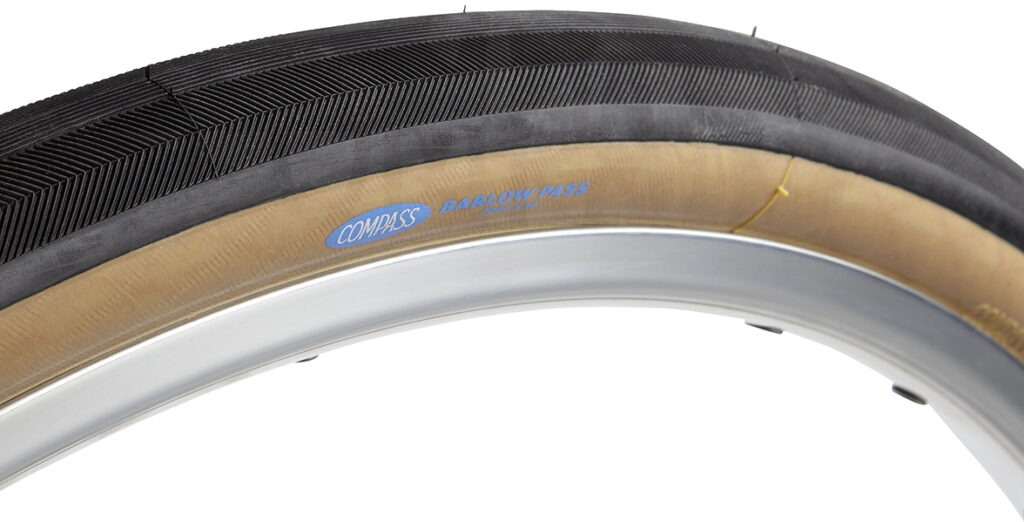
Previously known as Compass Cycles, Rene Herse grew out of the magazine Bicycle Quarterly, founded in 2002 by Jan Heine, a Seattle-based long-distance cyclist and journalist. Heine contends that wide, supple tyres perform better in every respect than skinny tyres, and perform better than would be expected from rolling resistance tests performed on smooth steel drums. And he’s put his money on it with a line of tyres that includes tubeless models.
Read our review of Compass Cycles Barlow Pass tyres
| Tyre | Claimed weight | Price |
|---|---|---|
| Rene Herse Snoqualmie Pass TC 44mm | 378g/329g | £76-£92 |
| Rene Herse Fleecer Ridge | 595g-700g | £80-£95 |
| Rene Herse Barlow Pass TC 38mm | 430g/380g | £76-£92 |
| Rene Herse Steilacoom TC 38mm | 423g/370g | £80-£95 |
| Rene Herse Bon Jon Pass TC 35mm | 355g/303g | £76-£92 |
| Rene Herse Switchback Hill TC 650B x 48mm | 478g/413g | £80-£95 |
| Rene Herse Babyshoe Pass TC 650B x 42mm | 410g/373g | £76-£92 |
| Rene Herse Pumpkin Ridge TC 650B x 42mm | 480g/418g | £80-£95 |
| Rene Herse Juniper Ridge TC 650B x 48mm | 455g-550g | £80-£95 |
Ritchey
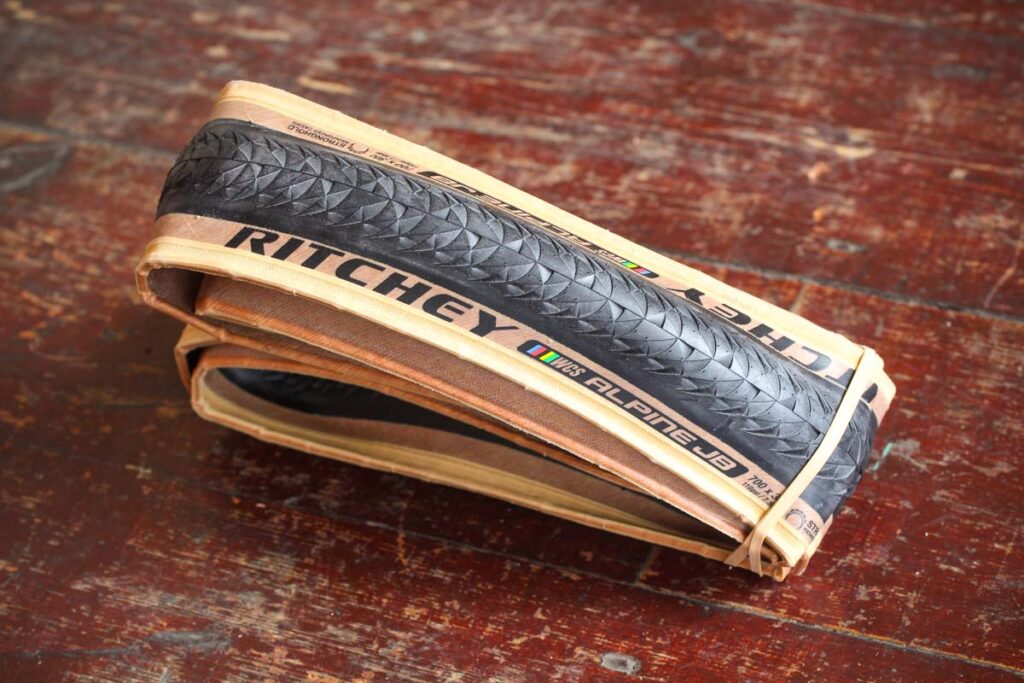
Ritchey has just one model of tubeless tyre, the 35mm version of the Alpine JB. We liked the non-tubeless 30mm equivalent, so for dirt road riding, the Alpine JB is well worth a look.
Find a Ritchey dealer
| Tyre | Claimed weight | Price |
|---|---|---|
| Ritchey WCS Alpine JB Stronghold 35mm | 400g | £51.99 |
Schwalbe

Schwalbe says “The future will be tubeless” in its blurb for the Schwalbe Pro One tyre, which it claims is its best tubeless tyre ever. We tested the slightly less advanced One Tubeless recently and found it rode brilliantly and, unlike many tubeless tyres, it was easy to get on the rim and to then pop into place on the bead seat.
Schwalbe offers a total of seven ‘Tubeless Easy’ tyres, from the Pro One, which is being reliably reported as having a super-low rolling resistance, to the aptly named Big One, a 60mm tyre intended for mountain bike beach racing but which we’ve included in case anyone’s thinking of building up a ‘monster-cross’ bike.
Read our review of the Schwalbe One Tubeless
Read our review of the Schwalbe Pro One Tubeless
Read our review of the Schwalbe S-One Tubeless
| Tyre | Claimed weight | Price |
|---|---|---|
| Schwalbe Pro One | 255g (25mm) | £38.20 |
| Schwalbe One | 275g (25mm), 295g (28mm), 305g (30mm) | £48.00 |
| Schwalbe G-One Speed | 330g (30mm) | £43.00 |
| Schwalbe G-One Allround | 400g (35mm) | £32.99 |
| Schwalbe G-One Speed 29×2.35 | 530g (60mm) | £39.99 |
| Schwalbe Marathon Supreme | 595g (40mm) | £37.99 |
| Schwalbe Marathon Almotion | 655g (40mm) | £52.99 |
| Schwalbe G-One Bite | 480g (40mm), 540g (45mm), 565g (50mm) | £39.00 |
| Schwalbe G-One Ultrabite | 530g (40mm), 610g (45mm), 665g (50mm) | £39.99 |
| Schwalbe X-One Bite | 410g (33mm) | £44.25 |
| Schwalbe X-One Speed | 380g (33mm) | £31.99 |
| Schwalbe X-One Allround | 380g (33mm), 390g (35mm) | £41.99 |
Specialized

Until recently, Specialized has focused on endurance and cyclo-cross riding with its Tubeless Ready tyres, which it spells 2Bliss because — well, who knows. Californians, eh? While the range is still gravelwards, Specialized offers a couple of standout road tyres in the S-Works Turbo RapidAir 2Bliss Ready and Roubaix Pro 2Bliss Ready.
| Tyre | Claimed weight | Price |
|---|---|---|
| Specialized Roubaix Road Tubeless | 295g (25mm) | £70.00 |
| Specialized Rhombus Pro 2Bliss Ready | 575g (42mm) | £45.00 |
| Specialized Terra Pro 2Bliss Ready | 370g (33mm) | £45.00 |
| Specialized Tracer Pro 2Bliss Ready | 365g (33mm) | £45.00 |
| Specialized S-Works Turbo RapidAir 2Bliss Ready | 260g (26mm), 305g (28mm) | £61.00 |
| Specialized Sawtooth 2Bliss Ready | 615g (42mm) | £30.00 |
| Specialized Pathfinder Pro 2Bliss Ready | £40.50 | |
| Specialized Roubaix Pro 2Bliss Ready | 375g (30mm) | £35.00 |
Teravail
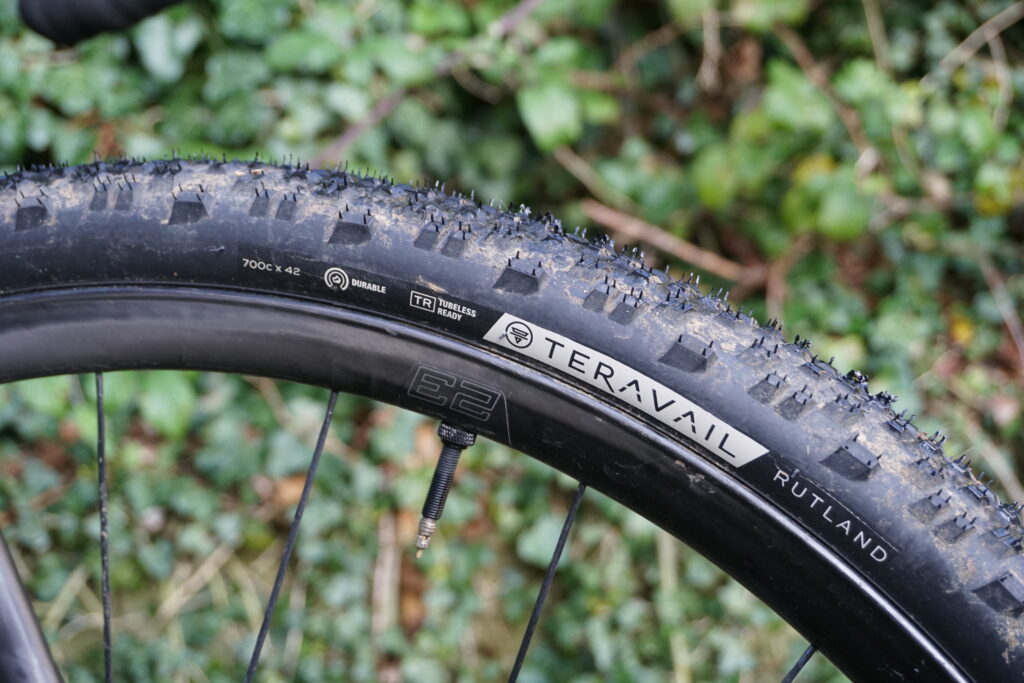
US brand Teravail specialises in off-road tyres, both for traditional flat-bar mountain bikes and for gravel bikes.
| Tyre | Claimed weight | Price |
|---|---|---|
| Teravail Sparwood 650B | 614g (55mm) | £60.00 |
| Teravail Cannonball 700C | 430g (38mm) | £50.00 |
| Teravail Rutland 700C | NA | £50.00 |
Veloflex

Known for their high-end Italian-made tubulars and ‘open tubular’ clinchers, Veloflex have recently added a couple of models of tubeless tyres to their range.
| Tyre | Claimed weight | Price |
|---|---|---|
| Veloflex Corsa Evo TLR | 235g (25mm), 265g (28mm) | £41.00 |
| Veloflex Corsa Race TLR | 225g (25mm) | £45.00 |
Vittoria

Vittoria makes the big claim that its Corsa Speed graphene technology tyre is the fastest ever independently measured, and the lightest tubeless-ready tyre too. A dirt tyre, the Terreno Zero TNT G2.0 has recently joined the range.
Read our review of the Vittoria Corsa Speed G+ Isotech
Read our review of the Vittoria Terreno Zero TNT G2.0
| Tyre | Claimed weight | Price |
|---|---|---|
| Vittoria Terreno Zero TNT G2.0 | 510g (40mm), 435g (35mm), 380g (32mm), 560g (650B) | £34.00 |
| Vittoria Corsa TLR | 290g (25mm), 310g (28mm) | £54.00 |
| Vittoria Corsa Speed TLR | 225g (23mm), 240g (25mm) | £97.49/pr |
| Vittoria Corsa Control TLR | 300g (25mm), 315g (28mm), 320g (30mm) | £49.00 |
| Vittoria Rubino Pro TLR | 305g (25mm), 335g (28mm), 370g (30mm) | £39.00 |
WTB
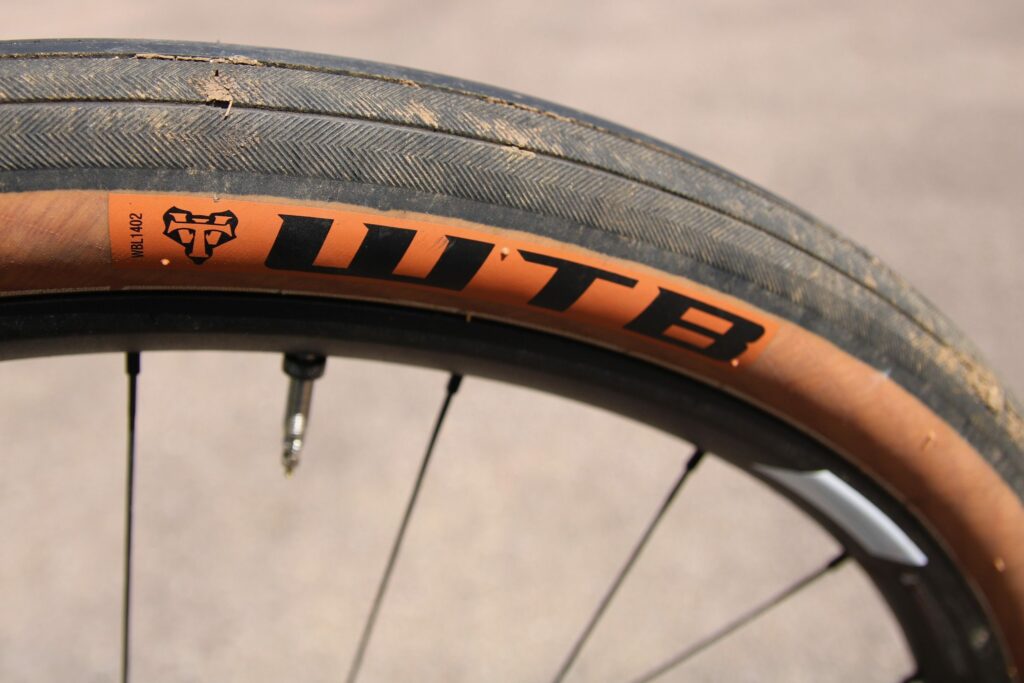
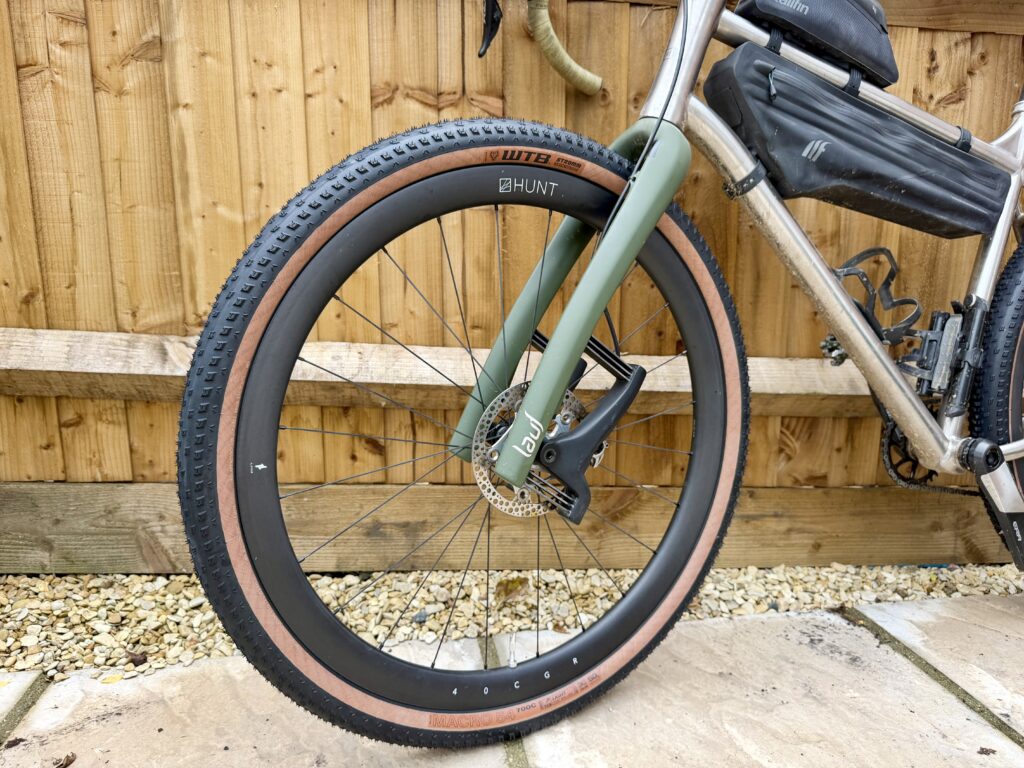
WTB are known for mountain bike tyres so it’s no surprise that they specialise in fat 650B rubber for mixed-surface antics or, as they more prosaically call it Road Plus. The range also includes cyclo-cross and road tyres.
| Tyre | Claimed weight | Price |
|---|---|---|
| WTB ByWay | 535g (47mm 650B) | £38.00 |
| WTB Horizon TCS | 515g (47mm 650B) | £40.00 |
| WTB Resolute TCS | 450g (42mm) | £38.00 |
| WTB Sendero TCS | 530g (47mm 650B) | £44.99 |
| WTB Exposure TCS Road | 310g (30mm), 315g (32mm), 370g (34mm) | £35.00 |
| WTB Nano TCS | 530g (40mm) | £38.00 |
| WTB Cross Boss TCS | 400g (35mm) | £27.00 |
| WTB Crosswolf TCS | 392g (32mm) | £27.00 |
Zipp
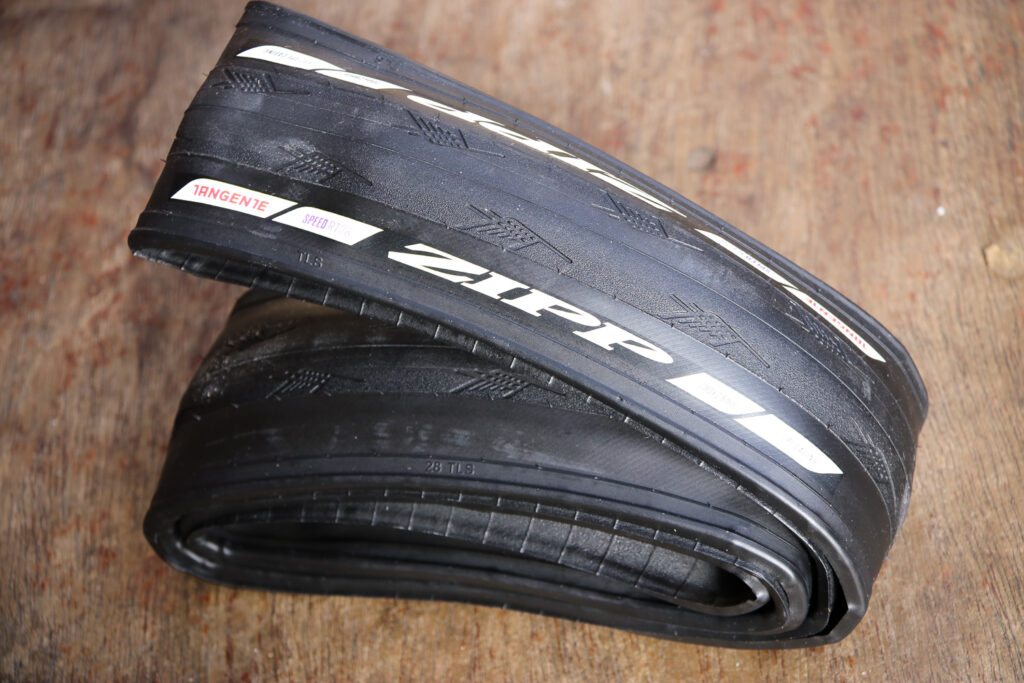
Wheel maker Zipp — part of the SRAM group — offers the Tangente Speed tubeless tyre in two sizes, 25mm and 28mm. We found them easy to install and fast-rolling, but they’re expensive. When you can find them at all, that is. There don’t seem to be any in stock anywhere at the moment
Zipp recently added a gravel bike tyre to the range, the Tangente Course G40 PR. They’re excellent in dry conditions, but also not cheap.
| Tyre | Claimed weight | Price |
|---|---|---|
| Zipp Tangente RT25 | 292g | £NA |
| Zipp Tangente RT28 | 302g | £NA |
| Zipp Tangente Course G40 | 482g (40mm) | £54.40 |





61 thoughts on “Buyer’s guide to tubeless tyres — find out all about new technology rubber”
I swallowed the marketing and
I swallowed the marketing and put some Schwalbe ProOne tubeless on my faster commuter bike.
Tyres did feel lovely, grippy and were fast.
Sadly after only 50 miles the rear got a gash about half a cm. Wouldn’t seal and had to chuck the tyre.
However the main problem is that you had to pump the tyre up almost everyday.
They would lose 10lbs pressure pretty much everyday (tyres were professionally installed on to brand new Hunt wheels not by me) and both tyres suffered pressure loss. My conclusion is tubeless is not for everyday use on road tyres.
On a race bike for specific races they’d be great but you’d still have to take a repair kit and spare inner tube for gashes which slightly screws the whole point of tubeless.
Anyone had any similar experiences?
Zjtm231 wrote:
Seriously? I have Schwalbe Pro Ones on my Hunt 4 Seasons and am more than happy to pump them up every couple of days (it takes 20 seconds, literally) rather than have endless punctures. Tubeless all the way from now on.
roof30 wrote:
Seriously? I have Schwalbe Pro Ones on my Hunt 4 Seasons and am more than happy to pump them up every couple of days (it takes 20 seconds, literally) rather than have endless punctures. Tubeless all the way from now on.— Zjtm231
I’m currently on over 10,000 miles of puncture free riding on schwalbe ones and pro ones.
Yes I have to pump them up slightly more regularly than with tubes, but not that much. I certainly don’t lose anywhere near 10psi per day.
If they are losing that much pressure that quickly then you need to reinstall properly. Doesn’t matter if they were ‘professionally installed’, they obviously didn’t do a great job. Put new good quality tubeless rim tape on – make sure you follow the instructions fully (so with stans you need to use the right width and put two layers on, making sure there are no air bubbles). Make sure the rim bed is clean first. Use about 50% more sealant than recommended. There is no chance you will recognize the additional weight and it will just provide a bit more protection.
As for gashes screwing the whole point of tubeless – you would have to put a new tube in a tubed tyre if this happened. You would probably have to bin the tyre as well if its cut through. So, no difference there. The fact that you won’t pinch puncture, that the vast majority of other punctures will seal themselves is a massive benefit
Zjtm231 wrote:
I run hutchison sectors on hunt 4 seasons and there was a slow drop in pressure to begin with.
Hunt sent me some new rim tape as they’d fitted unsuitable tape at the factory which deffo reduced aire loss.
The biggest change came when i increased the amount of sealant though and now they drop 1-2 psi per week which quite frankly is fine. Also, make sure the valve is cleanly seated.
A proper cut in a tyre is a PITA whether you run tubeless or tubed.
I’m running Schwalbe G-Ones
I’m running Schwalbe G-Ones on non-tubeless Fulcrum rims and they’re great. Don’t hold pressure as long as a tubed clincher but certainly not a faff. Some tyre/rim combos just don’t work very well, so maybe you’ve been unlucky.
Can’t say that I’ve noticed
Can’t say that I’ve noticed Pro Ones losing pressure any quicker than standard butyl inner tubes.
However, I did bin one after getting a big gash in it but apart from that one incident, they’ve been good (although a bit slippery in the wet).
What about the Schwalbe G-One
What about the Schwalbe G-One Speed? Great Tyre.
I’d add a +1 on paying
I’d add a +1 on paying attention to whether the valve retention collar is screwed up tight, it does need to be but my experience is that they can easily come loose. As noted, if you’re losing 10psi/day something is not quite right. A happy tubeless tyre will lose that in about a week. You don’t need to pump them up every day but you do need to stay across tyre pressure.
But – Pro One on a commuter bike? That’s a bit hopeful, I think. It’s a race tyre, and while robust for a race tyre, I wouldn’t commute on it. That G-One Speed, formerly S-One, would be a good choice.
I’ve been running Schwalbe
I’ve been running Schwalbe Pro Ones and S-Ones tubeless for well over two years now and have been very very happy. I find the Pro One is perhaps a little fast wearing and cuts up a tad easily, but no more so than most other ‘Race’ tyres, and the added confidence and reliability of tubeless is well worth a little extra faff setting up, and having to do one or two more strokes of the track pump from time to time. Perhaps I’ve been lucky but I haven’t had any catastrophic failures and have on several occasions ‘suffered’ a puncture that required no attention from me at the roadside whatsoever. In fact I have only been aware of them after the brief hissing sound of escaping air before the sealant has done it’s job. Only a couple of times has the sealant been a bit slow to seal and needed me to actually stop and top up the air, and even then I was able to carry on quite happily to a convenient place before doing so. A tubed tire would have deflated completely and needed me to stop immediately to repair/replace the tube. I do still always carry a spare tube and tyre boot though ‘just in case’, but that’s just the old boy scout in me wanting to ‘be prepared’!
My two pennnyworth:
My two pennnyworth:
Schwalbe pro-one on one of my bikes. Good when they’re working and a PITA when they’re not. THey have a nasty habit of looking liek they’ve sealed and then spray everything with a fine film of rubber. They’re still rideable, but bobbling along at 40 psi. It ususally involve a benign-looking little hole that will not seal. Answer is to put a patch on the inside, but some sealant seems to munch its way through rubber solution.
They’re utterly shite in damp conditions – as in the rest of the group goes round a bend and you go skittering across the road instead as the front wheel starts to slide away.
They deform and get bulges on the wearing surface (front and back). One’s unfortunate. Two’s careless. Three’s taking the effing piss at £60 a pop. I’ve got a new pair courtesy of a 2 for 1 sale. It’s their last chance, then it’s back to tubes.
Running them at 80 psi to see if that helps now.
@nniff – you can get the
@nniff – you can get the Schwalbe Pro-Ones a lot cheaper: £35 at Wiggle or you can get a pair with sealant and fitting liquid for £70: https://www.mantel.com/uk/schwalbe-pro-one-tubeless-set-doc-blue
I run Hutchinson Sector 28s
I run Hutchinson Sector 28s on [wide] Pacenti SL25 rims at 40PSi, any higher and they are way too hard and bouncey. They get absolutely hammered both on and seriously off road. Riding on road can be pretty brutal at times too with the state of many UK roads. I would get pinch flats weekly if I had tubes going by how often I feel my rims on stones, edges etc. The other massive benefit is that even when I had tyres badly sliced, the tyre deflates slowly enough that I can stop safely to then fix things. Had two big slashes on MTB tyres and one on my 40c tyres with no bouncing along floor drama as a result. Found several large metal spikes in one tyre after some metal swarf on road sliced through my front MTB tyre. Which must have been there a while.
Possibly the best thing to happen to bikes this century. You can run the correct pressure instead of pumping tyres too stupidly high in order to avoid pinch flats. Rolls better too.
You need to add the Maxxis
You need to add the Maxxis tubeless tyres in there. I’ve been running 25C Padrones on my road bike all year, and 40C Ramblers on my gravel bike. Both are good tyres, the Padrones are notably quick and grippy, if slighty on the narrow side.
Just tried using some Shoo
Just tried using some Shoe Goo on an almost new Schwalbe Pro tyre that got a bad 5mm star shaped puncture.
Sealant had sealed the puncture fine and the Shoe Goo has filled in the hole in the rubber.
200 miles later and the Shoe Goo is still there and no further problems.
I made sure the hole was clean and dry and gave the Shoe Goo a couple of days to go off before riding.
For a larger puncture I would consider patching the inside as well.
Tubeless or not you can’t do much if the inner casing is badly damaged but I’ve been riding tubeless on my bikes for years now, had several punctures but have never had to stop to fix them: sealant has just done the job as I’ve carried on cycling.
I also use about 50% more sealant (Stans) than recommended and change it a couple of times a year. Tyres tend to lose 5-10psi per week but I check them before every ride anyway when I’m checking brakes/gears etc.
Tubeless for me everytime!
Been riding schwalbe pro one
Been riding schwalbe pro one tyres all of this year. They feel great in 28mm and grip great, plus I’ve had several punctures which have all self healed except one 5mm slice. Have had to replace the latter. Haven’t noticed any particular gains in rolling friction etc, but neither do they feel heavier than my previous conti gp4000s.
You do have to pump them up before each ride as they lose 10psi overnight but then I always check my tyres before each ride anyway.
I am a big fan of tubeless,
I am a big fan of tubeless, espescially with the winter we are having. I may have had a puncture, i wouldn’t know, I haven’t had to stop by the roadside to repair a puncture, with cold freezing hands, cursing tyre levers and the world in general.
Now riding IRC Formula Pro RBCC tubeless road tyres from the Cycle Clinic on their Paceni tubeless rims. Compared to the Hutchinson Fusion tyres they are far harder wearing and crucially, provide excellent grip in the damp gritty conditions we seem to have persistently at the moment. Run at 80psi they are comfortable in the lanes and haven’t got a mark on them despite the flinty nature of the roads around Suffolk. Wouldn’t go back to tubes now.
Hi,
Hi,
I’ve recently switched over to some IRC RBCC 25mm and find them excellent in both the wet and dry. I was previously using the included Mavic UST tyres on my Krysium Elite wheels, but I never felt as if they were providing me as much grip in the wet and they seemed to cut up easily round the roads in Kent where I live.
Since using the IRC, they wear well and have next to no cuts etc and seem well planted in the wet and provide a decent supple ride..they also seem to produce a nice road noise when at speed.
Been using Schwalbe Pro Ones
Been using Schwalbe Pro Ones for about a year (7000 miles) now – wouldn’t go back to using tubes because of the ride quality and lack of punctures (or at least punctures I have noticed). Though, after removing a tyre I did once notice that the sealant had become just clear water, so wouldn’t have been of any use as I obviously hadn’t changed it soon enough, so I was lucky!
However, for about 6 months I’ve been using Milkit valves with the new Stans Race Sealant (even though Milkit and Stans say you can’t do it I thought I’d give it a try, and I’ve had no problems whatsoever with valve clogging or anything else). That’s solved my sealant worries completely, I just check it and replace it if necessary about once a month – it only takes 10-15 minutes for the whole job and doesn’t require the tyre to be removed or even deflated. Also I’ve found that I now rarely have to put any air in the tyres, they retain their pressure really well, so I guess that the valve, rim tape, and bead have all bedded-in really well because they haven’t had to be disturbed at all.
PS you don’t have to pay the stated price for Pro Ones, they are widely available for about half that price.
Westy wrote:
I didn’t get on well with Pro Ones, the first got an un fixable 4mm slash in the middle of the tread and I managed to pinch flat the other hopping a kerb, aggain irreperable.
But my experience is probably because I dared venture ever so slightly off-road with them, probably the fastest tyre I’ve used on good tarmac.
No Continentals?
No Continentals?
Jimnm wrote:
Conti donn’t make any tubeless road tyres. They have too much of the inner tube market to want to undercut that
paulrattew wrote:
Just like with their MTB tyres, Conti will change their tune when road tubeless starts to affect their sales.
Panaracer Gravelking smooth
Panaracer Gravelking smooth tread 32mm are tubeless compatible to 60psi and sub 300g, look cool in brown wall too, test them, only £30 each. Mavic Yksion all road tyres are terrible, prone to cuts.
Thelma Viaduct wrote:
Agreed – I’ve found they cut easily too, and they also have very poor wet grip in my experience. Mavic wheels are great but I so resent having to buy Mavic tyres with them that I don’t buy them anymore.
Thelma Viaduct wrote:
They’re good with tubes, glorious without.
You missed the new 32mm
You missed the new 32mm 120TPI version of the Roubaix 2Bliss (perfect for Rollin Stones?). I picked up a pair for under £55, not quite as nice as supple as the 25mm 160 TPI version but at less than half the price they’re really good.
Hi Initialised, not
Hi Initialised, not completely knocking your opinion but what exactly did you irreparably pinch in that bunny-hop puncture ?
Well everyone is absolutely
Well everyone is absolutely happy to pump his bike every week. That’s OK if you ride only on sunday, but if you commute every day it’s just as fun as riding without a saddle. I typically service my bike every 2 or 3 months, including pumping the tires. So I’ll stick with tubes. Sure puncture resistant tires cost a bit of weigth, but if your commute is not too long or if there is public transportation you can skip the repair kit and pump.
And pinch flats? Really that’s a urban legend. I think I had one in my life, and I am not too young anymore.
jerome wrote:
You inflate your tyres every 2-3 months??? what tubes are you using? I find I lose pressure far faster on my bike with tubes than my bike that runs on tubeless which typically loses ~5 PSI/week
jerome wrote:
Really, no it’s not.
I run tubeless on a lot of my
I run tubeless on a lot of my wheels, theyre great. The most valuable aspect, is if you have a puncture, it wont rapid deflate, (my recent descent of Mt. Teide @ 40+mph) which can be a disaster at the wrong time. I also use sealant in my tubular continental tyres. I did a 60 mile ride and only noticed at the finish that i had a thorn/glass puncture. It had self sealed without any issue. Tubeless also has the benefit of running lower pressure for comfort
I’ve got Sector 28’s on my
I’ve got Sector 28’s on my Hunt 4 Seasons Carbon and they pretty pretty nice to ride.
Looking to put some tubleless on my other bike, it can only take a 25mm, which it fine, but I was hoping to get some skin/tan-wall tyres for it.
Anyone know of any 25mm tkin/tan-wall tubless tyres?
There seems to be a lot of
There seems to be a lot of ‘marketing’ going here as with other new tech. It’s an expensive solution but perhaps well suited to certain segments, eg MTB and perhaps gravel. Same with disc brakes. More expensive and hassle in installation and maintenance. For both new tech solution – little to no benefits or value for money. The 2-3 punctures I get every year, one for about every 1,000 miles, are mended on the road in a couple of minutes. I save time on installing and pumping the tires much more often. The last ‘hyped’ tech I will mention is using wax instead of lube. Might have some advantages although I haven’t seen any proof. No pro teams use any of these technologies….
risoto wrote:
Feel free to ignore the ‘marketing’.
If you can change change a tube in two minutes, well done (but I doubt you can).
Disc brakes.. more maintentance? Now, I’m laughing.
I pump my (tubeless road, gravel and MTB) tyres up once per week – as i did before I got rid of the tubes.
I have no idea where you got the ‘wax’ as hyped tech idea from – my father used to wax way back in the 60s. Pro teams are using special coatings on their chains now (as well as disc brakes). Some pro teams are even using tubeless clinchers instead of tubs.
I’ve pinch flatted an MTB
I’ve pinch flatted an MTB tubeless tyre. Hugely annoying as the sealant really struggles to seal it.
Buy struggle, I mean that it didn’t seal it. Patched it in the end, which saved the tyre, but having a patch so close to the bead caused its own problems with sealing.
In summary, its something you can definitely do, much harder with tubeless than with tubed, but still a possibility.
I’ve recently changed from
I’ve recently changed from running Schwalbe Pro One tyres to Hutchinson Fusion 5 Tubeless Ready Performance tyres (not the 11 storm compound), due to the schwalbe tyres getting to the end of their useful life. At first I was really impressed with how they felt, the grip and the speed. With the Pro One tyres I was able to take them off and put them over and over, gently (very gently) using tyre levers where necessary. No issues at all. It seems though that the fusion 5s have a really fragile tyre bead. One removal of the rear fusion 5 and it looks like the bead is now useless as the tyre blows off the rim at 80psi (25mm version).
They’re actually the first tubeless tyre I’ve had this problem with (I’ve been running tubeless since 2012), so it was a bit of a shock and a disappointment. I’ve got a replacement (this time the 11storm compound) on the way so I’ll see if that fairs any better. If not then it will be back to the schwalbes no matter how nice the hutchinsons feel
I’m a bit puzzled by the
I’m a bit puzzled by the Hutchinson line up. Can anyone advise, please?
The, obstensibly, same tyre in the Fusion range has 2 options (plus normal clincher)
The Tubeless Ready & Road Tubeless versions!!
The Road Tubeless has a butyl inner that adds 60+g/tyre and does not need sealant.
Can anyone explain why i would choose this over a lighter (and cheaper from what i’ve seen at Evans cycles) Tubeless Ready varient of the same tyre? Will it seal punctures without the sealant? Seems unlikely.
Plasterer’s Radio wrote:
Tubeless Ready needs sealant to work at all. Road Tubeless doesn’t need sealant to work.
However, Road Tubeless still needs sealant in order to be effective at sealing small punctures such as thorns, glass etc. Without the sealant, Road Tubeless will deflate much slower than a tubed tyres though. You might choose Road Tubless over Tubeless Ready because Road Tubelss is much easier to seat on the (tubeless) rim – for the most part a decent track pump will suffice. Tubless Ready often need a ‘pressure tank’ such as Airshot to get them to seat and seal. Finally, Road Tubeless will be more puncture resistant than Tubeless Ready because of that extra layer of butyl rubber.
kevvjj wrote:
Thank you!
Hello guys,
Hello guys,
what’s the correct pressure for Mavic 25mm tubeless tyres on Ksyrium wheels with 100+kg rider ?
I think that 7bars should be enough for 80kilos, but I have total of 110kg with bike 😉
Thanks,
Pete
zozzi wrote:
You need to move upto 30mm+ tubeless tyres or move over to tubular so you can run much higher pressure to offset small size.
Tubeless run lower pressure compared to inner tubes. go bigger tyre and ride at recommended pressure for your weight
zozzi wrote:
Tubeless allows a lot low pressure to be used, you should be fine down to 6.2 bar quite easily. Start at 7 and see how you go.
Yksion Pro UST claimed weight
Yksion Pro UST claimed weight is 260g. The ones I bought were 255g. Excellent tyre, one of the fastest, highly recommended.
I’m a tubeless convert too,
I’m a tubeless convert too, though it took some time to learn about them. One trick to help reduce the slow leakage is to take the wheel off, pump the tire up to high pressure (80+) and slosh the sealant (I put in enough so that I can hear it) around a lot with the wheel held flat. Lie it down like that for hours or overnight, do that on the other side too. The idea is that if there’s a slow leak under lower pressure, you can speed the leak up under high pressure and give the sealant a better chance to get in there. Make sure to deflate your tires to the recommended max pressure or below before riding on them 🙂
I’m running Compass Barlow Pass right now and they’re great. I first got the thin walled ones but wound up with about 20(!) small holes in the front tire wall after some really nasty broken off-road (well, former road that had washed away) in Wales. But the tire kept going. In the end it was too hard to keep that tire inflated (despite my advice above) and I put it aside to use with a tube someday.
Tubless is certainly more faff, one way or another. But the peace of mind out on the road easily makes up for it. It doesn’t even cross my mind that I might puncture. The first time you do and you hear the short hiss and feel a bit of sealant spraying out, and then it stops….. magic! 🙂
This blog article I wrote a
This blog article I wrote a couple of years ago is still pretty much an accurate summary of tubeless “issues”. I just updated it
https://audaxing.wordpress.com/2016/12/24/whats-so-great-about-tubeless-tyres/
I don’t mention in the article that tubeless tyres are usually fantastically fast and always more comfortable than clinchers
vorsprung wrote:
There are a number of factual issues with the the first few paragraphs i’ve read – could I suggest maybe looking at the use of the word ‘require’ ?
Dear Road CC when you review
Dear Road CC when you review tyres can you score them for ease (or lack of) of fitting?
PS Thanks for the really sueful list and everyones comments above
Anyone tried the Pirelli
Anyone tried the Pirelli Cinturato VELO TLR? Not mentioned in the article above but seems to be a good tyre?
The list of tyres was updated
The list of tyres was updated on Martch 21th 2019.
Why you didn’t include Grand Prix 5000TL?
Any experience with the new model from Continentals so far?
Road.cc, you might want to
Road.cc, you might want to edit the intro to remove the now-outdated reference to Continental being a “notable no-show”.
Has anyone else had
Has anyone else had experience of Hutchinson Sectors? I bought some in the new 32 width (not on this list) in January and immediately noticed some traction issues on the rear from the smooth centre section. I didn’t pay enough attention to this and found myself literally flat on my face while making a right turn at low speed when the front wheel let go with no warning on a lightly damp road, I didn’t even ride on the markings. One facial fracture and about £100 of bike damage was the result. To be fair Wiggle refunded the cost of the tyres when I pressed them on the basis of the tyres being unfit for use. I have had no response from Hutchinson when I emailed them about the quality issue So I have a hardly used pair of Sector 32 tyres that road.cc is welcome to test for rolling resistance if they wish.
I was out doing a 25 mile
I was out doing a 25 mile mostly off road around Henley today. Lovely weather. There had been a lot of hedge cutting, or slashing really, and after a bit of farm tracks I got back onto tarmac and there was something in my front tyre, whack, whack, whack, stopped and thought there was a small twig stuck in the tread, pulled it and one end was stuck in the tyre, pulled it more , a loss of air and some orangey latex oozed out, a few bubbles and sealed in 20-30 seconds.
Checked the rear, big thorn, needed tools to get it out, sealed very quick, another thorn, smaller, hadn’t quite made it through.
I was very glad to have had my new bike set up tubeless, LBS did everything, probably Orange Seal, the long lasting one. If I had been running tubes, after changing 2 and a lot of pumping I would have cut my ride short, anxious about not having a spare and all the faff. I will add an extra squirt in a couple of days.
By the way, what did I experience 2 of today? Definitely not a flat, and it didn’t seem like the p-word. Any suggestions?
Hutchinson sector = good in
Hutchinson sector = good in the dry and extremely durable but grip on wet tarmac is next to nonexistent.
René Herse Barlow pass: I use those now, very happy BUT they’re not true tubeless tyres. To be run at low pressures, if you mount them, anything over 3.7 bar can cause a blowoff. René Herse themselves now -belatedly- caution against mounting them tubeless on any hookless rim or rims with a less than ‘standard’ (whatever that may mean) hook height.
Read this: https://www.renehersecycles.com/safety-advice-non-standard-rims-and-rene-herse-tires/
Again, they’re very plush riding but you should really heed this warning. Rims like Enve’s G23 are definitely out.
Having read all the accounts
Having read all the accounts of how difficult it can be to get a tubeless tyre bead off the rim, I thought I’d better have a dry run at home. The bike has WTB Riddlers on WTB rims, with inner tubes – i.e. it’s “tubeless ready” from new.
Turns out it was pretty easy to break the bead off – obviously different than normal tyres which more or less fall off the rim, but a bit of grunt and off they popped.
So I pumped it back up with a track pump and … it won’t reseat. It’s very obvious comparing with the other wheel, the tyre sidewall dives down into the well of the rim for for about 1/3 of the way. I tried several times, tried a water based lubricant, but no success. I do get a popping noise, but it remains clear that not all the bead is seated. When I deflate the tyre again it is clear that only part of the bead is locked into the rim, the rest just falls away.
What am I doing wrong?
And, does it matter – given that there’s an inner tube, so sealing is not an issue?
I think you might need to put
I think you might need to put a lot more pressure in. I use a slight diluted washing up liquid.
The popping noise is so loud and violent when mine seat, I flick the lever on the air tank and run into the next room. It terrifies me.
Thanks. The spiel on the tyre
Thanks. The spiel on the tyre sidewall (and the wtb website) says to pump upto but not exceed the max pressure (3.8bar, 55psi, so not much) to seat the tyre, then bleed it down to preferred running pressure. Is it safe to go much above the stated max pressure to seat the bead?
Edit, here’s their blurb, specifically for mounting with inner tubes:
“5. Slowly inflate the tire with a bicycle pump or CO2 cartridge, keeping an eye on both sides of the tire to make sure it is seating evenly all the way around and at the proper depth. This is done by watching to see that the tire’s molded rim line evenly follows the rim edge. Inflate to the maximum recommended pressure marked on 1(g)(2) WTB TCS/ETRTO Tubeless tires the side of the tire; then deflate to the desired riding pressure, making sure the pressure is within the range of recommended pressure marked on the sidewall of the tire. Check pressure with a tire pressure gauge.”
I couldn’t and wouldn’t want
I couldn’t and wouldn’t want to say.
Hopefully as you aproach 55 (or slightly more) the tyre will start to seat and so drop in pressure.
Good luck.
I’m new with the tubeless myself. So feeling my way.
One thing, my tubeles holds it’s pressure a lot better than my latex tubes, a fair bit less pressure, but a lot less regular pumping needed.
Ta. Sadly, the manufacturer’s
Ta. Sadly, the manufacturer’s blurb (this is done by watching…) seems to imply that by watching carefully you will make it happen. I watched it not happen!
I wouldn’t worry about the
I wouldn’t worry about the bead not seating if you’re going to be using an inner tube – that’ll force the bead into place when you inflate it.
In my experience, there’s usually three ways that a tubeless tyre won’t seat properly. Either there’s air leaking around the tubeless valve, air leaking through a damaged/mis-applied rim tape or there’s too much friction between the tyre bead and the rim bed (which is usually fixed with some dilute washing up liquid).
Or, it could be that you’re not getting in enough air quick enough to push the tyre into place – fixed with a tubeless pump/reservoir or frantic track pump usage. (That’s four ways that it won’t seat).
“I wouldn’t worry about the
“I wouldn’t worry about the bead not seating if you’re going to be using an inner tube – that’ll force the bead into place when you inflate it.”
No, that is the problem – I am using an inner tube and the bead won’t seat. I’m not fannying around trying to get the thing to work tubeless and spraying latex round the place (that may yet come – but not for now).
Anyway, thanks for the input, all help welcome. I think you were on the money with washing up liquid.
Ok, done. No magic, it will
Ok, done. No magic, it will be just as bad next time. I tried water based lube and suds (not together…). I used car shampoo since Fairy Liquid has loads of salt in it. Not sure if it made the difference.
I pumped the tyre to about 5bar (stated max limit is 3.8bar). Had loads of attempts, deflated partly and eased the recalcitrant sections of tyre inward to enable suds to penetrate twixt tyre and rim, then reinflate. Repeat multiple times. Eventually one side popped in – you could see the bead seat progressing around the rim until both ends met with a loud pop. But that was just one side… more slog until eventually the other side went as well. What a palava.
So if I do get a puncture I know I’ll be able to patch it on the trail. But will I ever get the tyre reseated, and does it even matter with an inner tube?