



“It’s the gown driving the town” – or should that be riding? Cambridge residents’ group rejects congestion plan which they say will ‘only benefit cycling students and dons’
The age-old town and gown debate, a staple of public discourse in the UK’s ancient seats of learning, has been repackaged in Cambridge this winter, where a controversy over a proposed congestion charge has apparently been boiled down to a simple dichotomy: ‘the gown on bikes versus the town in cars’.
The Observer reported over the weekend that a plan to introduce a £5 congestion charge on weekday car journeys into Cambridge has saw tensions rise within the city, with a protest march against the scheme (presumably the protesters won’t be marching in their cars, but who knows?) planned for this Sunday.
According to the proposals – introduced by the Greater Cambridge Partnership (GCP), a body made up of local councils, the University of Cambridge and business representatives – motorists will have to pay £5 when travelling into, out of or within Cambridge between 7am and 7pm on weekdays (discounts have also been proposed for low-income households and blue badge holders).
The GCP hopes the charge (which extends to about three miles from the city centre) will increase cycling journeys by up to 60,000 a day, reduce traffic in Cambridge by 50 percent, improve air quality in the city, and fund “significant” improvements to public transport and cycling infrastructure (which, in turn, would again increase the number of people using their bikes).
> Cambridge cyclists issue impassioned ‘Please stop killing us’ plea
“We know we’ve got an air-quality problem in the centre of the city, and that transport is a major contributor to local carbon emissions,” Peter Blake, GCP’s transport director, told the Observer.
Blake, who said the proposals could help bring bus fares in the city down to £1 per journey, added: “In general terms, we know that, if you’re on a lower income, you can’t afford to live in Cambridge. At the moment, some bus services are very expensive – and 30 percent of the poorest households in our area don’t have access to a car.”
“Cambridge is one of the most unequal cities and what we’re trying to do is make it a more equal city,” says the group’s chief executive Rachel Stopard.
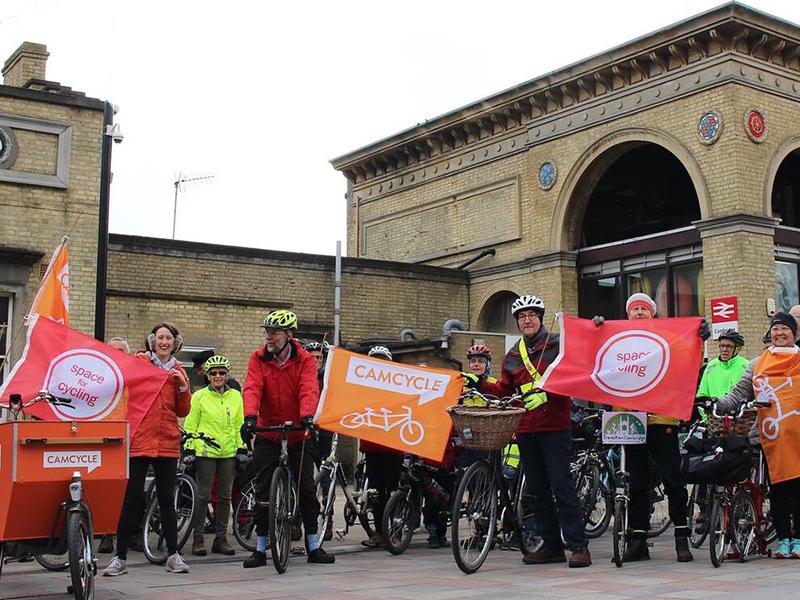
Roxanne De Beaux, executive director of Camcycle, has also told Forbes that a Sustainable Travel Zone for Cambridge would be “transformative for people in the area.”
“With fewer cars on the road and more space for protected cycle lanes and safer junctions, more people can choose to ride for their daily journeys,” she said.
> Make Cambridge cyclists pay congestion charge, says transport expert
However, the proposals haven’t gone down well with a local residents’ group (what’s new there?), who believe that the charges will only benefit Cambridge’s bike-riding students and dons.
“The proposals are driving a wedge between town and gown,” says Neil McArthur, vice-chair of Cambridgeshire Residents Group, one of the most vocal opponents of the planned charge.
“The town is going to become a ghost town and residents are really concerned about that. Whereas the student population and the Cambridge dons won’t suffer.
“They probably live and work within the city, they can walk or cycle wherever they want to go. The fewer cars in the city for them, the better.”
McArthur also noted that, while the university sits on the executive board behind the proposals, his residents’ group had no say in the matter.
“It’s clearly the gown driving the town, not the other way round,” he said. “It [the university] has so much impact on what is proposed and agreed, irrespective of the needs of the residents.”
A Cambridge University spokesperson told the Observer that it is incorrect to suggest that the congestion charge would not affect its staff, with almost 70 percent of employees living outside the city.
The spokesperson added: “The university understands the need for bold action to ensure that traffic is managed more effectively in our city region, which has among the worst congestion in the UK.”
2023 Transcontinental route unveiled
Dot-watchers, mark your calendars!
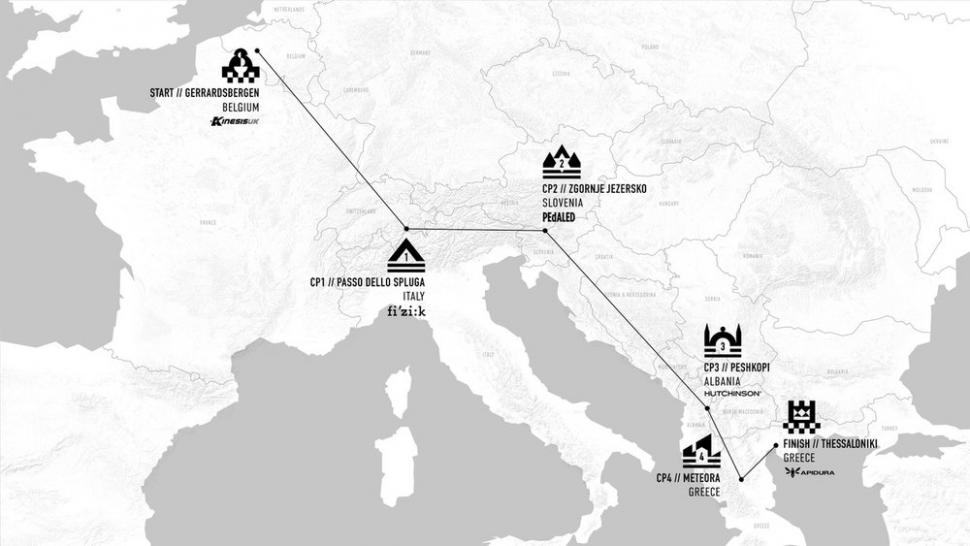
The route of the ninth edition of the Transcontinental race, everyone’s favourite self-supported jaunt across Europe, was unveiled last night – and it looks as gruelling as ever.
#TCRNo9 is here. https://t.co/V7cd1LGpxs. Starting once again on Flandrien cobbles, this year’s route guides our intrepid, self-supported riders south and east; across Alpine passes, through sheer gorges and along ancient roads, finally coming to rest on the edge of Europe… pic.twitter.com/dbLS0O2X1c
— The Transcontinental (@transconrace) November 21, 2022
Like this year’s race, won by Austrian ultra-distance cyclist Christoph Strasser, the 2023 Transconti will start in one of cycling’s true holy places, Geraardsbergen (the home of the Muur and the chapel), on 23 July before heading deep into the Alps on the way to the welcoming warm waters of the Aegean Sea for a finish in the Greek port city of Thessaloniki.
Pretty straightforward then.
“This Race offers the chance to pit mind, body and spirit against thousands of miles of Europe’s most beautiful, remote, inspiring, and challenging roads and tracks,” the organisers said in a statement announcing the route.
“As always, this Race rewards the most prepared; the strongest legs will only prevail in the presence of the sharpest wit.”
Heavy.
I suppose I better up my sessions on the turbo trainer while watching Only Connect…
Meanwhile, in Milan
Now, there’s one way of stopping motorists from parking on the cycle lane…
Whoa! 😲
3⃣0⃣0⃣ citizens of #Milan lined up on this busy street to protect cyclists on a bike lane. They’re calling for 30km/h in the whole city and a stop to parking on cycle lanes.
Such a powerful action! 🔥💪🚲🚴#ProteggiMi pic.twitter.com/fsj9c1rLoV
— Clean Cities (@cities_clean) November 21, 2022
Lancaster v Belfast: the clash of the bike lane parking heavyweights
This morning’s barefaced example of bike lane obstruction brought to mind another classic of the genre, featured on the live blog back in March:
Why Don’t Cyclists Use Cycle Lanes, pt 9,473: Lancaster pic.twitter.com/Z9kb1I5MWk
— Rob Ainsley (@realcycling) March 18, 2022
But which one is worse?
Let’s head straight to lane-side for some pre-parking analysis…
Lancaster’s lousy bike lane blocker is clearly all about the angles and aesthetics, with some precision-based (illegal) parking on display.
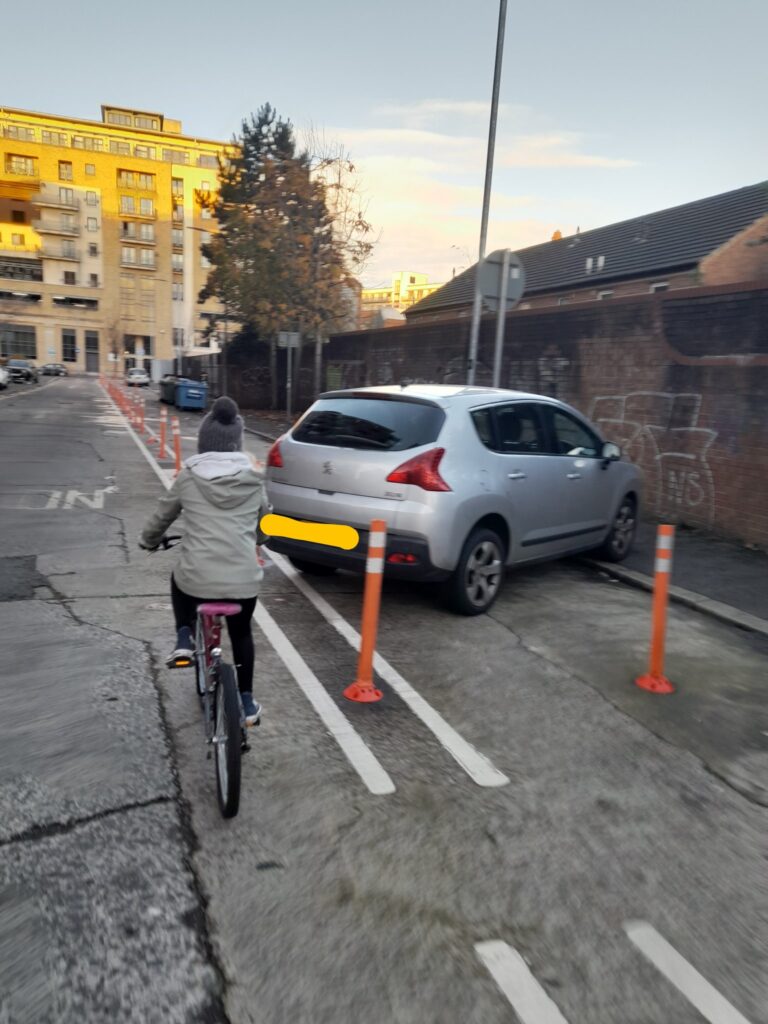
In Belfast, our driver is a touch more haphazard, certainly, but gains a few extra points for pure brazenness as they also had some ‘protective’ traffic wands to navigate on their way into the cycle lane.
It’s a tough one, I wouldn’t want to call it…
Extinction Rebellion and York Cycle Campaign join forces to call for better cycling infrastructure
It seems Extinction Rebellion have gone all bike-mad this week.
On Sunday, members of the climate change protest group staged a critical mass ride and scaled the entrance to the National Cycling Centre to condemn British Cycling’s partnership with oil and gas giant Shell.
And yesterday, the campaigners targeted another company intrinsically linked to cycling by spraying Ineos’ London HQ with black paint and displaying a banner reading, ‘Ineos=plastic=death’.
For the hattrick, they’ve turned their attention away from the world of fossil fuel companies and sportswashing, and towards the need for improved cycling infrastructure.
At 5pm today, Extinction Rebellion York and York Cycle Campaign will co-host a ‘Bring Your Own Bike’ gathering at the City of York Council’s offices, ahead of a crucial vote on the city’s planned active travel projects.
“It wasn’t long ago that York was a Cycling City. Since then, we’ve watched investment dwindle and the infrastructure degrade,” Extinction Rebellion member Rich told the York Press.
“The council is keen to trumpet investments of tens of millions into the ring road, but during a climate emergency it can’t even manage to invest one million in active travel.
“We cannot afford to bake-in unsustainable travel habits for a generation.”
World champion Tom Pidcock set for Dublin World Cup?
Yes, I know, I’m obsessed…
But with Mathieu van der Poel confirming yesterday that he will miss the much-anticipated Dublin round of the UCI Cyclocross World Cup next month (in favour of a sunny training camp in Spain, the sod), the cycling world is currently waiting with bated breath – alright, it’s just me – to find out if world champion Tom Pidcock will become the second of male ‘cross’s ‘big three’, after Wout van Aert, to book their spot on the start-line at the Sport Ireland campus in Blanchardstown.
While Pidcock, who returned to racing with a bang (and an unhealthy dose of bad luck) at the weekend, remains tight-lipped on the subject, this advertisement from the UCI, spotted by Irish cycling website Sticky Bottle, appears to suggest that there will in fact be a rainbow in Dublin on 11 December:

Come on Tom, it’s only a short hop across the Irish Sea. You know you want to…
Ian Stannard returns to Ineos Grenadiers as DS
It’s been an open secret for a few months, but last night Ineos Grenadiers confirmed that one of the British team’s long-standing stalwarts, Ian Stannard, will return as a DS for 2023.
Retired classics rider Stannard, who won back-to-back editions of Omloop Het Nieuwsblad in 2014 and 2015 and played a key domestique role during three of the squad’s seven Tour de France wins, joins Ineos from Trinity Racing, who he served as a directeur sportif following his retirement in 2020 due to complications with rheumatoid arthritis.
Deepening the strength of our performance team, we’re excited to welcome @IStannard and @DajoSanders to the Grenadiers 🤜🤛
Read more about our new Sport Director and Coach 🗣️: https://t.co/JztT88RYUO pic.twitter.com/OuOJR7tVpl
— INEOS Grenadiers (@INEOSGrenadiers) November 21, 2022
Stannard’s arrival in the Ineos team car follows a mass exodus of staff from the British team, with long-serving sports directors Servais Knaven, who joined the then-Team Sky as a DS following his retirement in 2011, Brett Lancaster (a DS at the squad since 2016) and Gabriel Rasch (2014) all leaving at the end of this season.
The dramatic overhaul comes as Ineos – who this year failed to win a grand tour for the first since in 2014 – attempt to play catch-up to UAE Team Emirates and Jumbo-Visma in the big three-week races.
> DS exodus at Ineos as Knaven, Lancaster and Rasch leave
“It’s very exciting to be coming back to the Ineos Grenadiers,” Stannard said in a statement.
“I had two great years and a steep learning curve at Trinity Racing which I think puts me in a good place to be stepping into a DS role. I’m looking forward to taking on new challenges with the Team, which has some of the young riders I worked with at Trinity.
“It’s been great to see the way the Team is building for the future and that is something I’m looking forward to being part of. It will be fun to be back working with some of my old teammates as well.”
Ineos’ Deputy Team Principal Rod Ellingworth added: “It felt like it would only be a matter of time before Ian came back to work with us again. He has a wealth of knowledge to pass on, especially when I think about our Spring Classics and Grand Tour teams.
“I’m looking forward to working with him and sharing time on the road with him again. If there’s anyone who embodies our ‘all in’ racing spirit, it’s Ian.”
“We must be relentless in our efforts to reduce road danger and protect people”: DCS Andy Cox calls for London’s Vision Zero to be adopted across the UK
Very privileged to speak at a service in Northampton today, remembering loved ones killed in road crashes, and supporting their families. Attached is my speech, detailing views on how to reduce road danger, and help stop such widespread loss of life. #WDoR2022 pic.twitter.com/YjaykBB31Z
— Andy Cox (@AndyCoxDCS) November 20, 2022
DCS Andy Cox, head of crime at Lincolnshire Police and national lead for fatal collision investigations, has called for Vision Zero – the road safety strategy he led at the Met which aims to secure no deaths or serious injuries on London’s roads by 2041 – to be adopted nationally, and has argued that an effective, “intelligence-led” approach to roads policing, focusing on the most risky roads, drivers, and themes, is key to stopping “eminently preventable deaths”.
Cox, who was addressing a service in Northampton to remember people killed in road collisions, also called on car insurers to incentivise dashcam usage, and claimed that deterrents to speeding – through both stronger legislation and societal peer pressure – are crucial in proactively preventing dangerous situations on the roads.
Here’s an edited version of the road safety campaigner’s speech:
Every death on our roads is tragic and unacceptable, and I have seen first-hand the utter devastation caused by serious and fatal collisions. Despite significant progress to reduce road danger over the last decade, more can and must be done.
The police and all those with a responsibility for managing and operating roads must be relentless in our combined efforts to reduce road danger and protect people.
The London Vision Zero aspiration is bold: No deaths or serious injuries on London’s roads by 2041. We should adopt this strategy nationally. We need bold partnership action and substantial societal change to make this aspiration a reality.
I passionately believe in roads policing, and know it plays an integral role in saving lives and tackling crime. All too often the dangerous driver is involved in other forms of criminality. As an example, research indicates more than half of uninsured drivers are active in other crimes, and these drivers pose a four to five times higher risk of being involved in a fatal collision.
This year, roads policing officers across the country, following a simple traffic stop, have seized weapons, guns, drugs, stolen vehicles and arrested wanted offenders. Recognising this criminal link helps ensure policing resource levels are optimised.
We have a new comprehensive, progressive roads policing strategy led by Chief Constable Jo Shiner, and it is pleasing to see investment in roads policing teams in Forces such as Northamptonshire and Lincolnshire. However, the Police can never alone solve road danger, and must have a cohesive partnership working.
Previously, in London, we established a stakeholder forum to facilitate meaningful dialogue between key identified stakeholders by introducing an ‘Independent Advisory Group’ dedicated to road safety. Discussions better informed understanding, decision making and action. We need such a group nationally.
To be effective, roads policing must have an intelligent-led focus on the few, rather than the many, by targeting the most risky roads, drivers and themes…
Speeding must be an absolute focus as it is the most frequent contributory factor present in fatal crashes. We should intensify patrols within 20mph and 30mph zones recognising the fact that vulnerable road users (pedestrians, cyclists, and motorcyclists) are more likely to be present. Dramatically increasing enforcement in these areas is a key part of supporting safer roads.
Police cannot be everywhere all of the time, but the public can be. 24/7, 365. When considering the mindset of the driver, enabling the public to report road crime via dashcam and headcam is a “game changer” for road safety. The driver may believe that no police or speed cameras are present, but will know the driver in the vehicle next to them is equally able to help enforce offences. That is a real deterrence, and has huge benefits to enforcement and crash investigations. I encourage manufacturers to equip new vehicles with dashcam and insurers to incentivise usage. Insurers can go further and incentivise black box usage. Technology is a key enabler to influence sensible and safe driving, and I advocate the use of speed-limiting technology as a very high priority.
During the pandemic, the message detailing speeding as a risk to life, with knock-on impacts to the NHS and Covid-19 patients, resonated with the public. We need to build on this and continue to amplify the deterrent effect through hard hitting public communications. For instance, drunk driving is rightly seen as socially unacceptable, and people will do all they can to stop the drunk driver taking to the road.
Currently, speeding is not socially unacceptable and speeding drivers go unchecked. There is a complacent risky driving culture, in which people believe ‘it won’t happen to them’. Unfortunately, of course, we know it can. We need to change this complacent risky attitude. The public must challenge their family, friends and themselves not to speed and by making speeding socially unacceptable influence genuine change in driving behaviour and standards.
Legislation must be strengthened. Why should somebody successfully plead exceptional hardship, when they have consistently shown they choose to break the law and endanger all other road users? On all occasions we must prioritise the hardship of crash victims over that of the proven law-breaking driver.
Whilst I was pleased to see offenders of death by dangerous driving can now be sentenced to life imprisonment, I feel we should intensify focus on strengthening proactive sentencing before crashes occur. I do not believe there is sufficient link to the harm and devastation caused by road criminals to other forms of criminality. For instance, an extreme speeder at excess of 150mph is punished very differently to somebody searched and found to be carrying a knife. Both present risk but so often the driver escapes any form of significant sentence.
Driving should not be seen as an entitlement but instead be a privilege granted and maintained through a proven safety record. To this extent, when appropriate I would welcome a rise in long term or life-long driving bans.
We need a combined effort and focused determination to prevent eminently preventable deaths and in-doing so save so many lives and prevent trauma for families left behind.
Welcome to Annemiek van Vleutenpad
Let’s face it, almost every road covered by the women’s peloton in the last few years (especially if it heads upwards) could be described as ‘Annemiek van Vleuten street’.
But the Dutch town of Vleuten – the world champion’s birthplace, if you couldn’t already tell from her name – decided to make it official today by naming a bike path after their most famous daughter:
Proud! In Vleuten the place where I was born my own cycling path! 😍 pic.twitter.com/sQ2w5Jxc0O
— Annemiek van Vleuten (@AvVleuten) November 22, 2022
The 40-year-old’s off-season hasn’t just been spent collecting accolades and preparing for more world domination in 2023; at the weekend Van Vleuten raised over €17,000 for charity after auctioning off her kit, including one of her Tour de France leader’s jerseys, at a local bike shop in Wageningen.
More then 17.000 euro for @AmyPieters Bikes4Masai! Thanks all for coming and donating! 💪 pic.twitter.com/GA5nndwjYd
— Annemiek van Vleuten (@AvVleuten) November 19, 2022
The money will be split between two charities: Bikes4Masai, a charity that helps get the Masai population, especially schoolchildren, on bikes, and the foundation of the Movistar rider’s compatriot, former teammate and 2019 European road race champion Amy Pieters, who suffered life-changing injuries in a training crash last December.
“I wanted to win races clean so I knew I could win doped”: David and Fran Millar sit down for first ever joint interview
Podcast (and cycling politics and doping) anoraks, this one’s for you.
The latest episode of the Performance People podcast, hosted by four-time Olympic gold medal-winning sailor Ben Ainslie and his wife, sports broadcaster Georgie Ainslie, features none other than brother and sister duo David Millar, the banned doper-turned-clean cycling advocate and ITV commentator, and Fran Millar, the former Team Sky executive and ‘head of winning behaviours’.
For anyone who’s read either of David Millar’s books, Racing Through the Dark and The Racer, there’s nothing particularly revelatory in his analysis of both himself and cycling’s ingrained doping culture in the 1990s and 2000s.
For instance, it’s no surprise to learn that winning the Tour de France clean in the early 2000s was viewed within the peloton as impossible, though the dystopian nightmare of that particular period of cycling’s history shines through most clearly in the former Cofidis and Garmin rider’s account of how he justified doping to himself so he could fulfil his goal of becoming a Tour contender.
“I wanted to win races clean. And then I could go, ‘Look, if I can do that clean, I’ve definitely got a chance of doing this if I dope”, he says.
However, the conversation does feature some fascinating insight from Fran (who was a key part of Team Sky since its inception in 2010) into the creation of the British squad’s controversial and rather naïve ‘zero tolerance’ doping policy – and how it butted against the ‘reformed cheat’ philosophy favoured by both Millar himself and his Slipstream team – and her belief that the decisions made by Sky’s management in the team’s early years have benefitted the sport as a whole in the long term.
That apparent “cultural shift” within professional cycling, Fran says, allows her to claim that she would “put my hand in the fire” for 2018 Tour winner Geraint Thomas as a clean athlete.
Interesting stuff.
“Hopefully there’s a middle ground to be found”: road.cc reader reaction to Cambridge congestion charge story
As a Cambridge residents’ group claims that a proposal to introduce a congestion charge would only benefit the city’s university staff and students – despite 70 percent of the uni’s employees living outside the city centre – road.cc reader and Cambridge resident Yossarian_uk had their say on the controversial plans:
Living in Cambridge, I can say from the perspective of my part of town the issue is not with a charge per se, but with the area covered. Most people (myself included) would love to see less traffic.
I cycle exclusively when heading into the centre, but own a car to take journeys outside the city which are often not served well by public transport. The size of the proposed charge area encompasses a significant proportion of what I would say isn’t ‘city centre’ and allows no discount for residents. It also charges everyone the same regardless if they are heading out of town (not generally a problem) from in the zone, or driving into the centre. Say you live north of the river and work in Bury St Edmunds; you’d be charged £5 per day to go to work when your driving had absolutely minimal impact on city centre traffic.
Another issue is that the Greater Cambridge Partnership has a bit of previous when it comes to ignoring feedback on consultations and pressing on regardless; I can see why people have decided to go big now and try and get their voices heard.
Hopefully there’s a middle ground to be found.
Comment of the day: “That could only be Belfast”
That could only be Belfast
— Stephen Hughes (@stevie_huge) November 22, 2022
Indeed…
“This must win a special award”: Is this the most blatant piece of bike lane blocking you’ve ever seen?
Over here on the live blog, we like to answer some of the oft-asked questions directed at cyclists (usually at speed, out of a passing car window).
One of these FAQs, ‘Why don’t cyclists ride in the cycle lanes?’, has even gained its own semi-regular slot on the blog.
But in the dozens and dozens of examples we’ve provided of terrible, narrow painted strips covered in leaves and potholes and one-metre-long paths to nowhere, I don’t think we’ve ever come across as blatant a piece of bike lane obstruction as this sensational spot of parking, posted on Twitter by the North Belfast Cycle Campaign:
And my personal favorite…this considerate soul who completely blocked the lane
/8 pic.twitter.com/COH3R6Cyso— North Belfast Cycle Campaign (@NBCycleCampaign) November 21, 2022
I’m flabbergasted.
“This must win a special award,” wrote one Twitter user, tagging in a well-known and expletive-filled page highlighting the worst of the country’s parkers.
Unfortunately, that wasn’t the only example of cycle lane parking found on the way back to the north of Northern Ireland’s capital after a few hours spent enjoying the car-free benefits of a pedestrianisation trial on Botanic Avenue, my old university stomping grounds in south Belfast.
Turning onto Marcus Ward St and things get a bit trickier…the number of cars in the cycle lane is ridiculous /5 pic.twitter.com/V2D1c2i0sJ
— North Belfast Cycle Campaign (@NBCycleCampaign) November 21, 2022
More cars
/7 pic.twitter.com/4kyydo2JOa— North Belfast Cycle Campaign (@NBCycleCampaign) November 21, 2022
Belfast’s motorists appear to have a slight blind spot when it comes to parking in cycle lanes, it seems.
Back in June, we reported on the blog that the country’s Department for Infrastructure was forced to clarify that the bike lanes on the city’s busy Newtownards Road (the scene of the Giro d’Italia’s opening team time trial in 2014) are only “advisory”, after local cyclists claimed that the lanes are “completely unusable” due to the number of cars constantly parked in them.
With Northern Ireland’s active travel strategy coming under increasing criticism – earlier this month Cycling UK described the cross-border bid to host the Tour de France later this decade as “baffling” when the devolved executive’s everyday road safety policy is still putting cyclists “at risk” – North Belfast Cycling Campaign’s entire Twitter thread from yesterday is a fascinating insight into the challenges facing people on bikes in the city:
This thread. Laying out exactly the sort of challenges for safe cycling in this city.
Failure by successive Ministers at the Department of Infrastructure despite almost 40% of households in this city not having access to a car/van. https://t.co/iVHzRsakSk
— Cllr Mal O’Hara (Castle DEA) Belfast he/him (@oharamal) November 21, 2022
Why we need separated infrastructure in ALL urban spaces @deptinfra
Marcus ward street should be an embarrassment to you.
Sailor town needs input to make it acceptable.
Disgraceful that Limestone/Cavehill road still has nothing. We were told the consultation would be in Autumn https://t.co/x4m5WEjety— Cycling UK Northern Ireland (@CyclingUK_NI) November 21, 2022
And if you can think of any even more glaring examples of terrible bike lane parking, please let us know!
22 November 2022, 09:54

22 November 2022, 09:54
And now for something completely different…

Blind man fined for cycling while drunk after crashing into car
Gintaras Jankauskas was seen weaving across lanes before hitting a passing vehicle
22 November 2022, 09:54






















56 thoughts on “Worst cycle lane parking ever?; Andy Cox calls for “relentless” road safety plan; Cambridge residents say congestion plan ‘will only benefit cycling students and dons’; Transcon route; David Millar: “I wanted to win races clean” + more on the live blog”
Grauniad article on road
Grauniad article on road violence
https://www.theguardian.com/world/2022/nov/22/he-was-fast-he-ran-you-right-over-what-its-like-to-get-hit-by-an-suv
And an interesting quote from
And an interesting quote from the article:
Cars don’t only bring
Cars don’t only bring anonymity, they bring invincibility. All the social courtesies and norms we’ve acquired in order to interact with others who might be able to injure our soft bodies or even kill us if they don’t like the cut of our jib can be chucked out of the window when we strap ourselves into a crash-tested metal box.
Nobody becomes a better person behind the wheel of the car.
srchar wrote:
This is true of course, but every now and then, you meet someone who is more than happy to get out of their crash tested metal box, and do you some good old fashioned damage with their fists and feet.
Often because they believe
Often because they believe that you may have the opinion that their standard of driving is not up to a suitable standard…
Fascinating article, thank
Fascinating article, thank you. This bit leapt out at me, because it applies to cyclists as well as pedestrians.
“That evening, lying under a blanket on the couch, I also felt weighted with defeat. I thought, there’s nothing pedestrians can do to ensure their safety on streets. Walkers are at the mercy of motorists. The only way to keep pedestrians safe is to drive more safely and design safer streets.”
We have to stop designing streets for motor vehicles and design them for everyone. We all know this and most people want it, but they still want to be able to drive everywhere.
How sprawling is Cambridge?
How sprawling is Cambridge? It can’t be very far from its “suburbs” into the city centre, surely?
(Like the irony of the protest being held on the Sunday, being a day on which they wouldn’t be charged for driving into the city anyway…).
It’s max 20 minutes on a bike
It’s max 20 minutes on a bike from the edge of Cambridge to the centre, although I don’t know how much of the traffic is from the surrounding villages rather than from within Cambridge itself.
In addition to the replies
In addition to the replies above, Cambridge also has an extensive park and ride scheme meaning there is NO NEED to drive into the centre of town if you are visiting or working there.
Cambridge does have a park
Cambridge does have a park and ride scheme, but it’s far from perfect. In particular, the last buses from the city centre outwards are around 8:30pm. So fine if you clock off work at 5pm and are going straight home; not so useful if you work odd shifts or want to do anything else in the city after work.
Perhaps but then again, how
Perhaps but then again, how often does that happen? And with the now rejected plan in place, I would like to think the P&R opening hours would have been extended.
I would rather visit Cambridge and use the park and ride than travel to most cities of the same size. And don’t forget…. they have the most wonderful Busway…. (I’ve used it once….was less than impressed what happened once it arrived in Cambridge).
They could fix that by using
They could fix that by using some of the revenue generated by the congestion charge to extend the evening bus services.
essexian wrote:
That;s not entirely fair (currently)
Firstly, I am in favour of road tolling as a fair means of taxing car use and I think that congestion charges do exactly what it says on the label they tax the use of some of the most congested roads and are the easiest to implement. I would pay the £5.00 charge but it might make me think about visiting if other options were available.
I travel in to Cambridge several times a year for gigs. I drive past the Maddingley Park and Ride but since the buses don’t run late this is not an option (at the moment) also some of the venues are not in the centre and if I want to get home at a reasonable time I would probably still drive to the venue (but factor in the additional cost)
The park and ride centres are
The park and ride centres are on the edge of town. Cambridge residents would be charged £5 to travel to them.
brooksby wrote:
The farthest boundary from Great St.Mary’s, the traditional centre point, is only 5.5kms away.
From the article:
From the article:
“Neil McArthur, vice-chair of Cambridgeshire Residents Group, one of the most vocal opponents of the planned charge…..“The town is going to become a ghost town and residents are really concerned about that. Whereas the student population and the Cambridge dons won’t suffer. They probably live and work within the city, they can walk or cycle wherever they want to go. The fewer cars in the city for them, the better.”
A Cambridge University spokesperson told the Observer that it is incorrect to suggest that the congestion charge would not affect its staff, with almost 70 percent of employees living outside the city.”
Now, tell me why this isn’t about culture wars, stereotypes, and them-versus-us? Cambridge city centre is, because it is a busy, medieval city, an absolute nightmare for traffic. The idea that it is a good idea to drive there is nonsense.
Choices, innit? But iterated
Choices, innit? But iterated.
It used to be prestigious to live in (the middle of) the city. Now living outside but getting all those benefits (jobs, ameneties and nightlife, social functions) is the thing. Especially when you get some money together and have children – so much nicer for them away from the traffic!
We also need all the low paid workers who clean the offices, serve the food and drinks etc to be able to get in to do so from the housing projects and sink estates on the edges of town.
Roll back a bit further and large numbers of people were walking several miles per day just to work / accomplish basic tasks. Ancient history! Except maybe at Amazon.
Or are you proposing some kind of social revolution? You’re not a … communist, are you?
the little onion wrote:
It’s a classic play – split a section of society off and designate them the out-group and then demonise them to distract from the facts of the matter.
The root problem is poor air quality, so the answer has to involve either reducing the number of motor vehicles or possibly upgrade the electricity supply and swap all the cars for EVs. Obviously reducing motor traffic is the easiest to achieve and if drivers are converted into active travellers, then there’ll also be the benefit of improved health and less costs to the NHS.
Not a Cambridge resident but
Not a Cambridge resident but I suspect that pollution is not the only root problem.
Cars reducing the flow of traffic, cutting commercial streets in half, converting profitable land into barren car parks, etc is a huge problem for all car-centric cities.
Car Delenda Est wrote:
Indeed. Building car-centric cities is a trap as cars require a lot more space and so the city has to become more disperse to fit in all the roads and parking. When cities become more disperse, it then becomes impractical to walk around them and cars become entrenched, which leads to even greater dispersal of the city.
Geometry hates cars.
I wouldnt have said Cambridge
I wouldnt have said Cambridge city centre has been car centric for years, I did it once 30 years ago, thought it was such a nightmare to drive around, Ive only ended up there again once as I took a wrong turn off the A14 (it was when they were doing lots of roadworks and the diversion sign wasnt that clear).
Think escaping from the one
Think escaping from the one-way system around Cambridge features as a comic device in at least one Douglas Adams book…
What % of the population live
What % of the population live within 3 miles of the centre.
Looks at least in part like Council overreach, perhaps. The lack of a discount for locals is strange.
mattw wrote:
Well if the problem is poor air quality caused by motor vehicles, then I don’t see the relevance of whether it’s local-produced pollution or stranger-produced pollution.
If people want to drive around and just dump pollution into the air, then it’s perfectly reasonable to charge them for that privilege (despite the money being no recompense for the people whose lives are cut short due to the poor air).
The congestion charging zone
The congestion charging zone is actually the entire city. It’s a very small city. Therefore, anyone living here in Cambridge will need to pay to use their car. At £5 per day, or £1300 per year for a car More for vans.
There’s also no discount for electrical vehicles.
Basically d’accord with you,
Basically d’accord with you, but pollution from tires and brake pads is far worse than from engines so EVs solve hardly anything in that area and nothing at all as far as congestion is concerned.
marmotte27 wrote:
Yes – this is an under-appreciated problem with the ‘solution’ of getting drivers to switch to car sized EVs. It’s remarkable that e-bikes and e-scooters don’t suffer so much from this and also help relieve congestion, yet the mainstream media don’t seem to care and continually push heavy electric cars.
(Not even going to mention the whole battery recycling problem which is rarely addressed or even the electric grid capacity issues)
By the way, your link is broken
There’s a documentary on
There’s a documentary on Netflix following one of the earlier Transcontinentals.
Living in Cambridge, I can
Living in Cambridge, I can say from the perspective of my part of town the issue is not with a charge per se, but with the area covered. Most people (myself included) would love to see less traffic.
I cycle exclusively when heading into the centre, but own a car to take journeys outside the city which are often not served well by public transport. The size of the proposed charge area encompasses a significant proportion of what I would say isnt ‘city centre’ and allows no discount for residents. It also charges everyone the same regardless of if they are heading out of town (not generally a problem) from in the zone, or driving into the centre. Say you live north of the river and work in Bury St Edmunds; you’d be charged £5 per day to go to work when your driving had absolutley minimal impact on city centre traffic.
Another issue is that the Greater Cambridge Partnership has a bit of previous when it comes to ignoring feedback on consultations and pressing on regardless; I can see why people have decided to go big now and try and get their voices heard.
Hopefully there’s a middle ground to be found.
I guess there will always be
I guess there will always be blunt edges to such schemes.
It’s easy to say this from where I am in Not Cambridge, but we need meaningful change, and meaningful change will be inconvenient for some people.
If the driving charge provides an incentive to get the train from Cambridge to Bury St Edmunds instead, it will have achieved part of its objective.
youd have to ramp the cost up
youd have to ramp the cost up significantly to do that, I know people who live in Bury and commute via train to Cambridge, but its not a great experience, its slow, quite expensive, infrequent, and prone to cancellations/delays due to freight trains. the new trains might have fixed some of the reliability/congestion but its never going to stop people driving the same distance regardless of what a pain in the proverbial the A14 is around Cambridge in rush hour.
https://www.eadt.co.uk/news/21342978.moved-away-suffolk-rail-service-poor/
They can already commute to
They can already commute to the park and ride, and then use the buses into their work place.
However, it usually adds 30-60 minutes into the journey time. Not because of congestion, but because of the number of stops along the route.
I experienced this in Bristol
I experienced this in Bristol – although there is definitely *was* because the buses were competing for space with heavy private motor traffic.
I see this as another case of “you might be able to have it better or worse, but at some point it’s not possible for everyone to have it their own way at once”. Limited space times space-inefficient transport (car) times number of people. Everyone wants to have nice traffic-free journeys, space to park – and car-free spaces at their destination!
Park and bike is also available – for the price of a folding one, which if you can afford to run a car you should be able to acquire.
In places where people have more experience of this solutions include there tends to be ample provision (bike parking and/or short-term rental) at transit hubs (former Cambridge resident David Hembrow illustrates – [1] [2]).
It does seem strange to be
It does seem strange to be applying a congestion charge to journeys that may not cause congestion.
Not sure if Cambridge Council would win that in court.
Not sure how far you’d get
Not sure how far you’d get with that. If you’re on any main route unless you can show that you never interact with the “main flow” (e.g. by passing through lights while incoming traffic is stopped) then I’d say it’s reasonable to say you’re still “traffic”. The main flow is presumably incoming in the morning but I’m sure it’s not just 4 people leaving town either.
Semantics maybe and as ever there will always be “where do you draw the line” and “but my case is special”. How’s this actually being levied? Is it levied if you cross certain points? If so then it’s a bonus for residents – they can take up space while driving in the zone and if they’ve got an engine (or have brakes and wheels!) they’re still emitting in the zone. And they get that for free as long as they don’t cross the boundary!
If they’re leaving town they’re driving within the town just as much as someone who’s coming into the town from the outside, no?
Vaguely related to the
Vaguely related to the Belfast ‘blatant parking in cycle lanes’: the Park Row cycle lane here in Bristol has developed a new problem – Deliveroo motor-scooterists parking in it to pick up from the various food places along there. Of course they don’t want to block the ‘real’ road, so they park in the cycle lane. And they don’t park parallel to the kerb, oh no, because that make getting back out onto the roadway more difficult (or might take a few more seconds): they park perpendicular to the kerb, thus completely blocking the cycle lane
Kick them over, they will
Kick them over, they will soon learn !
Once they’ve got their
Once they’ve got their scooter back up though they can catch you. Just let the tyres down maybe?
Don’t begrudge people a (minimally paid) job, I just question the system where people use heavy machinery (normally with an ICE engine) to deliver lukewarm meals of questionable quality not very far (often to perfectly able people – albeit sometimes intoxicated) and “have to park there” on the bike / pedestrial space while they “just pop in for a moment”…
I’ll probably start suggesting that foxes should go veggie next though.
hirsute wrote:
I can’t bring myself to do that, having read about the working conditions of Deliveroo riders.
Unfortunately, there’s not a lot of room between ‘kicking it over’ and ‘giving them a hard stare’ ((c) Paddington Bear)
On one of those
On one of those ‘documentaries’ (the one with cyclists as a plague of lotuses) there was a section where a bloke has a go at a deliveroo rider who replies “If I could get a better job, do you think I’d be doing this one ?”
Just wheel it forwards until
Just wheel it forwards until it is completely in lane 1 of the road.
I liked the “McArthur also
I liked the “McArthur also noted that, while the university sits on the executive board behind the proposals, his residents’ group had no say in the matter.” – As his council was part of the decision then technically they did have a say in the matter.
one thing I have learnt
one thing I have learnt having worked in cycle infrastructure for a few decades is that Resident Associations are often just one person or a couple of people who make an almighty noise. They say they are the voice of the residents but they are not. They can whip up a ‘fury’ if necessary with allegations of ‘increased pollution’, ‘bad for business’ (you know the sort of thing) In the case of Cambridge I don’t know – but I have dealt with plenty who object, object, object. Their views are also considered and taken into account. Also Resident Associations are self elected.
I don’t understand why
I don’t understand why numberplates of dangerous parkers would be hidden.
If the local authority and the police are both sloping shoulders, and the law is an utter dog’s breakfast, all that is left is the 2022 pillory – which is social media.
Unfortunately the thread does
Unfortunately the thread does not seem to take replies, whatever that means in twitter.
Clearly the Belfast lane
Clearly the Belfast lane blocker beats the Lancaster one because they blocked the pavement too.
If anyone is bored
If anyone is bored
https://github.com/PublicHealthDataGeek/Contraflow_cycling_safety
“We have found no evidence that introducing contraflow cycling increases the crash or casualty rate for pedal cyclists. It is possible that such rates may indeed fall when contraflow cycling is introduced if more accurate spatio-temporal cycling volume data was available. We recommend all one-way streets are evaluated for contraflow cycling but encourage judicious junction design and recommend UK legislative change for mandatory two-way cycling on one-way streets unless exceptional circumstances exist.”
DCS Andy Cox for PM!
DCS Andy Cox for PM!
Andy Cox speaks sense on
Andy Cox speaks sense on these matters.
This could be the ultimate
This could be the ultimate cycle bingo !
https://mobile.twitter.com/TfL/status/1595024328088854530
We’re running a challenge to find ideas to reduce congestion and use data to improve the way we operate roadworks in London.
Here’s one reply
“Introduce road pricing for Cycles to pay for their Cycle Lanes
Make cycle lane usage compulsory
5mph blanket speed limit for cycles, after DfT brings in Number Plates so drivers can grass up the wrong uns”
Am I totally missing the
Am I totally missing the point that this Cambridge chap thinks he’s making?
Wait – so people living in the city are worried about the city becoming a ghost town? How’s that going to happen – if they’re living there? Am I missing something?
Sounds good! It’s not quite 8 to 80 active travel but 18 to 80 isn’t a bad start. Go on:
Ah – so the concerned “residents” aren’t actually resident in the city. So basically “I want to have a place that is ‘lively’ but I don’t want to actually live there. I want to be able to drive to it when I like – oh, but obviously I don’t want to be stuck in traffic…”
Or are you saying that Cambridge – a small place rather well known for its massive university population and traditional short terms – becomes quiet when all the students leave? Good lord, you Cambridge chaps – sorry – Cambridgeshire chaps – are sharp cookies! Tell me again though, what have the cars got to do with it?
Enjoy your peripheral suburban (or countryside) life, Mr. McArthur.
RE: cycle lane blocking: that
RE: cycle lane blocking: that’s just amateur stuff, they’ve just not noticed the cycle lane. You need to actually trap the cyclists in the lane! Edinburgh driver shows how to do it:
Amateur effort – he’s left a
Amateur effort – he’s left a gap between car and pavement. Needs lessons from this one.
That photo taken on the
That photo taken on the equator of course
Glad the council have taken
Glad the council have taken on board criticisms of the Leith Walk lane and are now checking sections are fit for purpose!
They’ve got a bit of a steep camber there though.
DCS Andy Cox – keep telling
DCS Andy Cox – keep telling it as it is. Speed kills.