



The UCI has called for the creation of a “clear regulatory framework” governing the future use of airbag systems in the professional peloton, which the governing body says will enable the safety tech to “meet the needs of riders and teams”, while also aligning with “industrial realities” faced by manufacturers.
At a management committee meeting held last month, cycling’s governing body decided to launch a call for expressions of interest related to the development of airbag technology in both men’s and women’s racing, in order to “broaden the initiative to the greatest number possible of manufacturers and institutes”.
The UCI’s meeting in late January took place a week after Belgium-based project Aerobag unveiled for the first time in public its new innovative safety tech at the Velofollies trade fair in Kortijk.

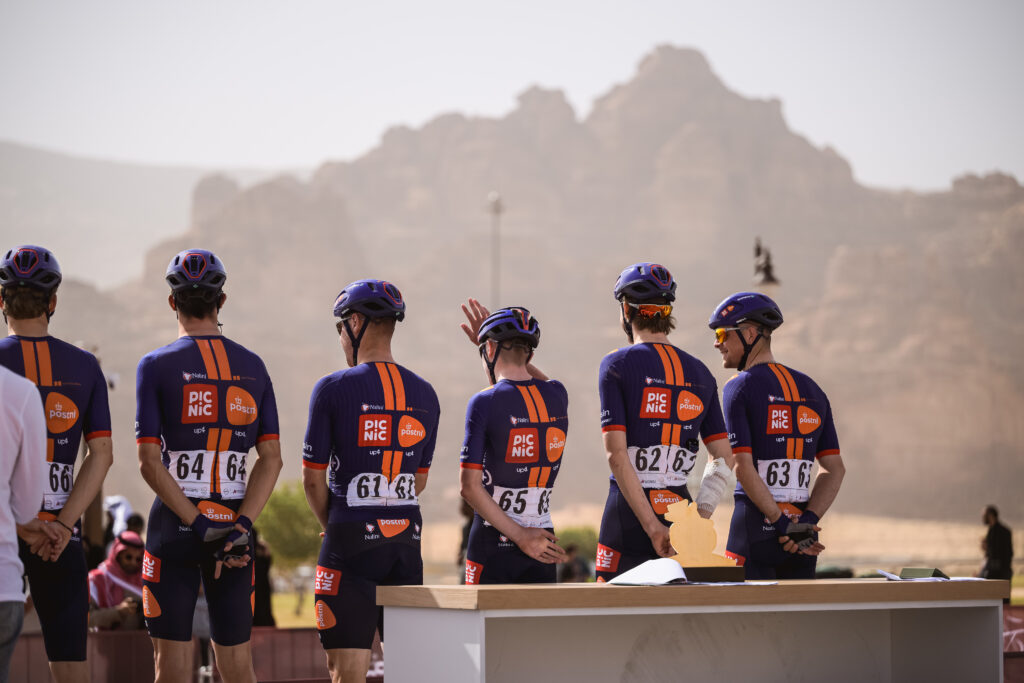
Developed in partnership with WorldTour team Picnic-PostNL, the airbag is carried in a pouch on the back of a rider’s bib shorts, and is made up of thermoplastic polyurethane (TPU) tubes, electronic sensors, and a CO2 cartridge.
The airbag is triggered when its sensors detect a sudden, significant change in the angle of the rider’s back, or in the case of a major ‘rotational acceleration’, quickly inflating to a thickness of 9cm around the back, hips, and ribs.
Aerobag’s system, which currently weighs 600g, is designed to deflate within minutes, in order to allow riders to resume racing shortly after a crash.
> Airbag cycling bib shorts designed to reduce injuries could become a reality in 2025
With airbags seemingly on their way to the professional peloton, in a statement issued on Friday the UCI said it is already in contact with “several players in the sector”, but wishes to “broaden the initiative to the greatest number possible of manufacturers and institutes working on the development of airbags and technical apparel for cyclists”.
This initiative, the UCI says, will “define a clear framework and appropriate standards to enable the development and integration” of airbag systems into racing and training.
The governing body says it also wants to “study the integration of airbag solutions into clothing and to identify ways to further strengthen the protection offered by textiles”.
In its statement, the UCI said “it is essential to bring together the various relevant parties to analyse the relevance of this equipment across the different disciplines” and “develop a regulatory framework defining clear and relevant standards for competitive cycling”.

The governing body also added that it aims to “encourage coherent development of protective equipment that meets the needs of riders and teams, and is in line with the industrial realities faced by manufacturers”.
To do so, it has invited anyone involved in the manufacturing of cycling airbags to express their interest in joining the initiative.
A “broad consultation” will then be organised during 2026 involving the interested parties, as well as independent experts.
“For the UCI and the stakeholders brought together within SafeR – the body dedicated to safety in men’s and women’s road cycling – the continuous improvement of rider safety remains a top priority,” the governing body said.
The potential use of rider airbags in professional races was first raised by the UCI in January 2025, as part of what turned out to be a raft of controversial equipment changes designed, ostensibly, to make professional cycling safer, including restricted gearing, wider handlebars, new rim height and fork width limits, and the banning of time trial helmets in road races.
The suggestion of rider airbags only leapt into the public consciousness the previous year, when Aerobag first reported that they had developed a functional prototype and had spoken to the UCI, medics, and clothing brands about introducing this new innovative technology.

We first reported on the airbag bib shorts for cyclists back in April 2024, when Sam Ratajczak, founder of the SID Sport Innovation Design and former head of research and development at Bioracer, said: “Ultimately, the introduction of an airbag system in professional cycling could represent a significant leap forward in rider safety, potentially mitigating the severity of injuries in crashes.”
Speaking to Domestique last month, Picnic-PostNL’s R&D head, Piet Rooijakkers, who has worked closely with Aerobag over the past two years to develop their system, claimed that airbag technology could be the biggest development in safety equipment since the introduction of the hardshell helmet.
“The helmet didn’t protect riders from everything, and the airbag will not protect from everything either – but in the end, the helmet had a big impact,” Rooijakkers said.
“The helmet is a lifesaver sometimes, and hopefully the airbag also will be. It doesn’t cover everything, but I think it has the potential to be as big as the helmet.”









2 thoughts on “UCI calls for “clear regulatory framework” to govern rider airbags”
Sadly yes, the UCI does need to apply some thought before this all gets to the peleton. It can’t be caught banning rider protection, but we can definitely predict:
– Some riders seeing airbags as a reason to take risks that they previously would have avoided.
– Rules around what happens to a rider when their airbag actually deploys (rather than the dodgy head impact roadside checks we currently see, it would allow a clean ‘your out rule’ – but teams are never going to like that, especially in multiday races (probably part of why the head impact accelerometers used in other sports haven’t appeared in cycle helmets)).
– Teams using them as a method to also sneak in aerodynamic advantages. Without some rules it will turn into an all out design war with rider cooling and actual effectiveness of the airbags taking a rear seat).
– Cost. Arguments about what happens when some of a race have airbags but not all. Does it need to be mandated as all or none, and if so, at what level of racing?
We can probably also predict the UCI taking a nice chunk of change to put their logo on kit so it can be used in the peloton.