


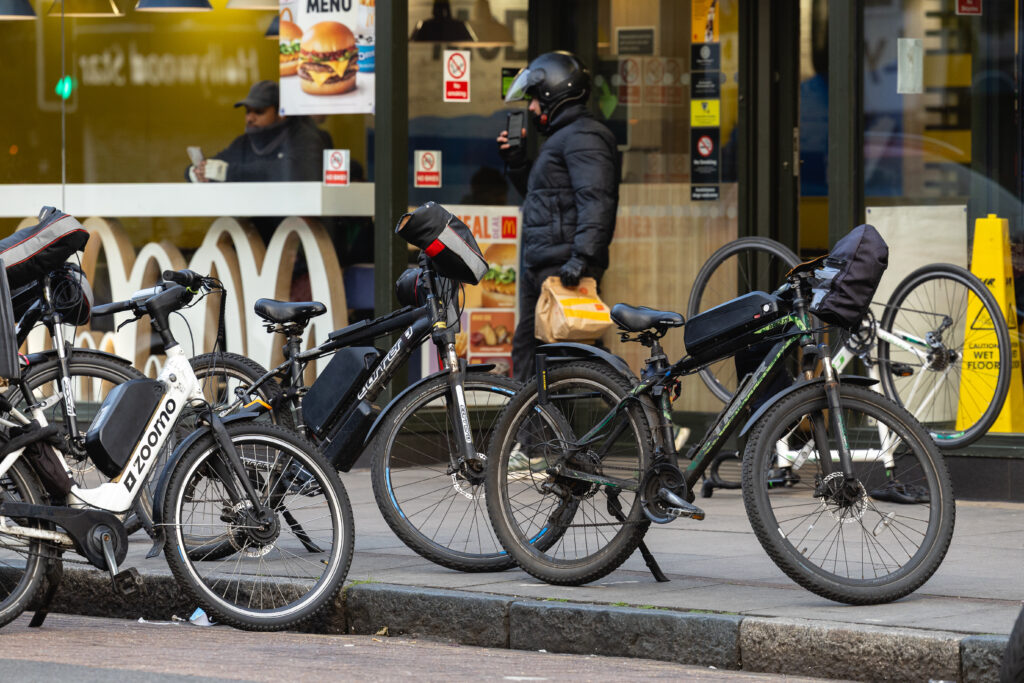

The Department for Transport has told ebiketips that there is no way of finding out how many collisions and incidents on British roads involve electric motorbikes and illegally modified e-bikes from its own recently published annual road casualty statistics.
The release of the Department for Transport’s latest reported road casualties in Great Britain at the end of last month coincided with numerous stories in the media about crackdowns on electric motorbikes and illegally modified e-bikes. With confusion rife amongst the public and even the police about the differences between compliant e-bikes (EAPCs) and pedal assist bikes that fall foul of the rules, we wanted to know if officers tasked with recording road collisions and incidents have a method of categorising electric bikes that are not EAPCs – bikes able to assist the rider beyond speeds of 25km/h (15.5mph) and offer more that 250 watts of power.
As suspected, the DfT confirm that although there is guidance available for the reporting of vehicles when making collision reports, there is currently no category for unregistered electric pedal cycles.
“Unfortunately these vehicles cannot currently be identified in the statistics”, a DfT spokesperson told ebiketips.
“Legal e-bikes would be included within the pedal cycle category. Illegal e-bikes – if their power is above the limit to be considered as an EAPC – would probably be classed as electric motorcycles, but… it can vary by force/reporting officer (sometimes they can be entered as pedal cycles, sometimes as other vehicles and it is not possible to identify them within any of the categories very easily).”
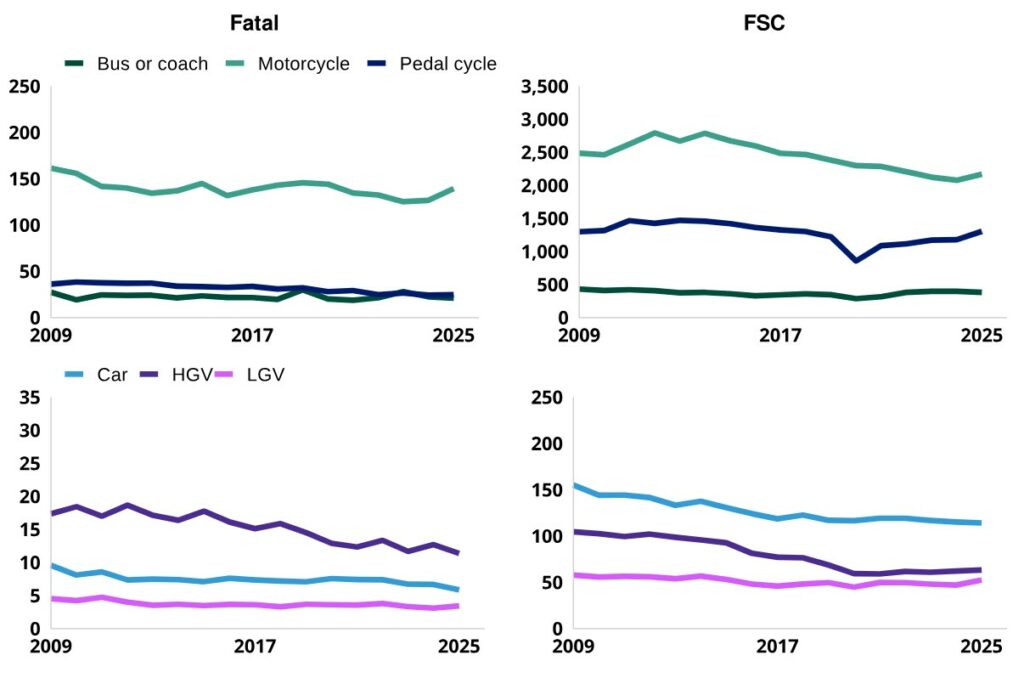
The final 2025 reported road casualty stats shown that while cyclist deaths dropped again, the number seriously injured increased sharply by 14%. Motorcyclists are by far the most likely to be involved in a fatal or serious collision per billion miles travelled compared to other road user types, and there was a near 13% increase in motorcyclist deaths and a 7% increase in those killed or seriously injured versus 2024 – however, while KSIs involving motorcyclists have been steadily rising since for the last three years (a total of 6,096 KSIs in 2025) this number is still lower than any year between 2015-2018.
Therefore, the proliferation of electric bikes on roads and paths that fall outside of the EAPC category in recent years does not appear to have contributed to a highly unusual number of KSIs looking at the data over a longer period of time – although there is arguably not yet enough data to demonstrate that these vehicles are or are not contributing to an increase in serious collisions, especially as there is no way of identifying them in the DfT’s statistics.
















18 thoughts on “Department for Transport admits illegal electric motorbikes “cannot be identified” in UK road collision statistics”
Quele surprise, Rodney…🙄
Clearly “but priorities”, but the poor granularity of some of the stats is another thing which works against improving transport safety.
This is easy in the future. It is either a legal e-bike, so a bicycle, or a motorbike. Just make sure the incidents are recorded correctly.
I admire your logic … and your optimism
It’s quite important if it’s an illegal motorbike, you could claim against the MIB for damages etc. How will you (or the MIB) know if it’s not recorded properly.
It is easier to trace fatalities and match them with the news story. In 2018 for instance, the only reported death where a “cyclist” was the other party, was the death of Sakhine Cikan, who was killed by someone riding an illegally modified machine.
I have done a bit of research for other years and found similar. Injuries are going to be harder.
“confusion rife amongst the public and even the police about the differences between compliant e-bikes (EAPCs) and pedal assist bikes”
And indeed this journalist. An EAPC is, surely a ‘pedal assist bike’. A ‘bike’ can be a bicycle or motor bike. So an e-bike can, equally, be either.
A Surron is an electric motorbike.
But an illegally modified EAPC could be classed as either as an illegal EAPC (eg. with higher cut-off – such as an american import or an aftermarket kit) or an illegal motor bike (eg. with throttle control).
And a modified EAPC isn’t necessarily illegal (eg. a bigger battery).
Here’s a hot take: there’s no such thing as an illegal EAPC.
If a modification to an EAPC pushes it’s capabilities outside the definition of a legal EAPC, by exclusion it is an e-moto / motor vehicle. If the e-moto has not met the minimum legislative requirements for road use, it is an unclassified motor vehicle, illegal for use in public.
Simple.
The complications are in teaching law enforcement what defines the boundaries of an EAPC and how to accurately test those parameters.
@ROOTminus1 The complications are in teaching law enforcement what defines the boundaries of an EAPC and how to accurately test those parameters
Nonsense! The Nation’s Finest are well aware that the infallible test consists of raising the driving wheel off the ground, spinning the pedals/maxxing the throttle and observing the speedo: if it says 0, it’s legal and if it reports over 25kph it’s illegal and should be destroyed or sold off privately
Sounds a bit over-complicated, when you can just look at the rider and decide whether they look like a wrong’un.
I agree about the importance of this ‘wrong ‘un’ criterion. Local observation, as well as in more crime-filled locales such as Blackpool and Preston, indicates that wearing a face mask is a sufficient but not a necessary condition for diagnosing an illegal electric motorcycle. I even saw one such crim on the Garstang Sainsbury’s access road recently. However, as Lancashire Constabulary officers have not even managed to work out that RLJs and years without MOT are offences, I don’t hold out much hope that they will be willing or able to take advantage of this latest intelligence
@ROOTminus1 So you are saying an American EAPC (20mph cut off) is not an electrically assisted pedal cycle; illegal in the UK, I grant you.
It is not capable of movement without physical input from the rider, so logically hardly counts as a motorbike.
However, these semantics do not affect the illegality of the machine.
The original question was classification of the machine for analysis.
I say potato, you say potato … let’s call the whole thing off.
Perhaps we could all agree to simply abide by (Catholic) church law … and that able-bodied folks need all the extra motors like a capybara needs a bicycle?
(Alas that won’t do, any more than pointing out that nobody “needed” AI but a handful of years ago… or indeed mass market cars in the late 1800s.)
On a bicycle you say…
There’s no such thing as an American (as in USA) EAPC. It’s a term from EU/UK regulations. In the USA they’d just be Class 1 or Class 2.
Legally speaking, if it doesn’t fit within the bounds of an EAPC (15.5 mph motor cutout, etc.) then it does count as a motorbike, whether it can move without rider input or not.
@ChrisA
I don’t see your point.
A Tesla Cybertruck is common way for moneyed inbreds to self-identity in the US but they’re illegal to import and register across western Europe.
A to-code American suburban family home by UK building regulations is nothing but a glorified garden shed.
Legal definitions of acceptable standards differ between different countries, bicycles are no different.
@ROOTminus1 An electrically assisted pedal cycle can be outside of the UK legal requirements, such as a Class 1 from the US, but it is still, technically, an electrically assisted pedal cycle.
Likewise, your “US suburban” shed is still a house and the cybertruck is still a piece of shit.
The original point was about classification of the vehicles and the lack of granularity within the classification.
Are these bad boys, EAPCs, overpowered EAPCs, throttle controlled EAPCs (now an e-motorbike) or just e-motorbikes? This needs to be a technical appraisal. Legally they are all illegal (if unregistered, taxed, insured, etc.), apart from the first one.
What are people wanting to achieve with these illegal machines? Is it faster, further, fun, food, felony, f… the rules?
If you want to deal with the problem, you need to know what the problem is.
Fuddlement