


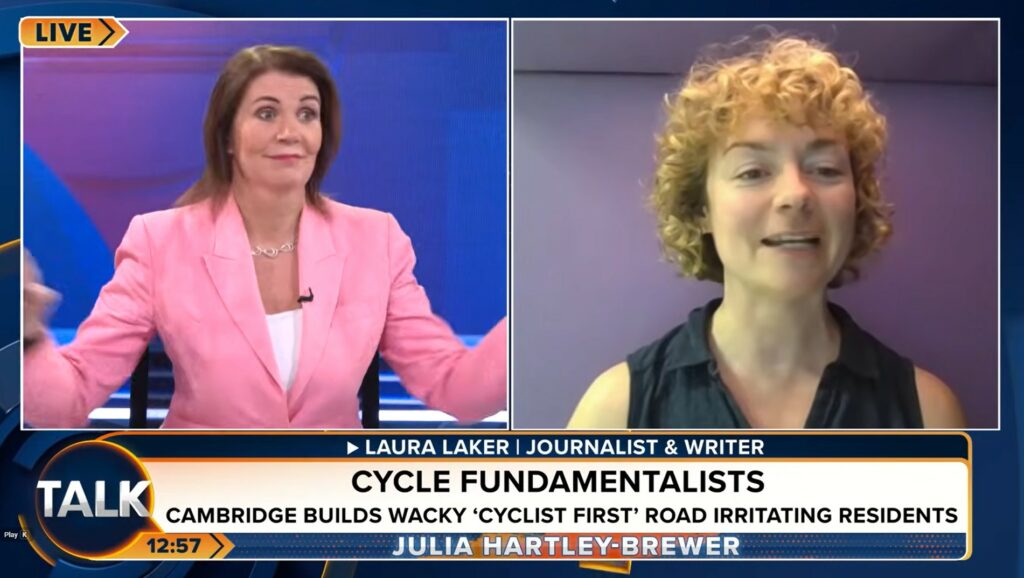

Talk TV presenter Julia Hartley-Brewer has been accused of “stonewalling, patronisation, and resorting to straw man arguments” after a segment on a new cycling infrastructure project in Cambridge descended into chaos. It culminated in Hartley-Brewer ordering producers to turn guest Laura Laker’s microphone off after the respected cycling journalist (and road.cc contributor, for full disclosure) simply claimed that “most people want to cycle”.
It’s fair to say Talk’s reputation isn’t based on any natural inclination towards calm, relaxed, balanced discussion. But, even by the streaming channel’s often incendiary standards, its latest foray into cycling and active travel was an especially fiery one.
During a tumultuous conclusion to her morning show on Thursday, Hartley-Brewer constantly interrupted Laker, talked over her, and seemed intent on stopping her getting her points on cycling and active travel infrastructure across.
Hartley-Brewer – an experienced broadcaster and journalist known for her forthright, often divisive views – also claimed during the segment that cyclists can “go faster” than motorists and that Amsterdam has a population of 75,000, while arguing that the UK can’t be “run around 25-year-olds in Lycra”.

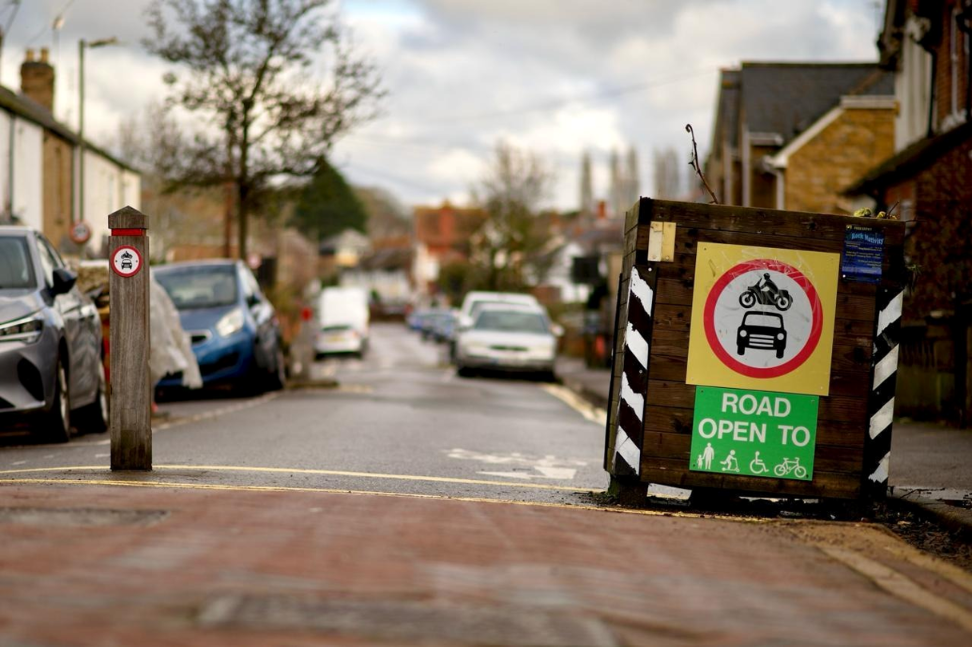
The bizarre exchange took place ostensibly during a segment on a new ‘cycle street’ that opened this week in Cambridge, attracting the attention of a number of mainstream national news outlets. The first of its kind in England, the £2.4m scheme on Adams Road in the west of the city, used by 3,000 cyclists a day, gives pedestrians and people on bikes priority over motorists.
The changes to the road include the removal of much of the on-road parking, the installation of wider footpaths, and redesigned junctions.
> England’s first “Cycle Street” will give priority to cyclists and pedestrians over motorists
Despite prolifically posting clips from the day’s coverage to its social media channels, interestingly Talk has chosen not to upload anything from Hartley-Brewer’s clash with Laker at the time of writing, so we’ve attempted to summarise as best we can below (you can also register with Talk to listen to the broadcast – which begins at around 2:54:20 approx – here).
Introducing the project during Thursday’s Talk TV show – in a segment entitled ‘Cycle fundamentalists: Cambridge builds wacky cyclist first road irritating residents’ – Hartley-Brewer asked: “Is this the future of our roads in cities? I fear it is.”
“I was already under the impression that cyclists and pedestrians have priority over motorists on most of our roads, don’t they?” she then asked Laker, a longstanding road.cc contributor and author of ‘Potholes and Pavements: A Bumpy Ride on Britain’s National Cycle Network’.
After noting that the updated Highway Code features a hierarchy of vulnerable road users, with pedestrians treated as the most vulnerable, Laker pointed out that it is “common courtesy” for those who can inflict the most danger on the roads to look out for others.
“It would be nice if people did do that, and I don’t see that courtesy from cyclists all that often,” interjected Hartley-Brewer. “I think that new rule where pedestrians have the right to cross over someone turning into a junction is crazy and actually quite dangerous for motorists.
“But we don’t see those rules being equally applied. Okay, motorists are in a big metal box, they’re safer than pedestrians and cyclists and therefore need to take care. But they also have a licence plate and can be easily identified. Anyone who owns that car will be responsible for something that happens.
“But we don’t see that with cyclists, who often can be going faster than cars on the street and who aren’t identifiable and causing problems and disruption. And often they aren’t as considerate of motorists or pedestrians. Why should they be given priority on a road when an awful lot of people need their cars?”
Laker responded: “I think it goes back to who is causing the risk on the roads. And 1,700 people are killed every year on our roads and that’s people driving who are causing most…”
“But the vast majority of people on our roads are drivers, not cyclists,” added Hartley-Brewer, to which Laker said: “That’s true, and then there’s 20,000 serious injuries and life-changing injuries, so there’s a substantial risk. And that’s why there’s a licence. Ultimately, cycling is such a positive thing, it’s good for our health, it’s a joyful thing.”
The host then interrupted with: “But you say that… I think you’re saying that as a young…”
Unperturbed, Laker continued: “And if you talk about licences, I think it makes it quite difficult for people to take it up. And where do you stop? Do you make children be licenced? It doesn’t make any sense.
“And with any good transport system, you don’t just provide for one means of transport. You’ve got the motorways and A-roads for fast, long journeys. And you’ve got the residential roads for the short trips. On those residential roads, you want people to have a choice. It’s quite lacking in our transport system, actually most people want to cycle.”
[It must be noted that Laker admits she mis-spoke at this point in the debate, and that she intended to point out that the majority of people say they would cycle more if the roads are safer. “The proportion of people who want to cycle more is generally around 43 per cent to 44 per cent… rising to 51 per cent among children,” she told road.cc on Friday. “While various YouGov polling shows that most people support greater investment in cycling, and most people say they would cycle more if the roads felt safer, the distinction is important”.]
However, Laker was unable to get that particular, more nuanced point across as things soon began to get out of control, Hartley-Brewer shouting over Laker as the cycling journalist battled to even get a word in.
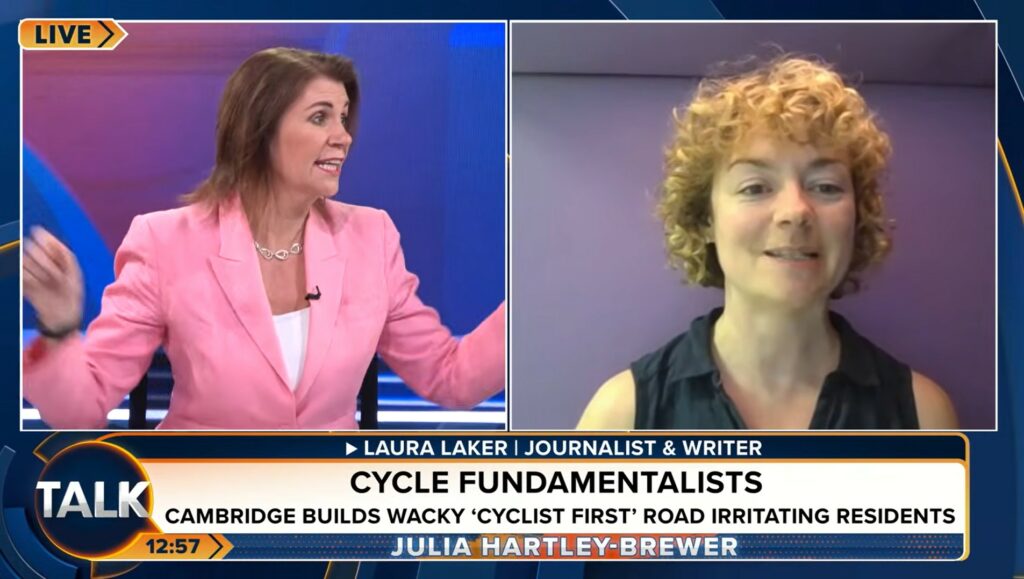
“No, they don’t! No, they don’t! No, no, no, Laura, Laura!” the host said.
“They do, they actually do, there are statistics, YouGov has done research on this…” a laughing Laker continued.
“Laura, my darling, you’re confusing… I know there’s plenty of research on it, Laura…” Hartley-Brewer, waving her hands in frustration, shouted.
“You might not want to, and that’s totally fine,” Laker added. “It doesn’t take away that it’s a great thing to do. Children can cycle and walk to school, that’s fantastic, and prioritising safety on the roads means people can walk and cycle.”
“Laura, you can keep saying it, but… Laura, Laura, Laura, stop!” the host, again talking over Laker and turning to her producer, said. “Earth calling Laura. Most people don’t… She’s just going to carry on. Can you just turn her mic off so we can actually explain?”
Getting her wish, Laker’s microphone was muted and Hartley-Brewer was able to launch into her own, somewhat ill-informed, monologue.
“Laura, people say they want to cycle. But the giveaway is whether people actually do it,” she said. “And even when our roads were way more cycling-friendly, it’s a tiny percentage of people who cycle. And you may say that’s because it’s too dangerous. And yes, we do need cars and buses on the road. The vast majority need to drive to work.
“Most people would love to… But they’re not young and healthy people who can put their cycle kit on and cycle along their nice flat road to a place that’s 20 minutes away. That’s not how most people live, that’s how some young people in central cities live. But it’s not how the vast majority of people live. We can’t run the entire country around 25-year-olds in Lycra.”
Her mic turned back on, Laker responded: “And that’s not what happens. If you’ve ever been to the Netherlands, you’ll see all sorts of people riding and walking, you get elderly people on bikes.”
“But we’re not the Netherlands!”
“But the Netherlands wasn’t the Netherlands in the 1970s.”
“People compare London to Amsterdam. Amsterdam has a population of 75,000…” added Hartley-Brewer. The Dutch capital, in fact, has a population of over 930,000 within the city proper and 1.5 million in its wider urban area, while Cambridge – the UK city that was originally up for discussion – has around 150,000 residents.
Finally, Laker referred back to the segment’s title, saying: “Nobody is being a fundamentalist about this, it’s not like every journey people are going to be cycling and walking. It’s about giving people choice.”
Reflecting on Friday morning on her rather tumultuous foray into Talk Radio ‘debates’, Laker told road.cc: “Normally when I’m asked on someone’s radio or TV show it’s because they want to hear my views. The experience on Talk Radio this time was a bit different.
“I’ve said yes to these appearances because I’m game for debating my views and being challenged on them. I also believe it’s important to present audiences with something that might make them think differently.
“This was the first time, however, I had an interviewer who seemed to want to stop me getting my points across in the first place – let alone one threatening to mute me when interruptions stopped working.
“This is a real shame for Julia Hartley-Brewer’s listeners, who I think deserve the credit for being able to hear both sides of a debate and making up their own minds about it. Instead, what they got was a presenter resorting to straw man arguments, patronisation, and stonewalling.”
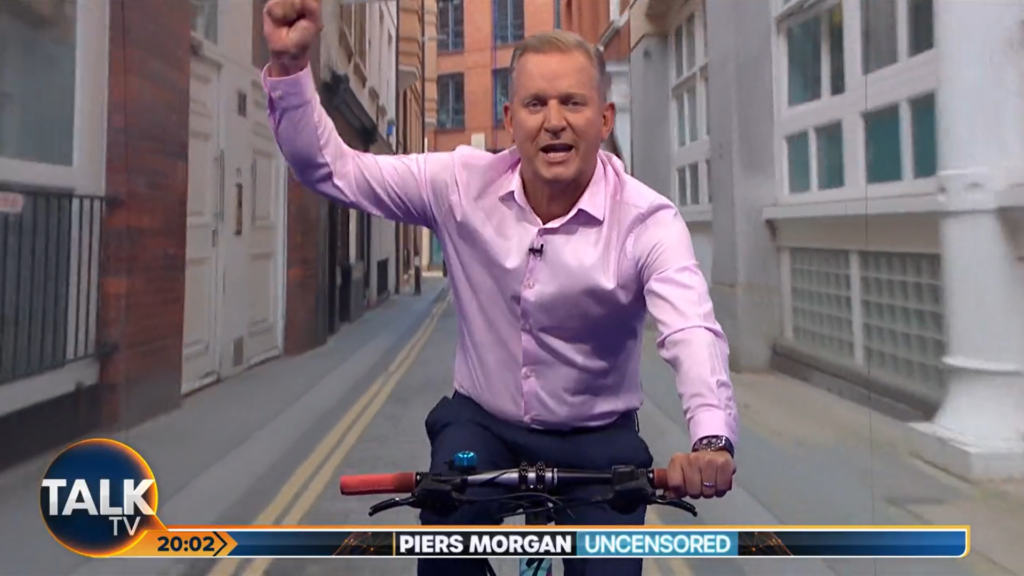
While she may be the first Talk TV presenter to turn her guest’s mic off during a discussion about cycling to our knowledge, a number of Hartley-Brewer’s colleagues have unleashed two-wheeled rants on their viewers and listeners in recent years.
Back in 2022, Jeremy Kyle delivered a green screened monologue for the ages, managing to reference tax, insurance, Lycra and the Tour de France, before saying that he gets “…irrationally angry about cyclists.”
Earlier that year, Mike Graham – best known for claiming that concrete can be grown in a debate with an environmental activist – appeared on Good Morning Britain to denounce changes to the Highway Code, claiming that giving priority to cyclists at roundabouts is “a recipe for disaster”, and that cyclists are being encouraged to ride “three abreast slowly in front of cars”.











20 thoughts on ““Turn her mic off!” Talk TV host Julia Hartley-Brewer has meltdown in bizarre exchange with cycling journalist, claiming cyclists “often go faster than cars””
Much like GBNews, Talk TV isn’t actually a news channel, but an entertainment one (this is how they get round Ofcom’s toothless regulations regarding impartiality). There’s no point in going on it and treating it like a news channel.
@the little onion It definitely isn’t news but calling it entertainment, maybe it is for folk who believe in the Propaganda it is, but I switch over in seconds if I happen to land on the channel and for me it most certainly isn’t entertainment either!
[sic]
However, she has been “working” for Talk Radio since 2016, taking a decade off the latter career.
Julia Hardly-Worthit, as a gutterhack, is a prime example – along with the claim of “experienced drivers” – that “experience” is no substitute for professional assessment.
Whatever it is she does, it isn’t any form of “journalism” worth the name.
@GMBasix * Talk Radio and Talk TV… as if her disembodied cackling wasn’t enough!
She’s a paid propagandist. Lady Haw-Haw.
@castorrandd@gmail.com Anything that slows her stately SUV (except other luxobarges) is a pest…
Well done Laura, we’re all proud of you.
I’ve largely been spared the ludicrous dribblings of JH-B since I packed in Twitter and its ragebait algorithm. Nice to know the ignorant, arrogant clown is still making a fool of herself for money.
I rather look forward to JH-B’s recipes during the TdF.
@KDee “Today Carlton I have for you a poisonous waffle on a bed of word salad served with a rich arse gravy, perfectly complemented with a very special bottle of Chateau Talk Radio pigswill.”
Delicious!
Sounds a bit rich… on the other hand perfect for those on a low-fact diet.
I know the likes of JHB don’t give a shit, but all of these unhinged anti-cycling rants contribute to making the roads that bit more dangerous for every mum, daughter, dad, son, sister or brother riding their bikes on the road. The persistent dehumanising of people on bikes is disgusting.
JHB is on the advisory council of the Free Speech Union, but if she doesn’t like what you say then she’ll turn your microphone off.
You couldn’t make this shit up.
We here at the Campaign for the Freedom of Information are completely in support of this.
Well I got to be honest she is correct on the fact that cyclist do go faster than motorists, I drive and ride cycles and trust me, here in Wales all cyclists go faster than motorists ever since the 20mph speed.limit came.in a couple.of yrs ago. As I mentioned I ride cycles, I have 9 altogether, 7 pedal and 2 electric, I also got seats, towbar and trailers.for the grandkids and trust me when I say that motorists and cyclists and scooter riders are all dangerous. ME and the wife every weekend we ride the bike trail from our caravan site in Morriston all the way to the pier in Mumbles and I got to be honest the bike riders and scooter riders have no thought for anyone else apart from themselves. We had our granbson on his “balance bike and a middle aged” T–T almost killed him and then started shouting at us to “control him”, a 3 Yr old on a balance bike doin about 100ft per day yet this guy was actually”bombing along”ppl walking, cycling, kids walking, cycling etc, even oaps that were needing their walking aids but it didn’t matter because we were all.spoiling his ride for.him.Now,as for everyone commenting on Hartley, she is correct on a few.things and so is the other woman. I can’t cycle.to.work myself because it would take me 8.hr to go back and fore for my tools, THERE IS A PLACE AND A TIME WHEN CYCLES CAN “TAKE OVER” BUT UNFORTUNATELY IT’S NOT IN BRITAIN
And this ignorant, useless buffoon gets paid X* times more than a nurse and Y* times more than a carer.
I suspect her choice of pink was not in recognition of the Giro.
* X and Y are large numbers, greater than 5.
Like GB News, Talk TV is basically a Reform mouthpiece. I don’t bother with either of them, or Talk Radio for that matter. Best ignored, and boycotted.
Talk TV and its Murdoch ilk focus on content not dissimilar to a truck stop’s broken toilet. Only that the blocked bowl has better presentation.
I thought Laura did well, and capped the bullshit firehose effectively – especially as she had never had an attempted mugging from a far-right shock-jock before.
Her “the Netherlands was not the Netherlands in the 1970s” is a genius point, which I will remember.
She could have added “Why do you want to live in a Carry On film” if she wanted to put JHB back in her hot air balloon..
But nonetheless – enjoyable, even though personally I probably preferred Laura’s debagging of Richard Madeley on Jeremy Vine iirc with sheer logic.