


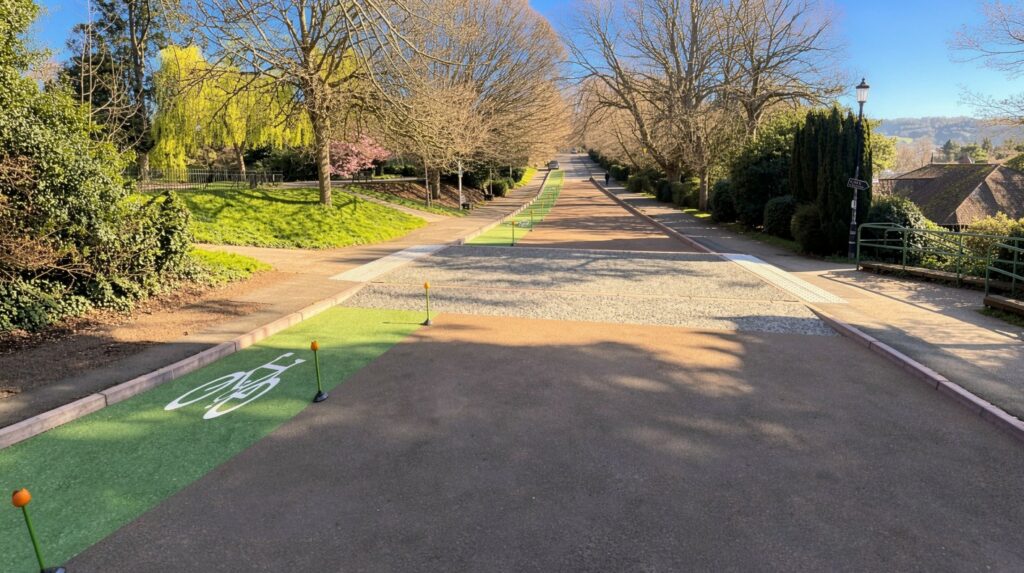

Local Green Party councillors in Bath have re-stated their opposition to a segregated cycle lane through a park in the city, arguing the additional lighting set to be installed is insufficient to prevent the route being “experienced as socially unsafe.”
Royal Victoria Park is one of the city’s largest public green spaces and includes a clockwise-looping, one-way ring road. As part of the Bath Walking, Wheeling and Cycling Links programme, which aims to better connect the surrounding area to the city centre’s infrastructure, a route is planned to join the Upper Weston suburbs to the city, seen in blue on the image below.
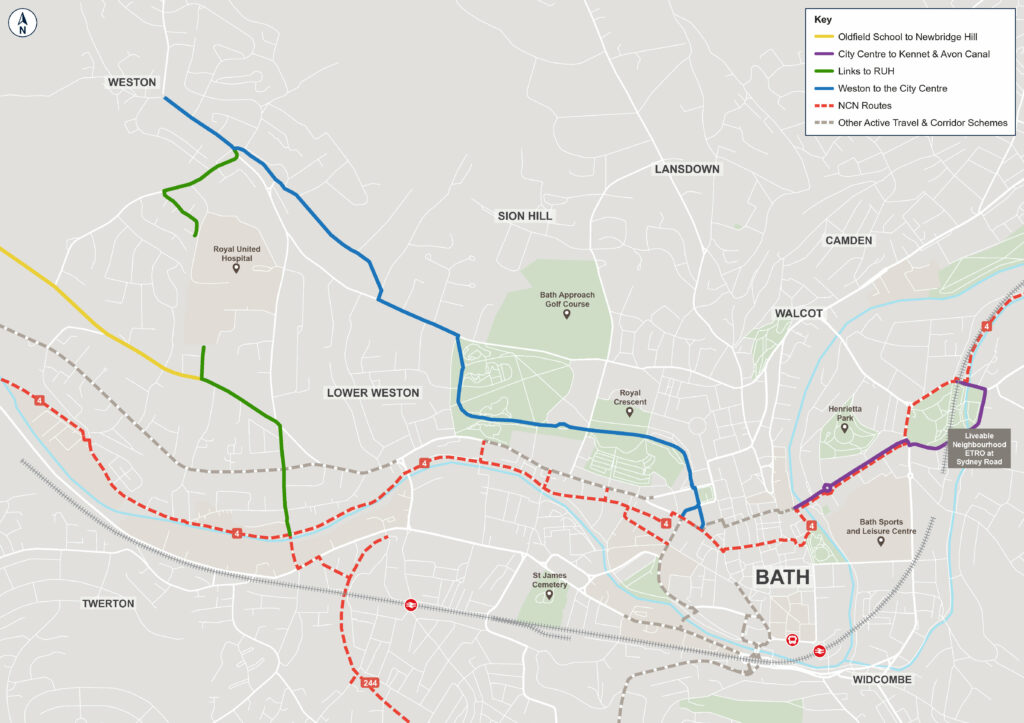
The Weston link includes a proposed cycle lane running through Royal Victoria Park alongside the ring road on its western and southern side, and would operate in the opposite direction to the road. In the opposite direction out of the city, cyclists would be expected to follow the single-lane road, which features multiple traffic-calming chicanes and has a 10mph speed limit.
The proposals were first put forward in December 2024 and would have initially closed vehicular access from the north west entry point. The local Green Party first stated their opposition to the proposals then, stating, “Royal Victoria Park is isolated and unlit. It is therefore not a safe route for many, including women and children, to ride on in the dark.”
Following a public consultation, Bath and North East Somerset Council submitted revised proposals.
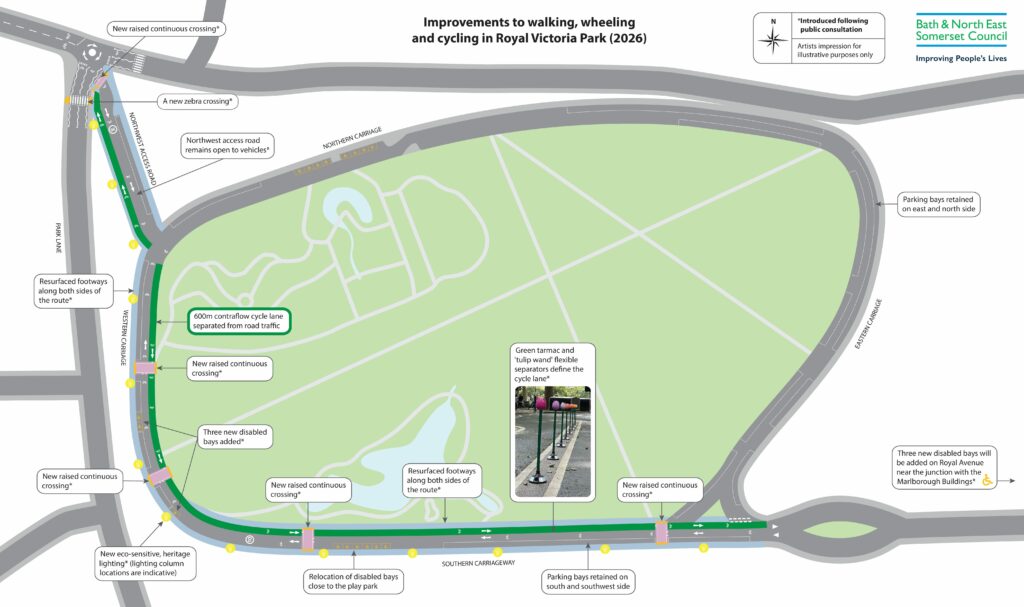
The new proposal added pedestrian crossings, pledged to resurface footpaths on both sides of the road and adds tulip-shaped wand kerbs to better segregate the contraflowing cycle lane from the road, which originally would have only used paint to separate the cycle lane. “New eco-sensitive, heritage lighting” would also be installed at regular intervals along the cycle lane, though they do not appear in the below mock-up of the proposal.
The new proposals are also subject to a public consultation which remains open until Thursday 27th August. However, the Green Party councillors remain opposed to the bike lane.
Councillor Saskia Heijltjes said in a post on the local party’s website, “We want to be able to support efforts to make walking, wheeling and cycling an option for more people but we cannot support the plans for Royal Victoria Park. Even with additional lighting, a secluded and quiet route through a park is often experienced as socially unsafe.”
Fellow councillor Joanna Wright added, “If we want people to take up cycling, we need to opt for socially safe routes which are not secluded.”
The group also linked to an academic study from 2015 which concluded, “there was no evidence for an association between the aggregate count of crime and [the] switch off” or dimming of street lights.
With the Green Party holding three of the council’s 59 seats, the Liberal Democrat-run council is set to approve work on the cycle lane beginning in the autumn, pending feedback from the public consultation.
Councillor Lucy Hodge, Cabinet Member for Sustainable Transport Delivery, said, “In Royal Victoria Park, we have listened to feedback and refined the plans, retaining vehicle access while delivering better facilities for people walking, wheeling and cycling through the park. The improvements will create safer crossings, better accessibility and a more welcoming environment for everyone.
“We will do our best to reduce disruption to traffic while these are installed and want to thank people for their patience as these improvements are put in.”
The local Greens’ opposition attracted the ire of journalist James Ball, who highlighted the objection to the cycle lane in his latest Nimby Watch column, writing, “Lots of things are ‘experienced’ as unsafe, even if in reality they’re very low risk. Many Americans think London is an incredibly dangerous city, for example, even though crime is lower there than any major US city. Trying to run the world based on what people think is ‘socially unsafe’ could quickly get very difficult, indeed.
“If you can’t get the Green Party to back one cycle lane, then what are you ever going to get support for? The British problem has become fussing at every single plan until it’s the best possible one, which makes every possible stakeholder happy, and that plan doesn’t exist. Until we start accepting plans that are just good enough, we’re going to be stuck with plans that are bad.”
Gender equality campaigner Susannah Walker defended the Greens’ proposal however, noting on Bluesky, “Work elsewhere has demonstrated that this kind of path will not feel safe for many women and girls – and others – after dark. But separated paths are also key for women cyclists.
“So unless the Upper Bristol Road [near Royal Victoria Park – ed] also has a fully separated cycle path, there are some good reasons for pointing out the issue. I’ve talked to women in N London who don’t use the back streets cycle routes at night because they’re too deserted and instead cycle along the Holloway Road. So the Greens, are, disappointingly for everyone, at least a good part right.”
In summary, a load of men talking about women’s safety and going ‘well I’m fine so I don’t see what the problem is’ while the Green Party line is actually based on evidence and the experience of women.
— Susannah Walker (@susannahwalker.bsky.social) 18 August 2026 at 09:06
In their 2024 General Election manifesto, the Green Party of England and Wales pledged its elected representatives would fight to invest “£2.5bn a year in new cycleways and footpaths” and would adopt Active Travel England’s objective of 50% of trips in England’s towns and cities to be walked, wheeled or cycled by 2030. Bath and North East Somerset Council adopted their own Active Travel Masterplan in February of the following year.
The Greens’ opposition in Bath to local active travel infrastructure also highlights the less polarised attitude towards cycling on a local level. Since winning control at recent local elections, two Reform UK-controlled authorities have championed active travel investments in their area. Their statements run counter to party leader Nigel Farage’s claim that council budgets “waste tens of millions being spent on cycle lanes that no one uses”.
> Opinion: Boris Johnson resignation – A blow for active travel? (From 2022)
Similarly, despite the Labour Party’s increased investment in active travel on a national level, local politicians have frequently opposed installing infrastructure in their area.









14 thoughts on ““If you can’t get Greens to back one cycle lane, then what are you ever going to get support for?”: Green Party councillors in Bath oppose lit, protected bike lane through park”
Clickbait headline much? As is often the case, the Greens oppose a lacklustre proposal in favour of something more fit for purpose (see “Affordable” housing vs Social housing) and the media report it as blunt oppose.
I was on the LCC Womens’ Network Freedom to ride ride a few years back in London and yeah, just because a cycle route is lit, it doesn’t make it feel safe. Disappointing headline from RoadCC.
I’m in agreement with the Greens here. We need to actively push back against cycle infrastructure that doesn’t consider personal safety. In West Yorkshire, millions have been ploughed into resurfacing canal towpaths as shared pedestrian/cyclist infrastructure, yet plenty of men, and masses more women, feel distinctly unsafe when commuting at peak hours in winter, when it is dark. Plenty of bits are dodgy in daylight!
@the little onion Absolutely, we must get out of the mindset of just gratefully accepting whatever scraps we’re offered which then end up underutilised because they’re unsatisfactory and so used as arguments not to build more.
Agree: some things are just blockers, no matter “but I do so you can” or “look at the stats, it’s really safe!”
But the devil is in “can we get there from here?” (sometimes literally).
Much of what supports mass cycling elsewhere is in the bigger picture. Like decisions about what traffic goes where made at the network level.
Or getting decent public transport in so that it’s easier to make that motor traffic evaporate.
I am very familiar with this area, and being a major route into Bath, it will be an every day experience for Road CC staff.
I am in S Gloucestershire, and it would appear you have the same issue in Bath, that given ANY proposal for spending on Active Travel Infrastructure, the Range Rover lobby suddenly become all environmently friendly and object on the grounds that ANY lighting will disturb the wildlife (a major issue with large parts of the Bristol to Bath Railway Path). I note that major changes to road junctions, including masses of extra tarmac and lighting, are never objected to on environmental grounds.
I know that Bath is getting a lot right on Active Travel infrastructure, and it appears the Range Rover lobby will be addressed by this lighting scheme, so that the scheme could go ahead. The alternative is a major road that runs alongside the park that I would never dare to ride a bike along.
I believe we should be supporting the scheme, and then putting the case forward for increased light levels once the scheme is in place, and exactly what is happening right now on the Bristol to Bath Railway Path in S Gloucrstershire.
As chair of Walk Ride Bath(NES), I can also confirm that WRB strongly opposed this section stating it fell significantly short of LTN 1/20 compliance in November 2024 highlighting that a much stronger route along the northern edge of the park along an existing lit road was better. The council appears to have ignored our response.
Also let’s be clear, the map used here is disingenuous. Nothing other than the park route is being delivered. Not the critical Queen Square infrastructure or anything linking into Weston. They are delivering a bit in the middle that adds f’all to the network that was there already.
Note West of England Combined Authority have already warned BaNES to stop descoping and increasing costs on City Region Sustainable Transport Settlement schemes they manage.
Wow. Last year, I resigned as Chair of the Active Travel Forum for Yate, Sodbury and Surrounding Area not only because there was little to nothing being done to make cycling safe around Yate, but I was coming under personal attack from pro-car (anti-cycling) local councillors, and everything possible was being done to keep our group (drawn from local parish councillors and members of the public with specialist knowledge) out of providing any input.
After nearly being killed by someone driving a car at about double the 30 mph speed limit (quite normal around here) I have given up, and we are moving to East Yorkshire. If we were still living in Bristol, had moved to Bath (Weston area), or I had confidence that the now no longer secret “Getting About In Yate” (directed by a couple of councillors who only drive cars) will make any real difference, I would stay.
Good luck in East Yorkshire. I am not well informed but suspect that is very much car country there.
They’re busy trying to gee Palestine. Along with others who’d been used as target practice if they actually ever went to see the poor misunderstood religion
@mason 89i I fail to see the connection between discussing cycle routes and the genocide in Gaza being supplied by our Labour government.
It’s all half-arsed, from the clickbait title of this article, to the unsafe design of the bike track. …Why do we live in such a world?
Capitalist fantasies of exponential growth vs conservative nimbyism – within the one Range Rover shopping cart world view!
The Greens are trying to do it right.
Everyone else has their knickers in a knot because their world view is small, and wilfully / selfishly half-arsed.
Bath cyclist view. Whilst being a very lovely city to live in, it is at times (and places) a car infested hell-scape which is easy just to accept when you live here. I pretty much walk and cycle within the city, and only get the car out if I have to (miserable at times). With narrow roads, lots of on-street parking, no outer ring road (geography; through traffic), a river splitting the city N/S, plenty of good private/state schools and some pretty steep hills, it’s a toxic mix of inconsiderate entitled drivers and rat-runs; for years the traffic problem has been in the council’s ‘too difficult’ box. They may not get it 100% right, but the current Lib Dem council are pushing ahead with new pedestrian crossings, shutting rat-runs, implementing 20mph speed limits, scooter/bike hire scheme and installing cycle lanes; it drives the car-lobby wild and their human right to drive wherever, whenever and however is violated (I include people who live around me in this group; “how will we get around?”). The local Greens seem to just side with the noisy NIMBYs, regardless of whether it’s ‘green’, as it probably helps their election prospects. As a cyclist, you need your wits about you and where to go to avoid toxic traffic; I’ve felt safer cycling in London. I think this new park route links the cycle route(s) from the centre of town up towards Weston and the hospital reasonably well; bit of uphill in the park (noting that a N route is recommended). The ‘antis’ point out that there are already 2 parallel cycle routes, the river path and the section of the U Bristol Rd that has dedicated cycle lanes (they’re still screaming about that one). The river path feeds cyclists towards the 2-tunnels route S and the Bristol Bath cycle path; tbh, it has a lot of pedestrian traffic and is pretty narrow and bumpy (tree roots) between Windsor Bridge and Locksbrook (apparently will be upgraded). The U Bristol Rd lanes incl floating bus stops etc (wouldn’t be cheap to remove), but at the W end they just stop and turf you out onto a pretty busy road. Cyclists travelling from Newbridge may just stick to the U Bristol Rd, and enjoy the respite offered by the cycle lane stretch, or could head down to the river path. I dislike the car zealots so much (one resident group has taken their self-funded LTN complaint to the High Court) that anything that sticks one up their proverbial is fine by me. If I can make an effort to get about the city by means other than a car (I even invested in a ebike to use a bike more; kills off the hill problem), then perhaps they could to.
My main arena is Oxford and was London. I think the main need is to make car use inconvenient, not stop it. 20mph limits are great, much of European urban centres have been that slow (30kph) for decades.
And … what they also have is multitudes of uncontrolled pedestrian crossings, at most junctions, which require drivers to slow down and look – of course normal (non- or legal-electric) cyclists are already in that realm.
In those environments cycling, walking and even motoring is so much more human and calm. Here, if a pedestrian crossing of any type is proposed here there are immediate objections to how it will “slow” motor traffic and that is what needs support.
The Iffley Road in Oxford is an example – its 1.2miles has 3 zebras and 3 pelicans, about 6 other crossing refuges – there’s about 20 junctions, if each of those had a zebra (along with similar in all the other streets) it would make a great change. Instead they are trying congestion charging and blocking most side streets.
In my opinion it would take a while to get used to, but more people would walk, cycle and drive only when needed.
I guess the high speed cyclists would get a bit frustrated with pedestrians but they might accept that more than 90% of cycle journeys in urban settings are for practicality, not fitness/sport.
I haven’t been in Bath much recently but I think it would benefit from a similar treatment – a zebra crossing at every junction on the London Road in from the A46, and similar across the city.
Every urban area in the British Isles please!
As someone who’s been nearly mown down more than once on zebras on the Iffley Road, I’m not sure that’s quite the panacea suggested.