


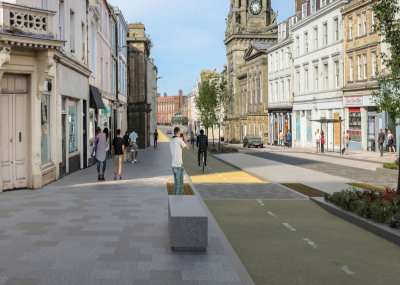

Confused councillors in Ayr are up in arms after cycle lanes they believed had been removed from a town improvement scheme popped up this week in the latest design report.
In January, it was reported that the bike lanes proposed as part of the Accessible Ayr scheme had been ‘scrapped’ after widespread opposition from residents and local politicians prompted the council’s deputy leader to call for a revised design without the cycling infrastructure.
The scheme, which forms part of an attempt to improve walking, cycling, and public transport links in the Scottish town, had caused uproar a few months previous due to the proposed removal of six car parking spaces, which local Labour MP Elaine Stewart claimed would cause “disruption” to the local economy.
However, members of South Ayrshire Council were told this week that no motion had been formally made to ditch the cycle lane plans and that statements made in January opposed to the infrastructure were merely “political” in nature.
Councillors were also informed that Transport Scotland’s funding of the initiative may be withdrawn if the cycle lanes are removed, due to the investment being granted on the basis that the programme promotes active travel.
> Plans to build cycle lane in town “hostile to anyone outside of a car” have been scrapped
The £19.9m Accessible Ayr scheme, first given the go-ahead in 2024, aims to improve road safety and public realms in the town by introducing new cycling and walking measures, changes to traffic movement and parking, and improved links with public transport.
A series of public realm improvements have been proposed as part of the scheme, including refreshed and level pavements, protected cycle lanes in key locations, new street furniture, reduced street clutter, improved pedestrian crossings, improved drainage, and better lighting.
This “significant” investment in the town, South Ayrshire Council says, would help make it “a vibrant and more attractive place for people to visit and enjoy and easier to access by people walking, wheeling, and cycling”.
The plans include a bi-directional cycle lane on the east side of Alloway Street, which would see parking spaces and loading bays moved to the other side of the road, as well as cycling infrastructure on Sandgate, where a traffic lane would be removed to become one-way for motorists.
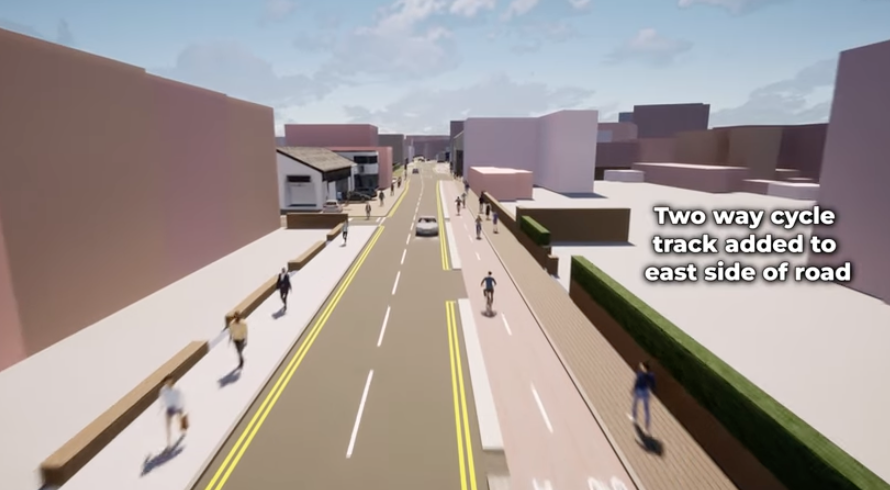
This part of the scheme was met with criticism by local traders during last year’s public consultation, with one takeaway owner claiming that the “politically correct” infrastructure would have a “detrimental effect on local businesses” and that Ayr does “not have the climate to prioritise cycle lanes over cars”.
Speaking at the council’s cabinet meeting in January, the local authority’s deputy leader Alec Clark said: “Due to further consultation and feedback, the report on Accessible Ayr has been deferred until a later date to allow for a redesign, which will not incorporate any cycle lanes in Ayr town centre.
“Cabinet will be updated on the new design as we go along, and to be clear, there will be no cycle lanes in Alloway Street, Sandgate, or Fullarton Street.”
However, the deferred report was finally considered by councillors on Tuesday and – despite Clark’s insistence – still included the original cycle lanes, baffling some of the cabinet’s members, Ayr Local reports.
“This document was deferred at a previous cabinet,” Clark told this week’s meeting. “Cabinet raised concerns about the cycle route within Alloway Street and the Sandgate. That is because concerns were raised by businesses and residents and also because you are moving Sandgate from two lanes to one lane.
“That feedback was provided, but it was not included in the report that would have gone to the last Cabinet. That was therefore deferred to allow feedback to be taken into consideration and the report was updated.
“But I am afraid the report has not been updated in that sense. We are still sitting with cycle lanes in Alloway Street and Sandgate, and we still have those same concerns from businesses and residents.”
Jane Corrie, the head of roads at the Ayrshire Roads Alliance, said the last round of consultation had received “something in the order of 28 objections” to the changes on Alloway Street and “20 objections to Sandgate”, while further anti-cycle lane pronouncements had been made on social media.
“What we want to do now is go back out and gather properly the feedback that was expressed through social media so that we can be properly informed, so that we can liaise with businesses and residents to see if there is a way that these proposals can be amended to alleviate their concerns,” she said.
“It is important that we do that through proper consultation rather than just through the social media channels that we were receiving the feedback through.”
Corrie also pointed out that South Ayrshire Council’s initial funding bid was predicated upon the scheme featuring active travel elements.
“It is also important to just note that the Transport Scotland funding is based on certain criteria and it is active travel funding,” she continued.
“If we just remove completely the cycle lanes from these streets, then there is a chance that they will not support that funding bid.”
However, independent councillor Chris Cullen argued that Clark’s comments during the January meeting of the cabinet had indicated that any plans for cycling infrastructure as part of the scheme would be scrapped completely.
“I can go back to the 20th of January and pretty much quote Councillor Clark’s statement when we deferred this paper that it was to allow a redesign of the streets in Ayr and that in no circumstances would there be any cycle lanes in Alloway Street, Sandgate, and he also included Fullarton Street,” he said.
“That was agreed by everyone when we took the vote. Yet this paper comes back with no material changes to this and a proposal to go out for another consultation.
“I personally met with shop owners and residents in both Sandgate and Alloway Street, where they conveyed to me jointly that they weren’t happy with this and they were representative of the people that were there.”
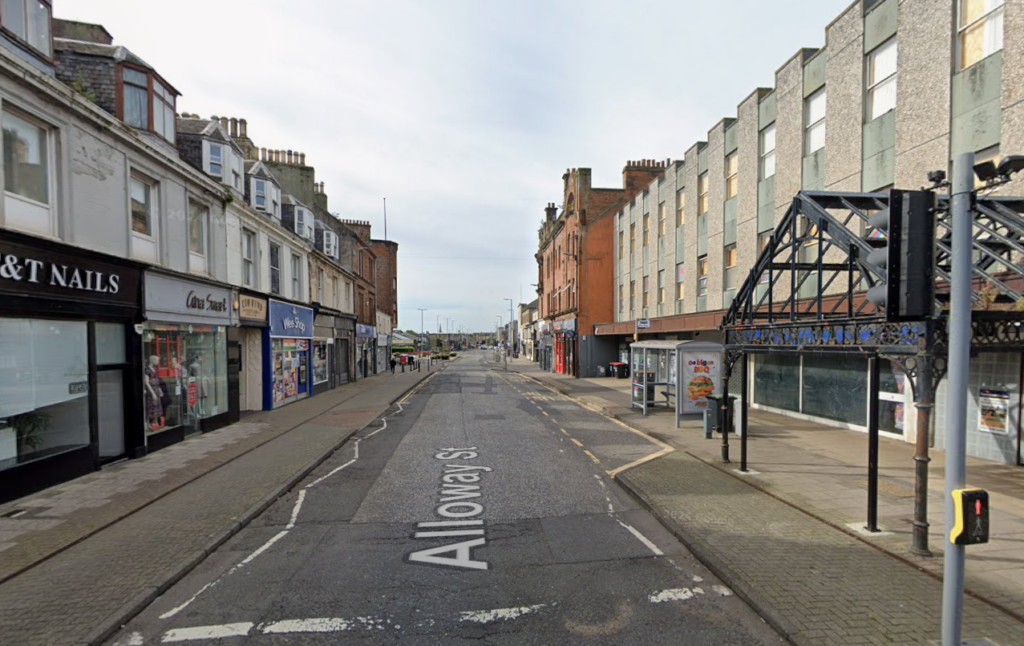
Another independent councillor, Bob Shields, added: “We sat here in January and were told no cycle lanes in Alloway Street or in the Sandgate. I reported this good news to all my community councillors. They were all beaming and smiling and saying great news.
“Then I sat down today in the same seat in the same room and found out they are back on the agenda.
“Sandgate and Alloway Street are both in my ward and I meet businessmen, members of the public, sit at the community councils, and the opposition to these cycle lanes is very, very strong and my opposition to them is equally strong.”
He then asked: “Will it boil down to either accept these cycle lanes to get the £20 million of town centre improvement that comes with it, or if we reject the cycle lanes, we’ll lose the £20 million investment? I think that has to be a core question in any consultation.”
Corrie responded by saying that Ayrshire Road Alliance officials had spoken to Transport Scotland about the potential impact of scrapping the cycle lane plans.
“The feedback was that they would consider it, but they were non-committal,” she said. “They said they couldn’t be confident that it would achieve the funding without that active travel element being incorporated.”
The council’s chief executive Steve Penman also said officers will approach Transport Scotland once again about the “limitation” of the funding provided and the implications of any changes, before describing Clark’s announcement in January as a “political statement”.
“A political statement was made, but that was not part of a motion and it was not decided. What was decided upon was that the paper would be deferred,” he said.
However, Shields hit back on that particular recollection, telling the meeting: “I appreciate Mr Penman’s point that it wasn’t a Cabinet decision when it was said on the floor here, no cycle lanes, but just from memory, the Cabinet’s decision was to come back with proposals that do not include cycle lanes.
“That was my memory of the Cabinet decision, and here we are resetting a proposal that still includes the cycle lanes.”
“The decision was to defer the report to a future meeting of the Cabinet. That was the only decision that was made,” Penman responded.
The cabinet agreed to a continued public and stakeholder consultation, which would help inform the development of the scheme’s design.


















29 thoughts on “Councillors fuming as ‘scrapped’ cycle lanes included in £19.9m active travel plans, after dismay at potential loss of six car parking spaces”
> “…gather properly the feedback that was expressed through social media”
> “I personally met with shop owners and residents in both Sandgate and Alloway Street, where they conveyed to me jointly that they weren’t happy with this and they were representative of the people that were there.”
As usual with cycling schemes, councillors prefer to listen only to the loudest anti voices. Maybe I should set up some social media bots to post loads of pro-cycle lane comments, given this is apparently how things work there? Or turn up and claim I’m a resident (and hence somehow become representative of what the whole town needs/wants)?
I really hope Transport Scotland pulls the funding if the cycle lanes are removed from the plans. These local “representatives” will then have to be happy in their car-first status quo.
Is there enough in the budget for a petard?
@belugabob following Chris Boardman’s rule of “those most affected get to make the decisions but also own the consequences” …
… I hope they leave a couple of quid from the grant to buy them a card which says “you chose ‘do nothing’ – your right. But therefore no right to extra cash to try to sort out any congestion, the crumbling road infra which we just can’t keep up with, and the health and economic consequences of declining activity in the population”.
@belugabob No need to buy a new one, they’ve got lots in stock.
@eburtthebike but those are occupied by the previous incumbents (or they sold them for scrap)
I’m not sure you can occupy a petard. It would have to be an unusually large one. And you’d presumably have to remove its contents first, which would render it benign anyway.
@mdavidford
“Accessible Ayr scheme”
Accessible only by drivers and dinosaurs.
“We sat here in January and were told no cycle lanes in Alloway Street or in the Sandgate. I reported this good news to all my community councillors. They were all beaming and smiling and saying great news.”
It isn’t good news, the community councillors don’t care about the community if they’re beaming and smiling and saying great news: they are out of touch and car obsessed.
Just how many schemes like this have to happen to show that they work, they make the community better, they increase trade at the shops and people like them? A thousand? A million? I’ve just realised that it probably doesn’t matter how many times such schemes are successful as the ‘it won’t work here’ neanderthals will never accept it in their back yard.
Depressing.
I’ve only visited Ayr once, and was glad to leave. Don’t think I’ll be going back.
@eburtthebike …well, not by bike, at least
I know Ayr is a bit teeny compared to Edinburgh but it’s worth noting that cycle journeys in Scotland’s capital now outnumber car journeys. Clearly, some Scots want to take advantage of active travel.
@OldRidgeback Unfortunately I don’t think it’s true that cycle journeys outnumber car journeys in Edinburgh. The latest news I heard (will post link separately) was that there was a recent survey (conducted in May 2026) in which the number of bikes exceeded the number of cars on Leith Walk in the morning rush hour. Whilst that is positive news, the unspoken implication is that outside of the morning rush hour, in locations other than Leith Walk, and potentially at time of year other than May (which typically has fairly clement weather), the number of cars still outnumbers the number of bikes.
I haven’t found good statistics for “number of trips” by mode, but Government statistics (link to follow) show far more cars than bicycles at pretty much every counter location in 2025.
@OnYerBike thanks! Although they didn’t go far enough I believe the general idea is that Leith Walk should be mainly a pedestrian “place” and public transport corridor and so there *shouldn’t* be many private cars there. So the figures *ought* to flatter cycling.
(The discouragement for motoring is that the space has been somewhat reduced, so now they might be stuck behind a bus. Of course there’s the parallel Easter Road they can use…)
@OldRidgeback
Leith Walk news: https://cycling.scot/news/scotland-s-bike-lane-networks-break-new-records
Vehicle counter statistics: https://storage.googleapis.com/dft-statistics/road-traffic/downloads/traffic/local_authority_id/dft_traffic_local_authority_id_29.csv (from https://roadtraffic.dft.gov.uk/local-authorities/S12000036)
I don’t know enough about Ayr local politics to get a proper handle on this, but those Independents look like the type of Foggy from the “Last of the Summer Whine” party we currently have throughout England, who are Reform or Restore without the logo.
Given the Conservative Party culture-war politics since about 2023 they now ‘have permission’ to be cavemen in public, and to make populist claims divorced from any evidence – which is the facilitator of policy failure.
I’m not sure what game the Labour MP is playing, but the constituency has had MPs from SNP, Con and Lab within the last 10 years elections so is contested (but not usually marginal) and perhaps tends away from extremes (Corbyn really poleaxed Lab in 2019).
Two further points deserve a mention:
1 – We DESPERATELY need real research into cycling and disabled people. Narratives around cycling vs disabled people are common, and cannot be dismissed because we do not have objective research into how many disabled people cycle, and on what forms of cycles.
From my own knowledge, huge numbers use standard cycles – but I have no demographic data of actual or potential use, only surveys of experience from disabled people who DO cycle.
2 – In respect of point 1, 40% of disabled adults (and 1/3 of retired people) do not have a driving licence – non disabled adults is 22% do not have a full driving license. That is published ONS data.
To invert that – 60% of disabled adults have a full driving license, compared to 78% for non-disabled.
https://www.gov.uk/government/statistics/disability-accessibility-and-blue-badge-scheme-statistics-2023-to-2024/disability-accessibility-and-blue-badge-statistics-england-2023-to-2024
This is a question about basic equality.
@mattw “1 – We DESPERATELY need real research into cycling and disabled people.”
That ought to help, particularly as the UK is very much “not invented *here*” in many matters.
BUT while logically this makes sense and I agree – how do you think this would actually help here?
Reason I ask is a) I think the data is probably already there for the use *
b) … but who is really looking? (and if not, why would they now)
c) … and more importantly is careful research of any use at all in the face of slightly interested but ambivalent governments and councils who are scrabbling for money? Especially when they’re constantly fending off aggrieved citizens who are feeling neglected. And/or get their “facts” from sources and parties strongly influenced by the fuel/motor trades and in large part the individualist political strain of the US?
I do still believe in the importance of fact-based counter-narrative **. But we have to recognise that story and emotion usually trumps facts and logic in wider discourse,
* There are presumably decades of data available from NL. Even if not you could probably get a PhD’s-worth of data merely by viewing online videos from BicycleDutch, NotJustBikes, David Hembrow, the Bruntletts, the Dutch Cycling Embassy etc. Or really blow the research budget and travel a hundred miles or so across the sea and go around NL with your eyes open…
** if only in the hope of providing a counter to eg. the … (now alas less) fringe views of some lobby groups (NFBUK *cough*). Like there is an extreme danger to pedestrians from cyclists, motor traffic reduction is a grave threat to those with disabilities etc. Those just happen to chime very well with the narratives of the “war on the motorist” crowd…
There’s another big question, which perhaps applies to a lot of cycle schemes:
Where is the cycle parking that allows people cycling in that street to stop and use the local businesses?
@mattw this is an excellent question. As people have reminded me – it’s not just about the journey, but also how safe *and convenient* it is to park / store your “cycle” at both ends of that journey.
Luckily “informal parking” works for the current hardy cyclists (free for councils!), but a) is insecure b) is not for those with non-standard / expensive cycles and c) it doesn’t scale.
The Dutch solution is perhaps illustrative: changes to building regulations mandating amount and *quality* of cycle storage in new build, and creating “multistory cycle parks” in urban centres.
@chrisonabike There was a fascinating video by Evan Edinger – a reasonably well known (1.22m subs, weekly for 10+ years frequency) Youtuber, comparing London (Hackney in this case) vs Cambridge (“UK Cycling Capital”) by cycling in one, getting a train, and cycling in the other on the same day.
He is interesting as he is a fairly recent, and erudite, adopter of cycling – just a few years.
He comments on how cycle parking is everywhere in Cambridge, whilst thinking that London does “system” rather than “island” thinking far better and more thoroughly. He is generally right imo.
@mattw thanks! Came across a couple of his videos before but didn’t realise he’d been cranking them out.
It sounds like a straightforward decision for the council. Include the cycle lanes in the scheme, or risk losing the £19.9m of funding, which was awarded on the basis of inclusion of an active travel element.
The attitude reminds me of my local council’s bid to be City of Culture. The emphasis was mainly on how much footfall and business the title would generate, rather than what would be done to promote arts and culture.
Quality of life and physical and mental health are not a priority.
@chrisonabike There was a fascinating video by Evan Edinger – a reasonably well known (1.22m subs, weekly for 10+ years frequency) Youtuber, comparing London (Hackney in this case) vs Cambridge (“UK Cycling Capital”) by cycling in one, getting a train, and cycling in the other on the same day.
He is interesting as he is a fairly recent, and erudite, adopter of cycling – just a few years.
He comments on how cycle parking is everywhere in Cambridge, whilst thinking that London does “system” rather than “island” thinking far better and more thoroughly. He is generally right imo.
One serious point on parking is that there are oodles of dead space in carriageways where no one ever drives which can be repurposed without actually costing drivers anything. This is visible, for example, in the large patches of snow left undisturbed in winter – so whilst we are fighting a war of attrition for space, there are also non-controversial wins available.
There are other huge questions in parking – such as why are hangars for mobility scooters not routinely included in parking schemes in areas where elderly people live in properties with no gardens, or that are up external or internal steps. THAT is just Equality 101; and is never considered.
(I’ll respond to your other comment later – needs some thought and a detailed argument.)
@mattw “oodles of dead space in carriageways”
Yes, there’s a surprising amount which – once you look, you can’t not see. (Although while I like Robert Weetman’s article on this I think the “look at the un-driven-on snow” is a weaker argument.).
It should be removed anyway (for “make crossing roads shorter distance”, “cue slower driving” and “less road to maintain” reasons)!
Although I hear there’s often push-back from local bus companies who are very hot on *their* preferred widths. Of course some of *those* may be because we allow parking everywhere and people just don’t leave enough space…
However the utility of this for improving *cycling* specifically might be overstated. Some of the “narrow” places *are* chokepoints (for several modes of transport) – and above all we need to sort out junctions.
A deeper issue is that because of our “multi-functional” roads (through-route AND “place”) we end up with “driving must be everywhere”. So we always “have to” mix modes, and it’s harder to get the benefit of the Dutch “unbundling” or “disentangling” approach.
@chrisonabike I have found the “look at he untouched snow” point to be a useful tool to illustrate the issue to a general audience, who are not anti-cycling but have been put on alert by culture war rhetoric.
I might then say “that means we can have a build-out to make the crossing distance for pedestrians shorter (without extending the motorist red or taking away road space they use) and we can put some bike parking on the build our without taking away parking spaces”.
It’s not what we need, but it’s a non-confrontational step in the right direction, which gives a 1+1=3 .
@mattw I believe this is exactly the kind of thing that The Ranty Highwayman and Robert Weetman worked on for Manchester City Council.
Fixing it for pedestrians *ought* to be uncontroversial. It *ought* to be a path that actually “works” to move forward for the UK. I believe Chris Boardman had success in Manchester with an approach which largely emphasised this (plus buses).
BUT… I do wonder if this leaves us stuck at pretty much the status quo – because it reinforces the current “either walking, or driving” split.
First we’d get “can’t have cycling infra because cycling gets in the way of cars and threatens pedestrians”. Then most people simply won’t walk far (especially if eg. carrying shopping). Which leads to “we still really need cars!” even for very local trips. Which then kills off active travel again, because cars take up too much space and suppress active travel.
@chrisonabike For the unbundling we need to start looking seriously at improving and joining up say 10-20% of our public footpath network.
We have the bones of a 3rd “Mobility” network from everywhere to everywhere already in place, but no one has noticed, and landowners want to steal it and police often want to block it off.
Since my LHA (ie Highways) are now Reform UK controlled, and they just want to live in an episode of Terry and June whilst the world goes to hell in a handcart, improving this is my current activism focus with stuff that I can legally enforce.
@mattw “footpaths”
Hmm… true this is an underappreciated resource and indeed in danger.
But I think this is very location dependent. If we’re taking in urban locations, are you talking alleys – narrow almost always no room for expansion? Or “footways” – also often not ample and we’re back to “fighting over scraps” with pedestrians or even forced-conflict with “shared use”?
In the countryside – perhaps? If what goes in NL applies more generally (and why wouldn’t it – they’re humans too) more people may be prepared to travel on bikes there than UK opinion holds. (“people depend on their cars… nobody cycles or walks … the non-existent footway beside the A-road!”).
Although that may depend on “cyclists and walkers get the direct route” which isn’t always how we do it…
@mattw completely agree about the wider accessibility in design being a “bolt-on” even though we now have law here.
Of course the solution to eg. “the shops are now really inaccessible as they’re in a remote shopping centre beyond the dual carriage way, via underpass and giant car park” is “we can’t limit driving then – those who are less able *need to drive* there” …
Actually, will we need the space for the latest version of flying taxis? 🤔
https://www.bbc.co.uk/news/articles/cwz0z5dppxypo
Won’t you think of the ageing millionaires?