



The Exposure Strada 13 RS has seen some major improvements over previous versions and it’s a very good light for road riding. The build quality is as good as it gets and the clever AKTiv dimming works really well. If you have sufficiently deep pockets, it’s a great investment.
Exposure has been making lights for a long time, and the Strada has been in the range for over a decade. At £355, the RS is the cheaper of two versions, with a claimed 1,600 lumen output. The Strada 13 SB offers up to 2,000 lumens for £415.
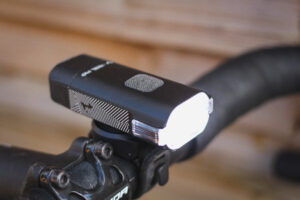
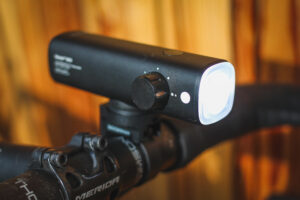
Like all Exposure lights, it’s a beautifully-made thing, with a machined aluminium body with cooling fins, the lens on the front and the controls at the rear. The light is IP67-rated, so it’s chuck-it-in-a-stream waterproof, and the build quality is second to none.
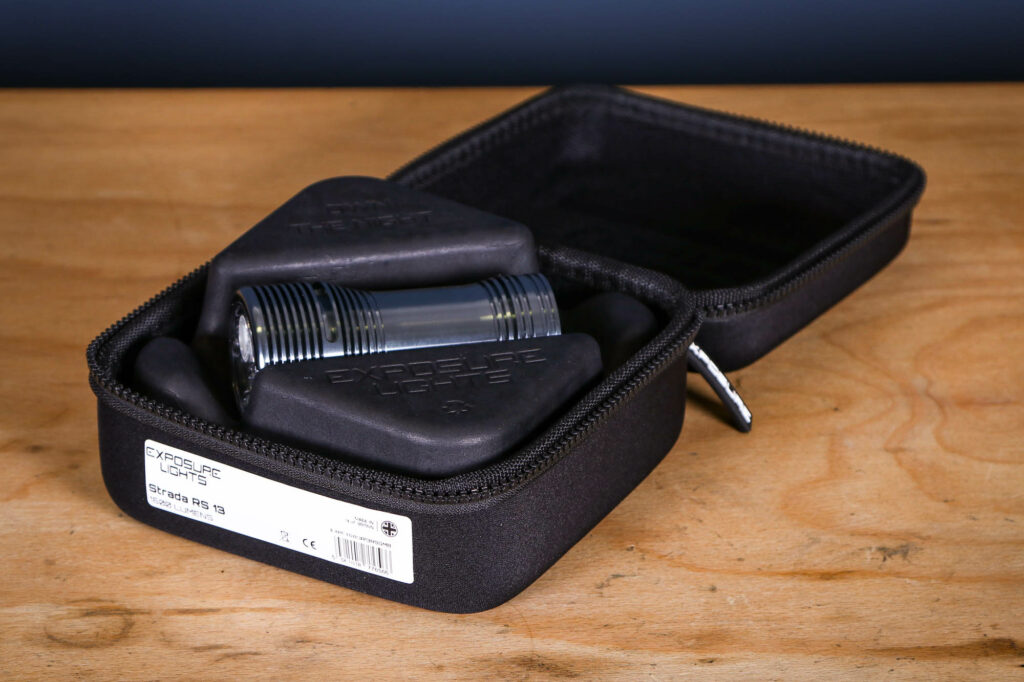
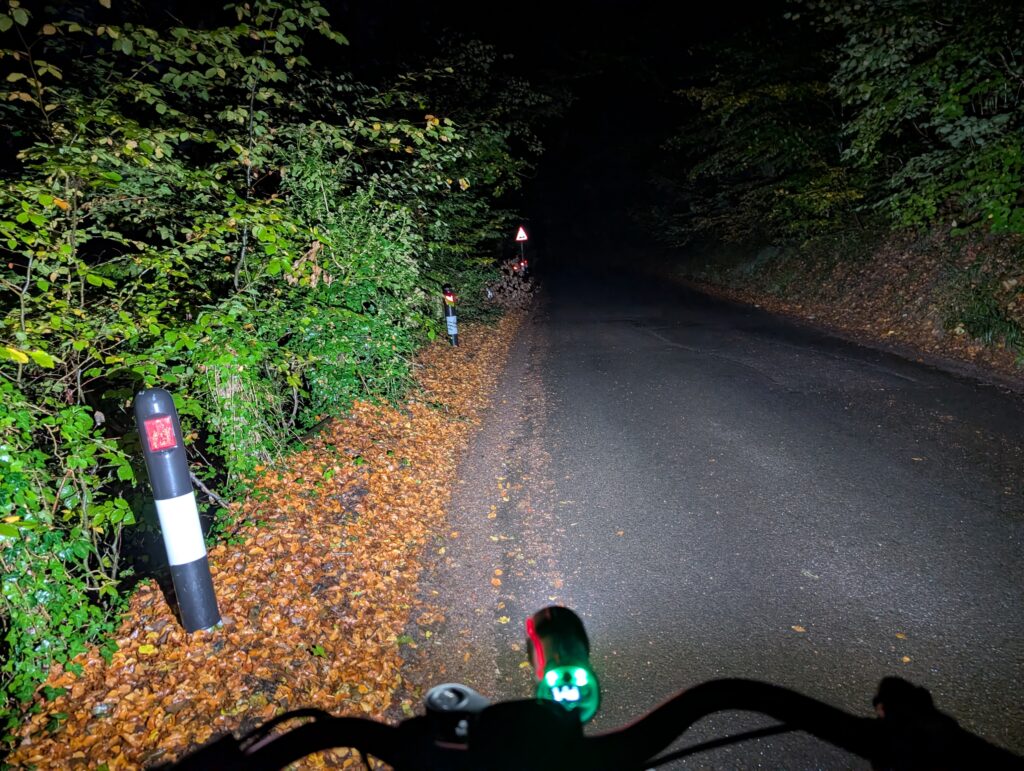
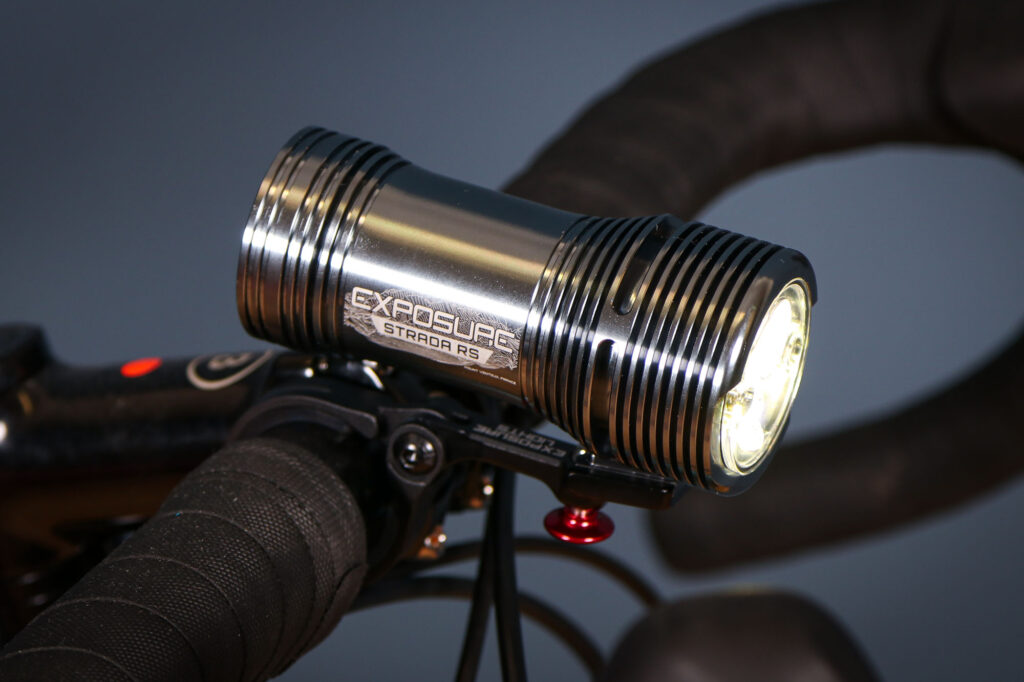
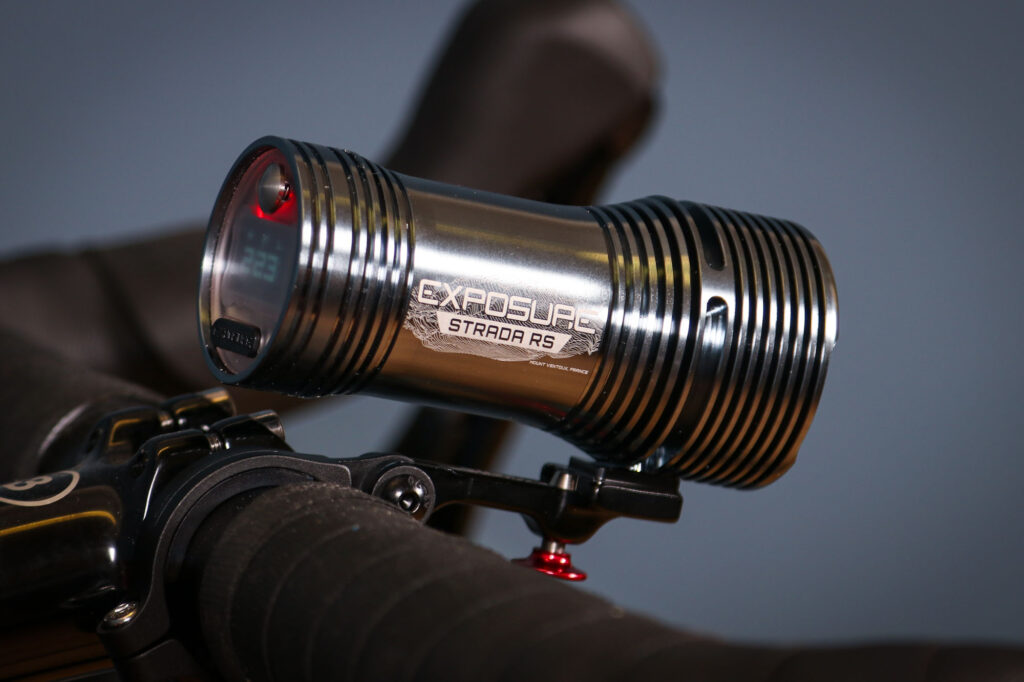
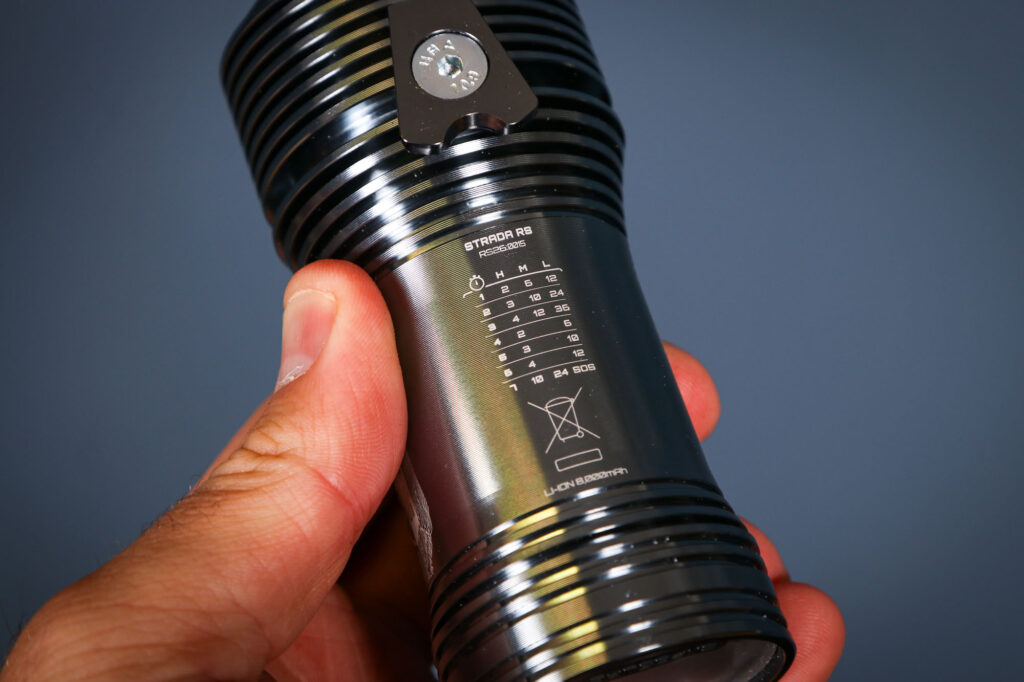
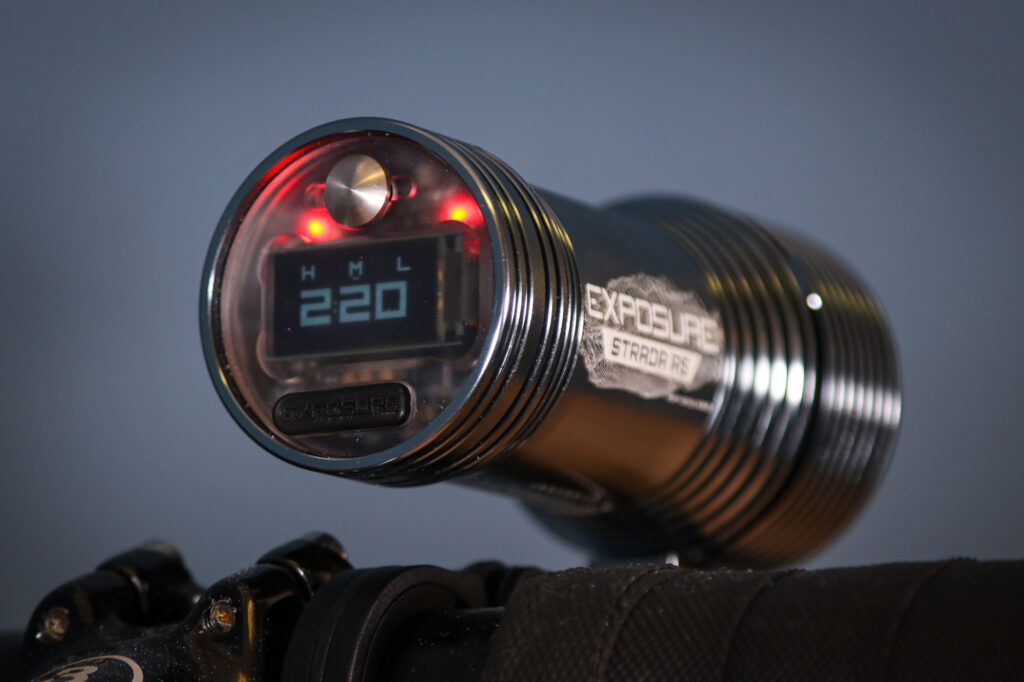
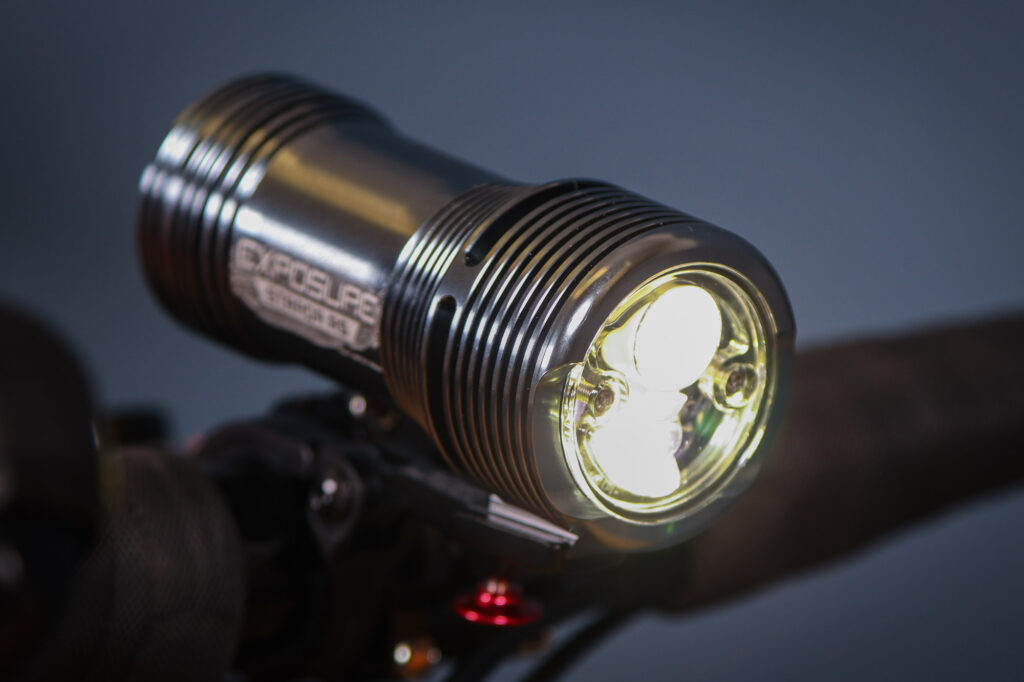
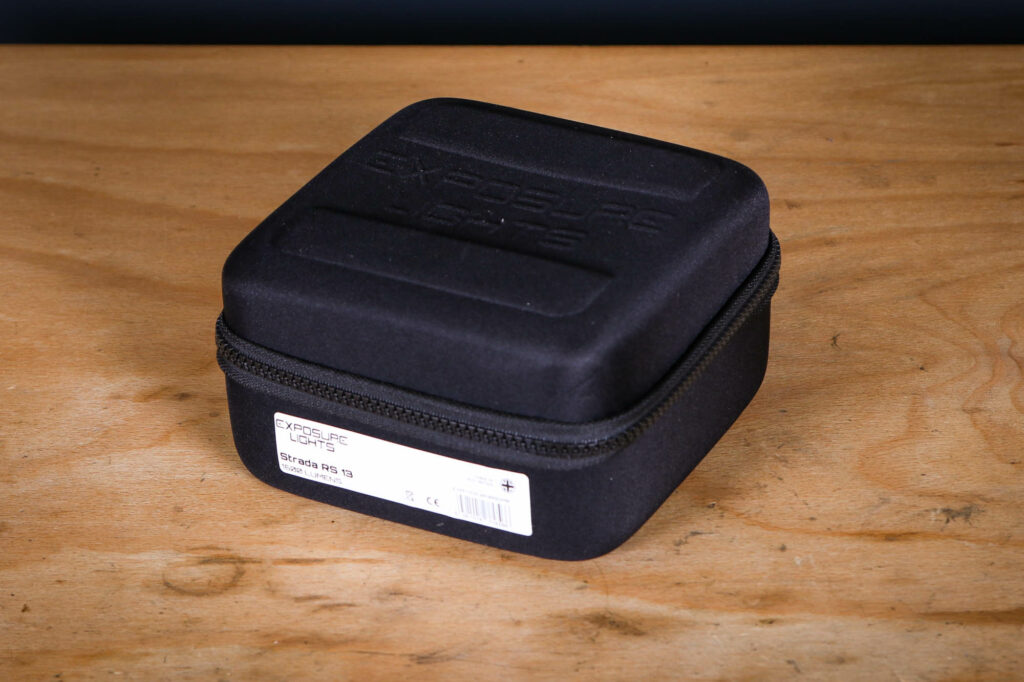
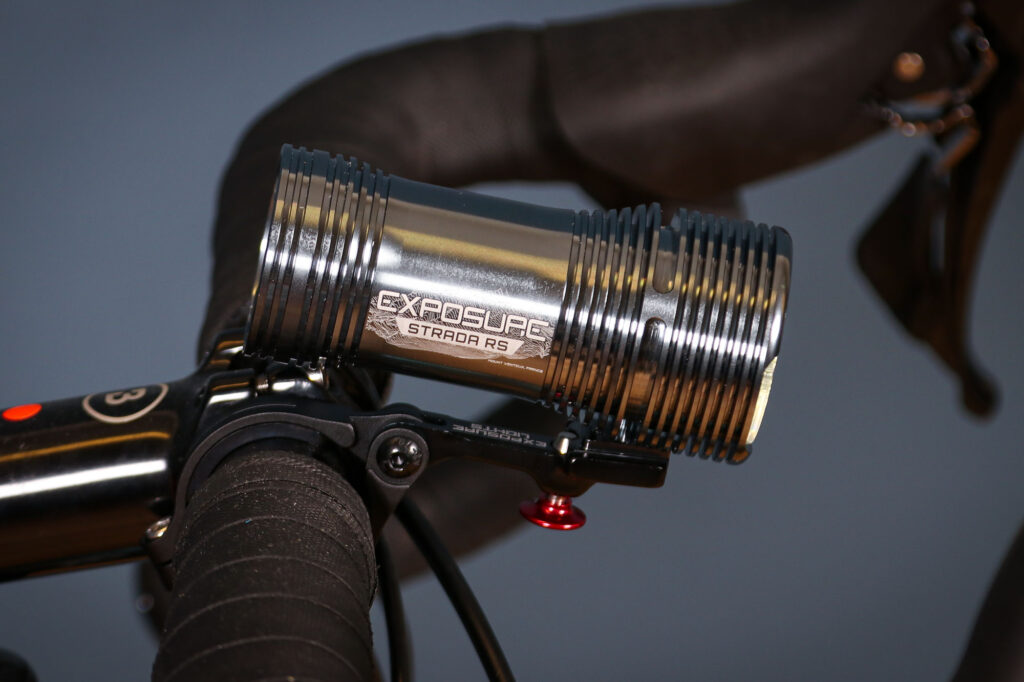
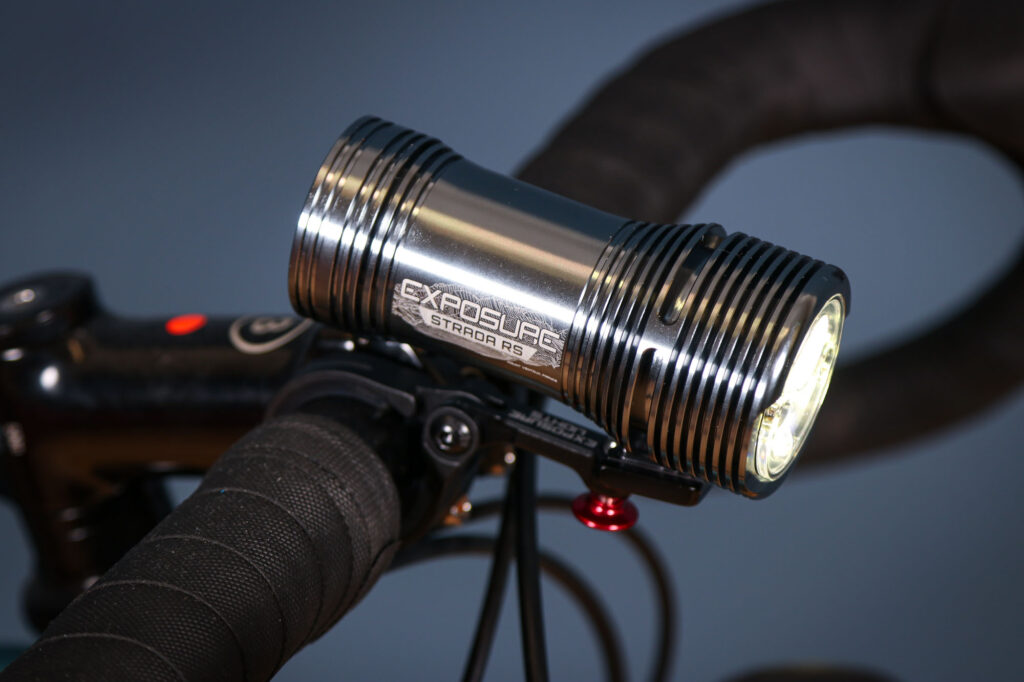
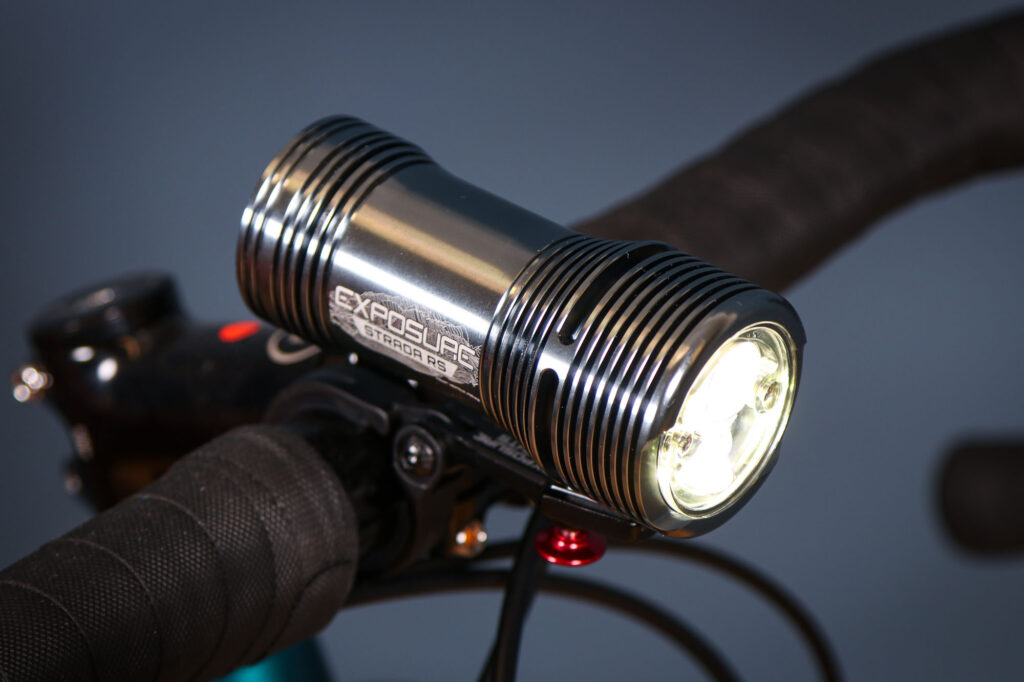
The light is controlled by a single metal button which gives access to a range of modes. There are seven different programs, each with two or three modes, and you can pick the one that works best for your riding: how much light you need, and how long you want it to last.
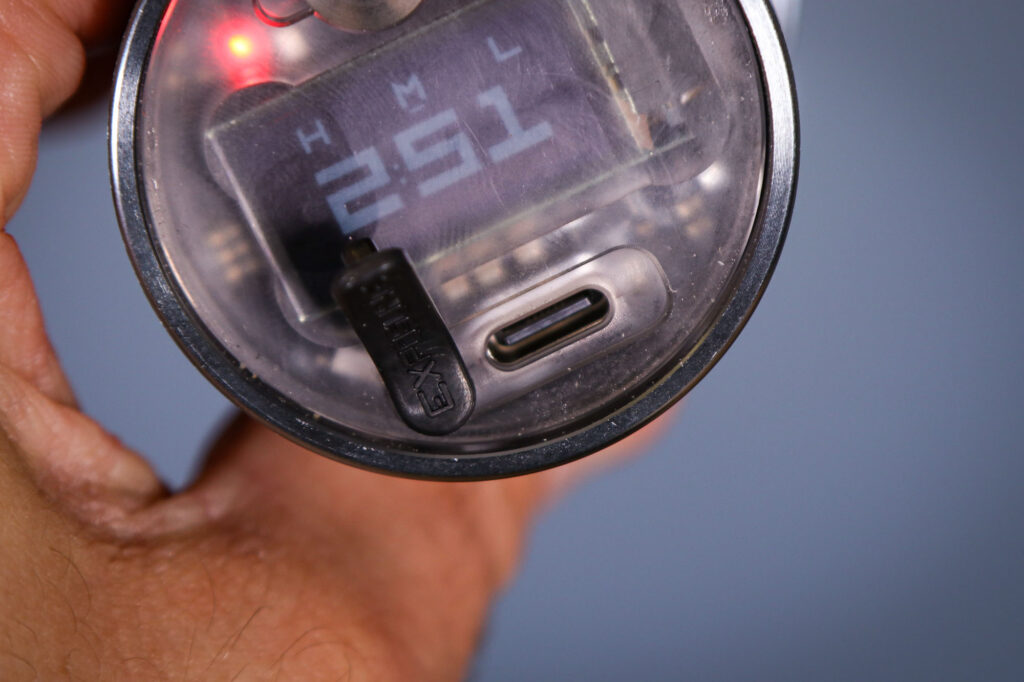
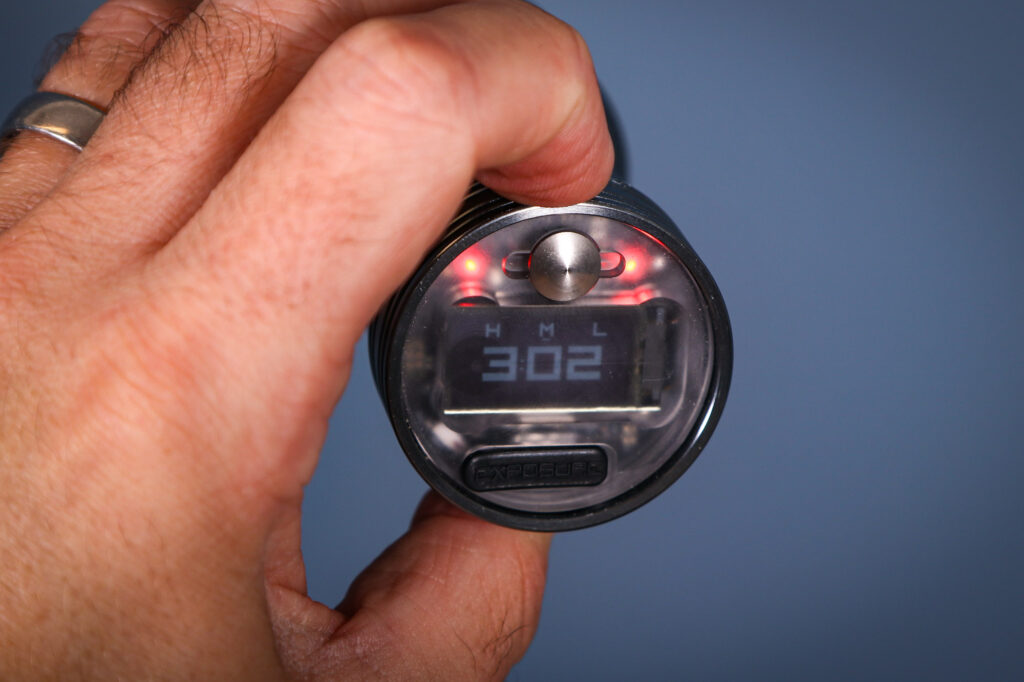
One of the big changes this year is the new, bigger OLED screen which improves usability a lot. Before you had to squint at the tiny laser-etched table on the bottom of the light to see what program had what modes. Now all the information is displayed on the screen, so it’s much simpler.
Switching between modes within a program is just a case of hitting the button, and a double press will bring up the flashing mode.
When the light is on, the OLED screen displays remaining run-time in the mode you’re in, and if you have the light mounted on top of your bars that’s pretty easy to see. It also has a traffic light fuel gauge system that uses green/amber/red and static/flashing to instantly tell you your battery state in 15% increments. This means that even if you’re not looking at the numbers you can always tell how the battery is doing.
At maximum output, the battery life is around 2hrs, and there are plenty of lower power modes that’ll see you through a whole night of riding. The lowest power mode gives you a day and a half of illumination. You can even pair the light via ANT+ to your GPS to display the battery state there.
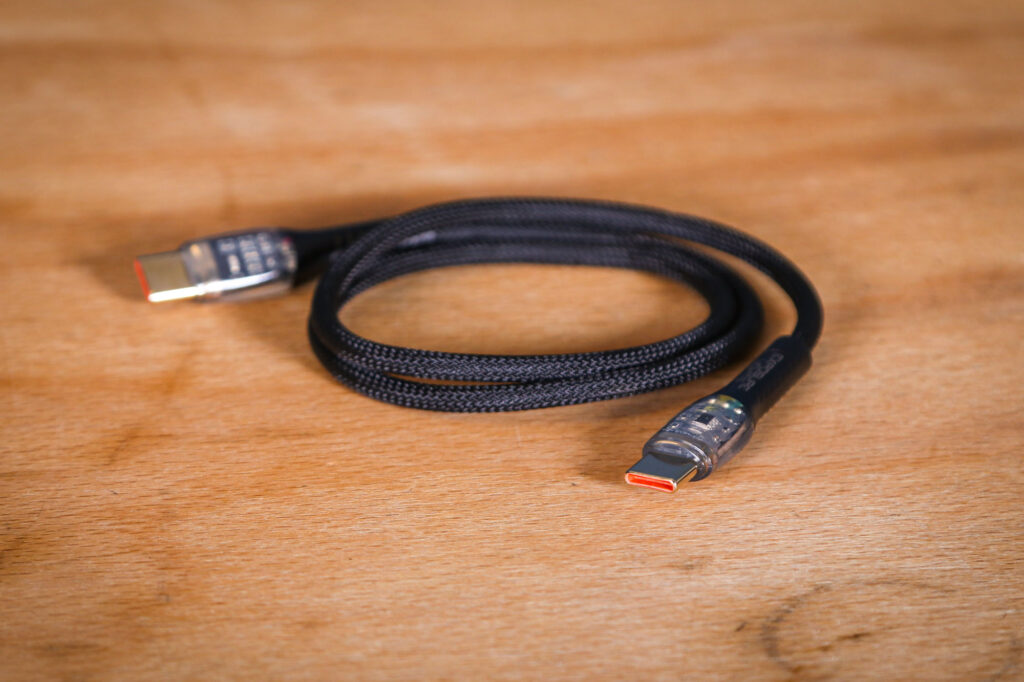
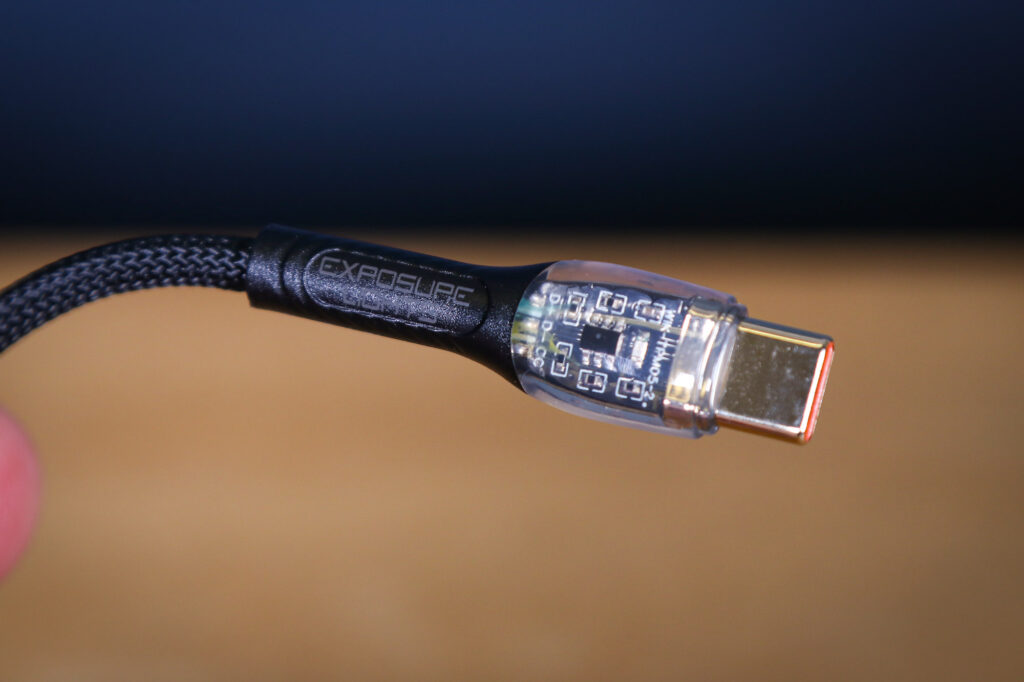
Exposure has (finally) moved over to USB-C, so you no longer need a proprietary charger, and you can also use the Strada as a powerbank if you need to redistribute some juice in an emergency – if you’ve remembered the right lead.
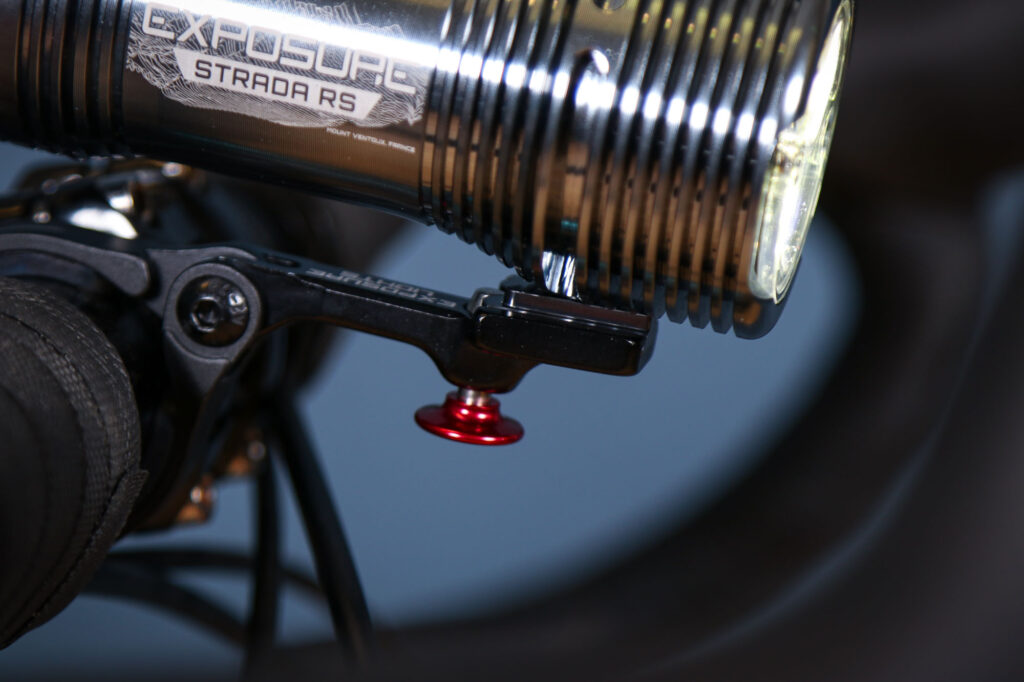
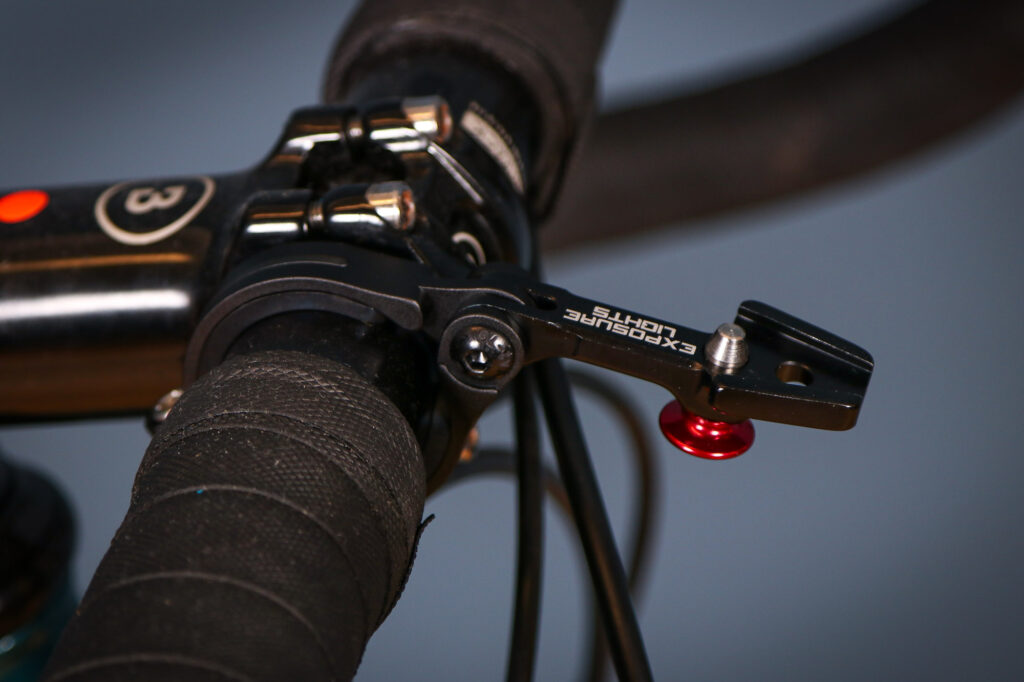
Exposure has updated its mount to include an articulated GoPro joint. That means it’s further out in front of your bars, and you can pull it apart and use one half to mount the light under your out-front mount.
Both of those things are nominally a plus, but overall I don’t like the change. One of the best things about Exposure lights has always been that tightly-machined, rock-solid mount: set it up once, never worry about it again. The joint adds complexity and a way for the light to move, and I just don’t think it’s an improvement.
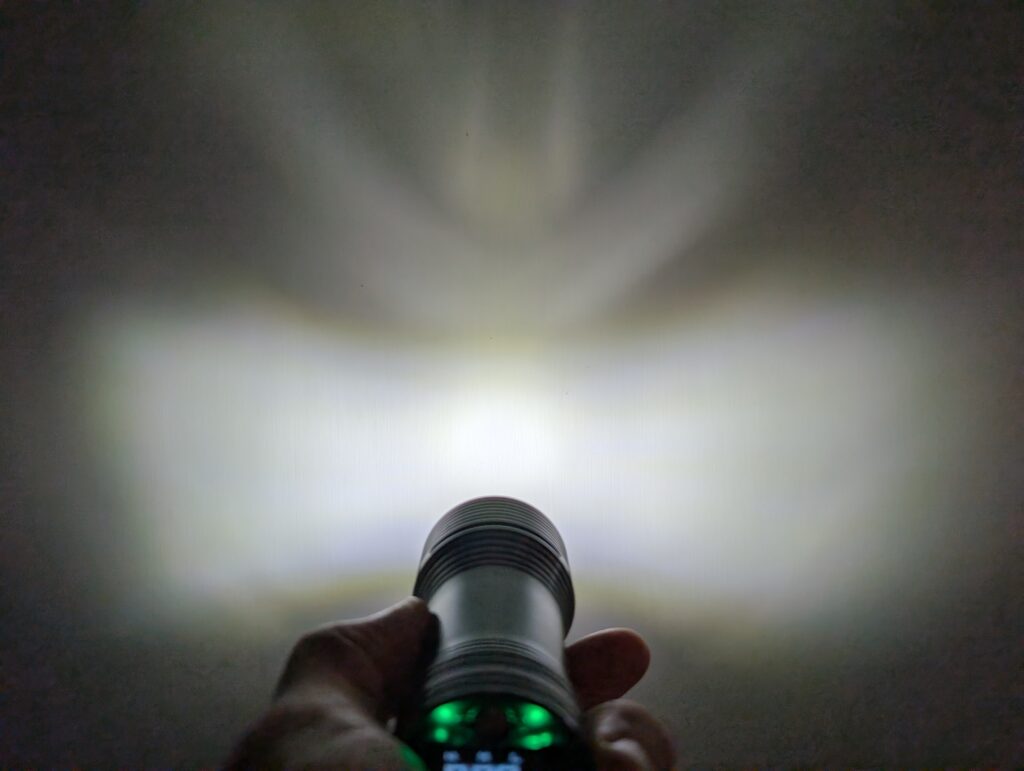
The beam of the Strada is decent enough, but I think it could be better. It uses two LEDs: one is a spot, and the other has a lens that creates a flatter, wider beam. Together the coverage is really good, and I had no issues riding on unlit lanes in the pitch dark, especially on full whack. But it’s more diffuse than it needs to be and could be tightened up some to give a bit more throw. It’s more of an issue on the lower ‘ride all night’ modes, which could do with just a bit more penetration.
The beam isn’t symmetrical about the x-axis, and in fact I’d argue it’s probably better upside down. There’s some spill out of the top of the beam and the top of the flattened section is wider, which the other way up means more light on the road.
One thing that does deserve a big slap on the back though is the AKTiv technology, which is excellent. The light has two sensors on the front that pick up oncoming cars and dim the spot beam. They also pick up bike lights and street lamps very well too, in my experience.
This is good on two counts: you don’t dazzle oncoming traffic, but you also don’t waste your battery pumping light into bits of your ride that are already well-lit.
I was worried that a false positive might leave me with not enough light on some country lane, but this never happened, and it’s a setting I’d definitely leave on all the time. It doesn’t really have a downside.
At £355, this is a significant investment, and you can buy very good 1,600 lumen lights for a third of that.
The Ravemen K1800 (1,800 lumens) is £99.99 for example, while its even brighter sibling, the PR2400, is £199.99.
There’s no doubt the Strada is a lovely thing though, designed and built in the UK with a three-year warranty and really good customer service.
Exposure is always iterating its lights and I think the changes made to this one – the better screen, the AKTiv tech, the USB-C charge port – have made it a significantly better light than the Mk12.
I don’t think it’s perfect. The beam could be improved for road riding, and I’m not a fan of the changes to the mount, but if you want a high quality, UK-engineered light that’ll last, this latest version of the Strada RS deserves your consideration.
Test Report
What does the manufacturer say about this product?:
The Strada 13 RS gives you the full Strada road beam and every piece of its technology, at 1,600 measured lumens. The beam spreads wide and even across the tarmac, with a focused spot reaching further down the lane. Twin-sensor AKTiv dips below an oncoming driver’s eyeline on its own, then returns to full power once they’ve passed. No button, no thinking required.
It’s sealed to IP67, charges over USB-C, doubles as a power bank for your phone or bike computer, and pairs over ANT+ so its battery shows on your head unit. It mounts either way up without changing the beam, so it sits neatly under your computer. Two to 36 hours of runtime, depending on mode. Designed and built in the UK.
Light is supplied with a handlebar bracket which can be fitted directly to round handlebars of 31.8mm or 35mm diameter. Or, remove the arm section of the mount for use with GoPro fixings, for a neat solution below computer mounts etc.
Built for lanes, back roads and the commute home after dark.
Tell us some more about the technical aspects of this product:
LEDs: 2 x Cree XHP35.2
IP Rating: IP67
Max Lumens: 1600
Battery: 8,000 mAh Li-Ion
Runtime: 2-36 Hours
Charging Time: 2hr 1 min
Weight: 218g
Material: Anodised 6063 Aluminium
Dimensions: Length 101mm, Head Diameter 45mm
Any further comments on quality?:
Build quality is second to none
How does the price compare to that of similar products in the market, including ones recently tested?:
It’s expensive. The most expensive, probably.
Any further comments on design and usability?:
The single button accesses everything and you need to read the instructions but the new OLED screen helps a lot
Any further comments on the clamp?:
Used to be my favourite. The new articulated one is not as good.
Does the light have a waterproofing rating? If so, what is it?:
IP67
Any further comments on battery life and recharging?:
8,000mAh is a good size battery and there are lots of modes to choose from
Any issues with durability?:
None
Any further comments on weight?:
Surprisingly light
Did you enjoy using the product? Yes
Would you consider buying the product? Maybe
Would you recommend the product to a friend? Yes
Use this box to explain your overall score
Most of the changes have made this a better light than the last one. Still pricey, but a good investment.
About the tester
Age: 54Height: 189cmWeight: 104kg
I usually ride: whatever I’m testing…My best bike is: Dward Design Custom Audax, Lauf Úthald, Cannondale Topstone
I’ve been riding for: Over 20 yearsI ride: Every dayI would class myself as: Expert
I regularly do the following types of riding: Road racing, Gravel riding, Indoor riding, Indoor racing, Bikepacking, Commuting, Touring, Club riding, Audax, Fitness riding, Leisure riding

12 thoughts on “Exposure Strada 13 RS review – beautifully made with excellent auto-dimming technology”
I considered the Strada SB because I think 2000 lumens is right for myself and my commuting. The SB is a boosted RS. They are both crazy expensive even compared to their own lights … the 2000 lumen Diablo is 240EUR or the 3850 lumen Toro is 395 EUR vs the 2000 lumen Strada SB at 415EUR. Plus import to EU. I will not buy the Strada, but am considering the Toro – can do double duty as a commuter light and MTB light.
I wish the Strada came in a dumb 2000 lumen version. I don’t think 2000 lumen is so bright to justify the beam dipping. I just want a super well made light with easy button operation. I have the Axis Mk10 and the button operation is not intuitive. The Axis is also how I know that 1300 lumens is not enough for my commuting. It’s great for road biking when there will be tunnels and chance of riding before or after sunset.
I love Exposure lights, but that price is nuts
After 2 weeks of use I am not very impressed. Yes it’s beautifully built but the beam pattern and spread of light is not good for road riding. It doesn’t reach far enough but spread LOADS of light up and wide and right in-front of the bike. On the road with speeds over 30km/h I want a light that reaches far and not spreads a carpet of light to the left and right or up into the sky.
Some cheaper options with cut off beams throw the light further while still having a wide enough beam to see everything.
AKTiv works but in constant traffic the beam just stays permanently dipped. I think the future is a cut-off beam rather than a generic wide spread. At this price hardly recommended, even though it’s beautifully built.
The GoPro style mount is nice but doesn’t work for all cockpits upside down: too short so the release button blocks angling it up high enough. Black inc. and cervelo need the reverse mount to ensure you can use it properly and that costs another 25£
@Rian_constant : I have the exact same issue with a totally different light: the Lupine SL Grano. Has a cutoff to avoid blinding oncoming traffic and also throws out a carpet of light. It’s ok 80% of the time but my commute takes me through a couple of pitch dark stretches where it’s simply not enough, certainly not riding at road speeds around 30-33 kmph average. It’s great in every other respect but that’s simply something that needs fixing. I’m willing to pay but want to be certain that it works and I’ve seen too many long exposure beam shots that appear to show unrealistic levels of illumination.
@Xenophon2 evo1700 from magicshine or hori1300 might be worth trying. I had the 1700 before it was stolen but hated the mount, the hori 1300 is great even though built quality by far not as good especially lupine or exposure but for 100 USD great deal, very good light and loads of power with the high beam!
@Xenophon2 I”m pretty convinced that my solution is an MTB light and take my chances with the police (I’m in Austria where StVZO applies).
Too many light reviews give good scores to lights that just do no put enough light where I need it. And give too much credence to safety features like dimming, dipping and beam cut off.
@Motivated you would be surprised that good beam cut off lights give you better results for road riding than MTB as they focus the light and power on the road instead of spreading it everywhere, ideally one with full beam via remote and you are covered. But I agree with ignoring STVZO as most of those lights are rather weak and overpriced
@Motivated +1 to what @Rian_constant said here.
While I do agree about dimming being rather pointless, the cutoff is both a safety feature and an optimisation upgrade. It enables the light to put a more powerful beam where it matters (on the road) while using the same amount of energy. Win-win, but it does require some skill from the manufacturer.
@tomlew yes, I have been looking at the beam pattern of the Toro and it seems to be actually round like a flashlight and therefore even for MTB is wasting light shining to the sky. I guess this is done to enable upside-down mounting. I agree this is not ideal when used on the road. I would not buy a light with a cutoff, so I guess I’m searching for a light with a shaped beam. 2000 lumen minimum. If there are suggestions, I’d be interested. Maybe something targeted for gravel as I imagine this bridges the light pattern between MTB round and road with a cutoff.
@Motivated sounds like you are looking for something like the RAY 3000
@tomlew exactly, its probably that manufacturing “shaped” beam patterns are expensive or hard to manufacture so most companies just dont bother unless they legally have to. magicshine and outbound lighting are the only ones who seem to care about a solid beam pattern at this point without trying to meet STVZO requirements
Still no vertical cutoff for safe use on public roads?
Thanks, I’ll just laugh once, then one more time when I see the price, and pass.
I’m going to take a close look at some of the lights mentioned. For reference: I extensively used the following:
– Nightrider lumina (don’t recall the exact model): horrible temperature control and after 18 months it bricked up on me and they refused to honour the warranty, will never buy anything from them ever again;
– Lezyne 1600 XXL, two issues, firstly the strap that attached it to the handlebar never kept in place really well over rough terrain. Secondly: a cop stopped me and although -to me riding the bike- it appeared well adjusted, he claimed I was blinding oncoming traffic. He actually held the bike so I could check for myself from inside his car and he was simply right: the light level on the ground was ok but indeed, I was blinding oncoming traffic. That’s a hard no, it had to go even though he didn’t fine me. I don’t want to annoy/be a risk to other road users;
– Then the Lupine: solid as a rock, mounted on a GoPro mount, USB-C charging, StVZO compliant…but alas not enough oomph considering terrain and desired speed;
Thinking back, it somehow seems like a light I had on my bike back when I was riding long distance events (Audax, crazy distances but lower average speeds) might have been ideal, that was a Son Edelux and it ran on a Son hub dynamo. But I don’t want to install a dynamo and again, lower speeds.