


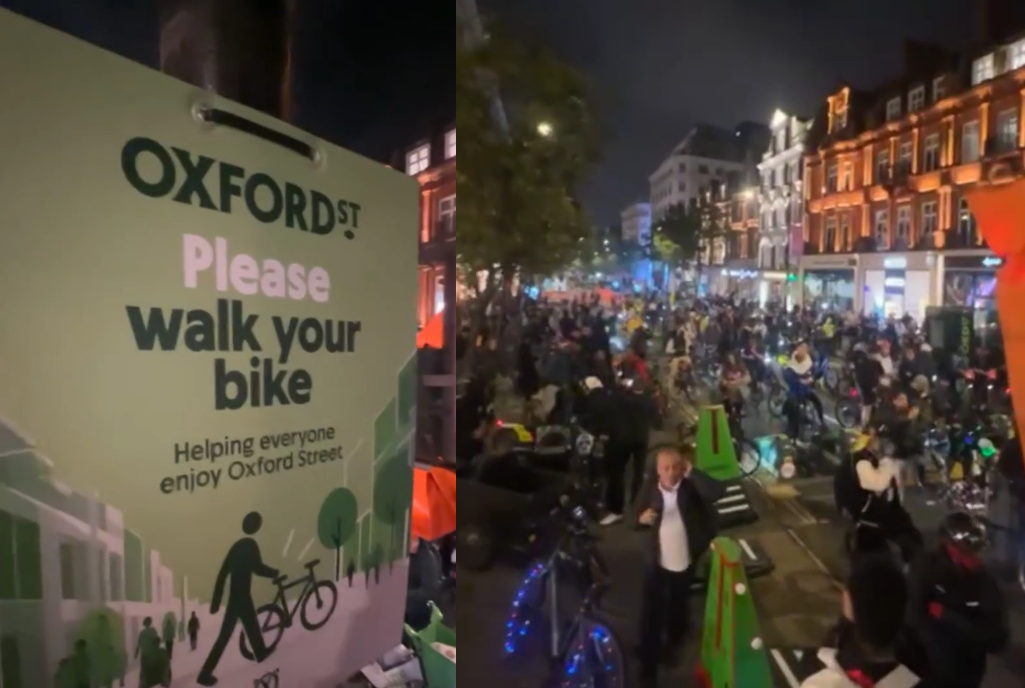

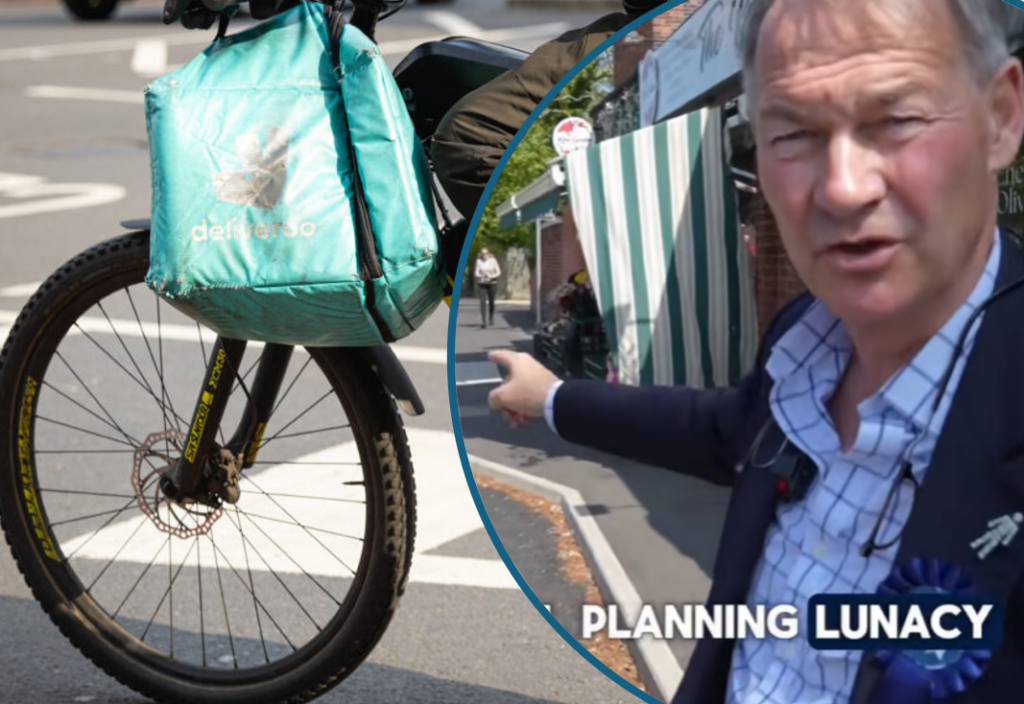
The deputy leader of Westminster Council says it doesn’t know where cyclists continuing to use Oxford Street following its recent pedestrianisation can go, despite the council previously publishing plans for alternative cycle routes.
Since the flagship London street was pedestrianised last week, several media outlets have reported on the presence of bike riders along the road between Orchard Street and Great Portland Street, despite not being allowed to ride. Following the widespread circulation of footage, Westminster Council’s deputy leader Tim Barnes told the Daily Mail it was “only a matter of time” before collisions between cyclists and pedestrians become common.
“We have been concerned from the outset that taking London’s main east-west road and pushing it to the smaller side roads behind was always going to inevitably lead to traffic problems,” the Conservative councillor said.
Westminster Council has long objected to the Mayor of London’s plans for Oxford Street’s pedestrianisation, and the street’s jurisdiction was prised from the council to a newly formed development corporation and Transport for London (TfL) to enable the street to become car-free. However, the council remains responsible for the area’s cycle networks and has been criticised by campaigners for not preparing alternative routes for cyclists to use prior to the pedestrianisation beginning.
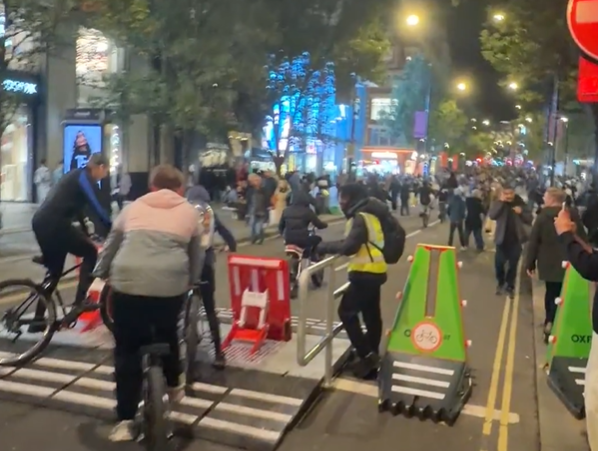
Interviewed by the BBC to mark a week since the road became car-free, during which time businesses have reported increased footfall but bus journeys have been lengthened, Barnes said “We just don’t know where this level of bike traffic can sensibly go.
“It’s not just about looking at where in any one stretch they should be, it’s how you create continuous paths. The problem with taking Oxford Street out was that it was London’s primary east-west route. Every journey time is going to be longer as a result of that. Buses are taking longer, taxis are taking longer, emergency vehicles are going to take longer to get where they need to be.
“Cyclists are just one of the many users who are going to lose out in terms of journey times and convenience.”
However, Barnes has been criticised for his remarks by former Labour councillor and Westminster Council’s Cabinet member for streets Max Sullivan, who shared plans for alternative cycle routes devised when the council was Labour-led before May’s local elections, when it returned to the Conservatives.
Bad news: Westminster Council are worried about where cyclists will go now that Oxford Street is closed to them. Good news!: it was my job to worry about this until May and there is a plan WCC can execute and TfL are ready to support it.
— Max Sullivan (@maxsullivan.eurosky.social) 3 November 2026 at 13:09
Sharing results from a 2024 public consultation, published last December, residents favoured the creation of a cycle route along the parallel Wigmore Street, but the council said “high traffic volumes” and “significant kerbside loading activity” presented “significant challenges” and was not “currently feasible”.
The council instead said it would support cycleway plans along New Cavendish Street, aided by its links to Cycleway 27 and Hyde Park.
“Transport for London were supportive of the plans, and have contributed £835k directly to [Westminster City Council] WCC to it’s programme of cycleways expansion in the borough in 25/26, and have provisionally committed a further £475k to continue the programme next year.” Sullivan wrote.
“It’s over to you WCC. I approved a £12.7M programme for cycleways – how will it be spent? Or will it be spent at all?”
Sullivan also linked to the London Cycling Campaign’s demanding safe cycle routes surrounding Oxford Street. In a statement, the organisation welcomed the pedestrianisation but warned “Westminster Council have not acted quickly enough to bring in high-quality parallel cycle routes. Traffic counts show that thousands of people had been cycling along Oxford Street daily, and those riders need safe alternative routes urgently.”
In the meantime, certain dockless e-bike hire operators have begun geo-fencing their fleets to prevent users of their e-bikes from being able to ride their bikes down the pedestrianised street.
Christina Moe Gjerde, a vice president at Voi, added: “With Oxford Street now pedestrianised, the focus should be on making it work as part of a joined-up transport network, where walking, public transport, cycling and shared micromobility complement one another.
“London is now a cycling city, so safe alternative cycling routes are essential to keep people moving across the capital while protecting pedestrianised spaces.”
It is not the first time Westminster Conservatives have been criticised by cycling campaigners. Whilst in opposition on the council, three councillors said plans to extend a cycle lane in Marylebone were “irresponsible” and “ignores the needs of pensioners, disabled people [and] those who rely on local parking”.
Since regaining control of the council, they have also attracted attention for their impounding of badly-parked e-bikes, a policy begun under Labour but expanded under the Conservatives.

> Westminster Council impounding electric hire bikes… again
Whilst work on building safe cycle networks around Oxford Street continue to falter, protestors have taken more direct action. A Critical Mass-organised “mass trespass” event on Sunday saw 600 riders cycle long the pedestrianised Oxford Street demonstrating for better, safer cycling infrastructure.
Whilst it’s unclear whether the protest called for cycle infrastructure to be placed on Oxford Street itself, something London’s walking and cycling commissioner Will Norman has previously predicted as being “extremely unpleasant”, one participant was quoted as saying, “Taking out motor traffic is a positive step, but banning cycling without first providing safe and direct alternatives along parallel roads either north or south of the closed part is not a sustainable transport policy.”


















1 thought on “Westminster Council claims it “just doesn’t know” where Oxford Street cyclists should go, despite former councillors sharing funded plans for safe, alternative routes”
To precis: Westminster Council are refusing to provide any alternative routes for cyclists despite both funding and the viable alternative plans being available. They are doing this out of sheer spite towards anything instigated by a Khan-controlled City Hall, the general and well-established antipathy of Westminster Conservatives towards cyclists, and due to pressure from wealthy vested interests in the area who all their natural constituency and funders. If any cyclists are killed or seriously injured as a result of this pettiness, the blood will be on their hands.