


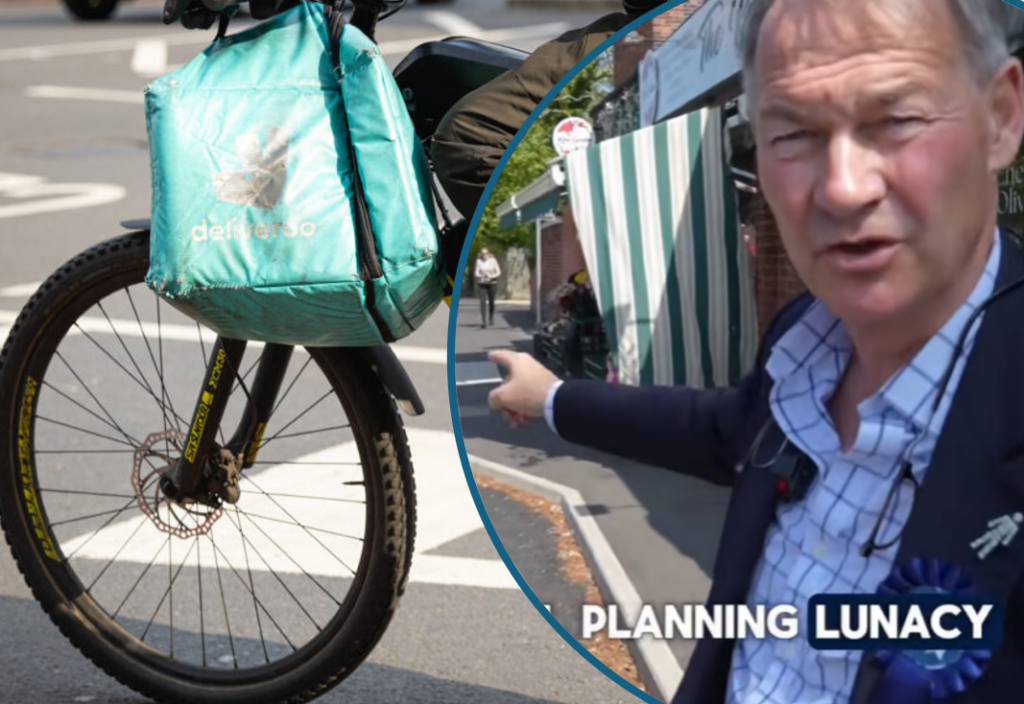

Restore Britain leader Rupert Lowe has vowed to crack down on e-bike delivery riders by introducing mandatory licencing and insurance, safety checks, and tougher penalties, which he believes will – alongside a “programme of mass deportations” – deliver “cleaner and safer streets for law-abiding British pedestrians, cyclists, and motorists”.
This proposed crackdown is the centrepiece of a bizarre and confusing new policy which fails to properly distinguish between legal electric bikes and their high-speed illegal counterparts, despite quoting directly from the government’s electric bike laws.
Instead, Restore Britain’s new ‘regulatory framework for commercial e-bikes’, published this week, focuses solely on the activity for which the bike is used, not the bike itself, drawing a distinction between ‘leisure’ cycling and ‘commercial’ riding.
According to the policy, “commercial e-bike delivery” – regardless of the bike ridden during the delivery process, it appears – is “not simply another form of leisure cycling”, which Restore claims generally takes place “during daylight hours and in conditions of higher visibility”.

The party argues it is in fact “a distinct commercial activity that not only creates serious and unique public safety hazards, but is fast becoming a scourge of modern life that continues to reduce our streets, pedestrian areas, and thoroughfares to little more than unruly third-world traffic intersections”.
“Britain’s streets and pavements should be safe for everyone,” Restore Britain says in its policy paper. “Yet the rapid growth of commercial e-bike delivery services has brought dangerous riding, illegally modified vehicles, obstructed pavements, and a proliferation of illegal working.”
To tackle this apparent scourge, Restore has proposed “a comprehensive new regulatory framework requiring commercial e-bike riders to be trained, licensed, insured and identifiable, with tougher enforcement against reckless behaviour, and a new public reporting system”.
The use of illegal, high-powered, unsafe bikes has long been linked to delivery riders, whose income is intrinsically tied to their ability to make deliveries as quickly as possible. Last year, a Deliveroo rider was handed a community service order and banned from driving for four years after he crashed into a cyclist on the pavement, killing her, while riding an illegally modified bike and looking at his sat nav.
In recent years, several police forces across the UK have vowed to target “dangerous” delivery riders on illegal, high-speed machines, with the number of e-bikes seized by police officers soaring by 83 per cent this year.
In August, the Labour government said that illegal bikes endanger pedestrians and motorists and “have no place” on the UK’s roads and pavements.
Earlier this month, Deliveroo, one of the largest food delivery companies in the country, announced its own crackdown on modified, dangerous bikes as part of its new Ride Safe campaign. The company also called on the government to prohibit the sale of unsafe e-bike conversion kits, while tracking its riders and banning them from the platform if they consistently register high speeds during deliveries.
Deliveroo also announced that it will partner with e-bike companies including Port, Zoomo, Otto Scooters, and Eskuta to provide riders with a legal alternative. Riders will receive onboarding guidance, and the company will run rider engagement events with councils, police, and fire services to highlight concerns from both sides.
What does Restore Britain’s new policy say?
At the same time illegally powered delivery riders have become a common sight on British streets, e-bikes have also been the subject of widespread confusion and misinformation, with national newspapers as well as flagship BBC programmes such as Panorama erroneously referring to illegally modified electric-powered machines as e-bikes on numerous occasions.
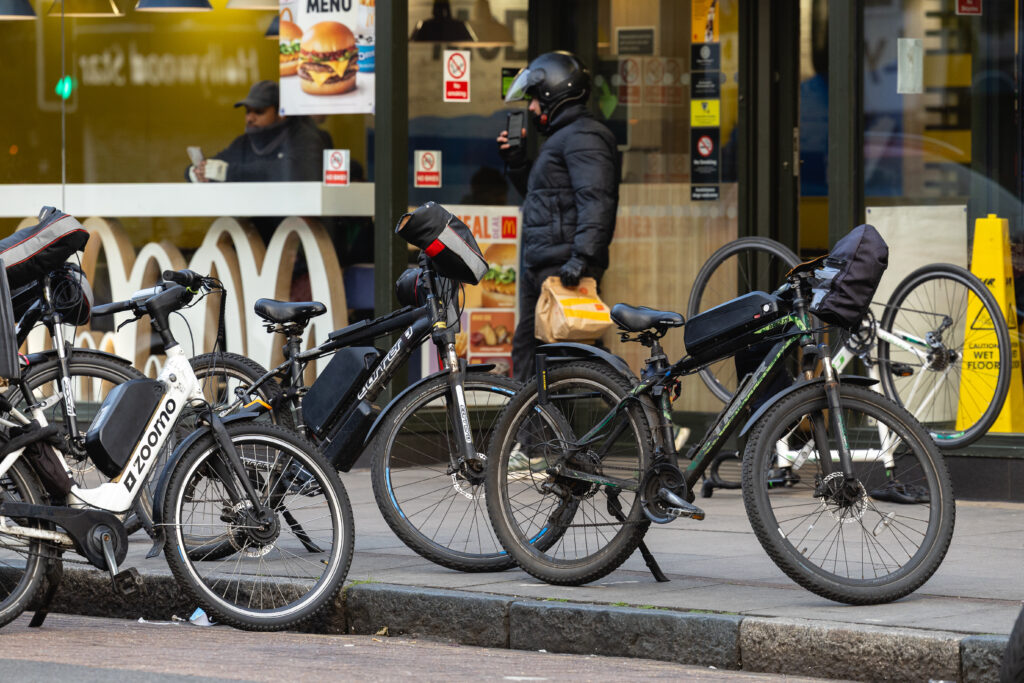
Under UK law, the term ‘e-bike’ refers to an electrically assisted pedal cycle (EAPC), legal electric cycles that can be treated the same as a conventional pedal cycle, provided the user is age 14 or over.
They must have pedals that can propel the bicycle, have an electric motor with a maximum continuous rated power not exceeding 250 watts, and cut off electrical assistance when it reaches 15.5mph. Riders of these compliant e-bikes do not need to register or insure their bicycle.
However, the use of modified bikes, which do not cut off assistance at 15.5mph and can reach high speeds without pedalling, has become an increasing issue on the UK’s streets, leading to widespread confusion with their legal counterparts.
Last June, the All-Party Parliamentary Group for Cycling and Walking warned that dangerous “fake” e-bikes are undermining the UK’s cycling efforts and putting the bike industry at risk.
Interestingly, Restore Britain’s new policy quotes directly from the government’s rules on e-bikes. However, on the very next page, the party criticises past and present governments for making “no formal attempt to distinguish between e-bikes used for leisure and those used for commercial activity”.
“For them, it is principally the e-bike itself that should be regulated, rather than its use or its user,” Restore said.
“However, there are clear differences between leisure and commercial cycling. While most leisure riders travel during daylight hours and in conditions of higher visibility, commercial e-bike riders often operate late into the night, particularly in busy urban areas when evening food demand is highest and visibility is reduced.”
The party argued that “if taxi and private hire vehicles are subject to specific regulations based on their use, it should be little different for the commercial activity of e-bikes”.
Restore then listed what it regards as the risks and dangers posed by commercial e-bike use, including “risky, time-saving riding”, illegal working, the threat posed to vulnerable pedestrians, and the use of the bikes for criminal activity, such as transporting drugs.

The policy notes that the “defining characteristic of food delivery e-bike services is not necessarily the e-bike itself, but instead a rapid-fulfilment business model designed to make as many deliveries as possible, as fast as possible”.
Once again, the party fails to distinguish between legal e-bikes and their illegal counterparts, claiming that there is “no legal requirement for e-bikes to be fitted with a bell or an audible warning device, or for the rider to wear a helmet”.
While cyclists in the UK are not legally required to wear a helmet, the illegal, high-speed bikes in question are in fact classed as electric motorbikes and mopeds, which do require the rider to wear an approved motorcycle helmet.
Nevertheless, the policy continues: “Nor is there a requirement for e-bikes to be registered or insured. There is no requirement for e-bikes to undergo regular testing, equivalent to motor vehicle MOTs. Owners of e-bikes do not have to pay Vehicle Excise Duty. There are no requirements for e-bike riders to undertake formal training, pass a competency test, or demonstrate knowledge of the Highway Code.”
Again, the illegal, high-speed machines commonly associated with delivery riders do, despite Restore’s claims, require a licence, registration, and Vehicle Excise Duty. While electric bikes and components that propel a bike beyond the EAPC limits are not illegal to buy – and can be used on private land – they cannot be used on the road without being licensed and registered.
Nevertheless, the policy states that a Restore Britain government would “make mandatory the registration, licensing, and taxation of all e-bikes that are used for commercial purposes, while introducing extra safety measures to keep the wider public safe, including a reporting system for reckless riders”.
If a bicycle is fitted “with a motor of any sort, and its rider is delivering consumable from a provider to a customer”, Restore says the rider should, among other things, be forced to wear high-visibility clothing and a helmet (which will feature a rider identification number) and fit the bike with high-vis markings, lights, a bell, and registration plates.
They would also be required to pass an ‘e-bike for commercial use’ training programme and carry proof they have a licence and that their e-bike has passed regular safety tests. Riders would also be barred from taking their e-bike on the pavement for riding or parking purposes.
There is no indication that this policy refers solely to illegal bikes, so it must be assumed that it would also apply to delivery cyclists riding legal e-bikes where the electrical assistance cuts off at 15.5mph.
This move would inevitably put more strain on an e-cargo bike courier sector, based entirely on the use of legal electric bikes, that is already under strain thanks to competition from multinational firms where faster, illegal bikes are the norm.
That confusion is compounded by the policy paper’s criticism of dockless hire bikes and e-scooters, which it says are “generating other significant challenges, which are also too often accepted as mere collateral in the wider green revolution”.
So, it appears that any form of electric bike, regardless of whether it is illegal or not, would be targeted by a hypothetical Restore Britain government. Especially it seems, if it is ridden by an immigrant.
“It’s unsafe, looks awful and generally feeds into the relentless societal decline we all hate so much”
Restore Britain is led by Great Yarmouth MP Rupert Lowe, the former Southampton Football Club chairman who founded the party following his suspension from Reform UK due to allegations of bullying, which Lowe denied.
Among the party’s other policies are the mass deportation of approximately two million people from the country that Restore estimates are illegal immigrants, “abolishing the asylum system”, and “rooting out subversive and anti-British ideology” from schools and universities.
In a statement published on X on Wednesday, announcing the party’s new commercial e-bike policy, Lowe said: “Our pavements are not racetracks for young foreign men on e-bikes or mopeds delivering pizza, or at least it shouldn’t be like that.
“Mounting pavements, jumping red lights and tearing around pedestrians on illegally modified e-bikes or whatever else. Our towns and cities have been turned into the wild west.
“And who pays the price? The elderly. Parents pushing prams. Disabled people. Blind pedestrians who should be able to walk down the pavement as unobstructed as possible.

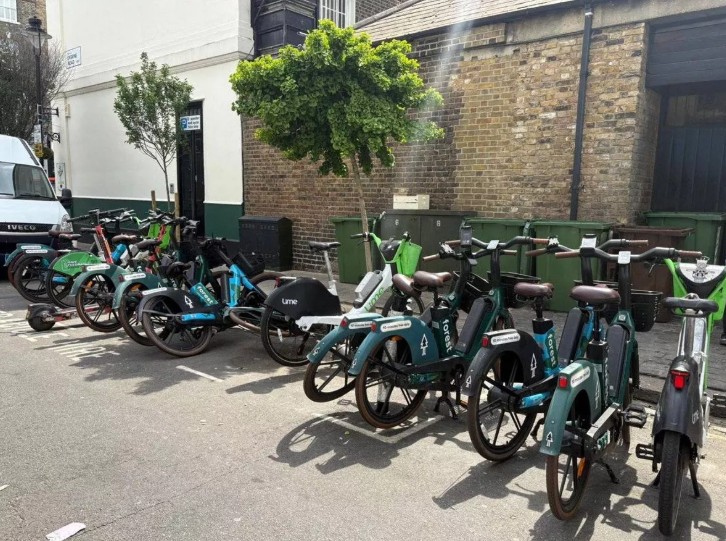
“Today, Restore Britain has published our plan to take back our streets. Mandatory licensing. Registration plates. Insurance. Safety checks. Tough penalties for dangerous riding. Public reporting system. And commercial e-bikes OFF our pavements. No longer will the footways of London or wherever else be strewn with these vehicles.
“It’s unsafe, looks awful and generally feeds into the relentless societal decline we all hate so much. Alongside our programme of mass deportations, this will deliver cleaner and safer streets for law-abiding British pedestrians, cyclists, and motorists.”
This isn’t the first time Lowe has weighed in on a cycling issue. Earlier this year, Lowe criticised Norfolk County Council over the £500,000 it reportedly spent on a new cycle lane in Gorleston-on-Sea, using the government’s Active Travel Fund.
In a social media video, Lowe can be seen jabbing his finger at the infrastructure, claiming it “has ruined a perfectly good road”.
“This is an example of central planning lunacy by Norfolk County Council,” Lowe says in the video. “A bicycle lane that’s very rarely used. I’ve declared bicyclists a rare breed here.”
Under a Restore Britain government, they may very well become extinct.



36 thoughts on ““Our pavements are not racetracks for young foreign men,” declares Rupert Lowe as Restore Britain leader vows to “take back our streets” in bizarre new e-bike policy… that doesn’t make any sense and targets legal electric bikes”
Ryan, this is entirely too many words.
The TLDR; is “Racist continues to spout racist and regressive views as ‘fact’, despite evidence”
Also, he’s repeatedly written “party” where he meant “assembly of loons”.
@mdavidford in fairness, that was pretty much the case with No10 covid parties.
@mdavidford slightly unfair to loons (the bird). They are black-coloured and from North America, so unlikely to be welcome in Restore’s “white British” UK
You say that, but they do seem to have some tendencies that might resonate with him.
The headline picture says it all ‘Planning lunacy’.
For people who think that Reform is far too left wing and sensible, Restore Britain is an ideal home. Idiotic policies made up on the hoof, in response to whatever story is in the news, especially if Reform has just said something about it.
Politics in this country, and others, was never nice, but now it’s abysmal, with ‘leaders’ trying to outdo each other in outrage on relatively minor matters, while ignoring the herd of elephants in the room. Pathetic really.
Rupert makes excellent points here. It is high time that the streets were reclaimed for the unimpaired use of drivers in their often uninsured, MOT free vehicles.
I can’t wait to hear Restore UK’s proposals for energy costs, defence funding and improving the NHS.
@Mr Blackbird I think it’s just ‘Restore Britain’. The other bunch of fascists is called ‘Reform UK’.
@This Wreckage Of course. My mistake.
The answer is much more simple than Rupert would suggest – instead of new laws, just enforce the ones that we already have.
@belugabob The ones we have now are apparently too complicated for the police to enforce.
@This Wreckage Just because they’re too complicated for Mr Lowe, doesn’t mean they’re too complicated for the police to enforce, or a 6 year old to understand
@This Wreckage well, it’s apparent that some officers on the ground have misunderstood the rules and seized bikes the are perfectly legal, but that’s really at the opposite end of the bell curve to what I’m referring to.
My point is that the laws we have are adequate – they simply aren’t being enforced.
The police could either do raids in the areas where fast food shops/delivery riders proliferate – or simply order some burgers and wait for the offenders to come to them.
No new laws required
“Under a Restore Britain government, they may very well become extinct”
Restore Britain: a party on the road to fascism. Fascist organisers increasingly regard Restore Britain as their electoral expression. Restore’s buzzword is “remigration”—code for ethnic cleansing. There are echoes of the BNP—electoral respectability outside, hardened fascist cadres within, mass deportation connecting them.
On y’ur bike I say
I would dispute that, they are not on the road to fascism, they have well and truly travelled the whole length of the road and reached their destination. Some of the statements on Lowe’s social media are quite sickeningly reminiscent of the Nazi party in the 20s and 30s: he has a list of criminals he “will have executed on day one of my administration”, he is going to lock up any civil servant found guilty of “facilitating” immigration, he is going to close down mosques if the local population (presumably the local white population) don’t want them, he says that being a Muslim is fundamentally incompatible with being British, et cetera et cetera. It’s all straight out of the house painter’s playbook, just with Muslims substituted for Jews.
@Rendel Harris with respect, it’s not 1930s but with Muslims replaced with Jews. They aren’t exactly fans of Jews either, who don’t count as white British under their definition. Plenty of obvious antisemitism alongside Islamophobia and all the rest of it.
But yes, totally down the road to fascism, at home, kettle on.
@Rendel Harris
Fascists who believe “Jewish ideas are destroying our country” were at the heart of Restore Britain’s campaign in the Holborn and St Pancras by-election in London.
Callum Barker, a former activist in the fascist Homeland organisation, appears in photographs of the campaign. It is a fascist party founded by figures who were once part of the BNP leadership.
“A former senior BNP official distributed its literature and apparently addressed its campaigners.” Weyman Bennett, SUTR co-convenor, said.
Restore Britain is keen to win over the far right thugs who’ve built up networks in mobilisations, for example, against refugee hotels. “All credit to the patriots who turned out in Portsmouth last night in numbers,” said Lowe.
Not sure what @OnYerBike has done to make you think they’re with the fascist cadres.
@mdavidford sorry
“Take back our streets”— does he mean from cars? I can remember when I was a boy; we played cricket and football in the streets.
@kingleo Jumpers for goalposts. Wicket chalked on a creosoted fence on a small grassed area. Tennis ball for Dukes cherry. Fielding at deep mid on in the middle of the estate road. Taking a steepling catch while watching for cars in your peripheral vision. Interruption to play when Carol Burke walks past on the far pavement. Mrs Spencer getting annoyed with the ball landing in her roses. Tea interval, Tonibell’s ice cream van is here – Lager and lime iced lollies – Ice Cream Screwball – Flick spit at each other with the plastic spoons. Marvellous!
His views are completely out of touch with reality 💩
Restore Britain to what? Caves, mud huts, the Romans, Viking or Normans or just some convenient cut off point in history to suit his racist views. Remember your great great etc grandmother for everyone on the planet was Lucy being the oldest human remains ever found which was in Africa which means we all have black DNA.
@Old fat man on a bike Lucy is neither human nor necessarily an ancestor of any human. But we are indeed all descended from African humans.
@Old fat man on a bike
Deport… er, sorry, I mean… ‘remigrate’ the Beaker Folk – coming over ‘ere with their weird pots…
@mdavidford Too right. We were better off lapping water from our cupped palms. No arguments over the washing up
@slc Fabulous, thank you. That clip can’t be repeated too many times.
@Old fat man on a bike People like Lowe and Farage mean restore Britain to the 1920s, 1930s or 1950s. Immigrants allowed in to meet post war labour requirements but then to piss off back to their “own country” when no longer required.
Workers to know their place and be happy to work for a pittance in unsafe unhealthy conditions, in order to maximise profits for business owners, while having no aspirations to improve their lot. Ruling and upper classes to be granted unearned respect and deference and not to be probed by the press.
Can you justify your claim that, “Under UK law, the term ‘e-bike’ refers to an electrically assisted pedal cycle (EAPC)”? Because that kind of false equivalence seems to me to be the hub (sorry) of the whole problem. As far as I know, the law actually avoids ‘e-bike’ and instead refers to EAPCs specifically because ‘e-bike’ is not a clearly-defined term. In fact, like ‘bike’, it can mean pedal cycles to some people (including most readers of this article), and motorbikes to others. That is not the law making the two terms equivalent.
So the problem is that, properly used, including in UK law, ‘e-bike’ is not the same as EAPC. If people, including Restore Britain, only understood that, we’d have a chance of the two main types of e-bike being properly regulated under the very different pieces of legislation that apply to each of them.
And people who continue to claim the term for their specific use are just reducing the chances of that.
I think there is an important distinction with the use of the word ‘bike’. ‘Bike’ is typically only used to refer to motorbikes where it’s already clear from context that that’s what’s being talked about. If you said, absent any other context, “they were riding a bike”, that would generally be understood as referring to a pedal cycle. On the other hand, if you referred to a ‘bike’ on, say, a motorbike forum, that would be clearly understood to refer *only* to a motorbike, and *not* to a pedal cycle.
By contrast, ‘ebike’ tends to get used either to refer only to EAPCs, or to a grouping that includes *both* electric bikes that are EAPCs *and* those that aren’t (and are therefore electric motorcycles). That tends to muddy the waters and lead to people thinking that they all need to be treated the same. So it would be good practice to avoid using the term ‘ebike’ to refer to things that aren’t EAPCs, and prefer ’emotorbike’ instead, for clarity. (It might, similarly to ‘bike’, be fine to use ‘ebike’ in contexts where it’s clear that you’re *only* referring to emotorbikes, but I’d suggest that that is (currently) rare.)
@slownomad An EAPC is only legal to use on the road if it conforms to the EAPC Regulations 1983. An EAPC with a cut-off speed of say 20mph or a bigger motor is still an electrically assisted pedal cycle, but it is treated as a motor bike & needs registration, tax, insurance & a helmet.
@ChrisA I guess it depends how you read the words. I’ve looked at the regulations in response to your post. However, the government advice below is quite specific that EAPC means something that falls within the terms of the regulations, whereas e-bike is broader. I still believe that it would be better if we all used the terms in that way and, regardless, that trying to claim ‘e-bike’ to mean pedal cycles only is doomed, given that we have not been able to claim unique use of ‘bike’ in over a century.
https://www.gov.uk/government/publications/electrically-assisted-pedal-cycles-eapcs/electrically-assisted-pedal-cycles-eapcs-in-great-britain-information-sheet
@slownomad From the DVSA/DoT Guidance Notes that your link refers to:
“To be classified as an EAPC under the EAPC regulations[footnote 1], the cycle must:” etc. .
It then goes on to say: “If an EAPC does not comply with the regulations, it is treated as a motor vehicle under the Road Traffic Regulation Act 1984 and the Road Traffic Act 1988”
So no, it does not say that the only EAPC is a legal EAPC.
As you say bike may refer to pedal cycles or motorbikes. E-bike logically follows the same usage and includes EAPCs.
“Electrically Assisted Pedal Cycle” is a technical description. The EAPC Regulations 1983 allow for some EAPCs to be treated in law as pedal cycles.
The Guidance Notes finish with a disclaimer: “This guidance is a summary of DfT’s understanding of what the law requires.” etc.. & finishes with
“You are therefore advised to consult the relevant legislation and, if necessary, seek independent advice.”
So even the DVSA & DoT don’t actually know what it all means.
@mdavidford I think there’s context and audience (for want of a better word). The discussion could have already clarified the type of bike. But for an audience who are bikers or have biker friends, relations or aquaintances, bike may well default to motorbike.
I think the e- bike naming thing is probably a lost cause. The public and popular press seem to view any kind of fast moving bicycle, with or without pedals, provided it is not obviously petrol powered, as an e-bike.
Whilst you might have expected a little bit of tinkering with your bike (motorised or otherwise) 40 years ago.
It is now easily possible to very substantially modify the performance of your steed. That, the total disregard many people seem to show for (or ignorance of) the rules and the lack of effective enforcement means that this problem is probably going to get worse, before it hopefully gets better.
I don’t give a shit who’s riding them, but I am definitely someone who would happily consign every electric motorcycle weaving around pedestrianised areas to the scrapheap and fine Deliveroo for the privilege at the same time.
Rupert Lowe may like to bang on about “young foreign men” riding e-bikes. But the two blokes who tried to steal a young bloke’s e-mountain bike while brandishing an angle-grinder the other day sound fairly local:
“The two suspects, Mason Portlock and Luke Beale, both 18, have since been charged with robbery and possession of a bladed article. One of the men was also wanted in connection with separate offences of robbery, possession of an offensive weapon, and breaching a court order.”
I’m all in favour of strict regulation, and nicking anyone on an illegal machine. But, I suspect Rupert Lowe cares more about things he can pin (rightly or wrongly) on non-white folks, rather than solving the entire e-transportation problem.