



Inverclyde Council has unveiled plans to install more car parking in Greenock after local residents and businesses repeatedly blocked a new cycle lane that used to be a row of parking spaces.
The £6 million Sustrans-funded infrastructure on West Blackhall Street opened last year and has proven controversial for local business owners who have complained the cycle lane has denied them business due to the removal of parking places. However, as reported a few weeks ago, many residents have taken to parking across the bike lane as if the spaces – as seen on Google Maps below – were never removed.
An online petition was launched by local shop owner Chris Jewell, who runs Cradle Care on West Blackhall Street, urging the council to remove the cycle lane and reinstate the previous two-hour parking arrangement. Neither of those objectives have come to fruition, however the council has opened a consultation on proposals designed to make the area more car-friendly.
Among the suggested proposals are “immediate, visible improvements to parking capacity” through converting loading bays into parking spaces after 10am, and a new one-hour parking limit both on West Blackhall Street and surrounding roads, designed to increase the number of visitors to the town. Four new parking spaces may also be created in the area. It is unclear if the proposals could directly affect the cycle lane’s design, which is only lightly segregated by a low kerb and a different road surface.
Announcing the consultation, which is open until next Tuesday, Cllr Michael McCormick said, “The West Blackhall Street redevelopment has transformed a tired and disjointed area into a more welcoming and accessible environment for everyone and that’s something we should be proud of.
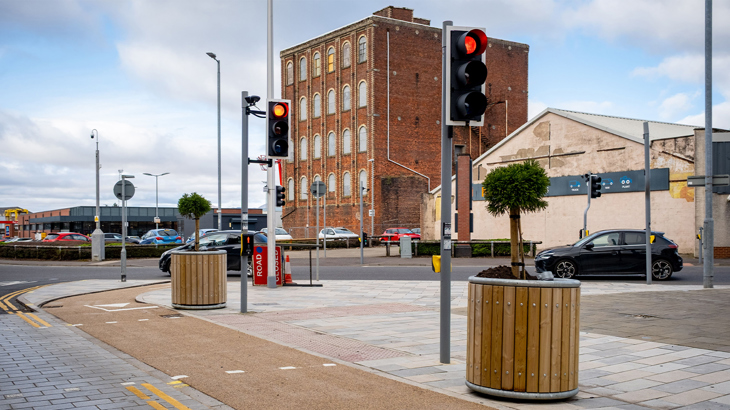
“But we have listened to the concerns about the challenges with parking, deliveries and inconsiderate parking, especially on the cycle path, and that’s why officers have developed a series of changes that could be made relatively quickly to alleviate some of those pressures.
“It’s important that businesses have the opportunity to have their say on the proposals and provide feedback about any further improvements that could be made.”
Jewell’s campaign has also attracted attention from both mainstream media outlets, and the local MSP Stuart McMillan. Earlier this month, McMillan met with traders on the street “to hear how the cycle lane is impacting business,” though it wasn’t clear what stance he took on the issue.
In his petition, Jewell wrote that “since the installation of the cycle lane, my business, as well as many others, has witnessed a drastic decline in footfall and revenue.
“The cycle lane, although well-intentioned for promoting sustainable transportation, has not achieved its purpose due to minimal usage. Observations show that the lane is frequently misused by cars and vans as a parking space, rather than being utilised by cyclists.” He subsequently argued that allowing motorists to park in the cycle lane would “avoid further issues.”
The same week the cycle lane opened, Jewell offered a more nuanced opinion, telling the Greenock Telegraph, “They have spent a lot of money and it certainly looks better. The number of street car parking places has halved, but there are more spaces in Jamaica Street and Dalrymple Street. I will do everything I can to keep the doors open.”
He added though that the business was, “Struggling to get back, even to where we were before the pandemic. Then there were the road closures due to the work, and footfall just plummeted.”
Inverclyde Council has previously confirmed that a review into the bike lane is due to be completed by August, when a meeting of the council’s environment and regeneration committee will consider various options. Active travel campaigners will be hoping to avoid a repeat of Linthorpe Road in Middlesbrough, where a £1.7 million cycle lane built by the council was loathed by both the local mayors and businesses for its reduced parking and ‘orca’ kerbs. The larger Tees Valley combined authority subsequently paid £2.7 million to remove it altogether.








6 thoughts on “Calls to rip out “disastrous” cycle lane always blocked by cars rejected – but council proposes extra parking spaces in concession to angry traders”
Cradle Care you say?
“Nobody shops for their baby clothes on a bike!”
“You certainly can’t carry a child on a bike!”
“No way can you carry *two* kids on a bike!”
“These cycle paths make it too dangerous for children which is why we all drive them and need to park right outside (to minimise the danger from … er … cyclists”
I’m being unfair, but isn’t it mostly “we can’t walk / cycle because places are unpleasant / feel too dangerous *because of all the motor traffic*?”
Yes, I know there’s quite a steep hill there…
That’s the most convoluted logic I can imagine! Cyclists don’t frequent this road because there is no cycle lane. Then a cycle lane is put in for the cyclists. Now cyclists don’t use the cycle lane even though there IS a cycle lane! What’s the point of putting in a cycle lane and wasting all that money!!!! (“Forgot” to mention that cars park in the cycle lane.)
Personally, I think all on-street parking should be a mix of disabled bays and loading bays. If you can afford to run a car and you’re able bodied, you can pay to leave it somewhere for an hour or so and walk to the shops. Or better still, leave the bloody thing at home.
Drivers seem to be using the pavement as well, perhaps there will be calls to remove this to if enough of them decide that’s the place to park.🙄
https://www.facebook.com/share/1D5GaMsTkF/
Where is the equivalent cycling and mobility aid parking?
They’ve got that covered: cycles don’t count as mobility vehicles currently, and “accessibility” is clearly covered by “provide motor vehicle access” because they can use taxis!