



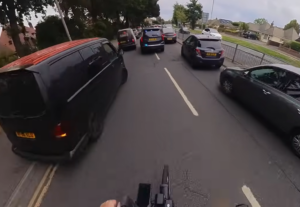
A cyclist had a “heart-stopping” moment as he barely managed to make through the narrow gap when coming down at speed from a steep hill in Cheltenham, as a van spilled into the other lane to overtake parked cars on the road, and then a car driver followed the van through, which led to the cyclist believing that the driver either saw him and chose to ignore, or didn’t check for any oncoming when following the van.
Richard, the road.cc reader told us that he submitted the footage to Gloucestershire police and just found out this week that the force decided not to take any further action in the complaint.
He was riding into Cheltenham on Harp Hill road, which he described as having “very poor” surface. “I wasn’t going too fast but it certainly wasn’t slow,” he said. “As I was approaching the bottom a van pulled out onto my side of the road in order to pass a parked car.
“I slowed a little and thought I had judged it to perfection as I only had to slow down and adjust my road position slightly to avoid it but as I moved left a bit I could see a car was following the van through. A heart stopping moment but I managed to get through the gap although it was a bit too tight for my liking especially considering the poor road surface.”
“The driver of the car had either seen me and come through anyway or the driver was just followed the van assuming the road would be clear neither of which should happen.
Richard pointed out that the car driver following him had to stop because of the oncoming driver as well. He added: “I reported it expecting some sort of action as my life had been put in danger and the fact that a car had been forced to stop to avoid a collision but it wasn’t to be, yet again.”
> Near Miss of the Day 902: “I can’t believe I wasn’t hit”
Previously, the cyclist had told us that he had changed the way he approached a roundabout in Gloucestershire after receiving two close passes, saying “I can’t believe I wasn’t hit” when the driver of an SUV subsequently made a very close pass on him at the same location in Bishop’s Cleeve, just north of Cheltenham.
Just as with the two previous incidents, no action was taken against the motorists involved other than a warning letter being sent to one driver, and also gave us some more detailed background of his experience of dealing with police when sending them videos of close passes.
“After a year of hearing nothing from my OpSnap reports to Gloucestershire Constabulary I’ve started asking for the outcomes of my reports after a year has elapsed,” he said. “After a short delay and chasing up for the first one I’ve been getting speedy responses to my requests.
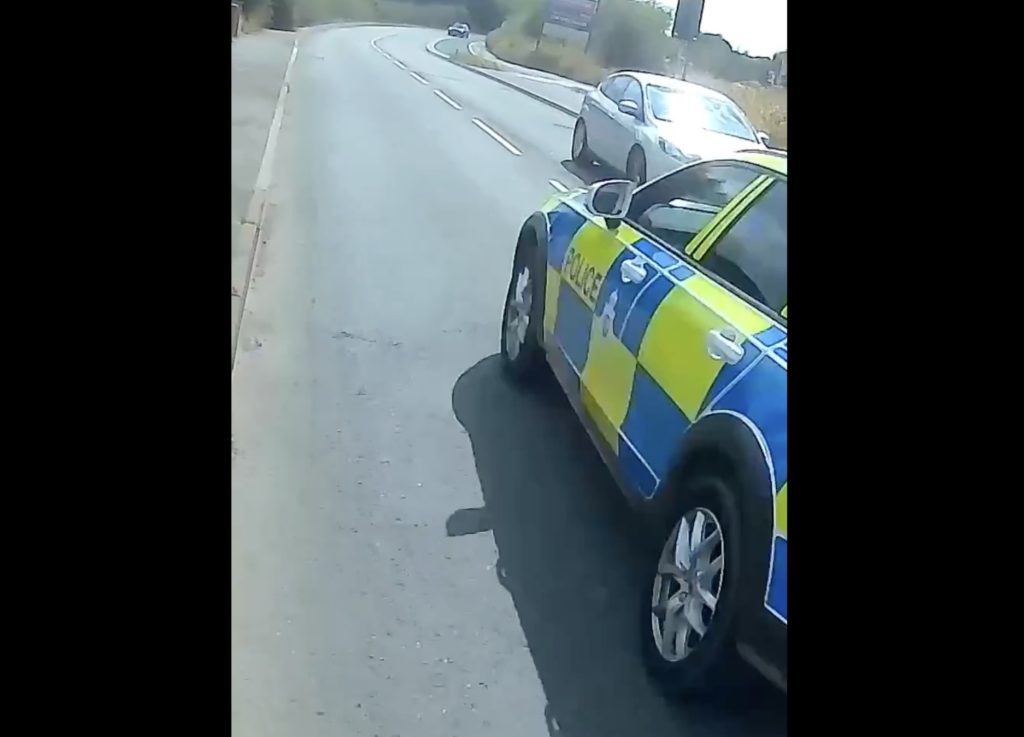
Recenly, Gloucestershire Constabulary had also come under fire after a cyclist criticised the force’s car driver for passing him dangerously with its emergency lights on after he slowed down and pulled to the kerb, but didn’t come to a full stop because of not managing to unclip his pedals in time — however, an oncoming driver didn’t move aside and allegedly didn’t slow down as well.
He told road.cc: “The police car had both its lights on and siren going. As soon as I knew that it was coming from behind, I pulled over to the side of the road as quickly as I could, but because of the speed of the police vehicle there wasn’t enough time to fully unclip from the bike.
“I am an experienced cyclist with thousands of miles cycled using clips, so I was able to maintain an upright position despite still being clipped in and despite the bow wave that hit me from the police car driving so close at such a high speed.”
> Near Miss of the Day turns 100 — Why do we do the feature and what have we learnt from it?
Over the years road.cc has reported on literally hundreds of close passes and near misses involving badly driven vehicles from every corner of the country – so many, in fact, that we’ve decided to turn the phenomenon into a regular feature on the site. One day hopefully we will run out of close passes and near misses to report on, but until that happy day arrives, Near Miss of the Day will keep rolling on.
If you’ve caught on camera a close encounter of the uncomfortable kind with another road user that you’d like to share with the wider cycling community please send it to us at info@road.cc or send us a message via the road.cc Facebook page.
If the video is on YouTube, please send us a link, if not we can add any footage you supply to our YouTube channel as an unlisted video (so it won’t show up on searches).
Please also let us know whether you contacted the police and if so what their reaction was, as well as the reaction of the vehicle operator if it was a bus, lorry or van with company markings etc.
> What to do if you capture a near miss or close pass (or worse) on camera while cycling















61 thoughts on “Near Miss of the Day 913: “Heart-stopping” moment as cyclist barely manages to make through gap after oncoming car driver follows overtaking van, ignoring cyclist”
Bit of a non-event no? If
Bit of a non-event no? If someone is overtaking cars on your side of the road and you are coming up to them then you just slow down and wait for it to clear. In the scheme of close passes this comes under “driver shouldn’t be doing that but you saw it a mile off and barrelled into obvious danger”.
I was out yesterday and following a car on my side of the road (parked cars blocking the other side) and a middle aged women in an SUV obviously didn’t want to wait for a cyclist so as soon as the car went past her, out she pulled straight into my path. Not a chance she didn’t see me, just wasn’t going to suffer the indignation of waiting for a cyclist.
At what point in the video
At what point in the video did you spot the car following the van? If it was before the van was passing, then I call you out as Superman with x-ray vision and collect my £10.
I spotted it after the van
I spotted it after the van started pulling back onto their side of the road. Luckily I have been driving and cycling for long enough that I don’t assume that there is nothing I can’t see immediately and compensate for that… something that we want drivers to do ie. why did you pull out if you couldn’t see it was clear
So, it’s a non-event so long
So, it’s a non-event so long as the cyclist has years of experience? I find that idea profoundly unsettling.
Common sense would probably
Common sense would probably tell you that you shouldn’t assume that the road is clear if you can’t see no? I know we all like to get out our high horses about the most minor infraction here sometimes but drivers are not perfect and nor can we expect them to be. The whole road system works on the vague idea that people have a little give and take. They let people out. They wait for a few cars to go past a line of parked cars before they get to go. If we all worked to the absolute letter of the highway code everyone would have a much worse time a lot of the time.
If you are not looking for potential hazards on your bike then you should be and yes, you need a certain level of common sense to be remotely safe on our roads. Our roads are not entirely safe and drivers are a huge part of that. You shouldn’t be cycling on them without someone else if you can’t come across a situation like this and manage it easily.
mctrials23 wrote:
The cyclist saw the van driver overtaking and adjusted their speed to avoid any incident, but the car driver following behind the van clearly had no view of the road and was performing a dangerous and illegal overtake. The cyclist couldn’t have seen the car driver in much the same way that the car driver couldn’t see the cyclist – that’s what makes the overtake so dangerous.
but also makes it dangerous
but also makes it dangerous for cyclist not to ride more defensively, because he/ she can’t see what, if anything, is past the van.
This is not an attempt to defend the driver, and cyclists shouldn’t have to ride defensively, but I agree with mctrials that this is one that could have been avoided with a slightly more conservative approach.
I generally cycle to the
I generally cycle to the reality of driving, not what should happen. I wouldn’t have been expecting there to be nothing behind the van because a huge amount of the time there will be. As someone else said, people just follow a car overtaking because everyone expects this behaviour and doesn’t just “go” when the first car has cleared the parked cars.
No the car shouldn’t do that but if this is the forethought and road craft this cyclist has, they are going to struggle on our roads when actually unexpected things happen.
Personally I encounter enough really shit and dangerous driving that normal driving behaviour like this doesn’t even register because I just slow down to make sure its clear before I can go. I would do the same in a car. I would even go so far as to suggest that kicking off about this sort of thing doesn’t help our case for being taken seriously when it comes to road safety. There is always give and take on the roads.
mctrials23 wrote:
The general idea behind the Highway Code is to not require years of experience in order to be able to use the roads safely. If we’re going to require cyclists to second guess all traffic conditions, then it’s only going to be very experienced cyclists that will be able to use the roads and how do we expect the cyclists to get all that experience?
Yes, it’s beneficial to be extra careful when your view is blocked by a van etc. but we still have to recognise when car drivers are overtaking recklessly and criticise them for doing so. It’s similar to when using a cycle lane and approaching a side road on your left when going past a high sided van – it’s wise to be prepared for a driver to attempt to turn into the side road, but ultimately, the onus is on the driver to only make a maneouvre when it’s safe to do so and to anticipate that a cyclist might be hidden by the van.
You have to expect people to
You have to expect people to have some base level of common sense and problem solving to cycle remotely safely on our roads. If you cannot see a situation like this and think “perhaps I should slow down because there are car(s) coming directly at me and I don’t know when it will be safe” then you are not safe to cycle on our roads. As I said, this is such a minor thing in the grand scheme of things drivers do but shouldn’t that I have no idea how someone who can’t handle this would react to something remotely surprising from a driver.
“Non event” is putting it
“Non event” is putting it mildly. The cyclist has no one but himself for the situation he found himself in.
Really? Not the drivers of
Really? Not the drivers of the vehicles on the wrong side of the road? They’re blameless are they?
Don’t know, don’t care. When
Don’t know, don’t care. When I find myself in a situation like that I tend to look for things I could gave done differently, and try to learn from them. The cyclist could have backed off. He chose not to.
As do I, as I can’t control
As do I, as I can’t control the actions of others. But that’s different to blame.
There are very few situations
There are very few situations on the roads that the “offended” party couldn’t have compensated for but the question is always, how much can you expect people to compensate for. In this situation I would place the burden firmly on the cyclist. This is an every day occurence and I would say that this happens probably more often than not. In heavy traffic it always happens and if it didn’t, one side of the road would never move.
This comes under “this sort of behaviour is what keeps the roads moving” rather than “this sort of behaviour is dangerous”.
john_smith wrote:
Looks as though he did back off to me – not to a complete stop but that’s not an easy task on that road. I think what he did was reasonable; certainly more reasonable than the oncoming car that blindly followed the van.
mctrials23 wrote:
I agree. The cyclist was heading directly towards the van way too fast meaning they would have met head on before the van had even cleared the parked car. To avoid a collision the van driver and the cyclist both had to move to their left and the cyclist had to brake very late.
The cyclist and the following driver couldn’t see past the van so in my eyes it’s 50/50 but obviously the driver has a responsibility to protect the vulnerable road user, even when they are riding badly.
I would have had a serious look at my own actions and certainly wouldn’t have reported it, and I’ve reported 100’s of drivers. I’ve had times when I got home furious that a driver had put my life at risk but after watching the video back I’ve realised I put myself in or even caused the dangerous situation. Sometimes the driver isn’t blameless but I’d rather learn a valuable lesson than give the police an excuse to do nothing.
Follow-my-leader driving
Follow-my-leader driving behaviour by the car driver. “If they have gone, so can I”.
Very common unfortunately (also see “running red lights”).
Not much to do if you’re cycling other than developing the habit of asking “what might be there which I can’t see” and the skill of knowing when to apply this extra caution.
I’d like to think I might have held back in this kind of scenario once the van made their move, but probably this would vary depending on speeds / road width / whether I was hurrying etc …
Doesn’t the concept of
Doesn’t the concept of committment come into play here? As I understand it if an oncoming vehicle has already committed to overtaking parked vehicles before you reach them then they have priority, is that not correct?
It’s always useful to take a boot on the other foot approach to these scenarios, if a cyclist was following another vehicle past a line of parked cars and then was confronted with a car which had assumed that the oncoming vehicle was the only one there and so continued rather than stopping to let the cyclist through as well, what would we say about that?
That’s reasonable. On re
That’s reasonable. On re-viewing this one it does seem that it would have been prudent for the cyclist to have at least slowed a bit more before the van driver had returned to their side of the road. They don’t seem to have left much space. It seems to me they are acknowledging this by moving left just before the van passes.
So a case of “discretion the better part” for the cyclist here?
As for the following car is also quite close to the van but maybe not too close in the “can’t see my mirrors? I can’t see you” sense.
The cyclist and the van driver do manage to pass each other OK (with note above). Then we have “only proceed if you can see that the way is clear” and “commitment”. Certainly neither the cyclist nor the car driver could see the road ahead. (Both could only see the van). At the point where they first saw each other (arguably too late) I think both were committed to the “manoeuvre” – but the driver was on the wrong side of the road AND there was space to their left. I think the advice is that in conflict where two parties have committed the party who’s least inconvenienced by doing so should move out of the way at that point.
Probably both should have slowed further or stopped and certainly the driver shouldn’t have just trucked on through, regardless of whether the cyclist was wise to continue or not.
Yep, it’s in Rule 163:
Yep, it’s in Rule 163:
“Overtake only when it is safe and legal to do so. You should give way to oncoming vehicles before passing parked vehicles or other obstructions on your side of the road”
There is no legal requirement to give way either – it’s only advisory (i.e. not a MUST). Giving way only occurs before overtaking, not during. Unfortunately, the video begins with the van already overtaking the line of parked cars, so we can’t see whether the cyclist was in view before they began their manoeuvre.
Some people think that if the obstruction is on the ‘other side’ of the road, then they have priority. Yet if the road is narrowed by an obstruction, that section doesn’t really have two sides anymore, it’s just a single lane; a narrow section of road similar to a country lane.
Perhaps the van driver could have pulled into the gap between the parked vehicles, but then perhaps they were aware of the following car and that gap wasn’t big enough for both vehicles.
The crucial thing is this bit: “The rules in The Highway Code do not give you the right of way in any circumstance, but they advise you when you should give way to others. Always give way if it can help to avoid an incident.”
From the video footage, the cyclist could not see that the road ahead was clear, but didn’t adjust their speed. That could be deemed careless cycling on their part.
I do get annoyed at bad driving that puts cyclists at risk, but this is a situation where the risk can be easily mitigated by the cyclist adjusting their speed slightly, so they are able to stop in the distance they can see to be clear.
HoarseMann wrote:
There has to be more blame put on the car driver as they decided to perform an overtake maneouvre when they had close to zero visibility of the road ahead and thus couldn’t determine if they had time to complete the maneouvre safely or not. The cyclist was merely travelling forward in their lane and whilst that doesn’t give them priority per se, I wouldn’t consider it careless to not correctly guess that a car driver was driving dangerously.
There seems to be different standards at play here – expecting a cyclist to predict that a hidden car driver was overtaking, but forgiving a car driver for overtaking when they couldn’t even see the road ahead.
hawkinspeter wrote:
Now I don’t agree with that. At the point the road narrows due to parked cars, there are no lanes anymore. It’s just a narrow section of road.
There’s no expectation that a cyclist needs to predict a hidden car, they just need to ensure the road ahead is clear before they commit to it.
The driver was already established. It’s not like they swerved at the last minute.
HoarseMann wrote:
I get your point, but I disagree. To my mind, the road user performing a maneouvre (e.g. an overtake of parked cars which involves using the other side of the road) should take care that it is safe to do so. The cyclist wasn’t performing any kind of maneouvre, but should maybe have slowed more so that they could stop within the space that they could see to be clear. I’d say that the cyclist was certainly established on the road (also didn’t swerve at the last minute), so the car driver should not have begun their overtake until the cyclist had gone past.
In general, I’d say that an obstruction on your side of the road means that you should give priority to the unobstructed side and certainly, performing a maneouvre that forces other road users to brake/swerve/stop to avoid a collision is simply bad roadcraft.
I think the points of debate
I think the points of debate here is where the overtake began and whether an oncoming driver/rider can assume that a vehicle will pull into a gap.
If I had been driving I would have pulled in, or performed an emergency stop if it was clear the cyclist was not slowing. If I had been cycling, I would have eased off until the road at the pinch point was clear.
There is a line of parked cars near me that are just before a tight bend, it’s not actually possible to see around the bend if there’s nothing coming before starting the overtake. I often begin the overtake when it’s clear, only for a driver to come around the bend and drive into the road narrowing, expecting me to reverse up the line of parked cars because I’m on “their side of the road”. They are wrong to do so.
The key is to ensure the road ahead is clear before committing and understand that yielding at parked cars/obstructions is not actually a legal requirement. You can’t expect other vehicles to yield in the same way they should for give way markings at junctions (which are a legal requirement).
Apportioning blame for any collision that might occur will be a toss up as to who did the least to avoid the other.
HoarseMann wrote:
I’d consider that in any collision, the party that was performing a maneouvre should be held more responsible as they are creating the hazard.
Is exiting a narrow section
Is exiting a narrow section of road more or less of a maneouvre than entering a narrow section of road? It’s debatable and very dependent on circumstance.
HoarseMann wrote:
Yes, but using the opposite side of the road would make it more of a maneouvre. In this situation, the parked vehicles are only on one side of the road, so it’s clear which direction of traffic should have priority – I think it would be less clear-cut if a road had parked vehicles on both sides, leaving just a single car’s width free in the middle.
Also, this particular scenario is directly addressed in the Highway Code Rule 163:
I don’t think that’s the case
I don’t think that’s the case at all. They are not using the opposite side of the road. The parked cars have narrowed the carriageway so that it is effectively a single lane. There are no ‘sides of the road’ at that point.
Here’s a road with
Here’s a road with obstructions on one side (bollards), that you cannot see if it’s totally clear due to a tight bend at the end of the road narrowing. They’ve had to put up signs to tell drivers not to enter until it’s clear, I suspect some will say ‘the bollards are on your side, you need to back up!’, but that really isn’t the case at all…
https://maps.app.goo.gl/j7PRkGJYuZKJq5br9
I guess the finer argument
I guess the finer argument would be whether you regard parked cars like bollards (effectively a permanent immovable – so what you’ve shown appears just to be a single track road section) or whether the fact that they can sometimes not be there makes any theoretical difference.
In the event in this one – I agree, cyclist should have slowed up a lot more or stopped before meeting the van. And as soon as the van in front of them moved right the driver behind should have been ready to take action also.
The general driving behaviour of simply following the vehicle in front without further thought is still problematic (though common). Too easy for drivers to lose situational awareness.
In the bigger picture the UK’s “informal parking, almost everywhere” also is problematic!
I would argue there is
I would argue there is absolutely no difference between a parked car being a temporary obstruction and a bollard being a more permanent obstruction. An obstruction is an obstruction, I don’t see any discrimination between the two in the Highway Code.
HoarseMann wrote:
You don’t overtake a bollard though.
hawkinspeter wrote:
Definitely not – they get terrible road rage if you try.
hawkinspeter wrote:
I would say you do if it’s an obstruction in the road, as these are.
Ultimately, there was an easy way for a cyclist to avoid this situation. That cannot be said of all dodgy driving that occurs around cyclists.
Now we’re down to the
Now we’re down to the pedantry! Are you a road maximalist or not, a lumper or a splitter? Is a bollard that’s concreted in “an obstruction in the road” – if e.g. it is the intention to stop vehicles driving on a section of the road? Or is that … a change to the road – so said section isn’t really “road for driving on” any more?
What about one of those rising ones – if you aren’t permitted to pass it is it just an “obstruction”?
I’d say if a permanently installed one – or even solidly “temporary” one – has fallen over (perhaps hit by a speeding cyclist?) and rolled into the main carriageway then “obstruction” would be a fair term. Otherwise not so much obstruction as a case of “where, sir, is your road?” To modify the original quote – “you don’t overtake a house though.”?
chrisonabike wrote:
I think there’s plenty of examples in another thread of drivers treating houses as obstructions
hawkinspeter wrote:
case in point…
https://maps.app.goo.gl/5pRjwXnkd2yKZSPi8
HoarseMann wrote:
As Chrisonabike points out, there’s a difference between immobile bollards that are designed to change the width of a roadway and parked cars. That bridge has been deliberately altered to only allow traffic one way at a time, so I wouldn’t expect either direction to have priority and it would be more of a first come, first served arrangement.
HoarseMann wrote:
The road does not narrow due to parked cars. The road remains the full extent of the road. However, one side of the road has parked cars on it, and drivers using that side of the road have a duty to other road users whose side of the road they may be encroaching if they intend to proceed.
Road users with parked cars on their side of the road need to give way to oncoming road users if they use the other side of the road.
GMBasix wrote:
That’s the misconception that a lot of people have.
The only point you need to give way is _before_ passing the obstruction. We cannot tell from the video here whether that occurred.
Rendel Harris wrote:
There’s a general principle and what happened here.
In general, I don’t see that “committed” gives carte blanche to initiate an overtake on the other side of the road just because the overtaker got there first. If you can see it to be clear and you can pass before approaching traffic gets there, you can go; if not, you wait. Inevitably, some instances will mean commencing before oncoming vehicles come into sight, but when they do there’s a conflict that needs to be negotiated.
What happened here:
The second oncoming vehicle proceeded when they could not see their way to be clear on the other side of the road. It was straightforward follow-my-leader regardless.
However, it is also obvious what was going to happen from the cyclist’s pov. It was obvious that there could be a following vehicle. I would have adopted a primary position shport of the parked vehicles to allow the onconing vehicle time to return, and me time to assess if there were following vehicles. Then I would have asserted myself into the lane giving clear indication for other oncoming traffic not to proceed.
Incidentally, there were gaps for the second oncoming vehicle to choose to pull in, if they had a mind for courtesy.
So,…
GMBasix wrote:
Pretty sure that is exactly how the majority of British motorists think that it works.
After a year of hearing
After a year of hearing nothing from my OpSnap reports to Gloucestershire Constabulary I’ve started asking for the outcomes of my reports after a year has elapsed
Assuming you’re not being duped with evasive accounts of the actual outcome (…it could be one of these outcomes etc.) you’re doing better than those of us coping with Lancashire Constabulary’s Total Secrecy Principle. They claim that the law prevents them from stating the actual outcome. I was unable to find out what happened to this bus driver after an offence of 2 years 5 months ago
https://upride.cc/incident/4148vz_travellerschoicecoach_closepass/
I’ve seen worse, frankly. The
I’ve seen worse, frankly. The video unfortunately doesn’t start early enough to show at what point the van committed to overtake the parked cars but by the time it does start, the driver clearly was committed and given that the cyclist can’t see what else is coming behind, it’s probably prudent to scrub a bit more speed off if possible. Admittedly, that’s a steep-looking hill and probably steeper in real life than it looks on video.
It is steep enough and rough
It is steep enough and rough enough that a quick (downhill!) stop is far from a formality.
Well that was pretty ‘every
Well that was pretty ‘every day’ to be honest. Nothing ‘heart stopping’ just another day.
Exactly.
Exactly.
Even here in The Netherlands (the much lauded ‘promised land of cycling’) this is a totally common manoeuvre. Not very close, not a very high speed, no sudden sideways movement. Nothing much to see here.
When roads narrow to a single
When roads narrow to a single lane, drivers will generally go two to three at a time before giving way. This is just how it works and the expected behaviour, regardless of what the highway code may say. The driver behind the cyclist gave a lot of room and slowed right down in anticipation of this. The cyclist should take this as a lesson.
I think certainly it would be
I think certainly it would be totally unrealistic to expect that if there is a fifty-metre line of parked cars for every driver – or indeed every cyclist – to wait patiently at one end while the car in front drove through, wait for them to clear the end of the line and then proceed.
Except in this case it’s not
Except in this case it’s not a line of parked cars. The van had got past the line of parked cars, there is then a large gap and then a single parked car. If we ignore the previous parked cars and start from scratch the van and the driver behind are passing a single parked car with a cyclist coming down hill towards them “established” on their own side of the road in the center of their lane. Are you saying that, at any distance from a parked car, as long as you move to the other side of the road you are committed (or is it established) and other road users should give way.
You can’t ignore the previous
You can’t ignore the previous parked cars as the van driver is clearly, and quite reasonably, making a single overtake of them and the single car. There is time and space enough for them to do this and the cyclist can see exactly what’s going on and has ample time to slow; the van has indisputably reached the point to overtake before the cyclist and therefore has no obligation to pull in before the final car. It’s notable that the cyclist makes no complaint about the van driver as there is nothing to complain about here. Having seen the van coming from a considerable distance the cyclist should have slowed and waited for the driver to return to their own lane before passing it; had they done so they would have seen the oncoming car and there would have been no conflict. I’m hardly the world’s biggest driver defender, nor the biggest fan of the police in terms of their readiness to refuse to act on bad driving, but I can entirely understand their refusal to act here; at worst the fault is evenly divided. Again, as I said above, it’s useful to reverse positions: if the cyclist had been following the van and a car driver coming the other way had not slowed sufficiently to let both vehicles through but carried on at a speed which meant they just missed the van as it pulled back in, putting them in conflict with the cyclist behind, whose side would we be on there?
Rendel Harris wrote:
I don’t think swapping the car driver and cyclist works in this scenario due to the difference in sizes – the size of the van would easily shield a cyclist following it as the car driver would need to be further away to give enough room for the van driver to pull back into their lane.
So how big does the gap have
So how big does the gap have to be before it is not a contunous line of parked cars?
Bungle_52 wrote:
Big enough for a car to pull into
What? That’s just rubbish. If
What? That’s just rubbish. If you have to move over to the right hand side of the road to avoid an obstacle you should always give way to oncoming traffic.
The fact is that some drivers believe that cyclists should always give way to them.
You give way _before_
You give way _before_ committing to the narrow section of road. It’s unclear from this video whether the cyclist was in view before the drivers moved into the road narrowing.
Totally understand the no
Totally understand the no further action on this one.
Van was already established passing the parked cars, trumping priority.
The car was guilty of blindly following the van when they were unlikely to be able to see the road ahead, however, the cyclist was equally guilty of exactly the same… blindly riding into a space they could not see was clear.
Lesson for all parties.
Jimmy Ray Will wrote:
However, the car driver went against the advice in the Highway Code on overtaking (rule 163):
The cyclist made the mistake of not being able to stop in the distance that they could see to be clear, but they weren’t endangering anyone other than themselves.
hawkinspeter wrote:
To play
Telegraph’sDevil’s advocate for a moment, it could have been a crossing pedestrian, rather than an oncoming car, that was obscured by the van.mdavidford wrote:
I would dispute that as the pedestrian would have had to be running behind the van to have kept out of sight of the cyclist. Possibly someone on roller skates holding onto the back of the van, but then there’s plenty of space for the cyclist to avoid a pedestrian anyhow.