



As a country, I don’t think we’ve had much to celebrate recently. Whether it’s the heatwaves, the rise of far-right populism, or the general malaise at everything, it all seems a bit crap.
As somebody who is an advocate for cycling infrastructure and increasing the number of people on bikes, I am guilty of falling into this cycle (pardon the pun) of negativity. My local town has awful cycling infrastructure, which is basically a rubbish segregated bike lane that goes nowhere, 10 metres of bollards, and a few painted lines. None of these things are going to get any more people on bikes.
I then look at other towns and cities around the UK and see trams and buses being added, but cycling infrastructure still being bloody awful… Birmingham, I am looking at you.
None of this will get people on their bikes either, and ultimately, advocacy for better cycling infrastructure is not for one person’s gain, but to get more people on bikes.
I moved to just outside the North Cotswolds 2.5 years ago from South East London, where I had lived for 15 years. In that time, while there had been improvements, the sentiment was still that somebody who regularly rides in London was taking their life into their own hands.
> My children were nearly left fatherless due to the actions of one callous driver
It was difficult to argue with. There were not many journeys where I didn’t have a run-in with a driver who did something stupid while I was riding near them. When I first started riding in London, the best cycling infrastructure was a couple of painted lines and being allowed to use bus lanes.
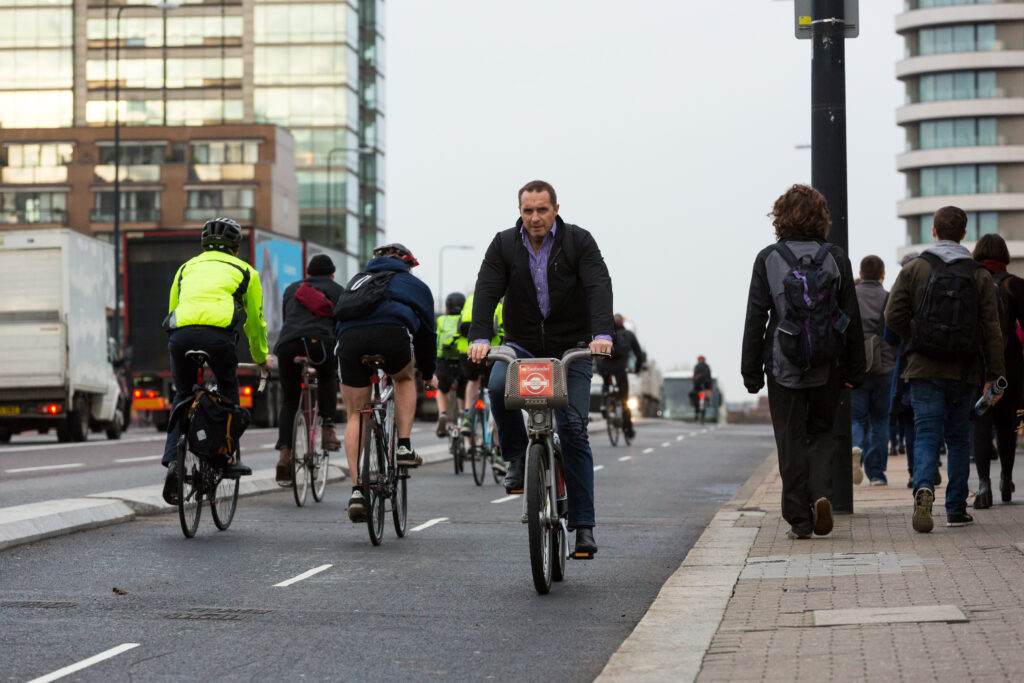
Today, however, London’s cycling infrastructure is bloody brilliant.
There will be people who still complain about it and look at where it could be improved, but when you compare it to just three years ago, the effort and money that has gone into improving it has had a huge positive impact. I rode from Paddington (North Central) to Honor Oak (South East) and for basically the entire journey I rode on segregated lanes or quietways. I had used half of these a lot in years gone by, but everything seems to have come together and created a usable web of routes. It meant I would get to different areas and choose which safe route to take next rather than it just abruptly stopping and forcing me into traffic, as used to be the case.
This is manifesting itself in not just a better experience for me riding from one place to another, but seeing the number and variety of people cycling, it is clearly getting more people on their bikes. Testament to this is that I was in London to go to a gig, the same gig in the same venue I have been to three times with the same people, both of whom aren’t massive cyclists. Every other time we got a tube and a taxi home, but this time there was no question that we would just use bikes.
It’s not just some anecdotal observation either, the numbers back this up. According to the City of London, since 2022 they have seen a 50% increase in the number of cyclists. This coincides with cyclists now making up 56% of all traffic in the square mile during peak commuting hours.
The important thing about those numbers is partly the increase they show, but also where they come from.
I found those on a City of London press release from April this year, but five years ago the Square Mile was one of the most anti-cycling places in London, where nobody wanted cyclists to be. I clearly remember riding through there a decade ago, where the already inadequate cycle lane just disappeared as soon as you hit the changed authority. The Bank crossroads was well-known as a death trap, and there seemed to be reports every few weeks of somebody going under the wheels of a lorry.
Now, the Square Mile is not just a positive case study in how improving cycling infrastructure increases participation, but it is actively sending out press releases about its success. That is some turnaround.
There is no debating that London has more money to spend on this kind of infrastructure than any other city in the UK. Since 2019 the total invested in cycling infrastructure in the capital has been close to £800m. Compare this to the Midlands Combined Authority which includes Birmingham, Coventry, Dudley, Walsall, and Wolverhampton, who had a total of £283m since 2015.
However, I am not bemoaning this. Far from it.
London now stands as a genuine success story that others can follow, and the case study is clear: if you want to improve active travel, invest in your cycling network.




















8 thoughts on “London’s cycling infrastructure is not a showing of inequality. It’s a blueprint for others”
Build it, and build it
Build it, and build it properly, and they will come!
Paint some lines on tarmac, and nothing will happen.
London is miles ahead of anywhere else in the UK. But the real transformation – not just in terms of transformation but in the whole feel of the place – is Paris. Unrecognisable from 10 years ago.
Absolutely but – at least in
Absolutely but – at least in the UK – this may need qualifying:
Build it properly, and where you already have a low percentage of driven journeys (for the country), slow urban traffic speeds (more recent numbers albeit this is from Tomtom), well above average public transport, somewhat effective parking regulation enforcement …
… then they will come!
I cycled through Paris last
I cycled through Paris last summer and it was brilliant, although I did get lost and ran out of data on my roaming allowance.
I don’t wish to bemoan what’s
I don’t wish to bemoan what’s happened in London either – but outer London is still dreadful, with a couple of exceptions. The central zones are getting very good and that is evidenced in the number of cyclists. I also agree with the comments on Paris – we live in London and Paris and I would say the infrastructure in Paris is more contiguous and more widespread, in that it reaches further out.
AIUI the the London plan was
AIUI the the London plan was roughly 25 years working through to 2040, which did strategic (spokes of the wheel “cycling superhighways”) radiating out. In 15 years I will be well into retirement, but I look forward to cycling it.
So taking cycling modal share over time, it can be seen rippling up in Central London, then Inner London, and in time Outer London.
Personally, I find in Paris I can fall of the edge of the new world too easily and too abruptly. So I actually prefer the London strategy – provided the Culture War Carbrain politicians are kept in their matchbox. One interesting artefact for me is that things that the outer boroughs cocked up through salami slicing – sub-standard bus stop bypasses everywhere – are now used as a weapon in the war.
Meanwhile, in my neck of the woods where we now have the Refukkers in control of four local County Councils, who are the Local Higwhays Authorities too – at least until it is all reorganised in 2027, and may be my District Council as well next year, I continue my war of attrition on A-barriers and chicanes, with the aim to create a real off road network of cyleways from those. Even here, where they were downgraded from ATE Level 2 to ATE Level 1, I see more people cycling.
I have still not really decided the arguments I need to make to get the local MP aka teh LeeAnderthal Man, on my side.
I was in Paris twice for work
I was in Paris twice for work last year. The first of those trips left me some time after my work finished before I got my Eurostar train back to St Pancras, so I opted to walk the 6km or so from where I’d had the meeting to Gare du Nord. It was a revelation. I’ve been visiting Paris since I was a kid and was used to the noise and streets jammed with cars. It’s so much cleaner and quieter and calmer now, with a lot fewer cars and far more people on two wheels. I loved it.
Living in London, I’ve seen things steadily improve for cyclists over the decades. I’m going out this evening and will ride my bike into town for a function as it happens. I’d never have done that in the past.
Not to decry London’s efforts
Not to decry London’s efforts, which are good – but I wonder how many cycle trips are diverted from public transport, rather than cars? That may still be a good – healthier, quicker – thing but it might also limit the transferability to other places.
IIRC there has been evidence
IIRC there has been evidence that in London that indeed the case – I think this Graundiad article has something on this?
Ultimately it’s about “alternatives to driving” (even in NL) *. Of course in the UK “but we have long journeys” (although … they have long commutes in NL also). But we probably do have slightly longer average journeys. And even though though a large proportion of UK journeys are relatively short even those may be significantly (for active travel) longer than in NL (see “drive to supermarket” vs. “pick up groceries at local shops in passing“).
So … initially it will be drive vs. public transport. (vs. “actually I don’t have to make the trip” – which tends to be a harder ask, even though often true).
That is until either a) the motor vehicle fuel runs out or all the power runs out, or b) everyone takes to the matrix so we don’t mostly don’t physically travel places.
* Motoring is great, and motor vehicles offer a pretty good “do many things” one-stop mobility solution. Except … that unfortunately mass motoring is a net economic drain, terribly space-inefficient and has lots of other negative side-effects. And it’s self-catalysing and suppresses other modes. (That is, once it’s established, which actually took much political choice, promotion, deliberately destroying other stuff to “make room for the car”, expensive building of infra, legendary sales technique defending the indefensible etc.).