



“Hey, hey, take my picture, please!” a man in orange, surrounded by other men dressed in orange, shouts in the direction of our group, which contains two photographers, as we disembark from the cable car that’s brought us halfway down cycling’s most iconic theatre, Alpe d’Huez.
As we turn towards him, the man – a few beers deep, as we soon discover – bends over and pulls his shorts down, revealing a startlingly hairy backside. His friends roar with laughter. We carry on walking down the steps.
Alpe d’Huez, baby.
The 13.8km climb, with its 8.1 per cent average gradient and 21 evocative switchbacks, is pro cycling’s Mecca. Other climbs, like the Angliru or the Mortirolo, are tougher. Mont Ventoux is more mythical, more foreboding.
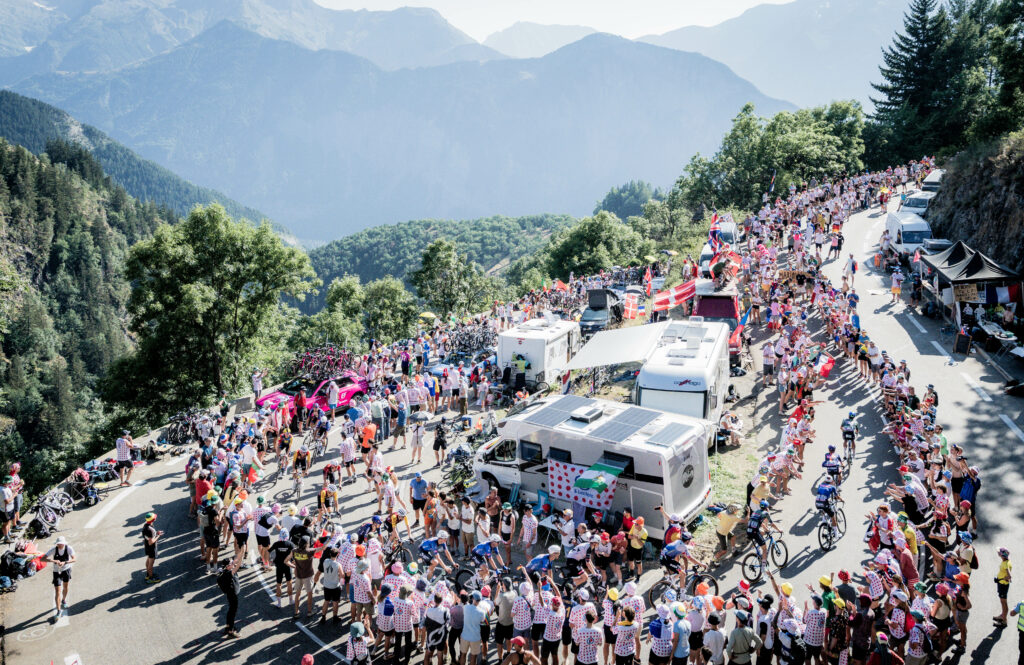
But there’s no place in cycling that draws a crowd like the Alpe. 600,000 people, according to some reports, are said to have descended upon those 21 famous hairpins on Friday afternoon.
Some were there for the entire week, staking out the perfect spot to roar on Tadej, Paul, and the rest. More than a few of them stayed an extra 24 hours, packing the ski resort for its condensed encore after the race returned to the Alpe for the second day in a row, via the more isolated Col de Sarenne, closed to the public towards its summit.
> Why Alpe d’Huez is the Tour de France’s most iconic climb – maybe – even if it isn’t the best
Those kinds of numbers, packed on Friday within the space of just 14 rowdy kilometres, bring noise, passion, and spectacle to the Tour. They provide the images that make the race, that captivate those sitting at home, and make those at the roadside desperate to come back for more.
But they also bring danger, and a sense of unease among the riders, race organisers, and those with a nervous disposition, who watch the best bike racers in the world navigate an ever-narrowing corridor of raucous, well lubricated fans through their fingers.
Alpe d’Huez, after all, is rooted in that duality, that fine line between passion and excess. It’s a climb of two faces, a metaphor made literal by the Tour’s eerily serene Sarenne detour, the new alternative route the quirky, quiet younger brother to the Alpe’s loud, swaggering, perennially drunk rugby player.
With rugby-style chanting and drinking games in mind, after getting off the cable car I made my way down to Dutch Corner, that most revered of hairpin congregations, picking my way through a sea of sunburnt fans, taking care to step over their empty beer tins.
I passed families sat peacefully under their campervan awnings, people sleeping in the shade, their caps pulled low, nestled amongst teenagers in cow onesies, middle-aged Englishmen dressed as Power Rangers, and a group of friends wearing matching bright yellow t-shirts and shorts adorned with ducks. When I asked one of them about their apparent love of ducks, they shrugged and told me they had simply bought the first yellow thing they’d found in the shop.
Unfortunately, Dutch Corner, as I feared, was a bit of a bust. What was once a boisterous orange carnival has been neutered by safety-conscious barriers, ridding the Alpe of its most vibrant spot. That parting of the Dutch sea into carefully separated rivers has also, some teams and colleagues have suggested, succeeded only in pushing fans onto other barrier-less bends, creating issues elsewhere.
Accordingly, I trudged back up the hill through Huez village, just as the race caravan, and its bleary-eyed, constantly dancing and smiling sweet and tat-throwing passengers, passed through. The party atmosphere upped a notch at this point, as fans scrabbled to score some stray bags of Haribo. A brilliantly crafted tat-grabbing net, made to resemble an open-mouthed Paul Seixas, was particularly successful. Meanwhile, I was hit in the side of the head by a hi-vis wristband telling drivers to share the roads with cyclists and give them space. How very road.cc.
Things weren’t as joyous on other parts of the mountain, however, with footage emerging online of two men, old enough to known better, fighting over a packet of Lenor (I imagine).
(Later on Friday evening, one prominent cycling journalist described his journey up the Alpe on the morning of the stage to me as the “worst” he’s ever experienced in his four decades following the sport, thanks to the unruliness of the roadside fans, banging on and shaking his vehicle for the duration of the climb.)
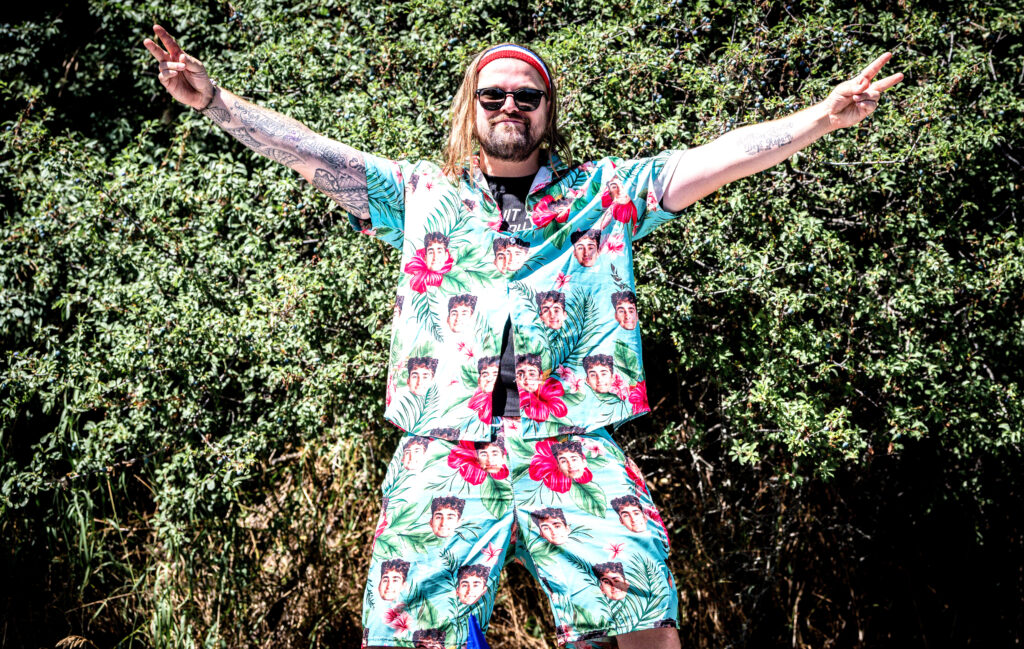
I ended up at Turn Six, Bugno Bend, where a group of Seixas enthusiasts were leading the crowd in a game of ‘sit down, stand up, jump around’. Seated crowd surfing also proved a popular pastime before the riders arrived, as a Blondie playlist bellowed from someone’s loudspeakers.
Sam and Izzy, a couple from Somerset, had been stationed on Turn Six since Monday, and so were able to soak in, first-hand, the crescendo-like atmosphere as it built in intensity towards the big day.
“There were only one or two cars on each bend when we arrived,” early bird Sam tells me. “But now look at it, there are so many people. It’s been very rowdy, we didn’t get much sleep last night.”
“I don’t even like cycling,” laughs Izzy. “I’m only here for him. But I’m in the mountains, and it’s been fun. So I can’t complain.”
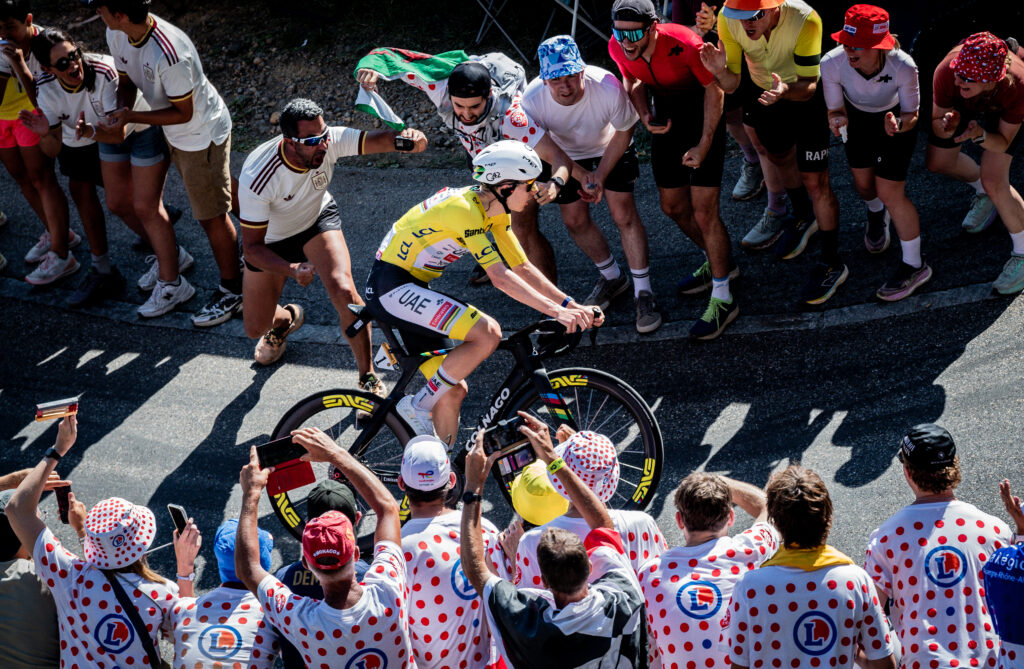
Down on the hairpin itself, Swansea cycling fan Lewis only turned up a few hours before the race, after hiking up the backside of the Alpe.
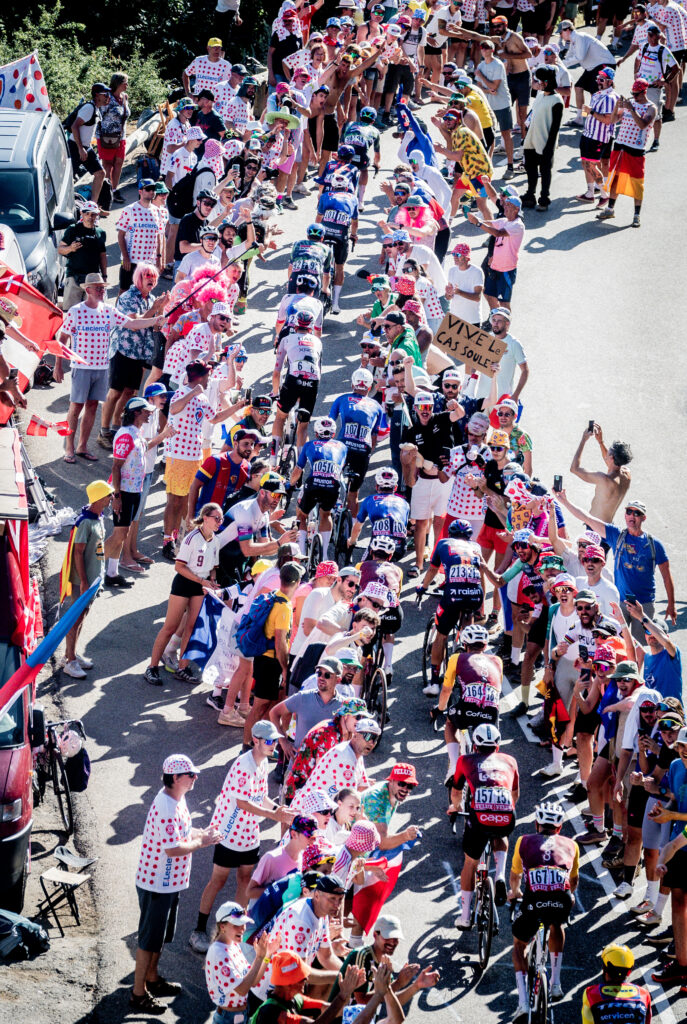
“It’s like a football stadium on the side of a mountain,” he says, gazing around at the crowds, who have by now all left their spots in the shade to converge on the road, narrowing it from two lanes to one.
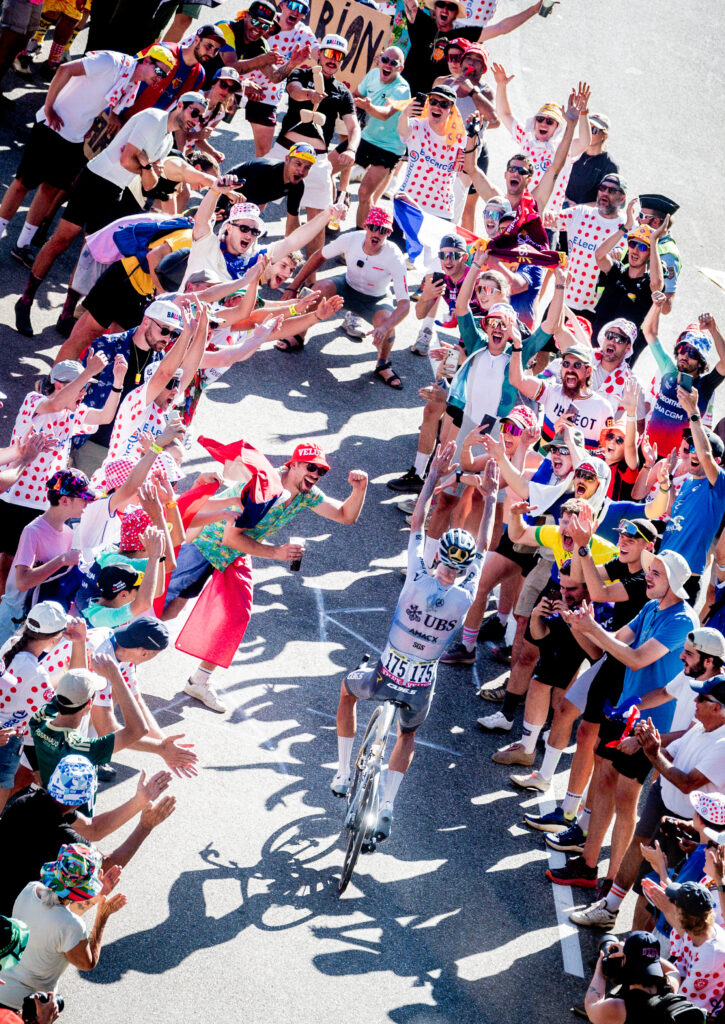
It’s even narrower when Richard Carapaz and Lenny Martinez finally arrive, the leading duo finding just enough space as they lean left through the bend and fans scream into their faces.
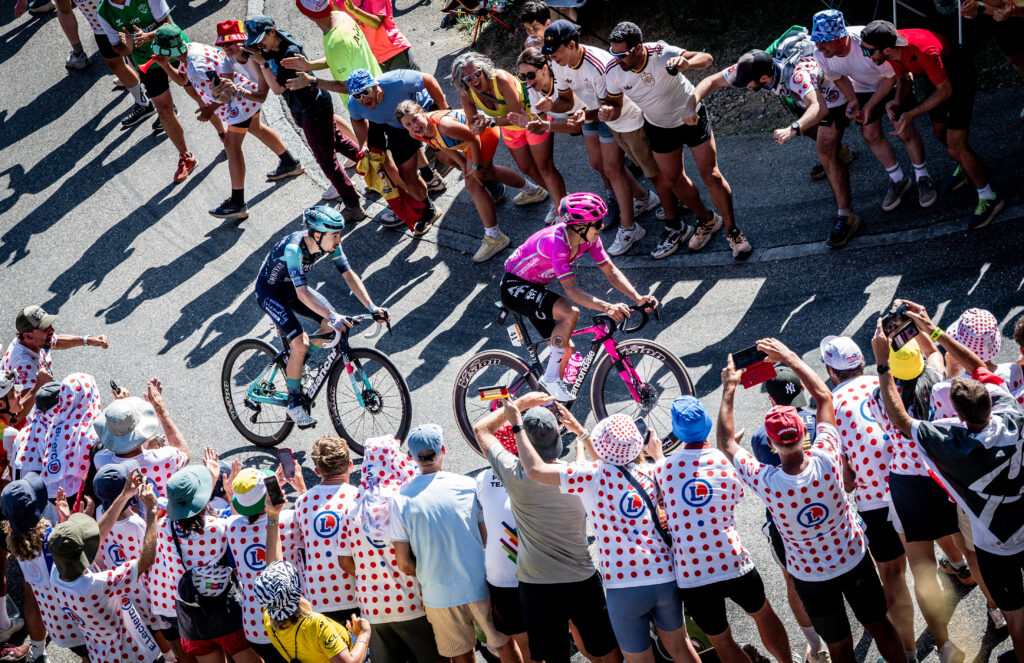
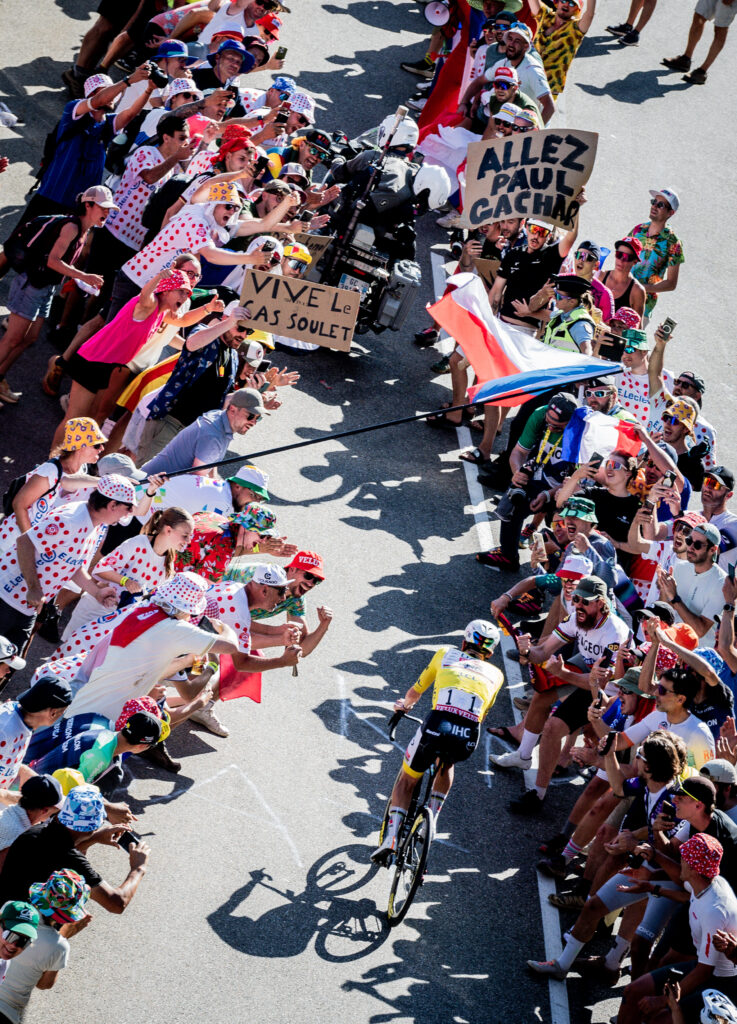
As a spectacle for fans, Alpe d’Huez is unparalleled in sport. When Tadej Pogačar appears, he’s so close you can – despite his record-smashing pace – stare into his face, study his grimace, spot the salt marks on his black shorts, appreciate the strain of something that on television often appears effortless.
But, like everything on Alpe d’Huez, there is another side to the proximity afforded by bike racing, and exaggerated in the unique atmosphere of its most famous climb. Further up the road, a Remco Evenepoel attack was thwarted when the motorbikes in front of him were held up by encroaching fans, slowing the Belgian.
More seriously, close to where I was standing, a young fan was hit by the driver of the EF Education-EasyPost team car, and Movistar’s Einer Rubio was left bloodied and battered when he smashed headfirst into the rear windscreen of the UAE vehicle following the yellow jersey, whose driver stopped suddenly to avoid hitting a spectator who fell into the road.
When it came to the racing itself, the duality of the Alpe – and its history of suspicious, rocket-fuelled performances – came to the fore on Friday afternoon, as Pogačar smashed Marco Pantani’s EPO-driven 31-year-old climbing record by almost a minute and a half.
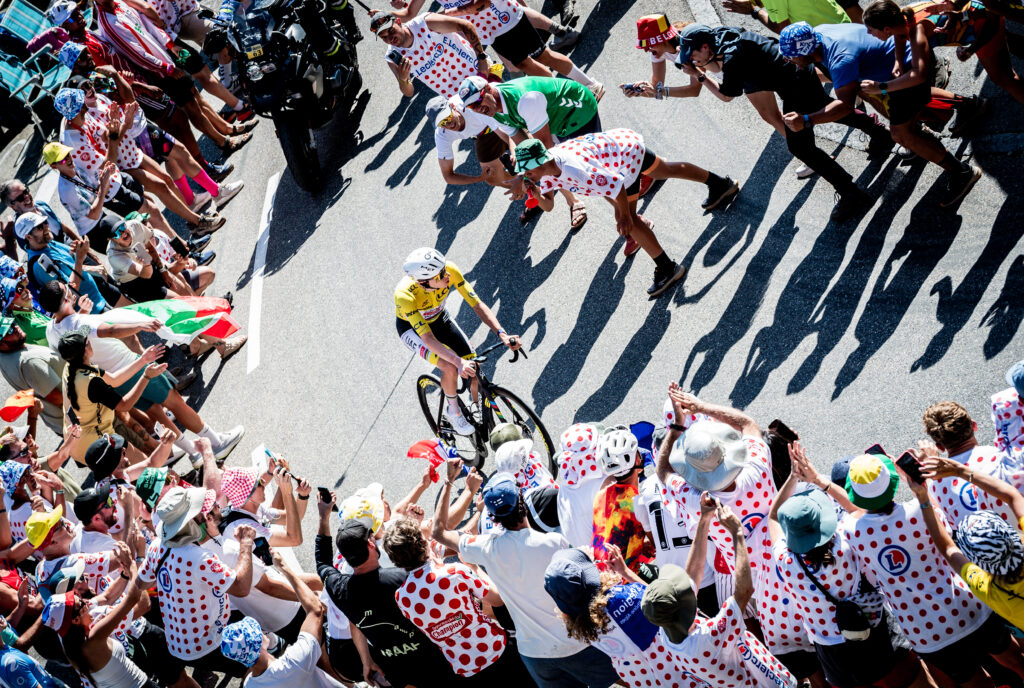
The Slovenian’s spectacular ride, clawing back the break to win solo, was one for the ages, but also one that has raised eyebrows among those familiar with the Alpe’s sordid past.
Not that anyone on the climb, at least outside the press room, cared that much. The fans who lingered in the town centre, long after the podiums were done and dusted, were treated to the sight of Pogačar riding with his press officer back to his hotel.
They greeted the yellow jersey with a deafening cheer. He responded in turn by raising one arm to the sky and twirling his index finger, conducting the orchestra on the Alpe.
A few minutes later, I saw Pogačar’s mechanic chase after a mischievous youth who apparently got a little too close to the Tour leader’s bike. The kid was given a stern telling off, and the bike was promptly put back into the truck, away from prying eyes and roaming hands.
The two faces of Alpe d’Huez, laid bare once again.











2 thoughts on ““It’s like a football stadium on a mountain”: The chaotic duality of Alpe d’Huez”
The orchestra of the alpe…nice story Ryan. I reckon the madness is more rock concert than football stadium. Whatever, it’s the best stadium in the world! …more containment would kill it, yet some more effective policing of idiots might prevent someone dying one day. …But as you say it’s the tension that makes it. That’s d’Huez’ rock n roll.
Just thinking about this but, if fans are camping out for days all the way up, those backwoods are going to stink. Ewww.