


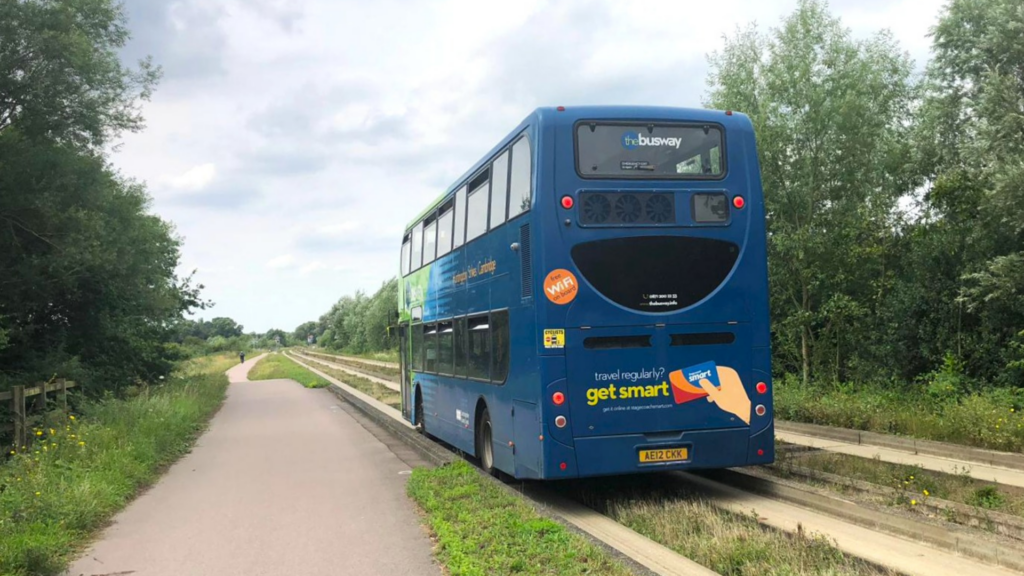

Cambridgeshire Police are to begin stopping cyclists riding faster than 15mph along a shared use path as part of an ongoing series of safety measures.
In the summer of 2025, Cambridgeshire County Council announced it would introduce a 15mph speed limit along the ‘maintenance path’ which runs parallel to the county’s Guided Busway network. Cambridgeshire Live now reports that the limit has been made “mandatory”.
The network spans from Trumpington, south of the city of Cambridge, to Huntingdon railway station and St Ives. The majority of the 16 mile (25 kilometre) network is on a specialist route closed to other road users, though pedestrians, cyclists and hired e-scooter users are permitted to use the adjacent maintenance path.
The introduction of the 15mph limit follows the deaths of three path users since the former railway lines opened as a busway in 2011. One cyclist, Steve Moir, was killed in 2018 when he clipped a kerb on the shared path that runs along the busway and fell into the path of a bus.
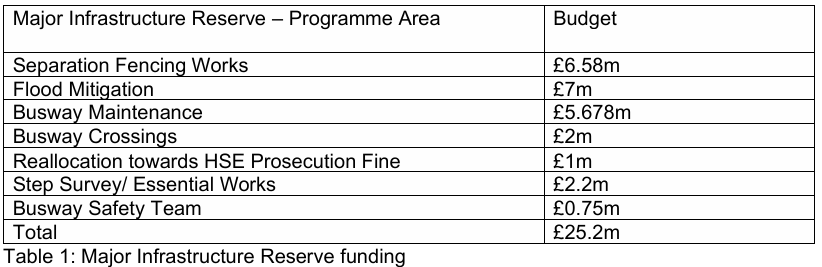
The Health and Safety Executive served a prosecution summons to the council in May 2024. The council was fined £6 million and ordered to introduce a broad package of health and safety measures. The total cost of the package is budgeted at £25.2 million.
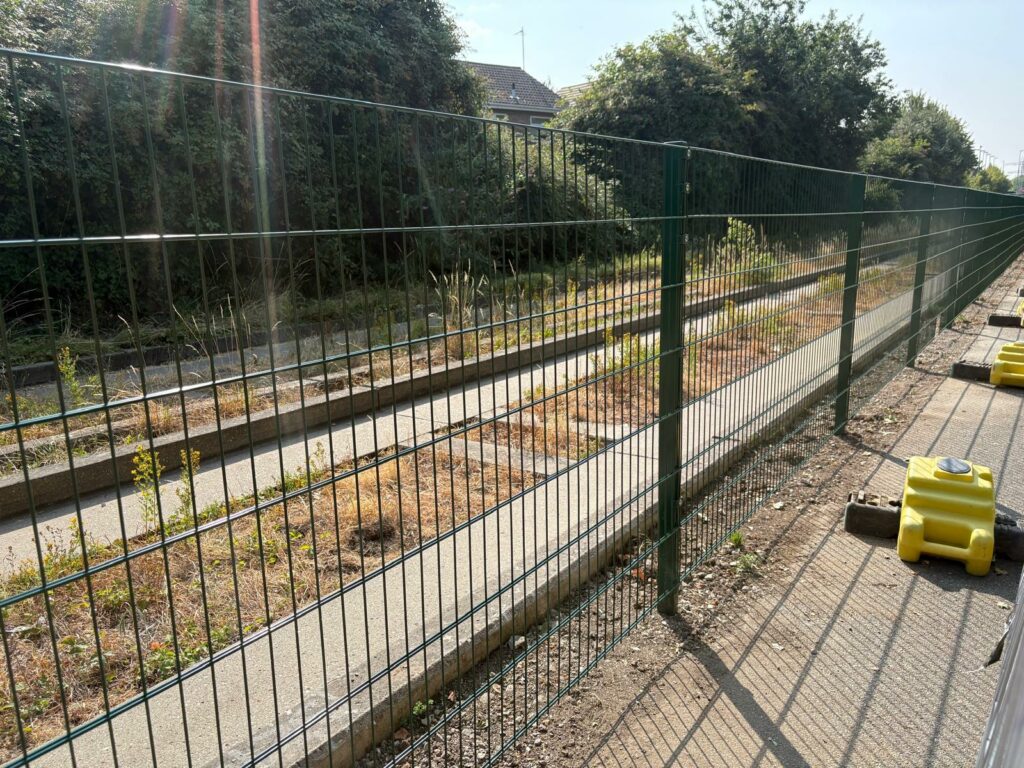
Bus speed limits have been temporarily reduced from 50mph to 30mph, dropping to 20mph at crossing points, whilst construction of physical barriers between the path and the busway has also been ongoing and is expected to be completed within the next year. The 1.5m “off the shelf weld mesh fencing, customised with mammal gaps and matching gates” is also intended to reduce the possibility for buses to be obstructed.
Following recurring flooding of the maintenance path, many path users have previously taken to deviating from the path and travelling close to and on the busway, and have been accused of “holding up” buses in the process. Flood mitigation measures are also included in the latest package of safety improvements, however a council report from June endorsing the latest safety measures warned, “There are a number of complexities associated with delivering the flood mitigation due to physical and budgetary constraints.”
The report also warned that a proposed bridge over regularly flooded areas would be “prohibitively expensive,” whilst a proposed “floating pontoon system” would cost in the region of £7 million. Work is not set to begin on implementing flood mitigation measures until spring of next year.
Following the completion of the safety works, the bus speed limit is set to rise back to between 40 and 50mph, “depending on the characteristics of individual sections, with junctions remaining at 20mph.”
Announcing the latest tranche of measures in June, Councillor Alex Beckett, Chair of Cambridgeshire County Council’s Highways and Transport Committee, said, “The Guided Busway is one of the most important transport routes we have in Cambridgeshire. It connects so many of us to each other and to schools, jobs, hospitals every single day. Keeping it safe is vital.
“I understand and appreciate the concerns that have been raised around the Busway safety works and we would like to thank everyone for their patience with the disruption whilst works are underway.
“I’d like to make clear that these works aren’t optional. We’re doing everything reasonably practicable to keep the Busway and the path open and safe for everyone who relies on it.”
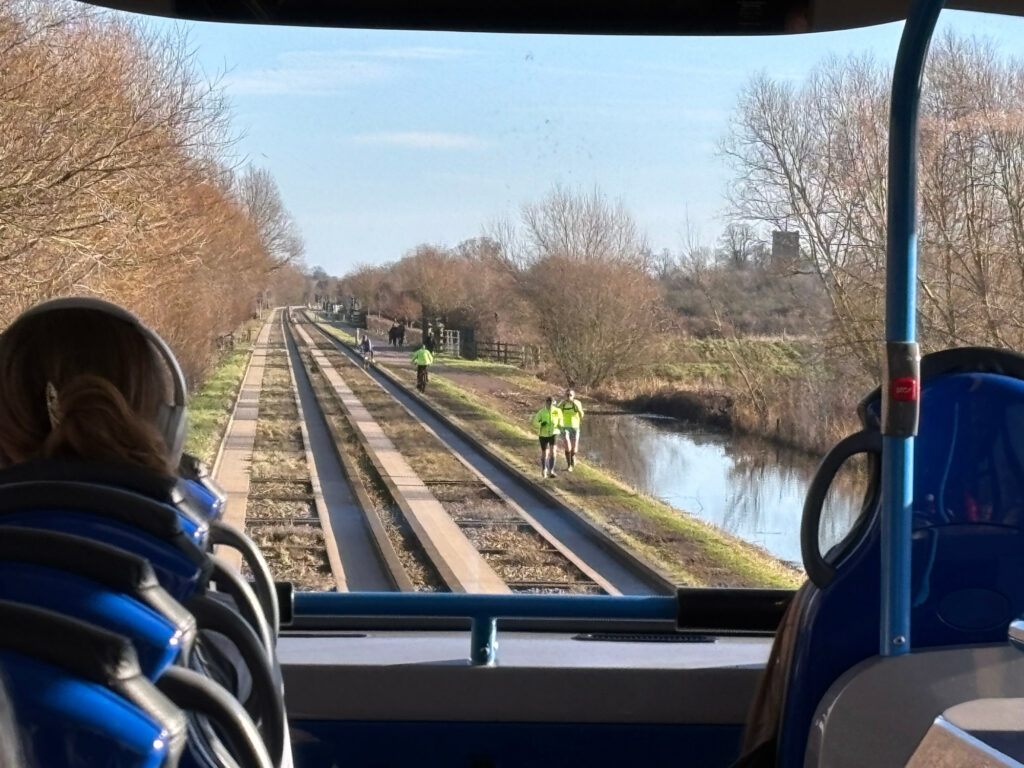
A spokesperson for the council also told Cambridgeshire Live that the mandatory speed limit was “an important control measure to enable safe active travel for all users of the shared use pathway.
“It also compliments the other Guided Busway Safety measures and is intended to reduce accidental conflict between users of the shared use track.”
Interest in the Guided Busway’s 15mph speed limit grew this week with a story in The Telegraph describing the ‘maintenance path’ as “Britain’s first 15mph speed limit for cyclists”. However, legal e-bikes have a motorised speed limit of 15.5mph, whilst the busway’s speed limit has already been in place, though not with the same level of enforcement as is now seen.
Cambridgeshire County Council has installed flashing signage warning speeding cyclists at fixed points along the busway path. Speed limits have also been painted on the ground, whilst “a dedicated police patrol”, alongside a “busway safety team”, are reported to be using speed monitoring equipment to catch those “clearly exceeding the limit”.
Anyone breaking the limit will be stopped by enforcement officers and advised to slow down, with repeat offenders expected to be met with harsher treatment such as fines.
However, given bicycles are not fitted with speedometers, coupled with concerns over the margin of error and calibration of speed guns designed for measuring cars, it is unclear how enforceable the speed limits will be. QR codes have also been posted on signs encouraging path users to report dangerous or anti-social behaviour to the authorities.

Further, whilst the Telegraph is correct that the Busway represents Britain’s first 15mph speed limit exclusively for cyclists, it is not the first speed limit which cyclists are obligated to follow. The Square Mile of the City of London has applied its 20mph speed limit to bicycles as well as vehicles.
Meanwhile several Royal Parks have applied their vehicular codes of conduct to bicycles, where speed limits vary between 5 and 20mph, though those restrictions are not legally enforceable.
However Wandsworth’s Parks Police has issued Fixed Penalty Notices to cyclists exceeding 12mph in Tooting Bec Common. The police enforcement followed a campaign by local residents who warned “a serious accident is waiting to happen.”












22 thoughts on “New police “safety patrol” to stop speeding cyclists on shared path… but only when they’re “clearly exceeding” 15mph speed limit”
It’s all to distract attention away from the road users who do most of the killing and injuring on our roads: car drivers.
So they limit the speed of cycles because people have been killed by busses???
Seems legit – we like to lump cyclists and buses in the same lanes (being essentially the same kind of transport obviously). So the cyclists can help to slow down the buses!
@chrisonabike So the cyclists can help to slow down the buses!
But it doesn’t work- at least, not where Lancashire Constabulary and Stagecoach NW are concerned
ttps://upride.cc/incident/px12dnv_stagecoach41_closepass/
@ChasP Not quite – that’s just confused reporting. The other safety measures have been put in place in response to people being killed by buses. That’s squeezed the space available to other users. Then the (increased enforcement of the) speed limit has been introduced in response to the situation of different modes having to share an inadequate space.
@mdavidford yes! That’s what we understand by “making it safe for vulnerable road users” (even if not on roads) here!
Open the space to motor vehicles “to share”, then when the casualties go up, shove all the non-motorists together into less space “for safety”. Let the resulting fight over scraps reduce the “problem road users” * still further!
* The problem not being that they “don’t pay road tax” but there’s not a billion-(trillion?) pound walking and cycling lobby. Although why the cake-sellers aren’t also involved I don’t know. Shurely more cycling, more fuel (cake) sold?
Not sure what “clearly exceeding the 15mph speed limit means.” But it seems to me that this 15mph speed limit is unnecessary.
The path beside the guided busway is heavily used at times, with cyclists, pedestrians and runners travelling in both directions, meaning that 15mph is unachievable much of the time.
As the busway is built on an old railway line, the path is mostly straight, with long sweeping bends, meaning that visibility is good. I can’t see a problem with cycling at higher speeds when the path is less busy
Having lived in Cambridgeshire for 15 years, I find it incredibly difficult to believe that there will be a “dedicated police patrol”
@Sedis I find it incredibly difficult to believe that there will be a “dedicated police patrol”
I don’t. They can just nab the odd cyclo-villain and ‘throw the book at them’, while sitting around at the station the rest of the time writing badly-spelled essays bemoaning ‘lack of resources
It seems a huge missed opportunity with the guided busway to put a separate cycle path and footpath along with some segregation between them. Would have been much cheaper to do it while it was being built, rather than retro-fitting now.
@thereverent I suppose it depends on whether the busway builders owned or were able to purchase any land beyond the width of the original railway. For instance about half a mile of the busway butts up against the perimeter of the Chivers Hartley jam and jelly factory at Histon. On the factory side there is a site road and lots of services and it is highly unlikely that a strip of land would have been offered for sale.
More use of compulsory purchase is needed. Active travel route providers need the same kind of financial and legal power that Highways England and analogous bodies have.
On the other side to the jam factory, by the junction in Histon, the busway path narrows as it goes past the bus stop and housing. It is the kind of pinch point where enforcement of the limit is most likely.
Yes. Local users of the maintenance track have said such things. Continuing to say them to decision makers is likely to encourage better decisions.
I look forward to the stats being published showing the reduction in KSIs is big enough to justify this nonsense…
Whilst nowhere near enough time, energy and money is spent on reducing the much bigger cause of KSIs.
Logical: use limited police resources/intelligence to deal with the number one killer of U25s; drivers (source:WHO) and the biggest deterrent to cycling; close passing drivers.
UK policing mindset: Follow the Murdoch brainwashing mode and target people riding bikes at over 15mph, despite a bike speedo not being a legal requirement.
I. Wouldn’t use a cycle lane with a 15mph limit
@stonechat Why not? Isn’t that a bit like drivers moaning about 20mph limits? Sure, if you’re a racer in training that could be limiting, but then you shouldn’t be using cycle tracks for that anyway. Most commuters, shoppers and leisure cyclists ride around 15 mph anyway and rarely exceed 20 mph on the flat; the path is 16 miles long, so the difference between 15 mph and 20 mph even if you’re riding the whole length (which most people won’t be, of course) is 64 minutes versus 48 minutes, not enough to make a big difference in anyone’s day. My most regular ride of around 16 miles is to my mother’s house on heavy-traffic roads across southwest London; due to congestion, traffic lights et cetera it usually takes me about 50-55 minutes. If someone offered me a completely motor-traffic-free path for the whole distance on condition that I took an extra 10 minutes for the ride I’d bite their hand off!
@Rendel Harris When I lived in Cambridge, I regularly used the busway for training rides, as did plenty of others. Particularly heading north from Cambridge towards St Ives, it’s generally pretty wide, pretty quiet (it’s not especially popular with walkers) and has very good visibility and few junctions. Being pretty much pancake flat, even a mediocre cyclist like myself could comfortable exceed 15mph. As with any shared path you should of course show consideration to other users, and this may mean slowing down sometimes, but the idea there needs to be a blanket 15mph speed limit at all times and along the entire length seems ridiculous to me.
This isn’t a cycle lane – it’s a shared use path (a service track with permitted shared use).
Under what law?
Under the law of it’s their land and they can do what they like.
“The Square Mile of the City of London has applied its 20mph speed limit to bicycles as well as vehicles.”
Bicycles are vehicles.