


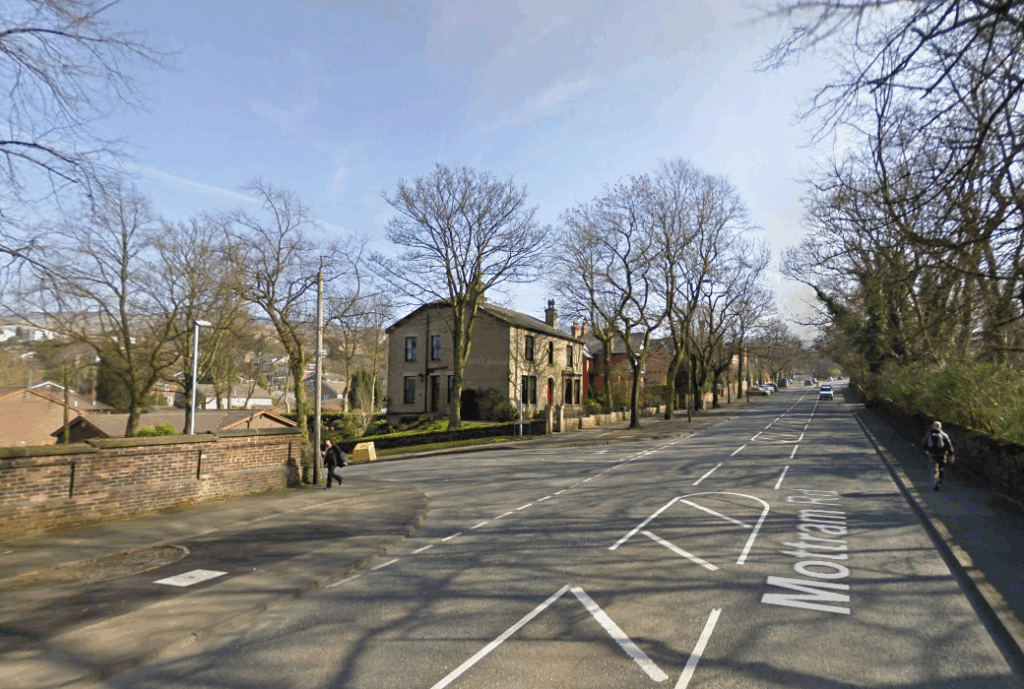

The husband of an 80-year-old woman killed in a collision with a cyclist taking part in last year’s Tour de Manc sportive has called on the government to enforce legal speed limits for people riding bikes, after an inquest into her death found there was no evidence to prove the rider was breaking the speed limit at the time of the fatal collision.
Patricia Jenkins was crossing the Mottram Road near Stalybridge, Tameside, at around 12pm on Sunday 4 May 2025 when she was hit by 41-year-old John Andrew, one of 1,200 cyclists taking part in the Tour de Manc sportive, an annual non-profit cycling event which raises money for a host of charities.
The 80-year-old pedestrian suffered a serious brain injury and broken ribs in the crash, and died in hospital three days later.
Manchester South Coroner’s Court heard last week that Mrs Jenkins was returning home from Cheetham Park with her husband Anthony when she crossed Mottram Road towards her house, at the junction with Fern Bank.
> Pedestrian, 80, dies in collision with cyclist during Tour de Manc sportive
The inquest was told that the part of the road where Mrs Jenkins crossed featured a 30mph speed limit and was a downhill section on the sportive’s route, where cyclists could allegedly “fly” and reach “car speeds”.
Anna Morris, the assistant coroner, said John Andrew had overtaken a number of other cyclists on the road in the moments before the collision, before approaching Kristian Birtwistle, who told the inquest that he had been travelling at up to 29.83mph at the time.
Mr Andrew, meanwhile, said that he had been riding at “at least 27 miles per hour”, a claim accepted by Morris, who noted that “there was no evidence” to suggest that he had exceeded the road’s 30mph speed limit.
The cyclist said he was aware of the 30mph speed limit on the road and had applied his brakes while descending, though he admitted he was unsure how often. He also stressed that he was not aiming for a fast time at the sportive, insisting that his only “goal” was to complete the event for the first time, adding that “whatever time I finished was a win”.
Police officers also reminded the inquest that speed limits do not apply to people riding bikes in the UK.
Footage from Mr Andrew’s bike camera showed that he had 1.93 seconds to respond once Mrs Jenkins became visible on the road, applying his brakes after 1.3 seconds, well above the average reaction time, the court heard.
He told the inquest that he had veered to the right before hitting Mrs Jenkins in the road’s central hatchings.
“I wish I could have done more,” he said. “In hindsight I would have moved left.”
One eyewitness to the fatal crash, Benjamin Ashworth, was driving 650ft behind Mr Andrew and Mr Birtwistle, and said “they must have been doing 30s… going as fast as a car”.
“I thought, ‘Has he not seen her?’ She was right in front of him’,” he said.
Ella McCalman, another witness, told the inquest that the cyclists were “going at some pace… travelling downhill”, noting that Mrs Jenkins “briefly glanced right” crossing the road before a “thud… [and] she completely flew”. A third witness suggested that Mrs Jenkins may not have looked before crossing the road.
Ahmed Abou-Zeid, a consultant neurosurgeon who treated the 80-year-old at Salford Royal Hospital, said a referral form stated she “was hit by a road bicycle at a high speed which was presumed to be over 30mph”.
Her husband, Anthony Jenkins, told the hearing that he believed his wife had “misjudged” the cyclists’ speed on a road which she regularly crossed, and that motorists “tend to respect the speed limit” in the area due to a nearby speed camera.
Police officer Adam Dixon added that “nothing could be obtained” from Mr Andrew’s Karoo bike computer, Strava, mobile telephone, and smart watch to accurately assess his speed at the time. He also noted that the cyclist’s 360 degree camera had distorted the image, making it impossible to determine Mr Andrew’s speed.
Det Con Aaron Cramer, who led the investigation, said “there wasn’t a realistic prospect of a prosecution” and he was “not satisfied Mr Andrew’s [cycling] manner amounted to wanton and furious driving”, which until the government’s new Crime and Policing Bill was given royal assent last month, was the only means of convicting cyclists involved in the death of a pedestrian.
Assistant coroner Anna Morris said Mr Andrew had provided “credible evidence” about his speed. Recording Mrs Jenkins’ death as a “wholly unintended and tragic accident”, she added that she understood the “frustration the family and police feel about the lack of data”.
Following the hearing, Mr Jenkins called on the government to begin legally clamping down on cyclists who break the speed limit.
“It’s unbelievable that cyclists can still not be prosecuted for speeding in this country,” he told the Telegraph.
“Bikes can go at a substantial pace and I know they can exceed the speed limit where the accident happened.
“The cyclist had a bike computer, a Garmin watch, cycling apps on his mobile phone, and a camera. But the police could still not establish his speed to a provable level.”













51 thoughts on ““It’s unbelievable cyclists can’t be prosecuted for speeding,” says widower of pedestrian killed by rider travelling “as fast as a car” in 30mph zone during sportive”
The speed thing in the newspaper is a red herring culture war thing to wind up the basement-dwellers of Tunbridge Wells.
The police have offences of Careless and Dangerous Cycling availabel to them, with which he could be charged.
In the absence of such charges, we have to conclude that he did nothing wrong and gave a credible account of himself – as per the statement from the coroner.
There is no evidence to suggest that the cyclist was speeding. But let’s assume that the cyclist was speeding just because it is downhill and possible to do so. And let’s clamp down on all speeding cyclists (even though there weren’t any involved here). And by the way it’s a disgrace that despite the cyclist having a garmin a phone and a camera the police could still not prove he was speeding ( even though it’s unlikely he was)
I think the key witness statement could be that the woman glanced briefly to her left and may not have looked properly or may have underestimated the speed of the cyclist.
A tragic case and loss, but the argument that because someone was killed, therefore someone must have broken the law is not a valid one.
Sorry right not left.
I suspect that a gps speed estimate is challengeable in court, but with the widespread adoption of 20mph limits, speeding cyclists has become an issue in some circumstances, I don’t think unreasonable for pedestrians to expect cyclists to respect the speed limit. Estimating the speed and distance of an approaching cyclist is difficult, particularly for a older person.
Pedestrians and drivers tend to assume that cyclists are only capable of a certain speed, and can get caught out when the actual speed differs from their expectations. That is not the fault of cyclists.
If she’d stepped out in front of a car being driven at the speed limit, would this be seen as anything other than tragic accident?
The Royal Park death a while back where despite signage warning road users to slow and a 20mph speed limit, a woman was killed in circumstances where had the cyclists been travelling at modest speed she most probably wouldnt have been. I see no good reason why speed limits shouldnt apply to cyclists, the current situation is a legacy of a time when bicycles didnt have ready access to speed meters and only a tiny proportion of riders and machines were capable of exceeding 30mph in the absence of a steep hill. The speedometer argument doesnt really stand as vehicles registered before 1932 do not have to have one, yet are subject to speed limits. Now that many cyclists are routinely capable of sustainably exceeding 20 and 30 mph limits and have and use gps devices to tell them how fast they are travelling I see no adequate reason not to apply the speed limits to all road users.
How would one enforce speed limits on cyclists? First, one would have to mandate that bikes had a speedometer, doable for new purchases but then you’d have ensure every bike used on the road is retrofitted. They’d have to be impossible to remove, perhaps be regularly tested. And before you even finish reading that you know that the cost would far outweigh the benefits and would be an idea swiftly shelved. The law is robust enough to deal with the one or two deaths a year that involve a pedestrian and a cyclist (the stat’s don’t reveal whether it was the pedestrian or cyclists who died). Over 1600 people are killed by motorists every year in the UK but, heck, that’s just the cost of being able to move around.
Lower speed is likely to have helped in both avoiding accident at all and mitigating consequences but that’s not a slam-dunk, especially when the victim is frail.
In the case of the Royal Park incident – as all of them and indeed motorists with or without speedometers – and whether or not road users were going within the speed limit – I believe it is still possible to bring charges (eg. if someone is killed). *
In the “poster child” case (the killing of Kim Briggs) the cyclist was convicted despite IIRC not being held to be going above the speed limit for motor vehicles.
Here’s another cyclist who AFAICS wasn’t held to have been speeding but cycled through a red light and killed someone – and was jailed: https://www.bbc.co.uk/news/uk-england-london-58009784
In the Regents Park case I’m not sure it’s simply “they were ‘speeding’ but that’s not criminal so we can’t touch them”. Although that was a common summary in the media. Again if the cycling was dangerous I don’t see why they could have been charged **. Nor that that the police couldn’t have stopped them earlier if they thought the riding was unsafe (less certain on that) – though * IANAL.
** As we all know we’re not drowning in road police and their time is … very carefully allocated.
@Robert Hardy
You’re tapping a rich vein of nonsense today, aren’t you? The cyclist in the Regent’s Park collision was doing 25mph (perfectly legally as speed limits do not apply to cyclists, so “ooh he ignored the speed limit sign” has no validity). According to an independent eyewitness, who was jogging past at the time, Mrs Griffiths stepped into the cyclist’s path when he was two metres away from her and the cyclist (witness account) “had no chance” of avoiding her. At 25mph the time between her stepping out and the collision would be 0.18 seconds, at 20mph 0.22s, at 15mph 0.3 seconds, at 10mph 0.45 seconds. People with the fastest reaction times (identification of hazard, processing of information and starting to brake) manage about 0.7 seconds, the average is around 1.5 seconds. Thus even if the cyclist had been doing 10mph, he would still have hit the lady. Much as the relatives (understandably and forgivably) and Ian Duncan Smith (despicably and for propaganda purposes) would like to believe Mrs Griffiths died as a result of reckless cycling there was one reason and one reason only for the collision, and that was that she stepped into the road in front of a cyclist when he was two metres away.
Rendall Harris, Which is why speed limits should apply to bikes, yes of course ,as with traffic laws applyed to cars, enforcement is a problem, but at the time of the Regents Park death I was shocked by the utter self entitlement shown by many posting on here, perhaps including yourself and the apparent indifference to the death of a vulnerable road user. The same physics apply to a cyclist as a car, impact energy rises the square of velocity. If you want to set personal speed records and ride in aero position, pay to use a velodrome, otherwise slow down. We expect to be treated as vulnerable road users ourselves, it is beholden on us to ride in shared public spaces with proper consideration and the awareness that there are frail people out there with poor eye sight.
@Robert Hardy So if the cyclist had been riding at the 20mph speed limit instead of 25mph and the lady had stepped into the road in front of him when he was two metres away the outcome would have been different? Nobody is indifferent to the lady’s death but having sympathy for her and her loved ones should not encompass trying to shift the blame for the collision away from where it quite clearly lies. Claiming that people stating the proven facts of the case are being entitled and indifferent to the lady’s death is extremely cheap but unsurprising, given your generally anti-cyclist agenda.
You show your ignorance or your bias in the statement that cyclists can routinely and sustainably exceed 30 mph. The fastest ever Tour de France stage averaged 31 mph. That’s on closed roads, with the draughting gains of team risding and the world’s top road cyclist not an at all routine. I ride more miles than your average cyclist, have ridden for hundreds of hours and thousands of miles so far this year and some of those miles are undertaken in areas with lengthy steep hills on open 60mph roads where I can get up some speed. My GPS shows a total time exceeding 30mph that can be measured in seconds so again not routine or sustained. Even lengthy (measured in minutes not seconds) stretches above 25 mph are rare. And there is a reason why GPS computers on bikes / watches can’t be used in evidence – they aren’t designed to record exact speeds. Speed being distance over time can be distorted if the time period is short and the distance is not particularly accurate. They only take a reading every second or so and are only positionally accurate to the nearest 5m or so giving potential for the recorded change in position between two consecutive readings being 10m more than it actually was which adds up to 22mph to the actual speed. Thats why my GPS will often give a maximum single reading speed for the ride that is both way in advance of the possible speeds I can achieve and is recorded whilst going up hill.
@Robert Hardy
> The same physics apply to a cyclist as a car, impact energy rises the square of velocity.
Your missing an important variable, mass.
KE = (1/2)mv2
So if it’s all about the physics of kinetic energy, then if the speed limit for cars is 30 mph, the appropriate speed limit for cyclists would be 300 mph.
@Robert Hardy that’s a stretch – “now that many cyclists are routinely capable of sustainably exceeding 20 and 30 mph limits”…many cyclists?
@Daveyraveygravey The ones who are actually moped riders.
@AidanR If the motorist hadn’t slowed on seeing the pedestrian hesitating on the edge of the pavement they might have been open to prosecution for causing death by careless driving. Because it might be difficult to prove I suspect they wouldnt be prosecuted and likely aquitted if prosecution, but this case does raise the wisdom of mass audax events on open roads. No matter the caviats there is pressure to maximise speed over maximising safe riding.
@Robert Hardy
The article makes clear the cyclist could only see her for 1.9 seconds, in which time he took evasive action including braking. So I don’t see why you’re evoking a straw man driver who spotted a pedestrian and ploughed into them at full speed regardless.
Agree that some will probably always take it as a race.
But presumably the safety record of such events is a matter of record and someone can crunch the numbers. I would expect (if sensibly run, which mattw indicates) these might have a better safety record than other times – both for cyclists and others – given that the presence of cyclists ought to be more obvious.
We manage to have other events on “open roads” though – marathons (lower speeds but masses of people), motor events (“within speed limit” can be 20mph and up, which can be lethal enough…)
Ultimately I think the way to better road safety involves much greater clarity about which road users and what behaviour to expect in a given location. And generally separating modes where momentum differs considerably.
@Robert Hardy Again, you need to check your facts. Audax events are about distance not speed, they are the ones with a maximum average speed of either 25 or 30KPH so 20mph. All the participants have third party insurance and agree to abide by a set of rules of the road that highlight the need to look after pedestrians and other vulnerable road users. They really don’t attract those who are out their to go as fast as they can, in fact the demographic is definitely older than your average cycle ride. But don’t let that lack of knowledge get in the way of a good rant.
@Robert Hardy Why single out Audax? Seems odd to me that you pick on the cycling discipline that focuses on distance travelled not speed. Indeed Audax had a maximum allowable average speed of less than 20mph, insures all participants for 3rd party risks, makes all participants sign up to a code of conduct. And because of the way a slight difference in pace over the distances involved soon breaks up any groups, even it’s biggest events in terms of entry numbers see individuals or at most small groups of two or three cyclists covering 100+ miles at an average of maybe 12 mph. As a discipline, it is the very antithesis of those who wish to speed around as fast as they can. Perhaps you just wish to ban all mass participation cycling events? Or perhaps it’s just another demonstration that you don’t really know what you are talking about.
@RobertHardy Audax cycle events are definitely not races. They are endurance events. There are control points and if you arrive too early (averaging more than 30km -18.6 mph) you have to wait before you can have your Brevet card stamped. If you finish the event averaging less than 15kmph -9.3 mph – you haven’t finished in time. Longer events or very hilly events have a slower speed requirement. This doesn’t mean that cyclists won’t go faster than 20 or 30 mph at times, I am just pointing out the whole ethos of Audax cycling is to enjoy cycling, the camaraderie amongst cyclists while respecting other road users. It is definitely NOT about racing. Your speed is never recorded on the event card. Your time over a 100km or 200/1000km cycle is recorded.
Time trials on the road are a different matter and are held on suitable roads open to traffic – never through a village or area where someone might step out into the road. Your position in relation to others is recorded. They are races against the clock. Cyclists set off individually and aren’t jostling next to each other like ithey might be in a closed road race.
Sportives aren’t races either. Your position amongst several hundred cyclists is not given but individual times are given so someone might painstakingly go through the times and work out where they “came” in a list of hundreds of people. I hope that clarifies things.
I agree that cyclists should obey speed limits. They are there for everybody’s safety.
But if a pedestrian finds it difficult to estimate speed of a cyclist, it is important that they look properly before crossing.
If cyclists can be jailed if convicted for causing pedestrian (or other party) death by dangerous cycling, it is only fair that the actions of pedestrians etc are thoroughly scrutinised.
I absolutely agree the recent legistlation is absurd pandering to the mob, Only a week or so ago a motorist found guilty of dangerous driving who was already banned, fled the scene, was drug impaired, in posession of cocaine who killed a woman whilst driving at over 80mph in a 30mph zone was given a custodial sentence of 12 years! It is difficult to imagine a greater level of criminal culpability.
@Robert Hardy 12 years is a massive sentence as they go for driving offences – are you sure you didn’t mean 12 months? That’s only 2 years off the maximum of a few years back (14 years). Which I can’t recall ever hearing was applied. IIRC some similar drugs and running off cases were sentenced in the 8 year range.
@Mr Blackbird I agree…. cyclists should obey speed limits, which apply to them.
Most speed limits do not apply to cyclists. To say that cyclists should obey speed limits which don’t apply to them is akin to saying that car drivers should obey the 60 mph national speed limit that applies HGVs on motorways – or, given that cyclists are not permitted to cycle on motorways, no one should drive on motorways either.
@jh2727 I am fully that speed limits do not apply to cyclists. And for much of the time they aren’t really relevant anyway. But as examples I can think of two villages near me which have 20mph limits and are entered on a downhill and have hidden driveways and schools. I always break to avoid exceeding the speed limit in these villages. It reduces the chances of me injuring somebody or being injured myself – parents collecting or dropping off children aren’t the most focussed drivers in my experience. Although speeding on a cycle would not be illegal, I would rather not have any bad consequences on my conscience. Also obeying speed limits is a counterbalance against the “Lycra clad louts…, speeding through red lights…”brigade.
Missed out “aware”
@Robert Hardy agree with your last point. (Which will continue to be an issue, probably for a generation even if the UK suddenly achieves mass cycling so that people *are* “thinking bike”.
Just want to explore this, not picking a fight … but “in some circumstances” – which? (There are some antisocial *fast* riders, but a tiny number compared to, say, cows, or even other cyclists).
Firstly since speed limits don’t apply but as others say the charges available don’t reference speed anyway. Second – exactly how often are people injured by cyclists even approaching the speed limit?
Of course perhaps the usual confusion of “electric motorbike being used illegally” and “cyclist” may be more than compounding things?
@chrisonabike That’s all correct.
We have previously agreed on these questions.
@Robert Hardy
But in this case it was not a 20mph limit and the coroner has accepted that the cyclist was respecting the speed limit and so not entirely sure why you’re bringing this up here?
@Robert Hardy Except that this was a 30 limit and he wasn’t speeding, even if it applied to him.
By her husbands own statement she saw the cyclist then decided to cross, even with them also stating that they believed cyclists came down there “flying as fast as cars”….
I don’t know how Strava and Garmin read speed. Strava has had me doing 40mph, when the garmin has only had me doing 34mph. It’s the same gps file 🤔
@HLaB Garmin uses raw GPS data so it’s susceptible to speed spikes where if your signal has been temporarily blocked by a tall building or tree cover it calculates too high a speed, e.g. say you’ve gone 100 metres in a straight line at a constant speed but for 30 of them in the middle your signal was blocked, Garmin knows you have gone 100m because it’s got you at beginning and end but it only has you moving for 70m, so using speed=distance/time it will give you a speed 30% higher than reality for that stretch. Strava uses “GPS smoothing” where the algorithm spots the no signal spikes and accounts for them, which isn’t perfect but better.
Interesting that Strava’s algorithm always gives me higher than the raw garmin data 👍
@HLaB Could your settings be different for the two devices? Strava uses auto-pause to remove traffic light stops etc from your ride by default whereas on Garmin you have to select it (I think), so it could be that the Garmin thinks you have a longer moving time than Strava for the same distance which would obviously result in lower speed.
RIP – we really should see fewer people being killed on the roads by now. *
Unfortunately the “the argument that because someone was killed, therefore someone must have broken the law is not a valid one” is not infrequently invoked in defense of what appears to be at least careless driving. (But there’s always that flexible definition of the standard expected of a careful competent driver to fall back on…)
I’m sure the organisers have safety in mind; just wonder how much consideration was given to route / reminding cyclists to cycle carefully (particularly in exactly these spots) / alerting those along the route of “fast” cyclists coming though?
Unfortunately the truth of it may simply be unfamiliarity with cycling / age:
“Her husband, Anthony Jenkins, told the hearing that he believed his wife had “misjudged” the cyclists’ speed on a road which she regularly crossed, and that motorists “tend to respect the speed limit” in the area due to a nearby speed camera.”
* And NOT just as we have in the UK eg. vulnerable road users have been removed through threat of violence or safety but with serious inconvenience (see long waits at multi-stage crossings, towering overpasses, “motorists take the direct route”). And where physical consequences have been minimised for motorists without maintaining balance with requirements for better driving standards / legal consequences.
@chrisonabike For this particular audax, “obey the rules of the road” was in the safety briefing recieved.
Plus there is provision to divert riders to shorter routes if they were not going to be able to reach the required-by-regulations closure time for the finish.
I have not really read ALL the detail but I think the organisers did a good job.
The comment in the court about a 360 degree camera meaning they cannot calculate speed shows that the system need to actually talk to people who use this sort of camera. OF COURSE speed can be calculated, in fact it’s even easier than on a normal camera, because you can change the angle of view. So set the Insta 360 app to look directly sideways (Other software available for other brands) and heck the time to pass 2 points dorectly to the side, then measure this in real life and calculate speed.
Another thing that is seemingly common is that her husband believes she saw the cylist but still chose to cross, claiming that it was downhill so they “fly down” on bikes, but again she chose to cross directly in front of a vehicle.
While her family have by deepest sympathies on their loss, it seems that there is a serious case of trying to shift responsibility onto the poor guy who was left with nowhere to go.
@StuInNorway It sounds like the police CBA. Either that, or they’re extremely thick. Quite possibly, it’s both.
“The cyclist had a bike computer, a Garmin watch, cycling apps on his mobile phone, and a camera. But the police could still not establish his speed to a provable level.”
What they mean to say is, the fact he had a device which is actually very accurate at recording speed data and because they couldn’t prove he was going faster than the posted speed limit – even though it doesn’t apply to cyclists – they give a wish washy answer knowing full well that to give the sport as accurate and below the limit would no doubt work against them in any case they might of had.
That’s a little unfair. Due to the increasing standards required and complexities of technology it can indeed be remarkably hard for the police to find admissible evidence when they’re not motivated.
@chrisonabike You have to take into account that the vast majority of rozzers *know* full well that cyclists are the guilty party in any given scenario so why go to the extra trouble of finding any evidence to confirm?
The numbers might not have agreed?
“Must have been speeding because he was going as fast as a car” is quite a giveaway opinion to hold.
@rkemb I think many would consider a cyclist travelling at half the speed of a car to be speeding and reckless.
I’m surprised that no one has yet mentioned it, but there >IS< a speed limit for ALL vehicles! It's generally referred to as "The Basic Speed Law", even though you won't find it in any code. "You can never go any faster than is safe". Example: If the posted speed limit is 30MPH and there is heavy fog, who, in their right mind would say 30MPH is safe? While the opposite is also true, you CAN go as fast as you like as long as you can PROVE it is safe, the crux is PROVING it --- damn near impossible.
The speed of light!
(Well, excepting warp drive vehicles, obviously.)
@mdavidford sometimes people think they see drivers of certain models going faster than the speed of light, but it’s just relativistic beamering.
It’s a sad outcome and my condolences to the family of the dead woman. But it does seem that the cyclist was not going faster than the posted speed limit and also reacted very quickly in trying to brake.
If a motor vehicle had been involved in the incident, it wouldn’t have had any media coverage, simply because such collisions are so common.
It has been stated, several times, that drivers and cyclists can be prosecuted for careless, or dangerous, driving/cycling, and inappropriate speed could very much be a factor.
And far from being an unwritten rule, and is stated very clearly, and in numerous places, within the Highway Code that you should drive/ride at a speed that is appropriate for the conditions (see e.g. Rule 125, Rule 126, Rule 144, Rule 146, Rule 152, Rule 153, Rule 154, etc. etc.). Rules 234 and 235 cover this for fog specifically (“Before entering fog check your mirrors then slow down.” “When driving in fog you should […] be able to pull up well within the distance you can see clearly.”
@OnYerBike (was meant to be a reply to Geoff H)