



Despite a nationwide crackdown on illegal, high-powered bikes, it appears that confusion remains rife within some of the UK’s police forces when it comes to the legal definition of an e-bike. Or at least that’s the case in the Police Service of Northern Ireland (PSNI), where one sergeant recently claimed that “under current legislation, e-scooters and e-bikes are deemed to be motor vehicles”.
That questionable claim was made by PSNI Sergeant Adam Patterson after his local policing team carried out two days of targeted action against the “illegal and anti-social” use of scooters, scramblers, and bikes in Lurgan and Craigavon, Co. Armagh, in response to “ongoing community concern”.
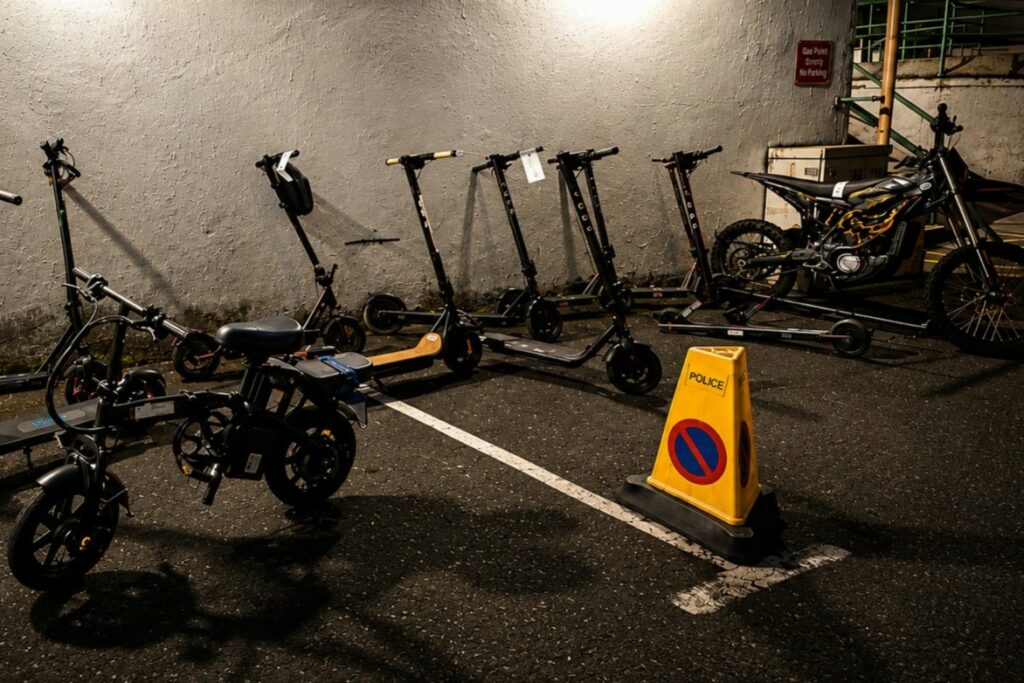
On 31 July and 1 August, the team seized a total of 23 vehicles, with two adults arrested (one a motorist) and two more cautioned for motoring offences as part of the ‘Two Wheel Vehicle Operation’. A young person was also arrested, while others were spoken to by police in the presence of their parents and guardians, and have been referred to the Youth Diversion Officer.
One of those arrests involved the seizure of what was described as a “an electric motorcycle”. Its 25-year-old driver was arrested on suspicion of a range of motoring offences, while a search of his property discovered over half a kilogramme of cannabis. The man was further arrested on suspicion of possession of class B controlled drugs with intent to supply.
A 58-year-old motorist was later arrested by officers on patrol – who were supported by a drone team – and charged with driving under the influence of alcohol.
A teenager was also stopped by officers “riding an e-bike on the wrong side of the road”. He attempted to evade police but was arrested on suspicion of driving offences and possession of a class B controlled drug. It was later established that the e-bike had been stolen.
In a statement praising the success of the operation, sergeant Patterson said: “23 nuisance vehicles are now off the road – and, as these uninsured vehicles are not road legal, they will be disposed of by police within 14 days of seizure unless the owner requests a review by the magistrates court, at the owner’s expense.”
He continued: “Under current legislation, e-scooters and e-bikes are deemed to be motor vehicles, meaning the rider must have a driving licence and the vehicle must be taxed, insured and fitted with lights and a number plate.”
That particular statement may raise eyebrows within the cycling community, which has frequently criticised the erroneous use of the term e-bike when employed by police and the national media to describe what is, in fact, a high-powered electric motorbike, with or without pedals.
‘E-bike’ generally refers to an electrically assisted pedal cycle (EAPC), legal electric cycles that can be treated the same as a conventional pedal cycle, provided the user is age 14 or over.
They must have pedals that can propel the bicycle, have an electric motor with a maximum continuous rated power not exceeding 250 watts, and cut off electrical assistance when it reaches 15.5mph. Riders of these compliant e-bikes do not need to register or insure their bicycle, nor are they legally required to wear a helmet while riding it.
However, the use of modified bikes, which do not cut off assistance at 15.5mph and can reach high speeds without pedalling, has become an increasing issue on the UK’s streets, leading to widespread confusion with their legal counterparts.
These machines are instead classified as motorbikes and mopeds and do require a licence, registration, Vehicle Excise Duty, and the rider to wear an approved motorcycle helmet to be used on a public highway. Electric bikes and components that propel a bike beyond the EAPC limits are not illegal to buy – and can be used on private land – but cannot be used on the road without being licensed and registered.

ebiketips approached the PSNI to ask why Sergeant Patterson had used the term e-bike to refer to an illegal machine, pointing out that such usage could cause confusion among the general public concerning the legality of EAPCs.
In response, Patterson insisted that his statement referred to “some” forms of e-bikes which should be categorised as motorcycles.
“It is defined in law, that some e-bikes should be regarded as motor vehicles and hence require insurance and tax,” he said.
“An e-bike is deemed illegal if it travels at a speed over 15.5mph or has an output over 250 watts in power.
“Everyone has a duty to keep our roads safe and this is ensuring that all vehicles are roadworthy. It is incumbent upon anyone using an e-bike to ensure that it meets the legal requirements for use.”
We then pointed out to Patterson that e-bikes are legally allowed to travel above 15.5mph, but that the electric pedal assist must cut out when it reaches that speed.
The confusion over an e-bike’s legal speed – even among the UK’s police forces – was underlined this summer, after a delivery cyclist’s hired Tern e-cargo bike was wrongly seized as part of West Midlands Police’s Operation FRISLEN, a “targeted initiative” aimed at “addressing the growing concerns surround the misuse of e-bikes and electric scooters in Birmingham city centre”.
In bodycam footage of the seizure, one of the officers can be seen raising the back wheel of the bike and spinning the pedals, causing the bike’s computer and rear wheel sensor to purportedly record a speed of 47kph – which they deemed evidence that the cargo bike was illegally powered, despite the cyclist telling them: “It’s off, there’s no assist”.

Nevertheless, the officers proceeded to hand the rider a fixed penalty notice, including a £300 fine and six points on his driving licence, and seized the bike. The Birmingham Bike Foundry, the shop which hired out the cargo bike under a council-funded scheme, then attempted to track down the bike, only to be told a month later that it had been destroyed, prompting them to launch an appeal against the decision.
However, after the case attracted national media coverage, West Midlands Police apologised for erroneously seizing and destroying the £6,000 cargo bike, while also agreeing to stop using the test carried out by its officers, admitting that, while there was “no malice” in their actions, it was inaccurate.
When the potential for this kind of confusion was pointed out to the PSNI and Sergeant Patterson, we were simply directed to a page on the service’s website, titled ‘E-scooter, Scrambler and Quad Safety’.
On the page, under the heading ‘Electric bikes’, the PSNI says: “Certain electric bicycles (e-bikes) are referred to as ‘electrically-assisted pedal cycles’ (EAPCs). To qualify as an EAPC, the bike must have functional pedals that can propel it forward, supported by an electric motor.”
A further link to NI Direct, the official government website for Northern Ireland, outlines the legal definition of an EAPC and the distinction between it and non-compliant bikes, which are legally classified as motorbikes or mopeds.
In reference to the recent ‘Two Wheel Vehicle Operation’, Patterson concluded: “From a safety point of view, their inappropriate use in public spaces poses a risk to the safety of both rider and the public. People have already been seriously hurt as a result of their use.
“The number of vehicles seized demonstrates the scale of this problem. As we do all we can to detect offenders, we’d ask that our local community continues to report the illegal and dangerous driving of these vehicles so we can help to make our roads safer for everyone.”
Earlier this week, new data revealed that the number of e-bikes seized by police officers across the UK has soared by 83 per cent this year.
According to the figures, supplied by 31 police forces across the UK, 7,049 bikes were deemed to be illegal and confiscated by police in the 12 months to 19 May, compared to the 3,858 seized the previous year.
The Metropolitan Police were the busiest force when it came to e-bike seizures, with 2,367 bikes confiscated in London alone during the documented period. 11 of the 31 forces also reported that the number of bikes they had seized had doubled year on year.










22 thoughts on “Police sergeant claims “under current legislation e-bikes are deemed to be motor vehicles” after targeted crackdown on illegal “nuisance” vehicles”
All he had to say was ‘modified e-bike’ since unmodified e-bikes are made to be compliant with the law.
Obviously the modification to remove 15.5mph assistance restriction makes it an e-scooter not a compliant e-bike.
It is perfectly legal to buy an electrically assisted pedal cycle that has a cut-off higher than 15.5 mph or a continuous rated motor in exces of 250W or indeed has a throtle.
It just isn’t legal to use it in a public place.
The term e-bike has no legal definition; it can mean, in popular usage, an assisted pedal cycle (legal or not) or a moped or a motorbike.
Likewise e-scooter is not legally defined, although the electric scooter legislation relates to the thing without pedals that you scoot, not a motor scooter.
Oh…. There are not “some forms of e-bike”. e-bikes are legal, and anything that is not an e-bike under the definitions of motor vehicles, would be an electric powered motorcycle.
E-bikes were being bought and used in vast numbers by older people in our area, but they have literally disappeared off our streets, not helped by a war on “e-bikes used illegally” by the S Glos councillor responsible for all things infrastructure related (including transport).
As the term e-bike has been misapproriated by those in power (but should have greater knowledge of things they have power over), I think that, perhaps, there needs to be a new name and remarketing for e-bikes that are perfectly legal, and hugely useful to many in our communities (including the 30% of people in S Glos who have no access to a car whatsoever).
@John Emms From DVSA guidance notes on EAPCs
“There are many products known as ‘e-bikes’ or ‘e-cycles’ available on the market. However, not all of these are classified as EAPCs.
To be classified as an EAPC under the EAPC regulations[footnote 1], the cycle must: ”
etc.
“footnote 1. The Electrically Assisted Pedal Cycles Regulations 1983 SI 1983/1168 as amended by the Electrically Assisted Pedal Cycles (Amendment) Regulations 2015 SI 2015/24.”
Even when he clarifys he gets it wrong .
It’s either an e bike or an electric motorbike .
It’s not difficult ,same as cars ,Motor car >EV ,they dont do it with cars so its willfully ignorance when it comes to e bikes
Even this article, trying to correct what I am EPAC and what is not got it wrong. You said that you have EPAC’s, and Illegally modified ones, that can go over 15.5mph. but not all “eBikes” that can go over 15.5mph are modified, and modified or not they are only illegal on road, not inherently. You can, and people do, buy a powerful, unrestricted ebike for use on private land. I know children who’s parents have bought them for them, they compete in e-motocross, and the bike is completely legal. If you use it on the road, that’s when you’re breaking the law. So it doesn’t have to be modified to be not road legal, and the bike itself isn’t inherently “illegal” if its motor / speed limit are not within limits, use on the road is what is illegal.
@edjz We’ve added a clarification to that paragraph, thanks.
edjz:
It’s not EPAC, it is an Electrically Assisted Pedal Cycle; EAPC.
Also. you keep stating that non compliant bikes are only illegal on the road. This will confuse some, as they are illegal on all public land, which includes cycleways and other tracks.
Even your correction of the correction isn’t quite right. It’s perfectly legal for an EAPC (not EPAC) to be able to go more than 15.5 mph – its just that the motor has to cut out above that speed. Also, it isn’t necessarily illegal to use a bike that doesn’t meet the EAPC requirements, provided you first get a vehicle approval and find someone willing to insure it (though, in practice, next to nobody’s going to bother with all that when they can mostly just go out and ride them without and no-one will do anything about it).
You can buy legal electric motorbikes and mopeds.
https://www.flexelectric.co.uk/category/e-mopeds
You’d think some of these were illegal if you saw them, but they have an MOT from new and can be insured. You’d want to carry your documents with you.
…(so assuming they’re “type-approved” if MOT exists) … and have the appropriate category on your driving licence (or presumably have done your CBT and have an L-plate), have got that insurance, wear an appropriate helmet and only ride on the road in accordance with the conditions for that kind of vehicle…
but other than that, it’s basically order on the Internet and go…
@chrisonabike
You missed registering with DVLA.
(Same paperwork as for a new car it appears. But looks like the importer selling them doesn’t do said paperwork, so I expect a couple of weeks before you can buy a licence plate to make them road legal…)
@bensynnock Yes, but I think edjz was referring to pedal cycles with an electric motor – I don’t know if there any non-EAPC-compliant examples of those with type approval.
There must be at least one as this very site (or was it its sister?) had an article reporting on using a legal “speed pedalec” in the UK.
(Would post link but it would probably be caught by the moderation system!)
@mdavidford Definitely not common, but a quick google brings up some retailers selling s-pedelecs which they claim to be registered and legal to use on roads with CBT. E.g. https://urbanebikes.com/collections/speed-pedelec “We can deliver all Speed Pedelecs fully registered and ready to ride – you won’t have to handle any paperwork […] Because of this increased power and speed capability, they are classed legally as a moped. Like a moped, they can be ridden by any rider 16 or over who has either passed a CBT course or has category AM or P on their existing driver license.”
Presumably since s-pedelecs are more common in Europe, a fairly solid regulatory regime exists and so more straightforward to get these approved in the UK.
Road.cc actually had quite an informative article a few years ago: https://road.cc/ebiketips/content/advice/advice/buying-and-riding-an-s-pedelec-in-the-uk-1637
The DVSA guidance regarding ‘Twist and Go’ EAPCs:
If a ‘Twist and Go’ EAPC has not been ‘type approved’, importers and individuals can apply for a Motorcycle Single Vehicle Approval (MSVA). For MSVA purposes, ‘Twist and Go’ EAPCs fall into the 250W LPM (Low Powered Moped) category.
“Ebikes that go over 15.5mph” he says.. Not that specific. Myself and most cyclists can pedal faster than 15.5mph, so I’ll have my ebike taken because you think my legs can’t propel the bike (with the help of gears) after the 15.5mph cut off? I love that test, how they lift the back end with the wheel off the ground, spin the pedals and gets it up to 30+mph, of course it will, the wheel is off ground with no friction like on the road to make the pedals work harder, so when it goes past the 15.5mph limit, electric cuts off and carries on till 30+, they think the bike is illegal.
Apparently Riese und Muller fixed it for them:
https://road.cc/ebiketips/content/advice/advice/buying-and-riding-an-s-pedelec-in-the-uk-1637
Yep – they went down the individual vehicle registration route for the purposes of the article, rather than it being type approved.
So it’s the equivalent of things like that motorised sofa?
BBC seem to have got the language right here (on a cursory read):
https://www.bbc.co.uk/news/articles/cgmkzm3318go
It starts well, but says later:
“A legal e-bike must have pedals and the motor is only there to provide assistance while the rider is pedalling. That motor assistance must cut out at 15.5mph (24km/h)”
An EAPC that can legally be ridden on the road as a conventional pedal cycle must . . . . , perhaps.