


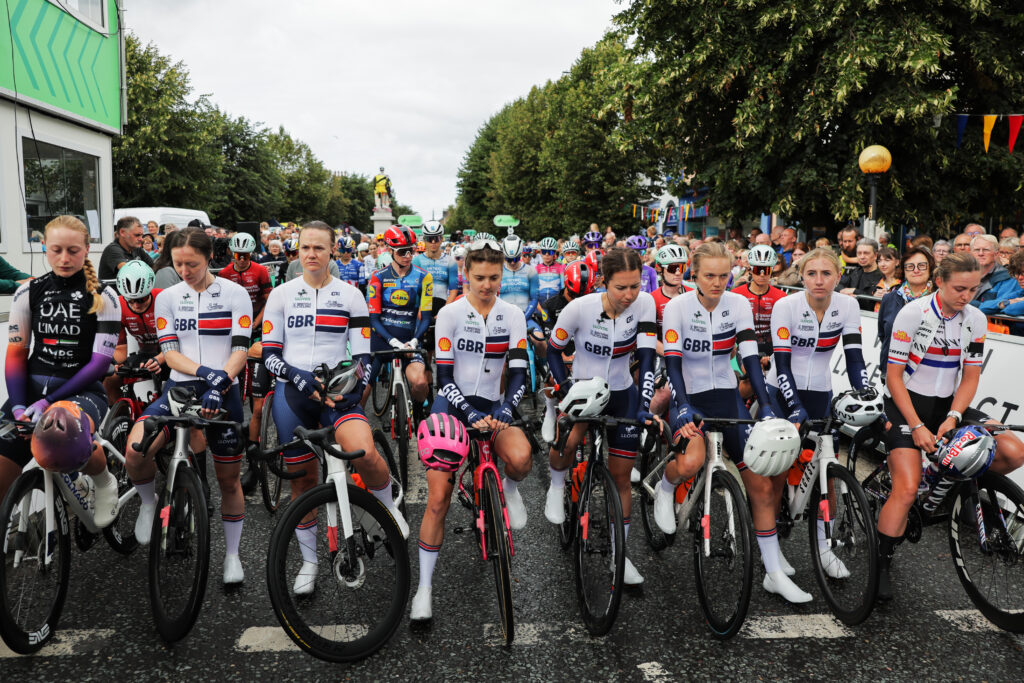

A pro cyclist riding in the Tour of Britain women has described how she was “nearly hit” by a driver who had entered the race route, despite the peloton still being in sight.
Maeve Plouffe, riding for British Continental team O’Shea Red Chilli Bikes, did not finish the race’s opening stage, starting and finishing in Cockermouth, and later detailed on her Instagram story how she had sustained a puncture and chased for 30 minutes to rejoin the peloton.
“On a side note,” Plouffe wrote, “While the race convoy was still in sight and I was less than two minutes down, there were cars from the general public coming at me from all directions, including one that nearly hit me on a roundabout. Later on, the moto escort was wonderful and I felt much safer.
View this post on Instagram
“But considering the recent devastating events in our cycling community, it’s scary to see situations like this, when we know that this can have horrific consequences, especially so soon after suffering such a tragedy. Stay safe over the next stages.”
In a statement, Events Director of British Cycling Ventures Jonathan Day said, “We note Maeve Plouffe’s comments about her experience during yesterday’s race, and we’re taking these extremely seriously. Rider safety is paramount and will always be treated as a priority in our planning and how we operate any race.
“We’re reviewing what happened with Maeve and her team O’Shea Red Chilli Bikes with the seriousness and empathy these comments demand.
“We recognise this comes at an especially difficult time for the cycling community, so we want to reassure all riders, teams and fans of the sport at this time of how serious we are treating these comments.”
The incident occurred just days after the death of Finlay Tarling at the Volta a Portugal. Tarling, 19, was killed when a van driver entered the race route and hit the Welsh rider head-on whilst he was on a descent. The Tour of Britain paid tribute to Tarling with a minute’s silence at the start of the race, whilst race chalkboards were also adorned with messages of condolence.
Unlike the Tour de France, the majority of smaller races are policed by rolling road blocks, where roads remain open until outriding police motorbikes approach and block key roads to allow the race to pass through. It is not clear if the roundabout where Plouffe narrowly avoided a collision was due to have been blocked or whether, as was the case in Portugal, a driver ignored a sign warning of the race’s passage.
Tarling’s death sparked an outpouring of tributes and a wider discussion within the sport of rider safety. Adam Hansen, president of the CPA, the union of professional riders, suggested that helmet safety standards needed to be improved as a matter of urgency, adding that “closing every single road is difficult”.
However, his statement has been criticised by a people within the sport, including general manager of EF Education-EasyPost Jonathan Vaughters, who criticised Hansen’s comments, including an implication that Tarling’s death resulted from “a hole in the system”, saying “I can’t even begin to comment on this level of insensitivity.”
The five-stage Tour of Britain women is due to finish on Sunday in Leamington Spa. The race’s opening stage was won in a reduced bunch sprint by Lorena Wiebes.
This article was updated at 2:20pm to include a statement from British Cycling.












10 thoughts on “Tour of Britain Women rider almost hit by motorist on race route, claiming “there were cars coming at me from all directions””
This is a shocking near miss, especially after the recent death of Fin Tarling. However, the article describes the Portuguese driver as ignoring a race warning sign, which from previous articles did not appear to be the case.
I have an unrelated comment about yesterday’s stage. I watched around 90 mins of yesterday’s stage and found it pretty dull. One rider broke away, gained around a minute before being closed down. Nothing much happened for the next 45 min. It appeared that the peleton had settled for a bunch sprint with around 80 km to go. I switched over to test match special radio coverage.
If better TV coverage, sponsorship and pay are expected, then maybe more aggressive tactics should be encouraged?
@Mr Blackbird From what I’ve understood from multiple reports, there was a warning sign at the point the driver in Portugal joined the road and he obeyed its instruction to stop, but he then asked the spectators present if the race had gone through and if it was safe to proceed and he was told yes.
Yes. That is my understanding as well.
Can’t agree with that comment. The race is the race – they’re not gladiators there for your entertainment.
I can recall plenty of very (very) long, dull Giro sprint stages in the men’s game.
Also doesn’t seem to bear much resemblance to the reporting of the stage elsewhere. Yes, there was a long period with only one breakaway (originally two, until the intervention of a rogue wasp), but that wasn’t because they’d settled for a bunch sprint – it was because they knew there was a bunch of climbing backloaded in the stage, with a lot of headwind and then a long flat section before it, so getting in a break would be a fruitless exercise. And only 30-odd riders made it to the end at the front to contest the win after multiple attacks and reconfigurations of the group, so if everyone had settled for a bunch sprint, it didn’t work out too well for them.
What about getting riders up the road?
Nothing wrong with breaks that fail. It is part of getting sponsors names noticed.
And isn’t thirty riders a bit of a bunch sprint?
It might get a couple of sponsor names out there, but I can’t see how it makes things any more exciting for the viewer when you know it’s doomed from the start.
30 riders might be technically a ‘bunch’*, but it’s hardly *the peloton* settling for a bunch sprint. And that was only the end result, after multiple splittings apart and comings back together.
You might as well argue that rider pay and coverage should be slashed for Milan-San Remo, because all the action only happens in the last 30km.
[* What is the technical lower bound of a ‘bunch’? When does it become a ‘group’?]
Fair point about Milan San Remo. But the article was about the Women’s Tour of Britain, which is on at the moment.
The fact that a break is doomed or probably doomed does not make it uninteresting. Quite the opposite. There are always points of interest.
“Will they be caught?”
“When will they be caught?”
“Those 1, 2 or 3 riders were able to ride hard enough for ten minutes to make a break and are holding off the peleton. Amazing power.”
However, from a sponsor’s point of view, I stopped watching yesterday and haven’t bothered watching today. Wrongly perhaps. But there is a lot of cycling on television at the moment and I need a reason to watch.
Or more likely they just rode off the front because no-one in the main contenders was concerned about them and therefore bothered about stopping them. There wouldn’t really have been any question of ‘will they be caught?’ yesterday – it would have been a foregone conclusion.
If you were watching today you’d be seeing a lot of them standing around in space blankets and the like, waiting for an RTC to be cleared, unfortunately.
Reply to Zermattjohn.
I disagree. Sport is a branch of the entertainment industry.
And it is possible to have more going on, without being too gladiatoral.
After all, there are only 5 stages.