



The dissatisfaction and safety concerns that cyclists in the UK feel compared with their European peers has been documented in new research highlighting the at times stark difference in experience between British cyclists and their counterparts in the Netherlands, Denmark, Sweden and Germany.
Water management company ACO last month published the findings of its research in a white paper titled ‘Pedalling toward better cycle lanes — keeping Britain on the bike’, the content of which was first reported by Highways News.
Having surveyed 100 urban cyclists from the UK, as well as an equal sample size from Denmark, Germany, the Netherlands and Sweden, ACO found that the British respondents were the least satisfied with design and maintenance of their cycle lanes, as well as being the nation of cyclists that feel less safe than their European counterparts.
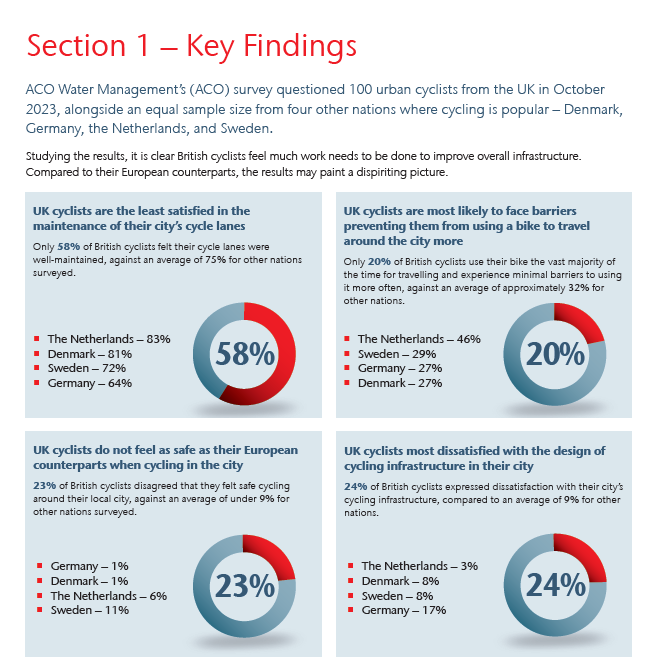
Just 58 per cent of the UK cyclists believe their cycle lanes are well-maintained, in comparison to 83 per cent in the Netherlands, 81 per cent in Denmark, 72 per cent in Sweden and 64 per cent in Germany. Furthermore, 24 per cent of the UK cyclists expressed dissatisfaction with the design of their city’s cycling infrastructure, compared with three per cent of Dutch cyclists, eight per cent of both the Danish and Swedish cyclists, and 17 per cent of the Germans.
On the issue of safety, 23 per cent of the UK cyclists disagreed with a statement about them feeling safe when cycling in their local city, a figure much higher than the 11 per cent of the cyclists from Sweden who reported feeling unsafe, the six per cent of the Dutch riders, and one per cent of German and Danish cyclists.
Finally, only 20 per cent of the UK-based riders reported experiencing minimal barriers to making more journeys by bike, again a figure that was higher than for cyclists in all four of the other countries.
When trying to explain the figures, ACO suggested that in the European countries used to compare with the United Kingdom, cyclists are prioritised in urban areas, an attitude often supported through roundabout or junction design.
For example, the white paper notes that in the Netherlands there are 35,000km of cycle paths, but also that in cities cars are viewed as “guests” with cyclists given right of way and 60 per cent of roundabouts in urban areas designed to include physical separation between the cycled route and motor traffic.
Likewise, in Sweden “higer priority is placed on bicycle traffic in community planning, with the emphasis on more functional and user-friendly cycling infrastructure”.
Michelle Osborne from ACO Water Management commented: “By understanding the issues faced by cyclists and what best practice looks like when designing cycle networks and pathways, further uptake of active travel can be encouraged. From safety and navigation concerns to the quality of roads and lanes, obstacles remain for bike riders. If the nation is truly to enjoy a cycling revolution, these should be addressed.

“As these survey statistics suggest, more work is needed to improve the interconnectedness of cycling infrastructure in the UK’s urban environments. The issue is not knowledge-related, as the expertise is already there within local authorities and the highway engineering sector, which are highly aware of the difficulties and considerations involved with building new cycle routes or expanding existing paths and networks. Instead, a simplification of the specification process should be pursued, with consistency prioritised across cycling infrastructure wherever possible.
“However, changing attitudes around cycling infrastructure will not happen overnight. It will be a gradual process involving the whole supply chain on projects of this kind. By working with related organisations on key areas such as surface water management and material suitability in abrasive environments, more effective designs and solutions can be identified and specified, leading to more positive perceptions of city cycle path quality, accessibility and connectivity.
“Developments from 2020 onwards, including the publication of LTN 1/20 and founding of Active Travel England, show that the nation is on the right track in this
regard. As local authorities and highway engineers use new and existing funds and apply standardised guidance to upgrade existing routes and establish new ones, the perception gap to the rest of Europe identified in this survey should shrink.”
You can access the findings and read the white paper in full here…









28 thoughts on “British cyclists feel less safe and more dissatisfied with their cycle lanes compared to European riders, research finds”
I do A lot of leisure cycling
I do A lot of leisure cycling in Germany. Both urban and rural cycle paths are more common (more unusual not to have a cycle path) and of far better quality, in terms of width, surface and practicality, further improved by German car driver understanding and abiding by the junction priority rules
.
In other news: The Pope shits
In other news: The Pope shits in the woods.
I don’t think anyone here
I don’t think anyone here would be surprised by the headline findings, but, although it’s not unimportant, I’m somewhat less convinced that better surface water management is the key issue that needs tackling to shift these perceptions.
Why did they not ask any
Why did they not ask any questions about that? !!
New survey finds British
New survey finds British cyclists are less satisfied with cycle lane design and maintenance, feel less safe, and feel they face more barriers to making bicycle journeys than riders in the Netherlands, Denmark, Sweden and Germany
My gob has never been more smacked: I’m astonished, amazed, confounded. Surely there must be something wrong with the methodolody of the survey if it found that our splendid, spiffing, utterly top notch British cycle lanes are worse than everywhere else?
eburtthebike wrote:
You forgot to say “world beating” 😉
brooksby wrote:
Of course, thank you.
I genuinely am shocked. I’m
I genuinely am shocked. I’m shocked that 58 people thought our cycle paths are well-maintained!
Another “shocked, shocked”
Another “shocked, shocked” punter here. Also all for optimism but it’s difficult to read:
… without thinking “we may be capable of *identifying* the right track. But governments and councils struggle to do this with any fanfare, to avoid upsetting the motorist. Every generation or so we tentatively put one foot on it (LTN1/20 is “guidance” with as many get-outs as you like) then immediately withdraw it “on the side of the motorist…”.
It works, but *everything*
It works, but *everything* revolves around vociferous & engaged local activism.
And the places that most need it, haven’t got it.
There’s clearly a desperate
There’s clearly a desperate need to change the collective UK mindset regarding cycling in general and cycle infrastructure in particular. It’s all very well trying to adopt the approach of successful nations such as the Netherlands, but how to alter the perception of cycling and cyclists amongst the general public is the big thing. The chicken or egg question is “did the Dutch (and similar nations) respect cycling first or did better infrastructure and legislation make that happen?”
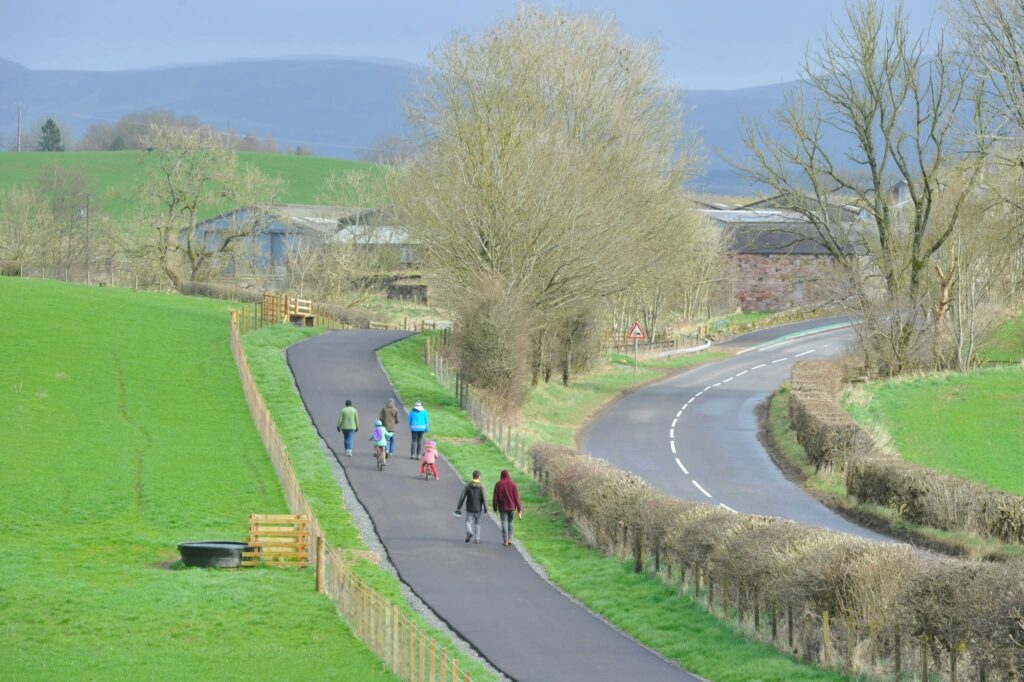
I was riding on that section of bike lane in the bottom photo yesterday evening (just opposite side of road and direction) and four otherwise sensible-looking adults were strolling along four abreast with their backs to me. Look how wide the footpath is. Why then was one of them walking on the cycle lane? ?
Education, education, education…
I think there’s a PhD in this
I think there’s a PhD in this one. I think there are some universals – in theory humans don’t care how we get from a to b as long as it’s quick, convenient and cheap. But in fact there are all kinds of complicating societal and social factors – does this bus trip make me look poor etc)
In the UK I’d say that “changing culture” task has to address several feedback loops:
– nobody cycles (so if you do you’re an other, and probably doing it solo – and indeed we try to enforce this – single file!)
– “our streets are too narrow” – we’ve allocated all the space to motor traffic, so then people walking are going to be “fighting over scraps” with those cycling.
– in addition the UK rarely makes separate space for BOTH cyclists and pedestrians and even less frequently marks this properly (choose a national colour and stick to it already! )
– nobody uses the cycle infra – often true because it’s rubbish – usually lacking width (because “our streets are too narrow”). But in places where it is used it often is empty simply because cycling can be so much more efficient at moving people, and 10 cyclists waiting at a traffic light take up a fraction of the space of 10 cars.
On the Dutch question – the
On the Dutch question – the answer is a story but essentially there were still a lot of people who cycled and cared about cycling when the moment came. BUT they still had to fight for it (literally – riots etc) and it took about a generation for the direction of travel to change.
There does seem to be a “they built it and they came ” *de novo* example in Seville though:
In other news research has
In other news research has shown that the Pope is catholic. Sorry couldn’t help myself a wave of facetiousness swept over me ?
Cyclo1964 wrote:
The survey was conducted by a water company, so the wave might not be facetious…
belugabob wrote:
In other news research has shown that the Pope is catholic. Sorry couldn’t help myself a wave of facetiousness swept over me ?
— belugabob The survey was conducted by a water company, so the wave might not be facetious…— Cyclo1964
They make drainage kerbs for bilke lanes !
Is it any wonder ? when new
Is it any wonder ? when new cycle lane provision in this country still just means a bit of paint on a road and a shared path sign
Technically thats not
Technically thats not accepted any more (at least down south) with LTN1/20. The government aren’t funding anything anymore that’s not compliant (segregated). There’s still some legacy stuff in the pipeline unfortunately (sites that got planning permission years ago on the basis of shared) and I don’t know how universally its applied accross councils on private developments 🙁
well technically what does
well technically what does segregated really mean, ultimately ? does it mean simply not being on the road anymore around motor vehicles?
because for example here are 3 brand new Active Travel England funded schemes out for consultation right now, all 3 schemes are basically widening paths to make them shared cycle paths, with some mandatory cycle lanes painted on the road where they cant widen the paths, with a couple of extra crossing points.
https://suffolk.gov.uk/council-and-democracy/council-news/improved-ipswich-walking-and-cycling-routes-proposed-as-residents-encouraged-to-have-their-say
Segregated from both traffic
Segregated from both traffic and pedestrians and most of that scheme reads that way except for Woodbridge Road. It says there:
“Dedicated continuous cycleways to allow people cycling to travel separately from motor traffic and pedestrians where possible.”
And then contradicts itself:
“Widened pavements to allow enough space for shared use between pedestrians and cyclists”
The latter is definitely not segregated, the former is :-/
What more do you need?
What more do you need?
As HLaB said – schemes that
As HLaB said – schemes that don’t lump cyclists and pedestrians together or design in conflict between them.
In many cases it’s really not technically difficult – find similar environment in NL, distill the simple principles* and that’s what you use. It’s not our streets which are too narrow…
* Simple principles which do result in designs with some subtleties to them – at least it may seem like magic if you’re used to designing for maximum motor traffic…
The answers simple then
The answers simple then emigrate to Europe bike there and the roads will be safer over here
It’s not so easy to emigrate
It’s not so easy to emigrate now – wot with that brexitty fing.
Well, there’s a surprise!
Well, there’s a surprise! Where I live most cycle lanes are half a metre wide and full of drains, potholes and debris that’s thrown up or fallen off cars (and the roads are never swept). It may all add to life’s rich pageant but, remembering my school reports, the phrase ‘could do better’ comes to mind ?.
New survey finds British
New survey finds British cycle lanes are subjectively worst in Europe. Corroborates evidence they are objectively worst.
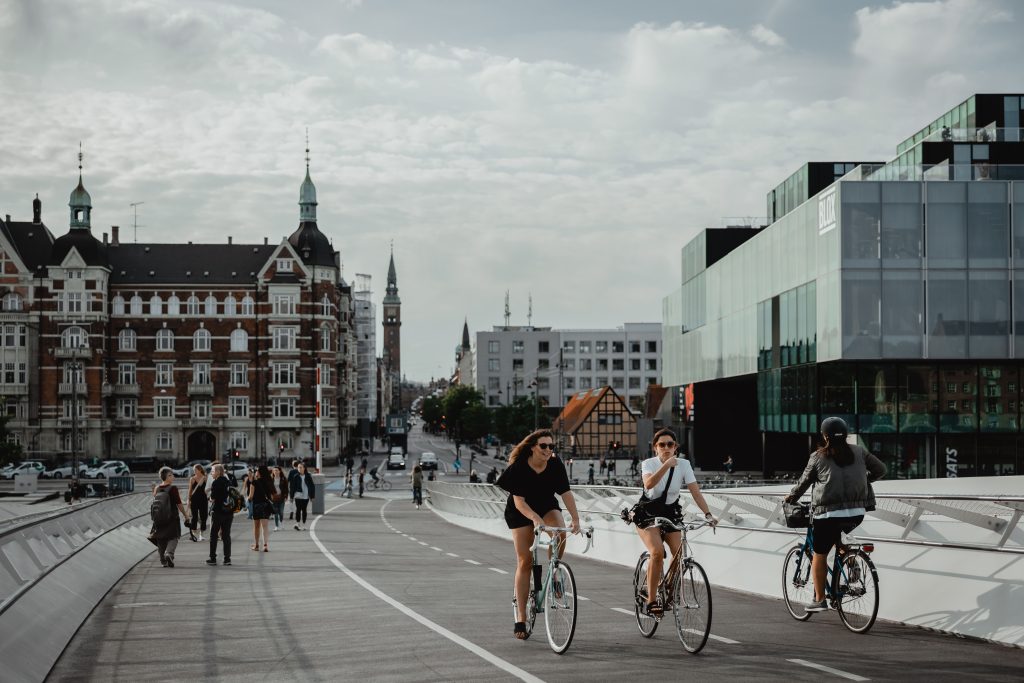
Has anyone any idea what city
Has anyone any idea what city is shown in the second pic (with the two girls riding towards the camera, one on a racing-style bike)?
Google says Copenhagen.
Google says Copenhagen.