


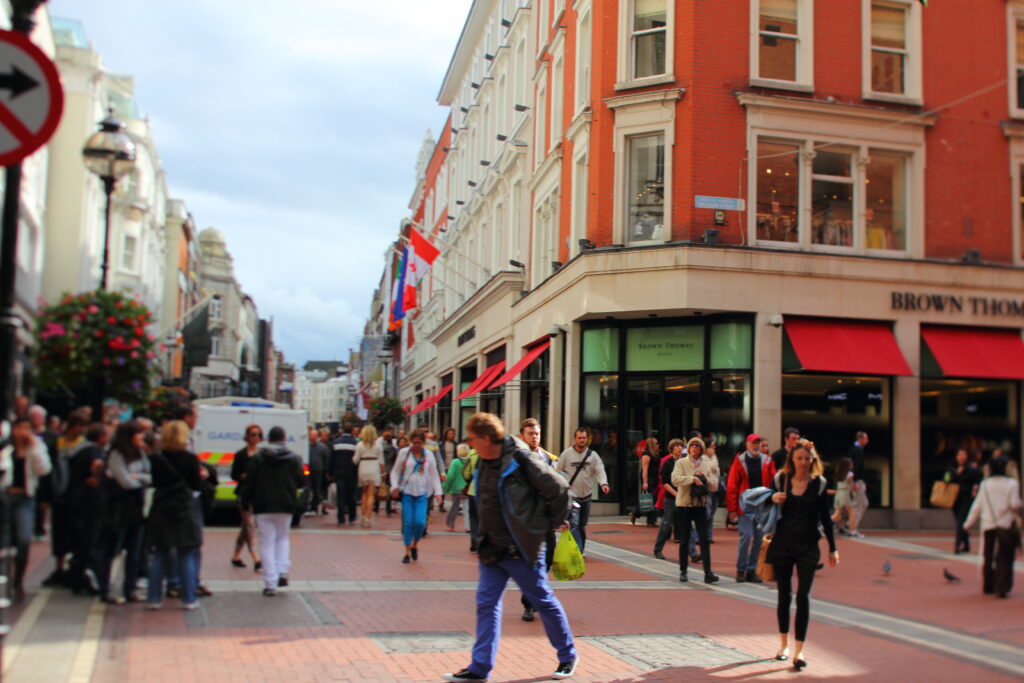

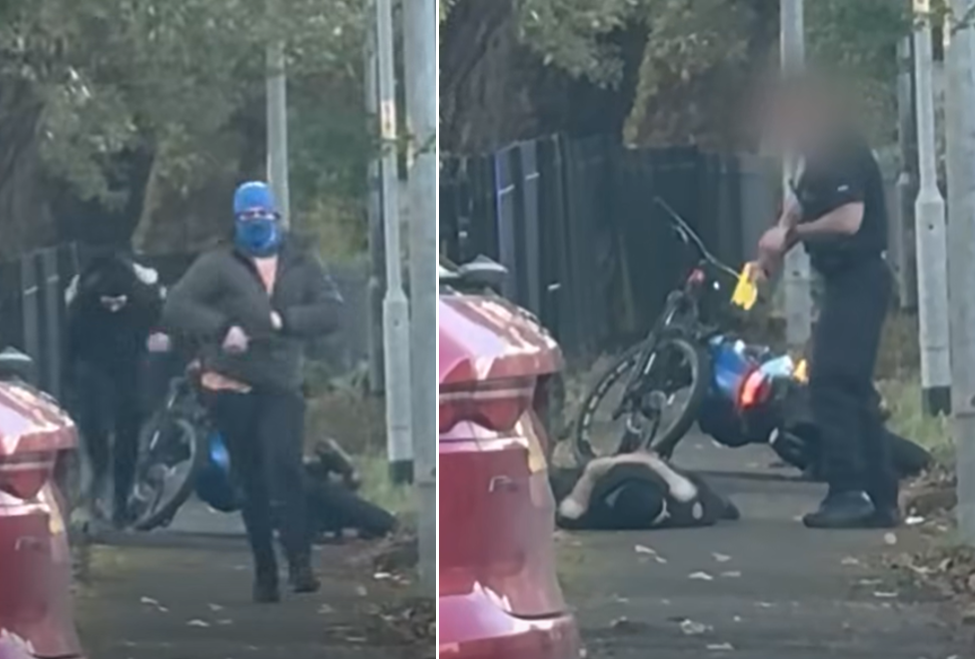
A cyclist has apologised for attacking a police officer who attempted to stop him riding his bike on a busy pedestrianised shopping street in Dublin, leading to the father-of-one being pepper-sprayed during the altercation.
45-year-old Thomas Connell kicked out at a garda during the “out of character” scuffle which ensued after he was stopped while cycling on Grafton Street, one of the Irish capital’s two main city centre shopping streets, Dublin District Court heard this week.
Grafton Street was permanently pedestrianised in 1982, with cyclists found riding their bikes on the street subject to a €40 fixed-charge notice, an on-the-spot fine introduced in 2015 as part of a series of measures intended, Ireland’s then-transport minister Paschal Donohoe said at the time, “to promote safe cycling practices and to discourage dangerous cycling”.
Dublin District Court heard this week that a garda sergeant was on duty on Grafton Street on 18 July 2021 when he saw father-of-one Connell cycling and directed him to get off his bike, the Irish Independent reports.
After the cyclist was stopped, he then began verbally abusing the sergeant before becoming more aggressive when asked for his details, kicking out at the garda and making contact with his stomach.
Pepper spray was deployed during the resulting affray, and Connell was arrested. The cyclist later apologised for his behaviour at the garda station, an apology that was repeated in court this week.
Connell’s lawyer also told the court that the cyclist – who was out of work while recovering from a recent injury at the time of the incident, and was helping out in a local charity shop – was “deeply embarrassed” by the attack, which he claimed was “most out of character” for him.
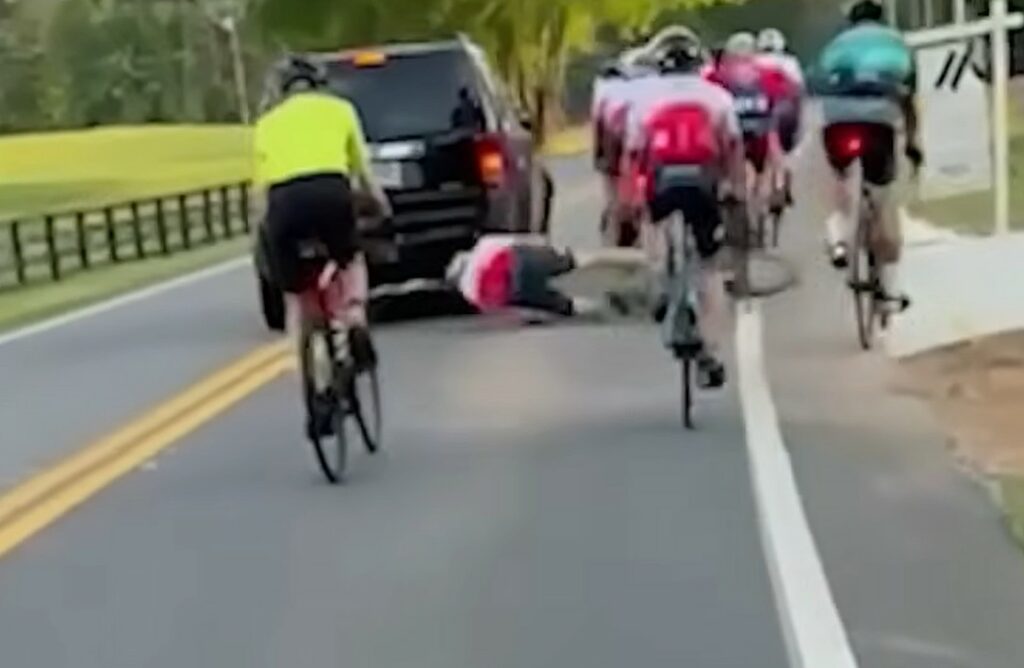
> Teenager arrested after hit-and-run motorist filmed ‘deliberately ramming’ cyclist
He pleaded guilty to using threatening, abusive, and insulting behaviour and resisting a garda. He was also charged with failing to appear in court, which his lawyer claimed was the result of a mix-up and “scheduling errors”.
Judge Stephanie Coggans adjourned the case for the production of a probation report and remanded Connell on continuing bail until March.
The altercation on Dublin’s Grafton Street isn’t the first time that the enforcement of pedestrianised areas has been forcibly challenged by cyclists.
In October 2022, an 82-year-old cyclist, stopped by a council officer and issued with a £100 fine for breaching a Public Space Protection Order (PSPO) banning cycling in Grimsby town centre, told the officer to “stick it up your arse” and refused to pay the fixed penalty notice.
“I’ve been riding my bike around here for 40 years and have never once been fined,” Barrie Enderby said at the time.
“When he gave it to me I told him, ‘stick it up your arse’. I’m more annoyed about it because my biking is what keeps me going. I won’t be paying it, I’d rather go to prison than give them £100. I’ve not got £100 spare to give them, that’s for sure.”
That particular town centre ban in Grimsby has attracted quite a bit of attention, with some locals accusing the council of targeting the “old and slow” and cyclists “they can get away with” for fines, and is one of a number of PSPOs introduced across the UK in recent years, in an apparent bid to quell anti-social behaviour in town centres.

Last month, North Lincolnshire Council claimed it had “escalated” and “intensified” its “war on cycling menaces” by implementing a complete ban on riding a bike in pedestrianised zones in Scunthorpe and Brigg, as part of a wider crackdown on what the local authority describes as the “scourge” of “irresponsible behaviour”.
However, the move has been heavily criticised by disabled cycling charity Wheels for Wellbeing, who argued that it had the potential to “deepen discrimination against cycling as a mobility aid”.
And earlier in December, a controversial ban on e-bikes in certain pedestrianised parts of Coventry city centre was introduced, with the deputy leader of the council warning that riders can expect strict enforcement.
The new ruling, which prohibits e-bikes and e-scooters being ridden through sections of the city centre, was approved in November, as Coventry City Council passed a PSPO despite protestations from the West Midlands’ walking and cycling commissioner Adam Tranter, who argued such a ban would “discourage cycling and penalise responsible cyclists”.
Meanwhile, in August we reported on the thoughts of a transport researcher from Dublin, who claimed that the Irish capital – named in 2011 among the top 20 most bike-friendly cities in the world – has become markedly less hospitable for cyclists in recent years due to a lack of connected infrastructure and policing to keep spaces for cycling clear, with many cyclists now fearing for their safety as they believe they are not recognised by other road users.
“Fundamentally there are too many cars in the city. That makes it a very hostile and precarious environment for cyclists,” Dr Robert Egan, an engineer and research fellow at Trinity College Dublin’s Centre for Transport Research, said.
“But another big part is the disregard for dedicated cycling spaces. You see cars being illegally parked where cyclists are supposed to go, but then where you’re on the road, you’re being beeped at, honked, and being close-passed, so you’re not being treated as a full, entitled road user.
“And finally, there’s a lack of protection for cyclists as well. There’s a lack of policing keeping dedicated cycle spaces clear, and a lack of appreciation for how frightening cycling can be, when you can be bullied off the road if somebody is not confident.”












12 thoughts on “Cyclist in court for kicking out at police officer who stopped him riding bike on city centre shopping street”
A lot of city centre bans IMO
A lot of city centre bans IMO are daft especially in dying high streets but unless it was stupid o’clock I can’t imagine trying to cycle down Grafton Street unless it has totally died in the last 20years since I lived there.
“war on cycling menaces”
“war on cycling menaces”
If only they took those blinkers off and looked at the real danger: drivers. But we daily see examples of dangerous driving going unpunished, deterring cycling and walking, while cyclists are the enemy.
Tough on cycling, tough on
Tough on cycling, tough on the causes of cycling- which as we all know is the cause of traffic jams, increased pollution, delay to hard-working otherwise law-abiding motorists etc. Banish the cyclist scum!
Weird set of comments from
Weird set of comments from people who seem to think being a cyclist absolves you of assaulting a policeman.
He deserves everything he gets. Grafton street is probably the most pedestrian dense street in Dublin and frequently crowded with shoppers and tourists.
Also I think anyone who pleads out of character should automatically have any previous brushes with the law brought to light.
Secret_squirrel wrote:
Agreed
Cycling specific infrastructure is good, and for valid reasons – surely also some pedestrian-only areas (esp ones established since the 80’s) are also legitimately required and there for pedestrians to use safely without fear of bikes.
It works both ways…not many cyclists like pedestrians in cyle lanes!
Indeed. What you can almost
Indeed. What you can almost guarantee is that anyone who is “of previously good character” or their actions were “completely out of character” are almost always just getting their first taste of consequences for their years of generally shitty behaviour. The same way most people who are caught 3x over the limit and high on cocaine probably aren’t a responsible and considerate motorist the rest of the time.
Cycling is permitted on the
Cycling is permitted on the busiest pedestrianised street here in Southampton, but there’s no way I’m cycling down it if there are lots of people on it. It’s just too much hassle, and too slow.
In my local shopping center
In my local shopping center they have recently had to put up signs telling bikers to dismount as idiots were riding their bikes at speed through hundreds of shoppers scattering them, parents ,children of all ages and disabled alike . I personally am looking into a dash cam that will fit a wheelchair, with a view to pressing charges against the next idiot that hits me with their bike on the pavement , and they never give me 1.5 mts clearance
Just this week, I intended to
Just this week, I intended to visit Lewisham Shopping Centre but no bicycles or scooters. Not just no riding – included no walking with them. The wrecked bikes chained to bad bike racks had me decide to give the Centre a miss. Spent my £100 on a new helmet at a bike shop a mile down the road. That and a couple of other things, inc a redevelopment consultation shopfront, skipped them.
But I can see their point. Age 68 with frail friends I find myself ashamed and appalled at the behaviours and attitudes of lots (most?) of cyclists and scooters of all demographics. Even many walking or parking bikes are doing it irresponsibly with regard to frail, blind, deaf people.
The ‘out of character’ thing has been addressed in other comments. Overlaps with car drivers I’ve known who were genuinely nice, thoughtful types in normal life but, behind wheel, they transformed. Being Christians, I challenged them if they exhibited the shalom of their Lord when driving. Tbf, I’d get a big physical reshaping of face, head, stance as they thought and then jaw dropped confessed it had never occurred to them and they’d have to change fundamentally. A lot of cyclists and scooters fit that profile but without the ethical rock they have ignored to return to. BTW, it was Christians but could have been other perspectives held by decent people who dropped their standards in car or on bike.
The wider transport and people movement infrastructure doesn’t help and has shaped a be aggressive or die mentality among cyclists but immediate issues are attitudes that alienate. Try Greenwich and Woolwich Foot Tunnels for toxic cycling by almost all cyclists of all demographics. Years ago, my son got a car to drive pregnant wife, then baby, from flat close to Foot Tunnel to us on north side of River – via Blackall Tunnel (Woolwich Ferry usually didn’t work then due to privatisation selling off their maintenance capacity)
E6toSE3 wrote:
Thanks, some interesting points. I think there is some measure of selection for “the fast and the brave” for cycling on-road – due to cyclists’ fear of motor traffic.
I’m not sure I understand what you mean by “The wider transport and people movement infrastructure doesn’t help … ” – if you think that adding cycle facilities, LTNs, pedestrianised streets etc. has made the average cyclist more aggressive – how? Given the evidence of NL (see pedestrians interacting with cyclists, or some figures on traffic casualties here in Dutch) – and many other countries – I would say exactly the opposite is true!
Unless you think that back in the day “cyclists” used to be much better road users than “drivers” or “pedestrians” and that attracting some former “drivers” and “pedestrians” has diluted the standard?
I think humans normally behave like humans. So just as I’d expect a measure of poor driving / aggressive behaviour behind the wheel en-mass there will be some Bad Cyclists. And indeed people who push past you or cut in front of you when you and they are walking.
I do think there are a couple of differences however. First currently choice of mode of transport is also bound up with things like social status. So I do think that motor cars change (some) people’s attitudes towards other road users – sometimes for the worse.
Second there is the fact that cyclists are similarly vulnerable to pedestrians in a collision – even in a collision with a pedestrian! This is not widely understood, presumably because of intuitions around e.g. cars. There are various reasons for this e.g. possibly higher cyclist speed, higher head height and less ease of adjusting body position in a fall.
It’s idiots like him that
It’s idiots like him that give cyclists a bad name and spoil it for the rest of us. He should do jail time.
I’m amazed he found a garda
I’m amazed he found a garda in Dublin.