



Yesterday’s protest that held up the men’s elite road race at the UCI Cycling World Championships in Scotland is not the first time that environmental campaigners have disrupted a major sporting event in the UK this summer. But unlike recent interventions by Just Stop Oil, yesterday’s direct action by a group called This Is Rigged, specifically referenced team sponsorship by the petrochemical industry as the reason it targeted the event, raising the question of whether what campaign groups term as ‘greenwashing,’ itself part of the wider issue of so-called ‘sportswashing,’ is now too big for the sport to ignore.
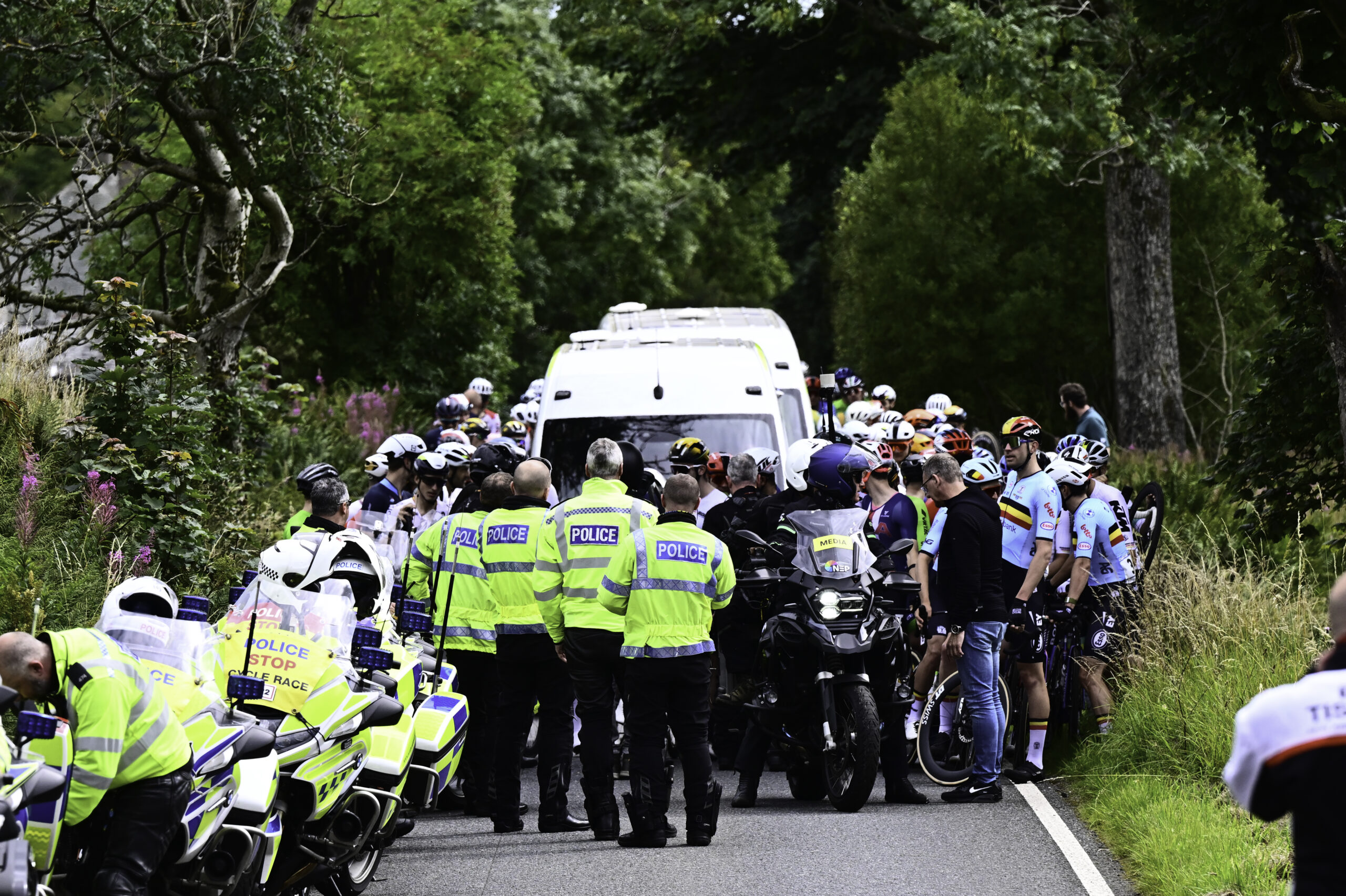
2023 world road race championships stopped following protest (Pauline Ballet/SWpix.com)
The incident, which delayed the race for an hour while police removed protesters who had cemented themselves to the road, comes after a protest from the same group last month when activists blocked the gates to the Ineos refinery in Grangemouth on the Firth of Forth, just a few miles away from yesterday’s disruption.

Ineos Grangemouth petrochemical plant (licensed CC BY-SA 2.0 on Wikimedia Commons by Paul McIlroy)
Named as Scotland’s biggest polluter shortly after it entered the sport following its takeover of Team Sky in May 2019, Ineos was targeted by anti-fracking protesters at that month’s Tour de Yorkshire, with the campaign group Friends of the Earth accusing it of greenwashing and calling for a ban on the sponsorship of sport by petrochemical firms.
Despite strong denials of greenwashing by Ineos owner Sir James Ratcliffe and the team’s then principal, Sir Dave Brailsford, who now heads up its entire sporting portfolio including its interests in Formula 1 motorsport, football and sailing, its efforts to establish some form of environmental credentials have hardly been helped by the cycling team being renamed the Ineos Grenadiers in 2020 to publicise the 4×4 vehicle it was developing at the time and which has recently hit the market.
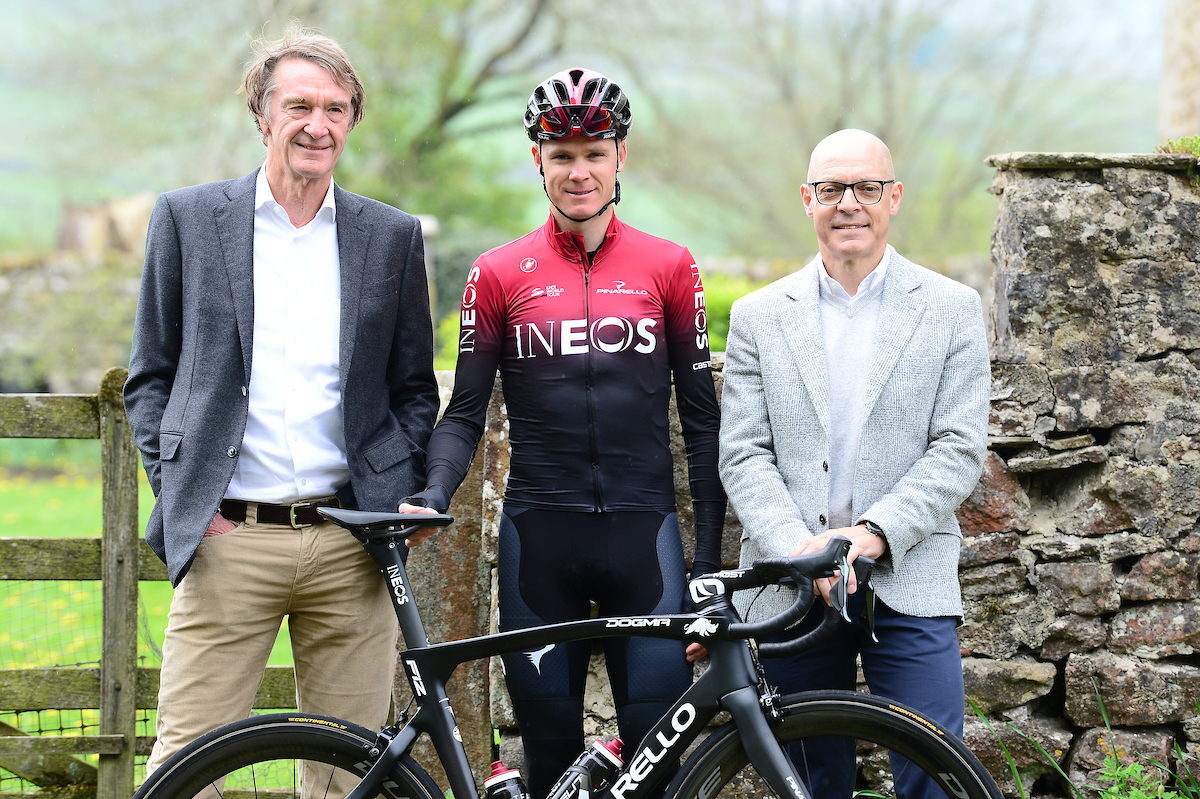
Sir Jim Ratcliffe, Chris Froome and Sir Dave Brailsford at Team Ineos launch in 2019 (copyright SWpix.com)
Sportswashing and greenwashing defined
Ineos of course is far from the only sponsor from the industry that is involved in the sport, and beyond companies operating within the petrochemicals sector, there is also the presence of oil-rich states with highly-criticised human rights records, which takes us beyond greenwashing and into what is termed ‘sportswashing’ – respectively defined by the Cambridge Dictionary as:
Greenwashing: behaviour or activities that make people believe that a company is doing more to protect the environment than it really is.
Sportswashing: the practice of an organization, a government, a country, etc. supporting sport or organizing sports events as a way to improve its reputation.
Sport becomes focus of investment
The Saudia Arabia-backed takeover of Newcastle United FC, the country’s financing of the breakaway LIV Golf Tour and Qatar’s hosting of the men’s FIFA World Cup at the end of last year are just three recent examples from the wider world of sport that have attracted widespread public and media criticism both on environmental grounds and because of human rights abuses.
Within cycling, accusations of sportswashing and/or greenwashing have increasingly been made in recent years as a result of partnerships between certain businesses or sovereign states and governing bodies, race organisers and teams, in some cases even overlapping more than one of those.
It may be other sports that attract most of the headlines in the mainstream press, when it comes to sportswashing, but cycling’s financial model regularly puts teams (and national governing bodies for that matter) in a precarious position financially due to their being starved of a share of broadcast income.
The consequent reliance on sponsorship for funding at a time when many businesses are looking to cut costs means there is a limited pool of potential major backers, and with campaigners having succeeded in getting sectors such as the arts to end their ties with the petrochemicals industry, sports including cycling have become willing recipients of that cash – possibly in some cases out of desperation, with perhaps 100 or so people facing losing their jobs if a sponsor departs and no replacement behind.
No cigarettes, hard liquor or porn – but oil and gas pass sponsorship test
While UCI regulations place restrictions on sponsorship by betting companies and lottery operators and also stipulate that “no brand of tobacco, spirits, pornographic products or any other products that might damage the image of the UCI or the sport of cycling in general” can directly or indirectly sponsor a team or event, companies undertaking activities that are harmful to the environment are not excluded.
With the UCI, as well as major race owners, keen to open up the sport to new markets, we have a situation where much of the money coming into cycling nowadays, and several high-profile races, comes from petrol-rich Middle Eastern states, which also have shocking human rights records (the organisation Human Rights Watch has compiled profiles of individual countries in that regard).
As far as hosting events is concerned, six years before Qatar hosted the most recent men’s FIFA World Cup, it welcomed the 2016 UCI Road World Championships. Elsewhere in the region, the Tour of Qatar may no longer exist, but other races in the region do – including the UAE Tour, the Tour of Oman, and the Saudi Tour.
Meanwhile, in the UCI WorldTour, besides Ineos, sponsors include UAE Team Emirates and Bahrain Victorious – both backed by state funding – as well as Jayco-AlUla (Al-Ula being a city in northwestern Saudi Arabia looking to push its credentials as a tourist destination).
Beyond those, French team Total Energies’ main sponsor is the third largest of the so-called ‘Big Oil’ supermajor companies in the sector, while Astana-Qazaqstan’s main backer is the holding company of Kazakhstan’s sovereign wealth fund, which owns the state oil and gas company KazMunayGas.
The three highest profile current commercial deals within cycling in Great Britain, all struck within the past four years, have each attracted criticism and protests over alleged sportswashing, or greenwashing – Ineos taking over ownership and sponsorship of Team Sky in 2019, Big Oil member Shell becoming lead partner of British Cycling last year, reportedly prompting many to cancel their memberships of the organisation, and Ford backing RideLondon.

Great Britain’s Sophie Capewell at 2022 UCI Track Worlds (copyright Alex Broadway, SWpix.com).JPG
The dichotomy of cycling as a sport – and a way of getting around
There is of course a huge dichotomy within cycling, in the widest sense, between using bicycles as a method of transport as governments around the world encourage people to swap cars for bikes for daily journeys to help reduce carbon emissions, and the environmental impact of the sport itself.
At its highest levels road cycling, in common with other cycling disciplines, involves athletes, support staff, officials and press criss-crossing continents by air.
On road events, there is also the cavalcade of vehicles (admittedly, increasingly electric-powered these days) that follows races, as well as helicopters capturing aerial footage and a plane circling high overhead to relay those pictures, as well as ones from cameras on motorbikes, back down to the host broadcaster for transmission.
Despite the ease of access to the roadside that has long made it a target for all kinds of protests, missing from the men’s Tour de France last month were those we have grown accustomed to major sporting events in the UK in recent months with activists throwing orange paint powder or confetti on the playing surface at venues including Wimbledon, Twickenham and Lord’s Cricket Ground.
The Tour was however targeted last year by activists from the French environmental campaign group, Dernière Rénovation, who briefly blocked Stage 13 of the race, saying afterwards that “Non-violent disruption is our last chance to be heard and avoid the worst consequences of global warming.”
Last month, Just Stop Oil’s lead funder, Dale Vince, said it is the high profile and media exposure of the sports it targets that make them attractive for direct action since that gets the message across to a wider public, and that any steps organisers are themselves taking to reduce emissions and make their events carbon-neutral are immaterial.
But in social media posts following yesterday’s disruption at the World Championships a campaigner from This Is Rigged made it clear that the group had targeted the event specifically because of sponsorship issues, saying: “The fact that Ineos has been allowed to sponsor a team in the race around the Campsie Fells – which were engulfed in wildfires last month – is a disgrace and an insult to the both cycling community and the people of Scotland.
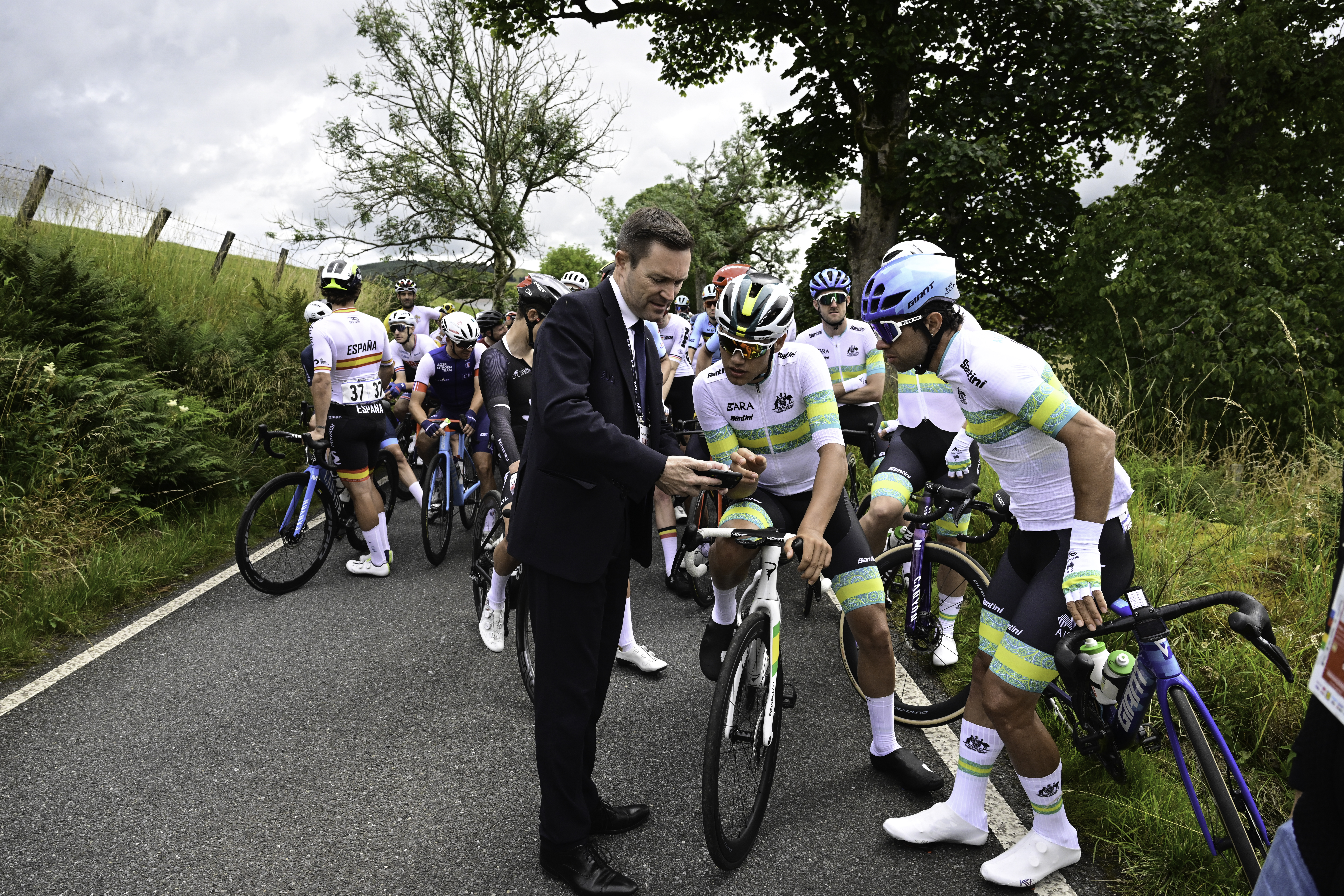
2023 world road race championships stopped following protest (Pauline Ballet/SWpix.com)
“We cannot continue with business as usual while our country burns and our futures are ruined. Time is of the essence and we need to act like it,” the statement added. “The Scottish government must stand up to Westminster and oppose all new oil and gas, and implement a fair transition now,” the campaigner added.
As a side note, with the event raced by national rather than trade teams, Ineos Grenadiers did not itself participate – although its branding was carried on the kit of one of its riders, Michal Kwiatkowski, the sole Polish representative in the race, and sponsorship from the oil and gas industry was visible elsewhere, such as the logos of Shell on the Great Britain kits, or Esso on the jerseys sported by the riders representing Belgium.
Climate change increasingly affecting races
Another issue is the setting itself that road cycling takes place in – outdoors, and often in areas possessing spectacular scenery but that can be subject to sharp changes in weather, whether that be along the coast or in the high mountains.
Such environments are also highly exposed to the effects of climate change, and we’ve seen a number of races affected in recent years by events such as flooding or wild fires as well as what once might have been thought of as freak weather – the recent record-breaking temperatures in southern Europe, for example – but which are now becoming more commonplace, as we highlighted in this article in May.
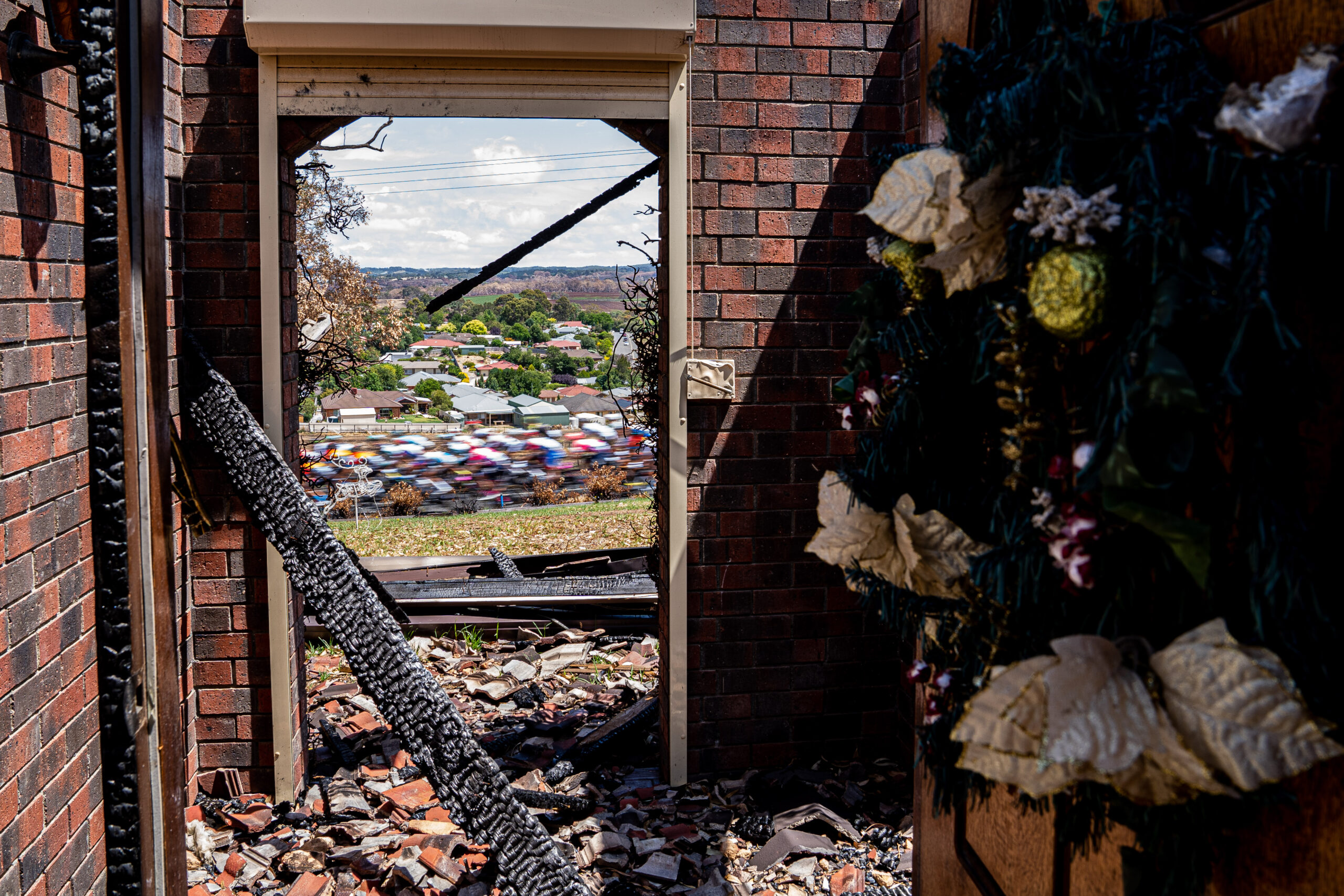
2020 Tour Down Under peloton rides through bushfire-affected area (Zac Williams/SWpix.com)
> The Giro just avoids Italy’s deadly floods – but cycling is now feeling impact of climate change
The past few weeks alone have seen a succession of reports in news bulletins relating to extreme weather incidents and natural disasters in recent weeks, such as storms, flooding or wildfires in western Europe as well as North America, the Indian subcontinent and South East Asia, and it seems clear that the issue of man-made climate change – and the role of the petrochemical industry in creating the situation – means that sponsorship from the sector will continue to attract not just criticism, but also direct action.
As we highlighted above, that contrasts with the public image of cycling for everyday reasons, whether that be travelling to work or to the shops, or going out to meet friends or take a ride in the park or along the river at weekends – the very thing that some sponsors from within the energy or automotive sectors, among others, will sometimes look to harness in partnership with their sponsorship of the sport itself.

Petrol Station copyright Simon MacMichael .jpg
The human element
While this article has focused on ‘sponsors’ and ‘teams’ mainly in the abstract, it’s worth considering the human element, too; at WorldTour level, besides 30 or so riders, each team will have dozens of support staff, and that’s without considering the thousands of others who depend upon the sport for at least part of their livelihood, spanning everything from the media to the crews who set up start and finish areas before a race and take them down afterwards.
We spoke earlier of the impact that potential loss of sponsorship can have on a team’s decision in taking on a new partner, and given human nature, it’s understandable that some of those affected may have to set to one side qualms about the business undertaken by the incoming backer against their need to earn an income.
Within the ranks of professional riders themselves – the elite of the sport, who will have made sacrifices for years to reach the top level, and whose skills by their nature cannot be transferred elsewhere – that perhaps creates even more of a dilemma, and a couple of individual instances are worth highlighting.
Last year, Gino Mäder, who died in a crash at the Tour de Suisse in June, raised more than €4,000 for a reforestation charity by pledging one Swiss franc for every rider finishing behind him on each stage of the Vuelta.
True, he rode for the Bahrain Victorious team, whose jerseys bear the logo of the state-owned petroleum company Bapco, but the initiative clearly underlined his concern for the environment.
Following Mäder’s death, his team mate Pello Bilbao made a similar pledge ahead of last month’s Tour de France, promising €1 to the same charity for each competitor finishing a stage below him, and double that if he won a stage – which indeed he did, taking an emotional victory on Stage 10 into Issoire.
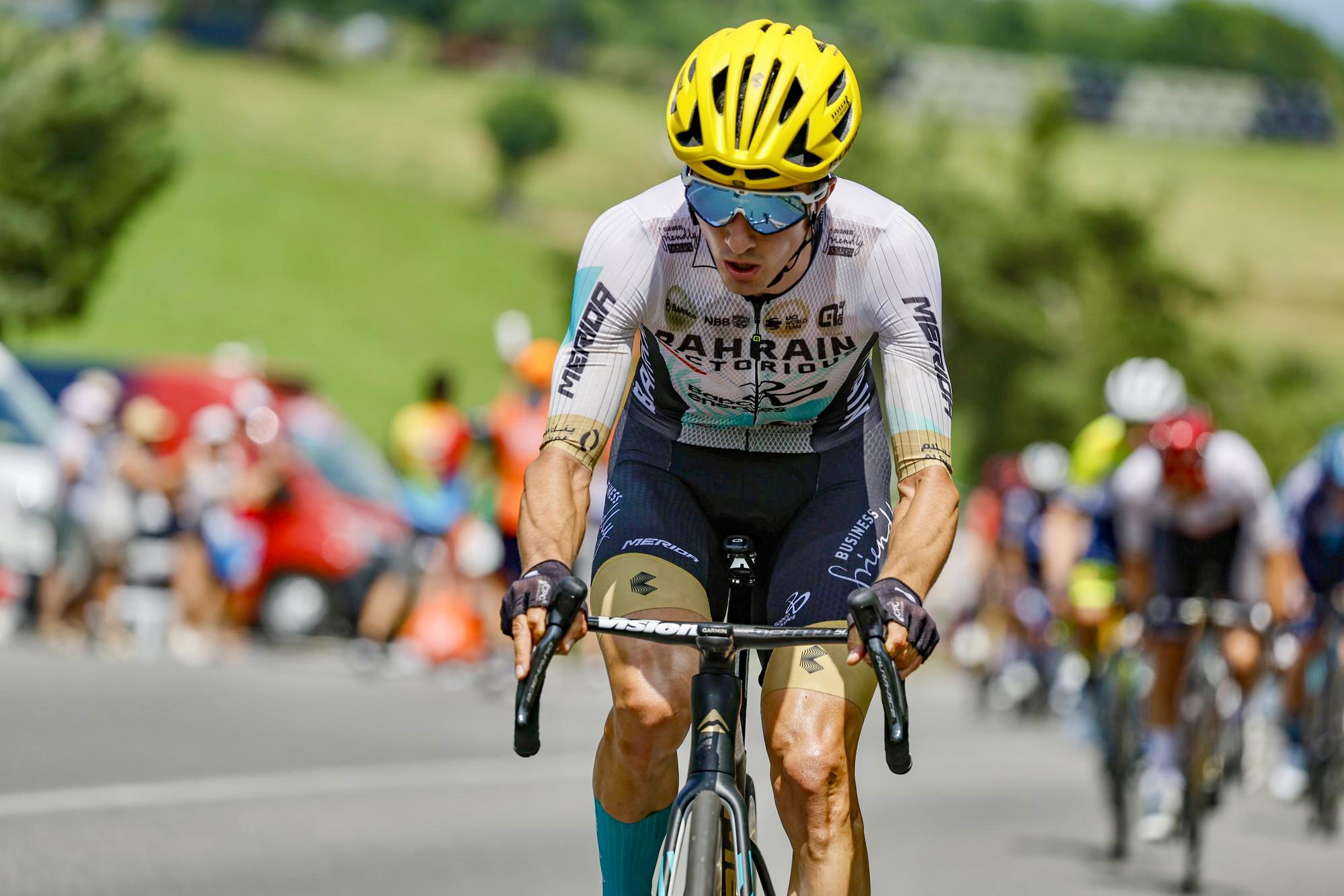
Tour de France 2023, 10th stage, Pello Bilbao, Bahrain – Victorious – photo Dion Kerckhoffs-Cor Vos-SprintCyclingAgency © 2023
During the race, it also emerged that under-23 world time trial champion Søren Wærenskjold’s insistence had turned down a lucrative offer to join UAE Team Emirates, saying that he had made “morally and ethically [the] right choice.”
In reportedly deciding to stay with his existing Uno-X Pro Cycling team until 2026, the 23-year-old Norwegian, whose signature is also said to have been sought by several other major WorldTour teams, said he did not want to “put the salary above everything else.”
The case of Uno-X Mobility, owner and sponsor of Wærenskjold’s existing team, which operates discount petrol stations with more than 300 outlets in Denmark and Norway is itself interesting.
Unlike other sponsors from the energy industry mentioned above, neither Uno-X nor its sister businesses are involved in oil production, and the business is pursuing a strategy of phasing out retailing of petrol in favour of greener energy such as hydrogen.
Reflecting that dichotomy between cycling as a sport and as a form of transport that we mentioned earlier, on the team website – Uno-X operates squads in both the men’s UCI ProTour and the UCI Women’s WorldTour – the company states its mission as being “to develop and promote solutions for sustainable mobility.”
It adds: “Our primary aim is to advocate for cycling as a vital measure for reducing emissions from road transport.
“Cycling represents one of humanity’s greatest opportunities for a shift towards a zero-carbon future.
“Our team riders serve as cycling ambassadors, and their most important task is to generate greater attention and enthusiasm for cycling.”
Marketing copy it may be, but in setting out that agenda, are we looking at a sponsor from the energy sector that should be given more leeway than others we have mentioned and embraced for its vision – or is there no place for any firm associated with oil and gas in the sport? Let us know your views in the comments.














70 thoughts on “Is cycling’s ‘sportswashing’ debate too big to ignore? World Championships protest shines spotlight on less-than-green sponsors”
Surely anything related to
Surely anything related to the intensifying climate crisis is too big to ignore? The way things appear to have accelerated this summer in comparison to scientists’ predictions is really alarming and we need to do something collective before it really is too late.
It’s telling that half of humanity seems to think that climate protesters are selfish when they cause disruption and delay when they’re actually totally the opposite – they’re putting our species’ future first. Sadly, Big Oil and the world’s politicians seem to want to line their pockets at our expense, so it’s clearly time we stopped pretending that they will legislate to do something about climate change. It’s something we need to do something about ourselves, and if people like Just Stop Oil, Extinction Rebellion, Greenpeace and This is Rigged make even one or two people do something positive then it’s worth it.
MattieKempy wrote:
Is it really half of humanity? Or a very noisy, highly amplified, and extremely entitled minority?
ubercurmudgeon wrote:
Is it really half of humanity? Or a very noisy, highly amplified, and extremely entitled minority?— MattieKempy
Is it really a minority? Or a very disgruntled majority? It’s the same people over and over who are protesting… and very much a minority if ever I have seen one.
While people are sympathetic toward their views, the ways and means they protest is definitely not in line or acceptable to the majority of people.
The_Tory wrote:
Aye, many humans are stupid (defined as believing and acting against your own interests as well as those of everythingand everyone that supports them, despite numerous warnings from reality). Off they go flying to somewhere about to catch fire – a fire largely caused by not just their flying but numerous other highly damaging behaviours recommended to them by greedy hooligan capitalists.
Are they in the majority? That hardly matters. What matters is whether there’s enough of them to trash the the biosphere, including themselves and everyone else, as well as a vast range of other living entities besides stupid humans.
The latest local emblem of such stupidity is the Toryspiv and its supporters. For a few extra groats and the opportunity to sit up the class-ladder sneering at “the undeserving poor” they’ve created, Toryspiv will do the very opposite of any conservative. They’ll trash the lot for their 5 years of infamous dominance.
But humans have always found ways to toss themselves over a cliff whilst imagining themselves doing so for a righteous cause. We’re all infested with toxic religions, ideologies and a vast range of other mental parasites that make us quite mad, let alone stupid.
Seems about right. History is
Seems about right. History is littered with failed civilisations. The difference this time is it is at planetary scale (but the planet will be fine).
Cugel wrote:
I can see that the madness has certainly spread to a few. Perhaps the only point we might agree on.
Yes. They are not really
Yes. They are not really protesting in the British way are they? What they should do is form an orderly queue at the post office and mutter quite loudly among themselves. Just as effective.
perce wrote:
There is a general election in a year or so time. Everyone who cares strongly enough about these issues is welcome to vote for the Green Party if they wish.
Ufortunately under our first
Ufortunately under our first past the post system voting green in all but one seat is a wasted vote.
You are quite right that we can vote green but the views that we are trying to express with that vote will be completely ignored until we have some form of PR.
Bungle_52 wrote:
The most important consideration is to make sure the Tories don’t get in again. Ideally, their party should get so few votes that they completely disband and their name disappears. (Though I’m sure that yet another far right, toxic party will spring up to pander for the xenophobes and racists)
“xenophobes and racists” –
“xenophobes and racists” – that good old fall back!?
gb901 wrote:
I’m not saying that all Tories are xenophobes and racists, but that’s the way that xenophobes and racists vote. It’s not even uncommon for senior Tories in government to make racist remarks, so voting for them indicates that it is acceptable language to use.
The Labour party has, of
The Labour party has, of course, never had a problem with systemic racism.
Absolutely no racism evident amongst their supporters.
No Labour politicians from particular backgrounds hounded out of the party.
Nothing to see here at all:
https://www.equalityhumanrights.com/en/inquiries-and-investigations/investigation-labour-party
Rich_cb wrote:
I’ll have no truck with the Labour party until Blair is tried for his war crimes and I don’t think the organisation is fit for purpose and I certainly don’t think that anti-semitism has any place in politics.
However, hounding politicians out of their party is far less odious than some of the bilge that comes out of senior Tories: https://www.bbc.co.uk/news/uk-politics-65249872
I notice that you leap to the defence of the Tories yet again and don’t immediately decry their racism. For shame.
And of course thatchers well
And of course thatchers well documented tacit endorsement of the National Front and their thuggery. Her fanboys seem to forget that. Or do they?
perce wrote:
Yes, that was a brutal time.
I wonder what the country would look like now if Thatcher hadn’t squandered the North Sea oil income?
https://eandt.theiet.org/content/articles/2021/01/north-sea-oil-a-tale-of-two-countries/
Have several “gangs of
Have several “gangs of British Pakistani men who’ve worked in child abuse networks” been successfully prosecuted for abusing “vulnerable white English girls”?
That’s what Braverman is quoted as saying in your link.
Is it true?
It would seem strange to make out that a politician stating things that have definitely happened and are a matter of public record is worse than a political party actively racially discriminating against people.
FWIW I think Braverman did not need to use the words “Pakistani, White or English” in those quotes and doing so, whilst factually accurate, was unnecessary and showed poor judgement.
I don’t think that quote is, in and of itself, racist though.
It describes what has occurred in several cities and has been well documented.
Would the sentence “gangs of white English men have sought to attack and severely injure black men of Afro-Caribbean descent” have been a racist thing to say after Stephen Lawrence was murdered?
FYI I didn’t leap to the defence of anyone in my original reply. I merely pointed out your stupidity in trying to make out that racism was only really a problem for one party when the current second largest party have recently been found to be racist and are still having issues with that same racism.
Rich_cb wrote:
I suppose that it could be argued that the party in Government being (not exactly subtly) racist and xenophobic is more of a problem than the party in opposition being so…
The difference is that for
The difference is that for all the consternation regarding the Conservatives’ ‘racism and xenophobia’ they’ve appointed the most diverse cabinet in UK history and overseen a huge expansion of non European migration.
Actions. Words.
Meanwhile the Labour party was actively hounding Jewish members out of the party whilst coming very close to being elected.
I know which concerns me more.
Rich_cb wrote:
Who are happily acting like the most white, crew-cut, polo-shirted males in political history… I’m not sure that you can decide that politicians are ‘goodies’ just because they’re brown or black.
In all fairness, Labour seems to be actively hounding anyone who isn’t either loyal enough or is too left wing out of the party…
I think you need to
I think you need to reconsider that first paragraph.
I haven’t said they were ‘goodies’, I’ve said it was the most diverse cabinet in UK history.
By stating that the cabinet members are behaving like ‘White… males’ you seem to getting dangerously close to Rupa Huq territory.
The point is that the apparently ‘racist, xenophobic, far right etc etc’ party has decided to appoint people of colour to pretty much all of the highest offices of state over the last decade.
That doesn’t really fit with the narrative does it?
Rich_cb wrote:
Poor judgement for you or me, but I’m sure (especially as a sometime lawyer) Braverman had very carefully considered this and had deliberately picked it not just as “a thing that happened (which quite rightly the government disapproves of)” but for a particular appeal.
Hence why in general why we haven’t been terribly fussed to call out “gangs of white English men…” – doesn’t have the same ring with some of the voters / papers.
Presumably there are examples of politicians looking the electorate in the eye and saying “a large minority of you are part of the problem / should do better” (e.g. men and sexual abuse, families and child abuse…) but I can’t think of any!
I’m sure she chose her words
I’m sure she chose her words carefully.
Her choice showed poor judgement.
The media are pretty quick to call out a lack of diversity these days, see the recent furore about an all white male chef team.
Rich_cb wrote:
Sounds like you’re defending them again.
https://www.independent.co.uk/news/uk/politics/conservative-party-racism-inquiry-islamophobia-b1853354.html
Still haven’t acknowledged
Still haven’t acknowledged your first post was completely and utterly wrong have you?
Keep banging the drum and pretending Labour antisemitism didn’t happen.
All parts of our society have issues with racism or discrimination, I’ve never said the Conservatives are an exception to that.
You have implied that Labour is.
You’re either entirely ignorant of recent British history or you don’t think antisemitism is racism.
Not at all – your vote will
Not at all – your vote will still count. And if enough people care that much to vote for the Greens, then they will win – simple as that.
Your vote will count for what
Your vote will count for what exactly? Under FPTP the majority of votes ( even the ones for winning candidates over and above +1 on the nearest challenger) mean bugger all.
I’ll vote for anyone that reforms this antiquated electoral system.
Clem Fandango wrote:
Every vote is important – this is why Government have “populist” manifestos, because they appeal to the masses (with a right/left slant on them of course) and that’s what you have to choose between – and it will win them a large number of individual votes.
Your one vote could be the difference between winning or losing a seat, and it’s this mentality that has led us to a dominant two-party system. (thankfully, as we all know coalitions are a bad idea at the best of times)
Good one.
Good one.
Manifestos are just a list of lies that will be ignored anyway & they’ll never get held to account over.
Where I live is a “safe” blue seat. My vote means sod all – believe me, I’ve seen it mean jack all over many election cycles. We even voted remain locally, but our Brexit loving blue swamp rat continually votes against the “will of the people” in his constituency. PR is the only way to deliver actual representation & value for your vote.
It’s the FPTP system that continually delivers failed government, through the false duopoly it forces on us. It’s the “it’s not broken” mentality of red & blue self interest that are the problem. Coalition is a “bad idea” – why? Because it forces dialogue & compromise? Sure the libdems got it wrong out of naivety but at least they tempered the worst blue excesses & got an electoral reform referendum through (though red & blue watered it down & campaigned against it).
From the 2019 General
From the 2019 General Election results analysis by ERS.
“The number of votes needed to elect an MP differed quite significantly for each party. On average, it took 38,264 votes to elect a Conservative MP, while it took 50,835 votes for a Labour MP. Strikingly, it took 865,697 votes nationally to elect just one Green Party MP and 336,038 votes for a Liberal Democrat – demonstrating how punitive Westminster’s warped system is on parties whose votes are not concentrated in specific constituencies, but spread out across the nation. The Brexit Party did not win any seats, despite having received 644,255 votes nationwide, while it only took 25,882 votes to elect an SNP MP.”
That analysis only counts the actual votes. I suspect if you included voters who would like to vote Green but actually voted tactically the analysis would be even more unbalanced.
Not so in East Hertfordshire
Not so in East Hertfordshire where the Greens now lead the Council and have control in conjunction with the LDs.
Protest votes are a wasted vote – however, if you are feeling the need for change so may 1000s of others so best to vote for what you want PR or no PR.
The PR train has left the
The PR train has left the station – it was put to bed when we had a vote on it about 10 years ago. The only advocates of pr on those who support parties who have minority support: it would inevitably lead to coalitions and we all know how successful they are!
The_Tory wrote:
you’d love that, splitting the vote of reasonable people to keep the likes of Jacob Rees Mogg and Steve Baker in parliament. Nothing is more imprtant than getting these destroyers out of a position of influence.
Being nice didn’t work for
Being nice didn’t work for the Sufferagettes, direct action did.
Also, if you look at the
Also, if you look at the histor of the likes of Belgium/Holland and the protests for car free living environments in cities. Direct action of a similar ilk is what gained them the transport systems we simply aspire to.
Samtheeagle wrote:
Indeed – in the case of NL there was certainly violent protest along with the other types of action (engagement with authorities, “just” protest, direct action such as blocking roads etc.)
chrisonatrike wrote:
I saw the Tyre Extinguishers appear to be escalating their action:
https://www.theguardian.com/environment/2023/aug/07/activists-drill-holes-in-tyres-of-more-than-60-suvs-at-exeter-car-dealership
I would’ve hoped they could have phrased it as “in which a Land Rover was driven through a school fence”.
jaymack wrote:
They often took direct, violent action. https://en.wikipedia.org/wiki/Suffragette_bombing_and_arson_campaign
I’ll repeat what I’ve said before – how people protest isn’t that important and there’ll always be people complaining that they’re not protesting in the “correct” way. What’s important is that people feel the need to protest and what they’re protesting about.
wycombewheeler wrote:
You have a vote (presumably), use it how you wish. If you care deeply enough about the environment to want Greens rather than the Tories/Sir Softie aka The Pointless Human Bollard, then use your vote to reflect your feelings.
I’ve just written a stern
I’ve just written a stern (but polite) letter to the gas board
That’s a coincidence – I have
That’s a coincidence – I have too!
Clem Fandango wrote:
Cue Pamela Stephenson as Esther Rantzen…
There is a common assumption
There is a common assumption that the UK government haven’t done much about climate change.
If you dig into the systemic changes that have taken place over the last decade, largely behind the scenes and unnoticed, you can see that huge strides have been made.
This has happened without a huge amount of political fanfare and with broad political support.
https://grid.iamkate.com is a really good resource for looking at UK electricity emissions as an example. The change over the last decade has been absolutely enormous. That hasn’t happened by accident.
Rich_cb wrote:
That’s the point. Decarbonising the grid has been politically simple and the punters don’t much care since the same stuff comes out of the sockets.
What’s next is much harder because it requires people to make changes in how they live (travel, heating their homes, etc.). We’re all in favour in principle – but many will vote against in practice (because China! Cost! Freedom! Whatever…).
All the ranting about “the government should do more” is largely misplaced: they’ll do what they think will get us to vote for them. Lots of people will vote for greener policies – so long as they aren’t inconvenienced or required to change their habits. Which is exactly what needs to be done.
Dnnnnnn wrote:
Whilst the UK has become more efficient in energy usage, a large part of the “decarbonising” has been by moving emissions to other countries.
I think it’s a bit simplistic to thing that governments will just do what they think will get us to vote for them as their doners and supporters have a vast influence. Also, the voters can often be fooled by narratives in mainstream media and thus not vote in their own best interest (or indeed the best interests of the population).
As an example, surely most people would consider that clean air is extremely fundamental and would not vote for politicians that wish to remove air quality regulations, and yet we have this: https://www.theguardian.com/environment/2023/aug/04/uk-government-ignoring-green-watchdog-over-air-quality-rules
I think it’s a bit simplistic
Of course voter opinion isn’t the only thing that governments take heed of – but it is what gets them into power. Without that they’re not implementing any policies.
And of course how people vote is influenced by such as the media amongst other things. But that’s the point – a nation whose favourite reads are The Sun and the Daily Mail is hard to convince to vote for deep green policies. As J.C. Juncker said on this topic, “We all know what to do, but we don’t know how to get re-elected once we have done it.” He might have added that he probably wouldn’t have been elected in the first place if he’d said he was going to do what needed to be done (a lesson Starmer seems to have drawn).
I wonder if the protesters
I wonder if the protesters looked at the nearby wind turbines in the glen not one was moving and with hardly any sun I doubt if much electricity was produced by solar panels, what are we suppose to do, the main problem in the world is to many people now. Maybe another world war to trim us down might help.
Every time I cycle anywhere
Every time I cycle anywhere (which is every day) I see car after empty SUV after taxi after car after car – always with just 1 person in it – sat in traffic, blocking the pavements and roads and cycle lanes, engines idling. How are people’s habits ever going to change?
BIRMINGHAMisaDUMP wrote:
They’re not going to change by sitting in a hi-vis and glueing yourself to the road.
People broadly accept that electric or non-fossil fuel vehicles are the future. Not maybe what people believe is the right choice, but what is being forced upon us. People will start accepting and using “green” cars when they become cost effective, and practical – something they are not at the moment. And to get there, we need the government to invest in tech companies, and manufacturing to get us there. Not pathetic subsidies and ULEZ tax.
Combustion of any sort is
Combustion of any sort is unhelpful to the urban environment. EVs will help greatly in reducing urban atmospheric pollution (hence ULEZ etc). Provided electricity is generated by genuinely renewable means then EVs are also helpful in reduction of carbon footprint. The more important ecological footprint of EVs remains to be clarified. It will be different to ICE vehicles but not necessarily smaller.
This is the problem. The
This is the problem. The average person has almost no power to do anything beyond try to make good choices where possible. Most of us work long hours, have children and try to have a small amount of time to do other things outside of that. Governments should be sorting this crap out from the top level.
The fact that companies can just make packaging that isn’t recycled still is ridiculous. The fact that companies can make whatever wasteful size of packaging is disgraceful.
They keep trying to push the burden of responsibility onto the individual (shock shock horror) to try and suggest that its not the massive companies that are the root of all these issues. Give me an electric car that meets my needs and I will happily use it. Tell me its going to cost me £30k and I will struggle to charge it conveniently and I won’t.
I’m also not going to fork out the £50k or more it would cost to get solar panels, a battery, turn my edwardian house into something that could actually use an ASHP or GSHP and then buy one.
Unfortunately we are basically placing all our eggs in the basket of “we will come up with a magical technology once shit gets bad enough”.
I don’t get all the bollocks about sports washing and green washing. No one thinks “wow, Ineos sponsor a cycling team, they must be less scummy than I thought because riding a bike is green”. No one thinks “wow, Qatar is such a wonderful country, I thought they were involved in horrible human rights abuses but that world cup has complete changed my mind”. If anything, the focus on these countries/companies as part of their sponsorship probably makes more people dig into their behaviour.
Fundamentally though people have enough on their plates and won’t be going out into the streets to demand action when they can barely keep their heads above water as it is.
That sums it up just about
That sums it up just about perfectly for me, thank you.
I’d also add on the sportswashing… I’ve never sought out a Shell garage, or indeed thought ‘ooh I must drive my car more” because of the British Cycling connection.
And yes, yes, yes, we are told that we are bastardo’s for wanting to go on holiday (whilst big tour operators and cut price airlines advertise their services without control), we are told we are the devils for buying packaged products (when the supermarkets insist on covering everything in single use plastic to maximise their profits), told that we are earth destroying failures for not having the wealth to buy a £40k+ electric car and £1500 charging point, oh and a house with off-road parking (whilst the car manufactures insist on making bigger and heavier cars for no other reason than to massage ego’s and maximise profits).
I can go on and on. If the governments want genuine change the pressure has to be placed further down the chain than the consumer.
Jimmy Ray Will wrote:
Completely agree with this and the above. The rot starts at the source – there is only so much the consumer or average joe can actually do.
The_Tory wrote:
“]If the government wants genuine change…”
What makes them want anything? Other than keeping their own jobs, looking out for their own and exercising their own bees in bonnets?
Feedback loops. Governments let companies do what they lobby for and people buy what they’re sold (which encourage more companies to sell more of those things) and eventually people vote for governments who facilitate the availability of these things.
Want change? You probably need more than one place in the wheel to put a stick in the spokes!
Not easy.
None of them can think beyond
None of them can think beyond the next election cycle (or probably the next headline). Long term issues just continually get kicked down the road. Career rather than actual tough (ie potentiality unpopular even in the short term) decision making every time.
Jimmy Ray Will wrote:
The cheapest family-sized electric car is £26,000 (MG4) and there is the potential for councils to fit on-street charging points free of charge where off-road parking does not exist (there are already five in my street). If you have off-road parking you can charge an electric car from the mains supply, or if you want a faster charger it can cost as little as £300 and you can apply to the government’s Electric Vehicle Homecharger Scheme to cover 75% of the cost (maximum grant £350). Still a pretty fair slice of change but nowhere near the figures you quote.
Jimmy Ray Will wrote:
Electric Vehicle Man channel on YouTube – just bought a 7 year old Renault Zoe for £4400 in a “buy EV for under £5k” challenge.
Spoiler: it was fine, and he’s going to keep it as a town car to replace the ICE Mini.
I disagree regarding the
I disagree regarding the sports green-washing (or simply, ‘advertising’). You see positive things that you like (eg some sporting event or personality) always next to some brand (eg Shell) and you begin to feel more favourable or at least less unfavourable towards that brand. Sporting personalities are recommending the brand to you, even if they never explicitly say anything about it. It doesn’t have to be a conscious belief for it to work. Presumably the companies spending their money on this have a lot of evidence that this tactic works. I believe there’s power in association, even if the logical, conscious part of your mind knows otherwise.
Agree with the comments re:
Agree with the comments re: expecting end user consumers to make small changes, to the benefit of capitalism, is not the path to a solution.
Strongly disagree that bringing ‘party politics’ into the conversation is relevant in any meaningful form, it’s not certainly not with Labour/Conservative/ScottishNP/LibDems etc..etc..blah blah.. swap one for another and we’re left with, ah yes.. no change.
Very much agree that our electoral voting system needs changing, it’s the only lever we could have which could give us some meaningful change. However with any meaningful climate change, it would upset a lot of people, companies would likely invest in other countries, jobs would be lost and our lives get worse. Lets say tomorrow we stopped buying cars and we lost the car industry. That’s an estimated 780,000 jobs lost and goodness knows how it’d effect the UK bank balance and our own cost of living.
The global capitalism model is out of control and ultimatley is at the root of our issues. It’s easy to blame the richest elite as they have faces, it’s the faceless investment consortiums who demand profits and take ‘humanity’ away from business decisions which I worry about the most.. these are our pensions etc. and there are too many people involved for anything other than legislation to affect change. If we villified Shell and had the board members removed, nothing changes, they are simply expensive puppets to the shareholders, of which are made up of ‘retail consortiums’ (investment firms).
Does anyone here honestly think the board at Shell would care if British Cycling refuse their offer of money.. no, they’d simply find another sport to invest in and probably save them paying some taxes in football or moto-gp etc.. In this respect and rather selfishly, I’d rather see my sport take the money, every time, better us than a form of motorsport.
I’m pleased to see people forcing the conversation to happen whether that’s gluing them selves to roads, draping politicians houses in black cloth or chucking orange paint about, I don’t always think it’s intelligent but each action is at least some action rather than no action, the more people speaking about the issues the more momentum gathers and who knows where that will lead to.
Personally, I couldn’t give a
Personally, I couldn’t give a monkeys!
I think those within the
I think those within the sport criticising protests that stop a race, as happened on the weekend should also think about extreme weather events that have also affected and indeed stopped races. These extreme weather events are going to become more common and I suspect that the same voices will not speak out against companies and governments that continue to contribute to these events through climate change. In my opinion that is the problem with greenwashing.
Just seen this, TBF, I think
Just seen this, TBF, I think George Monbiot got there before me ?
STOP giving the protesters
STOP giving the protesters press coverage. That encourages them to do more of it.
Rather than have debate in the proper spot: the legislature or the ballot box.
sullyvsn wrote:
NO QUITE THE OPPOSITE PLEASE.
A blind man can see the (current) ballot box and system is a utterly toothless tool for change.
YES. With the protesters ALL
YES. With the protesters ALL the way!
Fossil fuel company
Fossil fuel company executives are directly and personally responsible for millions of deaths already and many more millions over the coming decades through the downplaying of climate change and lobbying to avoid any action.
Anything less than lifetime prison sentences for all of them is a scandal. Arguing over whether its appropriate for normal people to be angry about it is a distraction they welcome.
Fossil fuel companies
Fossil fuel companies actively covered up climate change science.
Patrick9-32 wrote:
Really? If it wasn’t for fossil fuels, then you wouldn’t have half the products and equipment in your house or that you own today. Do you have any idea how many products are derived from oil? You wouldn’t be riding a bike with rubber tyres, or carbon if it wasnt for oil. Or even using whatever device you are to comment on this thread.
A lifetime prison sentence for the crime of making money is nothing short of fanatical extremism. If there is demand, there will be someone there to fill it. Rightly or wrongly.
Good – even if despite
Good – even if despite yourself – criticism of capitalism there.
?
Easy to protest. Hard to make
Easy to protest. Hard to make substantive changes in societies where people want to drive everywhere. EVs are a bandaid. Ebikes are way better, but they all have energy production costs.
And one has to face the reality that, Russia and China don’t give a shit about climate change no matter what lip service they give to it because Russia sees global warming as its first real opportunity to develop Siberia, a national dream for centuries, and China thinks it can turn deserts into farms and forests. It’s actually had some success in doing so.
As whacked as China is, they might even see global warming as a soft-power opportunity for expanding their influence. Thus, against the size of the problem, “sportswashing” would appear a pretty silly issue. If you don’t like the companies supporting pro cycling, just don’t do business with them.
Meanwhile, sad to say, it might be time to start thinking seriously about adaptation. None of which is meant to imply we shouldn’t all do all we can on our own. I walk or ride my bike (bikes) almost everywhere, including to the bike park to which many of my climate-change fretting neighbors and friends drive to ride their MTBs or eMTBs because the hills are big here.