



Yesterday morning, as discussions were being held about whether to shorten the tenth stage of the Giro d’Italia due to the rain and cold temperatures facing the riders on the day’s main climb of the Passo delle Radici in northwest Tuscany, less than 200km away on the other side of the Apennines the city of Cesena, which less than 48 hours earlier had welcomed the finish of stage nine’s time trial, was being hit by deadly flooding.
Much of the city, which lies 10km inland from the Adriatic coast, now lies underwater with the disaster engulfing Emilia-Romagna, plus the neighbouring Marche region to the south, claiming eight lives to date, and causing thousands of people to be evacuated from their homes.
Photos from an Italian Air Force helicopter posted to Twitter by the Ministero della Difesa show the extent of the devastation around Cesena and Forli.
#Maltempo EmiliaRomagna/Marche: #FFAA in soccorso.
In coordinamento con @DPCgov, 2 elicotteri #AeronauticaMilitare impegnati per salvataggio cittadini zona Cesena e Forlì. Min @GuidoCrosetto costantemente aggiornato da sala operativa COVI. Ulteriori assetti #Difesa in prontezza pic.twitter.com/Ogc6v5za84— Ministero Difesa (@MinisteroDifesa) May 16, 2023
While it may have been a matter of sheer luck that the race had departed the area by the time the floods came, it does highlight how natural disasters and climate change are impacting the sport, and raises questions about how well equipped it is to respond to them.
A tough day at the office.
Nothing but respect for the riders out there. #Giro #GirodItalia pic.twitter.com/pqoYslP6eA— Giro d’Italia (@giroditalia) May 16, 2023
It’s exactly 12 months ago today that the Giro d’Italia passed through the area of Emilia-Romagna currently hit by flooding, with a stage from Santarcangelo di Romagna near Rimini to Reggio Emilia, after racing had resumed following the first rest day in Pescara in the Marche, racing resuming there on the Tuesday with a stage to Jesi.
Needless to say, had those stages been on the parcours of this year’s race instead of the 2022 edition, they would not have taken place. Equally, had the deluge been a little to the west and fallen on the Tyrrhenian side of the Apennine watershed, it seems inconceivable that yesterday and today’s Giro d’Italia stages would have gone ahead.
That’s not just down to the obvious disruption to the route of the race, but also because of the demands that would be placed on the emergency services, not so much those who accompany the Giro, but the local units that support it as it passes through their territory.
#Maltempo EmiliaRomagna/Marche
Mezzi e tecnologie #Difesa in campo da subito per supportare la popolazione civile ma è sempre il personale a fare la differenza.
Min @GuidoCrosetto costantemente aggiornato da sala operativa COVI.
📷Stefano Tedioli – @qn_carlino per @_Carabinieri_ pic.twitter.com/3DxMU3XE5B— Ministero Difesa (@MinisteroDifesa) May 17, 2023
Indeed, it was to enable police, firefighters and medical staff to focus on the disaster recovery operations and helping those in need, as much as damage to the track and circuit facilities, that was cited as a prime factor in the decision announced at lunchtime today to cancel this weekend’s F1 Grand Prix at Imola, near Bologna.
The decision has been taken not to proceed with the Grand Prix weekend in Imola#EmiliaRomagnaGP #F1 pic.twitter.com/4taauGnFEA
— Formula 1 (@F1) May 17, 2023
The latest flooding comes just a fortnight after what was described as a “once in a century” downpour in Cesena and neighbouring cities claimed two lives, and little more than seven months since Storm Ana wreaked havoc in Emilia-Romagna and the Marche last September, with 12 people killed – and while that toll renders sport insignificant, the floods also resulted in the cancellation of that weekend’s Memorial Marco Pantani one-day race based around his home city, Cesenatico.
Extreme weather becoming more common – and cycling is not exempt from its effects
The fact is, in recent years extreme weather events, and the natural events they trigger such as landslides, flooding and wildfires, are becoming more common around the world due to climate change – and sport, including cycling, is not immune from their impact.
Just to take a few examples from the past four years, in 2019 a key stage of the Tour de France to Tignes in the High Pyrenees was shortened as a hailstorm led to ice forming on the descent from the Col d’Iseran, with a subsequent landslide rendering the route impassable, the stage timings instead taken at the top of the climb with eventual winner Egan Bernal taking the yellow jersey from Julian Alaphilippe.
This looks to be the reason why the race was stopped#TDF2019 pic.twitter.com/cbF3NHHEUH
— ITV Cycling (@itvcycling) July 26, 2019
At the end of that year, it seemed as though the crucial Poggio climb would be dropped from the following year’s Milan-San Remo due to landslides caused by heavy rainfall – though with the race postponed from March to August due to the COVID-19 pandemic, repairs had been made by the time the race took place.
Bush fires in early January 2020 threatened the Tour Down Under, not for the first time, with the race eventually going ahead as planned as the South Australian government took a ‘business as usual’ approach as the state began its recovery from the disaster, and with organisers and sponsors raising money for victims.
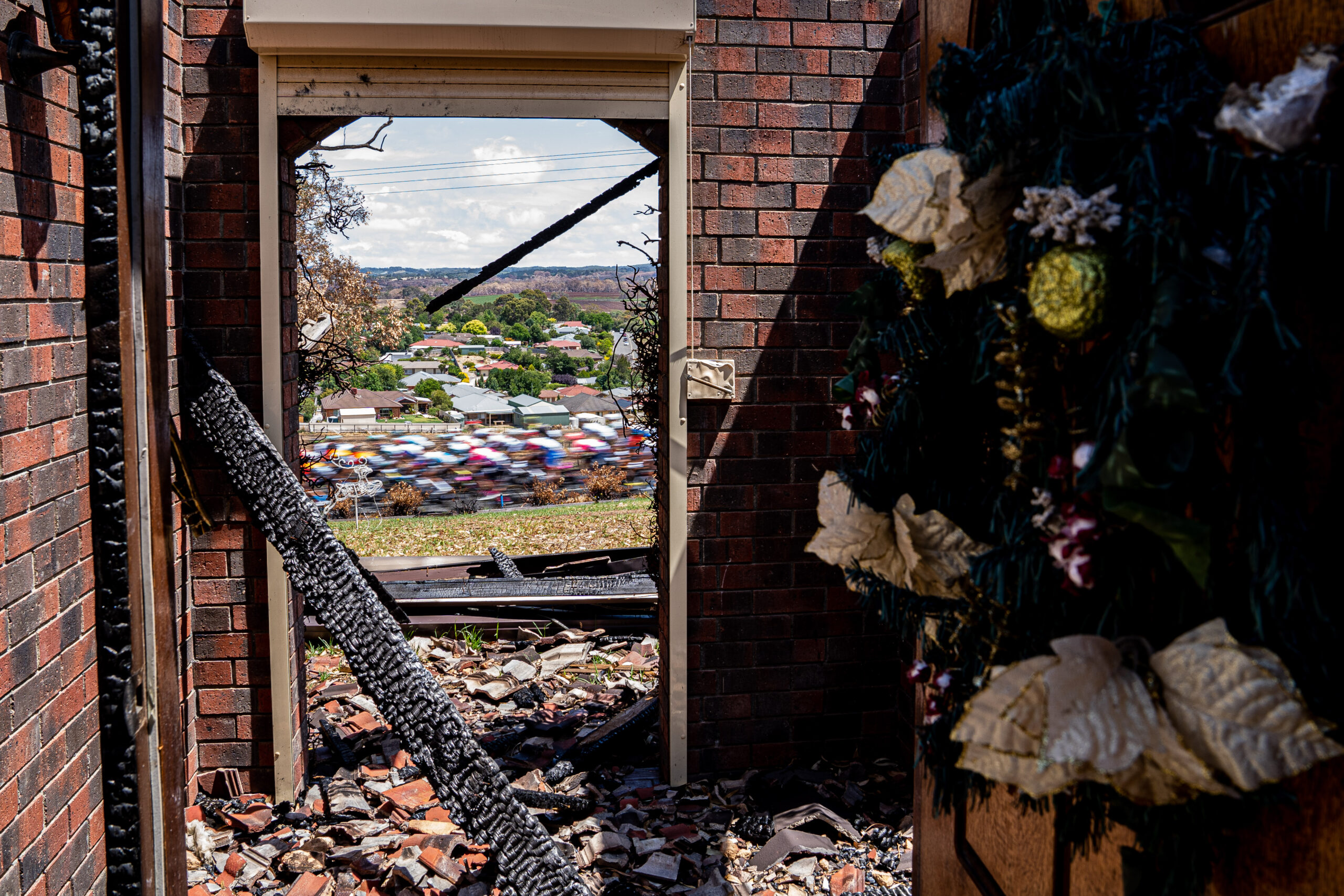
The 2020 Tour Down Under peloton passes a house destroyed by bush fires (Zac Williams/SWpix.com)
In July last year, the UCI’s Extreme Weather Protocol was invoked for stage 15 of the Tour de France from Rodez to Carcassonne as temperatures went above 40 degrees Celsius, with firefighters also using hoses to cool the road surface to prevent it from melting, while in March this year, a stage of Paris-Nice was cancelled due to the prospect of “exceptionally violent winds” above 100km/h.
Returning to the Giro d’Italia, in recent years a number of high mountain stages have been shortened or had their routes changed due to the prospect of snow or heavy rain.
Even two of the remaining stages of this year’s race have had to be revised, with the riders now skipping the Great Saint Bernard Pass, the highest point it was due to visit, while fan numbers will be restricted on the penultimate day’s mountain time trial, and barred from some sections of the route altogether, following recent rock falls.
And while the focus in Italy at the moment is on snow, rainfall and flooding, elsewhere in Europe we are witnessing the opposite extreme, with temperatures in Spain in recent weeks in excess of 40 degrees Celsius.
The UCI’s Extreme Weather Protocol
It was the rising occurrence of such widely varying conditions that in 2016 led to the UCI introducing its Extreme Weather Protocol, which among other things provides for changes to rules surrounding taking on food and drink, as well as providing for increased time limits at the finish, with invocation of the protocol undertaken following a meeting involving stakeholders including race organisers and representatives of teams and riders.
Defined in Annex B to the UCI Road Racing Regulations, the protocol defines “the extreme weather conditions that could lead to such a meeting” as including:
Freezing rain
Accumulation of snow on the road
Strong wind
Extreme temperatures
Poor visibility and
Air pollution.
It also applies to “an issue regarding the course or the organisation of the event or stage represents a risk to the riders’ safety,” including, for example, “Failings relating to the safety of the course (surfaces, obstacles, protective measures and barriers, signage, lighting, descents, narrow roads, bridges, etc.).”
Swift action will be needed to respond to effects
While some of those issues – strong winds, snowfall, extreme temperatures and the like – can be forecast with some accuracy ahead of a stage, their consequences, such as flash flooding, or landslides such as those witnessed on the Col d’Iseran during the 2019 Tour de France, can by their very nature happen with no warning and while racing is underway.
We suspect it’s an issue that will increasingly tax both world cycling’s governing body and race organisers in the years ahead – and one that when incidents do inevitably occur, will require a swift, decisive response to ensure the safety of riders, spectators, and all involved in the race.
It’s a feature of bike racing, of course, that once the event is over and the race crew have taken down the barriers, the portable buildings and other infrastructure making up the finish area, life quickly returns to normal in the location concerned – the race moves on at an astonishing pace, and a few hours after the riders have crossed the line, normal traffic has resumed and other than balloons and other decorations outside shops and bars, there’s little sign that the race took place at all.
But for the people of Cesena and nearby towns and cities yesterday and today, the visit of the Giro d’Italia at the weekend must now seem a very distant memory indeed as they start counting the cost to people and property of an extreme weather event that is now becoming far too regular an occurrence.









69 thoughts on “The Giro just avoids Italy’s deadly floods – but cycling is now feeling impact of climate change”
The warnings have been there
The warnings have been there for decades yet we all carry on as normal.
Pro-cycling is just as culpable as any other sport.
According to the latest scientific research we’ll be smashing through the 1.5C upper threshold for any chance of averting climate disaster within the next 5 years.
What a time to be alive….
https://www.theguardian.com/environment/2023/may/17/global-heating-climate-crisis-record-temperatures-wmo-research
They said that 20 years ago,
They said that 20 years ago, never happened. We should be more worried about the threat of Russia and China to world peace.
Facts and common sense
Facts and common sense relying on anecdotal evidence?
Wonderful, you’ll take the place of the last arsehole whose just been given the elbow.
Yep, let me the arsehole that
Yep, let me be the arsehole that can see right through an agenda that has gripped and blind sighted the world.
Bit windy today again! OTOH
Bit windy today again! OTOH good for keeping cool on a ride.
OK.
OK.
I can only assume that you
I can only assume that you are a post-doc in climate science or something like that. What’s it like being so intelligent?
See how quickly the little
See how quickly the little Fascist in them comes out. A year ago it was about vaccinations, now it’s global warming.
You must be banned. We can’t hear anyone’s opinions but the ones that make me feel good and I agree with.
If someone has been banned
If someone has been banned before and repeatedly comes back, you think no one should say anything.
Now that does sound fascist.
8 people drowned, thousands
8 people drowned, thousands homeless. Stuff the UCI and the Giro.
The climate has been changing
The climate has been changing ever since earth was created and humans have never had anything to do with it.
People have been confidently
People have been confidently stating things ever since the internet was created and facts and common sense have
neverrarely had anything to do with it.Hmmmmm…..so the first part
Hmmmmm…..so the first part of your sentence is (probably) 100% correct, so well done. Unfortunately the second part is only around 99.93% correct, and sadly it’s the last 200 years that matter, rather than the previous 300,000. So, good effort, but no cigar.
Nice!
Nice!
A climate-denying lunatic –
A climate-denying lunatic – unrelated to cycling – brought here by Google, or a new persona for one of the returning regulars? Only time will tell…
I in fact ride my bike 10hrs
I in fact ride my bike 10hrs a week, I wasn’t brought here from Google and I don’t deny that climates change. What I am saying is there is no evidence that humans affect the climate.
The second one it is then…
The second one it is then…
No to be honest, I never have
No to be honest, I never have been a commenter on here before. Just felt the need to voice my opinion when I saw this article. We live in a world where everyone has the democratic right to freedom of speech.
Facts and Common sense wrote:
I don’t know what planet you live on but it sounds good. Here on Earth about 15% of us have it (according to a study I just Googled).
Sorry you are right there. I
Sorry you are right there. I should have said the western world. I feel for people in countries like China, Nth Korea and Russia.
You can add a lot to that
You can add a lot to that list. On the other hand the regimes in the places you mentioned are indeed popular with some there. Perhaps for the inhabitants it never got good enough for long enough that people could expect more than “stability” (valued very highly apparently)?
As for freedom, Voltaire’s quote is still a good one, although perhaps he forgot to add “… but if you persist in saying things which are factually incorrect people are going to think you’re a fool. They laughed at Galileo – but they also laughed at David Icke”.
They didn’t waste any time.
They didn’t waste any time.
Another 2 to add to the ignore list.
No evidence that humans
No evidence that humans affect climate change?
Apart from the masses of peer reviews evidence that has been accumulated over the last 50 years?
Just because the likes of Nigel Farage want to spout bollocks on things they know nothing about doesn’t mean their opinion counts for anything.
Sadly, far too many people, including you cling to this delusional nonsense as an excuse to carry on doing absolutely nothing.
When it all goes tits up, which it will within the next couple of decades, don’t say you weren’t warned.
According to the data, there
According to the data, there is no climate crisis. However theoretical models can be made to point to one. (But in theory only)
plunt wrote:
Which data are you referring to? (Probably some YouTube video that seems convincing to idiots)
There’s so much evidence for climate change from human activity that you’d have to be some kind of fool to deny it.
https://climate.nasa.gov/evidence/
Facts and Common sense wrote:
So how would you explain the drastic changes that have come about since humans started burning loads of wood/coal etc?
https://phys.org/news/2019-09-climate-natural-man-made.html
hawkinspeter wrote:
So how would you explain the drastic changes that have come about since humans started burning loads of wood/coal etc?
https://phys.org/news/2019-09-climate-natural-man-made.html— Facts and Common sense
That’s the thing, isn’t it? For most of our history, humans didn’t have the capability to make huge changes (unless you count almost completely cutting down the Wildwood…) and the human population was not large.
But during the last couple of hundred years, as our engineering and technological prowess has increased – and our population! – then someone would have to be wilfully blind to think that we have not detrimentally impacted the environment and the climate.
We have the technological prowess to destroy it all, but not to fix it.
brooksby wrote:
We just weren’t trying hard enough! Look at the world-altering pollution caused by the cyanobacteria (it’s believed). If there had been newspapers then (or even tissues…) I’m sure there’d have been a lot of strongly-worded letters from other life forms.
brooksby wrote:
The fix is extremely simple – stop burning so much stuff.
However, the attempts to change people’s behaviour have been thwarted for decades by the oil/motor industries and their bought politicians. It seems that we’d rather the billionaires keep making more money than we’d like our world to be comfortable for us to live in.
https://www.youtube.com/watch
Even has citations.
Facts and Common sense wrote:
hi Nigel!
Climate change happens, but
Climate change happens, but the current rate of climate change post industrial revolution appears to be much higher than is thought to have happened before.
If a warming climate is going to be problematic for our lives why wouldn’t we look at ways of slowing this by reducing our CO2 output etc?? Even if it doesn’t stop a warming climate from ‘natural’ causes…
I’m in complete agreement
I’m in complete agreement that CO2 linked to human activity is driving climate change but what is interesting is that global temperatures likely reached their lowest point in 2000 years just before the industrial revolution.
Just looking at post IR data therefore exaggerates the changes as the start point was significantly below the average temperature.
Rich_cb wrote:
Well, apparently we’re enjoying a warm spot within an “ice age” so it’s just possible that we were about to go back to the time of wooly mammoths – but our exertions turned that around! Thus understating the change…
The consensus seems to be that the “little ice age” was mostly due to a combination of different things in different places so the above is quite unlikely though! Still, I’ll keep a pullover handy.
Rich_cb wrote:
is it just me or does that average line look higher than the pre IR average? Is the average line shifted upwards by post IR rises? Most of the pre 1800 data points are below the average line.
The average line is for 1880
The average line is for 1880-1960.
It’s interesting to compare the absolute changes in the 250 years pre and post the lowest point.
Gives some context to the post IR changes.
Pro racing should do a lot
Pro racing should do a lot more about its climate impact. Do they need helicopters now drones are so good? I guess they’ll be electrifying team cars and buses soon too. Don’t know how much air travel they do, seemingly not a lot
Don’t criticise the pro
Don’t criticise the pro cycling world, the cycling world is just a drop in the ocean for emissions. Where does most of our cycling products come from? China and Asia. I never hear criticism of them, people dont have the guts to criticise them. China is the largest emitter of emissions plus how many of their companies are run very unethically.
We in the West don’t
We in the West don’t criticise because keeping our eyes shut gives us cheaper products. While we THINK we don’t have to worry about polution in the East.
Criticising China for what?
Criticising China for what? Their contribution to man-made climate change that you claim doesn’t exist?
The helicopters act as relays
The helicopters act as relays for the TV camera signals from the motos. With another aircraft at higher altitude acting as a further relay.
That’s why when there’s bad weather that grounds the choppers, it usually also takes out the moto TV.
Italy is beginning to
Italy is beginning to experience a regular tropical climate; long periods of dry, arid weather followed by heavy precipitations. Italy will have to adapt its agriculture and water management to cope with this change in climate.
BIRMINGHAMisaDUMP wrote:
Or at least until their climate patterns shift again.
The new normal will be that there is no new normal.
Two weeks back I saw a report
Two weeks back I saw a report on the news that the Po was at levels generally only seen at the end of the summer.
Bicycle commuting and lycra
Bicycle commuting and lycra cycling can be a world apart regarding climate change.
The first cuts emissions drastically by keeping a car locked, the second means an SUV loaded with bicycles travelling for hundreds of miles to quiet places or even worse to sunnier places by air travel and shows that require thousands of air travel miles.
The point, “yes but your bike, comes all the way from China” is just silly. Slowly shipped cargo has very little emissions https://www.co2everything.com/co2e-of/freight-shipping . Yet it should be urgent that industry comes back to Europe, both for environmental reasons since China burns oil and coal, and for resilient economy reasons.
cyclisto wrote:
I think “can” is the operative word here, and you’re probably highlighting the extreme end of the spectrum. I (when I worked on site) commuted in Lycra on a sporty bike, and every leisure ride I’ve ever been on started and finished at my house. The only time my bike has ever been in my car was to bring it back from the shop.
cyclisto wrote:
— cyclistoI commute in lycra.
I’m confused. Can you tell me whether I am saving the planet or trashing it?
Come on, you are not five,
Come on, you are not five, you get the point.
@BalladOfStruth
Yes, you are correct, I may had been a bit harsh, a “can” is needed. But judging from me and my few cyclists friends, most of them are on either on the commuter side or on the 23c tire road/MTB side, so I was biased by my own little experience.
cyclisto wrote:
I get the point; I just don’t know how relevant it is. I’ve always lived in the countryside, so I don’t know what it’s like in more urban areas, but every roadie I’ve ever known tends to base all their rides from their own house (unless they’re doing an event or a race).
In fact, if anything, it’s the mountain bikers that are going to be way, way worse for this. Everyone lives near to a road of some sort, but not everyone lives near a decent set of trails. So, I’d assume that if anyone was going to bung their bike in their car and drive to their ride, it’d be a mountain biker. Anecdotally, this ties up with the fact that I hardly ever see road bikes on bike racks out on the road, they’re almost always MTBs.
But when, according to the national travel survey, the most common purpose for a car journey is “leisure”, I’m not sure how relevant even that is. At least with an MTB ride, the activity at the end of the drive is emission-free.
The 5 year old comment was
The 5 year old comment was for Simon E, should have made a @ for him too apart from the thread answer header.
Lycra goes for MTB too, at least for my good buddy that does XC always in lycra.
I don’t denounce lycra, I wore it too when I was strong enough to tour. But from my experience, commuters and recreational riders are different sides.
cyclisto wrote:
Different sides of what?
What you mean is that you’rejust making this up. And you didn’t answer my question. Did I use too many long words?
Ok I will write it in an
Ok I will write it in an simple manner.
People predominantly commute in normal clothes. You can see it on the road, you can see it in Streetview, you can see it on road.cc very interesting article https://road.cc/content/feature/londons-cyclists-what-they-ride-clothing-more-301157 . On the other hand recreational cyclists predominantly ride in lycra.
I believe now you have undestood whether you are saving the planet or trashing it. If still not and not trolling, I feel sorry for your boss/colleagues/clients at work.
Regarding the sides, you have already asked yourself which side do you belong. So you know. If still not and not trolling, you know again.
You have given no evidence
You have given no evidence why people who wear lycra are damaging the planet. You just asserted it ( and that they only use SUVs)
cyclisto wrote:
You haven’t explained why recreational cyclists are a problem for climate change. I’m a recreational cyclist that also commutes in lycra instead of driving. I will ride across town in jeans and when my commute was 5 miles I rode to work in ‘normal’ clothes. It’s not trolling to ask you to explain your poorly worded post.
If by ‘recreational cyclists in lycra’ you wanted to talk about people choosing to drive a car many miles to then ride a bike for fun then yes, that does happen. However, many of the keen cyclists I know ride locally most of the time. But if all the recreational cyclists in lycra stopped ‘recreating’ on their bikes then the impact on CO2, NOx, noise and other climate and environmental impacts would be undetectable. The negative impact on coffee shop incomes could be more significant. And they may then take up a pastime that burns even more fossil fuel than cycling.
Simon E wrote:
Yes I confess to this, but then many people drive their cars many miles to a wide range of leisure activities, and cycling is no worse than that.
e.g. if I were a regular football fan, travelling to every away game in the season by car would be a lot more miles than I do driving to audaxes.
I estimate my total annual milage to be no more than the average driver, despite driving two children to and from university, and having to make regular trips to various sites for work purposes.
I kind of get where cyclisto
I kind of get where cyclisto is coming from in that you will have people who purely commute and have no interest in cycling apart from getting to where they need to be using a bike, casually dressed etc…and then at the other end of the spectrum you will have your pure weekend, hobbyist cyclists who other than the odd weekend ride, on their 5k bikes and latest season of gear,don’t touch their bikes, drive in to work every weekday, probably drive the couple of miles to gym everyday . But I think the vast majority of cyclists are commuters who actually enjoy cycling enough to do it everyday and then more so that they do recreational rides on top of that. If that makes sense.
Yeah – and in the UK folks
Yeah – and in the UK folks driving to the ride likely aren’t helping. David Hembrow’s comment in a blog post about “green cars” has some relevance here:
However… people in the UK who do have bikes and do enjoy riding (actually quite a lot) have the potential to become early adopters of transport cycling. If we make some of those short journeys more convenient to cycle than drive.
Perhaps we should adopt some
Perhaps we should adopt some new words for this distinction? In NL probably the majority of the population are not “cyclists” and yet often ride a bike! A person so doing is a “fietser”. There’s a special word for someone engaging in “sport cycling” e.g. a roadie* – “wielrenner”. (See BicycleDutch’s guide to the lingo). That is a much less common activity I believe.
However that doesn’t stop “going for a ride” being a common form of recreation. Subtle benefits of riding are that it makes getting around easy (so you’re more likely to) and it also gives you a continuum of levels of exertion. So it’s a bit easier to get a little more exercise. Compared to the difference between e.g. walking and running. Of course cycling is so efficient that is it’s also possible to exert yourself less than going for a walk!
* I don’t know if they commonly include MTB or other things in this category – obviously you can be specific and say mountain biking too.
I have been 99.9% cycling my
I have been 99.9% cycling my daily commute since October 2021 (that one day after Storm Eunice & Dudley hit together still irks me), yet consider myself a runner.
I cycle in my running kit – so lycra leggings, runners shorts and hi-vis running tops. After almost a year and a half I bought some cycling shoes.
As much as I enjoy cycling, I would still more often go for a long run at the weekend rather than a cycle.
I do not consider myself an environmentalist. I was simply too cheap to buy a second car, BUT I bore the life out of people talking about how great cycling is for commuting. I try to convince people to give cycling a go.
I’m not as enthusiastic about convincing people to go running, so have been asking myself why I do it for cycling. I believe it is because I am keen to encourage exercise and cycling can be done by the vast majority of people, whatever their fitness level.
Would the environment benefit from everyone cycling more? Yes.
Am I going to take to the streets over that fact? No.
I think more people these days will take up cycling simply because it is a cheaper alternative to driving.
Simon E wrote:
You’re confused, I frequently commute in lycra from the waist down but with a casual hoodie or T-shirt on the top half, which bit of me should I be lecturing about climate change and which bit gets a pass? I tend to give it some watts in the morning and take it more leisurely coming home, which of these is preferable?
China started construction on
China started construction on 50GW of coal fired power stations in 2022 (2 per week), more than 6 times the entire capacity of the rest of the world combined, and 4 times increase from their previous year (Reuters).
The UK is 18th worldwide behind China’s 12,039 Gigatons of CO2 emissions last year, with its 348.
But yeh, sure beat up on everyone in the UK for breathing too much CO2 if it makes you feel better.
Just because someone else
Just because someone else does it is no reason to poo in your own bed.
Last year it was Covid
Last year it was Covid Bedwetters demanding we get vaccinated, now we have Climate Fascists talking about poo-ing the bed.
Phew.
Mungecrundle wrote:
Here are some lycra-clad recreational cyclists ‘pooing in Italian beds’.
https://www.cyclingweekly.com/news/well-do-it-even-screaming-in-agony-the-british-amateurs-riding-the-entire-giro-ditalia-route
Bloody charity cyclists giving us a bad name, they should be flogged as an example to the others thinking of doing something similar.
Roulereo wrote:
Even that’s slightly misleading though. They also deployed 87GW of solar just in 2022. And produced 300GW annual generation compared to the next best USA at 95GW.
And China has similar numbers for Wind.
The sheer size of China makes a lot of singular examples misleading.
Plus a huge amount of China power generation goes into exports which confuses the picture even more….
And given that China produces some huge proportion of the rest of the worlds solar panels they probably deserve a carbon “bye” for that too.
Yup – another (partly
Yup – another (partly accidental) example of “emit elsewhere”. In much of Europe (oh alright “and the UK”…) we are proud of “cleaning up our industrial processes”. There is some truth in this but quite a bit is that we just get the dirty / dangerous stuff done elsewhere.
Historically not a new idea of course. For centuries we’ve happily imported products (spices, cotton, sugar, still coffee and tea, now iPhones and clothes) with origins we’re much happier not to think about!
You’ve just waffled out
You’ve just waffled out weasel words, the equivalent of a defence lawyer talking about a horrible criminal who is also nice to kttens.
Such classic hypocrisy from the far left extremists who makes howl of protest about human rights from their Apple i phones.
Today I will mostly be
Today I will mostly be posting FACTS AND COMMON SENSE which fly in the face of all facts and common sense
Bizarre scenes at todays Giro
Bizarre scenes at todays Giro.
Better not blame the weather or Climate Change, eh?
I used to remember where snow was the usual suspect for shortening stages of the Giro on the high mountain passes, now the poor riders have to contend with having water-wings fitted to avoid the chances of drowning.
How un-aero are they?