


-1024x768.jpg)

The Dutch government has launched a campaign urging people to voluntarily wear helmets while riding their bikes, after new road safety statistics revealed that 17 per cent of all cyclists involved in crashes in 2024 suffered brain or skull injuries.
The ‘Zet ‘m Op’ (or ‘Put It On’) campaign will be initially aimed at children, commuters, and elderly people, and aims to ensure that 25 per cent of all cyclists in the Netherlands will opt for a helmet within ten years – a 600 per cent jump compared to the country’s current helmet-donning population.
However, behavioural scientists have warned that, while the government’s attempt to encourage helmet use can succeed, it will be a “long-term process” and will face resistance in a nation where cycling is the norm but helmets are not.
And the Dutch Cyclists’ Union and other activists have criticised the scheme and its “one-sided” focus on helmets, arguing that it will lead people to associate cycling with danger, and that the key to ensuring the safety of cyclists is creating more safe infrastructure and clamping down on dangerous driving.

In a country with a distinct, deeply embedded cycling culture and where 28 per cent of all journeys are made by bike, only 3.5 per cent of Dutch cyclists wear helmets, which are usually confined to the nation’s sport or leisure cyclists.
However, calls for the Netherlands’ fietsers, or everyday cyclists, to wear helmets while out and about have been increasing in volume in recent years, as the number of cyclists seriously injured each year has risen by 27 per cent over the past decade, according to injury prevention organisation Veiligheid NL.
New figures released by Veiligheid this week revealed that 74,300 cyclists ended up in hospital last year following crashes – accounting for over half of all casualties on the road – while 48,900 sustained serious injuries, a number that continues to grow despite the overall collision total dropping by just under 14,000 compared to 2023.
Of these cycling casualties in 2024, just under half (49 per cent) suffered a broken bone. Four per cent sustained serious damage to the brain or skull, while 13 per cent sustained a minor brain injury, meaning 12,500 cyclists in the Netherlands suffered some kind of brain injury last year.
40 per cent of the 246 cyclists killed on Dutch roads in 2024 were the result of a collision involving a motorist, while head injuries were the cause of 60 per cent of all cyclists’ deaths.
The Dutch Institute for Road Safety Research claimed last year that if all Dutch cyclists wore helmets, fatalities on the road would drop by 85 each year, and the number of serious injuries reduced by 2,500.
This week, David Baden, a doctor in the emergency department at Utrecht’s Diakonessenhuis hospital, told NOS that he sees cyclists who have been injured in crashes every day, and argued that more protection on the bike is “urgently needed”.
Speaking at the launch of the ‘Zet ‘m Op’ initiative at Haagsche Schoolvereniging primary school in The Hague on Wednesday, which was attended by infrastructure minister Barry Madlener, safety organisations, and former Manchester United goalkeeper and brain injury campaigner Edwin van der Sar, the chair of Doctors for Safe Cycling pointed out that voluntary helmet use should be part of a broader plan to improve road safety.
“We have a reasonable infrastructure, with good bike paths, but we cannot deny that there are a lot of falls,” intensive care neurologist Marcel Aries said at the launch, Dutch News reports.
“If you look at the injuries, almost a fifth involve brain injuries. That is a gigantic figure. If you want to keep healthcare affordable, there is much to gain here.
“But we aren’t there with just a helmet and a good campaign. The ministry should be open for rules and better infrastructure because cycling traffic is so different from 10 years ago, with speed pedelecs that go at 40 kph, e-bikes, and normal bicycles all on a relatively narrow cycling path.”
.jpg)
The campaign will feature test events where cyclists can try out helmets, while the government says it will attempt to make helmets more attractive through discounts and collaborations with manufacturers to “improve” designs.
It will primarily target parents of young children, commuters, and older cyclists, after the recent safety stats revealed that 41 per cent of all cycling injuries involve people aged over 55 – which Baden says are often the result of e-bike crashes.
“That has to do with reduced muscle strength, reduced reaction time, and a faster-moving vehicle,” the doctor said.
Baden also said that children regularly end up in hospital, because “they are just starting to ride a bike, they are still learning the skill, and have even less insight into the dangers of traffic.”
“We have spent 100 years trying to tackle the behaviour of car drivers”
However, with helmet use such a rarity in the Netherlands, a behavioural scientist at Rotterdam’s Erasmus University believes encouraging a quarter of all Dutch cyclists to don helmets will be a “long-term process”.
“These kinds of changes can succeed,” Inge Merkelbach told NOS. “But it will be a long-term process. Change always leads to resistance.
“You have to buy a bicycle helmet, it does something to your hair, and no one else wears one. People find that unpleasant: we don’t want to be the odd one out.”
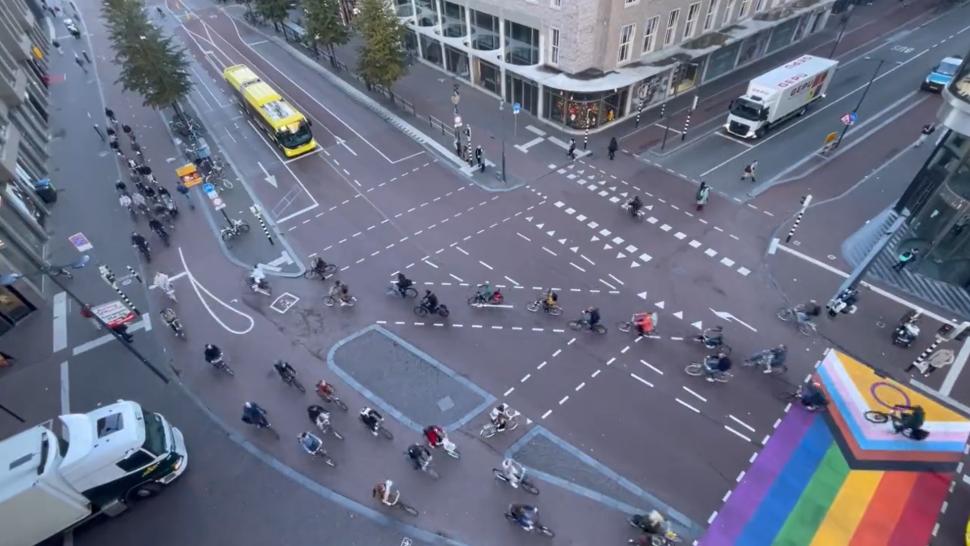
This resistance was strikingly evident at the campaign’s launch, where activists from lobby group The Lab of Thought – who weren’t invited to the event but handed out leaflets to children at the school – accused the government of abdicating its own responsibility to keep the country’s roads safe for cyclists.
> Why is Dan Walker’s claim that a bike helmet saved his life so controversial?
“I think it’s crazy that the person with the most responsibility and influence as minister spends his time giving out free helmets,” Frank Kwanten told Dutch News.
“It is saying that if the government doesn’t protect you, you need to do it yourself. There are all kinds of effects, such as people coming to associate cycling with danger.
“The system should be such that everyone can get to school safely. We have spent 100 years trying to tackle the behaviour of car drivers.”
Meanwhile, the director of the Dutch Cyclists’ Union, Fietsersbond (who also didn’t attend the event), accused the government of making hollow political promises to reduce the number of cycling injuries without investing in safer infrastructure.
“No-one is against wearing helmets, but the one-sided focus on cycling helmets distracts from the real issues: speed and the need for safer infrastructure,” the union’s director Esther van Garderen said, while Amsterdam’s cycling mayor Romee Nicolai argued that it would be “horrendous” if the responsibility for safety was passed on to children and their choice of headgear.
However, speaking at the event, infrastructure minister Barry Madlener criticised the cycling campaigners’ stance and said it was “totally incomprehensive” that they believe a voluntary helmet campaign aimed primarily at children constitutes “victim blaming”.
“Traffic is of course very much about behaviour and part of it is your own personal responsibility,” Madlener, a member of Geert Wilders’ far-right Party for Freedom (PVV), said.
“I think it’s good to be aware that we all contribute to our safety, for ourselves and for others, and that we should promote this message rather than a negative one that this is victim blaming – I completely disagree.
“We need an awareness that you are very vulnerable as a participant in traffic on a bike, because a lot of people don’t realise this sufficiently.”










39 thoughts on ““People find helmets unpleasant”: Dutch government launches ‘Put It On’ campaign urging cyclists to wear helmets as serious cycling injuries continue to rise – but activists say scheme “distracts from real issues””
Oh no, the Dutch government
Oh no, the Dutch government has turned in to /r/bicycling.
Given the Netherlands’
Given the Netherlands’ success in getting people to cycle- *especially* the young and the old who may be more likely to crash and more likely to be more seriously injured – it’s certainly reasonable to ask the question.
I think they may still have some things they might want to look at aside from helmets, though (although I believe the majority of *crashes* resulting in some kind of injury are “single-vehicle” e.g. people crashing of falling off their bike).
Also see:
https://www.aviewfromthecyclepath.com/2023/04/whats-gone-wrong-with-road-safety-in.html
Looking at deaths, not all injuries: figures and (translated, annotated) graph from here – albeit this is just 2 years and there’s the Covid anomaly.
Quote:
Very much pushing responsibility for the risks drivers take onto the vulnerable people who might suffer the consequences of that risk taking.
“It’s very likely this person
“It’s very likely this person wouldn’t have died from being shot if they had been wearing a bulletproof vest”
“Traffic is of course very
“Traffic is of course very much about behaviour and part of it is your own personal responsibility,” Madlener, a member of Geert Wilders’ far-right Party for Freedom (PVV), said.
I see. So it’s the responsibility of the vulnerable road user to protect themselves against shit drivers. Got it.
What IS it with these right-wing freaks and their hatred of cycling? Surely it represents the pinnacle of personal effort and self-reliance in terms of transport? Isn’t that what right-wing ideology is supposed to defend?
Eton Rifle wrote:
Good heavens no, right-wing ideology only really supports personal hard work and/or self-reliance when it is contributing to the greater ideal of the beloved nation state. If you’re going to have these cyclists whizzing around not paying a penny in duty and more importantly not buying hugely expensive vehicles and enormous amounts of fuel from the companies on which the state relies for its funding then you’re tantamount to a traitor. The Nazis were absolutely wedded to the idea of an automotive society, creating the autobahns and Volkswagens to get everyone into cars. Ironically they actually were quite pioneering in the creation of cycle paths, but not because they wanted to encourage cycling but because they wanted to get cyclists off the road so they would stop getting in the way of motorists. In 1936 the Nazis outlawed all cycling groups as they were predominantly socialist in origin.
There’s an interesting though unproven theory that Hitler had a personal animosity towards cycling because when he joined the army in World War I he wanted to be a motorcycle messenger, a job with considerable glamour, but he ended up with the ignominious position of bicycle messenger.
Rendel Harris wrote:
It was a common idea – the UK was doing the same thing at the same time for the same reasons. (See Carlton Reid’s project documenting these and even perhaps restoring some).
The Germans overall weren’t so ideologically driven that they passed over using cycle troops. Of course despite the existence of rockets, jets and other Wunderwaffen they also used lots of horse transport and antiquated kit from the time of the previous war. It was often what they had (as pointed out in the interesting “The Shock of the Old”).
Cycling has a long history of
Cycling has a long history of being emancipatory and linked to left wing politics. See the original Clarion club, for example. Many cycling clubs have roots in workers organising and it remains a cheap/free way for most people to get around. I’m not sure the fascists consciously know about the political history of cycling, but you can sort of see how it is at odds with any sort of authoritarian political views.
Although a lot of Clarion
Although a lot of Clarion members came from upper class interlectual backgrounds. Apparently a lot of their rides usually ended in pubs with the singing of patriotic songs such as “England Arise” This might explain why there aren’t any branches in Scotland, Wales and Northern Ireland!
Interesting! I don’t think
Interesting! I don’t think being an upper class intellectual precludes you from being a socialist though the singing of patriotic songs is definitely suspect. Socialism was a key part of the founding, anyway, and remains part of it (in the ‘proper’ clarion club, anyway). I can’t find anything about the political views of cyclists but based on my club I’d say it’s strongly left leaning.
They don’t like being told
They don’t like being told where, when and how fast they can drive. They think it’s an affront to their “personal freedoms”. I well remember the outcry when wearing seat belts became mandatory; lot of hot air about personal choice then. Now, it’s just a fact of life. Surprised that a fascist party could do so well in a country that suffered so much because of it.
So disappointing to see the
So disappointing to see the beacon country for safe cycling going down the helmet route, which has failed everywhere it’s been tried, with horrific unintended consequences.
Whatever the cause of these deaths and injuries, it is always better to treat that cause than the symptoms. If it’s ebikes that can reach 40kph unaided, then control them so that they can’t go over 25kph. If it’s lack of training, then organise the training. Just don’t do the knee jerk reaction of armouring the victims, which doesn’t work.
“The Dutch Institute for Road Safety Research claimed last year that if all Dutch cyclists wore helmets, fatalities on the road would drop by 85 each year,……”
Just like it didn’t in Australia or anywhere else those extravagant claims were made.
“This week, David Baden, a doctor in the emergency department at Utrecht’s Diakonessenhuis hospital, told NOS (link is external) that he sees cyclists who have been injured in crashes every day, and argued that more protection on the bike is “urgently needed”.
Observation bias much?
The only proven effect of helmet promotion and laws is to reduce the number of cyclists, who lose the overwhelming health benefits, get chronically sick and cost the health service a thousand times more than cycling injuries.
Don’t worry. The Dutch can be
Don’t worry. The Dutch can be as car brained as anyone. Read an article in my local online news this morning bleating on about it being an affront to peoples liberty if you do things like introduce paid parking permits to encourage reduction in car ownership. Article ended up with a throwaway paragraph about road safety where the journo suggests changing driver behaviour is more effective than reducing number of vehicles on the road.
eburtthebike wrote:
Sadly true.
Helmet promotion & compulsion is simply a distraction, a technique to avoid talking about the real causes of road casualties. It’s like being told to wear a cheap stab vest when you’re surrounded by psychos bristling with machine guns.
eburtthebike wrote:
I have to assume David Baden and his ilk are highly educated intelligent people. I’d love to ask him which is the better use of public funds, to prevent motorists driving into cyclists, or to make cyclist protect themselves against motorists driving into them? Which outcome gives the better prognosis for the cyclist?
If those initiatives come
If those initiatives come from far right PVV, it’s got nothing to do with safety of the cyclists.
BBB wrote:
I would have thought Geert Wilders would be too worried about “helmet hair” to go for that…
I always insisted that my
I always insisted that my daughter wore a bike helmet, mainly out of concern for her but also because I didn’t want another severely brain damaged child. Her elder sister was brain damaged at birth and basically has the functions of a baby. She’s blind, has never walked or spoken and isn’t in control of her bodily functions. She’s been like that for 30 years. On top of this I also have a son who’s autistic with the mind of an under 5. No matter how many people laugh at you wear a helmet and make sure your children do. It’s no fun for them being like that, it’s no fun caring for them either.
My heart goes out to you and
My heart goes out to you and your family, life has been unkind to you. And I would not argue with your conclusions. Clearly, as a matter of individual choice, wearing a helmet makes perfect sense – it’s the only part of the equation you can change.
However, as a matter of public policy mandatory helmets is a poor choice – since public policy has the ability to change the other side of the equation, the source of the danger, rather than simply mitigating it’s impact.
I think we get tied in knots if we ignore this distinction – individual choice and public policy have very different parameters, and it is entirely consistent as an individual to choose to wear a helmet whilst arguing against public policies aimed at making individuals wear helmets.
Quote:
About the same amount of time as it would take to get the fat arsed out of their cars and on to bikes perchance?
And yet again helmet
And yet again helmet discussions including fatalities…
See ski helmets – higher level of protection (see multinorm helmets – some ski helmets are certified for cycling) against similar risks (falls at speed onto hard surface)
Near perfect usage tracking (link helmet usage to lift pass via photos taken to prevent lift passes being shared. Track distance via lift usage)
Result of helmet usage going from single digit % to 85%.
~80% reduction in head injuries. No changes to KSI’s.
So ski helmets are great at avoiding having to pay for a blood wagon off the mountain to get cuts from ski edges stitched up at the local (probably private) clinic
They are completely useless in preventing people getting killed…
So any argument for helmet usage should be on minor injuries…
qwerty360 wrote:
Simple physics indicates that helmets preventing death is statistically unlikely.
An inch of EPS and composite shell can only absorb a limited amount of impact energy. Impact energy is proportional to impact speed squared.
In all probability either the speed of collision isn’t sufficient for a fatal impact energy, or you’re dead anyway. The band of impact speeds where a helmet would change the outcome of fatality is minute.
(I know I’m ignoring the mass part of the equation, im basing this off of someone falling off and hitting their head on a stationary object. If the impact is a car or anything larger in motion, the only viable protection would be another car or a tree or a very large rock.)
Does that mean I’ll ride without wearing a helmet? Hell no!
The main point is to reduce concussion recovery times from a period of months to a period of weeks, as well as the mentioned mitigation of superficial wounding.
In my opinion the best approach to the helmet “debate” is to encourage usage as part of a broader program of education and building cycle skills whilst importantly also implementing worthwhile infrastructure to separate vulnerable road users from motor vehicles.
Can we look forward to :
Can we look forward to :
“Cycle lane at the Van Gogh Museum is reducing the value of the paintings”, claims Jan van Hire, mayor of Amsterdam?
The money would probably be
The money would probably be better spent on developing more comfortable helmets to wear.
I suspect the money might be
I suspect the money might be better spent on several other things. However in the case of NL (but almost nowhere else) I might be wrong. It’s perhaps worth them carefullly doing the cost / benefit sums on this and looking at the detail (which I’m not entirely clear they have done, as opposed to saying “something must be done – here’s something”). That’s because they have “mass cycling”:
a) a significant proportion of the population sometimes cycles for transport, including those who are more at risk of crashes / more at risk of serious harm e.g. the young and the old.
b) Plus they have much improved safety with respect to collisions with motor traffic over time.
HOWEVER … they appear to have recently been going backwards on (b). And some people over there are apparently saying that it might be worth looking at the effect of e-bikes (opinions seem to vary).
Spending the money on continuing to improve the infra safety and convenience rather than “wear PPE” campaigns may bring additional health benefits (e.g. more people riding more trips) – which may outweigh the effects of “people injure themselves falling off / crashing their bikes.
Whilst watching the news
Whilst watching the news about the possible demise of British Steel, I was surprised to see they mandate the wearing of cycle helmets for all staff whilst on site. I would have thought one of those yellow hard-hats you see construction workers wearing would have been more appropriate, but it seems not?!
Although I think I spotted someone in the background ignoring the rule!
I’ll be taking my helmet on
I’ll be taking my helmet on my trip to Holland next year no matter how safe their network is. All it takes is a moment’s lapse or an unexpected wet, slippery patch and that’s it. Talking of Holland, has anyone ever got the overnight ferry from Harwich to the Hook of Holland and back? If so, perhaps you could tell me if panniers are safe to leave on bikes in the ferry and whether there are any cafes at either end where I could wait for the call for boarding? Thanks.
biking59boomer wrote:
I have but it was over a decade so get other advice!
I suspect we probably took our panniers off the bikes – don’t know if mandatory. Harwich – IIRC there is a cafe but not great and can’t recall if it was even open (arrived there on bike – this was on a tour). We didn’t even stop to check the facilities at Hook of Holland so no idea about that either sorry. For all I know it’s a nice place but it was pretty misty that morning and we felt we should get some miles in before breakfast.
Recent studies raises
Recent studies raises concerns about the safety claims for helmets and consequences of helmet promotion.
Clarke, C. and Gillham, C. (2019) ‘Effects of bicycle helmet wearing on accident and injury rates’ URL:
https://www.researchgate.net/publication/337367329_Effects_of_bicycle_helmet_wearing_on_accident_and_injury_rates , GB National Road Safety Conference Telford 2019.
Clarke CF, Is cycle helmet promotion warranted, July 2022 Edinburgh Napier University.
https://www.researchgate.net/publication/361798342_Is_cycle_helmet_promotion_warranted
Compares data for the Netherlands to Denmark.
Clarke CF, Investigative study of meta-analysis approach to assessing cycle helmets and mandatory helmet legislation, December 2024
https://www.researchgate.net/publication/386820804_Investigation_into_meta-analysis_claims_regarding_cycle_helmets
Shows the claims made for helmets are unreliable.
I wonder who is funding this
I wonder who is funding this campaign, or donated to the politicians who’ve approved public funds for it? Companies and rich individuals who stand to benefit from discouraging cycling use, presumably. Car companies, oil companies, building companies that don’t want the expense of incorporating bicycle provision in their developments, etc. The list is long, and their government is currently right-wing dominated. The Netherlands may be a cycling paradise, compared to the UK, but there are probably just as many people who’d love to shift the car-versus-sustainable-transport Overton window just a little bit. They just haven’t been as successful as their counterparts here, so far. And what better way to start than by getting the government to put up posters everywhere painting cycling as a dangerous activity.
As many have pointed out,
As many have pointed out, while cycling is mainstream there (unlike in most other countries) that’s not a guarantee it will continue to flourish. It may have some “cultural” status but mostly people cycle because it’s extremely *convenient* and indeed pleasant. If that is reduced – or people feel it’s not safe – many (most?) will look to travel another way.
…and they still own an awful lot of cars in NL…
Given “everybody cycles” there consideration of “normal population”-level effects may make it more sensible to look at encouraging helmets there than in other countries. But I think they’d still need to be *very* sure this doesn’t reduce levels of cycling and overall have a negative health impact.
Or that the money wouldn’t be better spent e.g. on a campaign saying “put it down” (your car keys, and ride / walk / take public transport instead).
The Dutch royal family have
The Dutch royal family have always set a good example by cycling. The attached photos show King Whillhelm and Queen Maxima. His three predecessors Queen Beatrix, Queen Juliana and Queen Whelmina, were also cyclists
Note the fashionable cycling
Note the fashionable cycling helmet she’s rocking, and also luggage (hand (-le-bar) – bag).
Props to them tacking some cycling fallacies (“can’t cycle in work / smart / fashionable clothes”).
This might be an advertising gig though (for Royal Dutch Gazelle)?
A lot more lives would be
A lot more lives would be saved if motorists and pedestrians wore crash helmets.
But that is unreasonable
But that is unreasonable though – driving and walking are very safe – and people *have to* walk and drive, unlike choosing to cycle… /uktransportsnark
I think there is some data to support that cycling is associated with some increase in the rate of and severity of head injuries over those expected from people just walking *. And in NL data shows that the major cause of hospital visits is from crashing or falling off your bike where nobody else is involved. (Though for deaths perhaps crashes with motor vehicles are significant? ) And given that far more of the very young and very old cycle there I think it’s reasonable to look the detailed sums.
But that would need to include consideration of the risk of putting people off cycling, which would have a negative effect on population health.
Still think they might get more benefits overall from “Don’t drive” campaigns though…
* Seems logical – compared to falling over when stood up your head may be a bit higher on a bike and your limbs tied up in the frame, impairing you breaking your fall. And if you managed to go over head- first you maybe travelling faster from a bike.
kingleo wrote:
Correct.
kingleo wrote:
Even more would be saved by ensuring that everyone wore a shower-helmet and used a ladder helmet when changing light bulbs etc. There’s probably a need for slipper helmets too as a surprising number of people trip up when wearing slippers.
Larger numbers perhaps but
Larger numbers perhaps but likely a very low rate / probability – so might not be the most effective to target. Depends on stuff like cost / how easy it is to persuade people to change given that this is has a low accident rate, chances of more people throttling themselves with their helmets (if the entire population is wearing them) etc.
Similar arguments could be made against bothering in the bike case of course – but they probably feel they have more leverage on this specific case.
I have not read that they have done a detailed enough analysis that this is the best use of the cash. Nor if (considering all factors) whether it is likely to be a net positive for overall health.
But given they now have much of the population cycling, and also that their data show the largest fraction of crashes requiring hospital attention (but not necessarily deaths…) are essentially “fell off bike” – which is within the parameters where a helmet might best mitigate damage – I think asking the question is reasonable over there.
I don’t think they’ll be very successful .. but then look how well the “dark arts” marketing skills of those who brought us mass motoring did (making the victims guilty via “jaywalking” etc). Perhaps they could flog the idea together with ebike use?
chrisonabike wrote:
Well, if it saves one life…