


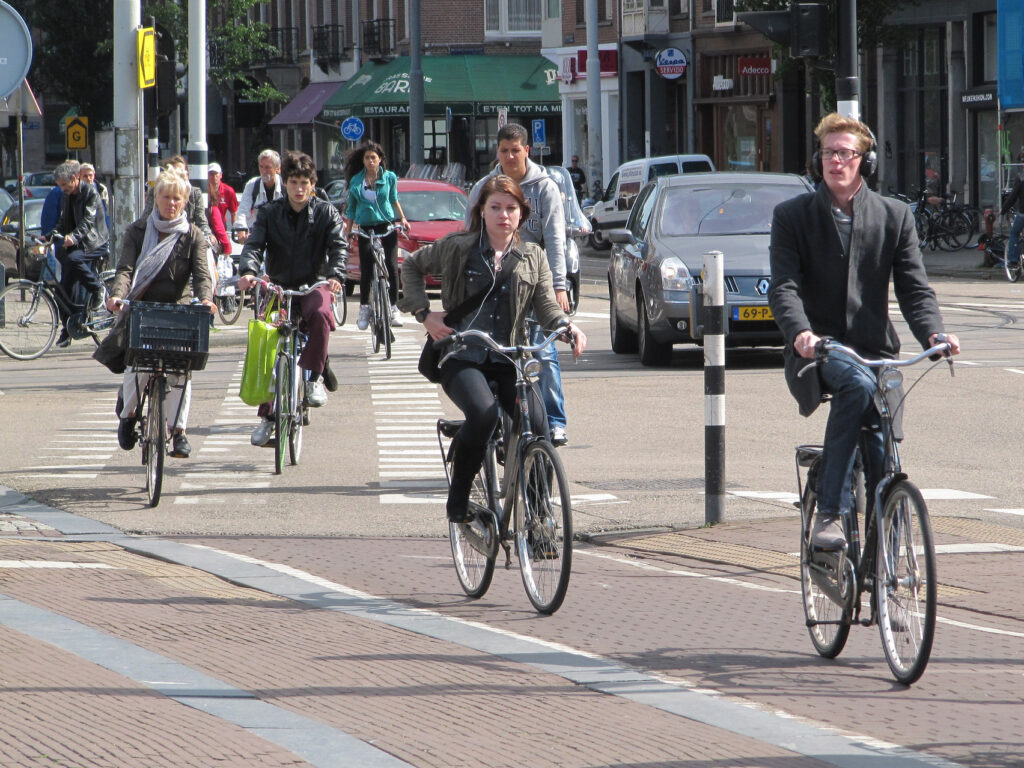

The Dutch Cyclists’ Union has admitted that it may be a “wise decision” to wear a bike helmet on a voluntary basis, but urged against placing too much emphasis on helmet use – which the group argued can actually discourage cycling and instil a victim blaming culture in the famously cycling-friendly nation – after local authorities, the government, and neurologists urged people in the Netherlands to don a helmet when travelling around by bike.
Next month, the Netherlands’ transport ministry will introduce new guidelines on voluntary helmet use, after provinces such as Utrecht ran a campaign in May offering a €25 discount on helmet purchases.
Gelderland, meanwhile, is currently in the midst of its own campaign which attempts to raise awareness of helmet use and promote “behaviour change” in elderly cyclists, with people over 60 accounting for almost half of all seriously injured cyclists in the Netherlands.

> Dutch surgeons call on people to wear helmets while cycling
In a country with a distinct, deeply embedded cycling culture and where 28 per cent of all journeys are made by bike, only 3.5 per cent of Dutch cyclists wear helmets, which are usually confined to the nation’s sport or leisure cyclists.
However, calls for the Netherlands’ fietsers, its everyday cyclists, to wear helmets while out and about have been increasing in volume in recent years, as the number of cyclists seriously injured each year has risen by 27 per cent over the past decade, according to injury prevention organisation Veiligheid NL.
The Dutch Institute for Road Safety Research has also claimed that if all Dutch cyclists wore helmets, fatalities on the road would drop by 85 each year, and the number of serious injuries reduced by 2,500.
In 2022, 88,000 cyclists were injured in the Netherlands, making up 66 per cent of all casualties on the road. Around half of those collisions involved a motorist.
> Cyclists wearing helmets seen as “less human” than those without, researchers find
In light of these figures, two of the Netherlands’ leading road safety researchers, Fred Wegman and Paul Schepers, questioned whether the country could truly be said to support Vision Zero and similar initiatives without addressing the problem of head injuries suffered by cyclists not wearing helmets – even calling on the Netherlands to potentially follow Australia’s lead by introducing an obligatory helmet law.
“Modifications to cars can reduce injury in a collision, but in single-bicycle crashes, a helmet is one of the few possible measures to prevent serious head injuries,” Wegman and Schepers said.
“In case of a fall or crash, the use of a bicycle helmet was found to reduce serious head/brain injury by 60 per cent and fatal head/brain injury by 71 per cent on average, while it is found that the protective effect is the same for children and adults.
“In summary, wearing a helmet while cycling reduces the risk of head and brain injuries, and this reduction is higher for more severe injuries. A helmet obligation could be more effective than encouraging voluntary wearing.
“Perhaps the latter may be needed to increase support in the Dutch society for an obligation. Helmet use by cyclists seems to be a very relevant contribution towards zero cycle casualties in the Netherlands.”
> Why is Dan Walker’s claim that a bike helmet saved his life so controversial?
Meanwhile, a number of medical experts have also called for more frequent use of helmets, with Evert Pronk, the deputy editor of the Medical Contact journal, declaring his support for the campaign by admonishing those who purportedly refuse to wear helmets “because they don’t look good” in an article that featured the headline: “Looks good on you, a skull fracture”.
“I’m a huge fan of cycling but it’s important to protect ourselves,” neurologist Myrthe Boss, whose mother died after being hit by a motorist on a roundabout while cycling in 2019, told the Guardian this week.
“The brain is a very vulnerable organ with limited capacity to recover. If you fall from a bike and sustain a brain injury, this has long-term consequences. And a large proportion of people who fall while cycling have brain injury.
“A helmet doesn’t prevent everything but it does ensure there is less impact from the street on your head,” Boss said. “You see what it does in your family when you lose someone that way.”
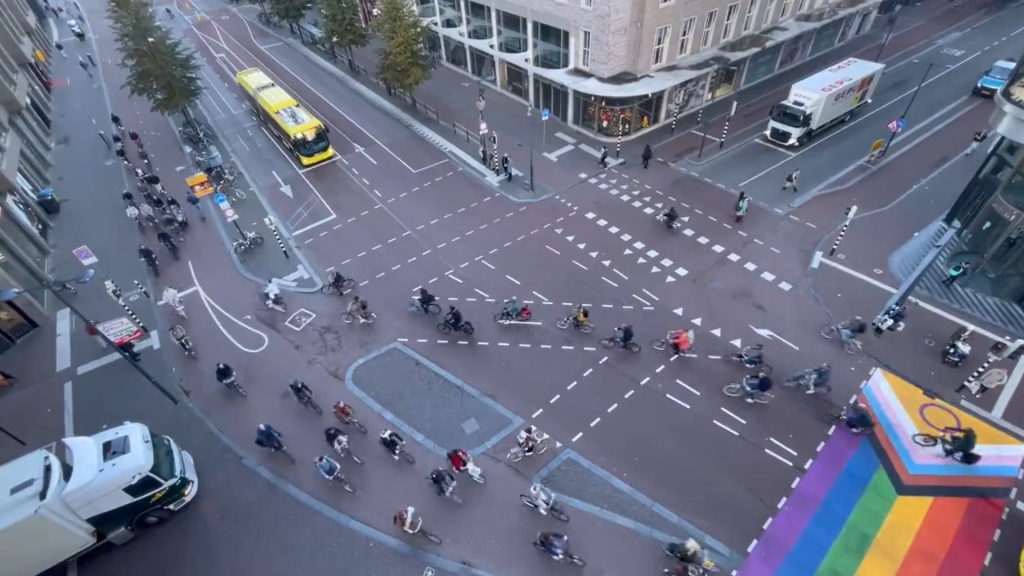
Responding to the increasing calls for helmet use, the Dutch Cyclists’ Union, Fietsersbond, admitted that helmet use has its benefits – but warned against placing too much emphasis on one aspect of bike safety.
“We have the position that helmets don’t prevent accidents but it can be a wise decision to wear one on a voluntary basis,” the union’s director, Esther van Garderen, said.
“Emphasising too much that you should wear a helmet would discourage people from cycling sometimes, though, and has the air of victim blaming.
“I think it’s coming slowly, although there’s no such thing as a society with zero danger and we value our culture where you can cycle safe and free.”
Back in the UK, meanwhile, the bike helmet debate once again made national headlines, after celebrity chef Gordon Ramsay said his helmet meant he was “lucky to be standing here” after crashing heavily while cycling in Connecticut.
“Honestly, you’ve got to wear a helmet,” Ramsay said in an Instagram video in which he showed off the severe bruising to his side caused by the crash.

“I don’t care how short the journey is, I don’t care the fact that these helmets cost money, but they’re crucial. Even with the kids, [on] a short journey, they’ve got to wear a helmet.
“Now I’m lucky to be standing here. I’m in pain, it’s been a brutal week. I’m sort of getting through but I cannot tell you the importance of wearing a helmet. Please, please, please, please wear a helmet – because if I didn’t, I wouldn’t be here now.”

-300x199.jpg "“He wants bikes in traffic lanes. Give him what he wants”: Cyclists urged to “slow every street down to bicycle speed” and ride in middle of lane amid premier’s war on cycle paths + more on the live blog")








192 thoughts on “Dutch government and neurologists call on cyclists to wear helmets – but cyclists’ union says “too much emphasis” on helmets discourages cycling and “has an air of victim blaming””
I wonder how much fatalities
I wonder how much fatalities would drop if pedestrians wore helmets…
(stats I have heard about for it suggests the drop would be bigger than for cyclists…)
qwerty360 wrote:
the risk per km is very similar (which surprised me), and while individual cyclists will cycle a lot further than people walk, there are very many more pedestrians. So overall I suspect the are more lives to be saved with pedestrian helmets. Especially for the over 70s who are more likely to have a fall.
The total number of head injuries will likely go down more with helmets for car occupants. even though the risk on an individual journey is smaller, the total distance travelled by people in cars, and hence the total number of head injuries will be higher.
Also even if cars were perfectly safe for occupants heads, the average person who cycles would see health benefits from cycling which far outweigh the head injury risk without a helmet.
Perhaps… even in NL there
Perhaps… even in NL there seems to be a measure of “well – injuries are going up so something must be done“. I think it is true that cycling is a bit more dangerous than walking all-told (in NL). But as it happens I haven’t seen / can’t remember the figures comparing modes – and that gets more difficult to the extent that they operate in different spaces and are used for different types of trip, by different people etc.
Even in NL it seems to depend on where you’re coming from. The medics and general safety organisations seem to take a “if it saves one life” approach – just like in the UK. Generally these do look at the big picture using the statistics. But perhaps not the big picture of how modes relate to each other, how public space is divided and what we’re wanting from our transport functions?
They’re unlikely to ask e.g. “but is more, faster transport actually ‘better’ ?” Or note that we’ve massively prioritised one mode and it just so happens that that one is the most space intensive and dangerous, along with supressing other modes.
Anyway for those who are interested (medium to very deep rabbit hole) here are some relevant recent-ish articles:
Bicycle Dutch (blogger) – Cycling Safety – understanding the challenges and searching for solutions – has the figures and some interpretation (like many Dutch people he’s not so keen on mandatory helmets) –
David Hembrow (blogger) – What’s gone wrong with road safety in the Netherlands? Thinks that if you look at the numbers the change is due to more collisions with cars or worse outcomes from same, because NL has slid back into being further under the thrall of motor transport.
Get it from the relevant bodies – some of the following need translation if you don’t read Dutch:
Fietsersbond (NL Cyclists Union)
– The number of bicycle accidents continues to rise. What’s going on? (2021 I think)
– Why the cyclists union is against compulsory helmets for cyclists – they say they obviously may help. Note – they don’t list helmets in their top 10 measures to improve road safety for cycling.
SWOV (NL road safety institute)
– Deadly traffic accidents on national roads (annual report)
– Factsheet -road Deaths in NL (Sept 2023)
– Factsheet – Serious Road Injuries in NL (Dec 2023)
– of course when you’ve mass cycling you have to consider all kinds of “whole population” things. See e.g. Effects of crowding on route preferences and perceived safety of urban cyclists in the Netherlands
Veiligheid.nl (general safety organisation)
I think they’re kind of “RoSPA” e.g. general accident prevention. I think I’ve heard they’re prone to suggest things like restricting things for cyclists because “safety first”.
Number of road casualties with serious injuries continues to rise (2021) –
They analyse the increase as being due to single bike accidents, and feel that e-bikes are an issue, plus that there were lots of brain injuries among those with serious injuries, ergo one thing to do is encourage helmets. (But not trikes apparently…). They’ve a pretty deep dive detailed analysis in PDF available.
Thanks for the David Hembrow.
Thanks for the David Hembrow.
Thanks, Interesting.
Thanks, Interesting.
Stats limitations at A&E, where cyclists are known to be under reported, probably inaccurate by type too. Bicycles, e-Bikes and Electric Motorcycles are not the same in law or reality so this needs better data collection for better insights IMHO.
Absolutely.
Absolutely.
While people always call for “more detail” … which doesn’t necessarily make things clearer but shows the world to be more complicated, or you end up with a bunch of narratives to digest…
… I think this is quite important for this kind of road safety consideration. Imagine if we grouped cars, vans, buses and trucks together as “motor vehicle” – we’d come up with some wonky conclusions.
For example in the UK PACTS data analysis we have casulaties by vehicle “involved in”. For cyclist / pedestrian safety (although “law of small numbers” applies here) some notion of what their role was in the collision (if possible) would help.
At least in the UK case it helps to know what kind of road / environment these things happen in – we now know that while a lot of crashes happen in urban areas the ones in the countryside are likely to have far more serious outcomes (probably due to higher speeds / greater distances from medical assistance / possibility of victims not being spotted). So it definitely makes sense to consider those separately.
Given that the only
Given that the only detectable effect of helmet compulsion is a fall in the number of cyclists, who then lose the overwhelming benefits, the costs would massively outweigh the benefits. Regular cyclists live longer and suffer less from all forms of illness, and even a small fall in their numbers would immediately wipe out any gain from the unproven reduction in ksis.
eburtthebike wrote:
Only casual cyclists would be deterred by the “helmet is inconvenient” idea.
Regular cyclists will have considered which part of their life will be better with a brain injury and how likely they are given the rides and behaviour involved.
Interesting to see what a high proportion of incidents are single vehicle, which suggests that better training and experience is required.
Obviously the main cause of Road danger are drivers of motor vehicles where helmet use is probably helping to dehumanise riders and incidental to being hit by several tonnes at speed.
My non-representative experience being that close passes are not prevented by wearing a helmet. I use other means..
lonpfrb wrote:
Given that the only detectable effect of helmet compulsion is a fall in the number of cyclists, who then lose the overwhelming benefits, the costs would massively outweigh the benefits.
— lonpfrb Only casual cyclists would be deterred by the “helmet is inconvenient” idea.— eburtthebike
…who are exactly those we want.
We don’t want a nation of casual (careless) drivers – damaging others and themselves (even allowing for all the safety features in cars and our road infra). We want a nation of casual cyclists. Even though they’ll still be falling over and injuring themselves. (Apparently at a fairly similar rate that they would on foot – albeit cyclists travel further and there is some data suggesting head injuries are more frequent). That would be vastly less problematic for us all, for a whole range of reasons.
Interesting to see what a high proportion of incidents are single vehicle, which suggests that better training and experience is required.— lonpfrb
Helmets can reduce the likelihood and severity of some brain injuries – in the currently available form they’re not a “fix”. (Indeed – they’re probably less suited to protecting the heads of “regular cyclists” – by which I guess you mean the more sports-oriented – than people just falling over getting on and off their bikes).
I think you’re overestimating the consideration people give most choices. It seems to me that most cyclists go with a compromise that suits them. Starting with “I’m going to cycle”. Don’t forget – don’t cycle, no cycling-related brain injuries! Whether it’s that cycling is considered “dangerous” so people look around for “protection” OR it’s just that there’s a “standard uniform” which gets approval I don’t know. But I think people mostly just do what other people do (or others tell them they should do because that’s “standard”).
Unless you’re aware of many people seeking out “safety-improved helmets” – perhaps going to custom safety-helmet-builders? I mean – that would be the informed choice, right?
As for training – the Dutch already get quite a bit of training and experience as children IIRC [1] [2]. So while that’s a thought I suspect “diminishing returns” here. You’ve got to provide it AND make people *do it*.
Note the crash rate from “trained and licenced” drivers and the enthusiasm for further training or even testing (not).
lonpfrb]
I suspect that covers the vast majority of Dutch people, and therefore the negative effects would be enormous.
lonpfrb]
Pretty much no-one gets to be a regular cyclist without first being a casual cyclist.
Besides which, it’s just not true – at least if by ‘deterred’ you mean ‘deterred from specific journeys’. I’ve certainly had times when I’ve decided not to cycle because lugging the helmet around with me at the other end would be too much faff (and so would having the argument about why I’m going without a helmet).
lonpfrb wrote:
2 orders of magnitude more lives would be saved by requiring motor vehicle occupants to wear helmets and “only casual drivers” would be deterred by that “inconvenience”.
Regular drivers will have considered which part of their life will be better with a brain injury and how likely they are given the rides and behaviour involved.
Where was compulsive
Where was compulsion mentioned? Massively raised vulnerability to catastrophic head injury isn’t a ‘benefit’. There is no need for an RCT on being hit on the head by a concrete coated planet. Are you sure you haven’t had a nasty tap?
Jj1234 wrote:
Um, in the article above?
Jj1234 wrote:
If you can’t even use any facts to support your argument then you’re just another blind idiot that favours compulsion/coercion.
It’s strange how people can drink and smoke themselves to death, eat mountains of shit and expect the NHS to fix them, drive like selfish twats and again expect the fire service & ambulance to retrieve them yet keep harping on about how a little polystyrene hat full of holes is the answer to cyclists’ safety. It does absolutely nothing to help vulnerable road users.
Dutch government: largely
Dutch government: largely neoliberal and main parties currently negotiating coalition with fascists
Neurologists: Experts on neurology and nothing else
Not the first people I would go to for advice on transport choices and policies…
You forgot a few other
You forgot a few other experts:
trollexpertlawyerTo be fair on the other side there are:
Boardman was quite a good
Boardman was quite a good road rider too.
Not sure how much expertise is really needed. If you want to wear a lid you wear one. If you don’t you don’t. Either way you might be lucky or you might not.
john_smith wrote:
A lot. Because the debate is dominated by people who have no expertise whatsoever, but lots of attitude. And attitude wins over facts.
If the threads on this site
If the threads on this site are anything to go by, I’d say it’s the opponents of helmet wearing who’ve got an attitude problem. For all their claims of expertise, they contribute little but rudeness.
There are no (or very few)
There are no (or very few) opponents of helmet wearing.
What people are opposed to is the constant messaging that you shouldn’t be cycling without a helmet.
Being constantly told that your personal choices are invalid/wrong or even in some cases immoral can give rise to a frustration that can come across as rudeness. But it’s a pretty rude thing to say to someone in the first place.
In my comment above I
In my comment above I expressed pretty much the exact opposite of what you describe. I don’t know who you feel has repeatedly told you you are wrong. If you disagree with them I suggest you ignore them. That is what I would do.
I wasn’t referring to myself,
I wasn’t referring to myself, or to you.
I choose to wear a helmet, not so much to protect me from head impacts, as to protect me from such tedious comments.
You don’t have to look very far for people saying this kind of thing – there are some in the very article these comments are under, and Gordon Ramsey is another very current example.
You choose to wear a helmet
You choose to wear a helmet because of tedious comments from strangers?
Sometimes it’s simply for a
Sometimes it’s simply for a quiet life. It gets tedious trying to explain it all. In the same way. It’s tedious trying to explain why cyclists don’t use cycle lanes. Hold a strong road position. People refuse to see that reasoning. I once explained why cycle lanes don’t get used. The individual said that makes sense but you should still use them.
No – not just strangers –
No – not just strangers – people I know too.
mdavidford wrote:
There are some, and there ought to be more. Wearing a bicycle helmet when not racing is deleterious to collective cyclist safety, and neutral to individual cyclist safety, and should be avoided. Those helmets do not work to save lives, but they do work to broadcast the falsehood that cycling is a dangerous activity suitable only for daring young men with little to lose. That depresses cyclng adoption, which is a negative for all manner of reasons.
If you are genuinely too scared to ride a bicycle without a helmet, you should first undertake a project to analyze that unfounded fear, but if that fails, you should be wearing a proper helmet like those worn (sometimes) by motorcyclists. A ~2 kg motorcycle helmet stands a chance of aiding you in a crash. A 250g bicycle helmet does not, which is why people die wearing them at the same rate at which they wear them — just like a placebo.
To be fair there are other
To be fair there are other options. A cap or wooly hat may protect you against abrasions and certainly keeps your head warm (a cold bonce can be distracting – and you don’t want to be distracted while cycling). A hat with a brim can provide protection against UV radiation (trust me on the sunscreen).
eburtthebike probably has the figures on this (and no doubt these will vary markedly for each starting point) but … I idly wonder exactly how off-putting “dangerising cycling” or even mandating helmets is? (In the Australian case I suspect attitudes of drivers and society at large had influence, along with a dearth of good cycle infra or even pleasant and convenient places to cycle. Perhaps an Australian expert could comment?)
In any case – as Chris Boardman noted (as do the Fietsersbond) these aren’t in most informed groups’ top 10 of things to address on the topic of “safety”. It’s also perhaps interesting to ponder on how people assess “safety” when considering transport (and that’s without getting into “salient issues” e.g. if something bad happened connected with this in your life / the news etc).
chrisonabike wrote:
I know, I have all three of those, although brimmed hats are only used when paddling, not pedaling.
Precipitous drops resulting from mandatory helmet laws have been well-studied, and the average is around a 30% reduction in cycling overall — typically more in younger groups, so the effect probably gets worse over time, to boot.
“Dangerising” is more difficult to quantify, but every study that I have seen has found that ‘Fear’ is the number one reason that non-cyclists are non-cyclists.
https://usa.streetsblog.org/2022/10/05/three-reasons-that-people-dont-bike-that-policymakers-should-pay-attention-to
No one who considers themself “pro cycling” should be contributing either to the misguided idea that cycling is dangerous or that bicycle helmets have any benefit to whatever the safety situation is. Both of those positions are demonstrably and completely wrong. Unfortunately, apart from Chris Boardman, almost all other cyclists prefer to brag about how dangerous their transport is, and how safe they are due to ~250 grams of plastic.
Sorry tablet so posting pics
Sorry tablet so posting pics more complex, but there are two fine pictures in the article of an Aussie cyclist, who has to wear a helmet, legally, and has a very wide brim.
https://www.theguardian.com/australia-news/2024/mar/31/more-australians-are-looking-to-ditch-their-cars-but-the-alternatives-havent-quite-arrived
dh700 wrote:
https://usa.streetsblog.org/2022/10/05/three-reasons-that-people-dont-bike-that-policymakers-should-pay-attention-to— dh700
Hmm, more bedtime reading.
I’m a little cautious about these surveys (although it’s trickier to find other ways). It does seem that sometimes people report things at some variance to what really motivates them. Particulary when asked about something e.g. like cycling which they likely haven’t considered doing before.
Indeed the article makes mention of other factors. Certain things seem necessary (like “places that seem safe and convenient to cycle” and “secure places to store / leave bike”) but are likely not sufficient. Other things e.g. facilitating the convenience of motoring may act to suppress demand for other modes (have car, will drive it). And obviously upgrading roads for motor infra and filling them with motor traffic is a good way to reduce the desirability for cycling there (and indeed walking).
I think the more tricky ones are “social” (not that building suitable infra, modifying laws and ensuring availability of suitably-priced “practical bikes” and places to park them are easy). And that can vary a lot depending on the country / region / population under study.
I think “representation” may be important also. People tend to emulate those they aspire to or flock to bigger groups – and who’s a notable transport cyclist / where is that clan?
People also seek to align with their close groups but if your friends, family, coworkers etc. wouldn’t be seen dead on a bike you may be othering yourself and reducing your own status (as a weirdo). We’re usually strongly motivated to avoid that! If others aren’t cycling it can be a bit lonely also. Of course in the UK there are effective strictures against social travel on bikes, unique among transport modes.
While it’s apparently “unfashionable” in some circles to dwell on The Netherlands I think that this kind of study might be interesting there – since the “infra” and “availability” barriers are very much reduced compared to everywhere else *. And also as they own a LOT of cars. And in fact they do drive a lot and driving is still convenient.
* Essentially they’re the “most cyclingest” sizeable country. Of course that’s outside of the UK … in the past (1920s-1930s)! And then places going through the level of development we were at then e.g. China more recently etc.
dh700 wrote:
There are some, and there ought to be more. Wearing a bicycle helmet when not racing is deleterious to collective cyclist safety, and neutral to individual cyclist safety, and should be avoided.— mdavidford
I did consider setting out this argument as a caveat to my comment but decided it would make it too long-winded, and would be irrelevant to the main point, since very few people propound it in relation to people on that side of the debate in general – the large majority are of the ‘it should be a personal choice – just stop telling me I should/must be wearing one’ viewpoint.
Strange that. Anytime I’ve
Strange that. Anytime I’ve politely commented I’ve always been called names and what not by those on the pro helmet side.
My issue is that far too many commentators within cycling forums and beyond tend to believe that a helmet is the panacea of road safety. Many of the views tend to fall on the “a helmet saved my life” line. I’ve come off my bike a handful of times in the last 50 years or so and have only suffered grazed elbows and knees and sprained wrists. I once asked someone if their driving behaviour would change if helmet wearing was made mandatory. They had no answer.
Wear one or not is entirely up to the individual. The wearing of one is not going to stop a distracted motorist driving through you.
I don’t imagine anyone thinks
I don’t imagine anyone thinks a helmet is going to help if a motorist drives over you. The fact that you have never banged your head, or that there will be many, many cases in which a helmet won’t help, isn’t incompatible with occasional claims that “a helmet saved my life” (whether or not they are exaggerated, which is a different question).
The unwillingness of opponents of helmet wearing to tolerate dissent reminds me a bit of that of brexiters.
john_smith wrote:
Again, not opponents of helmet wearing; opponents of being told to wear a helmet.
You’d be pretty surprised how
You’d be pretty surprised how many seem to think that a helmet offers protection to the rider in the event of a collision. When I was t- boned the first statement made by some folk was if I was wearing a helmet. My dry answer was quizzing them if it would have protected me from fracturing my clavicle , busting my ribs and severe tissue damage that prevented me from walking unaided for 6 weeks.
When you read about cycling fatalities the media are at pains to highlight the rider was sans helmet yet when the cyclist was wearing one they make no mention of it.
Every thread I read on this subject many commentators announce that a helmet saved their life and make derisory remarks about those who don’t. There is as much if not more intolerance and an unwillingness to discuss rationally from helmet advocates.
john_smith wrote:
Damage to a helmet is not proof it helped. Any delicate item strapped to the head would, by that logic, be a useful safety device.
It’s also clear to me that the number of helmet wearers with “The helmet saved my life!” claims greatly outweighs the possible number of cyclist deaths from head injuries that there could be if there were no helmets. Every other helmet wearer seems to have these stories, it just does not add up statistically – as deaths by “head injury alone” are vanishingly rare even amongst non-helmet-wearing cyclists.
It’s just bullshit.
Paul J wrote:
I carry an egg in my shirt pocket, amazing how many times it saved me from broken ribs/punctured lungs.
Hmmm. I only ever wore a
Hmmm. I only ever wore a helmet when out on my road bike putting in some miles and going a fair lick. On my pootles to the shop, commutes I never wore one, on my heavier, pannier laden bike. Unfortunately I now do wear a helmet for the sole purpose to have a helmet cam attached. That’s it. Not to protect my head, but to record the instance when I am getting wiped out by a drivist. Just so that my wife has evidence to present for the vein hope that it might add a further £10 fine if it went to court, if the police decide to do anything of course.
Good points well made. My
Good points well made. My solution to the shopper problem is to have cheap cameras permanently attached to the bike. I can leave them on when in the shop and not have to carry a helmet. Charging them is a little inconvenient when compared to a helmet cam. For other rides I use a helmet cam so I can hop onto whichever bike I am using and have a camera with me.
One other consideartion is the fact that hi-viz and helmet wearing are advised in the highway code. This means that in the event of a collision the fact that you are not wearing one can be, and often is, interpreted as not using the road in accordance with the highway code in an attempt, often successful, to divert blame. I am willing to take the risk but I would be happier if this section were reworded or removed.
Bungle_52 wrote:
Yes, it’s funny that isn’t it. Your fault for not wearing a helmet or high vis.
The HC also says look out for vulnerable road users and take special care round them which seems never to be raised to cancel out the helmet/high-vis gambit.
There’s two whole pages on
There’s two whole pages on speed limits.
We dutch people do not
We dutch people do not respond well to mandatory things..
On the other hand, wearing a helmet is common sense to me, i wear one everyday on my commute the sunday morning groupride, a mtb ride etc.
My kids do not wear a helmet on theire school run (low speed, low trafic) but do on sportive mtb rides.
In my 30+ jears of bike riding i seen lots of crashes often with damaged helmets as one of the results..
I do believe people should be free to disside , i see lost more elderly e-bike users wear helmets seldom see sportive riders without helmets so we are moving slowly in het right direction.
I am a strong believer that road traffic has grown, (phone use by drivers is growing fines should be doubbled )
Kees,
Kees,
The experience from the english speaking countries, which have generally led on this “safetyism” culture and pushing helmets for ordinary cycling, is that this push does not help cycling – it doesn’t help cyclists, it doesn’t help cycling participation, it doesn’t help cyclist safety.
NL has long got it right on cycling safety (and I remember watching the cycle paths getting built near our home in NL then, that I would later cycle to school on, on my own at age 6) by focusing on creating environments that are intrinsically safe for *normal people in normal dress* to cycle in/on. I really hope NL doesn’t get captured by the anglo-culture attitudes on safety – largely counter-productive!
I’m interested in where the
I’m interested in where the 27% rise in Dutch cyclist injuries over the last decade has come from.
Is this due to the higher average commuting speeds that come from eBike use?
It’s due to an aging
It’s due to an aging population. Around half of the injuries are over-60s. With age comes reduced reaction times, poorer balance, and reduced resilience to knocks. eBikes are a factor too.
And don’t forget increases in
And don’t forget increases in car numbers, I’m sure their van delivery models have some similarities to ours, and there is always the smartphone tempting vehicle operators from paying any attention from what is going on around them…
And don’t think that the Dutch are immune from the temptations of the vanity behemoth!
ktache wrote:
Maybe, though NL has been pretty concentrated when it comes to cars for a _long_ time. Lots of people in a small space.
ktache wrote:
It is a good question, and
It is a good question, and there are several interpretations as to the most important factors. I can only recommend you dive into the lengthy list of opinions, analysis and (towards the end) stats I’ve put in a post below.
Or alternatively, choose your favourite culprit and construct a theory to support!
Let’s start from car drivers
Let’s start from car drivers and occupants.
With reference to following
With reference to following the Australian example, the true measure of Australian concern for vulnerable road users is that while the government mandates the use of cycling helmets (and levies fines out of all proportion to risk/benefit if caught failing to do so) they also allow the owners of 2+ tonne trucks and their ilk to festoon the front of their vehicles with any amount of ironmongery (e.g. square-section frames to support long loads over the top of the cab and over the front of the vehicle, or multiple metal cylinders on frames on the front to carry fishing rods outside the cab!) which almost couldn’t be better designed to maim a pedestrian or cyclist in a collision.
To be honest, if there was any example of a true money-raising supposed “safety” measure, I’d suggest the Australian legislation ref. cycle helmet wearing would be right up there.
Unbelievable! A balanced
Unbelievable! A balanced helmet article in the media: in the Daily Mail!!!!
https://www.dailymail.co.uk/health/article-13538701/Gordon-Ramsays-injury-debate-helmet-cycling-safer-dangerous.html
I’m sorry but I refuse to
I’m sorry but I refuse to abandon my principles and click on a link to the Daily Heil, not even after reading your mega-clickbaity comment.
If the people working for these news outlets were genuinely concerned about our safety then we’d see more about the dangers of speeding, phone use (including hands-free) and more calls for police action and citizen reporting.
But instead they spend 95% of their time demonising out-groups including cyclists while glamourising powerful vehicles and speed, defending all the law-breaking driver behaviour that results in many thousands of deaths and injuries every fucking year.
Telling cyclists to wear a little plastic hat is one of the least effective things we can do to reduce harm while those who actually cause the collisions can avoid facing up to their responsibility to everyone else on the road (and to those on the pavement… and even people in their own homes).
And self-important, shit-stirring arseholes like Simon Heffer can fuck right off with their uninformed opinions about number plates on bikes. [twitter, 19 May]
Simon E wrote:
Motor cyclists on L plates have to ride a 30mph restricted bike. They have to wear a helmet with good reason.
One of my brother in laws is a consultant and two of my sisters one a matron and the other a senior SRN. They are supporters of helmets one both motorcycles and push bikes, Tbe reason being they have to pick up the pieces. Its not political from their standpoint and helmets do protect the head.
Ask a neurologist fot their opinions?
Is it only the head that gets
Is it only the head that gets hurt when a car crashes into a cyclist? I know many cyclists that have been smashed into by ignorant, impatient, distracted drivers and they have spent months in hospital. A helmet didn’t protect their limbs, but where that cyclist wasn’t wearing a helmet it was used as mitigation by the driver as to why the cyclist got hurt, in an attempt to reduce the drivers culpability and liability for damages. If you have a genuine interest in protecting cyclists, then put your effort into educating drivers so they don’t keep smashing into cyclists.
Stephankernow]
The very definition of observer bias. They see things from a very narrow point of view and are unable to see the wider picture, that helmet laws and promotion are negative in health terms.
Stephankernow wrote:
No, and for the same reason that we do not let bank tellers decide economic policy. And we don’t have infantry soldiers making war plans.
It turns out that opinions formed on the front-line are not an acceptable substitute for having the appropriate data and training to analyze a situation.
In this specific case, neurologists, bless their hearts, know absoutely nothing about traffic safety and helmet engineering. That’s not their fault, but it is not a topic on which they are qualified to speak.
So what’s their response to
So what’s their response to individuals coming in with broken bones, internal injuries, severe tissue damage and abrasions? Do they tut and say that full body armour should be worn?
eburtthebike wrote:
I’ll repost something I have
I’ll repost something I have already said on here, but it bears repeating in my view.
Helmet advocates/zealots are never about the actual security of cyclists. They’re about any or all of the following:
– deluding themselves that, wearing a helmet, they or people they care about are actually safe
– gaslighting others, even and especially loved ones, into feeling safe because of a helmet
– deflecting responsibility and culpability for the dangers they as motorists pose to others
– othering cyclists to assert their domination on the roads as drivers
– painting cycling as a dangerous activity to be able to blame the victims
– avoiding efforts to change their own transport choices and behaviour on the roads
– avoiding efforts to see, think about and understand the real risks in our transport system and wider society
– avoiding efforts to see, think about and understand the vested interests at work to skew our perception of those risks
– avoiding efforts to actually speak out about and do something about those real risks and the people who try to distract from them or hide them
All this includes those who would be in a position where they could address the real risks, as politicians or otherwise, to which you’d have to furthermore add those who actually do it knowingly and criminally, in the vein of oil firms on climate catastrophe.
As I have said on the other thread, it’s no coincidence that this shit pops up even in the Netherlands on the eve of the fascists taking over there.
Yup. Bl**dy zealots talking
Yup. Bl**dy zealots talking about voluntary helmet use. It’s like the Third Reich.
Quote:
marmotte27 wrote:
I’ll add one to your list (not sure I agree with all of them anyway, but):
“I wear a helmet because my wife has sworn that if I am ever in a collision and get injured in some way and am not wearing a helmet then she’ll bl**dy well kill me!”
brooksby wrote:
“I wear a helmet because my wife has sworn that if I am ever in a collision and get injured in some way and am not wearing a helmet then she’ll bl**dy well kill me!”
— brooksbyA sign of someone unwilling to engage in a debate using facts. I wonder what she would do/say if you lost a leg or sustained a serious spinal injury.
brooksby wrote:
I suppose that’s more or less covered by my first point.
Not sure about the “fascist”
Not sure about the “fascist” (or populist) connection? The little I understand there are nuances (plus politicians will exploit any difference / advantage) but AFAIK there is fairly broad cross-party support for cycling there – maybe even more cycling.
(IIRC the most noticable variation is in the more rural areas (not surprising – we have to drive) and some more working class districts).
I think people’s views on helmets are often to do with being “properly dressed” and/or “group membership”. Definitely noticable in the UK but I think also e.g. amongst “sports cyclists” in NL. Cycle helmets in a certain style* have become the “normal” thing to wear. If you deviate from that there’s a measure of “well they’re not a real cyclist / they are clearly a fool (not one of us)”. Some people have posted here suggesting they’re certainly not influenced by the opinions of others in this regard. I would just ask – how sure are they?
(All that being said it’s not a biggie – stick one on if it makes you feel happier, stops someone objecting to you cycling etc. Mine has at least saved me some bumps from low-hanging things / possibly road rash and kept my head warm – I tend to use a wooly hat for that now though.)
* Few people seem to be wearing motorbike helmets on bicycles – safety first! – or building their own. I’m pretty sure very few people do detailed analysis of risks and then plan their PPE. It’s the usual “gut feeling” / salience of “x happened to my friend / me”.
The fascist/populist
The fascist/populist connecting is not dealing with real risks but imaginary ones. Which the Dutch polder politics should maybe have prevented, but which it has not, the rise of fascism there having been as fast as anywhere else.
About the group membership thing, yes, that’s an important reason, one which again is also at the roots of close passes, near misses etc.
So talking about and highlighting real risks instead of imagnary ones is important.
I’ll repost something I have
[quote=marmotte27]
I’ll repost something I have already said on here, but it bears repeating in my view.
Helmet advocates/zealots are never about the actual security of cyclists. They’re about any or all of the following:
– deluding themselves that, wearing a helmet, they or people they care about are actually safe
– gaslighting others, even and especially loved ones, into feeling safe because of a helmet
– deflecting responsibility and culpability for the dangers they as motorists pose to others
– othering cyclists to assert their domination on the roads as drivers
– painting cycling as a dangerous activity to be able to blame the victims
– avoiding efforts to change their own transport choices and behaviour on the roads
– avoiding efforts to see, think about and understand the real risks in our transport system and wider society
– avoiding efforts to see, think about and understand the vested interests at work to skew our perception of those risks
– avoiding efforts to actually speak out about and do something about those real risks and the people who try to distract from them or hide them
All this includes those who would be in a position where they could address the real risks, as politicians or otherwise, to which you’d have to furthermore add those who actually do it knowingly and criminally, in the vein of oil firms on climate catastrophe.
As I have said on the other thread, it’s no coincidence that this shit pops up even in the Netherlands on the eve of the fascists taking over there.
[/quote
I would never riden my motorbike without a helmet.
Motorbikes =/= bicycles.
Motorbikes =/= bicycles.
What’s your point ?
Yesterday: Dutch helmet
Yesterday: Dutch helmet policy<—————–>Australian helmet policy.
Today: Dutch helmet policy<————->Australian helmet policy.
Helmet wearing encourages
Helmet wearing encourages worse over takes – personal experience of riding with and without.
nah it doesnt- it’s your
nah it doesnt- it’s your choice.
The type of riding without a
The type of riding without a helmet may differ to that with a helmet so such claims are difficult to substantiate.
boo-hoo for your hair-do, I
boo-hoo for your hair-do, I dont care
as society will have to somehow provide for/care for/ make allowances for victims of head injuries society does have the right to mandate helmet use. it’s the same thing with seatbelt requirements for passengers in cars- seatbelts saves lives.
Laz wrote:
Stab vests save lives to, so I hope you wear one whilst walking anywhere as otherwise you’re just putting a burden on society caring for your knife injuries.
It’s interesting that you compare bike helmets with car seatbelts. Car seatbelts are specifically designed for most vehicle collisions whereas bike helmets are not at all designed for multi-vehicle collisions – they’re tested for people coming off at up to 12mph and impact with a car (the most common kind of traffic incident) will be so far in excess of their design that it’s not even funny.
There are some shocking
There are some shocking trends in car design that have so much more an impact on the harm done to pedestrians and cyclists in collisions than the small increase in helmet use that might claimed by moving to compulsion.
Laz wrote:
?
Is this Taylor Swift or something?
Except that any remedy should be proportional to the social social cost it’s supposed to address. Which it wouldn’t even remotely be.
Better off just banning
Better off just banning cycling – otherwise people will be quibbling about cost-benefit analysis!
The costs we pay that other people incur are reasonable to debate. That quickly becomes a can of worms with implications everywhere though. Just a taste – how should we price exercise? Do people get credit for keeping themselves fitter, even if sometimes that activity is associated with occasional more-severe injuries? Should those doing so pay for those injury costs? Or only if they don’t follow some mandated (by whom?) “best practice”?
Mentioning seatbelts – d’you think society should remove the mandate to drive? Given that drivers cause a great deal of death and injury to themselves, never mind others?
Perhaps that’s objectionable – so what about only those drivers who’ve had a crash?
Or maybe drivers (or cyclists, or pedestrians) who knock over people and fail to “end them rightly” should pick up the costs for their subsequent care?
Seatbelts – someone has done the cost-benefit analysis showing that they reduce the hospital costs associated with crash victims. Presumably you also have the figures for the total costs at a population level (e.g. those who then need further care, and whether the cost of that outweighs the tax loss etc. had they simply died)? You’ll then want the same for helmets. If you don’t I suggest you consult eburtthebike of this parish although I think his views differ from yours…
Laz wrote:
— LazIt’s blindingly obvious that you haven’t read much (if anything) on this topic. Good luck with stopping 2 tonnes of metal at 30 mph with half an inch of polystyrene.
If society cares (I think you mean pays) for victims* then it should first look at the causes of most harm. Since the drivers of motorised vehicles cause 1,700 deaths and over 200,000 injuries every year we could definitely make some improvements there. The nationwide 20 mph limits in urban areas in Wales introduced in September 2023 are already having a positive impact.
We could look at what other things cause large numbers of deaths and injuries. 100,000 people have strokes / TIA each year, for example. Each year, 1.4 million people attend A&E in England and Wales with a head injury and 200,000 are admitted to hospital as a result. [NICE]
I can assure you that cyclists’ injuries caused by not wearing a helmet will be a loooong way down the list while the health benefits of physical activity associated with cycling were 21 times higher than the risk of injuries. [BMJ] [CUK]
But I am willing to bet that you don’t actually care about people. Like so many ignorant jerks, you just want to punish people for cycling by forcing them to wear an ineffective hat.
* it’s often insurance companies that pay out £millions for victims’ life-changing injuries and this is a big factor in the price of car insurance, though this doesn’t mean that there is no burden on the NHS, social care and other services.
Clearly a helmet is of no
Clearly a helmet is of no benefit when a Range Rover rolls over the top of you, but it may make a critical difference if you go over the bonnet and your head impacts the car in doing so, or you are knocked into street furniture. You don’t loose the health benefits of cycling, climbing , horse riding, kayaking etc when you wear some protective head gear. Rock climbing has moved from hard hat protection to that more akin to cycle helmets because they offer better protection in falls.
Robert Hardy wrote:
Are you sure? And should I ride into town expecting that to happen? Should I wear knee and elbow pads too?
Pedalling a bike to school / work / shops / library / hairdresser shouldn’t be made to appear as risky as kayaking down rapids between rocks, riding a singletrack descent or in a fast chain gang.
It has been shown before that mandating helmets by law is counterproductive, as others have indicated. But you’re not interested in that, you just want everyone to do what you think is ‘right’ or ‘obvious’ regardless of the opposing arguments.
Laz wrote:
society spends a lot more resources on head injuries to car occupants and pedestrians, so them first.
Love to see comparative data
Love to see comparative data for that claim. Talking per capita, similar speeds etc. falling out of the sky in a plane would be much more lethal than falling off a bike but the argument to focus on giving passengers on a plane helmets first is just as stupid as for drivers. Helmets stand a much greater chance of saving a cyclist than a driver due to speed and the limitations of a helmet. Totally ridiculous analogy.
gerardvok wrote:
I’m talking about total number of injuries treated p.a at a population level, since we are talking about the drain on society. If you wanted the maximum reduction in A&E head injury admissions, go for vehicle occupants. More people would be forced to wear helmets, sure, but the saving to society will be huge.
Meanwhile if you mandate helmets for cyclists and 30% of cyclists stop cycling in response, then the health costs will go up as cyclists are far less likely to suffer from obesity, heart disease, diabetes and even cancer than the general population. So if you want to save NHS money, getting people out of cars and onto bikes is the way to go, mandating helmets which gets people of og bikes and into cars has the opposite effect is not.
gerardvok wrote:
— gerardvokSo you haven’t seen the stats for people in cars who suffer head injuries?
Maybe you’d like to visit the 2 young men I know who had near-fatal car crashes due to excess speed, both suffering significant brain damage? Both were in their early 20s (one as a passenger), neither will ever walk or speak properly. They required significant hospital & rehab time and both will continue to live in adapted homes and have carers.
Helmets could offer a
Helmets could offer a significant improvement in reducing the severity of head injuries in severe car crashes, particularly in vehicles without curtain airbags. But much like some cyclists the enforcement of head protection would be an imposition too far for many drivers.
In an ironic twist, requiring
In an ironic twist, requiring motor vehicle occupants to wear helmets would save more cyclist lives than requiring cyclists to do so.
The former would so drastically reduce motor vehicle traffic (if enforced) that cyclists and pedestrians would enjoy tremendous additional open space, and their encounters with motor vehicles would be decimated.
gerardvok wrote:
Depends;
Off road riding sure; The issue is falls.
For road riding the main risk is car collisions. So the motorist gets a head injury AFTER crumple zones in the car, padding and air bags have removed a lot of the energy; The cyclist has JUST a helmet to deal with said energy.
So if anything one would expect head protection (n.b. helmets for driving need to be designed to interact with seat head rests etc; IIRC a long time ago an Australian uni did the research and worked out a padded sweat band was as effective as a full helmet) to be more effective for drivers – because they are killed after a huge chunk of energy has been removed…
Of course the only real way to know would be to make a few 1000 people wear head protection while driving and see what happens…
Those motor sport governing
Those motor sport governing bodies would seem to disagree with you.
And if it saves one life…
And if it saves one life…
Laz-y
Laz-y!
So you’re all about costs to society being born by those that cause them? How about then motorists bear the enormous costs their transport choices inflict on society, before we talk about cycle helmets?
Seatbelt laws were necessary
Seatbelt laws were necessary because there was a very low compliance with advise to wear seatbelts prior to compulsion and the benefits in terms of reductions in serious and fatal injury rates were very substantial. In the UK at least helmet wearing amongst cyclists is already substantial and well established and the benefit likely to be very much smaller or even negative if it results in people jumping in the car to make short journeys.
Society also has to care for
Society also has to care for people with inactivity related illnesses;
Which is a lot more expensive than treating the occasional cyclist with a head injury.
Especially given cycle helmets prevent the need to clean cuts. Thats about all they are designed for; concussion and TBI are generally caused by impacts so far beyond helmet spec as to render helmets irrelevent.
Personally I choose to wear a
Personally I choose to wear a helmet for road riding, but before “the state” chooses to start leaning on cyclists to always wear one, I’d be very interested in seeing some meaningful statistics around head injury fatality rates before and after the introduction of compulsory helmet wearing in relevant countries.
Many years ago now, but there was a study in Australia which found that counterintuitively, accident rates INCREASED when riders wore helmets, due to behavioural changes, mainly in DRIVERS.
I haven’t read the report for
I haven’t read the report for many years but there are so many factors involved in helmet use or nonuse that I suspect its very difficult to design a study that would come to an authoritative conclusion about the impact on driver behaviour of expanding helmet use in relation to cyclist injury risk.
Australia;
Australia;
Head injuries + rate went down at the same rate they had been going down for decades (despite a drastic increase in helmet wearing).
NZ – head injuries went down, but rate (i.e. head injuries per hour/mile cycled) went UP; I.e. they just scared enough cyclists off the road to reduce cycling head injuries.
Jersey – head injuries remained the same for mandated group; They can’t go down – there had been 0 recorded head injuries cycling on the island before they made helmets mandatory for under 16s (IIRC, might have been 14)…
There are probably other examples; IIRC the most important is arguably Australia, because a lot of other places have low/no enforcement; So mandating helmets makes no difference because without enforcement helmet usage doesn’t actually change…
If helmets were compulsory,
If helmets were compulsory, people would be less likely to hire a shared bike unless it was a preplanned hire. They would then have to hire a taxi. Perhaps that’s the underlying motive. Helmets are a good idea, making them compulsory isn’t.
Muddy Ford wrote:
sometimes
wycombewheeler wrote:
sometimes— Muddy Ford
I think these paired comments should be posted by the mods whenever “helmet row” appears, then further comments blocked.
Difficult to think of an
Difficult to think of an occasion riding on a bike when the wearing of s helmet isn’t a good idea! Easter bonet parade perhaps? That of course doesn’t mean compulsion with all the negatives that would bring is a good idea.
Difficult to think of an
Difficult to think of an occasion taking a shower, climbing stairs or a ladder, driving a car… when the wearing of s helmet isn’t a good idea!
marmotte27 wrote:
Getting a haircut?
mdavidford wrote:
Getting a haircut?— marmotte27
Days gone by a pudding bowl
Days gone by a pudding bowl would be used so not much difference. A mate who served in the navy juked that anything below the cap line belonged to the navy while anything above was his.
It is not at all difficult to
It is not at all difficult to think of occasions when bicycle helmets are not a good idea.
First off, bicycle helmets do not actually work to save lives, for a variety of reasons but chiefly that they are not designed to. The engineering priorities for cycling helmets are “Light, cool, cheap, attractive, aerodynamic, and safe” in that specific order. As a result, we wind up with 250 grams of plastic that are ineffectual — to no one’s surprise who has actually considered the matter. Even motorcycle helmets, which are vastly superior in construction, only show a small effectiveness signal.
This is why the percentage of bicycle helmet wearers matches the percentage of cyclists who are helmeted when killed. In other words, the statistical signature of a placebo.
Meanwhile, wearing such a decorative helmet when not racing your bicycle sends a message to all observers that cycling is incredibly dangerous — which it is not, statistically. It is healthier than sitting on your couch, for most. Reinforcing that false notion of danger depresses cycling uptake, which is a net negative for our collective safety.
Anyone wearing a bicycle helmet and preaching about its necessity is, unfortunately, a hypocrite. If you really wanted to be safe, you’d be wearing a proper helmet like motorcyclists do.
“This is why the percentage
“This is why the percentage of bicycle helmet wearers matches the percentage of cyclists who are helmeted when killed. In other words, the statistical signature of a placebo.”
This is good!
“If you really wanted to be safe, you’d be wearing a proper helmet like motorcyclists do.”
I hope, given that (it would appear) all the helmet zealots (on here) are incapable of seeing the obvious, no-one takes you up on that to make it the object of hundreds or thousands of road.cc posts, twitter contributions, BBC articles, law proposals and whatnot…
“This is why the percentage
It’s really not good. It would be outstanding if humans possessed the technology to build bicycle helmets that are wearable and effective — but we do not. So we build helmets that people will tolerate wearing, and we pretend that they have utility beyond virtue signalling.
Unfortunately, they do not, which is why, for example, 32% of US cyclists wear helmets today, and 32% of US cyclist fatalities were helmeted when they crashed. And those two numbers have marched in lockstep since anyone first thought to track them, each ticking up a point every couple years. Many will recognize that as the statistical signature of a placebo.
So much sturm and drang is and has been wasted on the topic of helmets, while the root problem — road user behavior — goes virtually ignored by comparison. There is no reason that human beings cannot be trained and incentivized to cooperate safety on roads. We can teach dogs to drive, so we can teach most humans, if we decide to.
dh700 wrote:
Not arguing for or against helmets but that statistic is only valuable for discussion if you can say how many of the deceased helmeted died of head injuries and how many of the non-helmeted did. Nobody is claiming a helmet will protect you from a car running over your torso. If the same proportion of helmeted deceased die of head injuries as those without, that’s definitely a point in favour of the anti argument. If a significantly lower percentage of the helmeted deceased died of head injuries, that would be a point for the pros.
Rendel Harris wrote:
No. If helmets work there would be a gap between usage and usage by fatalities. There is not, and there never has been.
We see this gap with other safety devices that do work. Motorcyclist helmet usage is 65%, and 54% of motorcyclist fatalities were helmeted when killed. That’s not a huge benefit, but it exists. Seatbelts, on the other hand, work quite well — 92% adoption and only 40% of fatalities were belted.
dh700 wrote:
That’s not necessarily the case, because you’re ignoring other variables such as the number of helmet-wearers in different environments, e.g. people are more likely to wear helmets in an urban environment where there are higher numbers of fatalities. You certainly can’t ignore the cause of death when quoting a parity between numbers of deaths and numbers of helmet wearers, if 20% of helmet wearer fatalities were caused by head injuries and 80% of non-wearer fatalities were caused by head injuries that would be a strong argument for helmets, and the same vice-versa; it’s only a relevant statistic if you can show that. As above, I’m not arguing for or against helmets, but that stat is definitely meaningless unless you know the other variables with which it’s associated.
Rendel Harris wrote:
In which case, we would see a decrease in urban fatalities if helmets worked — but they do not, and we do not.
Again no. You are failing to understand the statistics-in-question. I did not quote “parity between number of deaths and number of helmet wearers”. I quote parity in the percentage of cyclists who wear a helmet, and the percentage of cyclists who are killed that were helmeted at their end (ignoring subsequent hospital stays).
The match between those percentages is precisely the statistical signature of a placebo — a device that has no impact on the outcome.
It does not matter how many were killed by which injuries. We do not observe a reduction in fatalities with the increase in helmet usage. If they worked to save lives, we must necessarily observe that change. We do not. We never have. In your example, if the helmet usage percentage is 20%, your “strong argument for helmets” precisely matches the statistical signature of a placebo.
In order for your claim to find support, there would have to be some other unknown lethality factor that only effects helmet-wearers, that precisely counterbalances the imagined benefit that those helmets provide — and if that imaginary scenario were true, that would still mean that bicycle helmets do not work.
Put simply, if bicycle helmets save lives, we need to see lives being saved. And we do not. And we never have. Ergo…
dh700 wrote:
Yes it does. If 100% of helmeted cyclist fatalities died of non-head-related injuries, and 100% of non-helmeted cyclist fatalities died of head injuries, that would be highly significant. The same vice-versa. If you have statistics that show that the same proportion of deaths from head injuries occur for both helmeted and non-helmeted cyclists that would be extremely significant, just quoting the overall death figures without including the cause of death variable is meaningless.
Rendel Harris wrote:
Again, no. Please take a few moments and attempt to understand the relevant statistics being discussed, because you are not doing so yet.
Your abdandonment of your previous imaginary scenario and creation of a new imaginary nonsensical scenario does not change reality. In reality, we can identify no lives saved by the use of bicycle helmets.
How about you attempt to explain a mechanism by which bicycle helmets can save lives without those lives-saved ever appearing in fatality statistics? In other words, again, as I previously explained, identify this mysterious force that precisely counterbalances helmet effectiveness. And then explain why you believe that helmets work when there exists said force which entirely counterbalances their alleged benefit.
Again, if bicycle helmets save lives we have to see that effect in fatality statistics. We do not. We never have. The more people wear helmets, the more people die wearing them, at exactly the same rate. That cannot be the case if they work as advertised, or even at all.
dh700 wrote:
Suggest you go and have a think about that one and perhaps you’ll be able to understand that people who aren’t killed don’t appear in fatality staistics.
It’s you who is failing to understand I’m afraid, or rather is, I suspect, being deliberately obtuse. Once again, I am not arguing for or against helmet use, I am simply pointing out that your statistics are meaningless without further explanation. Nobody is claiming that helmets prevent death or injury from any other cause than head trauma, so the relevant statistic would be what proportion of fatalities from head injury occur amongst helmet wearers and is that proportion the same amongst non-helmet wearers. Additionally, you have totally ignored the point that some environments are more dangerous than others and so may have a higher proportion of helmet wearers.
If you have such figures and they support your argument, great, let’s see them. If you just want to keep repeating the same raw data without any examination of influencing variables and patronisingly accusing anyone who asks for a more sophisticated analysis of the data of a lack of understanding, don’t bother.
Rendel Harris wrote:
That’s the point, the fatality rate does not change with increased helmet adoption. Why, exactly?
I understand exactly what you are claiming — but you are just wrong, as I have repeatedly explained to you.
Again, for now the n-th time, we find no statistical support — anywhere — for the claim that bicycle helmets save lives. The more they are used, the more people die wearing them. That cannot happen if they work effectively. Explain this dichotomy, or stop wasting my time.
Again, for the n-th time, those variables would not cause the fatality rate to stay the same with increased helmet adoption. Which is exactly what we find. Again, the more people who wear helmets, the more people die in them — at exactly the same rate. This situation is not explicable by your environmental excuses. It is, however, the precise signature of a placebo.
And the injured body part still does not matter. Dead is dead. Even if your imaginary scenario were true, and helmets prevent fatal head injuries but the riders still die at precisely the same rate, what difference does that make? None at all. The point stands — bicycle helmets do not save lives.
Oh, so you are attempting to pontificate here despite being totally unfamiliar with the relevant data? Color me not that surprised.
I note that you declined to make any attempt to explain this mysterious force that you propose, which perfectly counterbalances the benefit provided by helmets, and also to explain why you still believe that helmets are effective, despite the existence of this mysterious balancing force that results in no safety benefit being identifiable, statisically.
If you have never bothered to study the problem, perhaps consider choosing a different topic to wade into, perferably one in which you possess the necessary grounding.
Rendel Harris wrote:
Ah, I see you’ve chosen the option not on the ballot paper, to simply repeat your previous statements without any further evidence. Quite extraordinary that you think that the efficacy of helmets is demonstrated by raw data about fatalities without any reference to the cause of death and whether or not head trauma was involved. According to your manner of interpreting data, if someone’s run over by a truck and has both their legs cut off and bleeds to death, if they’re wearing a helmet that proves helmets don’t work. That alone is enough to invalidate anything you say, however snotty and superior you try to be. Good day to you, no further comment from me, it’s you who’s wasting my time.
Looks like you have a bit of
Looks like you have a bit of a habit ending debates that don’t go your way in that manner. Maybe you should work on that…
I’m not a mathematician, who’d surely explain this far quicker but it’s actually not that difficult:
In a non helmeted cyclist population, x % of cyclists die in accidents, of which y% from head injuries.
When by and by a certain percentage of that population adopt helmets, we get two populations, one helmeted, H, the other not, NH.
So there’s population NH, x(nh)% of whom die, and thereof y(nh)% from head injuries,
and in population H x(h)%, and y(h)%, where, if helmets were effective, y(h)% would have to be necessarily smaller than y(nh)%.
These percentages “y of x” do not show up in the statistics cited by dh700, but if helmets were at least somewhat effective against death by head injury, at some stage of helmet adoption there’d have to be a visible decrease in y(h) which would necessarily lead to a decrease in x(h) as opposed to x(nh), and that would show up in the statistics.
But that’s not actually the case, x(h) remains the same as x(nh) whatever the degree of helmet wearers.
At least the decrease in y(h) is so small, that it never shows up in any population studies, and certainly so small that it doesn’t warrant incessant helmet appeals, law proposals, forum threads and whatever.
marmotte27 wrote:
Looks like you have a habit of holding a long-standing grudge just because somebody refused to continue debating with you when you got rude, aggressive and personal. Maybe you should work on that…
Seems to me you’re arguing
Seems to me you’re arguing past each other about, on the one hand
a) Are helmets effective against head injuries?
and on the other hand
b) Are helmets effective at reducing fatalities?
Given an equal rate of fatalities in each population, it’s quite possible for the answer to (a) to be ‘Yes’ and the answer to (b) to be ‘No’, if all those who would have died from head injuries but didn’t because they were wearing a helmet died anyway from other injuries.
[There are other potential routes to the same answer – e.g. perhaps helmeted riders get hit at a higher rate, that happens to cancel out the benefit from the helmet, but I don’t think that argument was advanced.]
I would point out that this
I would point out that this thread is about “a helmet saved my life”…
But to address your point, if bike helmets decreased relevant head injuries somewhat, there’d necessarily have to be some at the more grievous end of the scale that would have been fatal without one, and that should show up in the y-percentages and thus the x. It doesn’t seem to do so…
As concernes your bracketed argument: it was advanced by Rendel and dh700 addressed it. This mysterious force cancelling out the benefits of helmets would have to have been exactly as great as the latter, and for decades by now, otherwise it would show up in the statistics…. I’d apply Occam’s razor to that likelyhood.
marmotte27 wrote:
Not my point – Rendel’s. And I’m not convinced it does address it, because I still think you’re arguing about different things. Which is a bit pointless.
mdavidford wrote:
So let’s assume one of these hypotheses is correct, just for argument’s sake.
The end result is that bicycle helmets do not save lives. That is where the rubber meets the road. And that’s the entire point. They do not work as-claimed by their fans. They do not exhibit a positive safety signal, statistically. It is not essential that we understand why they do not work in order to state the plainly-obvious fact that they do not work. Similarly, we do not need to understand how clouds form in order to state that it is raining out.
All that said, we have a very good idea about why they do not work. 250 grams of plastic and styrofoam is simply insufficent for the task at-hand. Even 2 kg motorcycle helmets struggle to demonstrate a positive safety benefit, despite vastly superior construction.
None of this ought to be news, to anyone who has been paying attention.
dh700]
Pretty sure that’s not where the helmet’s meant to go.
But it is a very interesting
But it is a very interesting stat.
Funny how the cycling
Funny how the cycling socialists that populate the comments section, who normally love rules and mandates, are so virulently against helmet use being mandatory..
grOg wrote:
Yeah, weird, isn’t it. It’s like I favour restrictions on allowing ten-year-olds to buy vodka but I don’t think there should be restrictions on adults doing so, it’s almost as if it’s possible to believe in regulation when it’s appropriate and not when it’s not.
grOg wrote:
Because there would be greater benefit if effort was put into education drivers how to drive safely on the roads. i.e. stop smashing into cyclists, because the helmet doesn’t protect the body. The main motivation of those who push for a compulsory helmet law is to discourage cycling. i.e. idiots like you, who are too blind and stupid to realise towns and cities are being choked to death with vehicle congestion.
Muddy Ford wrote:
I’m sure there are certainly some that have th objectove of reducing cycling, but there are others who have a perception that cycling is dangerous, and that something must be done. Of course helmets are “something” and even better something that does not impact on the liberties of concerned drivers. So it’s a very happy solution for them.
Of course if I wanted to practice shooting on the high street and suggested that shoppers should buy themselves bullet proof vests for their own safety, they would be quick to point out that segregation of shooting and shopping would be a better solution than PPE.
grOg wrote:
With rules and mandates, it depends on who it serves. Rules around road use should be designed (and most of them are) to protect people from harm. Mandatory helmet laws reduce the number of cyclists which makes it slightly more dangerous for the remaining cyclists (safety in numbers as drivers will expect to see cyclists) and can lead to sedentary diseases in those who might have cycled, but instead drive everywhere. At a population level, mandatory helmet laws reduce the population health which makes it a ridiculous law to enforce.
That may be true, but it’s a
That may be true, but it’s a small price to pay for combatting the insidious growth of socialism whereby the weak are ruining the independent and entrepreneurial with their ever-growing welfare costs and at the same time leaving our Great Nation flaccid and powerless against our foes … (continues until the medicine tray comes round.)
Actually we do have some “problems of success” now that starvation is less common in the UK, more children make it past their fifth birthday, women aren’t dying in labour in such numbers and people don’t tend to drop dead of the consequences of work just after retirement. Not sure “to helmet, or not” has much to do with that though.
I dunno about that, there
I dunno about that, there seem to be a good number of helmet compulsion types, the eternally grateful “it saved my life, you’d be stupid not to” and “common sense, innit” types posting too, just like every other helmet debate.
I understand rules based on science and proven facts, not victim-blaming and ignoring the elephant in the room.
If more drivers followed the rules that are already in place then perhaps there would be no real need for most of us to wear helmets while cycling on the road. And you might find that the 19,000 pedestrians killed and injured on the roads every year [source] get to remain unscathed as well. That would be nice.
trOll
trOll
grOg wrote:
It’s (not) funny how after helmet use became mandatory in Australia and New Zealand, the annual numbers of cycling fatalities actually increased.
I would class myself a
I would class myself a socialist and I am very against the proliferation of unnecessary rules and prohibitions. I am absolutely against compulsory helmet rules, but also think that people who argue that helmets offer no protection are complete idiots akin to those who used to claim that seatbelts would prevent them being thrown to safety in the event of a collision.
Oh god is this another group
Oh god is this another group I have to pay subs to? I already have to pay the evil cycling lobby, cycling mafia, and cycling brigade. Now the cycling socialists as well – I thought cycling was supposed to be cheap. Johnny Tightlips never warned me about this.
perce wrote:
Johnny Tightlips never warns anyone about anything
perce wrote:
It’s shocking, especially as the membership fee of the Tofu-eating Wokerati has almost doubled in the last year as well. I’m not going to be able to carry on being a fully-paid-up Bike Nonce if this sort of proliferation continues.
You don’t say, It’s even
You don’t say, It’s even worse for me who comments on this topic in three languages. My fees include all of the above plus
– die linksgrün versifften Quinoafresser
– Kampfradler
– Radlrambos
– Fahrradlobby
and also
– les bobos-écolos bouffeur de quinoa
– les bobos gauche caviar
– la dictature du vélo
– les khmer verts
– les donneurs de leçons
and so on and so forth…
Yeah, they lied to you about
Yeah, they lied to you about the cheapness…
Selected quotes from “We Are
Selected quotes from “We Are Cycling UK” overview of topic, for discussion:
• Given the 20:1 ratio, telling people to wear helmets would result in a net increase in early deaths (due to physical inactivity etc.) if more than one person were deterred from cycling for every 20 who continue, even if helmets were 100% effective at preventing ALL cycling injuries (i.e. not just head-only injuries).
Once you factor in the proportion of serious and fatal cycling injuries that are not head-only injuries, and the at-best limited protection that helmets could provide (they are and only can be designed to withstand minor knocks and falls, not collisions with fast-moving cars or lorries), it can be shown that it only takes a fraction of a percentage point reduction in cycle use for pro-helmet policies to
shorten a lot more lives than they could possibly save.
Again, very good!
Again, very good!
You may also like this one…
You may also like this one…
To cyclists who may be reading this, please stop playing into the hands of your enemies, and talking about helmets. Helmets do not help, and in fact hurt, cyclist safety.
The problem — and it’s the only problem — is road user behavior. Cyclists are not exempt from blame there, since some of them do ride dangerously, but the enormous majority of the problem is the behavior of motor vehicle operators in public space. We can fix that problem, if we want to, and we even have the tools already, but first we have to recognize it. Blathering on about helmets and bike lanes is completely and utterly counter-productive. Just stop.
OTOH blathering on about a
OTOH blathering on about a grid of quality cycle routes using separated cycle infra where needed (that’s not just paint), motor traffic speed and volume reductions etc. is welcome! Just … not with the powers that be, or the media with an axe to grind, or with cool young controversialists who want to make a name for themselves, or ageing contrarians trying to stimulate their jaded peers etc.
chrisonabike wrote:
Building infrastructure dedicated to one vehicle type is a fool’s errand and a waste of time, money, and lives. We already tried that with sidewalks, a long time ago, and look how safe pedestrians still are not. And now we’re relearning that such does not work due to the proliferation of micromobility devices that are generally incompatible with their predecessors. Even if you could snap your fingers and build bike lanes everywhere, and even if you could get everyone to hop on bikes and use them, they’d be useless because they’d lack the necessary capacity — which we already see in heavily-cycled areas. So then people are forced to use the other lanes — which means your construction was a waste of time, money, and lives. If you made those bike lanes sufficiently wide for that capacity, they’d look just like the roads we already have — so again, don’t bother wasting all that concrete and paint.
Construction is not the solution to this problem — and pouring concrete and paint are some of the worst things you can do, in environmental terms, to boot.
Unless you are prepared to /vertically/ separate your dedicated transport infrastructures for each vehicle type, and eliminate intersections with millions of bridges and tunnels, you are just wasting time, money, and lives building bike lanes, and your only accomplishment is relocating a few fatalities from mid-block to intersections. So yes, this is a bathering waste of time.
Bike lanes do not save lives. They never have, and every municipality that has attempted a construction-based strategy has seen it fail, at the cost of many coins and lives, and then been forced to pivot to the only strategy that does work — correcting road-user behavior. Typically that plan involves drastically reducing motor vehicle usage and enforcing existing laws related to road usage.
And that’s the thing, because if you can do those two things, then you didn’t need to pour all that concrete and paint, and you only wasted time, money, and lives on that construction. With properly-behaved road users, dedicated lanes are redundant, and without properly-behaved road users, they accomplish nothing.
At risk of sounding like a broken record, there is only one problem here — and that is road-user behavior. So instead of continually persuing the same strategies that we already know cannot work — like blaming victims for their attire and building ineffectual dedicated infrastructure — how about we try a different tack, and address the actual problem?
Who said bike lanes?
Who said bike lanes?
I said “a grid of quality cycle routes using separated cycle infra where needed”.
We sound like we’re discussing slightly different goals here. So if you are enquiring how we “stop all people being killed by motor vehicles” then yes – the only way is to remove the motor vehicles from people (and indeed, people from within those motor vehicles) * (see note in other post about places with “social coercion” like Japan and e.g. Hong Kong).
… on the other hand, it seems that the UK is globally in the “very safe” (4th in Europe currently – albeit percentage-wise the best in Europe – Norway – is quite a bit ahead). Given we have mass motoring and given that we have widespread poor compliance and really low enforcement, that suggests that “police it right” is maybe not a major factor?
I must admit, I would welcome “safer roads” but I am equally interested in encouraging more active travel (and motor traffic reduction). I’m less convinced how much more “police it better” will do before we run into rapidly escalating cost-per-reduction – and cautious about exactly how many more police we want to have.
Any change is difficult but (from the UK) it’s rather difficult to see how people will be enthusiastic for more law enforcement on the roads AND also keen to leave their vehicles for some journeys without the provision of places where they’re not mixing with a lot of motor traffic, or where they have to wait ages at traffic lights etc. How come only a percent or so of people are seizing the opportunity to save a bit of cash and simply cycling local places on the roads – we know they’re statistically safe?
chrisonabike wrote:
That’s an insignificant distinction. Again, unless you are prepared to build and maintain millions of bridges and tunnels, and remove all or most intersections, “dedicated” infrastructure makes no difference. This has been already proven, over and over and over again.
And, for the record, when I say “bike lane” I am including both protected on-street lanes, and separated “cycle routes”. There is no meaningful difference between them, from a safety standpoint.
… on the other hand, it seems that the UK is globally in the “very safe” (4th in Europe currently – albeit percentage-wise the best in Europe – Norway – is quite a bit ahead). Given we have mass motoring and given that we have widespread poor compliance and really low enforcement, that suggests that “police it right” is maybe not a major factor?— chrisonabike
Absolutes are impossible, of course, so that first suggestion is nonsense. With regard to your second paragraph, you didn’t mention what metric you are even referring to, so I cannot weigh in on whatever you are talking about. You seem to be saying that UK roads are sufficiently safe, and that does not seem to be a widely-held opinion.
Being unfamiliar with your jurisdiction, I cannot guess about the state of your police. In many areas, and in my country in particular, the police who work at all work only a few minutes a month, and they spend the remainder of their time hiding out in the back of the most desolate parking lots, playing with themselves and their phones. We certainly would not require more, but we do require better ones, and/or a mechanism to make them actually do their jobs.
Per virtually every study ever done, because they fear drivers.
https://usa.streetsblog.org/2022/10/05/three-reasons-that-people-dont-bike-that-policymakers-should-pay-attention-to
Well, I’ve given you examples
Well, I’ve given you examples of things which actually exist / work in practice – perhaps we can make them work in theory to your satisfaction later?
I stay in Scotland but have travelled a little, including several visits one of the few countries (the only?) where there is nationwide “mass cycling” and the car has been (somewhat) tamed (NL). For “transport” and “pleasant environments to be outside a motor vehicle” it’s hard to beat. (Don’t live there as I still favour more relief to terrain…)
I’m no longer sure of what goals/principles you’re arguing to achieve? (making the police do their job – that’s important but the law turn up *after* the bad thing has already happened. Perhaps there could be a way to prevent things getting that far?). I wonder if there are some others you’ve not mentioned here which are important? Until that’s established we’re talking past each other.
I obviously agree with some of the things you suggest – and of course “less car”. Not seen a (non-dictatorial / non-societal collapse) example of this happening, outside of examples I gave. Do you have any?
chrisonabike wrote:
If you have already bought a car then every mile you drive lowers your cost per mile. While you may spend a bit more on local journeys in terms of fuel maintenance etc, you are in effect spreading the depreciation and insurance cost so your overall cost per mile goes down the more you drive. In addition bicycles are not seens as the most convenient way to take the family to tea with Grandma or indeed to take Grandma shopping so their use is percieved as being journey specific rather than a standard method of transport, that means that people have to actively choose to cycle a journey rather than it being the default get in the car and drive.
If you made parking dam near impossible or prohibitively expensive in city centres then you would see more people using alternate modes of transport more of the time. Again the convenience of the car over public transport is that it goes door to door and no changes needed.
Public Transport and Bicycles are not the best at moving a 1/2 cwt or more of provisions or goods over 5-6 miles especially if there are complexities to the public transport journey or hills. Electric bikes may well be the solution to this especially if there was a cargo bike version that could seat three behind the rider and or be used for loads possibly with an occasional tandem function. Do all of this and you may wean 20% away from their cars. My wife on the otherhand would still be in a car. The only other thing she may consider is some form of horse and buggy.
Weaning 20% away from their
Weaning 20% away from their cars would be great. Or – what normally gets measured – increasing the share of journeys made by bike toward 20% *without* there being a general large increase in journeys. That is expected, but we should confirm that we have a modal shift with a numerical decrease in motor trips.
However – that is the situation in some places now. And people tend to still have cars in those places (lots in the case of the Dutch). They just use them for the more specific uses you’ve identified (longer journeys, where the public transport options would be a significant barrier, when carrying lots of goods or people.
And the barriers to change / issues people raise that you note are real. And yet somehow this has happened – in more than one country. I guess the critical test would be to what extent it can happen where there wasn’t much if any cycling before (e.g. Seville). That would give something to respond to the naysayers and those who just don’t believe it’s possible from where we are in the UK.
In the UK – like most countries – the problem is several generations of mass motoring mean that not only is our environment built around motoring, but our culture – in fact not only “how we move” but what we consider it’s possible or necessary to do. We use tools to work on the external world but they also change our internal world – how we think. The car is a fairly flexible / general transport tool – but not perfect for all uses. And most people don’t carry a Swiss army knife everywhere; they have cutlery for eating and different kitchen tools for those purposes. And not everyone has that tool to get things out of horses’ hooves because most don’t need one!
Specific tasks – what can be
Specific tasks – what can be done by “normal people” plus bikes (with some help from the built environment…):
Travelling with the family or taking grandma shopping? Where cycling is convenient many people choose to do that by bike. Transporting heavy goods e.g. a large shopping trip? How often do most people actually lug 25.4 standard European weight units about even with a car? Obviously people do, but perhaps less than we think. The following is “transformation” and more than “just bikes” but in e.g. NL it’s common to do several smaller shopping trips throughout the week. I’ve certainly transported around 25kg on a bike a few times – which was at the limit for the tourer I was using. If I thought I might do so with any regularity I’d get a trailer again (common ones will shift 40kg or so), perhaps a more appropriate frame and possibly reconsider e-bikes…
Well while my family consists
Well while my family consists of Kim and myself. When going to the pub or out to lunch I have been known to cycle on many occasions but Kim always takes a car. So really you could say I am duplicating the journey, but I enjoy the bike ride and Kim is not going to be persuaded.
As far as load lugging goes when younger I used to use a bicycle and an old pram fashioned into a trailer to bring hay bales in from the field I think I could shift 3 bales about 36kg. I wouldn’t be able to do that at the moment as I need a new hip.
My shopping trip every week is 20kg horse food, 12.5 kg carrots, dog food 16kg, cat food 16kg, two loaves of local bakers white bread, two sandwiches and two sausage rolls. Kim gets pretty much everything else delivered.
It sounds like you’ve worked
It sounds like you’ve worked it out between yourselves!
OTOH unless it’s just the pair of you eating like horses (and dogs and cats) perhaps you could utilise some of that animal motive power? But … supermarkets probably don’t provide good horse parking.
Pram as transporter is a good idea. My last bike trailer was a child-carrying one – I used it for all kinds of cargo including to move flat with.
Supermarket hitching rails
Supermarket hitching rails now there’s an idea.
Amazing how we adapt the use of things we have to suit such devious purposes as being our own removals company.
With cars – people get a
With cars – people get a private transport mode. They go exactly when and where they want, door to door if possible, not sharing personal space with strangers. That is important to people. (Obviously in e.g. big cities with very effective public transport people do use that heavily).
Cycling (and walking – but not that’s very efficient / slow and limited distance) provides that! So far, so good…
… but it seems that people just don’t want to cycle with the motor vehicles. OK – apply your idea – just make them go away … ah – but how are people who were driving going to get around (ideally using a *private* mode)?
There’s a feedback loop here. We proposing change have the job of filling in the box in the middle between the one we’re in and the one we hope to reach (it better have its own feedback loop or we’re fools). And that box better not be “and then a miracle happens…”
If only. To make people abandon their cars and/or all take up cycling by “police it better” seems to be asking for a miracle to me. I’m reasonably confident since AFAIK nothing like hat has ever happened. That is – outside of:
a) places small enough to be exceptional e.g. small communities, some small islands where perhaps they don’t have motor traffic (maybe they never did?) or it’s very restricted
b) places with very-to-extremely restrictive societies and/or high levels of “social cooercion and conformity” (North Korea etc.). *
c) places at a level of development the UK was at when we had mass cycling, or below.
Where has genuine modal shift (to active travel) occurred? Places with a network of sufficient quality cycling infra or places (like Seville) which have created one. (I’m sure they also put some effort into policing and indeed many other things. Necessary, but not sufficient.)
I quite agree – this is an unpleasant conclusion in that it suggests we have to build more before they will come (and we better build good enough also, AND that’s relative to motor vehicles, or they won’t come or they won’t stay). But the good news is that separating bikes from cars means that in fact we need much less additional space (motor vehicles are incredibly space-inefficient), and we can do away with things like pedestrian crossings, traffic lights, roundabouts and other things which are needed for motor vehicles but not when you have only cyclists and pedestrians. Once you get far enough along (process, recall) then you discover that there is less requirement for motor traffic capacity and there’s support for reducing it. So you can unpave the roads [1] [2].
How can doing that affect drivers? I’m not aware of *studies* but I speculate that if cycling is normal there’s a greater chance drivers are looking for and expecting cyclists. If they cycle themselves they may have more awareness of cyclists’ behaviour. They may be more motivated because they have more “skin in the game” – even if they don’t regularly cycle, their family, friends, work colleagues etc. will do.
Again – safer and more convenient places to cycle are likely not sufficient but appear necessary. (And no, it doesn’t have to be “now we need to build a completely separate parallel network” exactly either). Anywhere which has reversed the trend (declining cycling, increasing motoring) has done this, and AFAIK nowhere that has resurrected mass cycling after it had become extinct has done so without addressing this.
Now – like helmets – that may be more addressing psychology / social factors rather than the actual facts of safety. But people in the mass aren’t scientists (Spock truly is an alien).
* Question mark over e.g. Japan as they have a) good road safety stats and b) quite a bit of cycling. Is it mass cycling? Not sure. They aren’t a dictatorship but there is certainly a strong hierachy, and social coercion / cohesion is off the charts by most Westerners’ understanding. They’re also not a police state – but I really, really wouldn’t want to end up in a Japanese police cell. (I’ve heard you may not get much rest, and a striking number of people confess.) (I haven’t visited Japan – have been in South Korea so have a foreigner’s grasp of pro-social east asian social strictures).
Hong Kong – also apparently has good safety numbers but I know nothing about it apart from reputation for being less free-and-easy as time goes on.
chrisonabike wrote:
I know. Motor vehicles are a brilliant invention, and there are good reasons why almost every human being on the planet wants one — or more. That does not change without governments making private vehicle ownership unpleasant — typically by making them prohibitively expensive — which some municipalities have done. Obviously, there are always some people who can afford whatever, but it has drastically reduced traffic in some locales.
The idea you are describing is not “mine”, I am just telling what does work, and what does not. Construction does not work, and never has. After wasting time, money, and lives on construction, every municipality is forced to pivot to traffic reduction and traffic enforcement. Not complete elimination of motor vehicle, obviously, just drastic reductions.
This has already happened, and is being proposed/planned in an array of places. It’s basically the core principle behind “Vision Zero” plans everywhere. Among a growing list: https://www.theguardian.com/cities/2018/sep/18/paradise-life-spanish-city-banned-cars-pontevedra
More to the point, however, if drivers are so attached to their cars, as you accurately describe, then let’s get serious about making sure that valuable privilege is respected. We do that by actually enforcing the laws that are already on the books, and punishing violators. Drivers need to fear losing that important privilege — for something less than killing a handful of innocent travelers.
And that parenthetical note is the point. If you can clean up road-user behavior, all that construction was wasted. Again, with properly-behaved road users, single-vehicle dedicated infrastructure is redundant. Without properly-behaved road users, single-vehicle dedicated infrastruction is useless.
So, why waste the time, money, and lives building it? Just for kicks?
This is a little-bit oversimplified. Single-occupant motor vehicles sans cargo are space-inefficient, but that’s only one scenario. On the other hand, a car loaded with a few weeks’ groceries, is not, since that’d require a whole bunch of trips to retrieve with a typical bicycle.
Furthermore, and more on-topic, space-efficiency is an enormous argument against building single-vehicle dedicated infrastructure versus addressing the actual problem of road-user behavior. Building infrastructure dedicated to each type of vehicle that comes along necessarily means space is wasted when each infrastructure is utilized under capacity. In contrast, if we just have roads, that are shared by everyone, we maximize our space-efficiency in the transport sector.
The Japan situation is quite simple, they enforce their traffic laws. Specifically, if you hit a cyclist or a pedestrian with your motor vehicle, you go to jail. No other questions asked. You do not collect $200. You go to jail. People are certain of this outcome, and so they take great pains to avoid it. You can go to jail for tons of other things, too, even tailgating a car with your bicycle (!).
That, works — as I’ve been saying.
Ah, Pontevedra is good.
Ah, Pontevedra is good. Effectively a large pedestrianised zone. Haven’t been to have a look yet! It’s not however an example of “police it better” across a whole city though, or region, or country…
Pedestrianised city cores are a useful tool. We have them in the UK. Still got mass motoring here though, little sign of change.
I have little problem sharing
I have little problem sharing the highway with motor vehicles, the problem is with UK drivers.
When I’m cycling in Austria, I enjoy wide passing space and perfect roads.
When I get a close/aggressive pass it is nearly always a UK driver, or Italian.
UK driving culture apes the extremely toxic American driver culture, where drivers get shot for cutting up traffic, and road rage is the norm.
Thanks for the culture notes!
Thanks for the culture notes! However interestingly according to (now a bit old) data Austria is qute a bit behind the UK in the road safety numbers.
Now – that is a pretty crude metric as far as I am concerned since I’m also rather interested in things like viability of active travel / are places “nice”. (Thought experiment – as I think numbers cycling are linked to the provision for them anyway – but if you had as many cyclists – including very young and old – as there are in the Netherlands on another country’s infra I would guess it would result in a much higher casualty figure).
… but (a partial sample):
Where not indicated 2019 – data here – https://apps.who.int/gho/data/view.main.51310?lang=en
Figures – first deaths per 100,000 inhabitants, second per billion vehicle km
Norway 2 / 3.0
UK 2.9 / 3.8
Denmark 3.4 / 3.9
NL 3.8 / 4.7
Compare Australia 4.5 / 4.9 (though that’s different dataset and in 2022)
Austria 4.9 / 5.1
Europe average 7.4 per 100,000 inhabitants
US 12.9 / 8.3 (2021 data)
China 17.4 per 100,000 inhabitants
The worst reported one is Dominican Republic 64.6 per 100,000 inhabitants
polainm wrote:
As I’ve said, there is nothing wrong with the roads — okay, some of them could stand to be repaved. The problem, and the only problem, is road-user behavior. So let’s address the problem, instead of applying never-ending and useless salves to the symptoms.
Don’t believe everything sensationalist media tells you. Road rage is not the norm across the US. I cycle on streets about 80% of the time, and there are zero protected bike lanes in my entire county of over 1M residents, so I am sharing the road with “American driver culture”. The enormous majority of drivers completely change lanes when passing me, and leave as much space as they can physically manage. About once every 25 rides, I am passed illegally, within 3 feet — usually this happens at ~5 mph as we’re both stopping at an intersection. Still illegal, but not tremendously dangerous — I still educate the driver regarding the law, and they are almost always completely ignorant both of the law, and in-general. There is one road, about 8 miles east of here, that I will not ride. For unknown reasons, drivers upon it are dangerous out of all proportion to any other roads in the area, despite it being otherwise unremarkable. That said, two friends used to live just off it, and road it often, and lived to tell the tale.
The biggest difficulty in street cycling around here is that drivers will stop and sit at intersections, and wave you across in front of them, even when they have the right-of-way. I know they are trying to be courteous, but that is dangerous and stupid. On almost every daylight ride, I have to sit at a stop sign for ~30 seconds until a driver finally crosses the intersection to which they had the right-of-way. Often this happens multiple times per ride.
Just one thing – you are
Just one thing – you are asserting that (from different posts)
First – I agree with you that traffic reduction is important – indeed a goal in itself. However again apart from “just police drivers more so they drive better” I seem to have missed where you explain how that is supposed to come about?
Then – what you’ve stated there that is – without further qualification – not correct. A very simple rejoinder would be to suggest looking at e.g. rail infrastructure. That’s always been “separate”. However as more effort has gone into keeping people (on foot, on bikes, in cars) apart from it (whether building fences along tracks or moving from unsignalised level crossings to completely grade-separated crossing) casualties due to these interactions have decreased.
In fact – sidewalks (“footways” in the UK) also point in the opposite direction to your suggestion (“share the road“). They do in fact increase pedestrian safety and in fact increase the willingness of people to walk (in places where there is any volume of traffic). They certainly do not guarantee safety – but I think you’d said you weren’t for absolutism so we don’t need to worry about perfect, just better.
Can we do even better than current footways? Possibly. Would everyone be safer if we removed them overnight? No they wouldn’t. In fact I predict that people would then make those journeys in their cars – and I suspect casualites would still be higher than the “imperfectly protected” footways and roads situation since there would be greater traffic. It certainly doesn’t make for nicer places… (See “shared space“).
Again – I’d agree with you that it takes combinations of things *. In fact – with sufficient traffic reduction (quite a lot – and speed reduction) some mixing of modes is tolerable. But you have to get to that point first!
It seems that is why having separate infra for modes with markedly different speeds / mass is *necessary* (if not sufficient). Without that I’m not aware of examples of places * where people who formerly haven’t been e.g. cycling will suddenly consider doing so without the traffic reduction you are – and I am – in favour of.
I’m a bit baffled by your assertion that cycle infra is “low capacity”. Can you explain that? (I agree that there’s a danger commercial groups will try to appropriate these spaces – but that’s a universal).
* An example of something else in the mix that hasn’t been mentioned is public transport. This may be a very import ingredient in achieving motor traffic reduction (ideally in combination with e.g. cycling to extend the “catchment area” of a stop or transit hub). Certainly it features heavily in e.g. NL.
** Again caveats of if you’re happy to live in a police state, or a place where cultural conformity is extremely strong (Japan – and I’m not sure I want to live around the Japanese police), or where no-one can afford more than a bicycle then that may solve the issue.
chrisonabike wrote:
I actually disagree with that. Traffic reduction does work to improve safety, but it is not necessarily “important” or a goal. The goal, and what is not only important but essential, is “traffic improvement”. By which I mean, eliminating the road-users who are incapable-of or unwilling-to cooperate in public space. That could be done by educating and incentivizing them to behave properly without reducing the traffic volume — in theory. In practice, some road users are probably sufficiently recalcitrant that the only solution is to lock them in prison, which constiitutes a reduction.
No other solutions are in-fact necessary, as I described above. Again, there is only one problem here — road user behavior. That is what we need to focus on fixing, and that can be done via improved education ( really, __any__ education, in my country ) and by taking enforcement seriously. In my country, there exists a very large hurdle to the second part, because we presently have no law enforcement to speak of, so we need to tear down and rebuild that branch first — but that would be vastly more productive than pouring concrete and paint and continuing to send thoughts and prayers to victims ( of all manner of crimes ).
No, rails are not often separate. Pedestrians and vehicles are hit by trains weekly in my area, and where they have been separated, the bridges and tunnels are typically in terrible disrepair. Those lines also snarl all other means of ground transport — both the town I grew up in, and the one I live in, are bisected by rail lines. In both cases, that forces all other traffic into a couple crossings and causes huges delays constantly. This does not scale at all.
And, by the way, what are we doing all over this country? Turning abandoned rail lines into mostly-recreational bike paths. Exactly because they were a waste.
Coincidentally, my neighborhood recently lost our many-year battle against the town, and was forced to watch them put in sidewalks on several streets. We didn’t need them, and we didn’t want them, and didn’t want the town to spend millions of dollars on a few thousand yards of concrete replacing grass and trees. No one uses them, we walk (and bike) in the street like we always did — and no one has __ever__ been injured by a motor vehicle in my neighborhood, since it was built three-quarters of a century ago.
That said, despite millions of miles of sidewalks, pedestrians are killed in this country to the tune of about 7,000 annually — exactly because they don’t work so long as at-grade intersections remain almost universal.
Cycling in Chicago doubled in five years.
Cycle-dedicated infrastructure as currently built is typically one lane in each direction. As long as a lane is lightly-used, this is generally fine. Once it is heavily trafficked, it becomes a problem. Passing a slower cyclist becomes well-nigh impossible, so everyone must travel at the speed of the slowest user in their vicinity.
If you build that infrastructure wider, it stops being any different from the roads we already have — so motor vehicles will use it ( see a number articles on that topic already existing on this very site ).
This is a fairly obvious Catch-22. In order to build cycle-dedicated infrastructure, it has to be narrow, or it will be abused by poorly-behaved road-users. If it is narrow, it is necessarily low-throughput.
Again, as I’ve said, the problem is road-user behavior. If we fix that, our roads are just damn fine for cyclists ( and everyone else ). In fact, it’s a lot easier for a low-skilled rider to navigate our current wide, relatively straight roads, than it is a narrow, zig-zagging, cambered bike lane, as they are frequently constructed.
I hate the idea of living in a police state. But I also hate the idea of living in a state where I, or anyone else, cannot safely travel in public space due to the behavior of the degenerate segment of our population. My unpopular suggestion is that, instead of implementing a police state, we attempt to incentivize better behavior — for which we require a stick. It just so happens that the United States, at this moment in history, might have a convenient stick available. We are soon going to have hundreds of thousands of empty jail cells, as we gradually surrender the War on Drugs and stop imprisoning non-violent drug users. Since we’ve already built them, and we’ve already got the COs to man them, we could start throwing people in jail when they prove unable to behave on public roads. That won’t have immediate effect, but over time, it will improve behavior — as we’ve shown using this approach with drunk drivers ( for a while, until our law enforcement quiet-quit en mass, but that’s another story ).
We actually have a decent amount of “cultural comformity” in both our countries — just not with regard to behavior on public roads — and I don’t mind that at all. For the most part, our compatriots conform to a culture of; not killing each other face-to-face, and of not stealing from each other. Maybe we can extend that culture?
At any rate, the point remains — we know that construction does not fix this problem. This has been proven too many times to count, by now. Nor does it scale to the necessary degree, even if it did. So repeating that mistake has now crossed the line into insanity.
You keep stating stuff like
You keep stating stuff like “construction does not fix this problem. This has been proven too many times to count, by now.”
Where has this been “proven”? By whom? How? I’ve given counter-examples… Again just so we’re not talking past each other I expect if more people are cycling, there will likely be more cycling casualties than where very few people are cycling, or people are only cycling in recreational facilities (that they generally drive to). I don’t count the latter as a success. It’s certainly not “mass cycling” as I understand it.
“Nor does it scale to the necessary degree, even if it did.”
I’m not sure I understand how the first and last parts go together there? Are you saying that with more humans fixing the existing infra can never catch up? Trying to understand where you’re coming from here – is it “you can never have 100% separation of modes ergo separate infra is a folly”. In which case I would suggest you might be attacking a straw man – this article might be of interest.
Again – I’m not 100% clear what kind of transport future you envisage (by “re-educating drivers” – which you have candidly admitted tends to be difficult in person, which I concur with). That doesn’t make for a good discussion. You have said you weren’t actually bothered about motor traffic reduction. I hope I’ve been clear what I’m interested in and why – approximately “more cycling / less driving, fewer road casualties” in that order. That’s because of the wide range of benefits accessible via cycling, it being an active, private, very space-efficient mode (necessary in our increasingly urban spaces) which enhances travel resilience and is very compatible with other modes, whereas motor vehicle use tends to suppress other modes.
If it’s just “approx. zero road casualties and we all share the road” well, pick a small, close-knit town and hope! Over larger populations that’s a dream because combining humans with the force-multiplying effect of the motor vehicle (and some psychosocial effects of driving etc.) is a recipe for road casualties. “Sharing” can work to a limited extent but only under specific conditions. Without careful control it’s very easy for those using motor vehicles to quickly force everyone else off the streets.
Improving driving is a good idea – but has its limits, at least while mass motoring exists. Perhaps if every driver could be trained and continuously monitored like airline pilots – but even then…
While I personally am a cycling enthusiast I don’t expect most people to be. Cycling is just currently one of the most effective tools for travel which has the least negative impacts.
The reason I doubt your assertions is that we’ve had decades of the same in the UK with practically nothing to show for it e.g. lots of “encouraging cycling” and exhortations for people to drive better, drive less etc.
It’s a little hard to get US cycling numbers (in the US – bit like the UK – people just tend to measure commuter use) but some of these have 3% of workers commuting by bike – that’s all good if accurate. Apparently your example of Chicago is a bit like “we doubled the cycling numbers – from one to two” – up to 1.7% modal share apparently, doubled from 2000. Again – great work in a city associated with the car industry. Comparatively – the share for the whole of Scoland (with a few denser cities but also “miles and miles of bugger all”) was 1.5% (2020). London is at 4.5% – it’s been increasing and coincidentally … they’ve also built some infra. Meanwhile in the Netherlands (for some reason some bike advocates seem to have some issue with NL) for the entire nation the modal share is variably reported but most have it at 28% of all trips (e.g. 2020 here or 2022 here). That is “mass cycling”.
The Dutch figures are a bit more granular than the UK / US figures I’ve been able to find so for example you can have the number of trips ONLY by bike or those using a bike as part of a multi-modal journey. That doesn’t change the figure greatly though. Indeed I think that’s a great use for cycling, enabling longer journeys which otherwise people might drive. There has been (rightly I believe) some criticism of over-inflation of cycling stats (e.g. here) – I think that applies everywhere though.
As for cycling safety – if you check out the figures for e.g. NL in detail (overview here, deep dive here (also in Dutch – beware these are “general safety” folks and recommend helmets!) ) you’ll see that a) lots of people are dying in “single-vehicle crashes” e.g. crashed or fell off their bike and lots of the people dying are older. So in NL people of all ages are travelling for transport (because they find it safe and convenient). Because of this a greater percentage are young (going to school) or older (have independent, car-free mobility). Particularly the old are boosting the casualty figures, in part simply because they’re more prone to crash or fall, and being more frail the outcomes are a lot worse when they do.
I’d say that’s a nice safety problem to have.
I’ve not yet found as good an authoritative source for the US numbers broken down by who is cycling, why and where. In the UK however where people are cycling many are cycling recreationally and quite a lot on trails / parks – so not encountering motor vehicles. Kids are not generally cycling to school and older people are certainly not cycling about in numbers. So we have quite good crude “road safety numbers”. Safety through “exclusion from the roads”. Would that be the case in the US?
chrisonabike wrote:
Where has this been “proven”? By whom? How? I’ve given counter-examples… — chrisonabike
Every single municipality that has attempted a construction-based solution has seen no safety benefit, and has subsequently been forced to pivot to one or both of the strategies that do work — traffic reduction and traffic enforcement.
For just one example, that is why the Netherlands — who have spent more on dedicated infrastructure than anyone, I believe — are now forced to turn to drastic speed limit reductions on both motor vehicles and cyclists.
https://ecf.com/news-and-events/news/30-new-50-dutch-reduce-default-speed-limit-nation-wide
https://www.bicycling.com/news/a43429658/new-e-bike-speed-limit-amsterdam/
I’m not ridiculous enough to concern myself with absolutes, but yes, separation or lack thereof is a major problem. Many studies illustrate that building protected cycling infrastructure with at-grade road intersections merely relocates a few fatalities from mid-block to the intersection, and has zero positive safety effect. This is not a productive use of our resources.
More to the point, however, is scalability. There are calls in many places, including in my area, for a “bike grid” — apparently so that cyclists can make part of their journey, but then die when they are forced to leave the alleged safety of that grid and ride to their actual destination.
We already have — in most places outside Alaska, and similar — a road network that reaches effectively all possible destinations. Attempting to replace that with a network which reaches, at best, a few percent of destinations, is as-close as necessary to the definition of “not scaling well”.
Which is superior, from these two options:
a) We build bike grids or similar networks in every city, allowing a percentage of cyclists to feel — but not actually be — safer, when riding to a tiny percentage of possible destinations. This does nothing to improve the lot of pedestrians, nor motor vehicle occupants, nor anyone outside those cities, nor anyone traveling between those cities.
b) We correct road-user behavior, such that all road-users — be they cyclists, drivers, or pedestrians — can use our existing network of roads to reach effectively all destinations in an appropriate level of safety. Without further damaging the environment by pouring millions of yards of concrete and paint.
Fair enough, I suppose. My vision is that road-users — of all stripes — undergo a level of training commensurate with their stripe before being allowed to operate on public roads. Obviously, motor vehicles are vastly more dangerous than alternatives, so that training needs to be the most rigorous. At least of equal importance, road-users need to be certain that their will be serious consequences for failing to take safety on public roads seriously. This is probably the biggest single change that I am discussing. At present, in many countries including both of ours I believe, it is commonplace for serious neglience to be mistakenly called “an accident”, which breeds carelessness, and, at the end of the day, carnage. We see precisely the opposite situation in Japan, as previously noted.
Crucially, unlike construction-based strategies, which have a perfect failure record, we have seen this education and enforcement strategy succeed already — at the national level in Japan, and in some smaller municipalities, as well.
While I currently own, um, twelve bicycles and just one car which almost never moves, my priority is not necessarily a shift in transport modes. I am very pro-cycling, but I am not going to waste my breath trying to convince people that cars are not brilliant transport devices. There are good reasons why motor vehicles revolutionized the world, and why virtually every human being wants one. Fighting that is tilting at a really well-built windmill.
Luckily — relatively speaking — defeating motor vehicles is not required. Hell, unless we get very serious about population reduction, it isn’t even feasible. There is simply no way to supply 9 billion humans with even the necessities, never mind all the things they just want, without motor vehicles.
A far more reasonable goal is to eliminate the degenerate behavior of a relatively-small segment of the population who cause the rest of us almost interminable headaches. This actually applies to crimes other than the traffic variety, as well. The world spends incomprehensible resources trying to stop theft, for example, instead of properly dealing with the thieves.
For illustration, again, pick your preferred scenario:
a) You are cycling on a single carriageway. You are approached from behind by one car traveling triple your speed, who passes you with half-a-handlebar of clearance ( ie, very illegally ).
b) You are cycling on a single carriageway. You are approached from behind by a constant stream of cars, who each pass you at 150% of your speed, while moving entirely into the opposing lane, and leaving you as much space as they physically can ( ie, completely legally ).
In other words, it is not traffic volume that is the problem, but traffic behavior.
That piece notes that cycling on a busy street will be “unappealing… due to the noise and delays inherent to motor vehicles”. Noise and delay are inherent to living in an urban or semi-urban environment, unfortunately. Neither are ever going away, unless we get serious about drastically reducing the global population, which will not happen until nature forces it.
Furthermore, as I stated, that piece is completely incorrect about the effectiveness of construction.
That site/cite is a complete waste of time. This is the last time I’m going to bother responding to its garbage (fyi). There will not “always be an anti-social and aggressive minority” if those persons are in prison, where they belong. Or dead, in the case of mass murders like Quintana-Lujan. Furthermore, that site falling back to “humans are not perfect” is extremely weak. We lost MH370, too, but that doesn’t mean we’ve stop flying planes.
I am not sufficiently naive to believe that “encouragement” works. Has serious training been attempted? Has serious enforcement? We know these strategies work, and they are the only things that have, to date.
Cycling statistics are poor almost everywhere, unfortunately. The most-detailed come from Denmark and the Netherlands, but due to both places’ pride in cycling, their statistics are unreliable, and adjusted with rose-colored brushes before publication.
That said, the Chicago area has 1/6th the population of the entire United Kingdom, so a doubling of cycling ( even measured coarsely by commuters-only, which is a pet peeve of mine ) is substantial.
By the way, you may be confusing Chicago with Detroit, with reference to the car industry. Apart from a Ford factory on the Southside, and a few suppliers, Chicago is not particularly heavy on automotive industry. Arguably, Chicago’s industrial contribution here is more on the cycling side, having been home to Schwinn production for many decades.
I’ve been over Dutch statistics many times. You’ll also find that they ride very short distances at very slow speeds ( on the order of 3km daily, at around 12kph ). Not many Americans would even bother pulling out their bike for such trips — in any urban area, the risk of theft alone would make most simply walk that trip.
I don’t believe anyone has ever compiled detailed statistics on why and where Americans ride. In point of fact, it’s a longstanding policy problem in the US that a huge percentage of cyclists — low income persons who tend to ride out of necessity — are missing from virtually all statistics.
Just about every study that has been done has concluded that roughly 1-in-3 Americans rides a bicycle at least once a year.
https://www.ncbi.nlm.nih.gov/pmc/articles/PMC5189688/
https://www.bts.gov/sites/bts.dot.gov/files/docs/browse-statistical-products-and-data/bts-publications/archive/203331/entire-1.pdf
Those studies do tend to pre-date the proliferation of alternate micromobility devices like scooters, but from a traffic safety standpoint, there’s no meaningful difference between a cyclist and a scooterist. They also pre-date the Pandemic-era cycling boom, so we can be reasonably certain that those percentages are low now.
That third of Americans who cycle includes a huge number of children, which can obviously effect safety statistics in a number of different ways. By every study that I have seen, the number of American children who cycle exceeds the entire population of the United Kingdom ( the former being roughly 70M ).
There is tremendous variety in where, why, and how those children cycle. Just in my immediate neighborhood, there’s a grade school that has full bike racks surrounding it every day, plus dozens more kids walking in, and virtually no cars performing spawn-delivery. On the other hand, there’s one just west of here that features a massive line-up of idling cars at pick-up time, despite none of those students living more than a mile away on quiet suburban streets. I am not aware of what causes that difference, but I suppose it is simply social coercion or lack there-of.
Except in Holland. Please
Except in Holland. Please show dedicated cycle infrastructure in this country that supports your argument.
polainm wrote:
The Netherlands has about 13M cyclists (officially, the actual number is much lower), and about 250 are killed annually. This rate is:
* Approximately 240% of the US’ rate, and quite high compared to many countries.
* Sufficiently high that the Dutch have been forced to pivot to the other strategies that I referred to, and are even implementing cycling speed limits to curb the carnage.
https://www.dutchnews.nl/2021/09/cycling-injuries-three-times-more-than-official-figures/
https://bicycledutch.wordpress.com/2024/03/06/cycling-safety-in-the-netherlands-understanding-the-challenges-and-searching-for-solutions/
https://etsc.eu/dutch-road-safety-thrown-back-in-time-15-years/
Among many other references on the topic, which I encourage you to read.
dh700 wrote:
And while we’re at it, please stop playing into the hands of those who want to promote culture wars by talking about people who don’t share your point of view as enemies.
mdavidford wrote:
There exist culture wars, but this is not one of them. A group of people trying to stay alive battling a group that is — at least — fine with watching them die, is not a “culture war”.
‘Battling’ is kind of the
‘Battling’ is kind of the defining feature of a war. Better to move away from battling and try to find ways of reframing the discussion, if you want anything productive to come of it.
mdavidford wrote:
I didn’t say “It isn’t a war”, I said “It isn’t a culture war”. Sometimes, not very often, war is necessary. Generally, those rare cases involve instances where one party is being killed and maimed by another.
It is very difficult and rarely productive to reason with a person who is — at least — fine with watching you die, and in many cases, willing to actively participate in your demise.
It’s a very asymmetric kind
It’s a very asymmetric kind of war, where one side, being so totally up its own arse, doesn’t really get why the other side is feeling attacked. A bit like colonisation or something (But… but… we’re bringing you Christianity and whatnot…).
marmotte27 wrote:
And democracy, capitalism, railways etc, etc. The least you could do is be grateful as we ship your wealth to us.
dh700 wrote:
Certainly people, on both sides of things are quite entrenched (that’s where the ‘culture’ bit comes in).
But I don’t accept your council of despair – “They’re never going to change, so there’s no point trying”. If that’s true, we might as well all give up and put the bikes in a skip – if you can’t change the minds, you can’t change the behaviours.
I’m more interested in trying to get people to climb out of their trenches. When it comes down to it, most people aren’t actually “fine with watching you die”, when they see you as a ‘you’, rather than an ‘enemy’.
mdavidford wrote:
I don’t believe I said that — in fact, my entire point is that we need to be focusing on changing behavior. I try to educate motor vehicle operators on almost every ride I take ( although I’ve no idea if it ever sticks ).
That said, the worst of the problematic road-users are likely beyond reclamation, and need to be imprisoned or put down. But that’s a small segment, and hopefully, those examples will be noticed by the rest of the “enemy” troops.
I’d venture to suggest that
I’d venture to suggest that it’s probably not sticking at all if you start from the point of treating them as ‘enemies’. That just pushes them to identify more with the small irredemable minority, and less receptive to a reasonable discussion. You’ve only got a shot at changing minds once you start approaching them as fellow human beings.
mdavidford wrote:
I’d venture to suggest that if you continue to make a habit out of speculating on a topic from a position of complete ignorance, you will rarely be correct.
As you’ve demonstrated with this comment.
You haven’t the slightest idea how I start, conduct, or finish such interventions.
Exactly. It’s not a war, as
Exactly. It’s not a war, as there is no equality. It is a massacre. There is no ‘war on motorists’ but a ‘massacre of people outside the motor vehicle’.
polainm wrote:
Ironically, in many places, that massacre is composed of vastly more “friendly fire” deaths than anything else. In the US, motor vehicle occupant deaths are 60 times that of cyclists, and 9 times that of pedestrians.
Most cyclists that are killed
Most cyclists that are killed were wearing helmets – this fact is kept very quiet.
The salient point is not the
The salient point is not the cyclists who die but those who live. How many cyclists who don’t die have a mashed up helmet and the kind of fervent zeal about the value of helmets that Gordon Ramsey demonstrated? You can certainly count me in that category.
It has been explained
It has been explained elsewhere in this thread, which I admit has become rather long : helmets or not makes no difference to survival rates.
“Explained” is a bit of an
“Explained” is a bit of an exaggeration. You have claimed it over and over and over again.
Tell me you don’t read what
Tell me you don’t read what you comment on without telling me…
Is English your first
Is English your first language?
It’s possibly whistling – but
It’s possibly whistling – but what difference would that make?
(I’m distressed to find out that yet again an enquiry leads to squirrels. Is there no escape?)
You could move to New Zealand
You could move to New Zealand – apparently that’s still safe from them. For now…
Same here. Had an off at
Same here. Had an off at 24mph, hit head quite hard on the road, was more than a bit dazed. I may not have died if I’d not been wearing a helmet, but I definitely would have been in A&E at the very least.
Most of them were riding
Most of them were riding bikes too. Why is explicit mention never made of this fact?
As are almost all
As are almost all motorcyclists. Your point is?
It’s important to promote as
It’s important to promote as many catastrophic head injuries as possible otherwise how will we reach and sustain herd immunity. I’m happy to see that the statistical grasp displayed by this forum suggests the effort is well underway.
Apparently the statistics
Apparently the statistics prove that a helmet offers no protection whatsoever, under any circumstances.
The statistics do not show
Relevant statistics do not show benefits from helmets that warrant governments, neurologists, TV cooks and commenters on cycling forums to call on cyclists to wear them.