


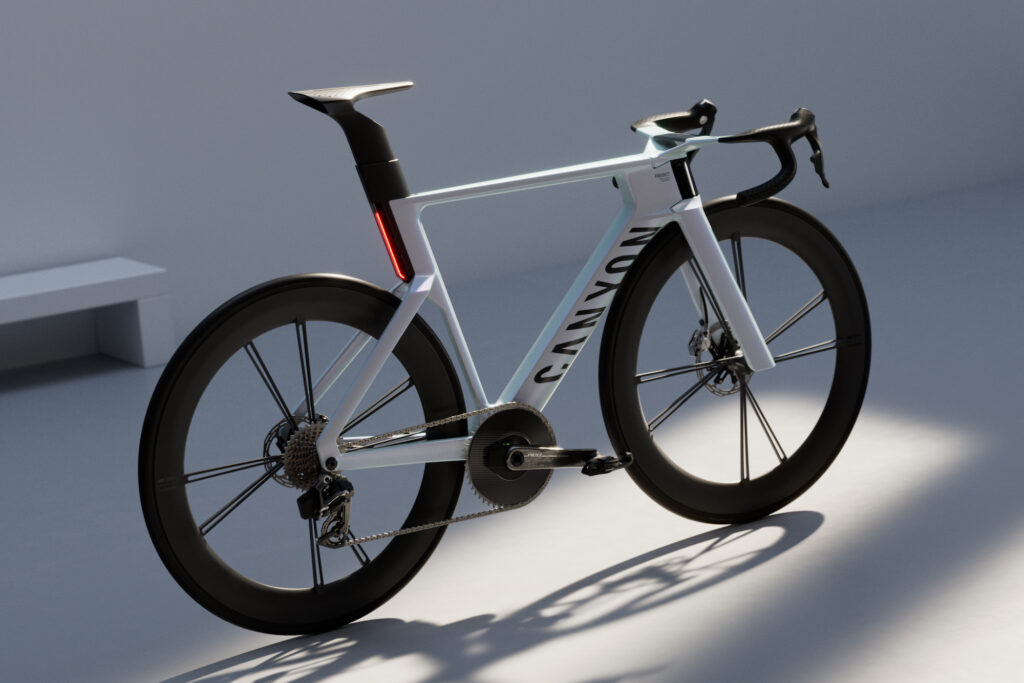

Canyon has unveiled a futuristic concept road bike that it claims could transform cycling safety by predicting hazards before riders spot them. The Predict prototype combines cameras, radar, edge AI and an integrated display to create a 360° system designed to identify risks, assist with group riding and provide real-time guidance.
“This breakthrough intelligent system architecture for road bikes is designed to see what you don’t see,” says Canyon.
“Rather than relying on traditional, reactive safety measures, Canyon’s Predict system uses a 360° sensor array to anticipate road hazards, anticipating other road users, tracking group-ride dynamics, advising on cornering speeds and predicting tricky surface conditions before the rider even notices them.
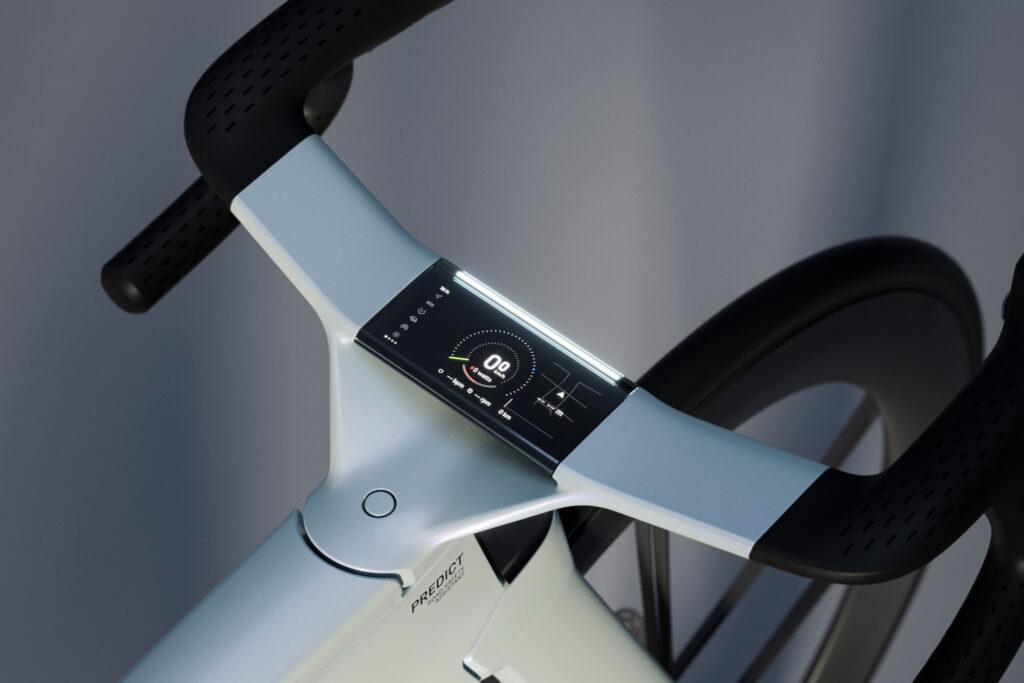
“As well as the technology being neatly packaged into a premium road bike with a data screen integrated cleanly into the handlebar, the Canyon Predict bike has the ability to connect to Canyon’s augmented-reality Stingr Smart helmet with its drop-down visor and data visualisation screen.”
We’ll come back to the Stingr Smart helmet in a minute. We’re used to seeing concept bikes that have little chance of becoming reality, but Canyon says that these innovations can soon become commonplace.
How does it work? Canyon’s video explains more.
Mazen Jrab, IoT hardware lead at Canyon, says, “The advantage of AI processing without the need of internet connectivity is that everything happens instantly on the bike with zero delay. Here, split-second timing could potentially save lives.
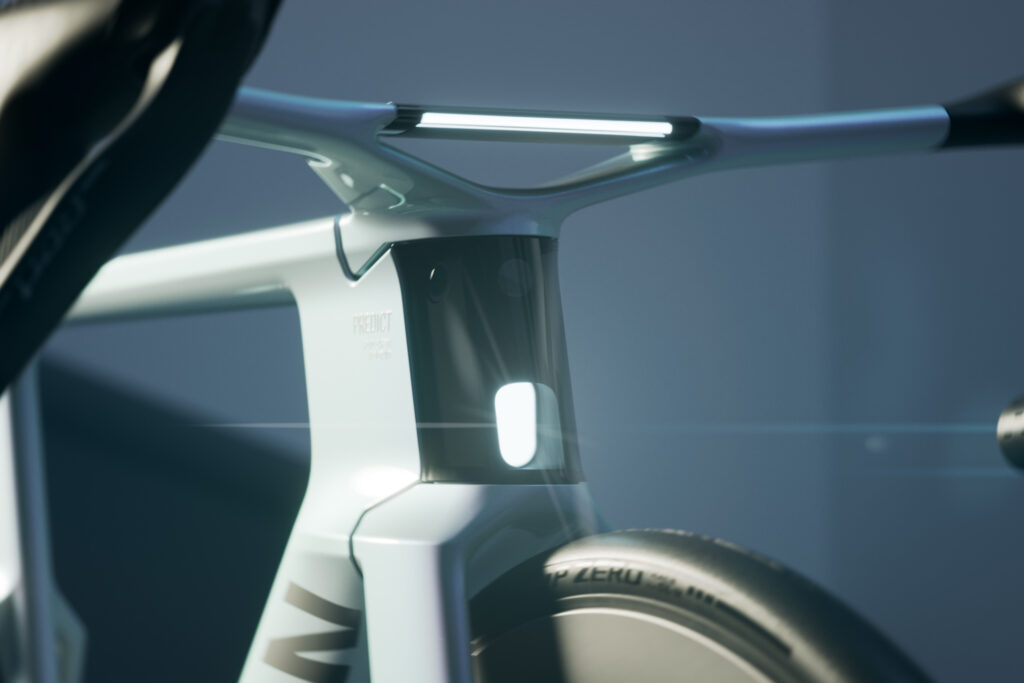
“This independent computing device pulls information from three main sources. First, the optical cameras covering 360°, capturing everything around you. Second, radars that measure how far potential hazards are away from you and how fast they are approaching you. Third, on-bike sensors that help the system factor in the bike’s own stability physics.
“Canyon Predict doesn’t just see hazards; it understands them, and more than that, it can interpret and predict possible dangerous trajectories.”
Canyon says, “Based on a communication system between a Canyon performance road bike and its on-board computer, this system uses the latest technological advances in cameras, radar signals and edge AI to improve both your riding experience and your safety – meaning less distractions, less multitasking, and more pure cycling.”
Edge AI refers to the running of artificial intelligence and machine learning models directly on local devices rather than on remote cloud servers
“This intelligent safety system transforms bicycle safety from reactive to predictive by continuously perceiving the environment, understanding context and anticipating hazards in real time,” says Canyon.
“Through the fusion of data from various on-bike sensors and integration of rider dynamics such as speed, steering, and stability, the system builds a situational model that goes beyond surrounding traffic.
“It combines 360° multi-modal sensing (camera + radar + distributed sensors including a multi-dimensional motion sensor in the DT Swiss wheel hub) with on-device AI processing to eliminate blind spots and remove internet dependency, enabling instant, privacy-preserving decision-making.”
“It predicts future trajectories of both the rider and nearby objects, before assigning risk scores, and communicating them through intuitive feedback, including directional lights, haptics, and display guidance.”
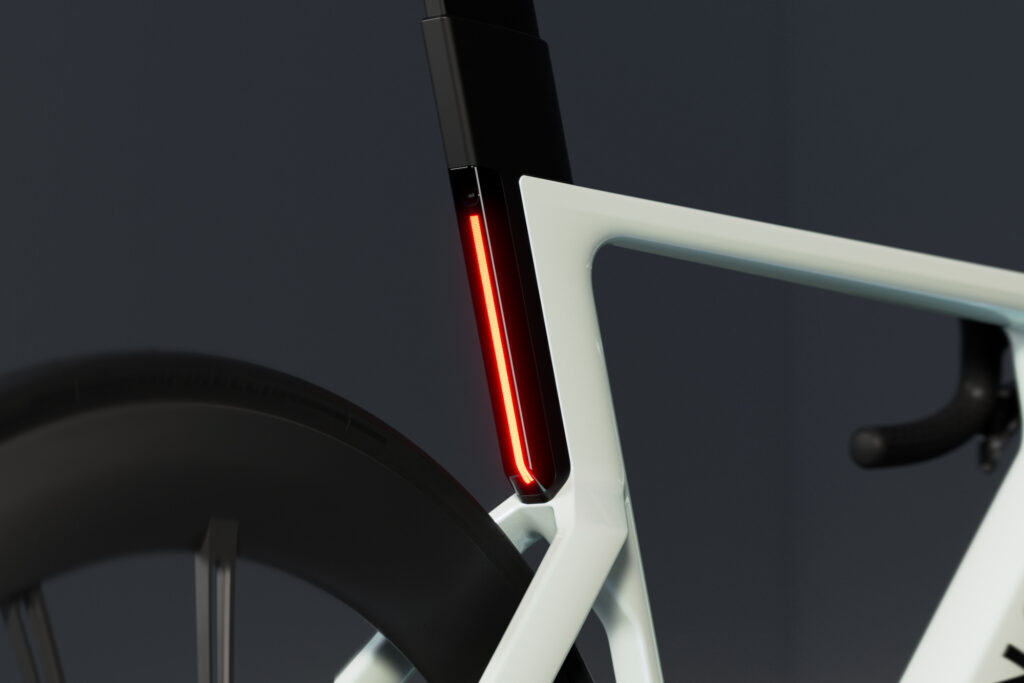
Essentially, the system warns you about potential hazards, and there’s the potential to use swarm intelligence when multiple users are riding together. Once warned, you can haul on the brakes, of course, but more than that, adaptive hardware can drop the seatpost, for example, to lower your centre of gravity, improve your stability, and increase control.
“The overall goal of the system is to transform bicycle safety from reactive to predictive by enhancing the rider’s awareness of the complete environment, significantly reducing reaction time to potential hazards, and providing intelligent, context-aware insights rather than simple alerts,” says Canyon.
“By integrating real-time perception with rider dynamics such as speed, steering angle, and stability, the system also aims to improve control in critical situations, while ultimately minimising both the likelihood and severity of accidents through timely guidance and interventions.”
Canyon’s Stingr Smart helmet
We mentioned Canyon’s Stingr Smart helmet up above. Based on Canyon’s existing Stingr aero helmet, it is designed to complement the Canyon Predict bike technology and also to operate as a standalone device.
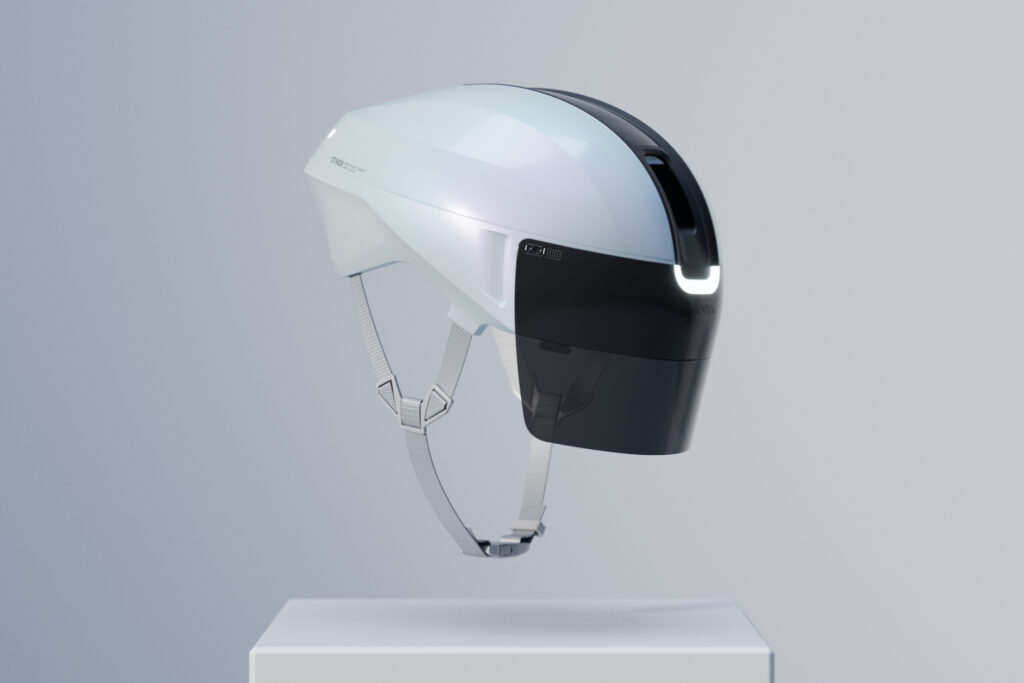
The Stingr Smart is a prototype head-up display (HUD) design with a visor and connection to on-bike AI safety systems. The idea is that it can provide you with both performance and safety information via visual, audio and haptic communication.
“The Stingr Smart helmet helps you see what you don’t see,” says Canyon. “Data visualisations such as road hazards, the behaviour of other road users, group-ride dynamics, and advice on riding behaviour can be displayed on the helmet’s head-up display which sits on the inside of a retractable helmet visor.
“Data visualisations are primarily projected into the rider’s peripheral vision to minimise cognitive load and keep the user’s primary focus squarely on the road ahead. Any alerts are designed to escalate in scale, including both customisable haptic sensations and warnings appearing centrally on screen.
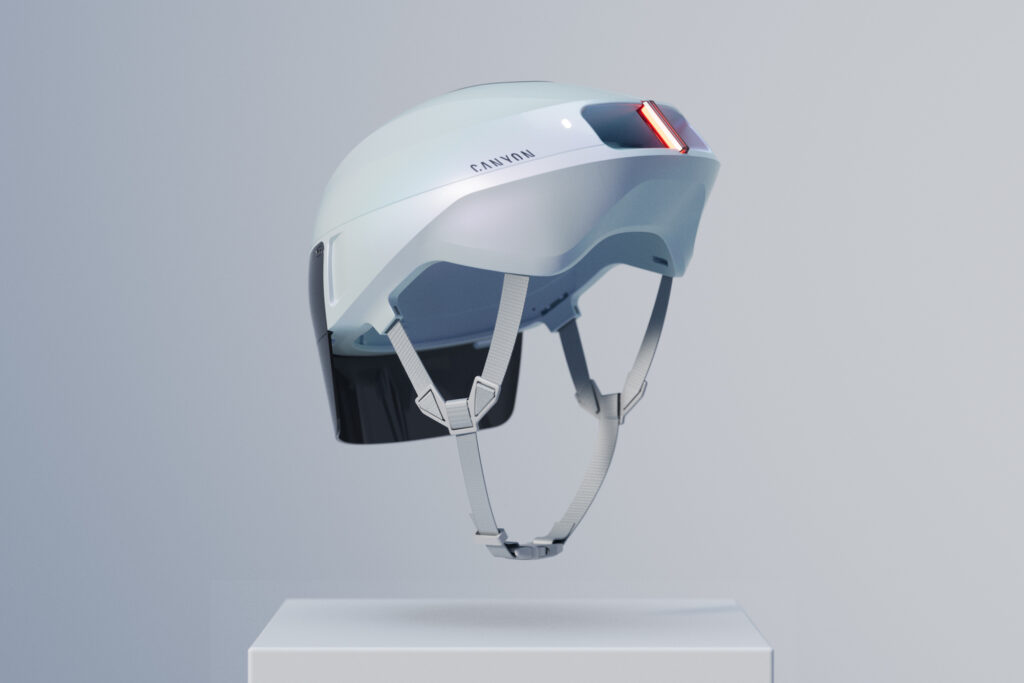
“The overall goal of the helmet visor is to provide intelligent, context-aware insights, rather than simple data and alerts, and to allow the rider to give commands, or to toggle through data views without needing to take their hands off the handlebars.
“Its primary function – setting it apart from other eyewear data systems – is to provide instantly visible alerts about the behaviour other road users (such as brake light activation, crash detection, etc) through the Canyon Predict system, including Prediction Assist, Distance Assist, Terrain Assist and Group Ride Assist.”
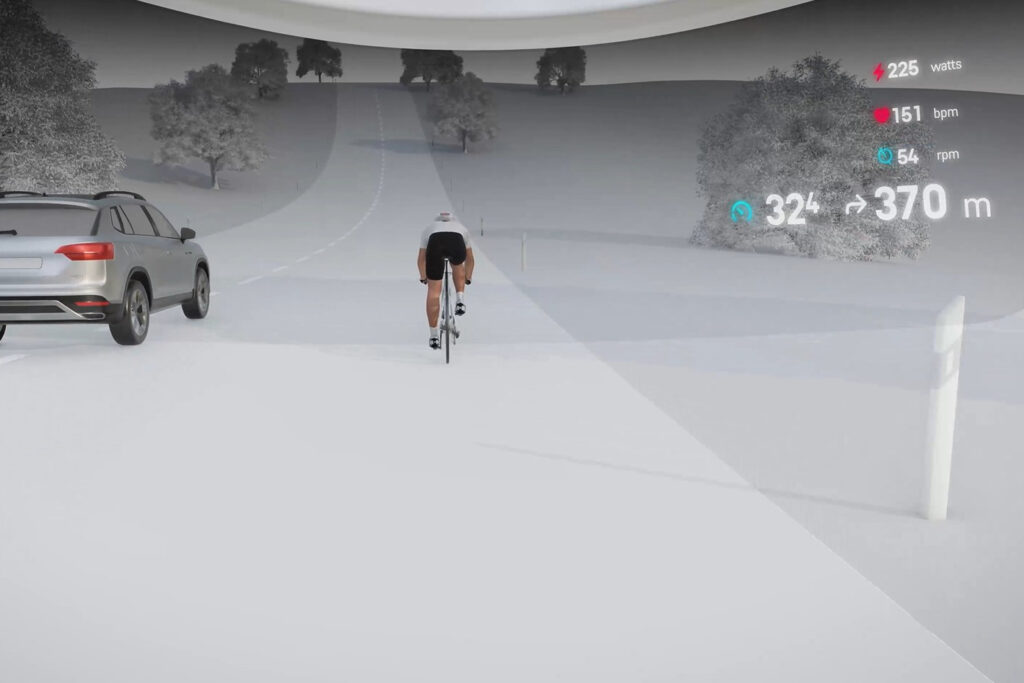
Alternatively – or additionally – the head-up display can give you more traditional metrics like speed, distance, time, cadence, power, elevation and gradient. The helmet can receive data input from your smartphone, which can appear in customisable data fields on the visor screen, and from other Bluetooth or ANT+ devices so that gear usage and battery levels can be displayed. There’s also the possibility for your heart rate to be measured from the helmet.
“Voice commands are provided through a near-ear audio system,” says Canyon. “Its microphone allows all functions of the helmet to be accessed without the rider needing to take their hands off the handlebars. Alternatively, the rider can operate the helmet by using touch buttons on the outer shell. The audio system also allows for warnings or notifications as well as route guidance, group messaging or hands-free calling when connected to a smartphone.”
Don’t want to see the display? A voice command or a press of a touch button will see it retract into the helmet. Each time the visor retracts or deploys, it passes through a wiper blade designed to clean the surface.
What do you reckon? Does Canyon’s Predict system have potential for improving rider safety? Let us know what you think in the comments.








20 thoughts on “Could this be the safest road bike ever built? Canyon thinks so”
I get on my bike to remove myself from the world where AI is being shoehorned into everything.
DO NOT WANT.
But it will lower your saddle adaptively all while preserving your privacy. Think of the (future) children.
@slc Did you mean preserving your privates?
Canyon are wrong. This is the safest road bike ever created: https://road.cc/content/news/florida-man-armed-cyclist-jersey-sparks-debate-303035
I’m sure I’ve seen this somewhere before.
@mdavidford
[citation needed]
A bike that can predict hazards.
The thing that makes cycling most dangerous is drivers doing unpredictable things. I don’t think any amount of tech will be able to fix that.
A autonomous A10 with a simple ‘protect steve’ objective?
oh, there are totally predictable, unfortunately.
I predict that they will kill 5 people, today, in the UK
Agreed except it might help a tiny bit e.g. a camera that could detect a driver looking down at a phone, or when you’re about to get close passed, and then give you a warning. You might get sick of the constant warning sounds though.
That’s the problem, this is less pure cycling.
Thankfully it’s a concept and doesn’t actually exist.
@momove maybe they mean “more pure cycling *marketing*”?
Shurely one of those Zwift bikes is safer?
As long as you get medical approval before use, always wear a helmet in case you fall off and don’t put it near a wall that someone might inadvertently drive a motor vehicle through.
It needs to read license plates, look them up, and tell you the registered owner has 26 prior driving offences. Ideally it would remotely hack their car and turn the engine off.
Driver: I only get ‘undred yards down road and another one of those bloody smart bikes shuts me down. Took me two hours to get t’ pub.
Those wheels are certainly a major advance in road safety for squirrels trying to cross the road.
The thing that makes cycling more dangerous (among others) is poor skill and situational awareness. Both of which will be exacerbated by this thing full of screens sensors and other distractions which will do nothing to help a novice ride better.
Maybe I’ll just go out on my MTB and ride in the woods. Thanks for reminding me of the future chaos you think the roads will be, Canyon – great message.
Anything that improves safety is a plus. Whether it will make a real difference is another matter: it’s not because the system correctly detects a dangerous situation that you’ll be able to do anything about it, or that you’ll have the time to react, such as with a parked car opening a door without looking (keeping your distance is still the best strategy there). It’s a bit like my Garmin Vario rear light: 90% of the time the radar adds nothing, 10% of the time what it displays is really helpful and I guess that once every couple of years or so it might really make the difference between nothing happening or an accident. Still worth it imo.
I came for the comments on a stupid bike with a stupid helmet. I wasn’t disappointed.