


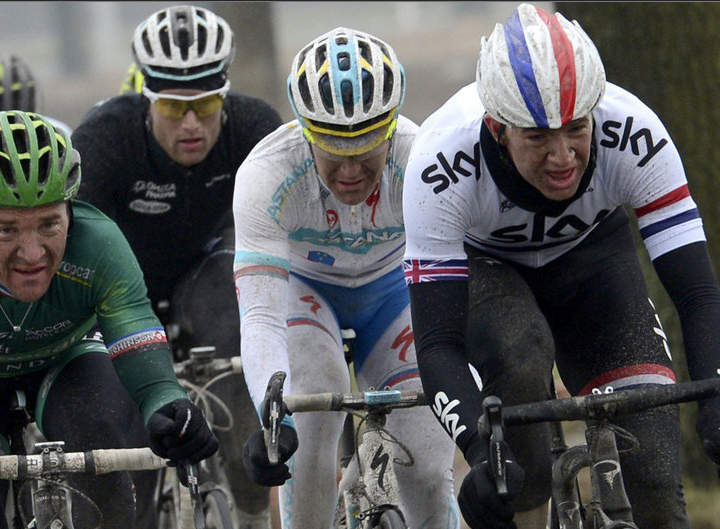

Ian Stannard showed that he's a classics winner in the making with an impressive show of force and power in the Dwars door Vlaanderen this week. But his futile attacks exposed a tactical naivety, leaving him to finish a disappointing 9th place.
I watched the race with fascination. Team Sky had the numbers on their side, two riders in the break. But they couldn't convert that advantage into a victory. But it was Stannard's display of power that I was taken by. I was reminded by Stannard’s efforts of Fabian Cancellara’s favoured method of winning bike races: effortlessly riding away from his rivals and soloing to the finish. Whether it’s 5km or 40km out from the finish.
Cancellara first demonstrated his signature move on stage 3 of the 2007 Tour de France into Compiègne. He then repeated it, but from further out from the finish, in the Tour of Flanders and Paris-Roubaix in 2010. Since those victories however, the peloton have given him little rope, and his success rate has dropped off significantly and his frustration has risen. Spartacus hasn't given up though, even tried trademark move in this weekeend' Milan-San Remo, to little avail. He finished third.
In the same way, Stannard is at risk of making himself a marked man. He has shown he's dangerously powerful but in showing his form so eagerly, the peloton are going to keep an eye on him. It worked so successfully for Cancellara because of the suprise of his attack and power. Stannard hasn't successfully deployed his power as effectively. The ouctome of Dwars door Vlaanderen could have been so different, and we would now be toasting a British classics winner.
He's a classics winner in the making though. In that race, and 6th at Milan-San Remo, he showed he's not afraid to get serious when the conditions deteriorate. He first showed this in 2010 where he finished 3rd in a wet edition of Kuurne-Brussels-Kuurne. He excels in really filthy weather. In fact it’s fair to say he probably looks forward to pulling back the curtains on race morning to reveal torrential rain and cold winds. This year's Milan-San Remo was run in horrific conditions, but Stannard looked to be right at home. Such weather is a variable that seems to favour him more than others.
In recent years, we’ve come to expect nothing but victorious riding from Team Sky. Their ability to control a race is commendable, but while it works brilliantly in a stage race, the same approach just doesn’t work in a one day classic. A stage race can be controlled by the numbers, there's a rythm to the race. But so much can happen in a one day race, too many variables to account for and too little time to put wrong errors of judgement or mistakes. Or a puncture. Team Sky’s desire to follow a carefully prescribed plan and ride by the numbers, simply doesn’t work here.
One day racing is fast and the changes faster still. In a one day race like Flanders or Paris-Roubaix the riders can’t rely on instructions relayed from the comfort of the team car. A rider needs to be able to read the road, the cobbles, the rapidly changing dynamics of the race and the composition of the group around him. The racing is fast and hectic, crazy and dangerous, and that calls for an ability to make quick decisions.
It must be said that Sky have enjoyed limited success in the classics. Hayman and Flecha finishing top ten at Roubaix last year, and Geraint Thomas and Flecha finishing top ten in Flanders in 2011. On the back of those races, Sir Dave Brailsford has declared an interest in winning one of the big classics. At early season training camps the squad has been split into grand tour and classics teams, and the classics riders have been working towards these races as their explicit goal. Team Sky are serious about winning a classic and given their past record few would argue against them ticking that box.
Crucially, Stannard isn’t a designated team leader, not yet anyway. He’s still a working rider for protected riders in the team, like Geraint Thomas at Milan-San Remo. In classics terms, Stannard could be considered to be in the same position Chris Froome when he finished second at the Vuelta a España in 2011. That’s when the Sky management sat up and took notice of Froome, and turned him into a team leader. He's on a learning curve.
Stannard is young at 25-years-old. But then Cancellara was just 25 when he won Tour of Flanders in 2006. A win in one of the big races is asking a lot of Stannard, but his current form shows he clearly has the power. In demonstrating his prowess in these races, Stannard is sending a clear message to the management of his team. He no longer wants to pull his team along, he wants to raise his arms in the air and put his name in the record books.
In an interview with road.cc last year, Stannard commented: “I believe I can achieve it and I really want to achieve it but I’ve got a long way to go before I get anywhere near that. You’ve really got to learn the races and study them and almost become one with them, so yes, I’ve got a long way to go.”
He's displayed his physical strength. He now just needs to display a tactical strength, and a classics win will surely be his. If not this year, but in the years to come.









13 thoughts on “Does Ian Stannard have what it takes to win a classic?”
Good article and will be
Good article and will be interesting to see if Stannard gets some more opportunities. It looked to me as if his chance at Milan-San Remo only came about because Thomas crashed. As you say, riders with power but without tactical nous are quickly found out: e.g. Cancellara in Milan-San Remo a couple of years ago basically towed Gerrans to the finish; he was also marked out of the race in Paris-Roubaix when Van Summeren took his chance to win but put in some phenomenal digs to try to get away.
good to see that they (SKY)
good to see that they (SKY) are giving him the ‘chance’ to go out there and “give it a go”! he is a true work horse and deserves his chance to win a classic. He is the British National champ after all not just a super DS.
If he does win a classic
If he does win a classic it’ll probably be Paris-Roubaix where power can still win eg Boonen last year. He’ll need a bit of luck though with a disorganised chasing group. Hoping Thomas doesn’t
crash again, but presumably Boasson Hagen will be the main one for Gent-Wevelgem or possibly both.
He is in the same position as
He is in the same position as Froome, G is the teams classic rider they pin their hopes on and Wiggins is the GC rider they pinned their hopes on.
Fortunately Froome has escaped from that shadow so lets hope Stannard can do the same.
Dave – this is a good piece
Dave – this is a good piece but when Cancellera rides away from some of the best bike riders in the world, he doesn’t do it “effortlessly”. It takes a great deal of effort. It might seem effortless, but it is physically impossible for it to be efffortless. It must hack pro riders off massively to see this word used. It’s used all the time and it’s almost always used wrongly.
I think its a bit unfair to
I think its a bit unfair to say Stannard is lacking tactically. I’m not sure what else he can do? he doesnt look to have a sprint, so how is he supposed to get rid of other riders? i’d guess Fabian is(or was?) probably capable of accelerating quicker up to warp speed so others couldnt go with him, but Stannard looks like more of a diesel – massive power but not much acceleration? I’d love to be proved wrong though!
Yes
Yes
Whilst he’s not explosive,
Whilst he’s not explosive, he’s very powerful and he can rip a bunch up with an acceleration up to top speed as shown at the vuelta stage 7 last year where the tactics completely destroyed Ben Swifts chances in the sprint, when Stannard took the front at 2Kms ramped the speed up to 65Kph and ripped the bunch to bits, then when froome took over 1km out he couldn’t hold that pace and it bunched leaving swifty too much to do on the run in.
With a turn like this there aren’t many who could hold his wheel at the end of a long classic, if he’s got the form, which he seems to have, so it does seem to be lack of tactics (as with sagans string of 2nds) coupled with a lack of confidence (which sagan obv doesn’t suffer!!!)
It’ll come with a combination of luck and maturity, def haven’t seen the best of him
see video form 07:00 onwards https://www.youtube.com/watch?v=UYpXgAcsHHs
Whilst he’s not explosive,
Whilst he’s not explosive, he’s very powerful and he can rip a bunch up with an acceleration up to top speed as shown at the vuelta stage 7 last year where the tactics completely destroyed Ben Swifts chances in the sprint, when Stannard took the front at 2Kms ramped the speed up to 65Kph and ripped the bunch to bits, then when froome took over 1km out he couldn’t hold that pace and it bunched leaving swifty too much to do on the run in.
With a turn like this there aren’t many who could hold his wheel at the end of a long classic, if he’s got the form, which he seems to have, so it does seem to be lack of tactics (as with sagans string of 2nds) coupled with a lack of confidence (which sagan obv doesn’t suffer!!!)
It’ll come with a combination of luck and maturity, def haven’t seen the best of him
see video form 07:00 onwards youtube.com/watch?v=UYpXgAcsHHs
A simple answer.
Yes.
His day
A simple answer.
Yes.
His day will come.
He’ll certainly be in the mix
He’ll certainly be in the mix for the next few years. He’s got the power and the motivation, and his own tactical nous will come with experience in the right races.
What he needs to win, rather than just to compete, is a dose of luck and some better tactical riding by his team – he’s not going to be a Boonen, Cancellara or a Sagan, who can win by pure superiority, so he needs to right combination of Sky tactics (get a man in the break!) and circumstances to allow him to top the podium.
Saw him in the flesh at the
Saw him in the flesh at the Vuelta last year and was impressed. He’s on my purist Fantasy team for the classics…
I agree that he does not
I agree that he does not appear to have the tactical nowse . Some of that is to do with giving your kick at the right time and some of it a physical capability, and knowing the strengths around you (and also the parcours). His pulls in the San Remo seemed to be ill-judged to my mind. Though he did well to get himself in contention.
Stannard strikes me as a bit of diesel engine. He can pull long and hard, which is the hallmark of classics rider. But for my mind he lacks the top end power for the sort of kick that really pulls a rider off your wheel (if they are marking you, or sucking your wheel).
That said, if everyone is looking the other way (at Sagan, Boonen and Cancellara). He can certainly use that diesel power to pull away. But at the moment he would need the right circumstances to occur.
I must admit that I haven’t really seen enough from Geraint Thomas to really appreciate why Sky think he will compete at the top end of cycling in the Classics. His junior title wouldn’t seem like enough to prove that ambition. But happy to be proven wrong.