


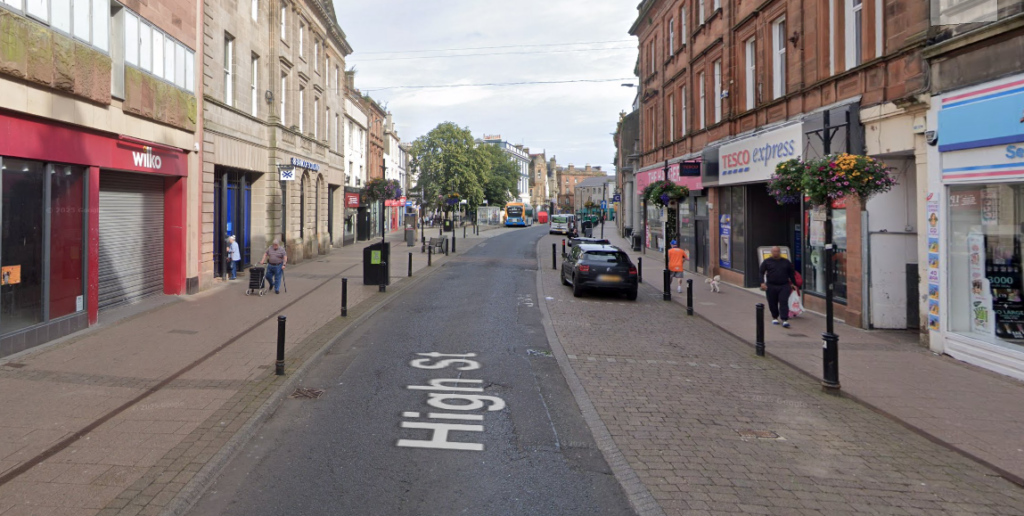

Proposed cycle lanes in Ayr town centre have been scrapped after the council’s depute leader called for a revised design without cycling infrastructure, following criticism from residents.
The controversial plans initially caused uproar as the removal of six car parking spaces would cause “disruption” to “our local economy”, according to MP Elaine Stewart.
There was public concern that the plans, which are part of the council’s Accessible Ayr programme, retained the cycle lanes despite public opposition.
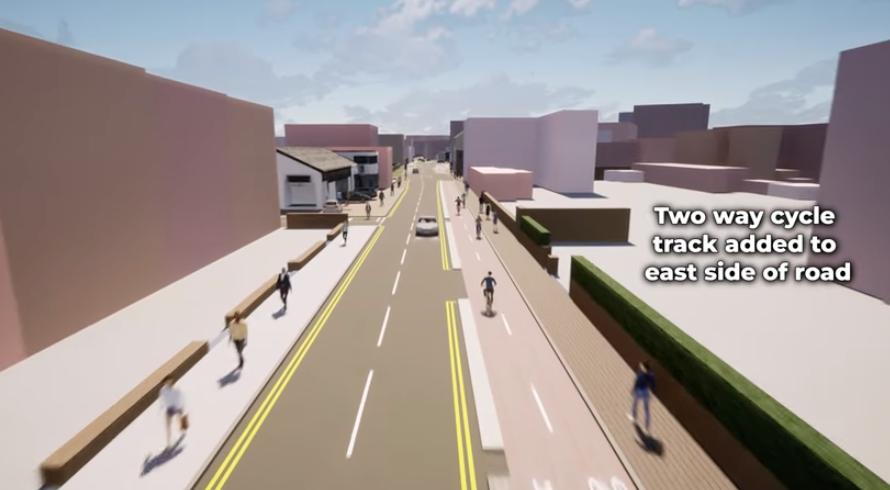
Siobhan Brown, MSP for Ayr, Prestwich & Troon, said on Facebook, “ARA has decided to defer the Accessible Ayr Project until a later date. It was also confirmed that the revised designs WILL NOT include any cycle lanes in Ayr town centre.
“I am all for active travel, but we must do it in a way which has the general public and businesses onside. It must be fully consulted on. I believe this is the right decision.”
In an open letter in October, MP Elaine Steward said that “we all want a more accessible, vibrant Ayr – but not at an economic cost. I urge South Ayrshire Council to pause these plans and listen carefully to the voices of business owners, cyclists, and the wider public.”
She also referenced the 2016 Holmston Road cycle lane project, which cost the council £95,000 to remove after an unprecedented level of opposition. “Repeating that mistake would further erode public trust and squander valuable public funds.”
This decision has been met with support from many residents, many of them calling for funds to be focused on regenerating the struggling high street.
Robert Dalziel said on Facebook: “Why would you cycle in Ayr when there’s nothing in Ayr town centre, unless you want vapes, nail bar or Turkish-style barbers.
“Town needs investment, not tacky shops to attract tourists, day shoppers, etc. Once that has happened, then encourage cyclists.
Jorden-Lee McEwan added that “as a cyclist, I’d rather the council focus on resurfacing the roads around Ayr for all road users. Especially cyclists, the number of potholes is ridiculous and dangerous, and the attempts made to cover them literally create speed lumps all over the place.”
However, there was also support for the original cycle lane plans.
Laura Cowan said, “That’s the idea. Get people out of their cars and more active. If it is easy to park and go to one shop, you also restrict visits to neighbouring shops.
“Funny how it works everywhere else. Also, who wants to doge cars when you are shopping?”
Ian Urquhard also highlighted safety concerns. “I’ve cycled in Ayr once. It’s hostile to anyone outside of a car. Elderly, disabled, child? Yeah, no consideration for you. You can drive through it easily.
“The bypass was built, but no one thought to adapt the town centre to make it accessible to people.”
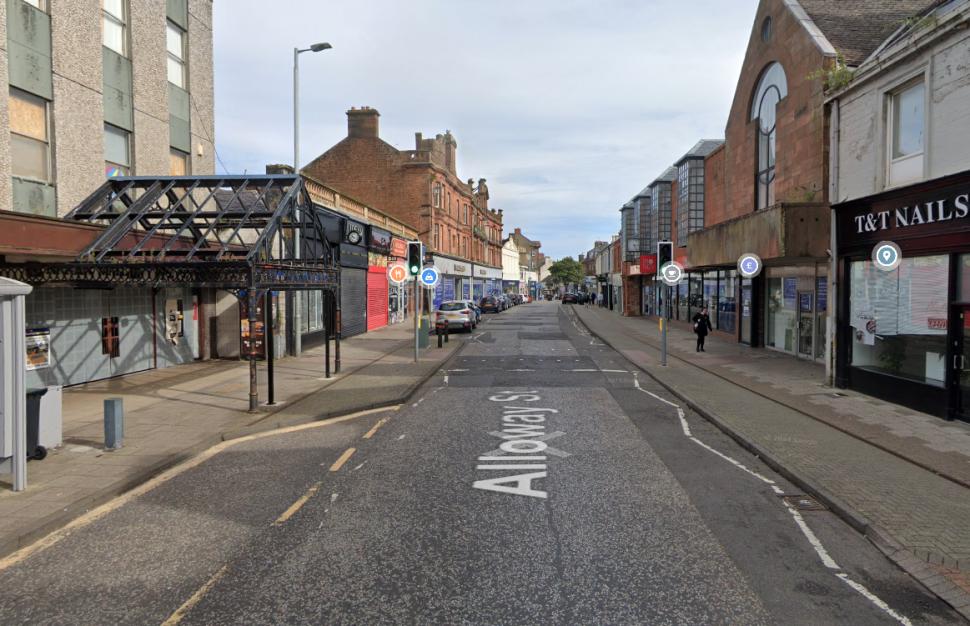
Despite expectations that the cycle lanes would be removed entirely from updated designs, a council report showed that while public feedback had influenced the programme, the only change had been to the design of the cycleway on Alloway Street.
> Improving cycle infrastructure and public transport has little impact on car use, new review finds
Speaking at the meeting, South Ayrshire Council’s depute leader, Alec Clark, said: “Due to further consultation and feedback, the report on Accessible Ayr has been deferred until a later date to allow for a redesign, which will not incorporate any cycle lanes in Ayr town centre,” STV News reports.
“Cabinet will be updated on the new design as we go along, and to be clear, there will be no cycle lanes in Alloway Street, Sandgate or Fullarton Street.”
Councillor Clark added that he has spoken to the director of Housing, Operations and Development, and agreed to defer the report so the plans can be changed.
The council said that no final decisions have been made and that redesigned plans will be brought back to Cabinet at a later date, while regeneration work at Burns Statue Square will continue as planned.
Other plans included in the proposal include safer crossings closer to the High Street, adjustments to traffic flow, including some one-way streets and new planting, seating and upgraded materials in the town centre.
The Accessible Ayr project is funded through the Scottish Government’s Places for Everyone programme and is delivered by Sustrans. It aims to improve accessibility for pedestrians, cyclists, and people with disabilities, while supporting local businesses and encouraging investment.

Phase 1 of the scheme carries an estimated construction cost of £19.9m, to be delivered in stages over four years. To meet national funding rules and minimise disruption, the work would be carried out in smaller sections over four years, with no more than £5m spent in one year.
The council officers have already submitted a funding application to Transport Scotland’s Active Travel Infrastructure fund, with the council expected to contribute around 30% of the costs.













25 thoughts on “Plans to build cycle lane in town “hostile to anyone outside of a car” have been scrapped”
Having posted before re the
Having posted before re the Ayr Bike Route debate I would say I’m surprised by this outcome, but I’m not. Sad, yes. Surprised, no.
I would be very interested to know what the clown show at South Ayrshire Council actually did to try and inform the businesses, residents and shareholders of Ayr Town Centre WHY facilitating increasing safe pedestrian & bike access is a good thing for retail, a good thing for communities and a good thing for public spaces. Above all, and in light of the UK’s appaling health situation esp. re obesity & Type 2 Diabetes, why facilitating increased movement and activity is good for everyone.
I’d have thought the Chairperson of the relevent Committee at “The Cooncil” or perhaps even an esteemed MSP would have lept (albeit lowly and slowly) at the chance of a freebie jolly over over to the Netherlands with, of course, a few leading business lights from the vape and phone unlocking sectors to see first hand how active AND car centric transport can work side by side with effective public transport. But hey, that would have taken some effort, thought, planning and a strategy. Things that SAC are decidedly unable to demonstrate they are capable of.
Another missed opportunity for Ayr.
All rather depressing
All rather depressing
Another SNP policy that is
Another SNP policy that is always 10 years away. It enables them to please everyone.
Prestwich is in Greater Manchester by the way, Editor. But Prestwick is not.
Meanwhile in NL – “rethinking
Meanwhile in NL – “rethinking the role of the car (in urban areas) – time to let go (of mass motoring)”. Featuring not 20, not 15 but 10 minute neighbourhoods!
Is this why the US government (and unfriendly allies) are condemning Europe and saying it’s going to collapse? Don’t panic! It’s not quite a done deal yet!
Indeed NL still has a very high car ownership. (And currently has to do quite expensive things like building parking garages – even underwater – to get them off the streets – see eg. https://m.youtube.com/watch?v=mXLqrMljdfU ).
But – that conversation is being had over there. While over here we’ve not yet decided whether “war on the motorist” is a bit of an exaggeration or a real, massive but covered up issue – indeed a real conspiracy to tax motorists AND take their freedoms!
(Only a few would go further and suggest this might be a conspiracy … by the motor industries! And the “war” a total fiction or inversion of the facts).
As someone who has done
As someone who has done multiple Chase the Sun North rides which start in Whitley bay and finish in Ayr. I’d suggest the organisers switch the finish point to somewhere else if that’s Ayr councils attitude. The CTS must bring in a fair bit of income from cyclists on the day. If they can’t be arsed with cycling infrastructure then let’s move the finish to somewhere that does.
Nah cyclists don’t spend any
Nah cyclists don’t spend any money, I don’t want them anywhere near my town centre or my struggling business ? Doh.
I don’t know if anyone here
I don’t know if anyone here is familiar with Tavistock Place and Marchmont Street in central London. It used to be a squalid rat run behind the Euston Road, with a greasy spoon and a fading old boozer on it. And lots and lots of taxis and vans trying to cut up past Kings X to Euston station. Camden council decided to block off one of the left turns and build a segregated cycle lane in both directions. A ‘resident association’ did the usual ‘what about the local shops?’ And the Taxi ‘union’ played the ‘what about the disabled?’ card, and managed to get a judicial review. I believe one amendment was installed – a taxi stand – but otherwise the cycle lanes were built, the no left turn was introduced and a one way was implemented. Go done there now – it’s full of people, shops, cafes, the pub has an outside area and it’s so quiet, apart from chatter and the hum of commercial activity. It’s total BS that cycle lanes kill shops. I believe it is the exact opposite. It’s queues of cars and vans that kill shops.
Rome73 wrote:
I am and I can absolutely confirm what you say, it’s turned what used to be a snarling nightmare into an absolute pleasure to ride through and the commercial parts of the street have definitely been revitalised. Examples like these should be raised at enquiries, comparing the scaremongering beforehand to the actual results.
What you say about Tavistock
What you say about Tavistock Place is true – but I don’t think it’s as helpful an example as you think. It’s full of younger, highly-educated, non-car reliant people in an area where there is plentiful economic vibrancy just waiting to be unocked by the right conditions. Ayr – like many faded provincial towns, and indeed most of everywhere – doesn’t have any of these things: it’s older, sicker, poorer, angrier, more car-dependent, etc.
I’d like to see more examples of where places like Ayr have been turned around by active travel – where are they?
Its not like there is a lack
Its not like there is a lack of parking in Ayr and when I’m walking about the town most people are going to more than one shop so its not like they are only a few feet from their car. I think it is a lack of vision by the council for what could be. There are plenty of young non-car reliant people in Ayr in the evenings, I wonder why they avoid the place in the daytime?
I didn’t say anything about
I didn’t say anything about parking in Ayr – although I know the town a little, parking is not a subject I’m familiar with.
My point was that central London (like Paris) probably isn’t a particularly useful example for how things might work in smaller, much less vibrant locations.
As for what Ayr’s young folk do in the daytime, I’d presume the same as elsewhere – be at their place of work, study or perhaps at home if they are unemployed, unwell or have caring responsibilities. At the weekend, I’d have thought that free travel on the X77 to Glasgow would be more appealing (but not being a young person in Ayr, I can’t be certain).
Dnnnnnn wrote:
No but the original article, goes on about the loss of 6 parking spaces.
I’m not sure that follows, yes there is a smaller catchment area for people to use the facilities but there is also less choice of places to go.
I’m not sure that 2 hours sitting on a bus is anybody’s idea of fun.
Backladder wrote:
You don’t speak for me!
I thought you preferred
I thought you preferred trains.
mdavidford wrote:
hawkinspeter wrote:
Nor me, actually. Some of the country bus routes to the South of Bristol have fabulous views from the upper deck.
Glasgow-Ayr isn’t quite so scenic (although it’s OK) but it’s only an hour each way and the buses are rather plush.
I’m not sure that 2 hours
I’m not sure that 2 hours sitting on a bus is anybody’s idea of fun
Not always true! The 555 Lancaster to Keswick and 280 Preston to Skipton are worth anybody’s time
wtjs wrote:
Haven’t used the 280 but a big thumbs up for the 555.
Perhaps we should have a favourite bus routes thread on road.cc?
Dnnnnnn wrote:
I take the point BUT isn’t there a measure of circularity there? (And TBF in most of our thinking about these issues)?
As in “we can only improve things at the expense of driving where people aren’t car-dependant”. (How did they become thus? Why *aren’t* they dependent?)
Or “people *here* are car dependant so you see we can’t have alternatives to motoring beside there isn’t space”? (Why are they? How do we think they will lose that dependency without some measures that result in driving less? )
It *is* circular in that (with lots of outside help at least at the start) mass motoring *appears* to be strongly self-reinforcing.
But … sometimes I wonder just how much. Given that it has been calculated by some to be an economic cost overall, not a benefit (at least to the state)?
I am unsure – certainly it often looks like “you can’t get there from here”. Certainly the “countryside” in the UK *looks* impossible to change.
And yet … we are overwhelmingly urban. Many of our journeys are quite short. In many urban areas (including poor ones, with old and sick people) car ownership (or even access) is *not* high. Some places are starting to realise that with a growing (and ageing) population we just can’t go on as before – we’re short of space and tax money etc.
Oh, and we now have remote working and communication possibilities we never had before. But I agree that doesn’t free cleaners, carers, couriers etc. from the need to travel.
Dnnnnnn wrote:
Well there must be some in NL. I think we did have a look at one of the poorest districts in NL in posts a while back. IIRC it was somewhere in Rotterdam. And it was accessible by car… but also well served by public transport and of course connected to cycling networks.
But that’s still in a city (small one though) over 10 times the size. I’d say Seville (got there from a less promising start) but that’s also over 10 times the size.
Ayr is somewhere around 46000 population says the net. Being on the coast it’s somewhat isolated – except it is not that far from Glasgow, it’s on the railway and … there’s Prestwick.
Bracketing that population in NL has Zutphen 47000, Ridderkerk 46000, Voorburg 43000 (rough numbers). I’ve never heard of them either. Let’s see…
Zutphen – looks very nice and it’s not in the most populous part. It’s apparently a railway hub though so will be different.
Ridderkerk – probably too close to more major cities to be comparable.
Voorburg – also basically a suburb of The Hague, so not helpful.
Perhaps Deltzijl? That’s “out of the way” for NL, on the coast. A bit smaller… and yet it still looks good, *two* stations, buses, haven’t done a streetview but sounds like it’s as accessible by bike as almost everywhere in NL. https://en.wikipedia.org/wiki/Delfzijl
At some point I’m sure it looked like it was on the same path to “car dependence” as Ayr…
chrisonabike wrote:
I agree towns in NL are (or once were) more likely to look a bit like Ayr than London. I wish more places outside NL (and DK) would learn from them – but it feels as if very, very few actually do. That’s a different discussion to the specific point I was making about London though.
I was referring to your point
I was referring to your point about Ayr as quoted.
London may or may not be helpfully comparable to more advanced urban places. Central London may not. BUT does that contain that the only “young, vibrant” neighbourhood in the UK? (Or the only place where people might be “primed” for a transformation)? (Answer – trivially no, because Cambridge – but in other less “outlier” places the pockets of change might be smaller, and fixing public transport will be harder. )
Central London *does* perhaps have generally better public transport, higher user of same and – in some parts – rather less car ownership. I suspect the latter is a question of size of area though?
London is a bit of an oddity here. On the one hand it’s it’s significantly bigger than places in NL (unless you count regions like the Randstad in NL – 8.4 million ppl). It’s significantly bigger even than Paris. But on the other hand – outside of central London it’s more a collection of towns.
I think more active travel- friendly places are simultaneously impossibly hard to imagine from here but also probably not that distant in time / money, *if* we decided to make a change. (Again Seville would seem the most striking example of change here).
“I am all for active travel,.
“I am all for active travel,….”
Oh no you’re not.
All this talk of making the town centre more accessible to people who don’t arrive by car having an economic cost is 24carat BS. If the evidence from literally everywhere else for the past thirty years shows us anything, it’s that making town centres more accessible to pedestrians and cyclists brings massive economic benefits. What is absolutely clear is that what they are doing now isn’t working, so any rational person would see that something had to change.
As Einstein pointed out, doing the same thing over and over again and expecting a different outcome is a form of madness.
But who needs facts when you’ve got prejudices.
“I am all for active travel..
“I am all for active travel…”
150% correct!! Writing/ saying that is a dead-giveaway to rank alongside ‘I’m a cyclist myself’ and ‘Some of my best friends are black/ Jewish/ gay etc.’
Based on the old adage that
Based on the old adage that to continue to do the same things and expect different results is the first sign of madness. Those in charge are bonkers.
Ayr town centre, with its current reliance on cars, very sadly is really run down and missing any spark. Surely a new approach is required. As people in cars are obviously traveling up to Glasgow for shopping and entertainment.