



A review, published by Transportation Research, has found that non-coercive measures alone cannot achieve significant national-level reductions in car traffic or emissions.
Non-coercive measures, or ‘carrots’, such as improving public transport, enhancing cycling and walking infrastructure, changing urban form, and behaviour-change, do produce valuable benefits which include better accessibility, healthier cities, and improved equity.
However, the study claims that the effect on the general traffic volumes is very small, especially from a climate policy perspective, where emissions need to be cut radically and rapidly.
It also found that overestimating their effects may “cause complacency [and] misallocations of scarce public resources.”
One of the main findings is that improving public transport through cheaper fares, more frequent services, or faster journeys does not reduce car use.
Although improvements attract more passengers to buses and trains, the review finds that most of these new riders were not previously driving.
Professor Ian Walker agreed on BlueSky: “This isn’t surprising, if only thanks to habit. If I unthinkingly jump in my car for every trip (as many do), new buses won’t change that.
“The implication is that there has to be action to disrupt, or add friction to, existing car journeys if we want to unlock the benefits of providing alternatives.”
Yet another evidence review argues very strongly that simply providing alternatives to driving doesn’t reduce driving This isn’t surprising, if only thanks to habit. If I unthinkingly jump in my car for every trip (as many do), new buses won’t change that www.sciencedirect.com/science/arti…
— Prof. Ian Walker (@ianwalker.bsky.social) 15 November 2025 at 09:13
Similarly, the study found that although multiple reviews confirm that better cycling infrastructure increases cycling levels, it does not affect car traffic.
This is mostly because many of the new cycling trips come from travelling by public transport, rather than by car.
This is mostly because many of the new cycling trips come from people who previously used public transport, which was a pattern repeatedly observed in European cities.
For example, in Stockholm, 87% of peak-hour cyclists answered that their second-best option would be public transport.
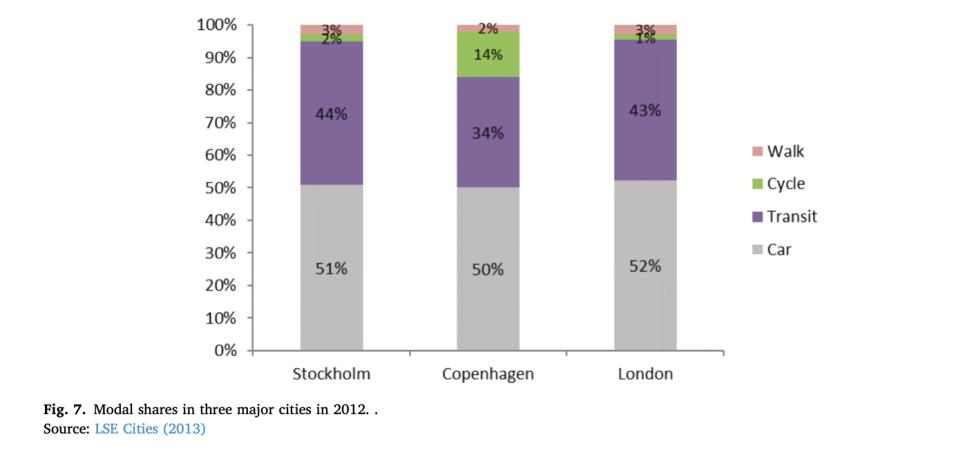
When comparing Stockholm, London and Copenhagen, Copenhagen has a much higher share of cycling than the other two cities.
However, its level of car travel is similar, suggesting that the extra cycling mainly replaces public transport trips rather than car trips.
Therefore, the research found that even increases in cycling have a limited impact on reducing the number of kilometres driven by car.
The study finds that to achieve meaningful reductions in emissions, these non-coercive ‘carrot’ policies need to be paired with ‘sticks’ such as higher driving costs or reduced car access.

Scot Close on BlueSky agrees: “Just as with alternative sources of energy, alternatives to driving are necessary but not sufficient to get people to change. You also need to add more friction to the old way of doing things.”
LancsCycleSam said, “unless you make bus only routes, a bus is always much slower than a car as it is in the same traffic as a car, plus it has to stop for people. Buses need dedicated routes so they can skip traffic, and parking made too expensive/difficult such that its less hassle to take the bus.
“I don’t even know how you begin to make the bus attractive in this case.”


















25 thoughts on “Improving cycle infrastructure and public transport has little impact on car use, new review finds”
What is the definition of
What is the definition of ‘new cycling infrastructure’? ….a cycle lane that runs 5km, then ends abruptly? A cycle lane covered in road debris? Even a separated cycleway on one main road, but not linked to surrounding connector roads? …when cycling infrastructure is as comprehensive as road infrastructure there will be a massive shift. But only if the cycling infrastructure is the priority not the afterthought and fit for purpose. …preaching to the converted I know, but isn’t that Road cc’s charter? Hmmm
It’s pull AND push, isn’t it?
It’s pull AND push, isn’t it?
The few who care probably hope we can change things just by doing a few *positive* things. Probably that will be less outrageous.
(Bit like “encouraging cycling” or “share the road” exhortations – wishful thinking).
It’s very hard for politicians (or anyone) because humans hate “losing” things. And the idea of saying “we’re not just incidentally taking some space from you – we are deliberately making it (very slightly…) less convenient” …
Plus of course there’s the “before there are competitive alternatives to driving you cannot rationally reduce convenience for it” vicious circle (after over a century of prioritising driving).
Busways are a more appealing
Busways are a more appealing set-up than a road going bus. They work well as part of the Bee network in Manchester and I’ve been using some recently in Rio. They are close to being as pleasant to use as a tram (e.g., Metrolink in Greater Manchester).
Making driving more expensive
Making driving more expensive would disproportionately affect working parents who have to drop their kids off at day care nursery on the way to work. Possibly discouraging parents from working at all given child care costs.
I cycle to work on the 2 out 5 days a week that I don’t need child care to save petrol costs. On the other 3 days, I have no choice but to drive and would simply have to cough up the extra cost of driving, making me poorer. If costs go up much more, going to work at all will be pointless. I might as well sit at home on benefits with more disposable income, and finally get that wall insulation for free, which I can’t afford as a worker. Please don’t make driving more expensive.
But the child care should not
But the child care should not be so expensive. When our children were small we found out that child care was more expensive than private school. (In London) So we didn’t use it. Now our daughter goes to an international school in Paris (where fees are ‘normal’) Child provision in Paris is much more comprehensive and affordable – although nursery care is also hugely expensive. Luckily we had jobs that were flexible so we could stay at home with the baby and toddler and still work – for the most part. We used an Urban Arrow to transport the small children around London; no parking problems, no stuck in traffic. But I agree – child care is much too expensive and it should be subsidised for working people.
It is unfortunate that
It is unfortunate that because of our complete car centricity in the UK, that any attempts to make motoring more expensive and/or less convenient, will be fiercely resisted. Hence why we remain in the congested mess that we are in, which frankly doesn’t benefit anyone.
In order to change behaviour, as the article points out, we must reward the ‘good’ behaviour as well as penalise the ‘bad’ behaviour. That doesn’t mean pummelling drivers into submission. Any changes need to be introduced gradually and consistently. Trouble is, albeit with a few exceptions, the UK generally struggles with this approach, usually seesawing between one extreme and the other.
Transitioning takes time, a long time, but can be done. Just look at Holland, Copenhagen, Paris, Strasbourg etc
Seville appears to be a very
Seville appears to be a very good example, although “specific conditions” (Communusts!)
It is very hard in the UK (but not *that* much more than some other places). There’s still those billions (trillions?) of pounds of motoring, haulage and fuel industries pushing (and buying politicians) in the opposite direction. And currently an “ally” saying “take our cars and oil and like it”. And instant grievance political capital from “why are you punishing motorists – we already pay for our cars and we *have to drive*”.
I agree that the benefits of our political system tend to work against more structural change (you can at least complain without arrest – mostly. And maybe even get one lot out when everybody gets to the next point of unhappiness). But again it hasn’t proved impossible elsewhere.
Probably Chris Boardman has the best approach for the UK. Focus on the kids and mostly on small and local improvements, mostly benefitting pedestrians (at the expense of some driving convenience). Accept that people have the right to say “no” – but they then have to own the consequences (like congestion and parking restrictions / charges etc) And for the local authorities: “cycling and walking – your least worst option”. https://m.youtube.com/watch?v=-MkK508ML5Q&pp=0gcJCR4Bo7VqN5tD
we must reward the ‘good’
we must reward the ‘good’ behaviour as well as penalise the ‘bad’ behaviour. That doesn’t mean pummelling drivers into submission
Oh yes it does! That makes change difficult as there are lots of them, and not very many of us.
Yeah it’s all about poor
Yeah it’s all about poor little you ??
A little uncharitable – you
A little uncharitable – you might as well say “at what point did you realise that having children could involve considerable expense, never mind inconvenience…” ?
We have been fixing it for driving to be the default mode (other than walking *very* short distances) for decades, and that has now assumed a major role in human society outside of any mere considerations of getting from A to B.
So people are not just using a car because it’s there, and because it now frames a lot of how we actually think about transport (what is possible / reasonable to do) but (hopefully not getting too pseud-y here) having and using a car and is part of our expression of ourselves in our community.
It isn’t about one individual
It isn’t about one individual’s specific circumstances.
There are lots of compelling reasons to make our towns and cities less car-dominated, and we’ll never ever do that if we make driving as cheap and convenient as possible.
“Provide it and they will
“Provide it and they will come” – the constant cry of the cycling infrastucture wishful thunkers. A few do. Very few. The car has become almost an extension of the modern human personality with those persons loathe to give up the feelings of power, convenience and status.
The cost of car is enormous. A million-plus directly killed worldwide with them every year. Many times that number permanently and badly maimed. Even more with lives disfigured by loss of a car-killed family member or friend as well as the vast pollutions of gases and particulates now embedded in everything, doing well-known degradations to the biosphere and probably many not-yet-known serious damages.
Carrots? What’s needed is an immense and very vigorously-used stick. It won’t happen. The status quo will continue until we all go over the extinction-cliff. We are human and very stupid ……. although blinded to this fact by an immense hubris.
**********
Meanwhile we cyclists can enjoy our bikes albeit many have to tavel a long way from where they exist in some city or urban hellscape to find the open roads on which cycling remains a pleasure. Progress? Ha!
Cugel wrote:
I’d say your cynicism is justified in most of the UK. And you are correct that since motor traffic is so pervasive, space-inefficient and otherwise very good at suppressing other travel modes change needs push as well as pull.
However … multiple places (not just NL and Copenhagen) have in fact made progress in increasing the use of cycling by very significant amounts – so cycling modal share increasing from say around 1% to 10%. The stand-out seems to be Seville, but plenty others now available.
And they didn’t get there by “lower speed limits” or “hire bikes” or “more police” or “better drivers” (though some of those might appear in this or that place – but the latter is … arguable. Or rather – “only in special circumstances”).
Not disagreeing with the overall thesis that water generally flows downhill / humans are good at finding self-catalysing self- destructive systems and behaviours though. We’re optimised for the short term!
Consider yourself remarkable – the last major design work equipped humans for a service life of “managed to sow our wild oats / carry a handful of children to term and get a couple to puberty” – and that’s it!
Well, I’ve actually bothered
Well, I’ve actually bothered to read the paper, which is very interesting. There’s a lot going on there.
A key issue is that bike infrastructure can and does replace short urban trips. But whilst these make up a large number of trips, because they are short they don’t make up that much distance. So if you have a city designed for long car journeys (distant commuter suburbs, out of town shopping centres) you can’t easily replace car journeys with bike journeys. Urban density is important – not only does Copenhagen and Amsterdam have great infrastructure, they are also dense cities.
It doesn’t mean that cycle lanes etc are futile, but they are just a component in the overall system.
Often better public transport can lead to more journeys, not just substituion.
Well, yes. The synergy
Well, yes. Ultimately moving away from cars isn’t “about bikes” – it’s about having better places. And also not wasting all that money on transport choices with so many negatives. Cycling just happens to be extremely space, resource and energy efficient and come with lots of other positives.
We have some very difficult challenges – mostly “because with a car people *can*, they will… and then any change is “ruining their lives”.
We have getting on for a century of literally building in the assumption of motorised transport to social conventions, land development patterns, zoning…
OTOH some urban areas are approaching the point where the average motor traffic speed is within cycling range (indeed with Dutch- quality network design they might be faster cycling…).
The synergy between public transport and walking / cycling is very important. It’s not that we have good public transport in most of the UK either but the idea of systematically designing for multi- modal use (other than “drive to the station”) appears pretty weakly supported (see eg. inadequate parking at stations, poor station connectivity with cycle routes etc.)
BUT … the UK does in fact have some fairly dense urban places (some would have been denser if we hadn’t bulldozed them for the private motor vehicle…) And both the UK and eg. NL have lots of countryside which is low-density (and for that matter even in the countryside UK settlements vary a lot in density). Yet that doesn’t stop them providing for cycling within the urbanised parts even if it’s clear that people will often drive elsewhere. And increasingly in between, to at least give an option for “the few” as well as encourage cycle-based recreation (health and economic benefits there).
There are interesting questions though. Here’s an interesting example – a station in the countryside, not terribly conveniently placed for the less-dense places it serves. We can ask what does it try to do? What makes this work?
Video on same:
I have read the paper too.
I have read the paper too. There is nothing new in it, by design. It does collect a bunch of specialist stuff in one place and make good job of trying to explain it.
One notable figure (7) compares modal share in London, Copenhagen, Stockholm. As we might expect, cycling in Copenhagen is far more prominent: 14% of distance travelled vs 1% or 2%. However, driving share is much the same at 50% in all three cities, while Copenhagen has far lower public transport use. In another figure (8) only the Netherlands (in another figure) has lower car use per capita than the UK, despite more cycling in Germany, Denmark, Finland, …
They also dispute the idea that better places (i.e places not turned over to cars) reduce car use. Outcomes are mixed and small. But their (data) perspective is limited to total distance travelled as a proxy for CO2 emissions. They do (in the opinion part of the text) suggest that better places are worth having because they are *better*, not for carbon emission reduction. I couldn’t agree more.
Yes. Studies are on “what is”
Yes. Studies are on “what is” – but of course discussion then tends to be anchored by eg. “we now drive x miles, if we want change we have to find another way to cover those x miles”.
We do need to know “what is” and the potentials of what can be and there are certainly traps of magical thinking*.
But “just like now but one thing differs” isn’t necessarily where we end up with a process of change. If change succeeds other things often change. So we don’t get “we can still drive where we like the same way, driving costs stay the same or get cheaper we don’t lose more than a couple of parking spaces BUT now 20% of trips are cycled”.
* Some government “encouraging cycling” stuff seems – if seen charitably – as if some think that it’s like a superpower people just need to be reminded they have and which can be tapped into with an “ad campaign”- level budget.
Yes, and as much as I believe
Yes, and as much as I believe that a lot of those who cycle to work would otherwise be on the bus or train (I’m one), it’s probably also because the sorts of places that have intested in improving cycling infrastructure and accessibility are also places that have a decent bus service in the first place.
They are places that have the required urban density to allow for efficient bus services, and for there to be sufficient congestion to make driving tedious and parking tricky, so those who aren’t particularly wedded to their cars aren’t using them. And people who are used to walking to and from bus stops and train stations are less horrified by the thought of spending time outside.
But I also think the sunk costs of having a car means that people aren’t thinking about how much any specific journey costs, unless it’s particularly long or parking is excessively pricey. On the other hand, every time I buy a train or bus ticket, I am faced with the full daily cost. Every time I commute to work instead of taking the bus/train, I know exactly how much money I am saving.
Even if I have, like many on here I’m sure, spent a reasonable amount of money on shiney things to attach to my bike and my person, plus those new waterproof trousers, and new gloves … But they feel like an investment. I think of them in terms of paying them off after avoiding x number of bus fares.
This stuff was also found
This stuff was also found decades ago by the guy who revamped Stevenage and observed almost nobody swapping their car to use his impressive new bike network:
https://www.theguardian.com/cities/2017/sep/19/britains-1960s-cycling-revolution-flopped-stevenage
I like the way many European cities work, almost no cars allowed inside ring road. All the other schemes like making parking very expensive/scarce, congestion charging, road pricing, just give motorists reasons to whine about being unfairly treated. Just ban the cars and see how people quickly find ways to adapt.
Sure it’s a big shock having to learn how to move around a few sq miles without a car but once you’ve seen how much nicer it is without traffic ruining everything, I think the vast majority then don’t want to contemplate going back to the nightmare that came before.
While I understand societies
While I understand societies are different, I think the summary is incorrect as regards non-coercive measures. In Queensland, Australia they introduced 50 cent fares and there has been a huge increase in public transport use. These are AI summaries.
The effect of the 50-cent fares policy has seen a significant increase in public transport use, a substantial saving for Queenslanders, and a positive public perception of the policy. Specific impacts include an approximate 16% increase in public transport trips across Queensland and nearly $200 million in savings for users within the first six months. The program has also led to perceptions of reduced congestion and environmental benefits, although some critics note that the benefits are not exclusively targeted at low-income individuals and that the cost could outweigh revenue in some cases.
The effect of the 50 cent fares on car use has been a mixed but generally positive one: public transport use has significantly increased, leading to some reduction in traffic and car use, particularly on key corridors.
Unfortunately for the UK its
Unfortunately for the UK its correct, as you say soceities are different :-/
That AI summary doesn’t
That AI summary doesn’t provide any evidence or quantification that the 50c fares have reduced car use at all – just a vague sentence at the end about “some reduction” which sounds very much like AI hallucination. It’s in stark contrast to the quoted 16% increase in PT trips earlier in the summary.
Given the complete lack of quantification of supposed car use reduction, it’s looking likely that the QLD case is a demonstration of the exact same problem researched in the paper.
Are we currently experiencing
Are we currently experiencing Schrodinger’s Cyclist?
“Improving cycle infrastructure and public transport has little impact on car use”
and
“There seems to be a virtuous circle. Segregated bike lanes increase safety, which leads to more riders, which in turn makes cycling even safer.”
https://www.bbc.co.uk/news/articles/cly02lljdero
Being from Amsterdam, living
Being from Amsterdam, living in Copenhagen, i think i can make a clear statement about Copenhagen. Yes there are a lot of bikes here, and there are bike lanes. But that does not mean the infrastructure for bikes is good. Its a secondary thing here and lately often downgraded to accommodate better flowing for cars. Sidewalks are narrow, bike lanes are joined with traffic a lot at traffic lights, on the bridges there is not even a curb and you have the feeling you ride on the shoulder of a highway, and bikes always have to make a two stop left turn by law where cars can just go. The amount of cars is enormous and the roads are superwide, even in side streets. No measures to make cars not want to go into the city. There are many cases where bikes and peds have to do illegal things to cross the roads, otherwise you will be buzy 10 more minutes to get onto your envisioned route, just because the stroads have almost no crossings or bridges/tunnels. The cars drive fast and only on the buzy intersection i live closeby, multiple traffic lights have been taken out by cars or trucks.
All this while the bike gets the blame for it all, even victim shaming is a big thing when you ride bikes. We are all lawless and things like that, according to drivers… Its not bike heaven and its gone backward compared to Amsterdam. In Copenhagen they did not improve anything in 25 years where Amsterdam is now very quiet and chill, and the bike routes are full, ofcourse to the annoyance of many, even Peds. But they would never complain about being stuck in traffic in a car or having ugly stroads running though town. Its just so crazy to me.
Anyway, to stop cars, its important to cut ways through town, and narrow the roads. Organize P&R with public transport hubs, and announce them on the highway.
Thanks for the local info.
Thanks for the local info.
Copenhagen has a LOT of cycling and probably nowhere in the UK comes remotely close (Cambridge if it had more obvious cycle infra?) … but for years it seems to have been #1 for promoting how good it is in this respect to worldwide.
Lots of comparisons available *, but I dream we can adopt something more along the path to the Dutch approach, without having to work our way through everything that Copenhagen has done before we get there.
* https://robertweetman.wordpress.com/2017/11/04/amsterdam-vs-copenhagen-part-1/
Notjustbikes video on Copenhagen https://m.youtube.com/watch?v=HjzzV2Akyds