


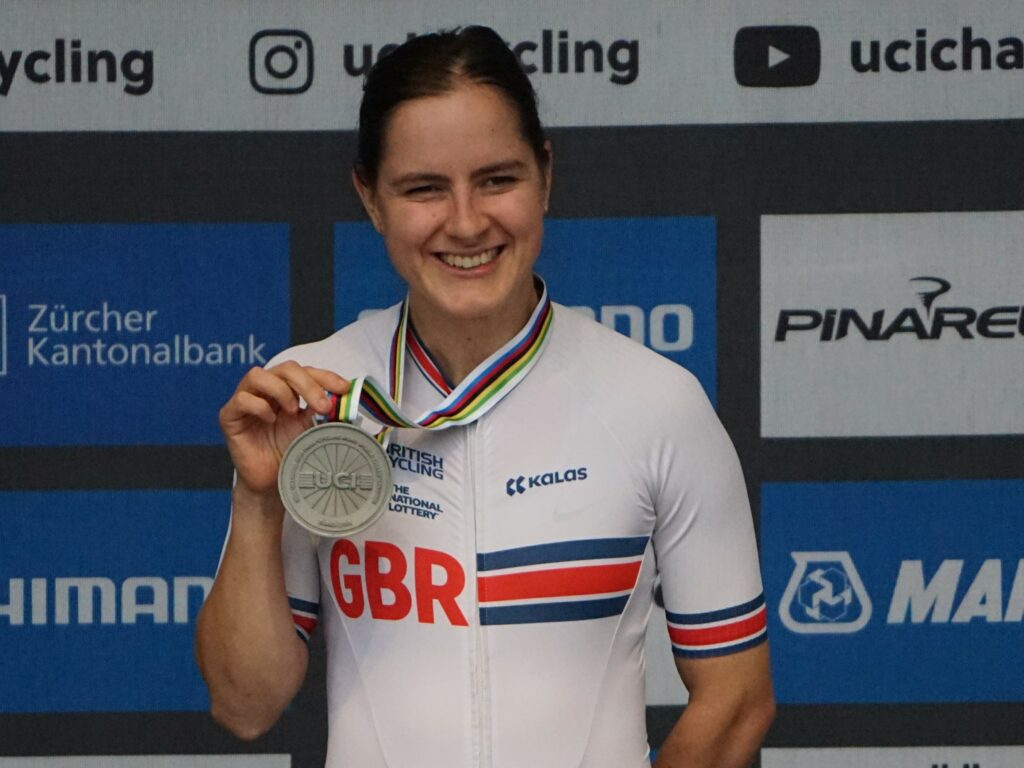

British Para-Cycling World Champion Daphne Schrager has been handed a two-year ban from competition following a lengthy anti-doping investigation that concluded she inadvertently ingested a banned substance and did not gain a performance advantage from it.
In a lengthy Instagram post published earlier today, Schrager wrote that she tested positive for Ligandrol, an anabolic agent, in June 2025, resulting in an immediate suspension from competition.
“Since then I have worked tirelessly alongside my team to investigate how this positive test occurred, and I have presented my full defence to an independent panel.
“I am glad that the Panel recognised that I have never cheated and never doped, and accepted my credibility without reservation – stating that I am a “credible individual, who had honest explanations.” That is the truth, and it is important to me that it is understood clearly and unequivocally.”
View this post on Instagram
Detailing her defence, and the “considerable personal expense” of attempting to prove her innocence, the 26-year-old said anti-doping rules still required her to serve a two year ban – backdated to the date of her positive test – because she could not identify the source of her contamination. That’s despite the UK Anti-Doping Agency (UKAD) finding the ingestion and environmental contamination were both inadvertent, and that the ingestion was not performance-enhancing or worthy of stripping results.
Schrager’s case echoes that of former pro Lizzy Banks, a two-time Giro d’Italia stage winner who retired following a lengthy legal battle after a positive test for a higher concentration of formoterol, an asthma drug, and chlortalidone, a diuretic.
After the UKAD found in Banks’ favour that the drug was detected due to inadvertent contamination, and waived her two-year ban, the World Anti-Doping Agency appealed to the Court of Arbitration for Sport, which retroactively re-imposed Banks’ suspension.
In Schrager’s case, she wrote, “By the time an athlete is informed of their positive test, too much time has passed to identify the exact source of contamination with the certainty that the rules demand.
“That is not a failure of honesty or effort, it is simply too much of a burden to be met in every case.”
Schrager, who has cerebral palsy, was inspired by the London 2012 Paralympics and initially competed in athletics as a sprinter, representing England at the 2018 Commonwealth Games. She joined British Cycling’s elite Paralympic programme the following year.
She won her first major medal at the 2021 Para-Cycling Road World Championships, when she won bronze in the C3 road race. The following year, she became world champion on the track in the C3 individual pursuit, a title she claimed for a second time two years later. She has also claimed five silver medals at major championships, including in the individual pursuit at the Paris 2024 Paralympics.
View this post on Instagram
Announcing her intention to return to competition following the expiry of her ban next summer, Schrager said, “This has been one of the most difficult periods of my life. Losing my contract, my team, and thee structure that had long shaped my purpose and identity left me facing a level of uncertainty I had never known.
“I’m deeply grateful to my family, my fiancé and my friends for their love, patience and belief in me. Their support carried me through, and I’m now able to move forward with gratitude.
“Over the past year I have lost a great deal. But I have not lost myself.”















7 thoughts on “British Paracycling world champion handed two year doping ban despite proving banned substance was taken inadvertently, ingested through contamination and not performance-enhancing”
Yet another example of the cure being worse than the ailment.
I hate the idea of letting actual cheaters off the hook, but it needs to be fair. If any doubt, it CANNOT be to the detriment of the athlete. This is people’s lifes.
@Losd You can always manufacture doubt. That’s why strict liability was brought in.
It’s the athlete’s responsibility to source food that doesn’t have steroids in it. And… that’s pretty easy to ensure, least if you live in Europe.
It’s extremely unfortunate in this case but the problem is, if the rules are any different, they’ll immediately be exploited.
Professional athletes go to incredible lengths with their nutrition and supplement purchases, to the extent that they only source from providers that do their own checking + that they keep sealed samples of the batches they purchase. For someone who doesn’t have an entire team behind him/her that’s just not feasible.
I personally know someone who got ‘caught’ and fined + suspended, also with a dose that was ‘sub physiologic concentration’ but nothing to be done. No idea about the source. 6 months later it turned out that the ‘bio’ farmer where he purchased meat got caught for having administered hormonal substances to his cattle. But nothing to be done, he had to prove that the stuff that he had ordered at the time was contaminated. All costs for analysis of course to be borne by him.
Where I am even recreational riders like myself -could never have made a living out of riding, never came even close to being good enough- are subject to tests and after a completely non-competitive gravel event that to me was strictly for fun even I got selected for testing. Strange feeling, having to pee in a cup with a guy watching. Anyway, it was negative.
@Xenophon2 Yes, strict liability exists for a reason, and as you say, professional athletes treat keeping on top of everything as part of the job, and allow time and money for them/their team to double check purchases and keep appropriate records etc.
My issue is that the punishment should reflect how plausible it was that it were an accident, as well as any theoretical advantages. They should also consider the financial position of the athlete. Someone who lives well from prize money and lucrative sponsorship deals should reasonably be expected to have more resources to protect themselves from accidental ingestion, and they’ll also be able to weather a suspension.
I’m assuming there’s not much money in paracycling, so a two year suspension is severe. I’d have thought a year more than sufficient to make a point.
I don’t understand how the authorities can say they accept the substance was ingested inadvertently when at the same time banning her for not being able to say from whence the substance came? One would have thought to prove the first proposition one would need proof of the second. Not in any way suggesting she is guilty of deliberate doping, but it doesn’t seem logical.
@Rendel Harris : cutting some corners, it’s a watered down form of strict -or rather: absolute- liability. The only thing that needs to be established is that a situation ‘x’ (such as the presence of a prohibited substance) occurred. Whether it was intentional, whether someone was negligent or not, whether the concentration was such that it could not foreseeably have had any effect….none of those things matter in the least once the objective fact has been established. The only defence that appears to be open is conclusive proof that the substance was inadvertently ingested through contaminated foodstuffs and that the defendant could not have been aware of this. That’s an almost impossible burden of proof.
@Rendel Harris It looks like UKAD exonerated her, but that wasn’t good enough for WADA, which decided that the source could not be unambiguously identified. So “the authorities” are really two authorities that disagree.