
Best turbo trainers Oct 2026
Best turbo trainers Oct 2026 (Image Credit: Farrelly Atkinson)

Looking to take your riding indoors? Here’s our selection of the best turbo trainers plus everything you need to know before buying

Make some great bang-for-buck fitness gains this winter with one of the best turbo trainers on the market
contributions from Mat Brett
UPDATED Wed, Oct 14, 2026 12:50

First Published: Oct 14, 2026

0
This article contains links to retailers. Purchases made after clicking on those links may help support road.cc by earning us a commission but all of our reviews are fully independent. Find out more about road.cc buyer’s guides.
Google icon
Add as a preferred source on Google

Thanks to the latest smart trainers and indoor training apps, choosing the turbo over riding outdoors no longer has to feel like a lonesome chore; you can ride and race with friends from all over the world. We’ve logged countless virtual miles testing a wide range of indoor trainers to ensure that we find you the best turbo trainers for this year and far beyond…
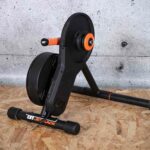
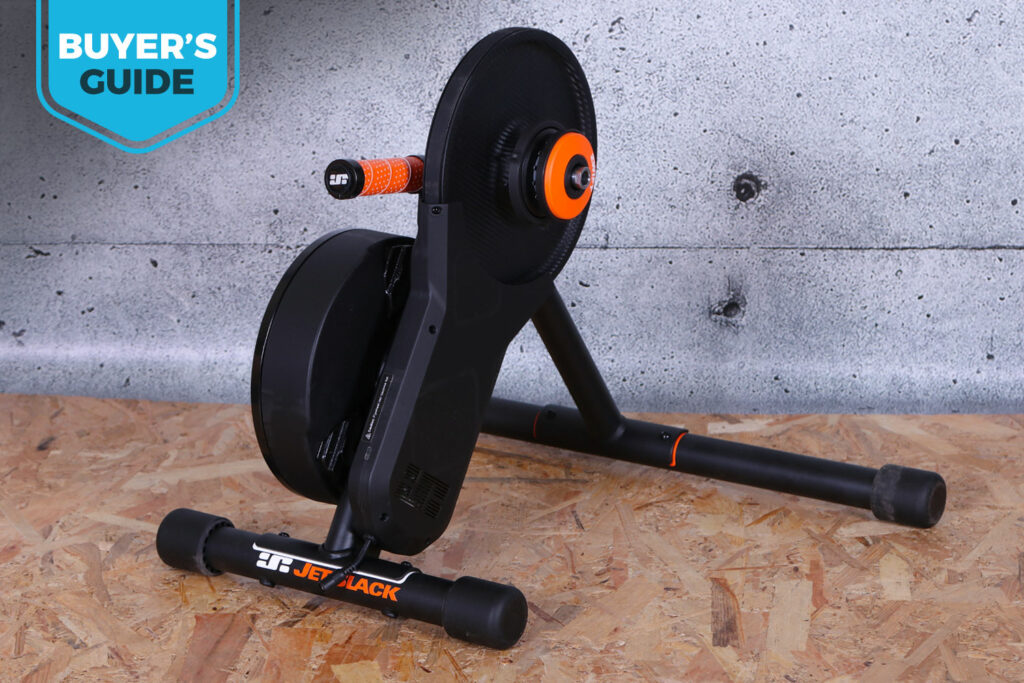
JetBlack Victory Smart Trainer with Zwift Cog and Click
Best smart trainer overall: JetBlack Victory Smart Trainer with Zwift Cog and Click
Tacx Neo 2T Smart trainer
Best money-no-object turbo trainer: Tacx Neo 2T Smart trainer
Saris Fluid2 Trainer Smart Equipped
Best basic turbo trainer on a budget: Saris Fluid2 Trainer Smart Equipped
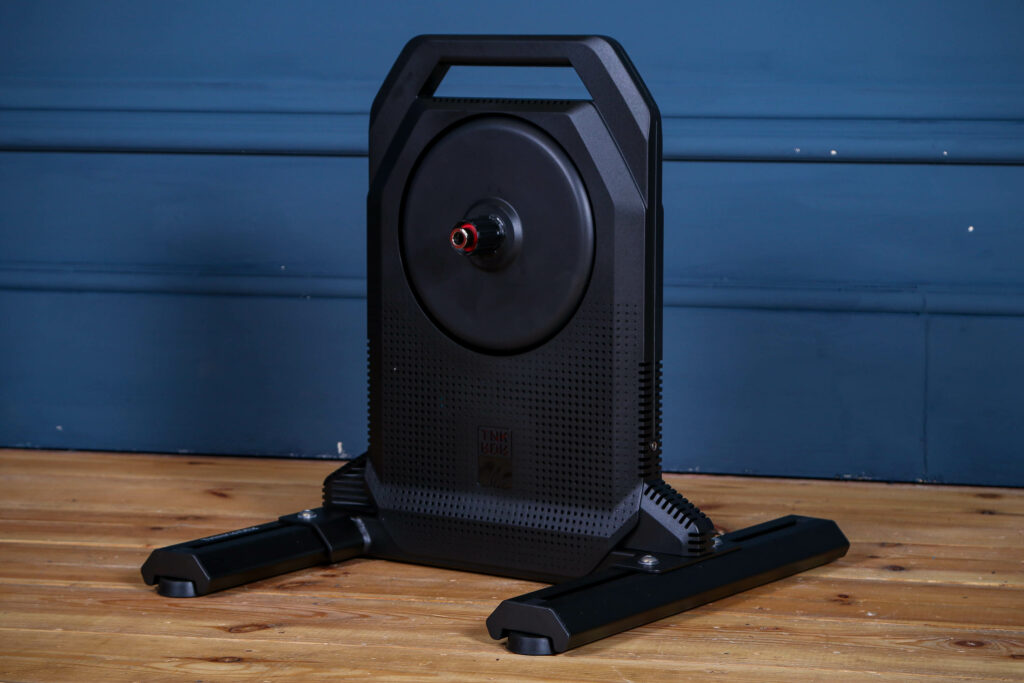
ThinkRider XXPRO Direct Drive Smart Bike Trainer
Best value smart trainer: ThinkRider XXPRO Direct Drive Smart Bike Trainer

By simulating riding outside from the comfort of your own home, a turbo trainer allows you to keep fit when the weather is unpleasant, or at times when it could be less safe, such as at night or during rush hours on the road. There’s also the time element; a lot of cyclists now incorporate indoor riding into their training year-round, because it’s time-efficient and little effort gets wasted. There are no traffic lights or dodgy drivers to contend with indoors.

In the last few years, the popularity of ‘smart’ trainers has boomed. These allow for an ANT+, Bluetooth or Wi-Fi connection to a computer, phone, tablet or Apple TV box. These allow you to control the level of pedalling resistance, expressed as your power in watts, via a built-in power meter.

If your budget is tight, you can stick with a ‘dumb’ trainer, but if you want to use a classic turbo with one of the best cycling training apps, then you will have to use your gears to alter the resistance. If the app is telling you to target a certain power or cadence zone, you’ll also have to improvise, unless you have a power meter and cadence sensor on your bike already.

Paired with useful software such as Zwift, TrainerRoad, Rouvy or others, smart trainers can be a great tool for winter training as they allow you to train to a specific power output target. The best turbo trainers can also simulate hills or put you in a virtual race or group-training session, all of which helps to make indoor training more enjoyable. Couple this technology with some of the best indoor cycling accessories like a large fan, indoor-specific clothing and a sweat catcher to protect your bike, and you’ll find indoor training enjoyable rather than the soul-destroying task it once was.

If you want a set-up that multiple people can use and adjust easily, then you might be better off looking at exercise bikes or smart bikes; but if you’re shopping for just you or are lucky enough to have space for multiple trainers in your ‘pain cave’ to keep the whole family fit, read on to see our top trainer picks…

And if you’re interested in how we choose the products to be included in this guide, have a read of this to find out how road.cc reviews products.

JetBlack Victory Smart Trainer with Zwift Cog and Click
JetBlack Victory Smart Trainer with Zwift Cog and Click (Image Credit: Farrelly Atkinson)

JetBlack Victory Smart Trainer with Zwift Cog and Click

Best smart trainer overall

Loads of connection options

Really good value

Zwift ready, but can be used on other platforms

Availability

Feet not adjustable

The JetBlack Victory proves that you don’t need to spend a fortune to get a seriously good indoor cycling setup. With high-level specs at an entry-level price, this smart trainer punches well above its weight and leaves some pricier rivals looking a little shame-faced.

The Victory works with most quick-release and thru-axle bikes and supports both virtual and traditional gears. Whether you’re building your first pain cave or upgrading an existing indoor setup, it offers the flexibility to fit around you, rather than forcing you to build your cycling life around it.

The Victory also boasts more functionality than direct competitors while undercutting them on price. That’s a pretty compelling combination: more features and no need to remortgage the house.

Unless you’re an elite athlete chasing every last performance advantage, it’s difficult to make a convincing case for spending more. Your legs won’t know the difference; your bank account, on the other hand, will.

Overall, the JetBlack Victory combines impressive functionality and broad compatibility at a bargain price. Right now, it’s the smart trainer to beat.

Tacx Neo 2T Smart trainer
Tacx Neo 2T Smart trainer (Image Credit: Farrelly Atkinson)

Tacx Neo 2T Smart trainer

Best money-no-object turbo trainer

Very accurate

Very responsive

Very quiet

Very powerful

ERG mode pretty brutal

Garmin’s Tacx Neo 2T is an exceptional trainer, and the price isn’t quite so stinging nowadays.

This very quiet trainer is a highly capable piece of equipment that’s easy to set up and to store, and has a resistance unit that’s able to simulate road surfaces by altering the resistance hundreds of times a second. It replicates a realistic riding experience on Zwift (plus many other training apps) from the comfort of your own home.

The Neo 2T has a maximum power of 2,200 watts and is highly accurate, claimed to be within +/-1%. At lower speeds, the 2T will produce powerful resistance and is also capable of very quick changes in ERG mode. Overall, it’s quiet (which your neighbours will be happy about) as well as capable.

In 2023, the NEO 2T was superseded by the Tacx Neo 3M with built-in multidirectional movement – but according to road.cc reviewers, the NEO 2T is still our favourite top-of-the-range turbo trainer. Although you can go much cheaper, the Neo 2T is a fabulous choice that offers impressive features such as sophisticated cadence sensing, the ability to power itself wirelessly, and a realistic ride feel.

Saris Fluid2 Trainer Smart Equipped
Saris Fluid2 Trainer Smart Equipped (Image Credit: Farrelly Atkinson)

Saris Fluid2 Trainer Smart Equipped

Best basic turbo trainer on a budget

Simple to use

Realistic ride feel

Clever resistance unit

Some instability out of the saddle

Instructions aren’t very clear

Although Saris trainers aren’t as easy to find as they once were in the UK, the Fluid2 is straightforward, affordable and simple: a classic wheel-on style turbo trainer which does its job very well. At under 100 quid at numerous online retailers at the time of writing, there’s little reason why you wouldn’t pick one up to use on the less than favourable winter days, unless your budget stretches a lot further, of course.

The Fluid2 uses fluid resistance, as the name suggests, which technically means there is no limit to how much resistance this trainer can handle (although it will start to feel unstable if you really sprint). There’s a handy click mechanism at the back to tell you when your tyre is properly mounted, so there’s no guesstimating involved during set up.

Although this offering from Saris is cheap, you don’t need to miss out on riding with friends or using your favourite indoor riding apps. Usefully fitted with a speed/cadence sensor, this means that the unit works with training apps like Zwift and Rouvy. Therefore, although basic, you can still enjoy some visual stimulation and motivation for a fraction of the price of other turbo trainers. That said, it isn’t as quiet as a direct drive turbo, and the simulated power reading will just be an estimate.

If what you want is a standard, simple, easy-to-use turbo trainer that is both user-friendly and much cheaper than what’s currently available on the market, the Fluid2 is a very good option. It’s basic, but it does the job and does it well.

ThinkRider XXPRO Direct Drive Smart Bike Trainer
ThinkRider XXPRO Direct Drive Smart Bike Trainer (Image Credit: Farrelly Atkinson)

ThinkRider XXPRO Direct Drive Smart Bike Trainer

Best value smart trainer

Excellent power fidelity

Ability to tweak the power to match your outdoor power meter

Self-powered option

Super value

ERG mode needs a tweak

Flashing logo light is annoying

Want a smart trainer with high-end specs but without a high-end price tag? The ThinkRider XXPRO delivers a lot of indoor cycling performance for the money and could be just what you’re after.

Setup is refreshingly straightforward: bolt on the legs, fit a cassette and plug in. That’s it. The ANT+ and Bluetooth connections work flawlessly with apps like Zwift, TrainerRoad and MyWhoosh, while the direct-drive unit is quiet, stable and impressively smooth. It’ll supposedly handle 2,500W and maximum simulated gradients up to 25%. That puts it in the top tier of trainers.

Power measurement is another highlight. Testing against Favero Assioma Pro-RS2 pedals showed excellent agreement. Cadence readings were similarly close, generally within 1rpm. In short, the ThinkRider XXPRO gives you consistent and accurate figures.

We did find that the ERG mode adjusts resistance a little too leisurely, particularly when you’re standing up to attack a hard interval. That’s not ideal when the workout demands fireworks.

That said, the XXPRO is remarkably capable at this price. It’s a proper bargain and easy to recommend if you want smart-trainer performance at a superb price.

The best of the rest

Tacx Flux S Smart Trainer
Tacx Flux S Smart Trainer (Image Credit: Farrelly Atkinson)

Tacx Flux S Smart Trainer

Quiet

Smooth ride feel

No handle

High resistance floor

The Flux S direct drive turbo is an excellent and pretty affordable smart trainer from the Garmin-owned Tacx brand. This pick in our best turbo trainers selection offers a smooth ride quality and doesn’t produce much noise at all. It’s also very accurate and offers great consistency of numbers, so it’s a great option for those wanting an indoor trainer for the colder months or to mix up their training.

Tacx claims the Flux S reads your power to an accuracy of +/- 3%. As well as that, this model can also simulate a maximum resistance of 1,500 watts, which is very reasonable and good enough for most riders and their training needs. Additionally, the Flux S can simulate a climb of up to 10%.

Overall, the Tacx Flux S smart trainer is a solid option for training purposes. It’s easy to set up and connect to your other devices, but the maximum resistance offered is a little lower than other direct drives. Also, it does notably struggle to deliver lower levels of resistance. But for the price, it’s a great option.

Wahoo Kickr Smart Trainer v6
Wahoo Kickr Smart Trainer v6 (Image Credit: Farrelly Atkinson)

Wahoo Kickr Smart Trainer v6

Standard 11-speed cassette

Wi-Fi connectivity

Easy to set up

Super-accurate power

Realistic ride feel

Kickr Direct Connect is not included

Higher price than before

Wahoo’s Kickr was already one of the best smart trainers you could buy in its previous iterations, and the latest version has been upgraded again with Wi-Fi connectivity and a more refined ERG mode.

The ride feel is high quality, it’s highly accurate with power accuracy a claimed +/-1%, and not even world-class sprinters will trouble its wattage ceiling at a huge 2,200 watts. The Wi-Fi connection is claimed to be 65% faster than Bluetooth or ANT+, so if you race on indoor training platforms like Zwift, it’s among the best on the market for ensuring nothing cuts out mid-event.

This is the Rolls-Royce of turbo trainers according to our reviewer, who added: “If you want to elevate your Zwift racing experience and ensure your connection is rock-solid and stays uninterrupted, there’s nothing quite like the immersive experience offered by the Wahoo Kickr v6 smart trainer.”

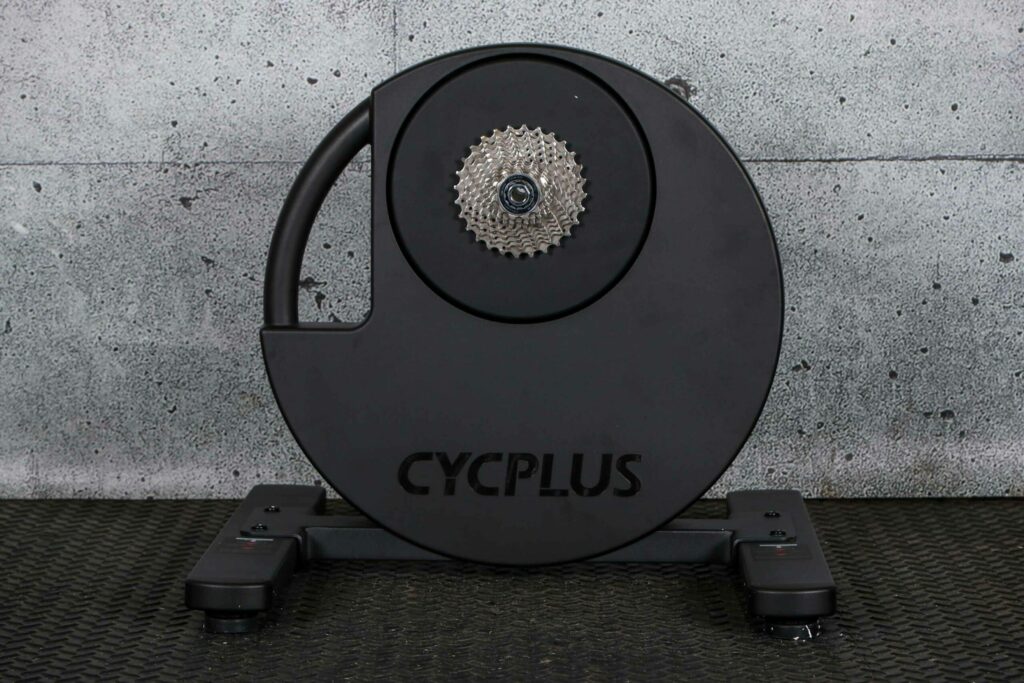
Cycplus R200 Smart Trainer
Cycplus R200 Smart Trainer (Image Credit: Farrelly Atkinson)

Cycplus R200 Smart Trainer

Great performance for the price

(Relatively) light and compact

Accurate on power readings

Good levels of resistance

Can work without mains power

Doesn’t come with a cassette

The Cycplus R200 is a compact and highly effective self-powered smart trainer that works as well in the home as it does in a car park for pre-race warm-ups. It weighs far less than most ‘wheel off’ options and yet is stable. In fact, the performance is really impressive throughout.

Setup is straightforward, although you’ll need to supply your own Shimano HG cassette (you can swap the freehub if you run SRAM XDR, although Campagnolo and Shimano Micro Spline aren’t supported). Once assembled, the R200 is impressively fuss-free, working easily with Zwift, TrainerRoad and other training platforms. You even get a two-month Rouvy subscription.

Cycplus claims power accuracy of ±1% and a 2,200-watt maximum. Our testing against Favero power pedals showed readings generally within 1-2%, with minimal lag. Gradient simulation goes up to 18%, and a handlebar-mounted Bluetooth controller delivers instant virtual gear changes. Perhaps best of all, the R200 can run without mains power, so outdoor warm-ups are entirely possible.

The H-shaped stand provides excellent stability without taking up too much space, and noise levels are reasonable at moderate efforts, although the flywheel does get louder when the resistance rises.

There were niggles: the companion app wouldn’t connect to a Wahoo TrackR heart-rate monitor, and the plastic leg endcaps proved vulnerable to clumsy dismounts. Still, these are minor grumbles considering the price.

Compact, accurate, robust and remarkably affordable, the R200 is an outstanding budget smart trainer.

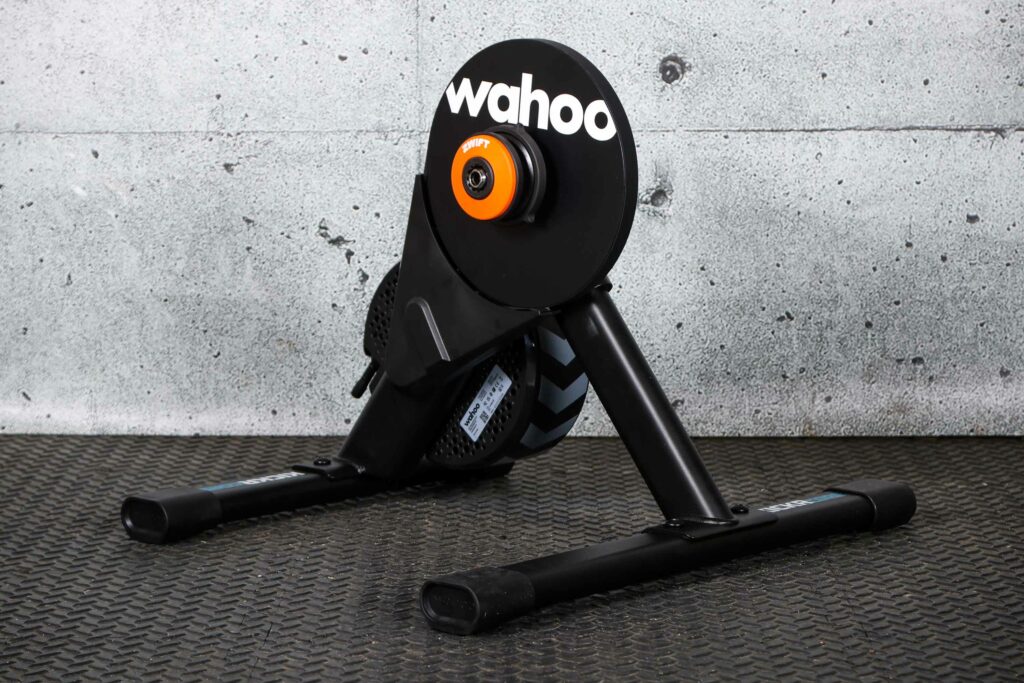
Wahoo Kickr Core 2 trainer
Wahoo Kickr Core 2 with Zwift Cog and Click (Image Credit: Farrelly Atkinson)

Wahoo Kickr Core 2 with Zwift Cog and Click

Accurate reading

Excellent Race Mode performance

Good price

Seamless virtual shifting

ERG mode lag

Poor Wahoo app performance

Unstable under maximum efforts

The Wahoo Kickr Core 2 comes with practical updates that could make it the most popular trainer on the market, although our reviewer found the performance compromised by software bugs and a few flaws.

The latest Kickr Core brings Race Mode, integrated Wi-Fi, LED status lights and redesigned legs, while the Zwift Cog and Click version we reviewed adds fuss-free virtual shifting. Setup is simple, with the trainer assembled in minutes, but getting connected wasn’t as straightforward, with app dropouts and firmware updates causing frustration.

Once up and running, things improve considerably. Virtual shifting is smooth while Race Mode delivers snappy responses to power changes. We found power accuracy to be extremely good, averaging within 1W of the dual-sided 4iiii integrated power meter we compared it with, and cadence readings are similarly impressive.

There are caveats, though. Bluetooth connectivity wasn’t the most reliable, with heart-rate and Zwift Clik connections dropping out. ERG mode occasionally lagged behind target power, and the legs allowed some unwanted rocking during sprints.

The price is competitive, but the £399 JetBlack Victory offers similar headline features and arguably better value.

Overall, the Kickr Core 2 is a capable, accurate indoor trainer with useful upgrades. Sort out the software gremlins and it could be a winner.

How to choose from the best turbo trainers

Is it worth getting a turbo trainer?

Turbo trainers are definitely a piece of equipment that is worth investing in for many different reasons. First and foremost, having one allows you to ride your bike even when the weather outside is unsuitable for riding, such as snow or ice. Moreover, they also offer variation in your training and riding experience, which can be a brilliant way to help break up training and keep you motivated and focused. Similarly, smart turbo trainers allow you to ride with friends all over the world, thanks to apps such as Zwift.

What are the main features of turbo trainers?

Perhaps the most basic thing you need to know is that there are broadly two physical types of turbo trainers: wheel-on and direct-drive. A wheel-on trainer has a mechanism that clamps your bike at the rear, usually by the quick-release; your rear wheel then drives a roller attached to a resistance unit. With a direct-drive trainer, you remove your bike’s rear wheel and the chain drives sprockets on the trainer. That drives the resistance unit and a big flywheel, surrounded by a plastic shell to keep out fingers and paws.

All turbo trainers have a frame that supports you and your bike. Some trainers are sturdier than others, but trainers from specialist brands are all pretty solid. A larger footprint and heavier frame will ensure it’s more stable, which you want if you’re doing maximum-effort intervals.

Space can be a premium in many households and many turbos fold flat, but how much space they take up when folded down differs greatly from brand to brand. Many trainers have adjustable legs or feet, so you can ensure you get the trainer perfectly level on uneven floors.

A wheel-on turbo fixes to the quick release of the rear wheel, and often a quick release is supplied with the turbo that is specifically compatible with the model. A cam locking system adjusts two cones that clamp around the skewer. The better models get ergonomic levers that make setting up a breeze. Most trainers also accommodate various sizes of wheels, and some feature a latch to bring the roller up against the wheel, saving you from having to set the roller each time you begin a session.

Direct drive trainers allow you to fit your bike to the trainer; most come with the necessary hardware to fit either quick release or through-axle frames.

What is a smart trainer?

Trainers can briefly be divided into smart and non-smart options. Smart trainers can be controlled by apps like Zwift, so you can ride in virtual worlds or follow precise training sessions, while non-smart trainers usually just have variable mechanical resistance with no electronic control. Smart trainers have become far and away the most popular variety in the last few years and are our pick if you’re serious about using a turbo trainer as part of your fitness program.

A standard turbo trainer has a stand to support your bike and a resistance unit driven by the rear tyre or chain. In a smart trainer the resistance unit has built-in electronics that transmit your speed to an ANT+-capable device and receive instructions from the device to set the resistance you’re working against. Smart trainers usually include power meters so you can train by that metric too.

How do I choose a smart turbo trainer?

If you are unsure which turbo trainer is the best for you and your needs as a rider, it’s a good idea to first start with a rough idea of your budget: this allows you to focus your search on the best turbo trainers in your price range, as they can get rather pricey. You should also consider what features you would like. For example, you may only be looking for a direct drive turbo trainer. But in general, as with many things, the more expensive the turbo, the more features and abilities it will possess.

Can you put any bike on a turbo trainer?

You can attach most bikes to most turbo trainers. However, compatibility can vary, and you may need an adaptor depending on the bike and trainer. For example, the mounting system will differ depending on whether your bike uses a quick-release skewer or a thru-axle to secure the rear wheel. It’s therefore important to check that your bike is compatible with your turbo trainer and that you have the correct adaptors.

Do you use gears on a turbo trainer?

This depends on what type of trainer you have and its capabilities; but generally, unless you’re using ERG mode on a smart trainer, it’s a good idea to change gears when using the turbo to alter your resistance and cadence.

We’ll deal with smart trainers first. These sophisticated trainers try to replicate the outdoor riding experience from the comfort of your own home, and if this is what you want, then it’s useful to practise your outside riding habits like changing gear. If you want to take part in virtual cycling events like Zwift races, you’ll need to use your gears to react to changes in gradient or catch breaks, so it’s just as important that your gears are shifting properly indoors as outdoors.

If you simply want to ride to a target power or do virtual training sessions, then pretty much all modern smart trainers offer an ERG mode. We go into far more detail in our ERG mode feature, but essentially this tells the trainer what resistance to feed in regardless of what actual gear you are in. This means whether you’re on the very hardest gear or the very smallest, if your session demands an interval where you have to ride at 250 watts, you will be riding at 250 watts no matter what. As ERG mode takes a split second or so to react and change your resistance level, it might be best to turn it off and stick to gear shifting if your session demands very explosive efforts.

For non-smart trainers, you have to change gear to alter your resistance level, so make sure your bike is shifting properly as you usually would.

Do turbo trainers damage your tyres?

If you are looking to buy a direct-drive, wheel-off smart trainer like most options in this guide, then you can skip this part, because there are no tyres attached to the trainer. You simply take the rear wheel off, and ride using the cassette that’s fitted to the trainer.

However, if your trainer is a more ‘traditional’ model where the back wheel spins against a resistance unit, then you should expect a certain amount of wear due to the build-up of heat between the tyre and the roller.

Because rolling resistance is not an issue when riding indoors, it’s best to get an indoor turbo trainer tyre that is made specifically to deal with heat generated from your turbo, and is extra durable to stop it wearing down too fast. Generally, they’re inexpensive and could last you thousands of virtual miles, with the Halfords Essentials Turbo Trainer Tyre costing just £15 as one example. You’ll want to pump it up to a higher pressure than you usually would with outdoor tyres (at least 100 psi) and top the air up regularly.

What is ANT+?

For a fully smart, controllable trainer, the function to look for is ANT+ FE-C capability. ANT+ is a wireless communication protocol, as used for speed sensors, heart rate monitors and other fitness gadgets. FE-C stands for Fitness Equipment Control and the clue’s in the name: it’s a set of commands over ANT+ that, well, control fitness equipment such as turbo trainers.

Smart trainers can also use Bluetooth to communicate with the controlling device, which is handy if you’re using a laptop, say, because you don’t need an additional ANT+ dongle. However, we’d always recommend buying an additional ANT+ sensor to plug in via USB, because it’s a superior connection for fitness equipment. We’ve heard of riders’ virtual training sessions cutting out mid-ride when using a patchy Bluetooth connection, which can be mighty frustrating when you just want to get it done. An ANT+ connection will make the likelihood of this happening minimal.

Jack is group editor across road.cc, off.road.cc and ebiketips, overseeing all three sites in the F-At Digital group to make sure everything’s up to scratch. He’s been writing about cycling and multisport for over a decade, arriving at road.cc via 220 Triathlon Magazine in 2017. He worked across all areas of road.cc including tech, news and video, and also contributed to ebiketips before being named editor of road.cc in 2021 (much to his surprise). Jack has been hooked on cycling since his student days, and currently has a Trek 1.2 for winter riding, a beloved Bickerton folding bike for getting around town, and an extra beloved custom Ridley Helium SLX for fantasising about going fast in his stable. Jack has never won a bike race, but does have a master’s degree in print journalism, and two Guinness World Records for pogo sticking (it’s a long story).  

No Comments

Leave a Comment


Read more...

Read more...

Read more...