


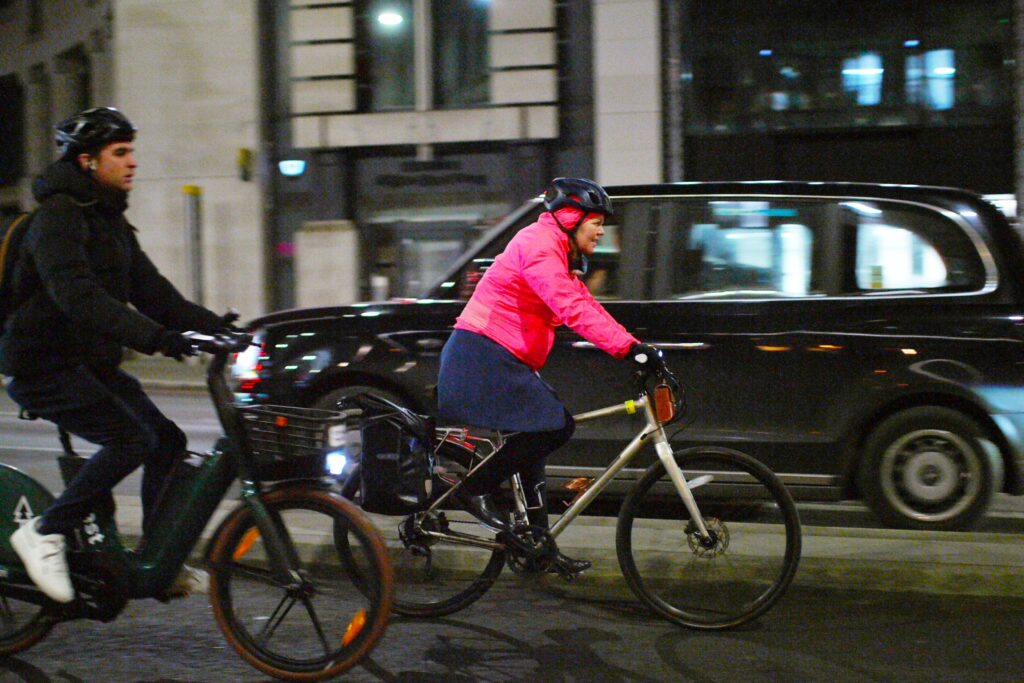

"Lower speeds save lives": Cycling campaigns urge government to "hold their nerve" on 20mph speed limits

Cycling UK and Cardiff Cycle City have urged the government to stick with 20mph speed limits, after Transport Secretary Mark Harper yesterday said the speed limit zones should “only be used in the right places” and that “it must be frustrating for those Welsh drivers ignored by Labour and for Welsh taxpayers who have to pick up the bill”.
That reaction came after Ken Skates, Wales’ new transport minister, had suggested there will be “changes” on the default 20mph speed limit policy.
Gwenda Owen from Cycling UK said: “The Welsh Government’s own survey showed that four out of five adults in Wales would support a 20mph speed limit in their neighbourhoods. Clearly the vast majority of people recognise slower speeds are good for communities, the environment and the wellbeing of children. It’s also the right move to increase the appeal of healthier alternatives to driving.
“Lower speeds save lives, and 20mph is a reasonable expectation where people live, work and play, not just outside schools and hospitals. The reality is, children, older people and other vulnerable groups aren’t tethered to single stretches of road outside schools and hospitals. If we enable more people to travel by bike and foot, they need to feel safe doing so. Lower speed limits are an important part of creating towns and cities where people have real choices in the way they travel.
“Local authorities are able to make exceptions to the default 20mph in line with set criteria. However, we recognise that there have been differences in the way some councils have applied the criteria and welcome the review of the guidance. The Welsh Government did the right thing, rather than the easy thing, in introducing the 20mph default, and we’re urging Ministers to hold their nerve for the good of Welsh communities.”
Likewise, Cardiff Cycle City released a statement asking the Welsh Government to “stand firm on 20mph” and stating that the campaign was left “disappointed and alarmed” by Skates’ assertion that there would be changes to the 20mph policy.
“In our view, there is no need to change the policy,” a statement said. “Local authorities already have the power to adjust speed limits where appropriate. It appears that Mr Skates has succumbed to pressure from a tiny but vocal political minority. We hope that he will put people before politics and leave this popular and effective policy in place, safeguarding the health and wellbeing of all members of our communities.”
Cardiff Cycle City statement in response to @KenSkatesMS recent announcement on the 20mph policy. pic.twitter.com/LQemrgfpOz
— Cardiff Cycle City | Dinas Feicio Caerdydd (@CdffCycleCity) April 18, 2024
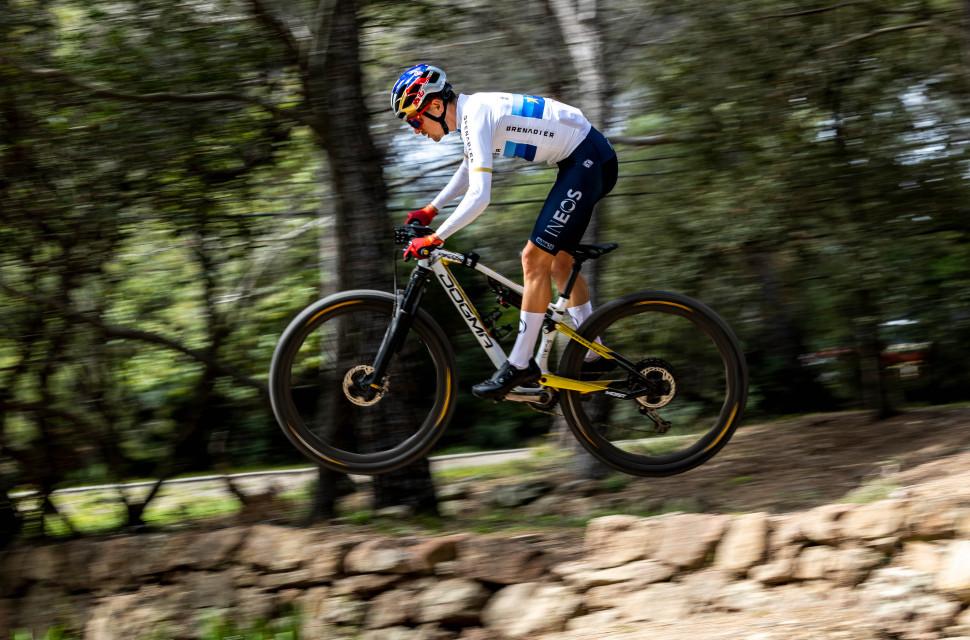
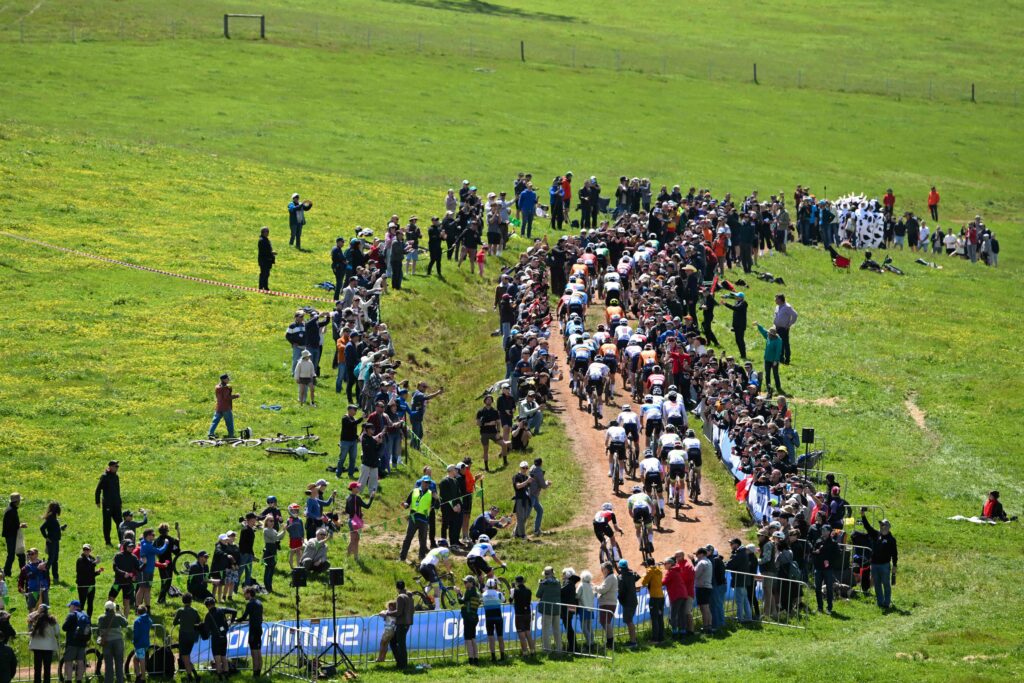
Pinarello marks its return to cross-country mountain biking with the Dogma XC
Our mates over at off-road.cc have everything you need to know about Pinarello returning to the cross-country mountain bike scene, officially unveiling the Dogma XC after its race-winning appearances in 2023 under Tom Pidcock and Pauline Ferrand-Prévot.
> Pinarello marks its return to cross-country mountain biking with the Dogma XC
Described by Liam as “cross-country mountain biking’s worst-kept secret”, given its high-profile appearances last year. He also got the chance to take the bike for a spin and gives all his thoughts in a first ride review.
"They were very happy with that": Tom Boonen bribed Qatari customs agents with nude magazines

A bizarre story next. Classics legend Tom Boonen has revealed how at the 2004 Tour of Qatar he got into (and out of) trouble due to some nude magazines at the airport. Speaking to Sporza’s Wielerclub Wattage podcast, Boonen explained that due to dodgy hotel internet, he and his teammates often bought magazines of a certain genre at Brussels airport to keep them company when away from home.
“Before the flight to Qatar I bought a car magazine, the P-magazine, a Ché, a Playboy and some other booklets,” Boonen said (we’ll look past the strange amount of detail for a 20-year-old shopping haul). “When we landed in Qatar, we had to wait a while for the luggage. I had left my backpack with magazines with the teammates and was waiting at the baggage carousel.

“Nick Nuyens wouldn’t have thought of anything better than taking one out of my backpack and leafing through it. I already had an idea that the customs officers were watching us. At a certain point I saw one of those customs officers say to a fellow customs officer: ‘Those men are looking at a book and there are naked women in it’.”
Threatened with punishment for the magazines, Boonen says it suddenly dawned on him that a mutually beneficial agreement could be found… “Those customs officers accepted those magazines and were very happy with them,” he explained.
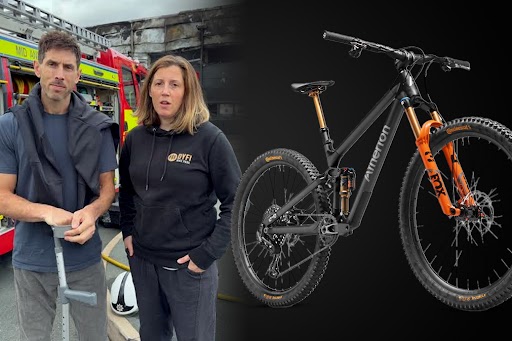
Kona Bicycle's parent company appoints new CFO amidst fears of "cost-cutting measures" after brand pulled out of major cycle show at last minute

The topic of yesterday’s company “town hall” meeting remains unknown…
QOM (Queen of the Maternity Ward)
thinking about this woman who recorded this as a workout on strava pic.twitter.com/i0Z2bjVI3C
— “paula” (@paularambles) April 19, 2024
Hit-and-run driver without licence who left cyclist with multiple injuries jailed for a year and disqualified from driving for four years
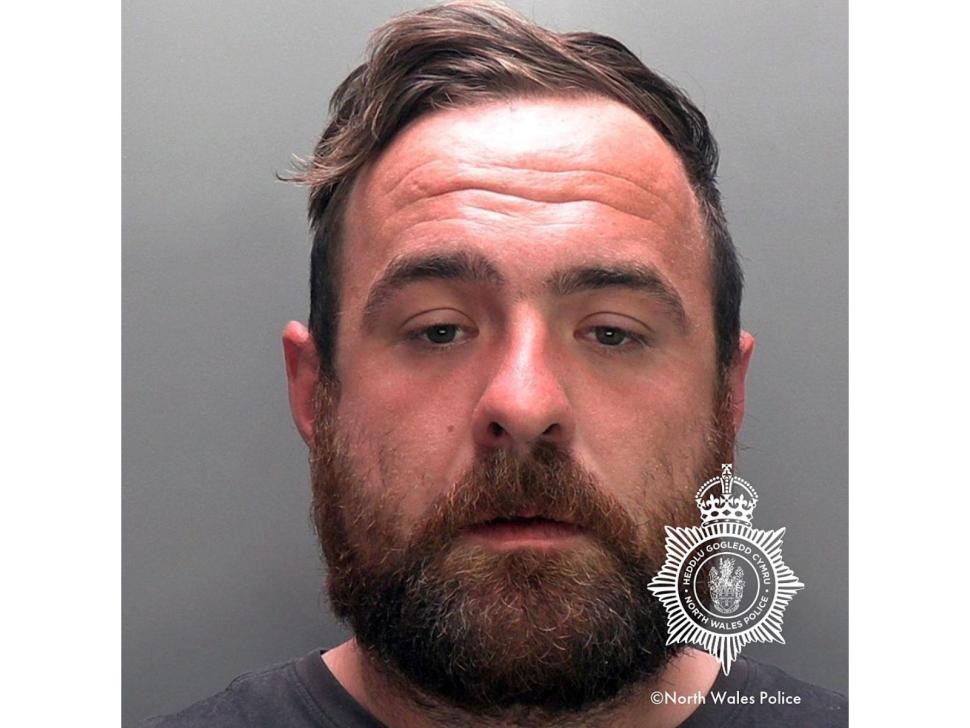
The cyclist suffered multiple fractures and other injuries, and died nine months after he was hit by the driver who already had six previous convictions for 16 offences. Read more…
"This is one of the very worst storylines Neighbours has ever run": Australian soap horrifies viewers with cyclist "serial pooper" plot
On to the day’s biggest news story. Neighbours, the Australian soap which returned to screens last year, has horrified its viewers with an ongoing plot about a man who can’t control his bowels when cycling. I hope you’ve finished your lunch…
Could Karl really be the serial pooper? 💩 pic.twitter.com/8ikQ5bYnfe
— Neighbours (@neighbours) April 18, 2024
Apparently the plot is inspired by the real-life “poo jogger” case that News.com.au claims gripped the country in 2018. Anyway, apparently someone is covering the lawns of Erinsborough and the community is shocked. Someone on the writing team’s surely just a huge pro cycling fan, right?
The plot hasn’t gone down well with Neighbours fans, the show inundated with comments about it being “disgusting”.
“This is one of the very worst storylines Neighbours has ever run. Just disgusting,” one said.
“This was funny the first time, but just gross now, as a Dr he would know the health implications of doing this in public places,” another said.
You're completing an indoor trainer session when... thousands of football fans spot your efforts...
Excellent pic.twitter.com/iTmW3rQbgL
— Nooruddean (@BeardedGenius) April 19, 2024
Bianchi presents the cycling world an "unprecedented experience"... to view a holographic Specialissima RC model with Apple Vision Pro headset
We’re sensing a good ol’ caption contest…
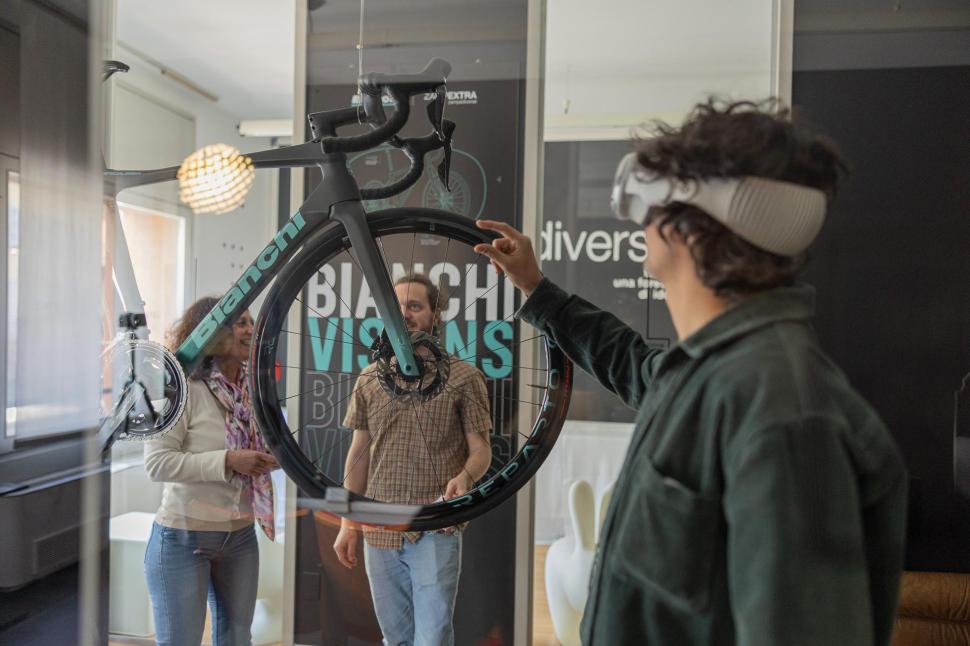
As part of Milan Design Week, Bianchi has offered the cycling world (or those in striking distance of the Italian city, at least) an “unprecedented experience” to view its Specialissima RC road bike in holgraphic form through the power of the Apple Vision Pro headset.
Bianchi says it allows viewers to see a visualisation of the complete bicycle in 3D, “even exploding into its components set in the physical space where the visitor is located”. On a completely tangental non-cycling point, if anyone fancies a Friday laugh, look up that time Ronnie O’Sullivan tried to play virtual reality pool with a headset like that. You can’t lean on the table, Ronnie, it doesn’t exist. Anyway, back to cycling…
“Bianchi’s vision is constantly focused on the future and seeks to integrate the most innovative technologies,” explained Claudio Masnata, marketing and communications manager at Bianchi. “Thanks to the collaboration with Zampediverse in this experiment, we can reduce the boundary between physical and digital spaces by offering an experience that didn’t exist before and by laying the groundwork for new product presentation methods.”
Happy Friday!
It’s the weekend…

Reaction to BBC Radio 4 AntiSocial... "Should cyclists stay in their lane?"
For those of you who weren’t able to tune in, BBC Radio 4’s AntiSocial episode looking at cycling (and questionably titled “Should cyclists stay in their lane?”) at least delivered on its promise to avoid being a slanging match, the at-length format and calm discussion instantly improving the usual ‘five-minute no holds barred shouting contest’ for cycling-related discussions on TV or radio.
Lauren O’Brien represented the cycling side of the discussion, earning praise from those who listened for her patient explanations about why a cyclist might not use a cycle lane, how cycling could be made safer and various other topics. One listener concluding she “pretty much had a monopoly on being reasonable in that discussion”.
The show also heard from James Woudhuysen, a journalist and visiting professor at London South Bank University. Among other things, he urged for greater Highway Code knowledge and viewing all road users in a more humanising way, rather than through respective transport tribes. Admittedly, those points came around plenty of unchallenged “war on the motorist” claims, an assertion that “snooping” camera cyclists are “very dangerous for the whole fabric of society”, comments about empty cycle lanes, and a bizarre anecdote about having “nearly been run over by lots of women in very tight Lycra [… but] nobody complains about their testosterone”.
That last one earned pushback from host Adam Fleming about why what they were wearing is relevant. Again, in fairness, Fleming was quick to question some of the claims made and the show was interspersed with a lawyer explaining the 2022 changes to the Highway Code, an academic giving a history of cycling in Britain, and stats from a producer. There was certainly far more work and research than your standard Good Morning Britain or Talk TV cycling segment that we’re all too familiar with by now, but did it go far enough? Here’s some of the early reaction…
I thought you did very well and was disappointed that your debating partner was allowed to get away with generalisations, straw man arguments and untruths without challenge.
I think if @adamfleming wants to have these type of people on he should be prepared to challenge them.— Cllr Liam Calvert 💚 (@LiamCalvert) April 19, 2024
noblecyclist: “Please challenge this guy when he mentions the fictitious ‘war on cars’. There is no war on cars.”
> ‘The War on the Motorist’ deconstructed — looking at the truth behind the myths
Plenty of discussion around the multiple minutes spent questioning why cyclists might not use a cycle lane…
Ian Cumming: “Why might I not be in a cycle lane? It may be strewn with litter, obstacles, or busy with slower cyclists and/or pedestrians. Given that I ride at 20-30mph and sometimes faster — the road seems like the safest and most considerate place for me to be.”
#BBCAntisocial @adamfleming
Why don’t cyclists use cycle lanes? pic.twitter.com/zXWDEwuDXr— Drew (@drewsnx) April 19, 2024
Not great feedback for guest selection (although we’re yet to see a complaint about one of the guests… no prizes for guessing)
Chris Whear: “Who is the guy, James? He is arrogant and biased. As a driver of over 50 years the last 10 have seen terrible driving standards and rage from car drivers (and some other groups) towards all road users. If he doesn’t see that they [cyclists] are vulnerable there’s no hope!!”
#bbcAntisocial
This man is ridiculous.— Bjbrightwell (@bjbrightwell) April 19, 2024
And before I forget, a bit more reaction to that title, cycling campaigner Ruth Mayorcas calling it “utterly disgraceful”.
“Every day my life is at risk from drivers who simply do not understand cycling as utility/modus operandi — and this simply compounds it,” she said. “Why don’t you get some lived experience @simontulett (one of the show’s producers) and come cycle with me?”
Anyone get a chance to listen in? What were your thoughts? Better than the usual ‘broadcast media does cycling’ fare, but what did you think? The full episode is available here…
BBC under fire over programme about "how best to share" the roads, titled... "Should cyclists stay in their lane?"
At 12pm on BBC Radio 4 is the latest episode of ‘AntiSocial’ with Adam Fleming, a show that is self-professed “peace talks for the culture wars”.
“In an era of polarisation, propaganda and pile-ons, Adam Fleming helps you work out what the arguments are really about,” the BBC’s website promo explains. Today, the topic is — yep, you guessed it — cyclists, a producer for the show suggesting it will be about “the debate between cyclists and motorists on how best to share” the roads. So, what is this “peace talks for the culture wars” episode called then? Erm… *checks and double checks notes*… “Should cyclists stay in their lane?”
In more detail, the episode description adds: “Cyclists shaming drivers online, fights over bike lanes, and the politics of pedal power.
“TV and radio presenter Jeremy Vine posts a video of a car failing to give way to him while he’s riding a penny farthing. Cue angry comments hurling insults and telling him he’d be safer in a car — and sympathetic responses from fellow cyclists. What does the Highway Code actually say about priorities on the roads? What are the stats on cyclists and safety? And how and why has cycling become such a toxic topic?”
Unsurprisingly, the title of the episode has raised some eyebrows this morning (as has the producer’s numerous messages to a wide array of potential guests, from anonymous anti-LTN (low-traffic neighbourhood) social media accounts to newspaper columnists responsible for such an award-worthy anti-cycling bingo full house as the one below…)
Earlier this week, we accepted an invitation to go on the show, an invitation that has since gone cold. But don’t fear, live blog readers, thankfully, we were promised the show aims to take a step back to explore the facts, the context, and the differing views in detail, all in the hope of cooling things down, and is the opposite of the shout-y slanging matches often seen elsewhere during cycling discussions. We’ve got high hopes…
In fairness, during the social media dissection of the title, the Richmond coordinator for the London Cycling Campaign, Tim Lennon, said he’s listened to the show before and it does tend to be a “pointing out the actual facts, rather than just being a two sides thing”, so who knows? Maybe we will all be quite impressed come 1pm.
For now however, much of the online discussion is about the episode name, The Ranty Highwayman calling it “unhealthy” and “the type of show that gets people hurt on the roads”.
Not just Charlotte, he’s also reached out to well known anti ltner thefox. Just the title alone shows there’s zero attempt at proper reporting around this. pic.twitter.com/1kv4VcePNb
— CykelTony (@tony_eh) April 19, 2024
We’ve been here before with cycling coverage on the BBC and how it’s communicated with a title. Back in November 2022, Panorama aired an episode, which despite doing a good job of showing just how vulnerable people riding bikes can be, was called “Road Rage: Cars v Bikes”, something the presenter we spoke to at-length during and after filming explained was a decision out of their hands, made pre-broadcast.
Some of that TV offering was actually solid enough, so maybe we’ll be back in the same position later today with “Should cyclists stay in their lane?”. Either way, from what we’ve seen people saying online, hopes aren’t high.











70 thoughts on “BBC under fire over programme about “how best to share” the roads, titled… “Should cyclists stay in their lane?”; Cycling campaigns urge government to “hold their nerve” on 20mph speed limits + more on the live blog”
20 MPH outside schools and
20 MPH outside schools and hospitals.
Question: Where are children and poeple that go to hospital, when they are not in school or crossing the road to the hospital?
Answer: They use all the other roads / pavements not outsire schools and hospitals
Quite so, which is why our
Quite so, which is why our village 20mph zone covers the whole residential extent.
Of course, enforcement is another thing..
Yes, this “outside schools
Yes, this “outside schools and hospitals” is so stupid it beggars belief…
I don’t agree with 20mph
I’m not sure I do agree with 20mph outside schools; they used to just have flashing lights saying ‘slow’. If you do have a 20 limit past a school, at least make it part-time; otherwise, you have a limit that changes at other times for no reason. The more that limits change for no apparent reason or in arbitrary locations, the more likely drivers are to dismiss them as irrelevant or not even notice them. If you don’t know when to slow down past a school, you shouldn’t be driving.
I’ve driven past schools at school times before, and even doing 20 quite naturally does not feel safe. There’s lots of kids about, lots of pedestrian activity, and many parked cars blocking my view. I could then drive past the same spot late at night at 30mph.
If I were assessing someone who drove past a school at school times at 30mph, that would be a major driving test fault and an instant failure. If the same person drove past that school late at night at 20mph and held up traffic, that would also be a major fault and an instant failure.
You have never been able to drive 30mph, bowl over a child then claim in court ‘I wasn’t speeding’. The same could be said for any narrow side street lined with parked cars; try doing 30 down there if you dare. Anyone doing that would fail a driving test also.
There used to be far more emphasis on better driver behaviour and not a drive-by-numbers mentality. Could you drive safely if your speedo broke? The fastest speed you can go varies widely; speed limits are meant to assume ideal conditions, and this is why there are reckless and dangerous driving laws on top of speed limits. If people aren’t able to judge their speed correctly for the conditions, don’t give them the licence in the first place.
ajuk.uk [at] gmail.com wrote:
You do know that 20 is the upper limit? You don’t have to drive at 20 if the environment doesn’t feel safe at that speed…
brooksby wrote:
I remember my motorcycle instructor doing a ride review with me and saying, “We got to that school zone with a 20mph limit, you went down to 19…” “Yes,” I said, thinking I was going to be praised for awareness and doing the right thing. “It’s literally a hundred metres, why not go down to 10/12 mph for a few seconds?” Twenty-five years ago but never forgotten it.
With speed limits it’s the
With speed limits it’s the “anchoring effect” – so they become targets!
I think this illustrates a common heuristic of “law abiding” – ultimately not limited to driving of course. Something like:
“obviously I wouldn’t break laws for the sake of it but it would be weird to be pedantic about things like speed limits. After all ‘everyone does it’ and 99% of the time it’s fine. I’m a good driver, after all. So I ease off a bit if I see the kids outside the school – but mostly they’re not so why not crack on? As long as it’s not ‘taking the piss’ like doing a ton on a motorway, or too far above 40/30 mph in a 30/20 zone (I do try to keep up but you can’t blame yourself if you occasionally get distracted) or going through a red light once it’s ‘established’…”
Also “…but holding up
Also “…but holding up traffic“. “Don’t hold up traffic” almost seems to be an axiom in the UK! There are technical reasons for questioning this of course (e.g. the phenomenon of induced demand. Make more space to avoid the traffic holding up the traffic, get more traffic). However I think choosing lower speeds in some places is more of a value choice.
That is – bringing down speed limits (and – as has been measured – often speeds) in certain places allows for several things. (Which may require additional measures of course – but would be much more difficult or not be possible without reduced motor traffic speeds). “Nicer places” as well as safer streets, plus less suppression of active travel etc. [1] [2].
However the counter argument (apologies – I’m simplifying this) certainly applies a direct calculation “if minute is worth x pounds, thus delaying y drivers by z minutes costs money – and more money that what we calculate we’re saving in terms of the cost of road casualties”.
On your last point – ain’t
On your last point – ain’t that just the problem? Mass motoring means we’re effectively letting people who are not suitable drivers in. Or – to be fairer – a one-off test is no guarantee of continued competent, safe driving. Especially not over a lifetime!
I happen to think it’s probably easier to engineer out issues rather than raising the average skill level (and more importantly – average concentration / alertness) of all drivers. (I think we agree on this in regards to speed limits and road design). Unfortunately that will take us a very long time to do! But in the mean time, if some psychological hack can be shown to make things safer and (slightly) more pleasant (like just reducing a number – because people see those as targets) why not?
Many people already drive like their speedo broke. I simply don’t think changing from a pretty arbitrary 30 to 20 (after a period for adjustment, because “change!”) will bring about the end of civilisation given that people pay any notice to speed limits. Which they mostly do! Albeit they clearly don’t think the “maximum” part is very important (almost like they consider them targets), nor the concept of “drive to the conditions”.
The misconception here is
The misconception here is that people drive at 30 because they’re used to it, 30mph is the speed most people would not significantly exceed in urban areas in the absence of a speed limit, most people want to not crash or run people over and drive accordingly.
People defaut to the speed they feel safe driving, and that’s more down to how our brains work rather than due a wilful desire not to follow the law.
That’s also why there’s some generous urban 40 limit roads with average speeds barely over 30mph. It works both ways, you can tell drivers they can go faster, and they still don’t.
This is not to say dropping speed limits can’t make a difference, for what difference limits can make to actual traffic speeds, they’re most effective when they match the design of the road they’re on and there’s evidence posting a limit slightly below engineering recomendations is the safest.This is why 20mph limits work on side streets.
The first video states quite
The first video states quite clearly that system 2 is, or should be, put to work on streets, not roads (his definitions and let’s not forget that he’s talking America where streets/roads are generally wider). People are, or should be, more engaged.
The evidence from Penn State is all about roads, or appears to be as it is open to interpretation, with higher speed limits. And again, this is USA where street designs are much different from UK.
But fully agree with Charles Marohn, urban driving needs more engagement, 20mph zones are the most cost effective ways of reducing speeds, and it has been evidenced that this is working. Given more money, I suspect that we’d see more speed humps to literally kick that system 2 brain into action, more mini roundabouts, chicanes or whatever is required to slow the flow, but I suspect the stop start nature would be negative for the environment.
One of the things I like on the mainland is the random traffic light. If you exceed the speed limit on a straight piece of road with no junctions, crossings, nothing, a traffic light will turn to red thus taking the average journey time down. Exceeding the speed limit is rendered pointless.
The problem with speed humps
I think both studies are relevent, The road through Roiget had 97% non-compliance with the 30mph limit and the council dropped it to 20 anyway, this caused the speeds to drop a bit, but also caused a big increase in speed variations and the non-compliance was then measured at 99.4%.
The road in question is also ribon devopment, meaning the road was there before the houses.
The problem with speed humps is that they cause pollution, damage to vehicles, and slow down ambulances. A better way is to design streets without traffic controls and low curbs, etc., that cause uncertainty in drivers’ minds, leading people to naturally drive slower. They aren’t aggrieved by it, and the traffic flows better.
I found Greek towns to be
I found Greek towns to be inspirational, back street intersections had no priority, no give way or stop signs and you drove straight through at your own risk… Or you stopped, looked and proceeded with caution.
Unfortunately the entitlement of english drivers ensures that they see these new fangled no kerbed roads as wider roads, that cheeky peds are allowed to use, but do offer safer parking as low profile tyres and diamond cut wheels are a nighmare (and expensive) on anything kerbed. And as you say the constant mounting and dismounting of kerbs in a taxi does indeed play havoc and damage vehicles. fortunately the horn exists to move these pesky peds out of the way, and as a courageous bus driver pointed out in his foul mouthed rant, something or other about getting out of his fucking way.
ajuk.uk [at] gmail.com wrote:
I think this is only really a “question” where there’s the cash and the will to completely rebuild the roads – which unfortunately there doesn’t seem to be. (Speed humps aren’t free either and indeed lots more pricey than simply changing the signs – just a lot cheaper than a complete redesign).
When you say “non-compliance” – in one important sense that’s quite irrelevant – that being “are people going slower”? If they are … then they are! I agree keeping good tabs on the monitoring – so not just average but some measures of the variation – is important.
For me if 97% of people were already driving faster than the 30mph limit the fact that even more were driving faster than 20mph isn’t really a biggie as long as they were (say on average) slower?
Quite often the road is there before the houses… that’s development for you! Question is – given that we’ve let people live there and places have grown, do we just say “tough – road was here first” or address that?
You’re suggesting that
You’re suggesting that compliance with the speed limit is irrelevant, as long as speeds decrease however there’s also a chance that raising such an unrealistic limit would cause speeds to decrease.
There is such a prevailing myth that if you set the limit lower many or most people will only dare drive a set amount above the limit, in reality, when limits match the road, compliance is normally much higher, but speeds aren’t. I think the average speed on that road was 32mph, that’s more than 50% over the limit and that’s the mean average, that’s like setting the age of consent to 24 and calling people having sex below that age ‘paedophiles’.
In the eyes of the law they are, but now being a paedophile is normal and socially acceptable because it no longer refers to people having sex with minors.
This is the absurdity of enforcing a rule that doesn’t align with common behavior.
With a limit subjected to such levels of non-compliance you may as well not bother having a posted speed limit. But we need speed limits, they’re important. My understanding of speed limits is that they’re there to single out and target reckless drivers, if far too many people are exceeding the limit either the limit is wrong, or the design of the road is.
ajuk.uk [at] gmail.com wrote:
Speed humps are not a great solution (they can be a literal pain in the arse for cyclists / difficult for adapted cycles etc.). But they can help.
“Causes pollution”. Well … I’m pretty clear that it’s not the speed humps, nor speed limits, nor indeed cycle infra producing pollution. It’s people driving polluting vehicles that are really at the bottom of it, I’d say. (Whether those are ICE vehicles or “emit some pollution elsewhere, but still particulates locally”). Yes – some people are going to drive like berks – even up to the point of damaging their own vehicles! Depending on the fraction of berks that may steer us towards different ways of addressing that…
Ambulances? I’m pretty sure the emergency services are consulted on most network changes including traffic calming schemes. Not aware they’re shouting about speed bumps per se? I’m sure they would find some places proposed more or less appropriate depending on how they route across the network?
Your last part sounds like you’re invoking an idea which has sometimes popped up under the “shared space” banner. Removing some visual clutter / simplifying things can indeed be good.
However I think that we should do exactly the opposite overall to the “better behaviour through uncertainty” idea. That’s flawed – not least because sometimes humans just go nuts or do unexpectedly strange things when uncertain. Per “Sustainable safety” it should be “better behaviour through always understanding what is expected” (predictability).
I don’t know if you’re thinking of the whole “shared space” idea (e.g. doing this in a residential area) but that’s widely recognised as being a bad idea for non-motorised road users and terrible for those with disabilities or sight impediments.
I should add – there are
I should add – there are indeed some places in NL where there are fewer markings and even mixing of modes. But those are e.g. residential areas where the narrowness of the roads, the fact these aren’t through-routes (the UK seems to frequently default to “fully permeable for through traffic” layouts), the presence of trees and plants etc. should all provide notice that it’s a place for people rather than just road for people driving.
But even there they had to first “tame the car” (or … seriously reduce traffic volumes, change the driving culture and re-educate the drivers) before such spaces would work well and people would trust those driving.
The same author seems to show
The same author seems to show something that looks like a shared space in his peice about the 85th percentile speed. However rather than an fully shared space this shows lower curbs and bollards, not traffic calming per se. The issue with traffic calming is that it presupposes traffic is an inherently unruly entity necessitating continuous ‘calming’ measures.
BBC in incorrect language/bad
BBC in incorrect language/bad reporting (regarding cycling) shocker…
Not.
“TV and radio presenter Jeremy Vine posts a video of a car failing to give way to him while he’s riding a penny farthing…”
should be
“”TV and radio presenter Jeremy Vine posts a video of a DRIVER failing to give way to him while he’s riding a penny farthing…”
Unless of course the car was autonomous/self-driving.
http://rc-rg.com
You should know by now that
You should know by now that drivers are never responsible for their vehicles – just look at the results of court cases.
The Sentencing Council has
The Sentencing Council has decided that the harm of causing death with a deadly vehicle is trivial so custodial sentences to be exceptional, not an aggravating factor.
This is why being a cyclist must become a protected characteristic so that discrimination law applies..
Danielle Griffith, deputy
Danielle Griffith, deputy practice manager at Kinfauns, in The Street, Little Clacton, raised £1,115 by clocking up 40 miles on a static bike while colleagues and clients chucked cream pies at her.
https://www.gazette-news.co.uk/news/24259150.clacton-vet-practice-manager-contributes-21k-fundraiser/
I’m more than willing to sponsor the road.cc team for this ! Or will Rendel step up ?!
I’m game, 100 miles, 100 pies
Quote:
Forget culture wars, that’s more like a call for an arms war – “They’re driving cars so I’ll trade my bike in for a car so I’m safer.” “They’ve all got cars so I’ll get an SUV – bigger is safer”. “They’ve all got SUV so I’ll get a Humvee – bigger is safer”. “They’ve all got bl00dy Humvees – I’ll buy an armoured personnel carrier” etc etc etc.
I did some extracts from a
I did some extracts from a twitter thread and put it somewhere in drivers and their problems. Basically as you put but ended up with a star destroyer and death star !
I imagine that the Star
I imagine that the Star Destroyer isn’t very convenient for getting to the shops – very few parking spaces a mile long…
You reckon? I’d suggest that
You reckon? I’d suggest that creating a moderately sized parking space should be a minor challenge for something capable of annihilating entire celestial bodies.
Well, you can always find a
Well, you can always find a parking space, but then the shops aren’t there any more…
Since when have logical
Since when have logical considerations like that been relevant?
It may have been a long time
It may have been a long time ago in a galaxy far, far away, but that doesn’t change logic. Or are you saying the Dark Side is seriously deleterious to reasoning as well as morality?
chrisonabike wrote:
Just asking out of interest, does anyone know of a galaxy that isn’t far, far away?
Depends if you’re a
Depends if you’re a Cosmologist working in light-years or a civilian working in terrestrial units..
I though those in the
I though those in the business used parsecs – or MPc / GPc for the intergalactic? The andromeda galaxy at 0.78 Mpc is right next door!
EDIT – and of course redshift when you get really far away.
Backladder wrote:
The Milky Way’s fairly close
Getting there e.g. to the
Getting there e.g. to the middle would be more than an Audax. On the plus side air resistance is less of a worry but I think grip would be lacking. And a shortage of cafes and petrol stations for refueling.
chrisonabike wrote:
Here’s a great website showing the different scales of stuff in the universe: https://scaleofuniverse.com/en
Unfortunately, they missed out the distance that a typical UK driver would be prepared to walk
I see it had hail, but I
I see it had hail, but I couldn’t find snowflake. Google does confirm he’s 1.73m though.
Notice a common theme when
Notice a common theme when motorists are ‘disadvantaged’ for the benefit of road safety? Comments such as “angry” and “frustrated” are liberally bandied about by those motorists. Strikes me that those are two qualities that tell me those people shouldn’t be allowed in charge of a tonne or more of lethal machinery in need of careful use…
don simon fbpe wrote:
You’ve lost me – who’s 1.73m?
Farage.
Farage.
This one.
This one.
chrisonabike wrote:
Isn’t that basically what we did to our High Streets & Main Streets in the 1960s?
It would have been fine,
It would have been fine, except the stupid council put in a couple of cycle hoops.
FionaJJ wrote:
… and they only left it there for a minute while the TIE fighters got back on board.
brooksby wrote:
Of course there is … it’s called a “cycle lane”
I’m guessing that Hierarchy
I’m guessing that Hierarchy of Responsibility didn’t appear…
🙂
Maybe a clickbait title will
Maybe a clickbait title will drag in a few anti-cyclist trolls and then ply them with facts. But most anti-cycling trolls probably do not know what Radio 4 is.
Why should governments be
Why should governments be told “to hold their nerve”, the democratic process was followed, in Wales, with a 2 year consultation period. These attacks are anti-democratic (and westminster knows this), this is not an attack on 20mph limits and a few noisy right whingers, it’s a westminster attack on the right of Wales to make democratic decisions.
Fact 1. The 20mph limit was clearly stated alongside the no pavement parking in the manifesto.
Fact 2. There was a 2 year consultation period (right whingers don’t like this).
Fact 3. It is not a dictatorship, right whingers just don’t like it, or the pavement parking ban would have been implemented too.
Fact 4. Right whingers are just noisy children that shout, bully and scream until they get their way.
If this gets changed I demand that Brexit is reversed.
Right whingers moaning about
Right whingers moaning about 20mph limits, cyclists and ‘woke’ are numbskull snowflakes IMHO.
If there’s anything in
If there’s anything in nominative determinism, Ken Skates should be great for active travel.
I understand the intuition
I understand the intuition that a lower speed limit is safer. However, when a council measures a non-compliance rate of 99.4% as they did in Rogiet, that’s not a few right-wingers, that’s speed limits being brought into contempt. And the measure is advocated by the very people speed limits are meant to protect, when speed limits are set properly you’ll find it’s the same people who break speed limits are the most likely to tailgate, run red lights and generally drive like twats, you only draw attention away from them by prohibiting the behaviour of people doing speeds well below 30mph even when clearly safe to be doing so under the prevailing conditions.
In some cases lowering a speed limit can make a road safer and in others raising it can. The DfT stated that raising “unrealistic” speed limits has little to no effect on average speeds and may even cause speed to drop, while giving vulnerable pedestrians a more realistic expectation of the actual traffic speeds causing them to take more care while crossing. There either seems to be the expectation that people only drive 5 or 10mph over the posted limit or people simply need time to get used to it. Traffic speed is induced far more by the a road’s design than by speed limits, limits are most effective when they match the design of the road or are set just slightly below the design speed.
Think we’ve been here several
Think we’ve been here several times now! I would agree things are not black and white. But the effect in Wales has been measurable, shouty voices regardless.
This appears to be the same old viewpoint as we’ve had for decades and hasn’t advanced the plot. Plus something ideological about “but contempt for the LAW!” For speed limits – sorry to inform – that horse has long bolted… I think we’re at a low ebb for enforcement on the road. Again while “police it better” is one of the less effective interventions, if there is *no* feedback for lawbreaking (no fear of being caught) few systems are going to work…
I think some adjustments are acceptable but they should actually be *building* on this and working on more safety measures (eg. New Road and street designs going forward, more active travel measures in tandem).
The idea that higher speed limits are “giving vulnerable pedestrians a more realistic expectation of the actual traffic speeds causing them to take more care while crossing” is new to me. Sounds like that could use some evidence!
I agree as usual with best practice being to make the infra guide behaviour eg. design streets and roads to cue behaviour such as speed. Strangely though wherever this is mentioned a *plan* for doing so is not. Even enthusiasm for overhauling existing rules so new roads and street designs change seems absent, never mind how to persuade the “hard-pressed motorist” to supply the extra billions to retrofit this to all our existing infra.
I remain unconvinced that raising the speed limit will make things safer or even (IIRC from one complaint) lower speeds(!)… However again there *is* direct evidence – even from Wales (as covered by the Beeb, plus evidence from other studies) – that just changing the numbers on signs often does make a difference. That is slightly surprising but it is real.
Unfortunately the Wales
Unfortunately the Wales experiment seems to be somewhat reduced now.
A sad state of affairs that
A sad state of affairs that Wales didn’t have didn’t have the cojones to stick with the original implementation of the 20mph plan, unlike Edinburgh which has not only almost entirely done so, but has expanded those plans since they came into force. Roll on the ‘war on motorists’ if thats what the motons insist on calling it.
Edinburgh is a nightmare to
Edinburgh is a nightmare to drive around anyway. Who’d want to take their car into the centre?
Well – I drive there seldom
Well – I drive there seldom but actually to drive *around* it (outside rush hour – agree that can be a different story) isn’t a drama (because ring road). Visit parts round the edges and you’ll find they’re “car towns” (eg. Portobello, bizarrely).
Too much traffic, but still not enough to win any “war on the motorist”.
My recollection is of it
My recollection is of it being a parking nightmare to the point of no one knowing where, or how to get to, a car park that was clearly marked on Google Maps and much the same for the hotel I stayed where the car was left on the street overnight some 2-300m away. Most certainly not car friendly in my book.
I kind of want to say “Glad
I kind of want to say “Glad to hear that!”
There are certainly parking complaints. However parking 200m from the hotel doesn’t sound like oppression exactly either. OTOH there are places (like where I used to live) where I’d be concerned to leave a car overnight – or even for an hour.
I guess it’s expectations – to what extent do people visiting a “historic city centre” (with “narrow cobbled streets” even) expect to drive? (Lots of places – some even in the UK – I wouldn’t think to do so). To what degree should be accommodated?
There’s also the “how”. Although the area of flats I live in has a fair amount of parking it’s behind the flats. So there’s a constant presence of people “justing” and delivery vehicles – on the pavement and cycle path. (This is several miles from the centre – in general there is also plenty of “casual” parking). Should there be an allowance for that (probably )? But if so how do you stop those spaces getting filled by those who just want to save walking 50 metres or can’t be bothered to check a map / drive round a corner?
Wales did put out a report
Wales did put out a report stating that average speeds decreased by 4mph however I think is looking at all speeds. So if one car goes at 20 and there’s a line of 9 cars following behind it counts as 10 cars going 20mph. Then you have the problem of vehicles bunching together, which increases accident risks. It’s not just an increase in vehicle speeds that increases accident risks, it’s if your speed differs substantially from the mean speed of traffic.
The Atkins study looked specifically at the reduction in speeds of free-flowing vehicles and measured it at 1.3mph. Also, most schemes that looked at are in towns and cities that kept a network of main roads at 30mph while in Wales you now have it 20mph on side streets and much wider main roads.
Look how they didn’t exempt Lloyd George Avenue even though that’s meant to bypass Bute Street and now they both have the same speed limit. The exceptions in Cardiff are so few and far between it makes a mockery of speed limits.
Even if average speeds go down that says little about the 95th or 99th percentile of speeds, these are the people who are overwhelmingly the most likely to do harm.
The most recent example of a lowering of a speed limit causing speeds to increase was Alcester Road in Stratford, after the limit was lowered from 40 to 30mph the average speed went up by 1mph, the 85th percentile speed went up by 2mph and the 95% percentile speed went up by 1.3mph.
I think it should be intuitive as to why if the limit goes up but actual speeds stay substantially the same, then the road will be safer. I’ve seen roads with 40mph limits report lower average speeds than some roads with 20mph limits. And the compliance statistics from some urban 40-limit roads are almost the mirror opposite of the worst 20-limits, with compliance levels as high as 98-99%, compared to less than 1% compliance and a higher average speed. This is where the safety aspect becomes obvious. People are generally more likely to follow and make an effort to follow rules they perceive as reasonable. Look up the Pygmalion Effect.
That’s not to say urban roads should have 40mph limits; it was originally applied to higher-standard roads with 85th-percentile speeds over 35mph.
You will probably find that my exempting more main roads means that 20mph limits will work better on roads where they do make more sense.
ajuk.uk [at] gmail.com wrote:
If you want to look at random speed limits, better you look at the english implementation, not Cymru. Now that’s random and most certainly not a measure we should aspire to. Given the confusion I’m led to believe the english have with bilingual signs, I struggle to see how they will cope with the ever changing urban speed limit signage in england, probably explains why many cities see people sit at 20mph… Just in case, like.
We have many (25-30) years of
We have many (25-30) years of data showing the effectiveness of 20mph speed limits for improving rad safety.
There is a ROSPA Factsheet collating a lot of it.
There appears to be a 100%
There appears to be a 100% compliance rate in reducing speeds, one of the objectives, and the majority seem to be sticking to the limits https://www.ukroed.org.uk/wales-speed-compliance-rates/, but you may be able to link alternative data.
I’d be interested in seeing how increasing a speed limit makes roads safer for anyone not in a vehicle (car, van, truck, etc.).
I stand with all of my original statement.
Do you live in the
Do you live in the Netherlands ?!
I listened to the BBC R4 prog
I listened to the BBC R4 prog “Should cyclists stay in their lane” and it was pretty much what you’d expect from the BBC, a well-informed cyclist vs a driving gammon, with the anti-cycling bingo card full after fifteen minutes. And of course a presenter used the term accident, not collision.
I’m sure one day the BBC will have a factual look at cycling, properly examining the benefits, but probably not this decade, or the next, but then, I and others have only been asking them for just that for four decades at least: so no rush.
It’s been said many times, the BBC is institutionally anti-cyclist, and although this prog was to some extent balanced in that they did have someone who knew the arguments about cycling, the title and the other guest made it clear that they were biased. The number of articles they’ve had about driving which were totally biased must run into tens of thousands, but, hey, that’s balanced.
Cycle lanes are very
Cycle lanes are very expensive. Said by the Dutch bloke and the presenter. No challenge and no concept of how much a road or roundabout costs.
War on motorists asserted with no challenge.
Of course he had to finish with the words road tax.
You shouldn’t need any cycle
You shouldn’t need any cycle lanes at all, and wouldn’t do if people could drive safely.
The anti-cycling guy – with a
The anti-cycling guy – with a full set of unevidenced tropes and some (frankly) lies – was a Reform UK (Brexit Party) candidate in the 2019 election.
BBC did not remark on it.
“TV and radio presenter
Does anyone have the KSI stats for penny farthings for the last 5 years, I suspect they are lower than for these so called Safety bicycles!
“…why has cycling become
“…why has cycling become such a toxic topic?””
I’m coming to the conclusion that it’s because those people have finally realised that it’s not acceptable to be racist, homophobic etc. anymore, and need some other outlet for their irrational hate.