



Factor has officially unveiled what it calls “the fastest UCI-legal road bike in the world”, the new One being a claimed 22% faster than the Specialized Tarmac SL8, and 8% faster than Factor’s own Ostro VAM 2.0. We all know that brands are forever declaring their bike the fastest ever, so we’ll come back to those claims in a bit.
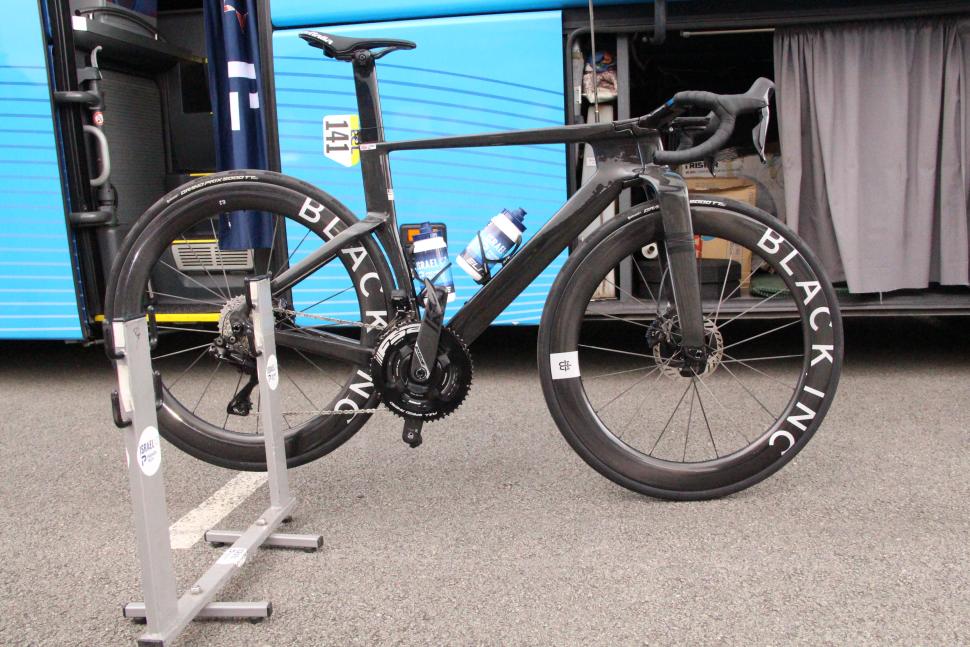
The Factor One is the bike that sparked something of a media storm when it was first spotted at the Critérium du Dauphiné (above), where Israel–Premier Tech’s Jake Stewart rode it to victory on the fifth stage – although we didn’t have a model name at the time. Factor launched the original One for the 2016 season, with an update in 2018. The most notable features of the new model are the super-wide fork and seatstays, plus a new V-shaped cockpit.
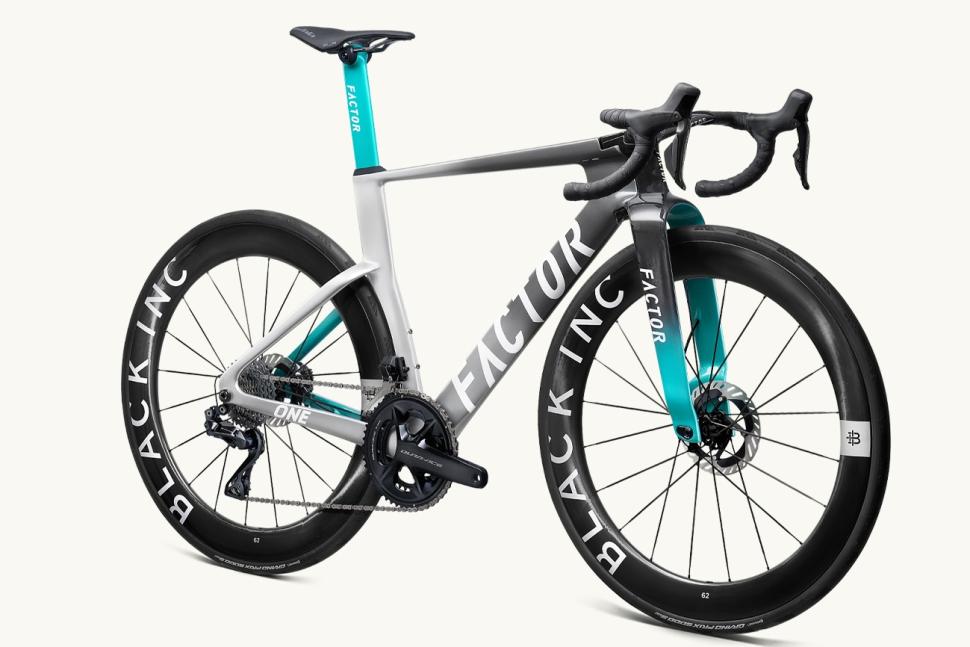
Jake Stewart apparently reported: “Holy shit, when it hits 50kph it really starts to fly.”
So what are we getting here? As you’d guess, Factor is talking all about speed.
Having already seen an unreleased Cervélo S5 and some new wheels from Specialized prior to stage 1 of the Dauphiné, we arrived on a large car park in the French commune of Domérat for the race départ expecting a fairly run-of-the-mill morning: grabbing as many photos of pro riders and their bikes as possible to use throughout the 2025 season, heading back into town for a coffee and croissant, then going to watch the finish.
We hadn’t had the slightest hint of a tip-off that Jake Stewart was hiding a radical prototype aero bike on the Israel–Premier Tech team bus, and when he carried it out, we happened to be in the right place at the right time to start snapping and telling social media about it within minutes. Stewart himself and the IPT staff were coy but played the game well, obviously anticipating there would be some attention around the new bike, and giving us just enough time to get plenty of pics before he spun away to the start line.
In what was a tumultuous and controversial season for IPT that ultimately led to the team’s complete rebranding and a change of nationality, the story surrounding this bike reveal will be something Stewart and his colleagues can look back on fondly.
Jack Sexty, road.cc editor
“The Factor One represents a shift in how modern race bikes are conceived,” it says. “Elite racing has evolved: riders sit further forward, run narrower bars, shorter cranks, deeper tyre volumes, and more aerodynamic positions than ever before. The One was engineered around these realities from day one, not retrofitted to them.”
As you’d also guess, the fork is a big part of the story.
“The defining feature of the One is its bayonet fork and ‘chin’ fairing system, a structure made possible by recent UCI rule changes and shaped through hundreds of CFD [computational fluid dynamics software] iterations,” says Factor.
Chin? It’s that forward-projected structure at the front of the fork, logically enough.
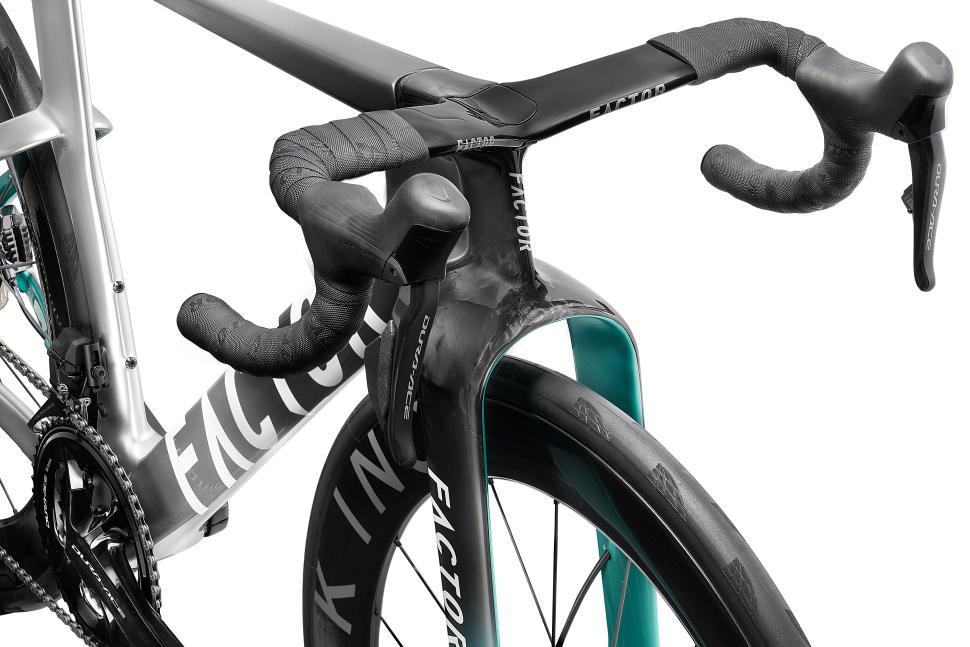
“It controls airflow at the very start of the bike, minimising spillover drag and sustaining advantage deep into yaw where other platforms lose efficiency,” says Factor.
> Find out more about UCI equipment changes here: Why the aero road bike is making a comeback
“Every variable was run through CFD with both half-frame accelerated models and full rider configurations before entering the tunnel in Canada. We confirmed the numbers: the wide fork with ducted chin produced the lowest drag and the most stable yaw performance, holding its advantage beyond 15° where competitors fell apart. The One’s front-end design isn’t simply about cutting the air — it dictates where the air goes next, ensuring smoother flow across the entire system.”
Essentially, Factor is saying that many rival bikes begin to stall rapidly at higher yaws: drag increases steeply as the flow becomes detached from the frame (and accompanying sections), so rather than acting as a sail and generating thrust, these sections create pressure differentials, spending energy and creating drag.
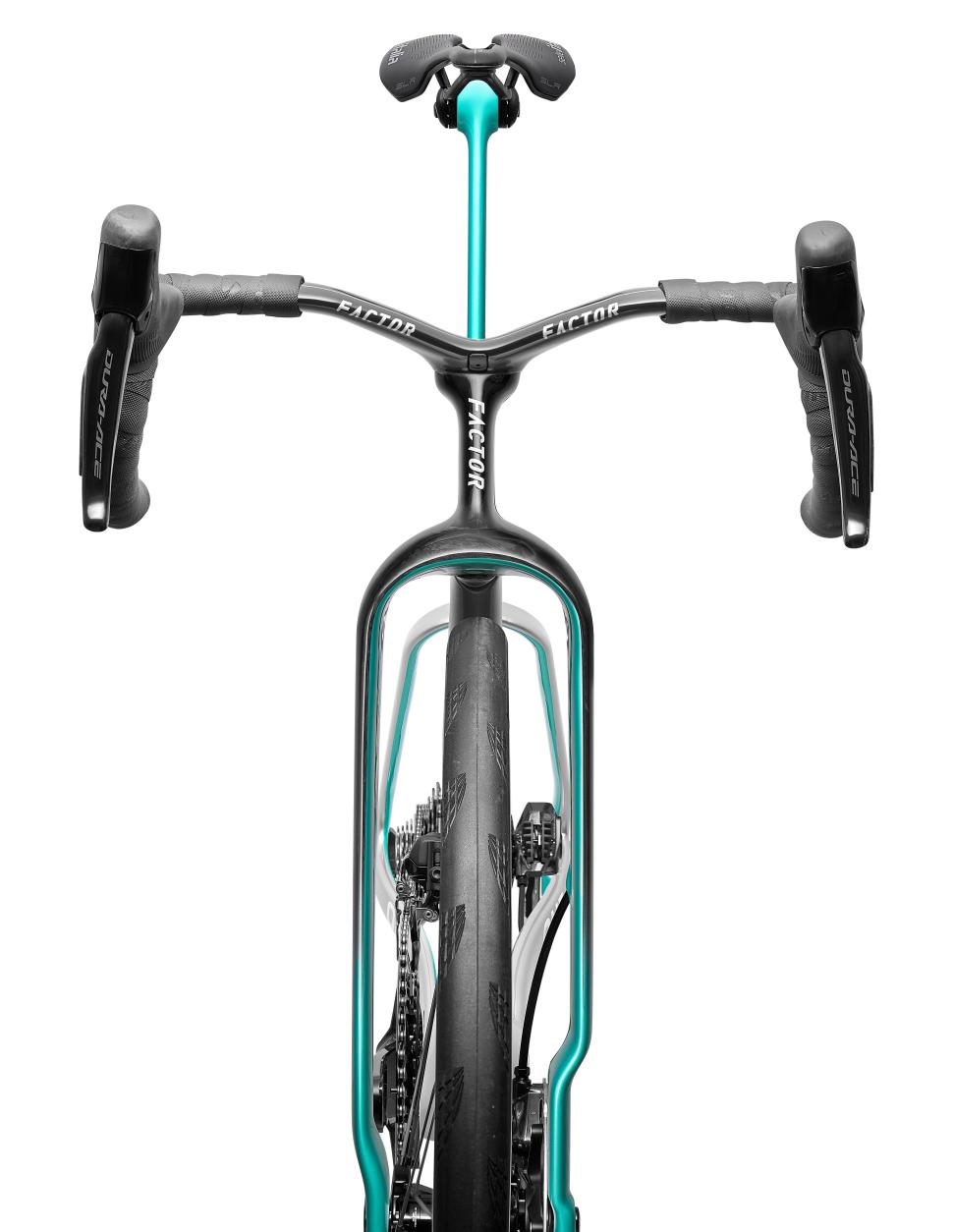
“One not only bests all available bicycles at low yaw thanks to its incredibly small frontal area, but both its aero cross sections as well as the transitions between these sections have been carefully designed and managed to ensure the airflow stays attached for as long as possible, adding a net thrust at yaw, and managing the vortex shedding of the airfoils to decrease the drag generated by downstream members such as the rider’s arms and legs,” says Factor.
“The One’s headline drag reduction is the sum of cumulative micro-optimisations validated independently and in system-level testing:
- Bayonet fork + chin fairing: Eliminated tyre spillover turbulence.
- Brake mount angle optimisation: Reduced interference drag by measurable margins by influencing downstream airflow.
- Bar top profile: Neutral section selected for aero gain + handling stability.
- Cockpit sizing system: Rider position optimisation without stem-induced instability.
- Centre of gravity control: Improved high-speed handling, preserving aero posture in cornering and sprints.”
Factor says that the One’s aerodynamic advantage has been validated in wind-tunnel testing at Guelph (Canada) and SASI (South Australian Sports Institute).
As mentioned up top, it says that the new One is more than 8% faster than the Ostro VAM 2.0 and over 22% faster than the Specialized Tarmac SL8. Although we don’t have the conditions of the testing, Factor usually bases its road bike stats on 48km/h (30mph), and averaging of results at yaw angles up to 15° on both sides of the bike.
There’s tons of debate about the best way to go about wind tunnel testing and the most realistic/informative way to present results. Factor says the largest performance gap over the Specialized Tarmac SL8 was at 10°–15° yaw – although we’re often told that we spend the vast majority of our riding time at lower yaw angles than that in the real world.
Factor also says that the One is approximately 15% faster than the 2024 Cervélo S5, although Cervélo did unveil a new S5 last year.
> Cervelo says new S5 is “at least 5 watts faster than the bikes of our competitors”
Factor says that the One “maintains aero advantage beyond 15° yaw, where competing platforms lose efficiency” – although, as the brand has highlighted in the past, experiencing yaws of this angle while riding is pretty rare.
Factor has also done a lot of work on geometry with the aim of enabling modern racing positions without destabilising handling or confidence. We all know the trends over the past few years: saddles are moving forward, cranks are getting shorter, bars are getting narrower, cockpits are getting longer to extend reach…
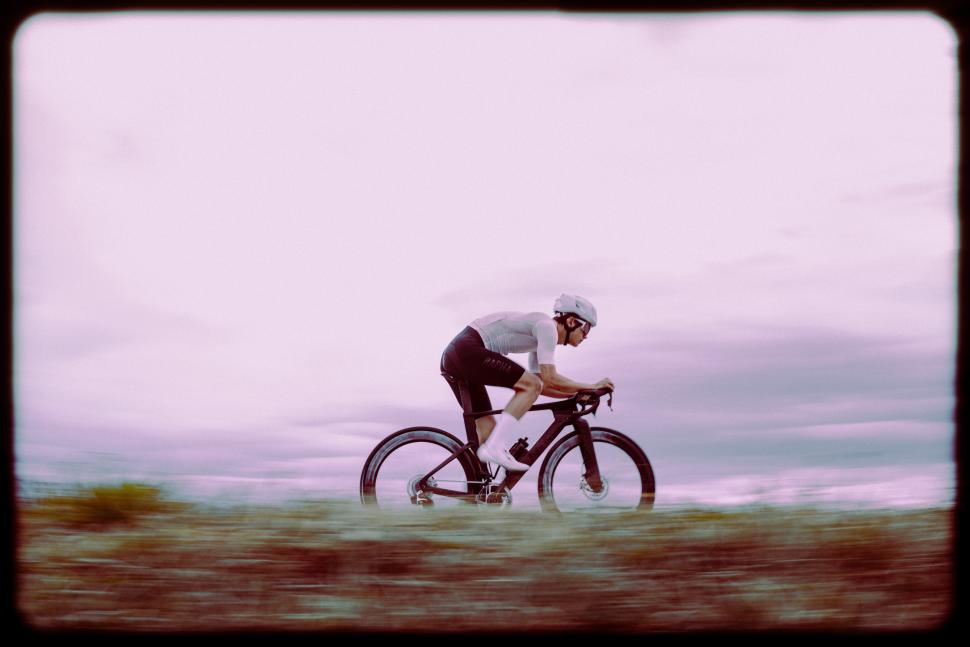
“These changes push the rider’s weight further forward, raising the centre of gravity and unbalancing the front/rear load split, a recipe for reduced stability and increased crash risk,” says Factor.
“[Our] engineering team embraced the reality that today’s riders are pushing fit boundaries once considered extreme. By decoupling the handlebar mount from the steering axis, the One enables reach positions that would previously require unstable stems.
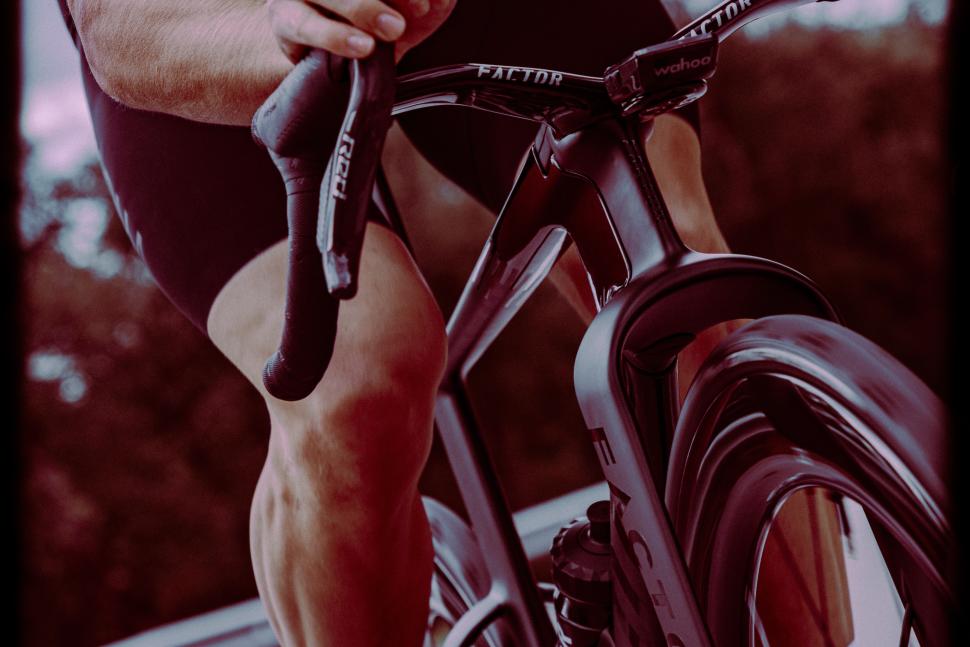
“By building cockpit sizing into the integrated bar system, the One eliminates the compromise of ultra-long stems while giving modern racers the forward position they demand, with stability and control preserved. The stiffness levels of the Gull wing bar are extraordinary: as much as 50% higher than an equivalent bar/stem combo.”
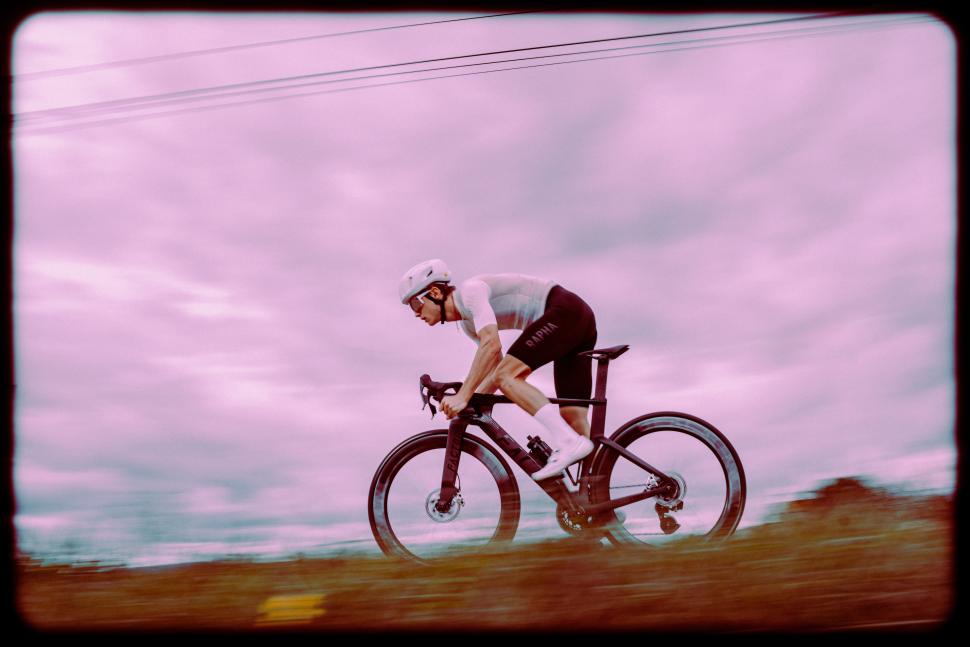
The new integrated bar system removes the stem, replacing it with a selection of five sizes (the equivalent of 110–150mm stem lengths), three rise options, and up to 15mm of spacer adjustability. With the spacers and the bar rises, you have a total front end height adjustability of 35mm “without sacrificing aerodynamics or handling”.
“A revised bottom-bracket drop restores handling balance altered by shorter cranks and modern tyre choices, keeping the bike planted at high speed,” says Factor.
The bottom bracket drop is 77mm on sizes 47 and 52, and 75mm on the larger sizes. That compares with a bottom bracket drop of 72mm and 70mm on Factor’s current Ostro VAM.
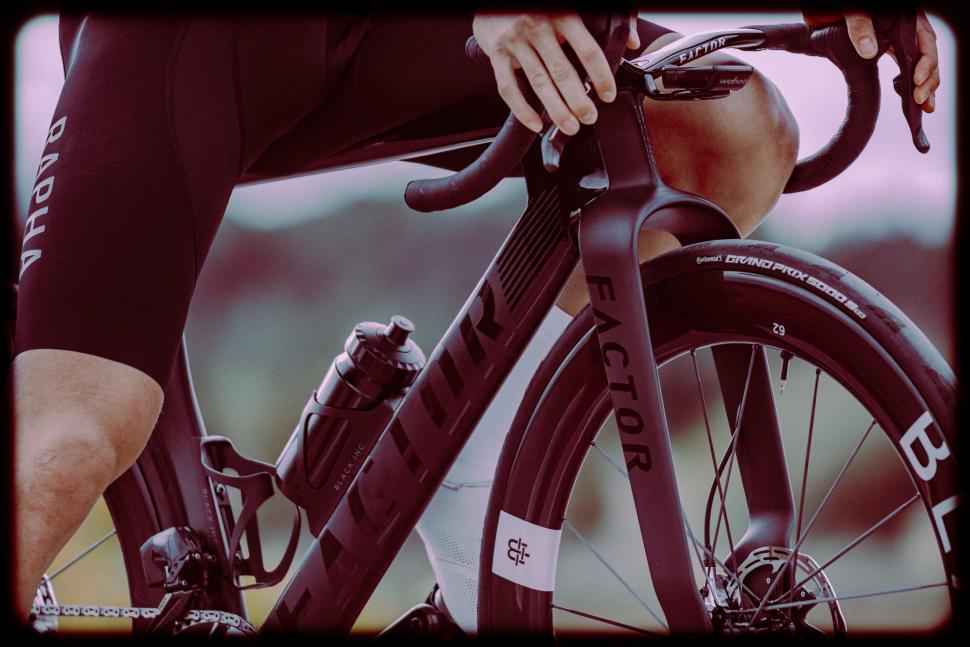
The idea is that the bike feels planted on high-speed descents. Riders fitting shorter cranks typically raise the saddle to compensate. The idea of dropping the bottom bracket is that it keeps your centre of gravity in the same place after this change has been made. The geometry is optimised for 165-170mm cranks.
What’s the One’s weight? Factor claims 900g for a frame (size 54), and 540g for the fork. That’s a little more than other forks at this level, but it’s hardly surprising given the leg and bayonet steerer profiles. The cockpit (size three of five) is 210g, and the seatpost is 230g.
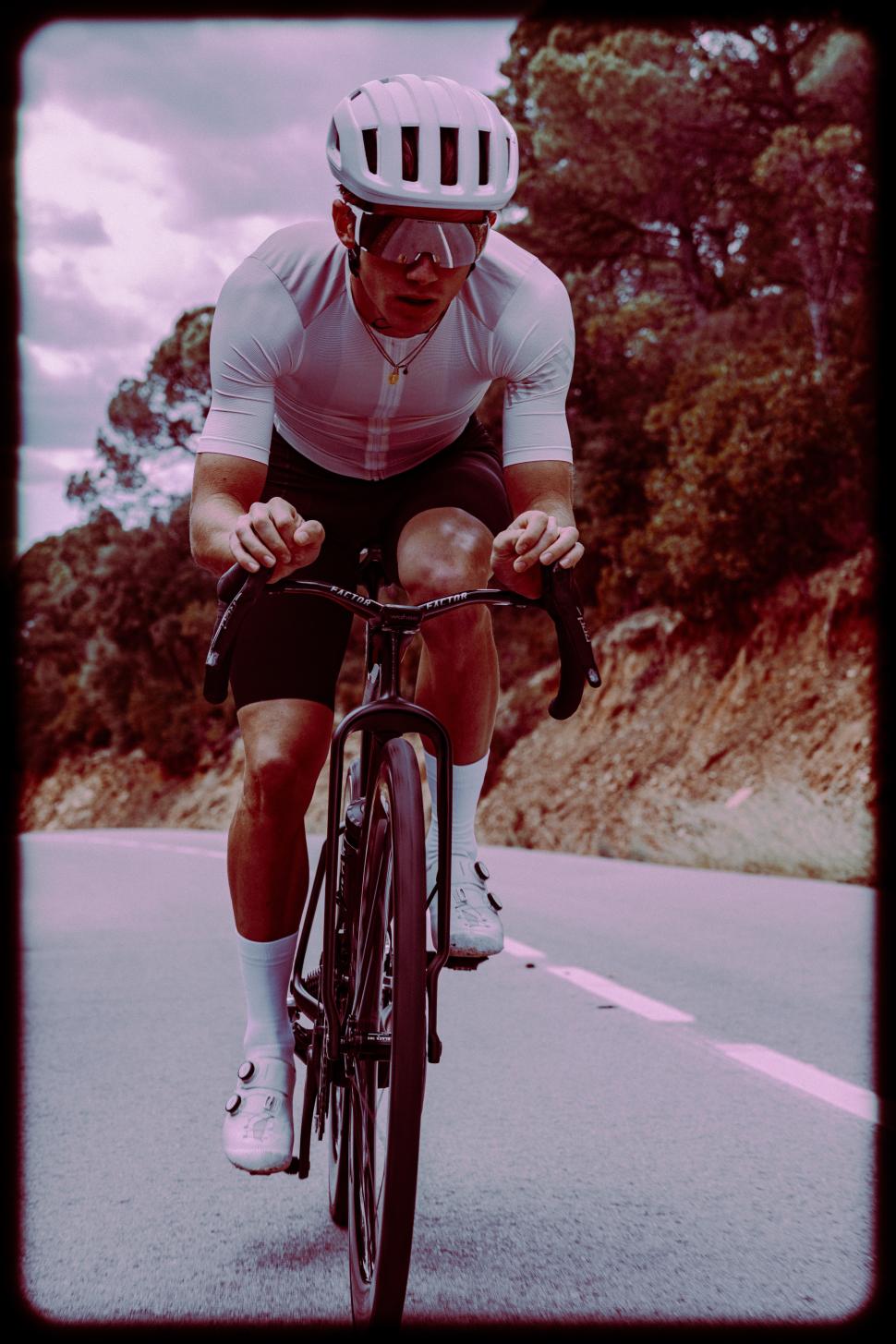
Tyre clearance is given as 34mm (measured) or 28mm (nominal), based on a 28mm tyre fitted to a rim with a 23mm internal width.
The Factor One comes in five sizes (47, 52, 54, 56, 58) the four colour options (Blush, Nimbus Grey, Onyx Black, and Silverstone).
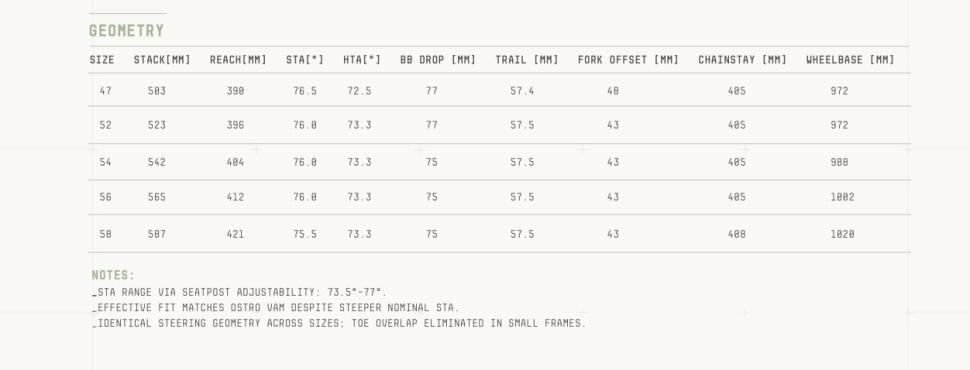
The adjustable seatpost head gives a virtual seat tube angle of 73.5-77°.
Factor says, “[The One offers] effective fit parity with the Ostro VAM – riders familiar with our flagship aero race bike will find their core coordinates unchanged, despite the One’s steeper seat tube angle.”
Graham Shrive, Factor’s chief engineer – previously at Cervélo – said, “This is the best bike I’ve ever made, and I believe the best bike produced in the road industry so far. The reason is clarity of purpose. No one questioned the mission: build a bike to help riders win races.”
Factor One prices
You can buy a Factor One Premium Package (frame, fork, cockpit, seatpost) for £6,899. It’s compatible with electronic shifting only.
Complete bikes come with Black Inc Sixty Two Wheels. The One is available with Shimano Ultegra (£10,899) and Dura-Ace (£12,599) groupsets, and with SRAM Force (£11,099) and SRAM Red (£12,899) groupsets. The SRAM models are fitted with power meters.







49 thoughts on “Factor officially unveils all-new One aero bike, declaring it “the fastest UCI-legal road bike in the world””
The UCI will quickly ban it
The UCI will quickly ban it now its been unveiled. If they are lucky they’ll get to show it off in a race first!
All cleared with UCI. It’s
All cleared with UCI. It’s been raced since June already.
Good to hear. I’m a little
Good to hear. I’m a little cynical of the UCI and adaption to change!
Always the possibility of a
Always the possibility of a rule change after the fact, like the soon to be outlawed Hope track frame
Always the possibility of a
Always the possibility of a rule change after the fact, like the soon to be outlawed Hope track frame
So if I’m riding along at
So if I’m riding along at 48kph on my (imaginary) Spesh SL8, I can expect to go over 58kph on this Factor?
No, I thought not.
no, because about 80% of the
no, because about 80% of the drag is from the rider, so you’ll only see about a fifth of that drag reduction as an overall system figure
I know Dave ? Although I’d be
I know Dave ? Although I’d be very surprised if a rider on this Factor would be going at 50kph when they’d be going at 48kph on an SL8.
But claiming that a bike is 22% faster than another one without a rider is nonsensical. Without a rider, both bikes are stationary.
*Whoosh* (with all due
*Whoosh* (with all due respect)
Their white paper actually
Their white paper actually claims that bike+rider is >22% more aero, not just the bike
Nice find, and what an
Nice find, and what an utterly garbage claim by Factor.
I was quite looking forward to this release, but the more I’m seeing of the frame’s limitations (no option beyond 38mm bars?!) and Factor’s offensively out-there marketing, the happier my wife and bank account have become.
For a yaw angle of 15
For a yaw angle of 15 degrees, the side component of the wind must be tan(15 degrees) = ~1/4 of the forward speed. So at 30 km/h side component would have to be 8 km/h, 40 -> 10, 50 -> 13, and so on.
The wind is rarely perfectly side on, so the side component is some portion of it typically.
Oh, I did the calculation
Oh, I did the calculation thinking the required side wind for 15 degrees would be really high – and hence uncommon. But… not as high as I’d thought.
Amazing machine. Luckily I’m
Amazing machine. Luckily I’m too old and slow for marginal gains, so I’ll stick to beautiful bikes.
For every ugmo bike like this
For every ugmo bike like this there is a Colnago C series or Bianchi Specialissima for those of us who still want a bike to at least look pretty as well as perform
From marginal gains to
From marginal gains to marginal pains
Judging by the publicity
Judging by the publicity photos it’s so fast it’s smashed through the space-time continuum and gone back to 1975, they look about equivalent to my dad’s first attempts to do home colour photo printing in the late 70s. So rubbish they’ll probably be up for an award somewhere!
A photo campaign that at one
A photo campaign that at one time would have had you fired and excommunicated from photographic circles is now the one-click vintage filter du jour of the world’s least vintage aero bike.
Jake Stewart wrote:
This doesn’t sound like a good thing – personally I mostly prefer my bike to stay on the ground.
On the other hand, I think I might have an idea what the next Red Bull challenge might be.
At 50kph that’s where my legs
At 50kph that’s where my legs start to die actually.
Excellent. I’ve been after an
Excellent. I’ve been after an aero summer bike and a winter fat bike. Ticks all the boxes!
Hope you have extra deep
Hope you have extra deep pockets. its ludicrously priced. I own a Dogma but even I think this is taking the piss
It may be fast but, by jove,
It may be fast but, by jove, it’s not a thing of beauty. Maybe it looks ok when it zips past you but it really doesn’t entice me in these marketing photos.
What these bikes are useful
What these bikes are useful for – if you watch them in the pro peloton – is for those last 400-500 meters when the sprinters turn on the afterburners. The rest of the race they are sat in the peloton getting a tow like everyone else. They fantastic marginal gains are only really profitable when doing 60kph in the final sprint.
Dont expect them to turn your average pace into uber fast numbers. Only your legs and lungs can do that
You could pretty much say
You could pretty much say this for every bike in the pro peloton.
This is also for the solo breakaways. It’s supposed to allow the rider to get into and maintain an aero position for longer.
Would you say a Scott addict
Would you say a Scott addict or a Cervelo R5 were designed fur 400 meter sprints?
The R5 was barely used in
The R5 was barely used in this year’s TdF though.
It’s still a pro tour bike.
It’s still a pro tour bike. And the Scott addict was used a lot.
Are you saying you can’t
Are you saying you can’t sprint on either of those bikes?
Its more than likely the factor rider will be on the Ostro if others are on the addict or R5.
WhichWayNow wrote:
I can’t. Or any other bike, come to that.
“Sprint” is used in the
“Sprinting” is used in the loosest sense for me.
Same as “climbing” and “pulling”.
In fact, “drafting” is what I’m probably best at.
…And those legs and lungs
…And those legs and lungs will be a little bit fresher than the rest of the peloton, is the idea.
I love bikes like this.
I love bikes like this. Pushing the boundaries of what’s allowed. Getting away from the cookie-cutter shapes the stringent UCI regulations have created.
A friend may be getting one, he has an Ostro VAM and he seems to think 7kg is achievable.
Would be great to see this go up against the new Incolor SSR in a wind tunnel.
You should get a tri-bike,
You should get a tri-bike, sounds like it’s a match made in heaven
Is that what this new factor
Is that what this new factor is?
WhichWayNow wrote:
Although it’s only really possible because the UCI changed the rules to allow new cookie cutters.
Bit of a pain to actually use
Bit of a pain to actually use…
I like to look at where bikes
I like to look at where bikes now are compared to a decade ago and think how bikes might progress over the next decade.
Over the next decade one thing that will change is the absence if the head tube. An external steerer will meld forks into handlebar stem reducing drag on the headtube and the toptube will go from sloping down to sloping up. From a very short head stock the top tube will move upwards towards the seat post , contrary to current designs.
Perhaps, but the additional
Perhaps, but the additional complexity, lack of adjustabilty, and aesthetics tells me that would be unlikely on all but the highest end carbon bikes.
I think we reached peak aero
I think we reached peak aero bike aesthetics in 2019 with the 3rd gen Venge. Since then things have not improved looks-wise in my opinion.
(declaring an interest here, I have one)
That was a deeply sexy bike,
That was a deeply sexy bike, especially in silver
Congratulations Hope
Congratulations Hope Technology and Renishaw for the original thinking that Factor have “innovated”‘ from.
Negative. You should be
Negative. You should be congratulating Lotus on the conception. Renishaw had an anciliary manufacturing role in the 2020 launch and Hope was given framebuilding duties for the 2024 HB.TT version.
I might be missing your point
I might be missing your point, but pretty sure Hope built the frames for the 2020 version too?
See e.g. (sorry for heretical link): https://www.bikeradar.com/features/pro-bike/hope-hb-t
The 2020 frames were built by
You’re right, my mistake. I had remembered something about the division of labor and when verifying it with Grok AI it literally hallucinated a made-up controversy about the 2020 frame being made in Italy and the bike being called the ‘Hopesport’…
Glad it’s fast, so I won’t
Glad it’s fast, so I won’t have to look at it for long.
The worst looking bike since
The worst looking bike since the 795 Aerolight
Well, they certainly won the
Well, they certainly won the prize for “fugly bike of the year”. What an absolute eyesore
That’d make a lovely winter
That’d make a lovely winter bike.
I could just blast this bike off with the hose and sling it in the shed till the next weekend. I assume it’s got ‘proper’ mudguard mounts?
I think Factor’s marketing team are missing a trick here.
/sarcasm