



A taxi driver who was banned from the roads for 12 months after pulling out without indicating and hitting a cyclist, leaving him with a “horrific” arm fracture, blamed the injured rider for the collision, arguing in court that if “he’d negotiated the roundabout properly I would have seen him”.
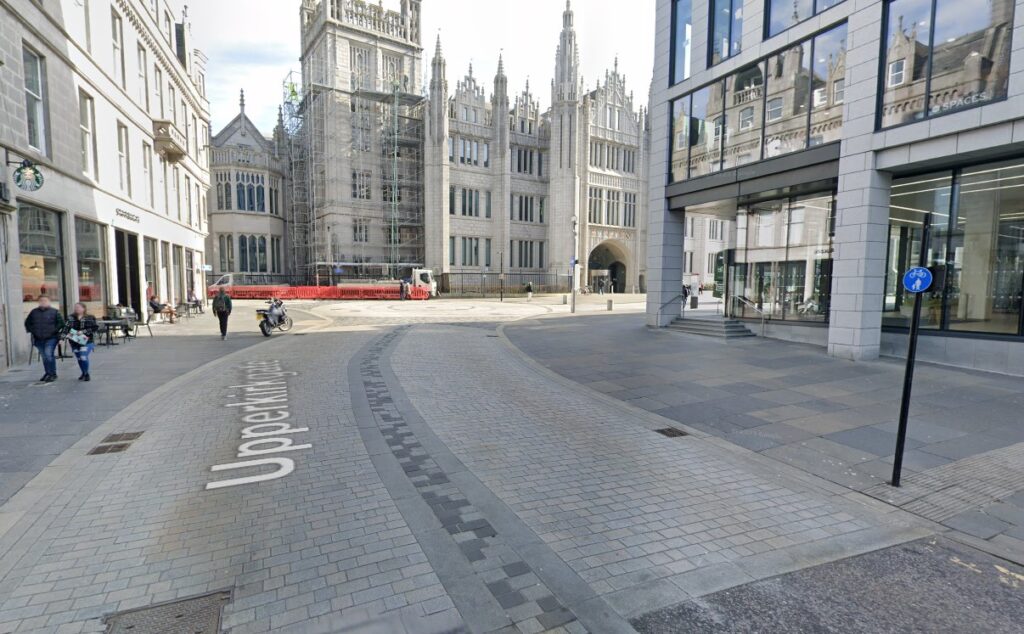
Stephen Bennett, a 50-year-old taxi driver in Aberdeen, was parked on the pavement at the top of the city’s pedestrianised Upperkirkgate, after dropping off passengers, when he pulled out in front of cyclist Alan McKay.
McKay, who had turned onto the street from Gallowgate, had no time to react when Bennett merged onto the road without indicating, sending him flying over his handlebars, the Aberdeen Press and Journal reports. The cyclist suffered a “horrific open fracture” to his arm in the collision.
At Aberdeen Sheriff Court, Bennett denied a charge of causing serious injury by careless driving, and instead told the court that McKay had failed to negotiate the roundabout linking Gallowgate with Upperkirkgate “properly” and that he would have spotted the cyclist if he “had stayed in his lane”.
> Screaming and swearing taxi driver cuts off and hits cyclist before speeding away
When asked by his defence counsel Gregor Kelly what procedures he’d undertaken before driving off the pavement, the 50-year-old said: “After my passengers left, I’m waiting to get another job. I’m given another job and check over my right shoulder and there was nothing there.
“I checked my rear-view mirror and wing mirror and forward to make sure there was nothing coming and slowly manoeuvred out doing less than one or two miles an hour, and I hear the thud of the cyclist.
“I didn’t indicate because there was no one else there whatsoever. The cyclist has come just after I checked over my shoulder.”
Bennett claimed that McKay had “cut the corner” and navigated the roundabout in the wrong lane, and if he had approached in the left lane “I would see him”.
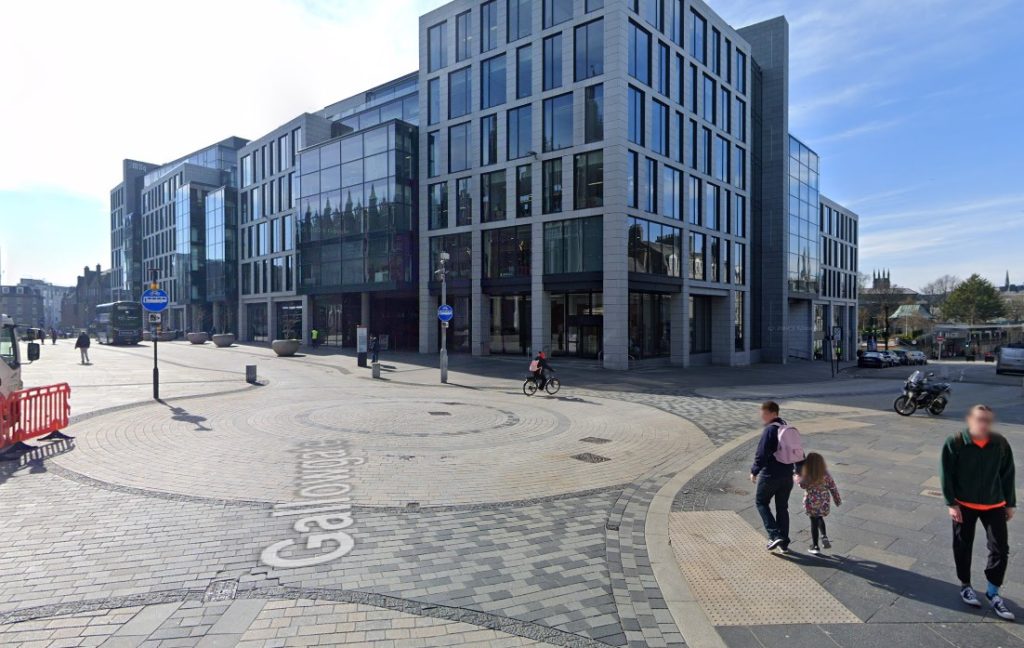
The approach to the roundabout from Gallowgate, with Upperkirkgate to the right (Google Streetview)
“He obviously appeared after I have looked over my shoulder,” he continued. “I felt really bad about it. I got out of my vehicle straight away. I was trying to help him, I asked if there was anything I could do.
“I wanted to take his bike home for him or pick his wife up and take her to the hospital. I would have done anything to help him.”
> Taxi driver given suspended sentence for deliberately hitting cyclist who called him a “fat f**k”
While watching CCTV footage of the incident in court, Kelly asked Bennett: “What commentary would you give regarding Mr McKay’s lane positioning?”
“If he’d negotiated the roundabout properly he’d have been behind me and I would have seen him,” the taxi driver replied.
Questioning Bennett, Fiscal depute Claire Stewart said: “I’m going to suggest had you carried out the necessary checks this collision would not have happened.”
“I did carry out the necessary checks,” Bennett said. “It wouldn’t have happened if he’d come round the roundabout the proper way.”
While also providing evidence to the court during the trial, cyclist McKay said that Bennett had failed to indicate before the collision and added that he “disagreed” with defence counsel Kelly’s assertion that he had not navigated the corner properly or kept his “lane discipline”, and that he had “contributed personally” to the crash.
> Taxi association warns drivers of “sneaky” cyclists with cameras catching law-breaking behaviour
Finding Bennett guilty of causing serious injury by careless driving, Sheriff Kevin Duffy told the court: “This is a very unfortunate situation both for Mr Bennett and indeed Mr McKay,”
“The question for the court to decide his whether the quality of Mr Bennett’s driving fell below the standard of a careful and competent driver.
“Looking at it from the CCTV, I have reached the conclusion that while Mr Bennett may well believe he carried out all the checks required, my conclusion is that he didn’t do so immediately prior to pulling out because if he had done so he would have been aware of the presence of the cyclist. Furthermore, he didn’t indicate.”
Following the guilty verdict, Kelly argued that the mandatory driving disqualification would have a huge impact on his client as it would leave him unable to work, and asked the sheriff to keep the ban to a minimum.
Sheriff Duffy disqualified Bennett from driving for 12 months – the minimum length of ban legally required for the offence – and fined him £790.




















63 thoughts on ““If he’d stayed in his lane, I would have seen him”: Pavement parking taxi driver banned for injuring cyclist after pulling out without indicating – but barrister blames cyclist’s poor “lane discipline” for crash”
Bizarre that the driver’s
Bizarre that the driver’s take away from this was it was the cyclist’s fault. It’s like parking on the pavement and then joining the road with only a precursory look and no indication was just normalised behaviour for a professional driver…oh, hang on…
Oddly stiff punishment – by
Oddly stiff punishment – by which I mean relative to the normal slap on the wrists. Is this a Scots law thing? Are driving penalties harsher up there?
the little onion wrote:
Causing serious injury by careless driving is a relatively new offence, with stiffer penalties. Previously this would simply have been careless driving and the horrific injury suffered by the cyclist would be largely irrelevant.
The 80 year old that left me
The 80 year old that left me needing to walk with a stick, arthritis and a brain injury got 6 points and a small fine.
In Scotland [where I am and the collision happened], if you admit guilt at the scene, you can pretty much get away with points. That was 2018 and before the new charge came in … but I can’t see it being much different.
I suggest that actually it is
I suggest that actually it is really really light punishment, to the points almost of being deriory.
It was Causing Serious Injury by Careless Driving (open fracture) ie bone poking out of his arm.
Also no guilty plea, continued denial and blaming his victim.
In England (I don’t know if Scotland has these in place yet … in England it was only 2-3 years ago and SGov take their sweet time) the range would be high level community order to 6 months custody.
And at least 3 (maybe 4) aggravating factors:
Victim was a vulnerable road user, including pedestrians, cyclists, horse riders, motorcyclists etc
Driving a goods vehicle, PSV etc
Other driving offences committed at the same time as the careless driving
Blame wrongly placed on others
They should make it a legal
They should make it a legal requirement to indicate before pulling out from a parking sport and turning into/out of side roads. Personally, I don’t get why so many drivers don’t bother as it’s not exactly onerous to flick a lever to indicate.
(I have heard previously on here that some driving instructors actually berate learners for indicating when there’s no-one visible around – that’s just plain stupid).
It seems common sense to me
It seems common sense to me to assume that I might not be fully aware of everything that’s happening, and that there could be somebody there that I haven’t noticed.
When I’m cycling I’m extremely wary of taxi drivers. They seem to think that the rules don’t apply to them. In fact you might assume that any driver who has pulled up on the pavement thinks that they are above the rules and may do something else equally inconsiderate.
bensynnock wrote:
I’m similarly wary of taxi drivers – they’re more likely to want to stop and/or turn around. They’re also often using multiple devices: a GPS, either built-in or fixed to the windscreen and often they’re on a handheld phone as well.
I wouldn’t classify all pavement parkers as inconsiderate as they’re often trying to be considerate to other drivers. The problem is that they prioritise drivers and fast roads over the health and safety of pedestrians.
hawkinspeter wrote:
The first sentence is still going too far even with the second – “I wouldn’t classify all speeding drivers as inconsiderate as they’re often being considerate to their passengers or the people they’ve said they’ll meet at a certain time”.
Yes – it could be seen as “be considerate of other drivers” but it could also be “if I don’t pull out of the way another driver could clip my motor…”
Or we can just call it “social convention” I guess?
hawkinspeter wrote:
IME a lot of motorists only seem to bother indicating if they see other cars.
Even if pedestrians waiting to cross who might have liked to know that you intend to turn into a side road and they could have crossed the road after all
“(I have heard previously on
Quote:
“(I have heard previously on here that some driving instructors actually berate learners for indicating when there’s no-one visible around – that’s just plain stupid).”
I recall reading this, and hearing it from my daughter when she was learning to drive. It is of course utter bollocks, but fits with the myth that drivers are all-seelng and all-knowing, and the only reason they hit other road users is because it’s the victims fault or they ‘came out of nowhere!’
Most in my local town only
Most in my local town only indicate after the act that they are supposed to tell others, pull into the left lane then indicate left, mind-boggling daft I know they will or should be turning left but I did not know that they were moving from the righthand lane until they did and stopped at the red light.
hawkinspeter wrote:
thats odd! I don’t get why they would do that.. years ago when I had a driving instructor he would tell me to indicate regardless as you can’t tell who can see you.. are they worried about using up the light bulbs??
Gravelproof wrote:
The theory behind it as I understand it is that the learner should be constantly thinking about their driving and the traffic around them. If they always indicate before turning etc. then it is apparently demonstrating that they aren’t thinking about who they’re indicating for.
However, that’s just obviously dangerous to not be encouraging learners to always indicate when performing a maneouvre with the exception being when indicating could be ambiguous (e.g. overtaking vs turning though that implies that they’re overtaking near a junction which isn’t great).
no its encouraging them to
no its encouraging them to think and use the concious part of the brain to check the traffic around them properly, something we as cyclists criticise drivers alot for not doing, rather than letting the brain automatically switch off the decision making aspect and just treat it as repetition.
its a very valuable lesson to be taught.
This is where I disagree with
This is where I disagree with the advanced driving guidance – it seems this is being used as much as a “sign of knowledge”. And in fact whatever you practice likely becomes habit over time (brain is *excellent* at saving expense by swapping doing work every time for “here’s one i made earlier”).
Neither indicating or deliberately not indicating necessarily correlate with you actually checking sufficiently. And your indication or lack of it is only one of the inputs other road users need to consider.
But hey – if it acts as mental meta-tool to cue awareness then that’s all good I guess.
stonojnr wrote:
That would be okay if it actually worked like that, but this incident demonstrates that some drivers don’t check sufficiently and don’t indicate. It’s particularly dangerous when they pull out of a parking space as there might be very little clue as to what they’re doing. Failing to indicate when it is appropriate just compounds the problems with their lack of observation. They don’t see an approaching cyclist, think that they shouldn’t indicate and then cause a collision that could so easily have been avoided if they had indicated “just in case”.
A colleague who did an
A colleague who did an advanced driving course was told the same thing. If there is no one around you don’t need to indicate.
Yes, a friend of mine did an
Yes, a friend of mine did an advanced driving course and got marked down for indicating where the instructor deemed it was unneccessary. I think the logic was that if he’d done all the required checks of mirrors etc (which he had done) then he would know that there’s nothing around to indicate to. But what’s the downside of indicating, just in case there was something which you didn’t or couldn’t see (e.g. in a blind spot)?
Even a pedestrian needs to
Even a pedestrian needs to know the intentions of a bicycle let alone a two-ton 150 HP SUV etc Some pedestrians are moving faster than four MPH like runners etc. They have eyes to see indicating traffic but not the mind-reading bit yet.
I’ve heard the same from the
I’ve heard the same from the police. My problems with it are drivers don’t always see everyone, it becomes a bad habit, and there’s no upside.
There used to be a statement:
There used to be a statement: Mirror Signal Manoeuvre.
Covered everything from pulling away, to changing gear, to changing direction and to stopping.
A *professional* driver would be using glance – look – glance – fecking *look* … there really is no excuse for colliding with anything when in *control* of a motor vehicle.
Indicators are funny things … some people don’t use them as they know where they are going and they don’t need the little arrow on the dashboard to tell them.
I remember a few decades ago on Look East; they were interviewing the head honcho of Suffolk Police Road Unit and the biggest gripe was that police officers didn’t indicate when pulling back in from overtaking.
He replied with [paraphrasing so not a direct quote] it forced the driver to check their mirrors and also, because you should return to the left when finished overtaking, other road users should expect it, and thus no need to signal the intent.
Oldfatgit wrote:
Ideally it should be Mirror Signal Mirror Manoeuvre. The second “Mirror” is also known as the life-saver.
hawkinspeter wrote:
Ideally it should be Mirror Signal Mirror Manoeuvre. The second “Mirror” is also known as the life-saver.— Oldfatgit
Yes! I was taught that I should indicate early enough to ensure people saw it before moving, which required a further check. I wasn’t to indicate where it could be ambiguous, and that included waiting to pull out from a parked space into moving traffic until I was ready to move. I should be waiting for the cars to pass, and indicating might give the impression that I was going to pull out in front of someone, causing them to break etc. The exception for that rule is buses.
I have heard that not indicating when there’s ‘no-one to see’ is acceptable/good practice now, but far too many people just don’t indicate unless they think it’s to their advantage. More often than not they don’t indicate where it would benefit pedestrians, but I see it a lot when I’m driving. While you shouldn’t assume that someone indicating to turn into a side street will definitely do so, an indicator along with judging the car’s speed and position can make the difference between getting out of that side street in a timely manner.
I think it’s just good practice to stick to mirror-signal-mirror/shoulder check-manouvre as habit unless you have a good reason for doing something different. At least that way if you are a bit distracted for whatever reason then you are giving those around you a fighting chance.
FionaJJ wrote:
That’s a good point about completely trusting that because someone has indicated that they definitely will perform a maneouvre. It’s more about intention – they use their indicator to tell others that they intend to turn or pull out etc. which allows others to be better prepared for them changing direction etc.
When cycling I often indicate
When cycling I often indicate twice – once before changing speed for a manoeuvre, and again when I’ve slowed down just before making the turn.
AidanR wrote:
When cycling, I’ll sometimes not indicate for a fast left turn as I’d rather keep both hands on the controls and it shouldn’t make any difference for other traffic behind me. I do however indicate if I think it’s useful info for pedestrians/drivers such as if they’re waiting to turn into a side road that I’m also going to be turning into.
Using the cycle lanes in Copenhagen introduced me to the concept of always indicating when pulling away from stationary as there’s so many people using the lanes and you don’t want to veer straight into someone.
hawkinspeter wrote:
Presumably to make sure that you draw attention to yourself?
mdavidford wrote:
Presumably to make sure that you draw attention to yourself?
You should follow the letter of the law, find an envelope of space and put your stamp on it.
And if the professional had
And if the professional had done that there would have been no crash, no severe injuries and no ban.
When I had some accompanied
When I had some accompanied drives with IAM (couple of decades ago) that was their stance.
Mine is that I need to regular habit because not signalling makes more likely not to do it when I need to, and if I don’t see someone they at least know what I am doing and can mitigate my mistake.
mattw wrote:
What snaps my cranks is that they could take that stance, but also encourage drivers to indicate anyway whilst stating “indicating just in case” which would fulfil their objective of getting a driver to think about the traffic and also provide the rest of us with a blinking light so that we can at least try to avoid a collision.
To be honest, I think they’re just being obstinate in pushing their “ideal driver” stance over the practicalities of avoiding collisions. They’re letting “perfect” be the enemy of “good”. Also, they’re promoting the idea of the omniscient driver – if they can’t see anything, then there’s nothing there.
Whilst the taxi driver
Whilst the taxi driver parking on the pavement prior to the collision has been mentioned plenty of times, there does not appear to have been any admonishment from the police/court for this.
I’m assuming it wasn’t legal as I don’t know of anywhere that it is.
I’m glad he got banned for a year.
This will hopefully make him a safer driver and word will get round to his colleagues that they could face similar consequences.
mitsky wrote:
I believe that it’s only within London that it’s illegal to park on the pavement – everywhere else is fair game, though in theory you could report a driver for causing an obstruction to using the pavement, but good luck getting the police or council interested.
London and Edinburgh, with a
London and Edinburgh, with a Scotland wide ban mooted. When the Edinburgh ban came in it was quite hillarious seeing the stories from parkers who had parked on “their” pavement outside their house…
Bigfoz wrote:
I think the Scotland-wide ban is now in force: https://www.transport.gov.scot/news/pavement-parking-ban/
Isn’t it illegal to drive on
Isn’t it illegal to drive on the pavement?
Didn’t he admit to driving on the pavement?
“Isn’t it illegal to drive on
“Isn’t it illegal to drive on the pavement?”
Not always.
Would the exceptions apply in
Would the exceptions apply in this case?
Don’t know. In any case,
Don’t know. In any case, he clearly didn’t look properly before pulling out.
Bungle_52 wrote:
It’s only a little bit illegal
hawkinspeter wrote:
In a specific and limited way?
If this junction is a
If this junction is a roundabout, should there be “roundabout” warning signs?
Who says this is a roundabout
Who says this is a roundabout? There are no road signs to indicate this. There are no road markings (white lines) in accordance with the legislation.
If you believe the pretty patterns in the block pavement are conclusive proof this is a roundabout, then what do the road markings indicate in the pic below? Should pedestrians do a U Turn in the middle of the road? Or is this a semi-roundabout? The problem is, Highways Engineers can’t follow the rule book, and road users suffer for it.
More ammunition for the war
More ammunition for the war on motorists meme.
There was this hard-working poor bloke wot never did no ‘arm to nobody, just earning enough to keep his family and aged parents alive, when some entitled cyclist decides to ram his car and sue him. An absolute disgrace and the Sheriff Kevin Duffy is clearly biased, probably a Green and, shock horror, possibly a cyclist himself.
Well done Sheriff Kevin Duffy, long may your good work continue.
“If he’d stayed in his lane, I would have seen him” not “If I hadn’t parked on the pavement and pulled out without looking or indicating.” Should have got an extra ban for being a prat.
That taxi driver is waging a
That taxi driver is waging a war on pedestrians.
A shout-out for Sheriff Duffy
A shout-out for Sheriff Duffy. The UK clearly needs a bunch more like him.
Motorists should always
Motorists should always signal when pulling out from the side, turning left or right even if they look and do not see anything – we all have blind spots in our eyes, any light from an object falling on these blind spots cannot be seen.
My point exactly!
My point exactly!
Do taxis have indicators? I
Do taxis have indicators? I never knew that – I’ve never seen an indicator on a taxi. Amazing. You learn something every day
Do taxis have indicators? I
Do taxis have indicators? I didn’t know that – I’ve never seen an indicator on a taxi. Amazing. You learn something every day.
We humans are not mind
We humans are not mind readers so that is why cars/vans etc are fitted with indicators to tell other road users what you are about to do as you will not see others every time you change lanes, turn on or off a road etc and please do not have all four blinking when parked in a group of other vans etc as it looks like your about to pull out!
What’s similarly unhelpful is
What’s similarly unhelpful is when people indicate to announce their intention to pull out at some as yet unknown point in the future, when there’s a gap in the traffic.
Not sure that that is
Not sure that that is unhelpful always.
Ashley Neal calls it an ‘asking for permission’ or similar, which to me seems about right.
If it is a stream or a queue of traffic, that allows drivers to adjust to accommodate the intention.
This isn’t about “asking for
This isn’t about “asking for permission” though. I’m talking about situations where a driver sits there with his indicators flashing, as other vehicles whizz by, or starts indicating just as traffic is about to pass. He has no immediate intention to pull out. Indicating doesn’t providing any useful information to anyone if the other drivers can’t let the driver out or can’t reasonably be expected to do so. It’s wholely unhelpful if not dangerous.
when do you think they should
when do you think they should start indicating then?
Car Delenda Est wrote:
The Highway Code doesn’t explicitly say when you should start indicating but it makes it the penultimate thing you should do before pulling away, after checking your mirrors and blindspots and just before making a final visual check all round, so by implication just before you pull out. If one thinks about it, indicating before pulling out should only ever be precautionary because you should never pull out if any other road user is going to have to slow or take evasive action when you do so. If you sit there with the indicator on when there isn’t space for you to pull out, you may cause other road users to take unnecessary evasive action which could in turn bring them into conflict with others.
Love the driver’s attitude. I
Love the driver’s attitude. I had a similar experience when a car came out of a side road, ignoring a “give way” sign, and broad-sided me, and the driver and his wife immediately insisted it was my fault, as I must have gone through a red light (there were traffic signals at another junction on my road, some distance before the side road they had come out of).
Do we have the CCTV footage?
Do we have the CCTV footage?
Is a taxi allowed to go down there?
(TBH looking on Streetview, this looks like another of Scotland’s “shared space” messes, and this one has only been in for 2-3 years. Everyone should no better by now.)
I don’t know the area. Here
I don’t know the area. Here I believe.
I think it was part of this project, starting around 2017.
FWIW totally agree – “shared space” with motor traffic is not the way forward for anything other than “do something” but keep the status quo. (Actually any sharing by different modes without certain critera in place is poor – see the UK’s low-ambition conflict-creating “shared use paths” for example).
(Ramble) I’m convinced this kind of stuff is a product of the “good idea fairy”. It triggers interest because it’s counter-intuitive (less “control” but people are said to “behave in a more human way”) BUT apparently (under controlled conditions) it “seems to work” *. Plus it looks great in the visualisation / artistic impression. In those pictures it now looks like a “place” – much nicer than the “road” before! Look – they’ve drawn in just a couple of cars and the drivers and imaginary happy people are politely sharing! There are children crossing without fear! I feel this is how it should be!
Oh, and by the way it’s (relatively) cheap ** and in fact we’re not “taking space” from motor traffic so push-back should be minimised…
* Unfortunately reality is less forgiving (as e.g. shown by crash data).
** UK example – Exhibition Road. In fact it’s often not cheap at all, and while initially some benefits seemed to emerge this was extremely poor value for the money spent when compared to other possible interventions.
A wonder that the police even
A wonder that the police even prosecuted the driver. There are plenty of police force areas where they wouldn’t have even bothered and left it to civil redress only.
I didn’t indicate because
I didn’t indicate because there was no one else there whatsoever. Unfortunately, I hit the person who wasn’t there.
“Kelly argued that the mandatory driving disqualification would have a huge impact on his client”
Huge impact. Is that like the huge impact of a 2.4t taxi causing an open fracture of the arm? Or just the impact of the removal of the privilege of driving from somebody who was clearly not competent for the activity and trade which depended on that competence?
Incidentally, it isn’t a roundabout. There are no signs on the approach to the junction; no rotation signs at the junction, and no raised centre around which traffic is directed. It isn’t even a mini-roundabout. It is simply an unmarked junction.
“I didn’t indicate because
“I didn’t indicate because there was no one else there whatsoever. The cyclist has come just after I checked over my shoulder.”
No one else is going to observe that a person who struggles this badly with object-permanence has no business ever operating a motor vehicle in public again?
Bicycles do not move sufficiently-fast to make this claim possible, in the physical world that we all inhabit.