



The presenter of the recent BBC Panorama investigation, ‘Road Rage: Cars v Bikes’, has responded to the accusation that he jumped a red light while cycling during the controversial programme, an incident which he claims demonstrates “how difficult” some junctions can be to navigate on a bike, as well as the wider “reality of cycling on UK roads”.
The Panorama episode, which aired last week and explored the vulnerability of cyclists on Britain’s roads, received a mixed response from cyclists on social media. While many cycling campaigners praised the programme’s willingness to highlight the dangers faced by cyclists on a daily basis, it was also heavily criticised for the decision to interview – as a counterpoint to the pro-active travel arguments of Cycling UK’s Duncan Dollimore – the notoriously anti-cycling columnist Rod Liddle.
> BBC Panorama – Road Rage: Cars v Bikes – the road.cc Podcast debrief
The latest criticism of the programme, however, comes from a rather more unlikely source. In a video uploaded yesterday to his popular YouTube channel, driving instructor Ashley Neal pointed out that, during the documentary, presenter Richard Bilton – who discussed the episode on last week’s instalment of the road.cc Podcast – “jumped a red light” while cycling in London.
“I’m not sure whether much has been said about this incident in this documentary,” the Liverpool-based instructor wrote in the caption to the video, which has been viewed almost 43,000 times on YouTube. “But it makes a little bit of a mockery when the question is asked ‘are the UK roads too dangerous to cycle on?’”
Neal, who described the issues tackled by the programme as “quite close to my heart”, began the eight-minute-long video (above) by criticising what he regards as the typically divisive character of the road safety debate, and praised Bilton for doing “a good, balanced job”.
Nevertheless, the driving instructor continued: “But I’m not sure whether anyone else had picked up on it, but the presenter, around 24 minutes in, jumps a red light.”
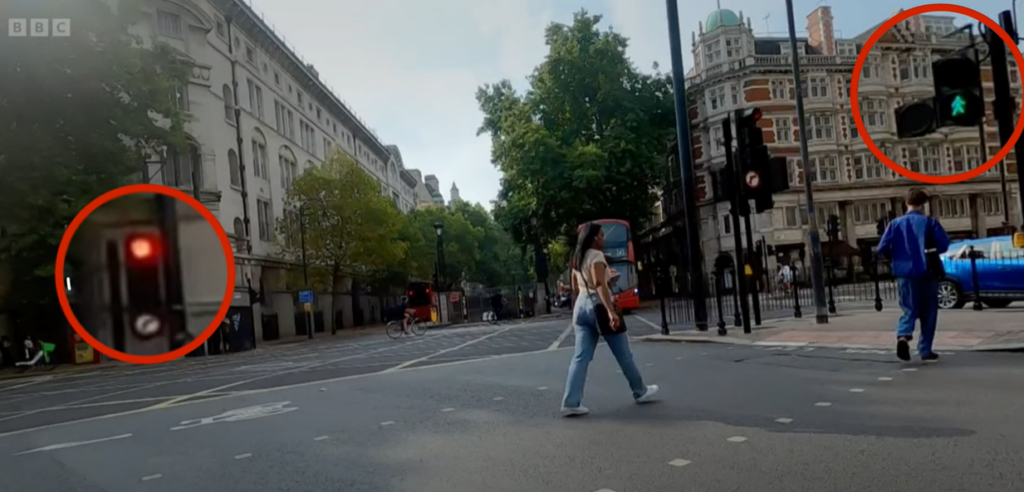
In the Panorama clip highlighted by Neal, Bilton attempts to navigate the infamous Holborn gyratory, an intimidating junction which lies at the intersection of two busy routes for cycle commuters and where eight people on bikes have lost their lives in crashes involving lorries and coaches since 2008.
Last month, Camden Council opened an “urgent” consultation, which runs until tomorrow, on changes to the gyratory, which at present provides no physical segregation from motor traffic for cyclists and has been the scene of regular protests by the London Cycling Campaign and Stop Killing Cyclists calling for safety measures to be brought in to prevent people on bikes from being killed there.
> Camden opens “urgent” consultation on changes to notorious Holborn gyratory
In his video, Neal highlights a moment in the Panorama programme where Bilton appears to slowly ride on through a red light at the junction, as pedestrians cross the road.
“Without effective observation, any infrastructure changes are pretty pointless to reduce risk altogether,” Neal narrated over the clip.
“The green walking man symbol is displayed allowing pedestrians to cross this section of road. And even more obvious, the red light is showing on the other side. But our cyclist still goes with the bus coming the other way.”
Using another clip from the junction submitted by one of his viewers to illustrate the point, Neal notes that “the pedestrian crossing area is across the full width of the road – so the journalist from Panorama shouldn’t have been going.”
The driving instructor then remarked that the bus driver – who was turning right at the junction as Bilton approached – “seemed to be taking no prisoners” and that he wasn’t sure whether the cyclist “would have been hit by the bus, but it would have been quite a late, sharp, abrupt stop.”
He continued: “I think the bus driver was saying ‘No, you are not going, I’m going to use my size to deter you from going’. And luckily enough, it worked.”
“It does show you the problems that humans can cause themselves – we miss things.”
Responding to Neal’s comments, Bilton told road.cc: “The point of the programme was to demonstrate the reality of cycling on UK roads. We did so in a balanced fashion.
“We included the sequence with the lights because it demonstrated to a viewer how difficult the Holborn gyratory is to navigate if you’re not familiar with the layout. It was my first time.”
Explaining the situation that led him to ride through the red light before swiftly stopping, the presenter said: “As you wait to enter the junction, there’s a set of lights for cyclists. I thought green allowed me to move across the junction.
“But green only allows you to move forward a couple of yards to another set of lights. I got it wrong and found myself in the path of a bus. As the film shows, I turned back and returned to the original position, commenting to the camera how dangerous the situation felt.
“As I mentioned in the programme, the London Borough of Camden has made some changes to the junction to help cyclists, but that it had recently announced an urgent review of how traffic is managed at this location.”



















40 thoughts on ““It demonstrates the reality of cycling on UK roads”: Panorama Car v Bikes host responds to accusation that he jumped red light during programme”
Time for me to get myself
Time for me to get myself down to Holborn gyratory on my bike I think. Are you up for it Richard Bilton?
I think Richard Bilton looked
I think Richard Bilton looked terrified riding around the Holborn gyratory. I’m quite sure he’d rather not do that again!
He was unfamiliar with the road layout and probably distracted by the camera, but who can honestly say they’ve never found themselves in the wrong lane or missed a road sign when riding or driving in an unfamiliar location – especially such a busy location in London, where there’s so much going on.
It’s a shame you didn’t dig a bit deeper in that video into the road layout that might have caused Richard to be confused about the traffic lights. It’s highly unusual. I have never seen anything like it before. It’s kind of like an advanced stop line on steroids, with traffic light controls to hold cars back whilst cyclists get a head start.
https://goo.gl/maps/epUzVo5CEuhyRqpg6
I don’t know how anyone can
I don’t know how anyone can give 100% attention to driving when giving commentary about some other event and also looking at the camera.
Ashley Neal wrote:
I haven’t watched the Panorama programme, but caught your above-linked clip and thought it was fair enough. That most certainly does look like Richard Bilton went through on a red and it seems like a strange mistake to make as the peds were obviously crossing the road and the approaching bus was certainly a big clue. I don’t know that junction myself, but it didn’t look too bad from my brief view through the camera.
However, I don’t agree with your characterisation of cyclists in that cyclists never accept blame or apportion blame to other cyclists – there’s plenty of examples on this site that show otherwise. I think the confusion comes about as a lot of motorist commenters (e.g. on Twitter) take a strange and outdated view of road laws and responsibility and falsely accuse cyclists of not getting out of the way – that’s when some of us stand up to make our interpretation understood.
I would say, however, that in general a cyclist’s view of the road and surroundings is much better than the limited view that drivers get through a windscreen (and A-pillars) and so cyclists are on average a lot more observant than drivers. Also, cyclists have to be alert as otherwise we tend to get hurt a lot – it can be something as simple as not spotting a wet drain cover on a corner or not anticipating a left-hook. That’s partly why the Near Miss of The Day series can be useful to watch so that common issues can be better anticipated and hopefully common errors avoided.
Nice to see you over here,
Nice to see you over here, Ashley.
I posted a long comment over at your place (re-edited above or below following the comment from Bilton), and I think Panorama rather missed the opportunity to explore how difficult it can be to get these right.
The type of meandering route followed by the presenter is exactly the type of thing that can get a cyclist killed by a left-hooking lorry, and I would argue demonstrates the need for far fuller segregation for passive safety reasons.
A couple of the 9 people on bikes killed in that area can perhaps be characterised as inexperiened. There’s nothing wrong with that, but inexperienced in a high risk situation with no passive protection, such as lorries or buses not being able to get at you by intention or mistake, can be fatal.
Matt Wardman
Ashley means well, but he
Ashley means well, but he really does miss the point sometimes.
He talks about not wanting an ‘us & them’ between drivers and cyclists, but then says things like ‘cyclists are not totally innocent in these situations, they never are‘. I’ve never heard him speak about drivers like that, framing them as an entity.
Then there’s the bit where he explains that perhaps the presenter was distracted by talking to a camera, but then that doesn’t affect him, as he has a better skillset. That really does sounds like the typical “I’m a good driver so I can do [insert dubious driving habit] safely”. This usually works for a while before their luck runs out. Do as I say, not as I do, never works well as a teaching method.
I would like to see him stop talking to the camera when he’s driving, especially when it adds no context to the discussion.
.
.
How dare he say things like ‘cyclists are not totally innocent in these situations’? How DARE he?
.
He pointed out that it was likely Bilton’s first time riding whilst speaking to camera, and so the mistake was entirely understandable, whilst he himself had a lot of experience of similar so was probably better at it, whilst certainly not being perfect.
.
As ever, Ashley tries for a reasonable, balanced interpretation of situations.
.
Clearly, that’s nowhere near good enough for you. What are those rules again?
.
Ah yes. Rule 1: cyclists are never wrong.
Rule 2: on those rare, largely theoretical occasions when a cyclist might, just possibly, marginally, debateably be in the wrong, well – see Rule 1 above.
.
Gosh, talk about seeing / hearing what you want to see.
.
Blinkered much?
.
you’ve missed the
.
you’ve missed the
.
too
“As you wait to enter the
The first time i came across infrastructure like this, i can’t remember if i rolled through in a confused state or made an uncertain stop in a confused state, but i remember being confused. Once you figure out the intention, it’s clear why you’re getting a red immediately after a bike-specific green, but at the time i was trying to figure out what signal, sign, or marking i had missed.
I was left similarly confused
I was left similarly confused the first (nay only) time I encountered a two-stage turn on CS6 – couldn’t work out where I should be looking for the green light.
It’s difficult to tell from
It’s difficult to tell from streetview, but it looks like you can’t actually see the light from the second stage of the right-hand turn, as it puts you ahead of it and there doesn’t appear to be a repeater light for cyclists at the far side of the junction.
The one I encountered was at
The one I encountered was at junction of Blackfriars Road / Southwark Street / Stamford Street – turning off CS6 towards Southwark Street. Can’t remember the exact details, but I was left stranded in the middle of the junction not sure where to find my signal. Quite alien when I was perfectly comfortable following car-based signals.
I recall a 2-stage turn
I recall a 2-stage turn design used on the 1st (or 2nd?) blue paint gen of cysling superhighways which involved doing a horizontal loop the loop across the shared pavement.
IMO this design is too complex, and will get simplified.
I hope on that jumction Camden will provide alternative attractive routes avoiding it altogether – eg an alternative via Queren Square for left turners from Southampton Row into Theobalds Road.
Great that Road.cc has picked
Great that Road.cc has picked up on this. I think that Neal has a point, but the panorama presenter has a decent explanation not explained in Panorama.
They should have said it was his first attempt, that he got confused and that the layout was confusing as the presenter’s path through the junction was bizarre, as a way of illustrating how complex / difficult it can be. And that’s its a *&^% dangerous place to make mistakes on a bike.
The footage is coming S down Southampton Row to the junction with Theobalds Road. My impression us that it is being reassessed/redesigned in a panic by Camden because several have been killed since they said it was in hand (in 2019?).
First of all, there *is* some protection in place, in that the 3 lane approach down Southampton Row is now 2 lanes plus an island plus a cycle lane on the left from about 30m before the junction to 10m (my est), where it reverts to full width tarmac. It can be seen in Google Streetview.
He approaches down the semi-segregated bike bypass lane on the extreme left of the carriageway (2 lanes on the RHS + protective island plus bikes on the left), which is where he should be for his eventual turn left, then he signals right on exiting the left turn protected cycle bypass, then within a very few metres (I estimate 6-8m) is on the outer edge of lane 2 of the now 3 lane carriageway to meet the bus. Then he swings right back across and is shown weaving back to the apex of the Left Turn corner.
Here’s the piccie. If you look backwards on streetview it shows a bloody great lorry virtually blocking the entrance to the cycle lane. SIgnage is not very clear.
So, is that a green light for
So, is that a green light for cyclists to turn left?
That could explain why the presenter made his mistake.
Edit: Reading Hoarsemann’s comment, it appears to be an advanced green light for cyclists though the timing raises the question of why was it encouraging cyclists to progress when they are likely to come into conflict with vehicles such as the bus? Of course, a green light only means that you can progress when it’s clear, so I’d still consider it the cyclist’s error.
I believe it’s two stages –
I believe it’s two stages – (1) there is a dedicated cycle signal at the end of the segregated cycle feeder lane. Green here allows you to proceed to another stop line at the mouth of the junction. (2) You then observe the (non cycle-specific) traffic lights at the mouth of the junction before proceeding.
EDIT: see the video embedded at https://road.cc/content/news/camden-consults-urgent-changes-holborn-gyratory-296735 at 2:28 for a similar set up they’re proposing introducing elsewhere on the gyratory.
quiff wrote:
Thanks – that makes more sense now and I’ve had another look at the segment in Ashley’s video of the RLJing.
It looks like a light-controlled ASL and I can understand Richard getting confused there. Here in Bristol, we’ve got a junction on The Triangle (https://www.google.com/maps/@51.4571235,-2.6079319,3a,75y,143.67h,84.4t/data=!3m6!1e1!3m4!1soFaj3LBJl4D_W0RjbUOSgA!2e0!7i16384!8i8192 – that’s from before the cycle-green light was added) that features a cycle-specific green light, but that is simpler in that it just allows cyclists (and quite a few e-scooters) to go forwards ahead of the motor traffic. Having a two-stage junction seems counter-intuitive – why not just use a standard ASL?
Yes, light-controlled ASL
Yes, light-controlled ASL would have been a simpler way of describing it! I think the answer to “why not a standard ASL?” is that it’s intended to give cyclists a separate phase to clear the junction before the motor traffic behind starts, and then holds cyclists in the feeder lane when motor traffic has a green light so as e.g. to prevent left hooks of cyclists. I believe there have been 2 cyclist deaths on this particular part of the Holborn gyratory and it’s a response to that.
quiff wrote:
There’s are a couple of similar arrangements on my commute into London, near Waterloo Station (at the junction between Kennington Road and Westminster Bridge Road near Lambeth North tube; and the junction between Bayliss Road and Waterloo Road. Both parts where a left hook can be a big risk as much of the prevailing traffic turns left. They work pretty well in my experience (and if you arrive when the cycle light is red, you can normally just join the car lane). They also seem pretty clear to me.
But are they clearer than
But are they clearer than this?
https://www.cycling-embassy.org.uk/dictionary/simultaneous-green-0
Or this:
The first might be legal in the UK right now (opinions seem to vary) and only needs changes to the traffic lights. Not cheap, but not as much as digging up the carriageway and installing islands (and probably still redoing the lights). On the other hand, if you’ve already got cycle lanes (or even cycle tracks!) at a location there’s the second.
There is of course the new the “Cyclops” version of the second too. I’m aware there are advantages for pedestrian crossings (ability to cross diagonally) being suggested for this design. I’m still not entirely clear why we can’t just copy the Dutch one given that there are considerably more than 4 in existence and these have been in use for decades. Unless it’s yet another case of “not invented here until we do it our way”?
I would imagine that an all
I would imagine that an all green phase would get discounted by most local authorities because the instant reaction would be that its going to have an impact on junction capacity and through traffic if one arms is not running where you’ve got two major arms (because cars innit…). Something that size in the video I’d be surprised if its continous crossing for peds, most likely 2 stage to get across 10 lanes. Implementing it off peak period only would probably then get pulled for safety by operating the same crossings in two different manners.
I’d be interested to see the difference in a junction model though between a standard set up and an all green. I might have someone I can ask.
Well many LAs discount
EDIT: Proposed recent trial in Richmond apparently as part of a cyclops junction – but looks like it didn’t actually come about?
Well many LAs discount anything which could possibly affect motor capacity. That is the big issue; our requirements essentially say “motor traffic capacity first, then make sure that’s safe enough, then any other considerations in a very poor third place”. Equally I think that they’re especially leery of doing things at junctions (outside of paint – e.g. bike boxes / ASLs) because these are seen as both bottlenecks for vehicles and places where “accidents might happen” and they don’t want a claim. Although that didn’t stop Edinburgh council building dangerous junctions for the trams – it took years of court actions and a death for things to register and they haven’t rushed to fix things either. Also the worry about change / casualies seems to stop changes which might make things safer also.
In many cities – Edinburgh for one – a few or even many pedestrian light cycles have a “scramble” or “all ways green” phase.
Another advantage is this design scales well. That’s because a big junction requires no more resources to set up than a small one. It doesn’t require much more time in a cycle either. That’s because cyclists tend to bunch up and are faster than pedestrians so they can clear the junction pretty quickly even when it’s a large one. See my link to David Hembrow’s article on this (last post). And the UK has plenty of huge expanses of tarmac…
I’m not saying “this is great!” but just noting it exists, is in widespread use abroad and appears to have some advantages especially over the “2 stage turn” or whatever other sub-standard designs we have in the UK now.
It’s a few years old old but there’s some debate on the legality (and if not now, what needs to change) here:
https://www.cycling-embassy.org.uk/node/3178
Ranty Highwayman – who is a professional civil engineer (although signals is not his main specialisation) has commented several times on this e.g.:
https://therantyhighwayman.blogspot.com/2014/07/traffic-signal-pie-third-slice-floating.html
History – in Peterborough there existed something like this – in 1979!
However, understandable for a
However, understandable for a first timer.
And the right evaluation for whatever emerges is whether first timers are automatically safe the first time they do it.
well yes but they went to
well yes but they went to this specific junction to film it, set up a camera man opposite, probably had a producer standing around somewhere, and at no point discussed what they were attempting to film or what the sequence they were doing, or looked at the junction and went wait hold on what do we do here now ? or tried it a few times.
Bilton just cycled straight into the junction as they shouted action and filmed it in one take, even though they knew theyd mucked it up abit as they filmed, didnt do it again, and kept it in the final edit, even though they then didnt make the specific point this junction is really badly setup for cyclists look how easy it is to make a mistake that could kill you, or use it to make any point, it was literally just used as a segue into his piece to camera, they could have used any moving image of traffic or cyclists using the junction and it would have had the same visual impact.
I’ve never cycled through
I’ve never cycled through this particular junction, but just from Street View it does look like a particularly confusing design and I can see why Bilton could easily have been confused or missed the red light.
I would note that the viewer that sent in a clip of “exactly the same junction” appears to have filmed it in October 2021* and the layout has changed since then (Street View history shows a clear change between December 2021 and August 2022). Doesn’t affect the conclusion that Bilton missed a red light and shouldn’t have been going, but does affect the degree to which you could have been confused.
Interestingly, one of the new things that has appeared as part of these changes are some arrows that I just can’t figure out – anybody?
* I know the timestamp could just be wrong, but the viewer’s clip has a few subtle cues that match the December 2021 Street View but not the August 2022 Street View.
OnYerBike wrote:
I think that indicates a two-stage turn for bikes. As I said in the comment below, I find them confusing. Worth noting that Camden is consulting on a lot of changes to the gyratory, including adding another “holding pen” arrangement like this one on Holborn: https://road.cc/content/news/camden-consults-urgent-changes-holborn-gyratory-296735
EDIT: ah, so that’s how they’re supposed to work. Not intuitive: https://www.youtube.com/watch?v=glDLUs2DLfE
“2 stage turn” is (especially
“2 stage turn” is (especially if implemented how we did on Leith Walk in Edinburgh) one of those stages a “developing cycling nation” seems to pass through – hopefully on its way to better things (lots of possibilities e.g. like this). I’m not aware of “good” ones although there are some that are awful. I think they indicate that authorities have realised that cyclists make turns and it’s not ideal just to treat them the same as motor traffic or merely stick an ASL / bike box across several lanes and call it done.
chrisonatrike wrote:
We have one of those in Edinburgh!? I really should check out Leith Walk sometime to see exactly how much of a binfire it is for cyclists. I would rather not “knock it ’til I’ve tried it”, but I do slightly dread the thought because I know it’s going to at least triple my journey time whilst I try to figure it all out and presumably give way more often and get held at far more traffic lights than if I just rode on the main carriageway.
quiff wrote:
That reminds me of cycling in Copenhagen – to turn left you first cross the side road and then turn 90 degrees and wait for the lights to let you continue. Strange at first, but easy enough when you get used to it. https://www.youtube.com/watch?v=YGnZOzNWzCc
quiff wrote:
I see, thanks. Definitely not intuitive – I note the video at least shows an information sign as you approach the lights, and coloured tarmac that might help guide a cyclist slightly. Both of those appear to be conspicuously absent from the Holborn junction.
To be fair, the junction that
To be fair, the junction that confused me does appear to have some signage too (at least heading northbound – https://goo.gl/maps/NQR9xqRnRTh7TNk59 ). The problem, as Hoarseman says, is that once you have pulled into the ‘refuge’ area and are waiting to take stage two of your turn, there is no visible signal to let you know when it’s your phase – you just have to take your cue from the traffic behind you starting to move.
quiff]
That video shows about 3 seconds of green light for bikes ahead of the green for other traffic. I hope that’s how it will be implemented, as all the others I’ve seen in Edinburgh give about 0.5 seconds at most.
The “turn left to turn right” thing also makes cyclists wait until all the motor traffic has gone through, and then for lights to change again – possibly with a pedestrian phase to wait through as well. When I am World King and chrisonatrike is my traffic czar for Edinburgh, it’ll be the motor traffic that has to wait – it shouldn’t be beyond the wit of humanity to sense a waiting cyclist and provide a separate right turn filter. This would be backed up by the default for all pedestrian crossings to be green man, and only turning green for motor traffic on demand and after a waiting period.
I speak as an expert on
I speak as an expert on Lancashire Constabulary’s indulgent and complete tolerance of drivers going through red lights up to 2 seconds after they turned red at 50+ mph on the A6. There’s always a couple of offenders every time I check these lights. Therefore, I disregard the patronising and deluded superiority of this Neal twerp with enthusiasm equal to that I display in ignoring the increasing number of trolls on here claiming to be cyclists.
The post by the driving
The post by the driving instructor is what is known as ‘sh*t stirring’.
BIRMINGHAMisaDUMP wrote:
How can it be “sh*t stirring” when the presenter admits to doing what he was accused of? It’s right there if you read the article.
So the discussion on the
So the discussion on the Gyratory was almost all about how it was horribly complex and had too much traffic coming from all directions, making it dangerous.
I can’t see how someone missing a red light at that does anything but support the argument that the junction is dangerous and so needs redesigning to make it easier to navigate safely on a bicycle…
The timeline for this is odd,
The timeline for this is odd, and validates previous concerns:
I read this article again, I
I read this article again, I wouldn’t call it an attack or toxic.
If anything, it seemed to me Ashley Neal was looking for fault in the presenter and when he found it, used that to turn his review of the programme into an 8 minute moan about cyclists.
As usual AN swiftly becomes
As usual AN swiftly becomes his usual patronising self. Yes Bilton jumps a red light, but quickly stops when he realises he’s made a mistake and trys to make amends by moving back.
The new laws do nothing for
The new laws do nothing for cycling safety or punishment for drivers that are at fault.
I cycle to work around 10 mile a day, I walk sometimes and im a car driver and to be honest if the person is an arsehole there an arsehole no mater what their driving a cycle a car, bus or lorry