


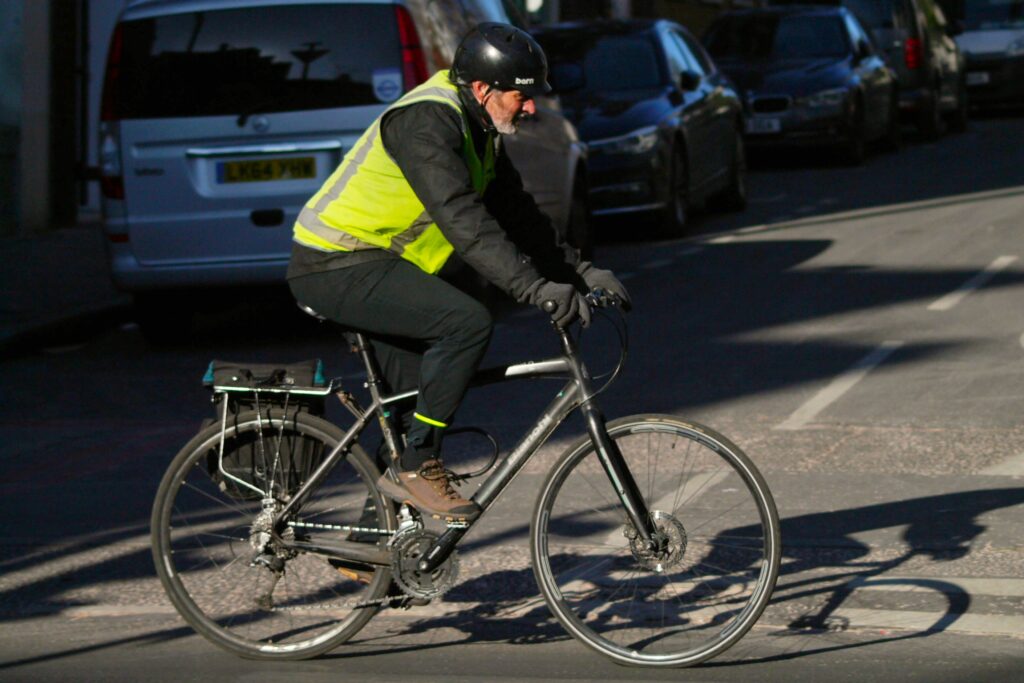

Cycling without a helmet or hi-vis clothing could soon become a criminal offence in Ireland, as the government appears to have added cyclists to an ongoing review of safety legislation concerning e-scooter users.
Earlier this month, Taoiseach Micheál Martin and Seán Canney, Ireland’s minister of state for road safety, announced that the government was planning an “aggressive” drive to tighten e-scooter laws, as well as improving enforcement of existing laws concerning speed and underage use, following a steep rise in collisions.
While there are no plans to introducing number plates or licences for e-scooter users, Martin and Canney, along with minister for transport Darragh O’Brien, said they will focus on making helmets and high-visibility clothing compulsory as part of the review.
It was understood initially that this review of safety legislation would only apply to e-scooters. However, last week in the Irish parliament, Canney appeared to indicate that cyclists and e-bike riders were also being considered as part of the plans, under the general umbrella of ‘micromobility’.
When asked by Fianna Fail TD Ryan O’Meara when the review on helmets and hi-vis will commence, Canney said: “Protective equipment is, as for bicycles and e-bikes, strongly advised but not mandatory in Ireland.
“The Road Safety Authority, which is responsible for public education and awareness, frequently undertakes campaigns to promote, among pedestrians, cyclists, and e-scooter users, the need for personal protective equipment and visibility on our roads. The safety benefits of reflective clothing and helmets are set out in detail in the Rules of the Road Booklet.
“The Department has begun examining this issue, with a view to considering mandating helmets for these and other vulnerable micromobility users, should the evidence support such a change, and I intend to bring forward proposals in this regard in the near future.”
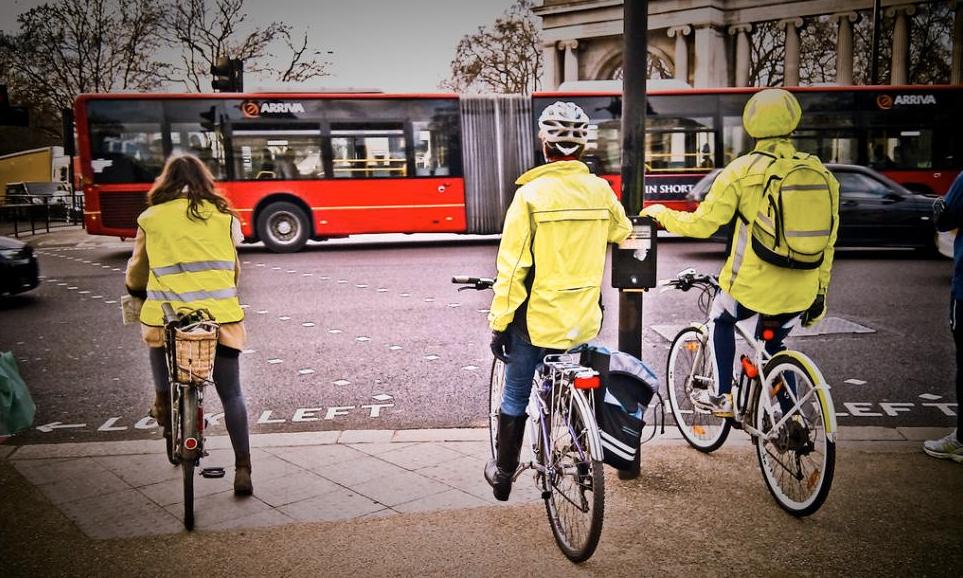
As IrishCycle.com outlined, the connection made by Canney between e-scooters, bikes, and e-bikes suggests that he was referring to cyclists when he mentioned “other vulnerable micromobility users” (with other forms of ‘micromobility’, such as Segways, outlawed on Irish roads, in any case).
The minister’s indication that cyclists could be subject to any new helmet and hi-vis law also represents an abrupt about-turn from a parliamentary answer published on 15 January, which stated that the Department of Transport was only considering “mandating helmets for e-scooter users if the evidence supports such a change”.
And, unsurprisingly, the prospect of compulsory helmets and hi-vis for cyclists in Ireland – which would see the country follow in the footsteps of Australia by making the refusal to wear a helmet a criminal offence – has been heavily criticised by cycling campaigners.
Kevin Jennings, a spokesperson for the Irish Cycling Campaign, told IrishCycle.com that the group “supports evidence-based decision making rather than vibes or populism, especially on an issue as serious as road danger reduction. Sometimes the evidence supports nuanced conclusions.”
He continued: “A parent insisting that their child wear a helmet when learning to cycle is not a natural parallel to a state insisting on similar.
“It is a public good if people cycle, with benefits to the person cycling, to their community, to the shared environment and other road users, and most often overlooked by our health service.”
Warning of the dangers of discouraging cycling by making helmets and other equipment mandatory, compared to the negligent safety effects, Jennings added: “It is vital to be bright and to encourage riders to wear bright clothing and to be visible on the road. Some members would like to see hub dynamo lights included on all bikes, with the exception of sports performance bikes.
“We all need to look out for each other and to make ourselves seen. Mandating these things might be an over-reaction for very little gain; it’s a little bit like telling a person who is struggling with their heating bill to put on an extra jumper.”

Meanwhile, Ciaran Cannon, the president of Cycling Ireland, who was struck by a motorist himself while wearing a yellow top, described any attempt to introduce compulsory hi-vis and helmets as “performative policymaking”.
“There is no credible evidence that mandatory hi-vis significantly reduces collisions or fatalities. Jurisdictions with the safest roads have achieved their outcomes not by criminalising people for what they wear, but by managing speed, designing safer streets, and enforcing existing traffic laws,” he said.
“Mandating hi-vis for vulnerable road users shifts responsibility away from those operating the most dangerous vehicles and implies that injury results from a failure of visibility rather than from road design, driver behaviour or enforcement.
“It is a form of performative policymaking, a measure that creates the appearance of action while leaving the real sources of danger untouched, and it runs counter to the Vision Zero safe systems approach to road safety that Ireland claims to support.”
He continued: “In every other hazardous environment, particularly workplaces, we apply an internationally recognised hierarchy of controls: eliminating danger where possible, engineering risks out of the system and separating people from hazards.
“Only as a last resort do we rely on personal protective equipment. On our roads, we invert this logic entirely, skipping straight to: ‘Be visible’ and ‘Watch out’.”
“High-visibility clothing can be useful and should be encouraged. However, if we are serious about saving lives on Irish roads, we should focus relentlessly on speed, street design and enforcement, not penalise people for what they wear.”
That particular message, however, was ignored back in 2023 by a Dublin judge, who cut the damages awarded to a cyclist, injured after being struck by a hit-and-run lorry driver, by 20 per cent after claiming that she contributed to her own injuries by failing to wear a helmet.
And when it comes to cycling’s ongoing ‘helmet debate’, Cannon and Jennings’ warnings about the potential impact of mandating helmets and hi-vis clothing were underlined by a recent study from Australia – where helmet wearing has been mandatory for over three decades – which found that an alarming number of motorists view cyclists wearing helmets and other safety gear as “less human”.
Of the 563 people surveyed for the study, conducted by Mark Limb of Queensland University of Technology and Sarah Collyer of Flinders University, 30 percent considered cyclists less than fully human, while cyclists with helmets were perceived as less human compared to those without, while cyclists with safety vests and no helmets were perceived as least human.
“Our findings add to this growing research, suggesting that cyclists wearing safety attire, particularly high-visibility vests, may be dehumanised more so than cyclists without safety attire,” the study concluded.

Of course, Ireland’s helmet debate isn’t new to these islands, where calls for legislation governing cyclists’ protective equipment pop up on a regular basis.
In June 2023, for example, Conservative MP Mark Pawsey introduced a compulsory cycle helmet bill into the House of Commons, arguing that if mandatory safety measures are acceptable for motorists, they “should surely be acceptable for cyclists”.
Addressing concerns that a mandatory bike helmet law would be difficult to enforce, Pawsey said: “While it would certainly create an additional burden on the police, it doesn’t strike me as being particularly difficult to enforce in comparison with other offences.
“If mandatory safety measures are acceptable for car drivers, they should surely be acceptable for cyclists. Now we know that cyclists are the most vulnerable road users.”
And in December 2022, the Department for Transport insisted that the then-Conservative government had “no intention” of making helmets mandatory, following a question from the Tory MP for Shropshire constituency The Wrekin, Mark Pritchard.
In response to the MP’s question, the minister of state for the department at the time, Jesse Norman, said the matter had been considered “at length” during the cycling and walking safety review in 2018.
Norman, himself the Tory MP for Hereford and South Herefordshire, also added that while the Department for Transport “recommends that cyclists wear helmets”, the “safety benefits of mandating cycle helmets are likely to be outweighed by the fact that this would put some people off cycling”.








28 thoughts on “‘Over-reaction based on vibes’: Are mandatory helmet and hi-vis laws for cyclists set to be introduced in Ireland?”
How on earth do you define hi
How on earth do you define hi-viz in law? Does my yellow and orange jersey count, or does it require reflective panels? If so, do the reflective details on my cycling shoes count?
It’s an opportunity for the
It’s an opportunity for the uci to diversify!
AidanR wrote:
I know it when I see it.
Schrödinger’s hi-viz. You can
Schrödinger’s hi-viz. You can’t tell anyone is wearing it until you see them? Or don’t see them (e.g. they came out of from nowhere).
AidanR wrote:
EN ISO 20471:2013
So now not only do I need to
So now not only do I need to replace my helmet every 3 years, unless of course I drop it. ?
Now I will need to replace my hi-viz regularly when it fails to comply at its periodic test, due to wear & washing. ?
When I go out I make sure I
When I go out I make sure I can be seen. Not rocket science
How? Details please.
How? Details please.
Coolkitty wrote:
That’s very different to meeting a legal standard for visibility
AidanR wrote:
It is. I’m against mandatory ‘hi-viz’ and helmets, mainly because of the mandatory bit, but in part because it’s difficult to specify in a way that won’t cause confusion with well meaning people getting it wrong.
However, making reasonable efforts to be seen in a way that’s appropriate to where you will be cycling is sensible and should be encouraged. Talk of things being mandatory seems to send people to the trenches, making many incapable of nuanced thinking.
If you cycle in a well lit area, in good conditions with segregating paths where people expect there to be bikes, then you are in a different position to most.
My own commute can be broken down into different sections, and my need for visibility, and what helps my visibility, varies. I moved offices recently, and this was my first winter cycling home in the dark past a lot of public Christmas lights. Regular bike lights alone, and even flashing ones, would not help me stand out as much as I’d like if I were wearing dark colours on an otherwise dark bike, especially on rainy nights with extra dazzle.
Another part of my regular route is a fairly dark shared path, and even with two front lights, some joggers and dog walkers can be hard to make out. Lots do wear something a bit easier to see in the dark, and quite a few joggers carry small lights, which is appreciated, but it is still hard to work out what they are until you get close.
I pass some cyclists coming the other way and most (sadly not all) have lights, but some are blindingly bright, with bright flashing ones particularly challenging. If they are wearing dark colours, all you see is that one light, and it’s hard to judge distance, or be sure of what they are, or where they are positioned in the path. Those ones tend to come towards me with much greater speed than vice-versa, because presumably they can see all of me, especiall as my lights are angled so as not to blind. But still better than the ones with no lights.
Closer to home, on at least some of the evenly lit, quieter residential streets it’s easier to spot a cyclist in dark clothing with regular lights, but it’s always easier to spot ones that have something extra on their bike or person that’s reflective, and even if not anything that could be described as hi-viz, not something that a cat burglar might wear.
Someone can’t see if they aren’t looking, but making yourself visible will help those who are looking to see you sooner, and improve your odds of being seen by those who are a bit lazy about looking.
Being seen early means giving other road users, including cyclists, joggers and dogs, more time to decide how to move past you, which IMO increases good will towards us. It’s not just about safety, it’s part of being a curteous road user, or user of shared spaces.
Agreed. I ride in light
Agreed. I ride in light colours with some reflectives. I’m also lit up like a Christmas tree, but with lights positioned not to dazzle – particularly important for unlit sections with pedestrians.
But I have a long(ish) commute in all weathers and wear technical cycling clothing (love my Castelli Perfetto). The idea of being mandated to wear some baggy hi-viz tabard over it is anathema to me.
And what about club jerseys
And what about club jerseys and skin suits when racing?
Most of these halfwit politicians seem to think that cycling is a means of getting to work or the shops. Full stop.
Mr Blackbird wrote:
Fixed that for you.
Nonsense like this seems to
Nonsense like this seems to come up every few years, as indicated in the article. Unfortunately, a jurisdiction only needs to apply it once and cycling then becomes even less appealing.
Mandatory hat-hair and special clothes for an activity roughly as safe as walking, per mile. Please.
For the “think of the children” brigade, start mandating helmets for car users. Then we can talk about the rounding error that is cycling.
I don’t disagree with you in
I don’t disagree with you in general: cycling is for the most part safe.
But the ‘cycling as safe as walking per km’ idea is wrong, and has been wrong for at least the last 20 years. Cycling UK promulgated this myth by talking only about deaths, not KSIs (reported on road.cc at one point),
https://road.cc/content/news/266941-latest-uk-road-casualty-stats-reveal-cycling-safer-mile-walking
But the numbers are clear. While the rate of cyclists *killed* per billion km (17 p.a. mean over the last 10 year) is similar to the rate for pedestrians (19) , the rates of killed + serious injury are more than twice as large (700 vs 300). The rate of all injuries three times as large (2800 vs 900). The KSI picture has been improving for walking, but not much for cycling.
https://assets.publishing.service.gov.uk/media/6937f3b0e447374889cd8f3d/ras0203.ods
On top of that, cyclists likely travel further than peds, so their ‘injury per commute or other typical journey’ rate is going to be yet larger.
There is an argument to be
There is an argument to be made though, is there not, that “per kilometre” is the wrong metric for measuring the danger. If you switch to injuries per hour travelled pedestrians are at greater danger of KSIs and of other injuries than cyclists. There are cases to be made for either metric but it’s not clear cut as to which group is actually in the greatest danger; however everyone can agree I think that the current system puts both groups in an unacceptable level of risk.
Rendel Harris wrote:
Injuries per hour makes a lot of sense (hence my last sentence), but the result is the other way round, no? Cyclists travel further (say 20 km vs 5 km) in one hour, so an hour spent cycling is (4 times) more hazardous than an hour spent walking if the per-distance rate is the same.
You’re right of course,
You’re right of course, apologies, got the figures completely mixed up in my head!
Easily done. Once I planned a
Easily done. Once I planned a route on a US map with elevations marked in feet. I converted to metres… twice. A slower day than I expected.
Who goes out dressed in black
Who goes out dressed in black when its dark? People can see bike lights but the beams don t actually reach very far. I m fed up of near misses with pedestrians
Coolkitty wrote:
Ninjas?
If you’re having trouble seeing black-clad pedestrians with your lights, then either get better lights or slow down. As you’re the faster/bigger vehicle (excepting very large pedestrians), then the onus is on you to be able to see what you’re riding into.
hawkinspeter wrote:
Mostly, but not always. I was riding down an unlit local road, with reasonable bike lights, and nearly went into the back of a couple running, entirely black clad, on the left hand side of the road, not facing oncoming traffic, when there was a pavement on the other side. I only saw them at the last moment because their dog had white patches on its fur.
It could have made an interesting legal and insurance case if I’d hit them.
Coolkitty wrote:
You must also be pretty fed up of all those trees, posts, etc. you keep running into too – who on earth let them go out without their hi-viz?
Coolkitty wrote:
A 50 lumen bike light (sets of which can be obtained from around £10) can be seen from a minimum of 250 m away, if your lights don’t reach very far get a new set. Quite recently I noticed that my £30 front light was strongly illuminating a reflective sign quite a way down the road, out of interest I checked the distance on my Garmin when I reached the sign, I had been 375m away.
These kinds of laws are very
These kinds of laws are very much a “re-arranging deck chairs on the Titanic” kind of deal. They’re not prepared to tackle the root problem (too many drivers, not enough traffic policing) of traffic safety and so they do something cheap and easy and as cyclists are the minority, they won’t get too much political push-back.
On the plus side, if they do mandate helmets, then we should get some relevant stats on whether it provides a benefit or whether it just reduces the number of people cycling. I’m not sure it’s an ethical experiment though.
Its a long time since I’ve
Its a long time since I’ve cycled in Ireland (mainly Dublin) and my friend who was in the Dubin Cycling Campaign at that time used to use the phrase ‘Urban Camoflage’ for ‘Hi-Viz’, I think he was right!
Its already proven none of
Its already proven none of this .makes drivers drive and look properly .Look forward to X amount of deaths and their reason why after this the numbers remain the same .One look at the sentencing in Ireland for killing someone with a car and you see the route cause
There appears to be some quite bad developments to this story in the last week. It appears the Irish government previously discussed plans to make helmets and hiviz mandatory for ebikes and escooters are being extended to apply to bicycles too (reportedly because of a push at cabinet by Simon Harris): https://irishcycle.com/2026/02/04/all-bicycles-included-in-draft-plan-for-mandatory-helmets-and-high-vis-department-confirms/
Write to your TDs now!