



A cycling campaign group and London’s walking and cycling commissioner have warned that a potential ban on the floating bus stop design of cycle lane could “stop new protected cycle lanes”, would mean “fewer people cycling” and “lives at risk across the country”.
The reaction comes after the Guardian this afternoon broke the news that the Transport Secretary Mark Harper is considering a ban on the cycle lane design which sees passengers walk cross cycling infrastructure to access bus stops.

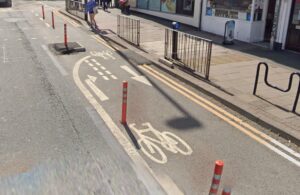
Despite having attracted criticism from many, notably from blindness campaigners and charities who say the design puts blind people in danger and can be intimidating, they have been used widely across Europe and some UK cities due to challenge of building effective protected cycle lanes on bus routes when road space is limited.
> “Like playing Russian roulette”: Blind people raise concerns about ‘floating’ cycle lane bus stops
In January, leaked documents suggested that there was a “low risk” of cyclist collisions at floating bus stops, slides from a presentation made by London’s Walking and Cycling Commissioner Will Norman showing that of 623 reported instances of pedestrians being injured in a collision with a cyclist in London between 2020 and 2022, just four occurred at a floating bus stop (0.6 per cent — two people were seriously injured and another two suffered minor injuries).
It is to that context that Norman has this afternoon reacted to the news that the Transport Secretary is considering banning the design by warning that it could “stop new protected cycle lanes, putting lives at risk across the country”, whereas the risk of a cyclist hitting a pedestrian at one is “very low”.
The London Cycling Campaign also reacted, saying the “evidence” does not suggest that they “represent a major barrier to mobility, a major danger, nor a new emerging issue”.
“Yes, some cyclists fail to stop, yes, better design guidance needed, but removing them would mean likely fewer people cycling, particularly women, kids, elderly and disabled people,” a thread on social media began. “Meanwhile, there are other issues government is dodging — it’s sat on pavement parking action for years, a huge issue for the visually impaired, disabled people, parents etc. (and don’t get us started on how many signalised junctions lack pedestrian crossing signals, or are staggered crossings, or force you to wait for minutes at a time!)

“This, then is the government… promoting a ‘Plan for Drivers’, which is increasingly leaving any planning for cycling, walking, wheeling, the climate and road danger by the roadside, stranded.”
The Guardian’s Peter Walker explained how it is believed Harper has taken the concerns of groups such as the National Federation of the Blind UK (NFBUK) seriously because he formerly served as the minister for disabled people.
Duncan Dollimore, Cycling UK’s head of campaigns, commented on the news: “Bus stop bypasses are needed to separate cyclists from motor traffic on some roads which include bus routes and cycle routes, to create continuous cycle tracks which enable more people to cycle safely, enabling them to live healthier, happier, and greener lives.
“But we must ensure this is done in cooperation with people with disabilities, whose needs must be fully considered in the design process.”

A Department for Transport spokesperson added: “While TfL are responsible for these schemes in London, we expect local authorities to engage with disability groups and follow our guidance which clearly sets out that all infrastructure designs should be accessible for everyone.”
Yesterday, Transport Secretary Harper said tougher legislation to prosecute cyclists who kill or injure pedestrians is “under review” and will be considered “with an open mind”, the comments coming after Sir Iain Duncan Smith, the former leader of the Conservative Party, has this week tabled a series of amendments to the Criminal Justice Bill that would see cyclists, as well as riders of electric scooters and “personal transporters”, subject to stricter laws if they ride dangerously and kill or injure.














34 thoughts on “Warning government considering ban on floating bus stops “could stop new protected cycle lanes””
Here we go again.
Here we go again.
In 2014 London Guide Dogs For The Blind made up a load of bollocks about how one in four guide dog owners said their dogs had been hit by cyclists.
I dismantled their hopeless survey methods here.
Nothing in this latest flapdoodle makes me change my conclusion:
“Guide Dogs chose to target another group of vulnerable road users instead of taking on the source of risk to all: bad drivers and London’s abysmal road system.
“Road traffic danger limits everyone’s mobility, and its main source is motor vehicles. But Guide Dogs doesn’t have the gonads to say that London’s awful roads keep partially sighted people from getting out and about, because like everyone in their position they think of traffic as being like weather: it just happens and nothing can be done about it.
“Far easier then, to go after cyclists, knowing that the mass media won’t question that “irresponsible cyclists” are “smashing into blind Londoners” than to demand London’s roads be organised for the convenience of people rather than motor vehicles.
“Lazy, lazy campaigning, with the wrong target.”
That looks by date to be
That looks by date to be linked to the campaigns around the floating bus stops at Guys and St Thomas Hospital between the hospital and Kate Hoey MP, where the hospital gave money to campaign against then were shown to have no evidence to justify it.
The whole thing was astroturf.
As covered here by Laura Laker:
https://road.cc/content/news/197621-hospital-admits-it-didnt-research-bike-lane-it-tried-block
And by blogger James Avery:
https://web.archive.org/web/20160723035206/http://www.pedalparity.com/bus-stop-bypasses/
I suspect (and hope) this
I suspect (and hope) this will come to nothing.
Just in case it doesn’t disappear overnight and not that anyone is interested (even those backing one side or other) … there have been some (very small…) studies even in the UK – where of course this is all a) new to everyone * and b) non-standard:
Sustrans 2015 Cambridgeshire ‘floating bus stops’ interaction analysis
Edinburgh Napier university 2018 – Analysis of cyclist-pedestrian interactions at a floating bus stop site in Edinburgh
TFGM Manchester – Oxford Road trial bus stop evaluation report
For a good (IMHO) overview of the position in the UK – the Ranty Highwayman. (* also noting we have effectively had these for decades in the UK without calling them anything). Also his article on the 2013 TFL trial.
For the gold standard – Bicycle Dutch. For “somewhat second rate, but it seemed to work” (but much criticised by organisations representing the blind in the UK) see “Copehagen Bus Stops”.
What about those most concerned?
The RNIB are apparently anti – although measured. Their position (see e.g. this doc) seems to be that basically any “shared space” that pedestrians have to cross is a serious barrier to accessibility. (Has anyone mentioned the roads? They also say that even in low traffic areas safe access to motor vehicles e.g. taxis is required for those with disabilities). However they are “participating in research and trials to find solutions”.
The National Federation of the Blind of the UK (not the RNIB) essential decry these treatments (and it seems having cycling anywhere near people on foot – because e.g. cyclists have been observed to harrass groups of people walking in the cycle lane by shouting at them – then trying to weave through). They have made some site visits and sent the govt. their position here.
That is an excellent post.
That is an excellent post.
One thing I would add is Wheels for Wellbeing’s Floating Bus Stops discussions sheet, which encourages thought about the interests of *all* disabled people, and also standard pedestrians.
https://wheelsforwellbeing.org.uk/thinking-about-bus-stop-bypasses/
Their general view is that footways are for pedestrians not cycles, with cycles useable as mobility aids at basically walking pace by disabled people. Alongside that that cycles should not be forced into traffic (me: i.e., support for separated infra including a mobility network).
I am not aware that they have a fully developed policy position, partly because they prefer to work by conversation leading towards concensus, and perhaps also because there is a genuine balance of interested that needs to be developed and struck.
Thanks, yes missed that!
Thanks, yes missed that!
In the UK we largely seem to gloss over that “cycle paths” could also be of benefit to e.g. not just those with adapted cycles but wheelchair and mobility vehicle users. Maybe due to our binary of “space for vehicles” vs. “everything else (but essentially pedestrians)”? Maybe “they’re now trying to make us fight for our scraps“?
I’ve also heard the idea that the “C”-word (cycle) is a trigger for some?
This is nothing to do with
This is nothing to do with Mark Harper’s concern for disabled people.
If he had that he would be looking at KSI statistics, he would be looking at disabled people who use cycles and mobility aids.
And he would know that NFBUK are a tiny, fringe group with around 600 members in 2019, reducing to around 500 by 2022.
It is another cynical kneejerk which runs directly against the evidence based policies of his own department.
But then so has all the other recent stuff been.
“Plan for drivers” – like the
“Plan for drivers” – like the last 60 years hasn’t been just that….
Quote:
NFBUK are pretty much a single-issue lobby group that really hates cyclists, they pretty much only target them and scooterists most of the time. They won’t disclose their membership numbers but last time I looked on Twitter (about three months ago) they had about 3000 followers, this out of 340,000 registered blind/partially sighted citizens in the UK, and yet they claim to be “The Voice of the UK’s Blind People”. If Harper’s listening to them no wonder he’s coming up with such nonsense.
Rendel Harris wrote:
NFBUK are pretty much a single-issue lobby group that really hates cyclists, they pretty much only target them and scooterists most of the time. They won’t disclose their membership numbers but last time I looked on Twitter (about three months ago) they had about 3000 followers, this out of 340,000 registered blind/partially sighted citizens in the UK, and yet they claim to be “The Voice of the UK’s Blind People”. If Harper’s listening to them no wonder he’s coming up with such nonsense.
NFBUK are a tiny, fringe group with around 600 members in 2019, reducing to around 500 by 2022.
Mentioned in their annual reports to the charity commission, and in their position submission to the Government linked by chrisonabike.
They are one follower down since they blocked me when I asked them for supporting evidence for their claims.
Cheers, they wouldn’t answer
Cheers, they wouldn’t answer when I asked – they just blocked me, obviously their way of dealing with any suggestion that their claims are somewhat dubious.
The usual best place to look
The usual best place to look is annual reports on the Charity Commission website.
Perhaps they shouold be
Perhaps they shouold be called the National Blind Federation – NB FUK seems a lot more (in)appropriate…
Rantyhighway man is good on
Rantyhighway man is good on this
Looking forward to Mark_J_Harper providing his technical insight into how one designs this without a floating bus stop.
Perfectly sensible and not dangerous in the least. [/s]
Depending on budget you could have:
-some kind of tunnel
-some kind of bridge (with lifts at each end)
-some kind of teleportation device.
Edinburgh has some “Covid-era
Edinburgh has some “Covid-era” “bus-stop bypasses” (e.g. here *). They are (part) protected on-road cycle lanes which disappear at the bus stop … but have some cycle symbols painted on the outside of where the bus would stop.
Safety first. Job done!
Not sure what that one is doing in front of the bus mind…
* If you spin the view round you’ll see it’s clearly a case of “our dualled carriageway is too narrow”. A cynic might say that there are cycle lanes installed here because it was easier than elsewhere. This used to be 2 2-lane sections (with median) but the traffic flows are usuall low (for the space) and the signed speed is also lower than maybe expected.
Is that the A40, West Way? Or
Is that the A40, West Way? Or ‘Motorway City’ in the 1970s Hawkwind song.
https://twitter.com
https://twitter.com/edwardlamb/status/1788948507732095381
Rear view as he passes the bus at a stop.
Let me get this straight,
Let me get this straight, shared space schemes where you have pedestrians and cyclists mixing all over the place with no separate space for anyone is ok, and bus stop bypasses with clear and designated safe spaces for each is not ok?
I have a couple of either
I have a couple of either design on my cycle route to and from work and tend to avoid both and just cycle on the road, but appreciate that doesn’t work for less confident road users.
I much prefer the floating design to the non, when the stop shelter is to the left of the path as the bus comes through people just walk out into the path to understandbly make sure the bus stops and then most of the time que across the path or randomly step off the bus in your path.
I’m very pro bus user and have no issues with the people quing across the path, but one of these stops is up the start of a fairly step Itchen Bridge.. if there is a bus at the stop I effectively have to go right out into the lane and cycle round the bus up a hill to get through and avoid any risk of hitting a person getting on or off the bus.
” Here’s a floating bus stop
” Here’s a floating bus stop on the A10 in Hackney. It’s been there for years but you won’t get obsessive former Hackney Councillors who pretend to care about blind people tweeting about it dozens of times a day because it’s not a cycle lane, just a road. “
” Here’s another at Ham, LB Richmond. The bollards are there to stop drivers parking, which also makes it less accessible. “
” This one Range Rover driver
” This one Range Rover driver injured more people at UK bus stops, more severely, in one go, than all cycling incidents at floating bus stops over 3 years. A competent Transport Secretary would focus on these dangerous machines. “
https://www.mylondon.news/news/zone-1-news/live-aldwych-updates-9-people-28004140
Hirsute wrote:
I think it’s fairly obvious that our current government doesn’t work for the people, but are following their own divisive agendas.
” A competent Transport
Root cause identified.
Guys (including girls ofc) we
Guys (including girls ofc) we are missing a trick here with the proposed legislative change. We should actively encourage stricter punishments for cyclists who kill or injure, so long as the punishment to drivers is equally stiffened. If every cyclist gets a mandatory sentence of 10 years for negligently causing death then I guarantee that will effect no one reading this. Responsible cyclists don’t kill. And so if at the same time the same sentence applied to drivers the roads would become 100X safer for people on bikes. Drivers don’t injure and kill cyclists because it’s unavoidable, they do so because they can’t be bothered to check properly at junctions. And they can’t be bothered because there is no imperative to do so, if they hit a cyclist there are no repercussions bar a driver awareness course. If drivers knew a mandatory 10 year sentence applied to those who kill cyclists they will all be taking the maximum care. We need a stiff deterent to make cycling safer, nothing more nothing less.
stevemaiden wrote:
Couple of problems with this.
1) I can’t see all penalties being made more severe in the way you suggest.
10 years ago the government said it was going to review road law across the board. Nothing since. The only movement have been some fairly recent flailing “because cyclists”.
2) heavy penalties can only deter if they’re applied. Currently there’s a potential 14 year sentence IIRC for killing people with your car. But a) this has been applied extremely rarely and more importantly b) detection, charging and conviction rates are really low.
So no, don’t think we’re missing anything here. If you want a deterrent the place to start is with the police and CPS (but they may still be thwarted by the jurors and judiciary).
stevemaiden wrote:
I admire your optimism, but police, judges and juries are still going to be letting off drivers that kill with the most ridiculous of excuses e.g. “I don’t remember it”, “I can’t remember who was driving”, “they came out of nowhere”, “they weren’t wearing hi-vis” etc. Meanwhile, they’ll be looking to string up as many cyclists as possible.
A good selection of
A good selection of information here. I can’t get exited though, I don’t live in London, or a big city, so suspect that the chances of me seeing a floating bus stop are near zero. In the meantime I’ll avoid the ‘murder strip’ at all costs. In fact due to the ever increasing number of potholes and mad-motorists I’ll be staying home and training indoors.
Sadly in many places in the
Sadly in many places in the UK *any* bus stop would be a change, never mind floating ones. Or at least one with buses more than a few times per day.
Sorry that you feel it’s a case of “give up and stay at home”. Another “cost of mass motoring (as practiced in UK)” that isn’t often considered.
In theory, Colchester is
In theory, Colchester is getting one but I expect the haters will be out to stop it. There are a number of regulars who just say “That would not work here, we aren’t X” not matter what the subject is.
Bus stops and deadly cyclists
Bus stops and deadly cyclists again! BBC must be really bored / the tiny group National Federation of the Blind UK (NFB) must be delighted – they’re national news again.
https://www.bbc.co.uk/news/uk-england-london-69001698
Also – fair play to NFB, they’ve managed to get a petition signed by a large number of organisations – most of whom seem to be more nuanced than them.
As always – we should be
As always – we should be working together with other “vulnerable road users”. However I think there’s a lot of “how the UK is now” feeding into this e.g. people using buses generally are not of a mind that they should need to consider people cycling. And some people – when given real “safe space” to cycle in – can be less considerate of others too. Just like how they are when they’re driving. And – as it is now – you can see this does cause “conflict” (though not as far as I’m aware any major increase in injuries).
BUT – as always, if we do want (or at least grudgingly accept) change that means that things will not remain the same. Again as far as I know bus stop bypasses “work” for everyone in NL. And indeed in the less “nice” design in Copenhagen. And as the Ranty Highwayman points out – for decades in the UK before we had a name for them and even when people had to cross not just a narrow cycle path but a wider road full of cars! Those are exactly equivalent to the NL design, just with cars substituted for bikes.
So it seems people can learn how to use them – including the (old) UK case. From one perspective you could see that as pedestrians feeling “bullied out of the space” and cyclists not respecting the “established rights” of people boarding busses. But in the NL design (and indeed the earlier UK versions) they’ve got their own space.
I think it’s mostly “fighting over scraps” again. Because we’ve allocated so much motor vehicle space anyone else (pedestrians with or without disabilities or visual impairment) is fiercely protective of their own “safe space”…
chrisonabike wrote:
Is the list of other organisations available anywhere? I couldn’t immediately see it.
Can’t seem to find their full
Can’t seem to find their full list and their own site doesn’t seem to make a big play of it oddly. It’s in their newsletter – that also seems to use the same figure for another petition. Although of course it’s quite possible they got everyone to sign both as I think they were delivered to Downing Street together (also here).
Newsletter is a mix of perfectly sensible and reasonable concerns and also “speeding cyclists” vox pops e.g. from Joan Collins (also covered by road.cc), a Conservative London assembly member describing “death trap bike lanes” etc. And on their site news a classic headline: “Do blind people have a future in Glasgow in Scotland and in the UK? Or will climate change adaptations design them out of town?”
chrisonabike wrote:
Not the same petitions as the ones you link to were delivered in December and March and claimed 170 signatories, the one in the BBC report claims 270 and “will be handed into Downing Street later” (report from this morning). I too would be interested to see the full list of signatories and wonder how many are bonafide organisations representing the disabled and how many are other types of organisations that pay lip service to disability access in order to further their own agenda, e.g., local anti-LTN groups (it’s amazing how many of them apparently care deeply about the plight of the disabled, the elderly, the less well-off and ethnic minorities in a way that one wouldn’t really have imagined from looking at their membership…).
Agreed – I was just going on
Agreed – I was just going on ones which IIRC were mentioned incidentally as supporters e.g. I think I read RNIB (who certainly were against these and also concerned about shared space, but seem to be a bit more “we’ll work with people”)? Some specific local accessiblity groups also.
But let’s see if anyone can find the list.