


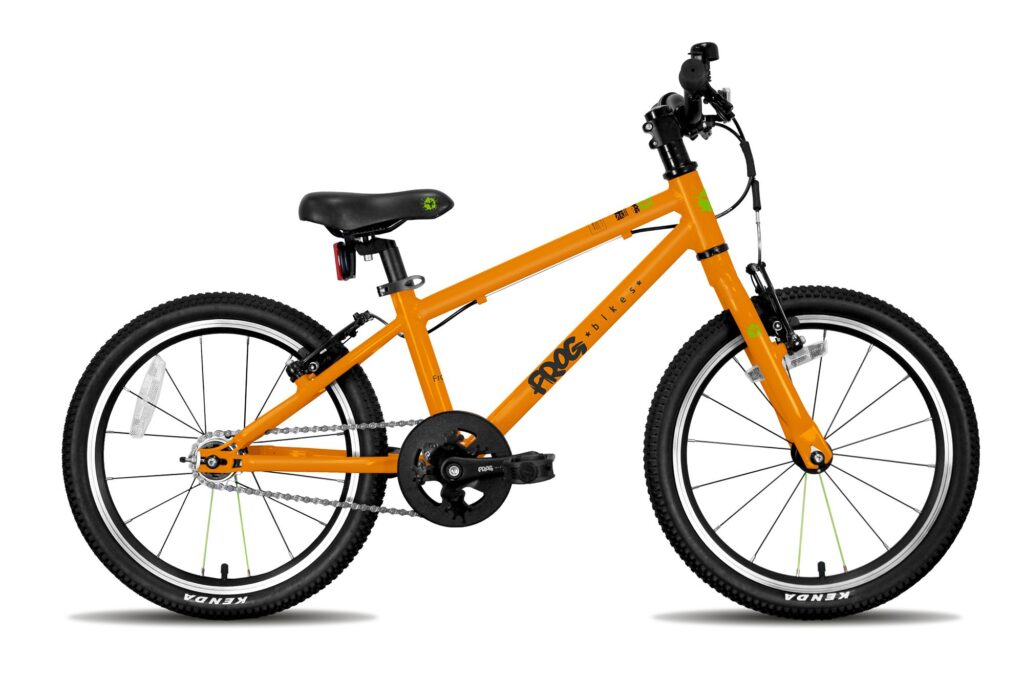

Frog Bikes has released its annual accounts for the financial year to the end of February 2022, reporting losses of more than half a million pounds as co-founders and directors Jerry and Shelley Lawson point to the “continuing friction” from Brexit holding their business back.
Back in April 2021, the owners of the children’s bike manufacturer based out of a factory in Pontypool, said Brexit had cost them an extra £250,000 in the first two months of the year, a story which appears to have been repeated in the year that followed.
In the accounts for the financial year to the end of February 2022, spotted by Cycling Weekly, Frog Bikes reported pre-tax losses of £530,476 as mounting Brexit-related costs pushed the business into the red.
> “It is very difficult to be positive”: Brexit lost Cycloc 25% of sales, founder reveals
Commenting on the losses, the Lawsons said they had struggled with “continuing friction” since the end of the Brexit transition period at the start of 2021.
“The day to day issues in fulfilling orders have dominated most of our trade relationships with the EU,” the couple who set up the business in 2013 after a “fruitless bike hunt for their own two children” wrote.
“The business was hit by an unexpected import duty of 47.5 per cent, applied to most of our componentry, after the UK left the EU. Prior to this, we had an EU manufacturer’s suspension. A full exemption was granted in November 2021, but not refunded, and the 10 months of additional duties (Anti-Dumping Duties) cost us £1.5m from Jan to November 21, and caused the business to make a loss.
Frog Bikes’ EU audit was delayed due to Covid, meaning the suspension from Anti-Dumping Duties granted for 2019 was not accounted for, something the company is still awaiting a refund for.
“After lots of lobbying through Trade Remedies and with various MPs, in November 2021 it was laid in UK law that Frog Bikes was granted an ADD exemption,” the Lawsons continued.
“However for the prior ten months the cost of these duties to us was about £1.5m. For a relatively small business, this was an enormous cost to have to absorb, akin to our entire wage bill for a year.”
The lack of refund meant Frog Bikes also had to go back to its results for the 2021 financial year and restate the pre-tax profit of £249,016 as a loss of £7,474.
“Non-tariff barriers have increased our costs to deliver to our key European markets,” the Lawsons said, noting “we compete against European brands which do not suffer from these barriers” and hoping they can find a solution that will “get bikes into the EU without our stores having to incur customs and pay VAT”.
“I couldn’t say there was anything positive,” Jerry Lawson said about Brexit in April 2021. “There’s extra paperwork, and there are extra costs. And there’s a whole lot of unknown.
“The paperwork is also incredible. To begin with, some of the countries wanted the paperwork in their language. Now we send them a commercial invoice with a whole lot of customs information. Plus, it’s four or five times we have to print it.”
Earlier this month Brompton’s CEO bemoaned “bloody Brexit” during an at length interview about the state of play in the bike industry. Will Butler-Adams noted the folding bike manufacturer’s pre-tax profits for the last financial year were down 24 per cent to £7.3 million despite revenues rising 40 per cent.
But it is not just the b-word, of course, and Butler-Adams also outlined a combination of factors, including Brompton’s supply chain being affected by the Russian invasion of Ukraine and tensions between China and Taiwan, with both Ukraine and Taiwan producing titanium used in the folding bikes’ frames. On top of that there are the ongoing effects of the Covid pandemic, rising energy bills and a cost of living crisis.











26 thoughts on “Ongoing Brexit “friction” blamed as Frog Bikes reports £500,000 losses”
Im confused. I thought Anti
Im confused. I thought Anti-dumping duties were specifically to stop China dumping cheap ass bikes (BSO’s) in the EU, not relatively pricey kids bikes from the UK – albeit manufactured in Asia.
Yet another Brexit benefit I guess. Seems slightly odd that no-one else has indicated this specific level of mess (though maybe the lack of detail from others). I wonder if its a “not having a department full of lawyers” issue.
There are all sorts of duties
There are all sorts of duties. Based on the context, and it is UK law that has given them an exemption, these appear to be duties to stop China dumping cheap imported components into the UK – (not it also specifically talks about components not bikes).
My assumption is this would be tariffs on imports of e.g. steel tubes, or wheels etc. into the UK – whilst a lot of these will have been with China in mind, because WTO’s would limit what discriminatory rules can be put in place (and Boris Johnson and co are all idiots anyway) they’ll probably have captured anything falling within the “class” that is imported into the UK.
It depends on the origin of
It depends on the origin of the components, their price, fraction of their value in the total bike and the value which is added in (in this case) the UK.
I’m in the EU but anti-dumping can be a disaster as it typically drives costs up much more than customs duties and is not always easy to predict given that it can be very technical to determine whether or not it will apply.
Tbh, I think this B-thing has brought nothing but grief for everyone. I used to regularly order with SJS but have given up since the formalities and customs clearance costs just made them uncompetitive and the entire process is a hassle. Also, I’d like to visit the UK again for a holiday but now I’d need a bloody passport for the entire family + the story of a friend of mine who went to a congress but was detained for almost 8 hours because border force thought she would be seeking employment (she’s an anesthesiologist, not a fruit picker) certainly cooled me down. A couple of border force guys actually started to quizz her on medicine.
The whole mess could have
The whole mess could have been avoided had the then leaders of the EU27 not decided to granstand and make an example out of Cameron when he asked for failry limited compromises that were rejected out of hand. They doubled down on it by deliberately making him look stupid – only to themselves request some of the same compromises from the Commission a few years down the line.
The same is true with the NI Protocol. For some years we had the likes of Simon Coveney telling us that Britain would need to learn its place and the proposed protocol arrangements from the UK could never be accepted, only for the Commission to accept those same amendments this week.
UK / Europe’s weakness is a generation of leaders who see pragmatism as a weakness – meanwhile other economic regions prosper at our expense (loss of jobs / industries etc etc).
open_roads wrote:
Surely even the most ardent Brexiteer can agree that Cameron made himself look stupid.
open_roads wrote:
Fixed that for you. There is literally no evidence to back up your claims around Europe and much to suggest its the opposite.
open_roads wrote:
The UK had the best deal of any nation in the EU. That is a fact. Margaret Thatcher had many failings but understood the importance of Europe and she also had some grown ups doing the negotiations. Cameron asked for the ridiculous and was described as a lightweight by US president Obama.
OldRidgeback wrote:
Still a thousand times better than Poundshop Churchill though.
True
True
Can I just say that frog
Can I just say that frog bikes are very good. Not as good as islabikes, but a damn sight cheaper.
Also, Brexit can get in the bin.
This for sure. We’ve had a
This for sure. We’ve had a couple of Frog bikes that have moved through our 3 kids. They’ve been great and will still have a lot of milage left in them when our youngest has outgrown the biggest.
At the time, they were great value I bought the last one in 2018 I think, but looking at our local (Irish) stockist now, they’re out of stock of the bread and butter ones, and prices are well up on what we’d have paid – 30% or so off the top of my head. A certain amount of this is no doubt down to inflation and supply/demand, but from the article I’d have to believe that the B word that keeps on
givingtaking away is a factor.Nevertheless, I hope they get themselves sorted out
Maybe they should move to
Maybe they should move to Northern Ireland. Maybe all British businesses should move there, if it is going to have the “incredibly attractive proposition” of becoming “the world’s most exciting economic zone” thanks to having the same access to both the UK and the EU markets that we all had until a couple of years ago. (Those are direct quotes of that ardent Brexiteer the prime minister, BTW.)
ubercurmudgeon wrote:
https://www.theguardian.com/politics/2023/feb/28/sunak-decides-the-protocol-sucks-and-the-single-market-is-great-after-all-john-crace-brexit
Gotta love a John Crace quote
Gotta love a John Crace quote.
Once again blaming Brexit for
Once again blaming Brexit for everything. I don’t like it either, but take some responsibility for your own business and stop blaming the big bad brexit
ChuckSneed wrote:
“The business was hit by an unexpected import duty of 47.5 per cent, applied to most of our componentry, after the UK left the EU. Prior to this, we had an EU manufacturer’s suspension. A full exemption was granted in November 2021, but not refunded, and the 10 months of additional duties (Anti-Dumping Duties) cost us £1.5m from Jan to November 21, and caused the business to make a loss.”
They’re not making some amorphous “it’s not our fault it’s Brexit” claim, their supply chain costs rose by nearly 50% as a direct result of duties arising post-Brexit and cost them £1.5M. Whether you approve of Brexit or not, it’s impossible to deny that the loss was a direct result of the UK leaving the EU.
“Whether you approve of Brexit or not, it’s impossible to deny that the loss was a direct result of the UK leaving the EU”.
You could deny it but you’d be a complete fantasist to do so. Oh, hang on…
ChuckSneed wrote:
Are you insane? They have supplied conclusive proof. You’re free to have your own opinions, of course, but when they’re factually incorrect, it might be better to refrain from sharing them.
Agree. While it’s likely that
Agree. While it’s likely that Brexit will be thwarted by the WEF supporters, this ridiculous claim that it also was behind everything from frog bike sales to not getting vegetables from Morocco is outrageous.
The idea Brexit wrecked their business is as likely as the tall story that they set up the business after a “fruitless bike hunt for their own two children”. They set up the business to make some fat juicy profits – there is nothing wrong with celebrating that – but decent children’s bikes did exist prior to ? bikes setting up business.
In the recent Sunday Article
In the recent Sunday Article the same claim was repeated – that they they set the business up due to a lack of good kids bikes in the UK.
Frog was set up in 2012, some 7 years after Islabikes changed the market with their own range of kids bikes – which as far as I know were the first to use specially designed components e.g. small brake levers, fully enclosed chain guards etc etc.
I mean, they’re not
I mean, they’re not incompatible. ‘Lack of’ isn’t the same as a complete absence – just means they thought the market wasn’t saturated and there was room for another supplier of quality kids bikes (Islabike owner here).
They didn’t claim that Brexit
They didn’t claim that Brexit was responsible for a fall in sales, they have shown with indisputable evidence that they had to pay a 47% import tax on components which cost them £1.5 million. It helps if you read the article before commenting. Also, yes of course they set up the business to make a profit, who doesn’t? Why is that incompatible with them being inspired to do so by what they saw as a gap in the market for quality balance bikes? It’s not.
The Accountant wrote:
Please read the article again….
Commenting on the losses, the Lawsons said they had struggled with “continuing friction” since the end of the Brexit transition period at the start of 2021.
“The day to day issues in fulfilling orders have dominated most of our trade relationships with the EU,” the couple who set up the business in 2013 after a “fruitless bike hunt for their own two children” wrote.
“The business was hit by an unexpected import duty of 47.5 per cent, applied to most of our componentry, after the UK left the EU. Prior to this, we had an EU manufacturer’s suspension. A full exemption was granted in November 2021, but not refunded, and the 10 months of additional duties (Anti-Dumping Duties) cost us £1.5m from Jan to November 21, and caused the business to make a loss.
“I couldn’t say there was anything positive,” Jerry Lawson said about Brexit in April 2021. “There’s extra paperwork, and there are extra costs. And there’s a whole lot of unknown.
“The paperwork is also incredible. To begin with, some of the countries wanted the paperwork in their language. Now we send them a commercial invoice with a whole lot of customs information. Plus, it’s four or five times we have to print it.”
I wonder if there are any
I wonder if there are any business that say trade with the EU has become better and easier and more profitable thanks to brexthick. I mean, that’s what the brexitty loons promised – so it should have happened right?
Another brexitty benefit.
Another brexitty benefit. More friction, more costs. Even the brexitty PM is extolling the benefits of the EU single Market and the privileges and benefits it bestows on business. Are they efffing mad this lot? N Ireland is in an ‘incredibly attractive position’ according the UK PM. As were Wales, Scotland and England until the swivel eyed loons took charge.
Yes sure it’s sad that Frog
Yes sure it’s sad that Frog have suffered from Brexit so badly, but just think about the other side of the coin – all the British businesses that have benefited from Brexit. Like… Ummmm…..