


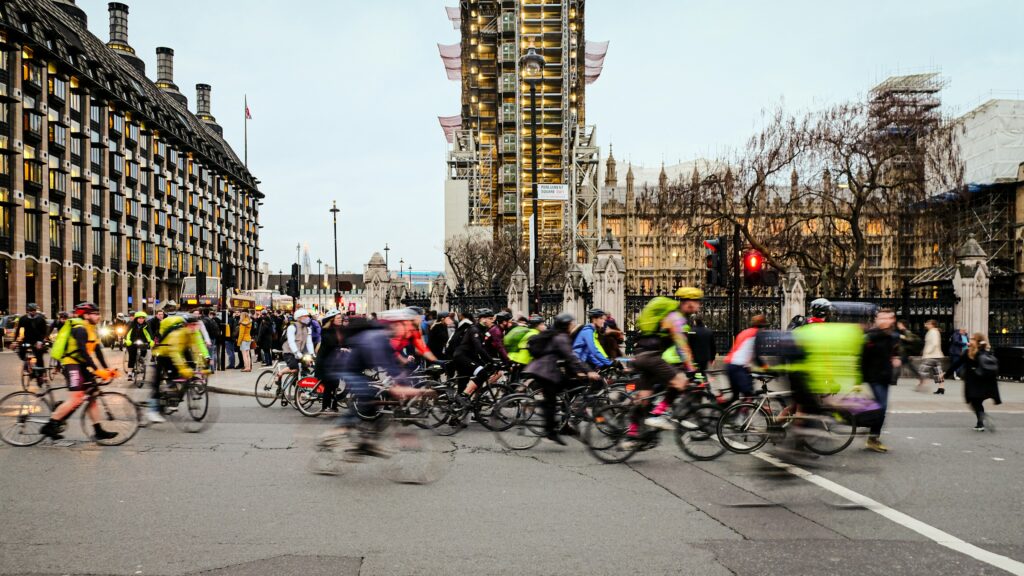

A new report published by Transport for London (TfL) has revealed that pedestrians, cyclists and motorcyclists continue to be the most vulnerable road users in the capital, making up 80 per cent of all people killed or seriously injured in 2023, while drivers were involved in 68 per cent of all casualties on London’s roads.
According to TfL, the number of people killed while cycling in London has fallen by 40 per cent against the 2010-14 baseline, from 13 to eight. Meanwhile, as per data published last year, the number of daily cycle journeys has continued to increase, going up by 6.3 per cent in 2023 to reach a total of 1.26 million, thus suggesting that cycling trips have become safer overall.
The report also mentioned that “concerns around safety remain one of the biggest barriers to cycling”, and to reduce risk and increase the number of people who choose to cycle, there is a “need to continue to introduce safe, segregated cycling infrastructure, lower speeds and road safety initiatives”.
> Government knew it wasn’t investing enough in cycling, according to new document
Will Norman, London’s Walking and Cycling Commissioner, said: “Every death or serious injury on our streets is devastating. We’re making significant progress but we know there is more work to do to eliminate deaths and serious injuries from London’s roads.
“The Mayor is committed to making it safer and easier for people to walk and cycle around our city, which is why we are expanding our safer speed programme, tightening the Direct Vision Safety standard for HGVs and working with the boroughs to deliver high-quality cycle routes as we work to build a greener, safer London for everyone.”
The report also revealed that cars have continued to be the main vehicle type involved in collisions in 2023, with drivers involved in 68 per cent of all casualties on London’s roads.
TfL said that it is continuing to work on lowering speeds across London, having lowered the speed limit on selected roads in 14 boroughs, exceeding its target to lower the speed limit on 140km of roads by March 2024, and a total of 264km of TfL roads that were now subject to a 20mph speed limit.
The local government body said that it’s also working closely with the police to increase their capacity to take enforcement action against drivers and riders who speed, with the Met enforcing more than 800,000 speeding offences in 2023, and currently on target to take action on a million speeding offences by the end of 2024/25.
Nick Simmons, CEO of RoadPeace said: “It is encouraging to learn that there was a slight decrease in road deaths and serious injuries in London in 2023, but we are still deeply saddened by the tragic and unacceptable loss of life and the extreme suffering caused by collisions in the capital. The ripple effect of road crashes goes far beyond the statistics; it devastates families and shatters communities.
“So much more needs to be done to achieve Vision Zero, and road users must all take responsibility, no matter how they use London’s roads. We need collective action and commitment from everyone – drivers, cyclists, pedestrians and policymakers – to see a significant reduction in road deaths and serious injuries and to create safer streets for all.”
In the last couple of weeks, the cycling world has been dominated by the headlines of the “dangerous cycling bill”, an amendment to the Criminal Justice Bill proposed by former Tory leader Sir Iain Duncan Smith that would introduce tougher legislation for cyclists who kill or injure through dangerous or careless cycling.
The bill was agreed to be passed by ministers two weeks ago, but was then thrown into jeopardy after the sudden announcement of the general elections by Prime Minister Rishi Sunak, with the Parliament’s prorogation meaning that the House of Lords won’t have had sufficient time to pass the bill.
However on Tuesday, the Labour and Conservative party mutually expressed support for the law once again, with Labour committing to pass the bill if they win the upcoming elections on 4 July.
Meanwhile, last week, it came to light that the Department for Transport (DfT) was aware that it was not investing enough in active travel to hit its targets, after a report initially produced in 2019 was finally made available on the government website.
The document explained that the modelling suggests “some £5-8 billion of further investment across the economy (not solely using funds from central Government) is required to reach the cycling aim of 1.6 billion cycle stages”.
In the summer of 2022, the Department for Transport said it would invest £3.78bn in active travel schemes until 2025 as part of its refreshed cycling and walking investment strategy. In March of the following year, Chancellor Jeremy Hunt slashed the budget for active travel schemes, a widely criticised move that the Walking & Cycling Alliance called a “backwards step” and one that would make it “impossible” to hit Net Zero and active travel targets.
Transport Action Network (TAN) is challenging the cuts in the High Court, and hours before Mr Justice Jay’s decision to permit the challenge, lawyers acting for the department were forced to disclose slides which highlighted how the cuts would “devastate” sustainable travel in most of England’s local transport authorities outside of London.
In another unfortunate development, Parliamentary Advisory Council for Transport Safety (PACTS) announced today that a staggering 500,000 people have died on the roads in Great Britain since records began in 1926. “In the same period, for context, there have been 375,000 UK citizen deaths due to warfare since 1926 – which includes WWII,” the transport safety charity wrote on Twitter.
Today, we passed a grim and shaming milestone: 500,000 people have died on the roads in Great Britain since records began in 1926. In the same period, in context, there have been c375,000 UK citizen deaths due to warfare since 1926 – which includes WWII. pic.twitter.com/2ytkEnZ38d
— PACTS (@PACTS) May 30, 2024




















16 thoughts on “Cyclists continue to be “most at risk” alongside pedestrians and motorcyclists, together making up 80% of all people killed or seriously injured on roads in 2023, reveals Transport for London”
The PACTS announcement should
The PACTS announcement should be headline news, I wonder if there’ll be any mention of it anywhere else?
I will be shocked – shocked I
I will be shocked – shocked I tell you – if the same meeja pushing for new dangerous cycling laws isn’t rabidly pursuing tougher sentences for killer drivers and greater protections for vulnerable road users in the form of adequate infrastructure and prolonged education & awareness campaigns aimed at drivers.
Surely there will be MPs and “journalists” on every residential street with speed guns and cameras?
Somehow I doubt they will,
Somehow I doubt they will, but they did print this yesterday “What Britain must learn from the rest of Europe about looking after cyclists” https://www.telegraph.co.uk/travel/activity-and-adventure/britain-looking-after-cyclists-europe/
stonojnr wrote:
might want to get your sarcasm detector recalibrated.
might want to read the
might want to read the article first
Paywalled I think. Is it
Paywalled I think. Is it that rare event of an article appearing in an otherwise ruthlessly unbiased (ahem) rag that actually doesn’t contain anti cycling prejudice?
fortunately theres an
fortunately theres an alternative https://www.msn.com/en-gb/travel/other/what-britain-must-learn-from-the-rest-of-europe-about-looking-after-cyclists/ar-BB1ng6a1
I read it as somehow I got
I read it as somehow I got behind the paywall and whilst the article was great a lot of the comments below were the normal telegraph readers expect responses filled with the usual anti cycling bingo.
Yes, but that’s the truth. No
Yes, but that’s the truth. No one’s interested…
There has been a big increase
There has been a big increase in drug and drunk driving over the past few years – which probably explains why most of the accidents involve a car. The increase in drug/drunk driving will probably be explained away again by a government person as ‘statistically insignificant’ as happened last time there was an increase in drunk driving.
You make a very good point,
You make a very good point, but may I point out but drunk/drug drivers don’t have “accidents” like a little whoopsie, the have crashes, collisions or incidents. Ta.
There’s been an even bigger
There’s been an even bigger increase in distracted driving from people using their smartphones for texts and emails and internet use while at the wheel. I’d say that is the biggest issue that needs to be addressed.
OldRidgeback wrote:
mobile phones should be required to have software that shuts down all use once paired with the car, most people are pairing either for streaming music or google maps.
hide texts, stop messaging apps, blank phone screen, no internet. Basically anything which is not navigation or continuing on the same playlist should be prevented.
Except that the car companies
Except that the car companies all advertise all of that as a feature of their vehicles.
brooksby wrote:
linking the phone so you can navigate by googlemaps instead of a nine year old map provided by the car company is good. beaming google chrome onto the cars display is bad.
Applying the fix to phones rather than cars results in a quicker roll out, since phones are probably 18 months old on average while cars might by 8 years old on average.
There’s been an even bigger
There’s been an even bigger increase in distracted driving from people using their smartphones
Of course! , when the police just ignore good video evidence of such offences- like Lancashire Constabulary has with this one
https://upride.cc/incident/ld71uom_amazonprime_handheldmobilephone/