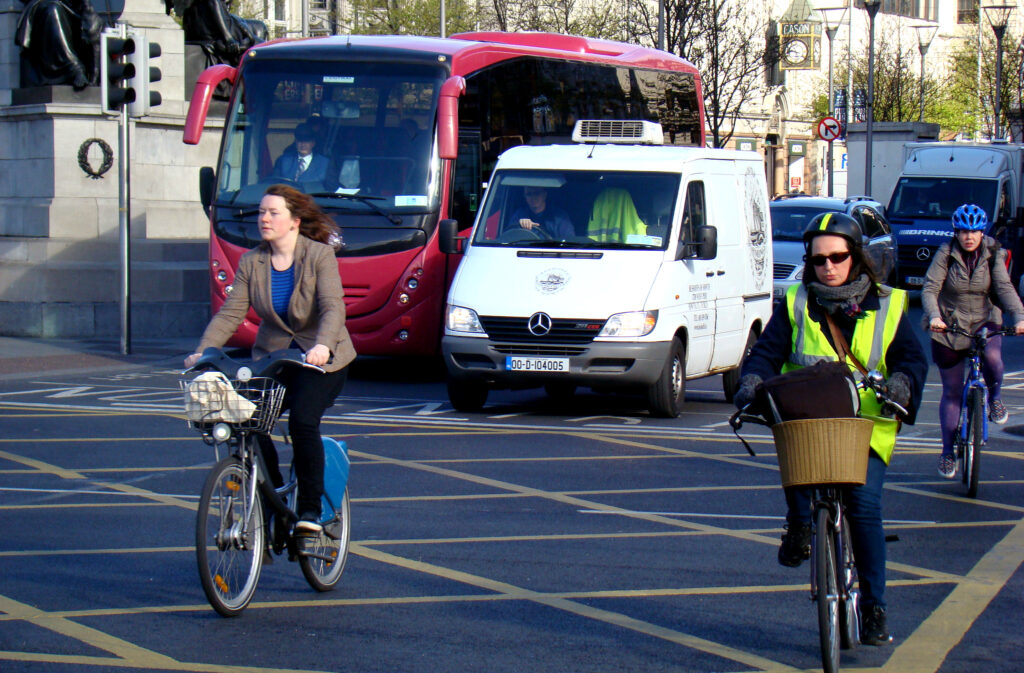
City cyclists (CC BY-NC-SA 2 (Image Credit: Farrelly Atkinson)
“Cycling is inherently safe; driving is dangerous”; Oxford and Cambridge top bike theft rankings; Highway Code changes; comeback kids (and elder statesmen); ‘cross carpets + more on the live blog
It’s Thursday (or Alex Ferguson’s Birthday Eve), and Ryan Mallon is here to guide you through what’s left of the soulless drudgery that was 2021… What, too upbeat?
While the city, to me anyway, certainly doesn’t seem like the perfect stomping ground for the Conors and Jocks of the world (that’s a “Young Offenders” reference, for those scratching their heads), a plethora of students with cheap locks ensures that the area has long proved fertile for sticky-fingered bike snatchers.
Even with the pandemic reducing the number of students living in the city over the past year, 214 reports of bike theft were recorded in Oxford Central between March and August 2021.
Reading, Lincoln, Norwich and Bristol sit alongside Oxbridge in the top ten of places where your bike is likely to go missing.
30 December 2021, 12:26
Highway Code Changes – a reader’s response
You may have read our article this morning on Cycling UK’s bid to persuade the government to launch a properly funded awareness campaign over changes to the Highway Code, due to come into effect at the end of January.
One road.cc reader, Colin, has got in touch to share his thoughts on how we can all be safer and more accommodating on the roads. What do you think of Colin’s suggestions?
I have been a cyclist all my life, and a driver holding a variety of licences since my twenties, which means I’ve been driving for 60 years. It’s good to see that cycling is becoming once again a serious means of transport as well as a leisure activity and I applaud all efforts to make it safer. I have lived in West Somerset for many years, so my observations are mostly about rural cycling, where there is a serious conflict of interest between cyclists and all other road users, including pedestrians. On our roads cycling, like walking, is inherently dangerous. Narrow, winding, with high hedges and poor visibility, to say nothing of often very rough edges and potholes, they were never constructed to carry the traffic they now have to. The A39 is a road where, in many places, large vehicles can only pass each other with care, and where overtaking anything safely can be difficult for miles. It’s not uncommon to see a long line of vehicles stuck behind a lone cyclist who is stubbornly ‘claiming his/her space’. In the end people take risks, which don’t always turn out well, often in a ‘red mist’ of anger and frustration. Cyclists riding in groups can be impossible to deal with.
Alternative routes suggested for cyclists are often impractical. Anyone who thinks that country lanes are safe is living in the middle of the last century, and has certainly never tried to ride a bike along one!
None of these problems will ever be resolved as long as each side goes on beating it’s own drum, refusing to really listen to what others are saying. There is an urgent need for a better level of understanding of the problems faced by all road users and for all of us to stop just shouting the odds and blaming everyone else. There is an equally urgent need to provide proper separation for cyclists in particular. Painted white lines on already inadequate roads provide answer to anything.
Whatever the shortcomings of the new Highway Code may or may not be, it will have achieved a lot if it leads to a sensible debate, and maybe even some wise decisions, about how we can all be safer on our roads.
30 December 2021, 12:26
Move over Pog – there’s a new comeback kid in town
Surely that has to be up there with Cav’s return to the top this year, Van Vleuten in Le Grand-Bornand, Froome on the Finestre, Pogačar’s Tour-winning TT, or even Floyd’s impersonation of Lazarus in 2006? I could go on…
(Incidentally, a similar mishap happened to my five-year-old cousin on the start line of his first ever cyclo-cross race last month. Unfortunately he didn’t quite muster the same kind of comeback…)
Speaking of improbable comebacks, it was revealed this week that seven-time grand tour winner (or nine, depending on who you ask) Alberto Contador was seriously considering a spectacular return to the sport during the reconfigured 2020 season.
According to his brother Fran, with whom he runs the Eolo-Kometa team alongside former Giro winner Ivan Basso, Contador eyed up a comeback at October’s Giro d’Italia, won of course by Tao Geoghegan Hart.
The Spaniard, who turned 39 this month, retired from professional cycling in 2017 after he capped off his career in style with a solo victory atop the fearsome Angliru on the penultimate stage of the Vuelta a España.
“After retiring he has continued to feel strong and has been capable of pushing big numbers,” Fran Contador told the BiciEscapa podcast. “I understood perfectly that Alberto had that fire to return, that ‘why not’, the ‘I’m going to train and see if I can or not’. But in the end it was left at that. Alberto retired in a good way, at the top, and is now enjoying his life away from the bike.”
It is perhaps surprising that Bertie even contemplated a return to the peloton after so long out of the sport. He did, after all, spend a turbulent 2009 sharing team leadership with a certain brash Texan who made what could be charitably described as an ill-advised comeback…
Not that it needed proving, but Wout van Aert showed us once again today that there is little he can’t do – check out this cool-as-you-like save after his back wheel slid out during the X20 Badkamers Trophy race in Loenhout.
Cyclo cross is officially the most ridiculous sport in the world and I loves it.
Also Wout is just insanely good at it so his massive duck collection must be growing. pic.twitter.com/mGHdD3Erzq
Also, in the list of completely bonkers cycling prizes, today’s race has to be up there. Makes you wonder: who would you rather fight – one Wout van Aert-sized duck or 100 duck-sized Wout van Aerts?
“Cycling is inherently safe; driving is dangerous” – readers respond to email calling “for a better level of understanding of the problems faced by all road users”
While a few expressed at least some degree of sympathy with Colin’s viewpoint, most of you took exception to his claim that cycling and walking on country roads is “inherently dangerous”, with one reader commenting that “danger is brought into this environment by inappropriate driving.”
Here’s a selection of some of your views:
Well, I disagree with Colin’s opinion…
Cyclists are obviously part of the solution, not the problem so it’s insulting and disingenuous to claim that some lone cyclist is ‘stubbornly claiming his/her space’ without also realising that a large percentage of drivers are also sole occupants and using much more space.
Some people have been fed the ‘car is the solution’ story so many times that they can’t spot that the personal car has spectacularly failed as a mass transit solution and is also very damaging to people’s health and welfare.
“Cyclists riding in groups can be impossible to deal with.”
What’s “impossible” about driving behind them until there’s a safe legal opportunity to pass?
Colin’s comment is worryingly close to ‘the responsibility for road danger is 50-50, can’t we all just be nicer to each other?’ That is to misunderstand the problem and any possible solution.
I have some sympathy for what Colin says. And yet, he paints a picture of even a solitary cyclist being the problem, on roads which are “inherently dangerous”.
Both postulates ignore the truth, which is that the problem and the danger are presented by the excessive numbers of drivers in vehicles… The dangers and frustrations Colin describes are real, however. We have arrived here by following a path of ever more cars. Demonising car substitutes can not be the answer.
I think there needs to be a happy medium in Colin’s story between unfairly calling out a solitary cyclist undertaking a worthwhile journey, and condemning the reckless and selfish antics of large groups of leisure cyclists hogging the roads and making cycling more dangerous for everyone.
30 December 2021, 12:26
Tabloids go two wheels, Part II
The Daily Mail is really loving its celebrity cycling stories this Christmas.
Yesterday we delved into their quite creepy fascination with Harrison Ford’s “clinging” jersey; this time around we have a report on an interview with Nicole Kidman where she reveals – make sure you’re sitting down for this – that she didn’t perform all her own cycling stunts for the 1983 Australian film BMX Bandits.
“While I did do some of the riding in BMX Bandits, they also had a professional body stunt double – who was a teenage boy wearing a padded bra!” Kidman apparently laughed. Scintillating stuff.
Kidman’s first major film role, BMX Bandits follows three young BMX aficionados (never saw that coming) who foil a gang of bank robbers with their silky cycling skills. At least I think that’s what the plot is, I’ve never seen it. I’m more a Breaking Away kind of guy myself – now that’s a film.
30 December 2021, 12:26
Great news - the government is finally tackling the pothole crisis! Oh, you mean like that…
A Conservative peer has received more than £300,000 from the government’s “levelling up fund” to fix potholes on his 7,500-acre private estate.https://t.co/ZwZDkUh0GE
And finally, next time you hit a pothole on your commute to work, spare a thought for the Conservative hereditary peer who had to apply for over £300,000 from the government’s “Levelling Up Fund” to fix the potholes on the driveway to his 7,500-acre private estate.
Yes, you read that right. Lord Nicholas Gage (not to be confused with the Con Air actor) received £330,000 to repair a road to the independently-run Charleston Farmhouse in East Sussex from a fund the government claims “contributes to the levelling up agenda by investing in infrastructure that improves everyday life across the UK.” Makes perfect sense.
That’s all for today folks, I’ll catch you in the New Year. In the meantime, if anyone knows a hereditary peer, tell them there are a few potholes that need fixing down my way…
Help us to bring you the best cycling content
If you’ve enjoyed this article, then please consider subscribing to road.cc from as little as £2.49. Our mission is to bring you all the news that’s relevant to you as a cyclist, independent reviews, impartial buying advice and more. Your subscription will help us to do more.
After obtaining a PhD, lecturing, and hosting a history podcast at Queen’s University Belfast, Ryan joined road.cc in December 2021 and since then has kept the site’s readers and listeners informed and enthralled (well at least occasionally) on news, the live blog, and the road.cc Podcast. After boarding a wrong bus at the world championships and ruining a good pair of jeans at the cyclocross, he now serves as road.cc’s news editor. Before his foray into cycling journalism, he wallowed in the equally pitiless world of academia, where he wrote a book about Victorian politics and droned on about cycling and bikes to classes of bored students (while taking every chance he could get to talk about cycling in print or on the radio). He can be found riding his bike very slowly around the narrow, scenic country lanes of Co. Down.
53 Comments
53 thoughts on ““Cycling is inherently safe; driving is dangerous”; Oxford and Cambridge top bike theft rankings; Highway Code changes; comeback kids (and elder statesmen); ‘cross carpets + more on the live blog”
I have some sympathy for what I have some sympathy for what Colin says. And yet, he paints a picture of even a solitary cyclist being the problem, on roads which are “inherently dangerous”.
Both postulates ignore the truth, which is that the problem and the danger are presented by the excessive numbers of drivers in vehicles.
The driver is frustrated not by a solitary cyclist, but by the sheer number of motorists which makes it all but impossible (in a world where 60 seconds seems like forever) to overtake. The road itself is quite benign – that is staringly obvious – and yet motorists so casually assign agency to the road for the danger presented by themselves.
The dangers and frustrations Colin describes are real, however. We have arrived here by following a path of ever more cars. Demonising car substitutes can not be the answer.
I am frequently that “lone cyclist stubbornly claiming his/her space” on a rural road (i.e. I am not David Copperfield and I cannot just disappear because someone wants me to), but as I see it the main problem drivists have getting past me is the constant stream of drivists travelling in the other direction, meaning they wouldn’t be able to overtake anything else of similar speed such as a tractor.
When I am driving on the same rural roads, does it feel really slow following a cyclist? Yes. Does it subjectively feel like it is delaying my journey? Yes. Is there anything the cyclist is doing as a fellow road user that justifies aggression, abuse and dangerous driving? Absolutely not.
Yes, it is rather galling Yes, it is rather galling when the one “stubbornly claiming” the least amount of space is deemed – by those wasting the most amount of space – to be the problem.
Yes, it is rather galling when the one “stubbornly claiming” the least amount of space is deemed – by those wasting the most amount of space – to be the problem.
— Sriracha
A credible safety culture requires taking responsibility for own actions or omissions as a first step.
On the Crossrail programme we had multiple sites with more than one million hours worked with no injuries. Everyone has the right to go home after their days work.
That intent came from the stakeholders so became a mandatory requirement for all involved.
I am frequently that “lone cyclist stubbornly claiming his/her space” on a rural road
When I am driving on the same rural roads, does it feel really slow following a cyclist? Yes. Does it subjectively feel like it is delaying my journey? Yes. Is there anything the cyclist is doing as a fellow road user that justifies aggression, abuse and dangerous driving? Absolutely not.
— SimoninSpalding
In the face of Chinese Communist Party aggression HM Government directs the Royal Navy to conduct Freedom of Navigation in International waters so as to confirm that right to free passage.
That “lone cyclist stubbornly claiming his/her space” is conducting Freedom of Navigation for vulnerable road users everywhere on our motor vehicle entitled streets.
The data shows that more cycling improves road safety. Long may that continue…
“Cyclists riding in groups can be impossible to deal with.”
What’s “impossible” about driving behind them until there’s a safe legal opportunity to pass?
— Rendel Harris
Motorists driving in groups can be impossible to deal with too, unless you choose a slimmer form of transport and just overtake them because there is actually enough road space as long as you don’t require side-by-side seating.
Firstly, it’s not the roads that are dangerous, but people’s behaviour of which poor driving skills are the biggest cause (obviously, a jogger or cyclist is going to be less dangerous even if they’re not paying attention).
If there’s not sufficient room in country lanes (which is a valid issue), then I would submit that the best way to approach that is either to widen all the lanes (expensive and may not be feasible without compulsory land purchases) or to use a form of transport that takes up less width (e.g. motorbikes, cycles, e-scooters even horses).
Cyclists are obviously part of the solution, not the problem so it’s insulting and disingenuous to claim that some lone cyclist is ‘stubbornly claiming his/her space’ without also realising that a large percentage of drivers are also sole occupants and using much more space.
Some people have been fed the ‘car is the solution’ story so many times that they can’t spot that the personal car has spectacularly failed as a mass transit solution and is also very damaging to people’s health and welfare.
This is the point I frequently point out to people when they argue that cycling is dangerous. Cycling is inherently safe; driving is dangerous. They tell me I’m arguing semantics and it all amounts to the same thing, which is, of course true, unless we are trying to tackle the caus of the problem rather than the symptom.
There is room on most country roads, but not to drive like we’re auditioning to present Top Gear.
What is lacking is ongoing messages and training for drivers, partly as guidance changes and partly as drivers’ untested “experience” is allowed to dictate to them what is a reasonable course of action and attitude on the road. There is far too much presumed “priority” and too much talk about “60mph roads” and the like. Passing your test is, in practice, the pinnacle of our driving standard, and it should be the baseline.
…. There is far too much presumed “priority” and too much talk about “60mph roads” and the like. …
— GMBasix
I find it absolutely staggering that for roads outside built-up areas 60mph is the default, and only reduced on risk assessment. It should be completely the other way round – speed limit low (eg 20 or 30) default. Where a road is used frequently it’s worth doing an RA to set a safe maximum other than the low default, but without an RA it should be 30 max
Passing your test is, in practice, the pinnacle of our driving standard, and it should be the baseline.
— GMBasix
The DVLA test pass is the statutory minimum standard of competence.
The HMSO Roadcraft book describes Best Practice as developed by the Police Road Traffic Division. Advanced Driving programs are available from organisations such as Brake or the Institute of Advanced Motoring (IAM) for those who wish to be more than competent.
Sadly once the DVLA test is passed, it is the personal responsibility of the driver to be aware of changes in the law and act accordingly. Clearly that falls far short of the minimum standard in practice.
A credible safety system would require regular testing, including obvious high risk events such as different vehicle types, as practiced by Commercial Aviation.
The concept of pricing for risk, as the insurance industry does, only addresses the value of property and not the value of people.
Testing every 10 years has been proposed but no politician has the courage to do that.
The DVLA test pass is the statutory minimum standard of competence.
— lonpfrb
I wish that attitude was used in court cases for careless/dangerous driving. They should use an experienced driving test examiner to declare whether the driving would constitute a pass or fail on a driving test, and if they declare that it would be an instant fail, then the judge should instruct the jury (assuming not a magistrate’s court) to return a guilty verdict.
Passing your test is, in practice, the pinnacle of our driving standard, and it should be the baseline.
— lonpfrb The DVLA test pass is the statutory minimum standard of competence.
The HMSO Roadcraft book describes Best Practice as developed by the Police Road Traffic Division. Advanced Driving programs are available from organisations such as Brake or the Institute of Advanced Motoring (IAM) for those who wish to be more than competent.
Sadly once the DVLA test is passed, it is the personal responsibility of the driver to be aware of changes in the law and act accordingly. Clearly that falls far short of the minimum standard in practice.
A credible safety system would require regular testing, including obvious high risk events such as different vehicle types, as practiced by Commercial Aviation.
The concept of pricing for risk, as the insurance industry does, only addresses the value of property and not the value of people.
Testing every 10 years has been proposed but no politician has the courage to do that.— GMBasix
When public mood is in that direction no courage required. It’s merely a case of shifting the Overton window in the right direction, which as we saw with Brexit is perfectly possible in a short period of time.
Again this will require vision, competence and resourcing, but most of all will.
The party that is currently in the position to be able to do it has little of the first 2, and have better uses for the 3rd (eg awarding it to pub landlords posing as PPE contractors).
The actual stopper in my view is the 4th. They don’t have the will to overcome the motor industry lobby, even when the prize is fewer deaths, less pollution, and better quality of life for the electorate. It isn’t even a consideration let alone a priority.
The DVLA test pass is the statutory minimum standard of competence.
— lonpfrb
Well, quite. My point is that, while it is reflects the minimum required standard, it is the pinnacle of performance standard.
Advanced Driving programs are available from organisations such as Brake or the Institute of Advanced Motoring (IAM) for those who wish to be more than competent.
— lonpfrb
I’m not a fan of driving software. They use ot for the hazard perception tests, and I don’t think it trains or assesses the right thinking.
A credible safety system would require regular testing, including obvious high risk events such as different vehicle types, as practiced by Commercial Aviation.
— lonpfrb
A requirement for training, delivered in a less-than-cynical way would be a good start. HGV/PCV drivers scoff at CPC training, and I am led to believe it is delivered with much the same vigour. It would be good if courses were positivelty viewed and extended across all drivers. I’m not convinced, at this point, that people living in repeated fear of losing their licence promotes a positive attitude to the process. Commercial aviation practises a great many things that work in a different environment, including rewarding a professional attitude with a ‘no blame, let’s learn’ approach in the first instance. That’s great for people who go to work knowing that their own mistakes could kill hundreds of people including themselves, but for people who treat driving car or truck as a right and a mundanity, there’s a long way to go before the practices in aviation could be practised on the road.
Testing every 10 years has been proposed but no politician has the courage to do that.
— lonpfrb
Yeah, for the reasons above and more, I don’t think it will happen for a long time. But training could happen (and it would be facilitate identifiable economic sector growth).
Advanced Driving programs are available from organisations such as Brake or the Institute of Advanced Motoring (IAM) for those who wish to be more than competent.
— GMBasix
I’m not a fan of driving software. They use ot for the hazard perception tests, and I don’t think it trains or assesses the right thinking.— lonpfrb
Sorry for not being clear! By ‘Driving programs’ I don’t mean software. Rather a programme of observation and guidance to develop the observation, understanding and critical thinking required to operate the Roadcraft system. I’m not allowed to call it Training because it legally is not that…
I think there needs to be a I think there needs to be a happy medium in Colin’s story between unfairly calling out a solitary cyclist undertaking a worthwhile journey, and condemning the reckless and selfish antics of large groups of leisure cyclists hogging the roads and making cycling more dangerous for everyone.
That’s why I’d like to see a “Singapore” style system where groups of more than 4 cyclists can be stopped by the police and have their bikes seized and sold at auction.
This would simultaneously solve the problem of antisocial group cycling while improving the relationship between well mannered and courteous cyclists and other road users. The profit made by selling the bikes can be ploughed back into cycling infrastructure and road safety measures.
The police could stop *everyone* using the road system, check if they are making a necessary/important/worthwhile journey or whether their journey could be made using a different mode of transport.
The number of cars on the road would halve (or less!) within days 😉
The police could stop *everyone* using the road system, check if they are making a necessary/important/worthwhile journey or whether their journey could be made using a different mode of transport.
The number of cars on the road would halve (or less!) within days 😉
— brooksby
But remember as far as Nigel is concerned…. all car journeys are “worthwhile” but there are very few reasons why anyone should be out on their bike.
I’m sure he will go and check his opinion with his mum first though
I am not sure why you hate cyclists socializing and riding in groups which is a perfectly safe and worthwhile activity. You have a bitter view of the world.
Welcome back Nige, was the uncharacteristic tone on Chirstmas Eve due to enthusiastic pilfering of your mother’s Christmas sherry?
— SimoninSpalding
I was being polite and courteous to all as always – Christmas is a time of year where I hope everyone feels happy and optimistic for the year to come, regardless of their personal views and ideas.
I disagree with a lot of Colins sentiments regarding rural roads. Having spent most of my driving and cycling life travelling on narrow rural roads, the biggest danger to motorists/cyclists/pedestrians/horse riders on rural roads are motorists who are going too fast for the road or conditions.
To put it quite simply many people see the speed limit on rural roads as a target when it is blatantly not safe to travel at the speed limit. When I learned to drive I was taught that you should in essence be able to stop in the distance that you can see ahead of you, if you cannot you are going too fast.
And also I disagree with the “lone cyclist who is stubbornly ‘claiming his/her space'” viewpoint, as it flies against most of the general advice in relation to safe cycling. If it is not safe to overtake a solo cyclist riding in primary position, then in general it is not safe to overtake a solo cyclist. Colin’s thought process seems to be that a cyclist should ride in to the edge of the road to allow motorists/more important road users past at the expense of your safety.
Slightly OT, but now we know how to get those pesky potholes filled in; you need to be a tory aristo with a private drive and apply to the levelling up fund. Sorry it’s the DM.
Road cc shouldn’t have cited @Garage at Large’s comment in their array of answers to Colin.
There is absolutely nothing “reckless” or “selfish” in leisure cyclists cycling in groups, nor ar they in any way “hogging” the road or “making cycling more dangerous” for anyone when ding so.
Road cc shouldn’t have cited @Garage at Large’s comment in their array of answers to Colin.
There is absolutely nothing “reckless” or “selfish” in leisure cyclists cycling in groups, nor ar they in any way “hogging” the road or “making cycling more dangerous” for anyone when ding so.
— marmotte27
I’m now expecting Road.cc to invite Prick Ferrari , clarkson or Christo Pooface as guest columnists, probably with a side order of Nick Griffin and a chaser of Haty Kopkins.
Don’t give me that “balance” shit the BBC practices – they’ve been known to give air time to moonlandings deniers on prime time – I shit you not.
Keeping an open mind is reliant on not being so open your brain falls out
Fair. In my defence, Clarkson was too busy to make a statement so I had to make do. Hammond volunteered but I turned him down.
I was originally going to preface his comment with ‘And now for the controversial opinion’ but decided that was too on-the-nose. Sure, what’s the internet without a viewpoint to complain about?
(For the record, of course I agree with both of you)
Fair. In my defence, Clarkson was too busy to make a statement so I had to make do. Hammond volunteered but I turned him down.
I was originally going to preface his comment with ‘And now for the controversial opinion’ but decided that was too on-the-nose. Sure, what’s the internet without a viewpoint to complain about?
(For the record, of course I agree with both of you)
Colin, Colin, Colin, you’re Colin, Colin, Colin, you’re right, there is an urgent need…for all drivers to be reminded of their obligations to drive responsibly. Close passing is one of the biggest problems on our roads, in my opinion. There’s NO NEED for expensive infrastructure if drivers make the effort to drive properly around more vulnerable road users.
Yes, unfortunately it would be watered down to having the camera locations installed on sat-navs and printed in newspapers because apparently speed signs and road laws are not enough of a warning that they might get caught, they have to be given the opportunity to drive within the speed limit for the bits the cameras watch.
Colin says “On our roads cycling, like walking, is inherently dangerous”. It isn’t walking and cycling that present the danger. A simple experiement would be to ban motor vehicles from a set of these country roads for a given period and see what the accident rate was and compare it to the same period before. I think we all know what the result would be, which would lead to the conclusion that Driving is inherently dangerous, as it is that which presents the danger.
Colin says “On our roads cycling, like walking, is inherently dangerous”.
— iandusud
This is one of those slippery arguments which embed the underlying assumption without us even realising it.
Compare with, “On our [i]motorways[/i] cycling, like walking, is inherently dangerous”. I don’t think there is any disagreement there. And yet we could equally agree that cyclists are endangered on roads. So what is the difference?
The assumption, which is valid in the second but which is being smuggled into Colin’s statement to be accepted unopposed, is that pedestrians and cyclists do not belong on and should not be using the roads. Hence his characterisation of the road-going cyclist as “stubborn”.
Colin says “On our roads cycling, like walking, is inherently dangerous”. It isn’t walking and cycling that present the danger. A simple experiement would be to ban motor vehicles from a set of these country roads for a given period and see what the accident rate was and compare it to the same period before. I think we all know what the result would be, which would lead to the conclusion that Driving is inherently dangerous, as it is that which presents the danger.
— iandusud
Nailed.
The issue partly comes from the “safety” improvements that are applied to vehicles constantly. Elected improvements (ie elected by the industry, and not legislated) are, without fail, driven by an intention of 1st party safety.
In an own fault collision when driving you have to be either extraordinarily unlucky, or in the main cock up so monumentally to get seriously hurt. Hence driving seen as safe, and what happens to the vulnerable, unprotected people around you is clearly their fault. Roads are inherently dangerous, because roads are inherently used by drivers.
Colin does have a point about the A39 although it doesn’t apply to country roads in general. Last summer I walked from Kilve to Watchet along the coast. Pretty mixed terrain including beaches and rocks. Certainly not easy. Caught the (free) bus back to Kilve. The bus absolutely flew back along the narrow road much as Colin describes. I wouldn’t have wanted to cycle it let alone walk it. However, as far as I could tell there’s little alternative for active travel connecting the villages. I’m sure the route of the A39 hasn’t changed in centuries and must predate the car. I think the only real solution is reduce speed limits so that this space can be shared by all forms of transport. The car has no inalienable right to dominate this historic route. Drivers need to understand that on these routes they are the interlopers.
It is perfectly safe to walk or cycle along country lanes, both in terms of 1st and 3rd party safety.
Danger is brought into this environment by inappropriate driving. Sometimes to the driver themselves, but more frequently, and to a greater extent, to other road users.
The whole view of hazard in road safety is arse about-face. I recently had words with some numpty on YT who insisted that cyclists and pedestrians were a hazard. He couldn’t accept that the agent with the propensity to cause harm is the driver where they drive inappropriately.
First of all, the process of testing hazard perception conflates risk and hazard, with an arbitrary timing/scoring process ahead of the point of conflict. By over-simplifying that, what the video process actually tests is your ability to game a video system rather than think about the tells that a careful driver is actually assessing.
Secondly, by labelling pther road users as “hazards” projects responsibility away from the driver. The driver still has to handle the situation, but by calling the pedestrian walking in the carriageway a “hazard” takes away the responsibility of it all goes wrong.
It is a hilarious football anagram joke. Mr Warnock has been known as Colin by opposing fans (and indeed his own fans when at Leeds) because if you extract Colin as a first name from Neil Warnock you are left with Newark, and everbody hates that part of Nottinghamshire.
It is a hilarious football anagram joke. Mr Warnock has been known as Colin by opposing fans (and indeed his own fans when at Leeds) because if you extract Colin as a first name from Neil Warnock you are left with Newark, and everbody hates that part of Nottinghamshire.
Or something like that
— SimoninSpalding
Ah consider me enlightened!
Nice one Flaneur, I doff my hat
I see quite a few MAAP items out in the Surrey Hills. The new shop has a cafe and they're from Melbourne so the coffee should be good: I'm looking forward to visiting.
I wasn't saying that nor talking about people who say that. I said it was silly to claim that wearing a helmet indicates acceptance of dangerous driving and poor infrastructure. I choose to wear a helmet; I also regularly report dangerous driving to the police and correspond with councils and road authorities about ways infrastructure could be improved for cyclists. I rather doubt I'm the only helmet wearer who does so.
@Rendel Harris ".....but the claim that wearing one is somehow to be accepting dangerous driving and poor infrastructure is silly."
Not that silly. Demanding that cyclists wear a helmet is seen by many people as 'the answer' to cycling safety, so there's no need to put in infrastructure.
The difference between infrastructure and helmets is that infrastructure works.
Helmets are a distraction from what really works, and the more time we spend talking about them, the less time we spend on things that do work.
Helmets should be consigned to the dustbin of history as a failed experiment, and we should cease even mentioning them.
@Mr BlackbirdHats off to George Hall
My hat's not coming off- despite this touch of cycleway-washing, Hall still bears the Mark of Cain, until he repudiates his party altogether
Perhaps an article showing a) what is available in the uk as cargo bikes and) comments from real life scenarios from those already using bikes or cargo bikes as one gentleman has done in the comments. Perhaps road.cc could follow up with this. Even the London Assembly member said not every business should use cargo bikes but suggested a more nuanced approach suitable for certain trades or companies....

















53 thoughts on ““Cycling is inherently safe; driving is dangerous”; Oxford and Cambridge top bike theft rankings; Highway Code changes; comeback kids (and elder statesmen); ‘cross carpets + more on the live blog”
C’mon Reading!
C’mon Reading!
ktache wrote:
C’mon Tim!
I have some sympathy for what
I have some sympathy for what Colin says. And yet, he paints a picture of even a solitary cyclist being the problem, on roads which are “inherently dangerous”.
Both postulates ignore the truth, which is that the problem and the danger are presented by the excessive numbers of drivers in vehicles.
The driver is frustrated not by a solitary cyclist, but by the sheer number of motorists which makes it all but impossible (in a world where 60 seconds seems like forever) to overtake. The road itself is quite benign – that is staringly obvious – and yet motorists so casually assign agency to the road for the danger presented by themselves.
The dangers and frustrations Colin describes are real, however. We have arrived here by following a path of ever more cars. Demonising car substitutes can not be the answer.
I am frequently that “lone
I am frequently that “lone cyclist stubbornly claiming his/her space” on a rural road (i.e. I am not David Copperfield and I cannot just disappear because someone wants me to), but as I see it the main problem drivists have getting past me is the constant stream of drivists travelling in the other direction, meaning they wouldn’t be able to overtake anything else of similar speed such as a tractor.
When I am driving on the same rural roads, does it feel really slow following a cyclist? Yes. Does it subjectively feel like it is delaying my journey? Yes. Is there anything the cyclist is doing as a fellow road user that justifies aggression, abuse and dangerous driving? Absolutely not.
Yes, it is rather galling
Yes, it is rather galling when the one “stubbornly claiming” the least amount of space is deemed – by those wasting the most amount of space – to be the problem.
Sriracha wrote:
A credible safety culture requires taking responsibility for own actions or omissions as a first step.
On the Crossrail programme we had multiple sites with more than one million hours worked with no injuries. Everyone has the right to go home after their days work.
That intent came from the stakeholders so became a mandatory requirement for all involved.
Where is that intent on the road?
#VisionZero
SimoninSpalding wrote:
In the face of Chinese Communist Party aggression HM Government directs the Royal Navy to conduct Freedom of Navigation in International waters so as to confirm that right to free passage.
That “lone cyclist stubbornly claiming his/her space” is conducting Freedom of Navigation for vulnerable road users everywhere on our motor vehicle entitled streets.
The data shows that more cycling improves road safety. Long may that continue…
“Cyclists riding in groups
“Cyclists riding in groups can be impossible to deal with.”
What’s “impossible” about driving behind them until there’s a safe legal opportunity to pass?
Rendel Harris wrote:
Motorists driving in groups can be impossible to deal with too, unless you choose a slimmer form of transport and just overtake them because there is actually enough road space as long as you don’t require side-by-side seating.
Well, they’re feeling so
Well, they’re feeling so boxed in, in their- er – two tonne sofa-carrying boxes…
brooksby wrote:
It’s so difficult moving these two tonne sofas around with these “narrow” country lanes. If only there was a better way…
Rendel Harris wrote:
To answer your first sentence see your 2nd….
Edit: to be clear, many drivers find it “impossible” to drive safely.
Well, I disagree with Colin’s
Well, I disagree with Colin’s opinion.
Firstly, it’s not the roads that are dangerous, but people’s behaviour of which poor driving skills are the biggest cause (obviously, a jogger or cyclist is going to be less dangerous even if they’re not paying attention).
If there’s not sufficient room in country lanes (which is a valid issue), then I would submit that the best way to approach that is either to widen all the lanes (expensive and may not be feasible without compulsory land purchases) or to use a form of transport that takes up less width (e.g. motorbikes, cycles, e-scooters even horses).
Cyclists are obviously part of the solution, not the problem so it’s insulting and disingenuous to claim that some lone cyclist is ‘stubbornly claiming his/her space’ without also realising that a large percentage of drivers are also sole occupants and using much more space.
Some people have been fed the ‘car is the solution’ story so many times that they can’t spot that the personal car has spectacularly failed as a mass transit solution and is also very damaging to people’s health and welfare.
I agree.
I agree.
Colin’s comment is worryingly close to ‘the responsibility for road danger is 50-50, can’t we all just be nicer to each other?’
That is to misunderstand the problem and any possible solution.
This is the point I
This is the point I frequently point out to people when they argue that cycling is dangerous. Cycling is inherently safe; driving is dangerous. They tell me I’m arguing semantics and it all amounts to the same thing, which is, of course true, unless we are trying to tackle the caus of the problem rather than the symptom.
There is room on most country roads, but not to drive like we’re auditioning to present Top Gear.
What is lacking is ongoing messages and training for drivers, partly as guidance changes and partly as drivers’ untested “experience” is allowed to dictate to them what is a reasonable course of action and attitude on the road. There is far too much presumed “priority” and too much talk about “60mph roads” and the like. Passing your test is, in practice, the pinnacle of our driving standard, and it should be the baseline.
GMBasix wrote:
I find it absolutely staggering that for roads outside built-up areas 60mph is the default, and only reduced on risk assessment. It should be completely the other way round – speed limit low (eg 20 or 30) default. Where a road is used frequently it’s worth doing an RA to set a safe maximum other than the low default, but without an RA it should be 30 max
GMBasix wrote:
The DVLA test pass is the statutory minimum standard of competence.
The HMSO Roadcraft book describes Best Practice as developed by the Police Road Traffic Division. Advanced Driving programs are available from organisations such as Brake or the Institute of Advanced Motoring (IAM) for those who wish to be more than competent.
Sadly once the DVLA test is passed, it is the personal responsibility of the driver to be aware of changes in the law and act accordingly. Clearly that falls far short of the minimum standard in practice.
A credible safety system would require regular testing, including obvious high risk events such as different vehicle types, as practiced by Commercial Aviation.
The concept of pricing for risk, as the insurance industry does, only addresses the value of property and not the value of people.
Testing every 10 years has been proposed but no politician has the courage to do that.
lonpfrb wrote:
I wish that attitude was used in court cases for careless/dangerous driving. They should use an experienced driving test examiner to declare whether the driving would constitute a pass or fail on a driving test, and if they declare that it would be an instant fail, then the judge should instruct the jury (assuming not a magistrate’s court) to return a guilty verdict.
lonpfrb wrote:
Passing your test is, in practice, the pinnacle of our driving standard, and it should be the baseline.
— lonpfrb The DVLA test pass is the statutory minimum standard of competence.
The HMSO Roadcraft book describes Best Practice as developed by the Police Road Traffic Division. Advanced Driving programs are available from organisations such as Brake or the Institute of Advanced Motoring (IAM) for those who wish to be more than competent.
Sadly once the DVLA test is passed, it is the personal responsibility of the driver to be aware of changes in the law and act accordingly. Clearly that falls far short of the minimum standard in practice.
A credible safety system would require regular testing, including obvious high risk events such as different vehicle types, as practiced by Commercial Aviation.
The concept of pricing for risk, as the insurance industry does, only addresses the value of property and not the value of people.
Testing every 10 years has been proposed but no politician has the courage to do that.— GMBasix
When public mood is in that direction no courage required. It’s merely a case of shifting the Overton window in the right direction, which as we saw with Brexit is perfectly possible in a short period of time.
Again this will require vision, competence and resourcing, but most of all will.
The party that is currently in the position to be able to do it has little of the first 2, and have better uses for the 3rd (eg awarding it to pub landlords posing as PPE contractors).
The actual stopper in my view is the 4th. They don’t have the will to overcome the motor industry lobby, even when the prize is fewer deaths, less pollution, and better quality of life for the electorate. It isn’t even a consideration let alone a priority.
lonpfrb wrote:
Well, quite. My point is that, while it is reflects the minimum required standard, it is the pinnacle of performance standard.
I’m not a fan of driving software. They use ot for the hazard perception tests, and I don’t think it trains or assesses the right thinking.
A requirement for training, delivered in a less-than-cynical way would be a good start. HGV/PCV drivers scoff at CPC training, and I am led to believe it is delivered with much the same vigour. It would be good if courses were positivelty viewed and extended across all drivers. I’m not convinced, at this point, that people living in repeated fear of losing their licence promotes a positive attitude to the process. Commercial aviation practises a great many things that work in a different environment, including rewarding a professional attitude with a ‘no blame, let’s learn’ approach in the first instance. That’s great for people who go to work knowing that their own mistakes could kill hundreds of people including themselves, but for people who treat driving car or truck as a right and a mundanity, there’s a long way to go before the practices in aviation could be practised on the road.
Testing every 10 years has been proposed but no politician has the courage to do that.
— lonpfrb
Yeah, for the reasons above and more, I don’t think it will happen for a long time. But training could happen (and it would be facilitate identifiable economic sector growth).
GMBasix wrote:
I’m not a fan of driving software. They use ot for the hazard perception tests, and I don’t think it trains or assesses the right thinking.— lonpfrb
Sorry for not being clear! By ‘Driving programs’ I don’t mean software. Rather a programme of observation and guidance to develop the observation, understanding and critical thinking required to operate the Roadcraft system. I’m not allowed to call it Training because it legally is not that…
I think there needs to be a
I think there needs to be a happy medium in Colin’s story between unfairly calling out a solitary cyclist undertaking a worthwhile journey, and condemning the reckless and selfish antics of large groups of leisure cyclists hogging the roads and making cycling more dangerous for everyone.
That’s why I’d like to see a “Singapore” style system where groups of more than 4 cyclists can be stopped by the police and have their bikes seized and sold at auction.
This would simultaneously solve the problem of antisocial group cycling while improving the relationship between well mannered and courteous cyclists and other road users. The profit made by selling the bikes can be ploughed back into cycling infrastructure and road safety measures.
Actually you may have a point
Actually you may have a point.
The police could stop *everyone* using the road system, check if they are making a necessary/important/worthwhile journey or whether their journey could be made using a different mode of transport.
The number of cars on the road would halve (or less!) within days 😉
brooksby wrote:
But remember as far as Nigel is concerned…. all car journeys are “worthwhile” but there are very few reasons why anyone should be out on their bike.
I’m sure he will go and check his opinion with his mum first though
Garage at Large wrote:
Doris Stokes was approached for comment but, perhaps somewhat surprisingly, there was no reply.
The rest of your suggestion is, as ever, unqualified blx.
More Nigel Nonsense.
More Nigel Nonsense.
I am not sure why you hate cyclists socializing and riding in groups which is a perfectly safe and worthwhile activity. You have a bitter view of the world.
Welcome back Nige, was the
Welcome back Nige, was the uncharacteristic tone on Chirstmas Eve due to enthusiastic pilfering of your mother’s Christmas sherry?
SimoninSpalding wrote:
I was being polite and courteous to all as always – Christmas is a time of year where I hope everyone feels happy and optimistic for the year to come, regardless of their personal views and ideas.
Btw, I really don’t drink much alcohol since Donald Trump gave his invaluable advice on the subject. As always, fantastic advice from the greatest president in world history.
Have you ever considered (or
Have you ever considered (or indeed already have) a career in comedy?
I disagree with a lot of
I disagree with a lot of Colins sentiments regarding rural roads. Having spent most of my driving and cycling life travelling on narrow rural roads, the biggest danger to motorists/cyclists/pedestrians/horse riders on rural roads are motorists who are going too fast for the road or conditions.
To put it quite simply many people see the speed limit on rural roads as a target when it is blatantly not safe to travel at the speed limit. When I learned to drive I was taught that you should in essence be able to stop in the distance that you can see ahead of you, if you cannot you are going too fast.
And also I disagree with the “lone cyclist who is stubbornly ‘claiming his/her space'” viewpoint, as it flies against most of the general advice in relation to safe cycling. If it is not safe to overtake a solo cyclist riding in primary position, then in general it is not safe to overtake a solo cyclist. Colin’s thought process seems to be that a cyclist should ride in to the edge of the road to allow motorists/more important road users past at the expense of your safety.
Slightly OT, but now we know
Slightly OT, but now we know how to get those pesky potholes filled in; you need to be a tory aristo with a private drive and apply to the levelling up fund. Sorry it’s the DM.
https://www.dailymail.co.uk/news/article-10353483/Labour-demands-probe-330-000-taxpayer-grant-millionaire-Virile-Viscount-ex-Tory-peer.html?ito=native_share_article-top&fbclid=IwAR0NOB9lipadGfP7-gAivReYYojkJrAKX02hSXPHY7K6JR7kBxCmfzeAwNU
I would say unbelievable, but
I would say unbelievable, but it is in fact very believable. Cheers!
Rad CC shouldn’t have cited
Road cc shouldn’t have cited @Garage at Large’s comment in their array of answers to Colin.
There is absolutely nothing “reckless” or “selfish” in leisure cyclists cycling in groups, nor ar they in any way “hogging” the road or “making cycling more dangerous” for anyone when ding so.
marmotte27 wrote:
I’m now expecting Road.cc to invite Prick Ferrari , clarkson or Christo Pooface as guest columnists, probably with a side order of Nick Griffin and a chaser of Haty Kopkins.
Don’t give me that “balance” shit the BBC practices – they’ve been known to give air time to moonlandings deniers on prime time – I shit you not.
Keeping an open mind is reliant on not being so open your brain falls out
Fair. In my defence, Clarkson
Fair. In my defence, Clarkson was too busy to make a statement so I had to make do. Hammond volunteered but I turned him down.
I was originally going to preface his comment with ‘And now for the controversial opinion’ but decided that was too on-the-nose. Sure, what’s the internet without a viewpoint to complain about?
(For the record, of course I agree with both of you)
Have a good New Year.
Ryan Mallon wrote:
Happy new year to you too Ryan, have a good one!
Welcome to the team Ryan – I
Welcome to the team Ryan – I think you’ll fit in just fine around here!
Happy New Year
Isn’t @Garage a shill account
Isn’t @Garage a shill account created and operated by the site’s admin to stir up the natives?
Colin, Colin, Colin, you’re
Colin, Colin, Colin, you’re right, there is an urgent need…for all drivers to be reminded of their obligations to drive responsibly. Close passing is one of the biggest problems on our roads, in my opinion. There’s NO NEED for expensive infrastructure if drivers make the effort to drive properly around more vulnerable road users.
Can’t be soon enough for
Can’t be soon enough for these to be brought in legally and should be used in lots of roadways, not just Motorways.
https://metro.co.uk/2021/12/30/new-game-changer-camera-caught-15000-drivers-using-their-phones-15839654/
AlsoSomniloquism wrote:
Sounds like a war on the honest, law abiding motorists
Yes, unfortunately it would
Yes, unfortunately it would be watered down to having the camera locations installed on sat-navs and printed in newspapers because apparently speed signs and road laws are not enough of a warning that they might get caught, they have to be given the opportunity to drive within the speed limit for the bits the cameras watch.
Colin says “On our roads
Colin says “On our roads cycling, like walking, is inherently dangerous”. It isn’t walking and cycling that present the danger. A simple experiement would be to ban motor vehicles from a set of these country roads for a given period and see what the accident rate was and compare it to the same period before. I think we all know what the result would be, which would lead to the conclusion that Driving is inherently dangerous, as it is that which presents the danger.
iandusud wrote:
This is one of those slippery arguments which embed the underlying assumption without us even realising it.
Compare with, “On our [i]motorways[/i] cycling, like walking, is inherently dangerous”. I don’t think there is any disagreement there. And yet we could equally agree that cyclists are endangered on roads. So what is the difference?
The assumption, which is valid in the second but which is being smuggled into Colin’s statement to be accepted unopposed, is that pedestrians and cyclists do not belong on and should not be using the roads. Hence his characterisation of the road-going cyclist as “stubborn”.
iandusud wrote:
Nailed.
The issue partly comes from the “safety” improvements that are applied to vehicles constantly. Elected improvements (ie elected by the industry, and not legislated) are, without fail, driven by an intention of 1st party safety.
In an own fault collision when driving you have to be either extraordinarily unlucky, or in the main cock up so monumentally to get seriously hurt. Hence driving seen as safe, and what happens to the vulnerable, unprotected people around you is clearly their fault. Roads are inherently dangerous, because roads are inherently used by drivers.
Colin does have a point about
Colin does have a point about the A39 although it doesn’t apply to country roads in general. Last summer I walked from Kilve to Watchet along the coast. Pretty mixed terrain including beaches and rocks. Certainly not easy. Caught the (free) bus back to Kilve. The bus absolutely flew back along the narrow road much as Colin describes. I wouldn’t have wanted to cycle it let alone walk it. However, as far as I could tell there’s little alternative for active travel connecting the villages. I’m sure the route of the A39 hasn’t changed in centuries and must predate the car. I think the only real solution is reduce speed limits so that this space can be shared by all forms of transport. The car has no inalienable right to dominate this historic route. Drivers need to understand that on these routes they are the interlopers.
It is perfectly safe to walk
It is perfectly safe to walk or cycle along country lanes, both in terms of 1st and 3rd party safety.
Danger is brought into this environment by inappropriate driving. Sometimes to the driver themselves, but more frequently, and to a greater extent, to other road users.
The whole view of hazard in road safety is arse about-face. I recently had words with some numpty on YT who insisted that cyclists and pedestrians were a hazard. He couldn’t accept that the agent with the propensity to cause harm is the driver where they drive inappropriately.
Beat me to it. 99.9% of the
Beat me to it. 99.9% of the danger on rural roads comes from drivers.
Agree.
Agree.
First of all, the process of testing hazard perception conflates risk and hazard, with an arbitrary timing/scoring process ahead of the point of conflict. By over-simplifying that, what the video process actually tests is your ability to game a video system rather than think about the tells that a careful driver is actually assessing.
Secondly, by labelling pther road users as “hazards” projects responsibility away from the driver. The driver still has to handle the situation, but by calling the pedestrian walking in the carriageway a “hazard” takes away the responsibility of it all goes wrong.
I’m just amazed Neil Warnock
I’m just amazed Neil Warnock found time to email in
Flâneur wrote:
I’m afraid you have the better of me….
Permission to enlighten you
Permission to enlighten you sir?
It is a hilarious football anagram joke. Mr Warnock has been known as Colin by opposing fans (and indeed his own fans when at Leeds) because if you extract Colin as a first name from Neil Warnock you are left with Newark, and everbody hates that part of Nottinghamshire.
Or something like that
SimoninSpalding wrote:
Ah consider me enlightened!
Nice one Flaneur, I doff my hat