



It may be squeaky bum time on the present front, but it’s still not too late (just) to nab the perfect gift for the cyclist in your life. And luckily, we’ve got the perfect guide to help you out…

> Last minute Christmas gifts for cyclists 2024 — very last minute ideas + lots more for the cyclist in your life
Parking around the Christmas tree bike racks
We’ve seen plenty of shopfront Sheffield stands obscured by all manner of paraphernalia down the years, from bags of soil to plant racks and trolleys – so it’s nice to be treated to a festive rendition of an old ‘cycling as an afterthought’ classic:

O Christmas tree, how lovely are your bike stands…
“Yes, we have bike racks, right in front of the main entrance,” was the advice handed out to road.cc reader Rob yesterday, as he struggled to find a space to park his bike outside the Go petrol station in South Cave, East Yorkshire… only to find the shop’s bike racks had been transformed into a last-minute bargain Christmas tree sales unit.
“To be fair, when I politely raised the issue, the friendly counter staff promised to move the trees,” Rob told us this morning.
Well, it is the season of goodwill – if not adequate cycle parking provision – after all…
Cycling legend and double world champion Rik Van Looy – the first rider to win all five monuments – dies, aged 90
One of the greatest classics riders of all time, and cycling’s oldest living world road race champion, the Emperor of Herentals Rik Van Looy has died at the age of 90, according to reports in the Belgian press.
Het Nieuwsblad reported this morning that Van Looy, arguably the sport’s dominant figure in the late 1950s and most of the 1960s, passed away from a short illness, days before his 91st birthday.
After an incredibly dominant spell in the amateur ranks, Van Looy turned pro in 1954, going on to amass 161 professional victories (though some sources put that figure as high as 377) during a groundbreaking 15-year career.

Originally known as Rik II, after his namesake and boyhood idol, the double Tour of Flanders winner Rik Van Steenbergen, Van Looy soon eclipsed the feats of his hero, and soon gained the rather more regal nickname ‘the Emperor of Herentals’ (though he was actually born in nearby Grobbendonk).
Van Looy’s autocratic reign at the top of the sport saw him become the first rider (and one of only three in history) to win all five of what are now known as the monuments – Milan-Sanremo, the Tour of Flanders (twice), Paris-Roubaix (three times), Liège–Bastogne–Liège, and the Tour of Lombardy – and the first to win all eight of what were then deemed to be the biggest one-day classics (the monuments plus Paris-Brussels, Paris-Tours, and Flèche Wallonne, which he won in 1968 at the age of 34).
A powerful sprinter who could hold his own on the climbs – gaining a rather unfair reputation as a “wheelsucker” – Van Looy also won the world road race championships twice, as well as seven stages at the Tour de France, 18 stages of the Vuelta a España, and 12 Giro d’Italia stages.
A sleek and handsome star of cycling, Van Looy was known to be generous with fans and journalists, but ruled his Faema team with an iron fist, prompting British rider Vin Denson, who spent the 1965 season alongside the Belgian legend, to describe him – at least when it came to his finances – as a “complete bastard”.

As Van Looy’s career faded in the late 1960s, his status as cycling’s greatest one-day rider seemingly secured, his successor – a certain Eddy Merckx – proceeded to smash all the records Van Looy had cultivated over the previous 15 years.
But then again, there’s only one Emperor.
Speaking to Het Nieuwsblad, Merckx – who had his own scare last week after a bike crash – paid tribute to one of Belgium, and cycling’s greatest stars.
“Rik’s passing is very sad,” Merckx said this morning.
“I was aware that things had not been going so well for him recently. He is one of the best Belgian riders ever. He was a great champion and a great opponent. If you had to ride against Rik… it was not against just anyone. His willpower and his will to win are things that will always stay with me.”
A rainbow world champion’s jersey, Strava, AND Gran Fondo logos? We need to have a word, Gavin & Stacey Christmas Special
That’s it, Christmas is cancelled:

It really looks like the Gavin & Stacey put ‘cycling kit’ into an AI generator and plastered it on Uncle Bryn.
I shudder to think what other cycling references they have up their sleeve in the episode itself.
‘Watt’s occurring?’ and so on…
“It’s a bad example still lingering around”
The Linthorpe Road cycle lane saga, chapter 780. Or at least it feels that way, three years on…

> Plans to scrap “unpopular” cycle lane unanimously approved by council, as mayor aims to bring “credibility” to active travel initiatives
That’s a cycling kit!
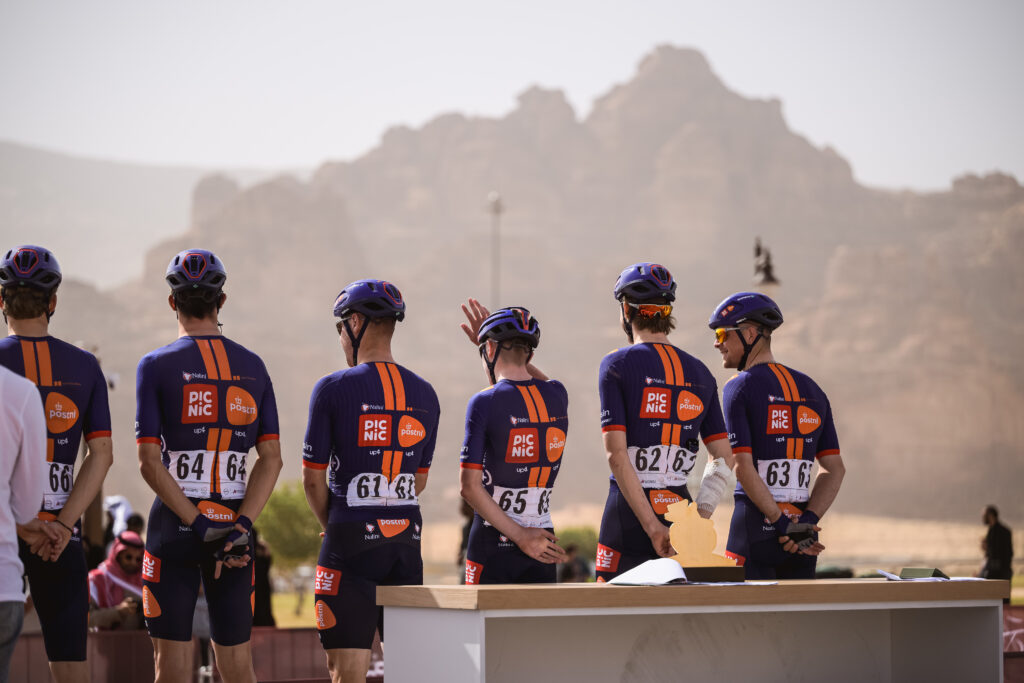
Awkward Australian film references aside, MAAP have knocked it out of the park – in this humble live blogger’s opinion – on their WorldTour debut, with Jayco-AlUla and Liv-AlUla-Jayco’s new extremely purple kits for 2025:

Very cool – more of this please.
Although I’m more than a touch concerned about the fate of the poor rider who looks to have spontaneously combusted, Spinal Tap style, during their winter training camp press conference:

I’m sure the team will put out a press release about this soon – I hope they’re not ruled out of the spring classics…
GT Bicycles reportedly in trouble, as pro downhill racer claims all employees and racers are “being let go” – but brand insists it is only “pausing new product releases” amid lay-offs
Our colleagues over at off-road.cc are currently chasing this one up, but it seems that things are looking less than rosy at GT Bicycles, the iconic US mountain bike and BMX brand.
Last night, pro downhill and BMX racer Phil Kmetz claimed on his ‘Skills with Phil’ YouTube channel that GT’s parent company Pon Holdings has decided to “pause” the brand, while letting go of all its employees and sponsored athletes.
“We were just informed that GT is going to be no more – this wasn’t a decision any of us knew about,” Kmetz said in a video.
“Pon are going to sell off the inventory. And then once that inventory is done, they’re going to pause the brand. It’s a bummer.”
However, speaking to Bicycle Retailer and Industry News (BRAIN), GT’s managing director Jason Schiers insisted that, while there will be lay-offs before the end of the year, the brand will continue to sell bikes in 2025 – but will pause any new product launches.
“To ensure a sustainable and successful future, we are implementing a strategic reorientation to align with evolving customer preferences,” the official statement by GT said.
According to the statement, the brand will focus “on core strengths, and refining our strategy to position GT for long-term growth” and “will continue to sell our current range from existing inventory”.
The statement continued: “GT Bicycles remains a brand with strong potential, and this decision has been taken to lay a solid foundation for its next chapter.”

Last year, GT separated from the Cycling Sports Group group to become a standalone Pon Holdings brand, a year after Pon acquired the group, which also includes Cannondale, Schwinn, and Mongoose, from Dorel for £600m.
However, warranty and customer service will be handled by Cycling Sports Group over the next few months, GT said this week.
While selling a range of road bikes over the years – including the one which helped propel André Tchmil to victory at the 2000 Tour of Flanders – the brand in recent years has returned to its off-road roots, an apparently short-lived “renaissance” emphasised by Schiers earlier this year.
We’ll have more on this story when we get it.
Lotto goes ‘90s retro with new red-black look for 2025
It’s a new kit bonanza today, as the soon-to-be Dstny-less Lotto squad unveiled their 2025 threads this afternoon.
And as well as embracing vowels again, Lotto appear to have dipped into full-on nostalgia mode, with a dark red and black look that harkens back to the Belgian squad’s design style from the 1990s and early 2000s (which, to my eyes anyway, was uncharacteristically understated for that particularly garish period in cycling fashion).

In other words, I think it’s very cool.
And, after a turbulent few seasons scrapping for UCI points, I’m sure Lotto will be hoping that the retro vibes conjure up some of the magic of Andrei Tchmil, Peter Van Petegem, Robbie McEwen, and Rik Verbrugghe in 2025…
The Red Bull takeover of professional cycling continues, as Julian Alaphilippe’s Tudor Pro Cycling team up with energy drinks brand
Will there be any professional cyclists not sponsored by Red Bull by the end of 2025?
Earlier this year, the energy drinks giant became the new title sponsor of German squad Bora-Hansgrohe, in addition to its existing deals with individual riders such as Wout van Aert, Tom Pidcock, and Zoe Bäckstedt.
And now, in a move that would have UEFA and FIFA twitching over conflicts of interest in football, this afternoon it was announced that Red Bull is partnering with Fabian Cancellara’s Tudor Pro Cycling as the Swiss team’s official energy drink partner.
The partnership marks the latest joint venture between Red Bull and watch brand Tudor, who have teamed up as part of the Visa Cash App Racing Bulls team in Formula 1 and Alinghi Red Bull Racing in competitive yacht racing.
The deal comes as Tudor – who secured 13 wins this year, mostly courtesy of Arvid de Kleijn and Matteo Trentin – aim to make a big splash next year, following the signings of double world champion Julian Alaphilippe and mercurial Swiss star Marc Hirschi this winter.
I for one can’t wait for the revamped Tudor backed by Red Bull to take on Red Bull-Bora at what will almost certainly become known (probably) as Red Bull Roubaix or Le Tour de France Powered by Red Bull in the next few years…
He always delivered the goods when it mattered: Isle of Man Post Office honours Mark Cavendish with new/old collection of stamps celebrating sprinter’s record-breaking career
During his glittering, victory-laden career, more often than not, when it really mattered, Mark Cavendish was first past the post (alright, I’ll stop now).
So it’s only fitting that the Isle of Man Post Office has celebrated their home hero’s retirement from cycling with a new collection of commemorative stamps, depicting some of the finest moments of the Manx Missile’s career.
The Isle of Man Post Office produced its new eight stamp sheetlet to coincide with Cavendish accepting the BBC Sport Personality of the Year lifetime achievement award, to celebrate the 39-year-old’s “outstanding career” and “incredible achievements”.

This isn’t the first time, of course, that Cavendish has been honoured by a “postal tribute” on his native Isle of Man.
Ahead of the 2012 Tour de France, where the then-Sky sprinter won three stages in the rainbow jersey, the Isle of Man Post Office also released a set of Cav stamps, while a special 50p coin was minted too, bearing the world champion on one side and Queen Elizabeth II on the other.
And if you look closely at this latest collection, you’ll quickly spot that the Isle of Man Post Office hasn’t pushed itself too hard when it comes to providing cycling fans with an up-to-date appraisal of Cavendish’s career, lingering mostly on his achievements between 2006 and 2011 instead.

Of the eight stamps featured in the new collection, six are from the 2012 set, including images of Cav at the 2006 Commonwealth Games and during his T-Mobile days in 2007, while another one – a stylised image of Cavendish in Team GB kit in 2016 – is from the 2021 ‘Great British Olympians’ set. Meanwhile, another stamp depicts the sprinter winning in the green jersey in Paris in 2011.
But at least the sheetlet itself features his record-breaking 35th Tour de France stage win from July.
“Sir Mark Cavendish KBE is one of the greatest sport stars of all time, smashing records and setting new standards during his 19-year professional career. It is fitting to mark the retirement of such a legend, and especially so for the Isle of Man Post Office to celebrate a Manx-born great,” Maxine Cannon, the General Manager of Stamps and Coins at the Isle of Man Post Office said in a statement.

“This sheetlet brings together wonderful images of Cav at his competitive best, sprinting to victory and proudly celebrating his success. The island is immensely proud of Mark and everything he has achieved. This was perfectly demonstrated in August when the raceway where he began his career was renamed in his honour and so many members of the Manx community came out to pay tribute to our home-grown legend.
“Isle of Man Post Office has celebrated highlights throughout this remarkable career and is proud to mark Cav’s retirement with this commemorative sheetlet.”
Hardly ‘throughout’ Maxine, but I get your point.
So, if you want a ‘Cav: The Early Years’ stamp collection (or at least, that’s my unofficial title for it), the set is available to order now, and is expected to dispatch in the middle of January.
And now for a heartwarming, festive bike lane tale from Brighton to wash away all the Christmas doom and gloom this Wednesday evening…

> Cake by the bike lane: Cyclists bring cake, mince pies and non-alcoholic Prosecco to thank workers for building new segregated cycle lane
“As far as making cities safer, they’re complete dogshit”
Speaking of John Franklin, Cyclecraft, and why “self-confidence” is apparently key to making cycling safe for everyone, cycling writer Peter Flax has taken to BlueSky to share his thoughts on the kind of messages shared by Franklin, who argue that cycling on the roads is safe… as long as you’re assertive, of course.
“If you are chatting with someone who says they’re a big cyclist and they’re arguing against bike lanes… ask them what their favourite bike book is,” LA-based writer, and former editor at Bicycling, Flax posted this week.

“If the answer is ‘Effective Cycling’ (John Forester), ‘Cyclecraft’ (John Franklin), or ‘The Art of Urban Cycling’ (Robert Hurst), then move along.
“Most folks who love those books are middle aged men who like to ride fast. They’ll likely disavow being a vehicular cyclist, but advocate for riders to learn expert skills to assert themselves into urban traffic to be safe – and advocate against efforts to make roads more hospitable to casual riders.
“If I’m honest, I think all three books are interesting. They offer useful information and perspectives that many riders, especially experienced riders, can apply.
“But as far as offering a philosophy or policy prescription that can grow participation and make cities safer, they are complete dogshit.”
So there you have it, the anti-Franklin argument…
Tom Pidcock’s long-term coach and soigneur set to leave Ineos Grenadiers and follow double Olympic champion to Q36.5
The Ineos Grenadiers’ prolonged period of painful transition and staff upheaval continues today, after it was confirmed, as expected, that Tom Pidcock’s long-term coach Kurt Bogaerts has left the British team to follow his rider to Q36.5.
The Belgian has coached Pidcock since 2018, moving with him as he turned pro at Ineos in 2021. The 47-year-old has been removed from the British squad’s website and is expected to be officially unveiled as a Q36.5 staff member in the next week or so, after forming part of the deal that took Pidcock to the Swiss second-tier outfit.

Coach Kurt Bogaerts, soigneur Xenia De Roose, and Fausto Pinarello celebrate with Pidcock after the British star secured his second career Olympic mountain biking gold in Paris (Alex Whitehead/SWpix.com)
Bogaerts coached both Pidcock and Pauline Ferrand-Prévot as the duo won mountain biking gold at the Paris Olympics in the summer. Ferrand-Prévot has also left Ineos this winter, as the French star sets her sights on a return to the road with Visma-Lease a Bike.
Ineos soigneur Xenia De Roose, who has worked closely with Pidcock over the past few years, is also expected to make the switch to Q36.5, after her profile was removed from the Ineos team website this morning.
It is understood that Q36.5 will make an official announcement concerning the arrival of Pidcock’s entourage in the coming days.
“I don’t watch cycling actually,” says Mark Cavendish, as Manx Missile collects Lifetime Achievement gong at the BBC Sports Personality of the Year awards
In ‘news’ (yes, I know, it’s stretching it a bit) that may well shock some cycling fans, but come as no surprise at all to anyone who’s spent time with competitive cyclists, pro or otherwise – it turns out Mark Cavendish doesn’t actually watch that much cycling on the TV.
The retiring Manx Missile revealed that he’s cycling’s version of Ben White (the Arsenal player who isn’t that arsed about football, apparently) as he collected his Lifetime Achievement award at last night’s BBC Sports Personality of the Year awards.
> Mark Cavendish wins “special” BBC Lifetime Achievement award after record-breaking final season
As Chris Hoy, Laura and Jason Kenny, and a very dapper Bradley Wiggins watched on from the stage (and Liverpool centre half Virgil van Dijk appeared in a pre-recorded video… because he’s Dutch?), the 39-year-old delivered, in true Cavendish style, the most world class display of unplanned waffle you’re likely to see this side of Boris Johnson’s book tour.
(And before you accuse me of Cav blasphemy, the former world champion – known for his analytical, rapid-fire recaps of sprint finishes – admitted himself that he was unprepared and waffling on.)

“I’ve always been a sports fan,” Cavendish said, desperate to link his career to SPOTY’s annual shindig, which saw 800m star Keely Hodgkinson nab the top prize.
“And sport has this incredible ability to inspire, whether you want to compete, or do it for fun, or as a family. It doesn’t matter what you do, if you want to keep fit. You can do what you want with sport, especially cycling – that’s what I loved about it.
“But also to watch as a fan. I’m a sports fan, not just… I don’t really watch cycling actually. I watch everything else!”
Well, there goes that Eurosport punditry gig…
Safe cycling author calls for “less exaggeration of danger” and says cycling on the road is “very safe” – but cyclists argue “massive cultural change” for drivers is needed instead
Is riding a bike on the road in the UK a “very safe activity”?
While the evidence of dangerous driving often featured on this very site would suggest otherwise, that’s the opinion of John Franklin, the author of cycling skills manual Cyclecraft, which forms the basis of Bikeability, the UK’s national standard for cycle training.
In the quick-fire Q&A section of the latest edition of Cycling UK’s magazine Cycle, Franklin was asked – among other things, such as ‘Who mends your punctures?’, ‘Lycra or normal clothes?’ – “what single thing would most improve matters for UK cyclists?”
“More self-confidence among cyclists and less exaggeration of ‘danger’,” he said. “Cycling on roads is actually a very safe activity.”
That answer, unsurprisingly, has divided cyclists on the internet, it appears.

“I was mulling on this as I rode home tonight while I avoided a pincer movement by one van blocking the cycle lane that I was in and another turning right in front of me,” Singletrack World forum user Mr Sparkle said in response to Franklin’s Q&A claim.
“Followed immediately by a car driver parked on wrong side of the road and so unsighted, pulling out on me. I’m 62 and been cycling since I was about seven. I ride pretty much five days a week year-round and have been doing so for years.
“I’d class myself as an experienced and confident road user (cyclist, full motorcycle and car licence etc, etc). I have lost count of the times over the years where I’ve come very close to being injured or worse through no fault of mine.
“I would argue that, while self-confidence (if you have the sense and experience to back it up), is great – I don’t see it as being the ‘single thing that would most improve matters for UK cyclists’.
“A massive cultural change where drivers are required to be tested more frequently and suffer greater punishment in court for road crimes that they have been found guilty of would be higher up the list.”
“It’s a bit like asking why the zookeeper insists on all the lions being locked away before going in to clean the enclosure and suggesting that if they just had a bit more self-confidence, they’d be fine,” agreed Crazy Legs.
“It’s a shitty attitude and one that is responsible for a significant failing in ever increasing the number of people cycling.”

> “Some drivers see safe cycling as a character flaw”: The fight for fewer close passes
However, not everyone believed the Cyclecraft author (who, of course, makes a strong case for riding in primary position in his guide) had missed the mark.
“I think I agree with him that the danger of cycling on the road is a bit over exaggerated, and in the sense that I think more cyclists on the roads = slightly safer for everyone, and that it doesn’t help to be putting people off riding,” said another forum user.
“But definitely agree with you that it’s way down the list of answers I’d give. Charitably, there’s not a lot of space for his answer and I guess the first part of his answer he’s wearing his Cyclecraft cap and advocating for more training.”
“He has a very good point,” argued Scot Routes. “Too many folk are put off by an exaggeration of the dangers (often on social media).
“The more cyclists there are, the more ‘usual’ it will be for motorists to see cyclists on the road and the better the infrastructure provision will become. The Field of Dreams approach (build it and they will come) has been only partially successful as it sends a message that shared infrastructure isn’t for cyclists.”
“I understand the sentiment but probably badly worded,” another user said.
“Confidence/assertiveness link to positioning on the road, and I found doing Bikeability a few years back that my positioning wasn’t as good as I thought it was. Getting that right and being more proactive on the road led to fewer close passes.
“And I think because we are aware of how vulnerable we are on the road, we overestimate the actual danger to us at an individual level. I know two people who’ve been killed while riding in 40 years. I know more who’ve died unexpectedly young from other causes.
“Cycling is relatively safe. I have no more concerns about my kids cycling on the road than I do of them driving now they’ve passed their tests.”

> The guilt, the danger and the dichotomy of being a cycling parent
Meanwhile, KCR said: “It’s a quick-fire format interview, and he was asked to pick one thing, so I wouldn’t read too much into it. I’m sure he would have more to say on the subject if he was interviewed at length.
“I think one of the things that would improve matters most would be to get more cyclists on the road (and I’m including cycling infrastructure when I say ‘road’).
“If more people were cycling, it would reduce the ‘othering’ of cyclists and make them an expected part of the transport system that motorists would be more likely to look out for.
“One of the things that deters many people from using a bike for transport is a lack of confidence and a perception that it really is a dangerous thing to do, so Franklin has a point.”
What do you think? Does Franklin have a point? Is self-confidence the key to being safe on the roads? Or is it way down the pecking order on the list of things that keep cyclists safe?








56 thoughts on “Safe cycling author calls for “less exaggeration of danger” and says cycling on the road is “very safe” – but cyclists argue “massive cultural change” for drivers is needed instead; Cav: “I don’t watch cycling”; Xmas bike stands + more on the live blog”
I’d agree that one of the
I’d agree that one of the biggest barriers to widespread cycling adoption is the _perception_ of safety.
Of course it’s a mostly accurate perception but still.
Cycling is pretty safe in the
Cycling is pretty safe in the UK if you look at it statistically in terms of KSI, however a lot of that is down to the fact that regular cyclists know how to ride defensively and watch out for bad driving; it’s a very rare ride in London when there isn’t at least one incident where I would probably have been hit if I hadn’t anticipated that a driver was going to do something stupid and/or illegal. Cycling can only considered to be truly safe when you don’t have to ride continually on edge. At the moment it’s rather as if there was a high crime neighbourhood but the vast majority of residents had learned how to spot and avoid the criminals and modify their behaviour so they didn’t become victims, rather than the authorities having done anything to strike at the root causes of the crime – great, it’s a fairly safe area but only because everyone is living in fear.
Rendel Harris wrote:
Exactly – cyclists will receive lots of “almost” incidents on most journeys.
The answer has always been for better road policing and for the courts to apply appropriate penalties.
great, it’s a fairly safe
great, it’s a fairly safe area but only because everyone is living in fear
Yes- I suffer from a perception of lack of safety daily, but the universally non-cyclist police (if they were ever called upon to explain their determination to take no action against drivers who offend against cyclists) would say “you’re 72 and claim to both cycle every day and be in good health- the roads can’t be that dangerous can they?”. This one of the cases I sent to the informal Parliamentary inquiry
https://upride.cc/incident/ca70mkc_citroenvan_closepass/
It’s the only one I have where I can demonstrate being ‘inconvenienced’, in the new police dodging phrase- I had to pull over because I was so shocked by the unexpected close pass at speed. The police ignored the offence, of course
Rendel Harris wrote:
The whole cycling-safty in the context of road cycling is a very complex issue, with many factors coming into play. Many of these factors have complex inter-relationships, so it’s perhaps a poor approach to try to isolate them and to put them into some sort of hierarchy of importance for fixing one-by-one.
Consider the factors: driver attitudes to cyclists; mass media cycling opinion pieces; legal system responses to road crimes; life-circumstances of both drivers and cyclists. Altering any of these has fairly obvious effects on all the others.
For example, if drivers & cyclists were less stressed by their life circumstances the anti-cyclist pieces in the gutter press would have less appeal and therefore probably reduce, whislt driver and cyclist antagonistic behaviours would reduce so making road crimes less “usual” such that courts would take those that did occur more seriously.
One aspect emerging from recognising the interdependence of many factors in creating and maintaining “a situation” is that its probably a poor approach to either concentrate on fixing only one factor; and a poor approach to invent some sort of apartheid to prevent the mixing of the prime actors in such situations.
For example, proposing cycling infrastructure separate from roads, covering every route that cyclists could go without encountering cars, does nothing to fix widespread stressful socio-economic circumstances, gutter press yahooing, bad driving or an ineffective legal response to bad driving. And it would cost billions whilst doing even more damage to the biosphere.
Cugel wrote:
Cugel wrote:
That’s a bit of a straw-man argument – I don’t think anyone is proposing that.
hawkinspeter wrote:
For many, including around this forum, cycling infrastructure is the be-all and end-all for solving cyclist fear of road traffic. There’s also an assumption that “build it and they will come”.
In practice, there’s a lot of very poor cycling infrastructure but even when its well-built, many sections see no increase at all in cycling. This may not be true in London but that’s really an exception, as are the half dozen other places where building cycleways does see a (small) increase in cyclists.
The fact is, Blighters have come to prefer the car, not because its less expensive and provides a better experience than does cycling (a car does the opposite) but because of all sorts of psycho-factors to do with feelings of power, worth, inviulnerability, laziness, desire for cosseting comforts and so forth. Perhaps the largest car-use inducement is the glamoor pasted over the tedious reality by advertising and the infantile antics of Klarksons.
And cars are good for jousting (aka road raging) to service various modern angsts in a way that bicycles aren’t.
There’s also an assumption that more cycling means less driving. But is this true? I suspect that even habitual cycle commuters will still drive if conditions are less than optimum.
There’s also another assumption that removing cyclists from the roads, or encouraging more of them on to the roads, will somehow reduce car aggressions and the associated murder & maiming. There’s really no reason to assume that. Car aggression is due to all sorts of factors and affects many more road users than cyclists, not least car drivers themselves.
There’s far too much assumption that cycling will somehow auto-construct better humans. It doesn’t and it won’t.
Cugel wrote:
Who are these imaginary posters?
Cugel wrote:
Some truth to that. I’d say that on a level playing field (and that’s kind of what the Dutch managed to establish … and not just due to the lack of mountains) most people are going to pick the most convenient way to travel. (But yes – there are clearly psycho-factors). Where that is cycling, they’ll cycle.
In the UK it’s almost always “car” (by design – by infrastructure design!). And in fact when you say “better experience” there’s a century of “pimp my ride” making the driving experience nicer – which otherwise could be miserable – sat inside a metal box next to hundreds of other boxes. (And lots of building concrete and asphalt to make it easier). And on the flip side making cycling a worse experience – by demanding cyclists are NOT social e.g. can’t ride two-abreast or more, shouldn’t listen to music, can’t chat because of the traffic noise…
Cugel wrote:
That is a question. The biggest experiment we have (NL) shows that over the last 20 years or so there has a generally small increase in total distance travelled each year BUT a greater increase in numbers of cars [from here]. So less distance per vehicle. Also according to numbers here quoted in this article, from 2012-2022 the average driver drove less far. There was an increase in distance cycled also – unfortunately the one doesn’t balance the other though!
The bigger question is – what sort of change are you hoping for? No change (which in the UK actually means more driving)? Far less or even zero car use (unlikely to happen)? More – a massive drop in usage of ALL powered transport (inc. trains, buses, cars, … ebikes?)? Probably even less likely unless we start teleporting via our mobile devices!
I’m not sure anywhere has managed to do better than NL (without someone bombing their infra…) while also reaping benefits of independent mobility for children and the old, health (physical and mental) benefits for the population etc.
Cugel wrote:
Well perhaps if we had a different overall principle/philosophy than “roads are for cars” and “better roads permit higher throughput of motor vehicles; better places provide more parking”? Maybe such a philosophy could just change that goal to “the safe and efficient movement of people” and also pay close attention to “human factors” e.g. acknowledge that people make mistakes / break rules and work with that? Maybe that could guide making our public spaces safer for all? And that could also make them less frustrating?
Beyond that – I think fixing “humans and their emotions” in general might be above the remit of transport infra!
One idea might be – as you’ve alluded to – addressing people trying to sell products (vehicles, media) via fear, or through some people’s need to prove their superior status over others.
But good luck with fixing that human design feature!
Cugel wrote:
Again – who’s proposed that? As far as I can see people who would like less driving or driving further away from un-armoured people are mostly keen on harm-minimisation. Take the automatic weapons from people (cars) or remove them to where they are likely only to collide with each other – that’s a great start! Especially as some people can’t have them (children, some people with disabilities etc.).
Certainly there are selfish or aggressive idiots in the world and when on bikes they can still hurt or even kill you. But that is much less likely than with the aid of a powered metal exoskeleton. It’s not just that there’s far less potential energy to transfer or crushing force to apply. Those tempted will know they’ll likely hurt themselves also. And perhaps the law will take more interest than if they’d done it with a motor vehicle?
Cugel wrote:
Here we go…
Who’s proposing that then?
This article is rather old now but should cover it. Not sure whether it’s entirely fair to say you’re attacking a straw man? There does seem to have been confusion over this. Certainly in the past cycling advocates did put lots of focus on trying to get some decent separate cycle infra *. That seems to have caused some people to conclude ** that this was the only thing that was being proposed and ergo it was a) entirely unrealistic and b) plain silly.
* I suspect because a) this was a very visible difference between high-cycling places (not just NL) and the UK, and b) it covers the “feels safe, and IS safe” requirements, and usually “is convenient” and “can be social”. Of course this includes safer junction treatments of various kinds (better than “bike boxes”) and “filtered permeability”. Historically there has been less emphasis on also doing traffic calming-and-reduction – and especially making it less direct and ultimately less convenient for motorists. That’s because in the UK people might grudgingly listen when you asked for better cycling, but if you proposed doing this at the expense of driving that would be a fight, and if you suggested actively reducing convenience for drivers as a goal nobody would listen to you further.
** Example is people wrestling with what this means in the comments to this article on why Milton Keynes isn’t a cycling paradise. (Answer – because ultimately whether or not the cycling treatment was much good, it was made far easier to drive!)
Within towns & cities, where
Within towns & cities, where most people live, separating cyclists from through motor traffic is the obvious goal/solution, and where new cyclists are likely to be encouraged.
If/where cyclists are on the same road as motor vehicles, then driver behavior & policing is important. This will be the case for most cycling outside of towns & cities, and where assertive cycling helps.
With the number of collisions on motorways & cycle excluded tunnels etc, it’s clear that driving behavior is poor, without cyclists or pedestrians involved!
Indeed – the fallacy /
Indeed – the fallacy / confusion seems to have been that:
a) Many advocates for safer cycling have been very loud about the need for separated cycling infra (because the main “streets” – the key routes – are now roads or urban motorways).
b) BUT that doesn’t mean that they are only about that (which would be silly). Or against all the other helpful tools like tackling junctions, using modal filters to give cyclists alternative routes that motor traffic can’t use, making some residential streets very low traffic, low speed etc. And then where appropriate using that plus the modal filtering to help build a network using the existing streets.
c) It also doesn’t mean that people are simply saying “zero cyclists should / will cycle without a separate cycle path in every circumstance”. (I would however put this as “not sufficient, but necessary” – quite a lot of people simply will not cycle amongst heavy traffic and/or where speed differences are high).
d) Some of the existing quick and brave (or just “bloody minded cyclists”) saw in the above a falsehood (“well that’s nonsense, I’ve cycled on A-roads, man and boy, never had a problem…”). Or some of the following potential threats:
So e.g. “but cycling infra will slow us down / be inconvenient / is just building more stuff / give those drivers an excuse to keep on driving AND ammunition to demand that cyclists get off the roads”. Or just missing the point (“we just need to stop all / most drivers driving” or “we can just share the road / if drivers drove properly / the police just arrested all the bad ones – there would be no need for cycle infra“). And possibly “so it’s a waste of money / money we don’t have“.
In light of much of the rubbish has been built in the UK some of that is understandable. In the light of how roads and culture are in the US the threat of getting banned from the roads (or just assaulted more) probably looks quite likely to folks over there. Plus the chances of real change across the nation – zero.
FWIW my take is that “where
FWIW my take is that “where driving is easy, Brits drive” (borrowing Carlton Reid). People assess the relative ease and attractiveness of journeys. If we already have cars, and excellent roads, and convenient parking everywhere – people will drive – unless we can make cycling that trip relatively attractive to driving it.
BUT even if it was much more expensive and miserable to drive (and people are already sat in jams for large parts of their lives) there are some things which would just stop them cycling. If it doesn’t feel safe, they won’t. If they don’t have secure places to store or park their bike (which have to be convenient!) they won’t have a bike. Then there are social factors – and in the UK we see cyclists as oddballs (or worse), and we actually discourage or prevent people from travelling socially on bikes (unlike any other transport mode)!
And don’t forget all the
And don’t forget all the people who are not in the KSI figures because they were put off cycling in the first place.
HarrogateSpa wrote:
That works both ways, because people who could have taken advantage of the health, financial and social benefits of cycling are put off too. Those are journeys that could have helped make the case for the better dedicated cycling infrastructure, and helped drivers to expect to see cyclists on the roads and to drive accordingly etc etc.
The phrasing isn’t what I’d use, but a good faith interpretation is that he was raising the chicken and egg situation above. I assume he comes across a number of people who are in the position of needing that extra bit of confidence that bikeability provides, so it’s not surprising it seems more pertinent to him than to experienced cyclists who just want drivers to behave themselves.
The rise in cycle-cams and sharing footage of dangerous driving should be an effective tool to educate/shame drivers and to support the prosecution of some of the worst offenders. Unfortunately that comes hand in hand with reminding a lot of potential cyclists, and their loved ones, of all of the scary things that could happen to them. That might be fine if they saw that action was being taken against the obvious law breakers, but they also see that it isn’t.
To buck that trend we need to see offenders facing punishment.
‘Be more confident’ is not
‘Be more confident’ is not going to help if people’s experience is that drivers make it feel unpleasant and dangerous.
The figures speak for themselves really. 2% modal share where no infra is provided, 30%+ in places where cycling is properly provided for.
Stiffer penalties for
Stiffer penalties for dangerous drivers, and stiffer penalties for people who use the expression ‘over exaggerated’.
I’d consider myself a fairly
I’d consider myself a fairly confident cyclist, normally feel safe,even when ive had at least 5 drivers try to drive into me this week and 1 shout abuse, but there was a moment last week where I just thought any moment the next driver is just going to hit me, it felt really sketchy in an unsafe way I’ve not felt for a long while riding in traffic.
Fortunately I made it home in one piece, so there’s no stat recorded about it, no ksi data anyone can cite,not even any close pass submissions(too detailed to explain why,its not because there werent any) ,but it felt as unsafe as expletive.
This was written over a
This was written over a decade ago, and still rings true today: https://departmentfortransport.wordpress.com/2012/06/28/fuck-you-john-franklin/
Plus ça change…
Ranty Highwayman has
Ranty Highwayman has similarly ‘strong’ views on Franklin
Yeah, saw the name and had a
Yeah, saw the name and had a “great dinosaurs of the past” moment (more here, and the “grandad of the movement” here).
Seems the vehicular cycling ideology is still alive in the US (indeed seems oddly popular amongst ex-pat UK folks there also). There are reasons for that (US culture – not just “car culture” either). But these folks just sound antediluvian in the light of progress made for “nicer places” and “mass cycling” in Europe.
As always there are some elements of truth on both sides. The VC folks did promote some helpful “survival techniques” (like taking the lane) – helpful if you’re taking on the traffic. And cycling is statistically a very safe mode of transport in the UK – which has one of the safer road environments overall (especially when compared to the US).
However I’d suggest there is still too much road death, injury and definitely too much intimidation (deliberate or just thoughtless) by motorised road users. What I think isn’t so important though – one of the reasons (reported in many surveys) that most people in the UK do not cycle (and particularly women, the young and the old) is that “it doesn’t look / feel safe“.
There are plenty of other non-“whatabout” reasons for the low fraction of trips cycled. We’ve made it not social, inconvenient (or at least less so than driving), cyclists are an “out group”, there’s a lack of safe places to park or store a bike, we already have cars. But without addressing “it doesn’t look / feels safe” most people simply won’t cycle. That’s not sufficient, but necessary.
But then – “most people cycling” doesn’t seem to be a big concern of vehicular cyclists. Indeed it seems (at least for some) it is predicated on a kind of elitism – the fit and the brave asserting their individuality and agency by cycling despite inconvenience, disapproval and danger.
Cycling is relatively safe, I
Cycling is relatively safe, I would be very interested in seeing how Jo Public’s view of cycling KSIs compare to the actual prevalence of cycling KSIs.
The point is that it COULD and SHOULD be much safer, with a different attitude from the same Jo Public, and from local and national government, highways engineers, and the police.
(let me be clear, Franklin is part of the problem with his vehicular cycling nonsense)
Franklin is part of the
Franklin is part of the problem with his vehicular cycling nonsense
I hadn’t read that bit about his book and opinions, until you prompted me. One problem is that the benefits of increased cycling would be manifested at the population level if they ever came about, but the genuine (as opposed to the imaginary ’causes pollution and congestion, etc.’) ill-effects are decidedly personal
https://upride.cc/incident/g6noope10zvf_vwaudi_veryclosepass/
Meanwhile, the police dimwits are thinking ‘what’s the problem?- I could easily cycle up that gap between the vehicle and the pavement’
John Franklyn is as
John Franklyn is as unbalanced as he always is. He has half the case, but ignores the other half, which is for people who are not like him.
That purple strip is peculiar. It reminds me of two things:
1 – The England football strip some years ago that caused them not to be able to see each other.
2 – Torville & Dean’s outfits in Bolero.
Perhaps what we need to do is
Perhaps what we need to do is give these wankers a sense of perspective. I am going to start following them around randomly and threating them with my fist or jumping out from behind things and screaming at them.
Its OK though because I won’t actually punch them very often and being scared isn’t actually dangerous. They would just need a sense of perspective and need to understand that they aren’t going to get hurt that often. Its just the threat of violence. Nothing to worry about.
Thats what being a cyclist is. People constantly scaring you and threatening you with their cars.
Ah but “we have to drive”…
Ah but “we have to drive“… so it’s a normal activity and assumed to be innocuous so you will need some plausible deniability for your tailgating, jumping out at them and fist-waving!
Re. the ‘cycling is dangerous
Re. the ‘cycling is dangerous’ thing – it seems like maybe we need to define terms a bit. There are (at least) two ways to interpret the statement:
The former is somewhat complex, as has been picked over by others here. However, I find I encounter a fair amount of the latter, which is straightforwardly nonsense, and convincing a few less people to believe in it would be no bad thing.
Quote:
– the post-Mark period, if you will…
Fabulous. Well done sir.
Fabulous. Well done sir.
I actually do think that far
I actually do think that far too many people are overreacting to road riding with the old “everyone is trying to kill me” bolloxs.
Yeah, there is the occasional shit pass but they are so rare now that I actually remember them.
I find the vast majority of drivers safe and courteous.
That said, I don’t ride at rush hour or in a big city.
S13SFC wrote:
Well there y’go, then
Quote:
I’m not sure that’s for a rider. Looks more like they’ve adopted a chimp as a mascot.
I hadn’t realised that John
I hadn’t realised that John Franklin was still alive. Much as his style of vehicular cycling does include some very useful tips, taken as a whole it seems like something from another age…
Re the Gavin and Stacey
Re the Gavin and Stacey jersey I’m sorry to have to inform you that it’s a real thing available on Amazon, made by the famous cycle clothing firm of X-CQREG and yours for the bargain price of £37 for a jersey and shorts combo…
With the popularity of the
With the popularity of the Gavin and Stacey series i can see this becoming a best seller : Buy now while stocks last !!!
Can you post a link ??
Can you post a link ??
It can be viewed in all its
It can be viewed in all its glory here, happy shopping!
Thanks
Thanks I predict a sell out lol
I cycle into City of London
I cycle into City of London daily from the suburbs and have done for 20 odd or so years and as such have had a fair few run ins and accidents, none my fault. I would say I’m a very confident cyclist.
My colleagues at work think I’m mad and often cite people in cars being dangerous as to why they would not even contemplate doing it.
So the question is how do you become confident if the percieved danger puts you off from even attempting it ?
In London as in the rest of the UK the provision for cycling is hapazard at best , often leaving the cyclist in the most dangerous of places with zero protection. How often does a nice wide road with cycle provision suddenly stop when the road narrows or a 2 lane roundabout start ? And please dont get me started on the highways agency and their woeful cycle provision on A roads.
I commute on my bike because I love cycling and take the ‘risk’ that comes with it – but that risk is very real and very much in evidence on every commute, that is not the case if I chose to drive my car and it is not something that a child just cycling to school should be open to. Basically if you would not let your child cycle on the road that that road is inherently unsafe, and that basicallly is vast majority of roads in london (i dont cycle outside so can speak for other places but wld guess its a similar experience).
We all know the answer, safe and seperate cycling provision but regretfully we are in the minority and petrol heads and carloonery are the order of the day. So people have to make an active choice to accept the risks for cycling otherwise they will not do it. Unsuprisingly, people are not willing to take that risk and instead buy a bigger car than last time because that make them feel ‘safe’.
Sorry slightly longer than I intended but unfortunately until any goverment significantly changes the heiracy of road use people of bikes will always be at the bottom of the pile/consideration.
For clarity… are we saying
For clarity… are we saying that vehicular cycling is *good* or *bad*?
I take control of the lane; I’m in the outside of the lane when passing parked vehicles or turning right.
I ride primary and rarely ride secondary – especially in urban areas where there are lots of minor side roads or driveways … thus giving me space to maneuver and them [in theory] time to react.
I’ve found that my road position doesn’t affect the number of close passes I get … I just feel a teensy bit safer when I’m in the middle of the lane, with nothing to my inside, when Richard close passes me in his Dick Mobil.
So … is the consensus here that I’m wrong to be aggressively demanding the same space as I would get in my car?
You’d have to try hugging the
You’d have to try hugging the gutter and seeing how that makes you feel I guess – plus see if you get more / worse passing? And how many times you crash because of all the rubbish and metal grates / covers / tarmac trashed by buses.
For the full comparison you’d have to repeat but changing your attitude so that you were not confident, then try taking the lane and not “quickly accellerating to a moderate speed of 20mph” after junctions. (Perhaps ride a cargo bike, with a child attached)?
Certainly some of the techniques propounded by the VC folks are of use where you’ll be interacting with lots of (fast) motor traffic. However the whole thing seems to be a bit of a self-fulfilling prophecy. (I guess they might say it had nothing to do with getting more people cycling, it was just techniques for those that do … but they did go further than that).
Ignoring the elitist stance taken by some of its proponents (and possibly turning it into something they didn’t intend!) the other issue is that this is never going to be an acceptable way of riding for most people, never mind attractive *. So it won’t lead to many more people doing so.
And that’s why where infra prioritises drivers we see people cycling like this – but don’t see many of them. And in the few places where the infra also makes cycling more pleasant ** we see lots of people cycling but not riding “like they were driving cars”.
* In fact surveys indicate that lots of people just don’t want to ride with a lot of motor traffic, or large vehicles, or with much faster ones. In fact even most seasoned UK cyclists much prefer riding on empty roads…
** And – to be complete – makes driving some journeys (especially short ones) slightly less convenient, to give people a push to walk, cycle or use public transport!
I can safely say that the
I can safely say that the only time I’ve *ever* quickly accelerated to 20mph has been on a steep downward facing hill.
I would absolutely *love* to have a 20mph average … even with the motor on the e-bike I struggle to consistently get above 14.5mph average.
I’m happy to admit that yes, I do change my riding when on segregated paths … but only where the segregation is total [such as Bathgate to Caldercruix, Balerno to Ball Green via The Waters of Leith or when gravel riding].
The big change in my riding came after getting hit and left with life changing injuries [you’ll all be bored hearing about them by now …]
I stopped being timid and started being more forceful, more precise in my intentions … like I said, it doesn’t change the number of close passes, but at least I know I’ve got bailout room.
I’m not an ambassador for cycling – although I do lead Club group rides. I encourage people to ride a bike … if they want to.
I don’t subscribe to the whole “how do you guess if someone cycles? You don’t need to… they’ll soon tell you”. I don’t see cycling as a religious calling [unlike some seem to on here] and I also don’t see cyclists as faultless, innocent, blameless little lambs [again, unlike some on here].
I ride a bike because I like to, it keeps me reasonably fit [and its the best exercise I can do following the collision], and I get to see parts of this beautiful countryside that I’d never see otherwise.
Oh …and the scones at Clubbiedeans…
Oldfatgit wrote:
Took a while to sink in but I think years of doing a regular “just getting places / doing errands” riding on the North Edinburgh paths has had that Netherlands effect on me. At least – I have my helmet from when I first moved to Edinburgh over a decade ago (which I always wore), but I realised a while back I couldn’t actually recall the last time I’d put it on. (I think it was a Ride to the Sun from Carlisle to Cramond a few years ago).
Amen to all that!
I live in a mostly flat town
I live in a mostly flat town and can maintain 22-25mph. Makes no difference to drivers who still overtake frantically even only to slow down to my own speed immediately after or brake to a stop 100m down the road due to congestion or a red light. I feel there is no speed I could do that would prevent the pointless overtaking. Drivers think it is some sort of a computer game though In real life where they get credits or additional lives or whatever for overtaking a cyclist. Or feel that it is some sort of stain on their honour to be behind a cyclist so they absolutely must get in front.
The evidence in the
The evidence in the Netherlands doesn’t care what Franklin thinks or says.
Franklin is out of touch with
Franklin is out of touch with reality in the world of road cycling. The number of people killed or ending up in emergency rooms, the existence of and building of new and better bike paths are strong, unknowable testaments to the dangers. There also is a strong hate relationship from many drivers toward cyclists. But thank for posting his claims and attitude I will no longer feel any need to read any of his writings. I have been riding a bike much longer than he and witness the reality daily.
Three boys arrested after 13
Three boys arrested after 13 moped-rider assaults on cyclists in Bristol
Moped riders reportedly pushed or tried to push cyclists off their bikes
https://www.bristolpost.co.uk/news/bristol-news/three-boys-arrested-after-13-9801834
Know dangers of e-bike
Know dangers of e-bike Christmas presents – police
https://www.bbc.co.uk/news/articles/cdek333z3rlo
Just a comment on the “less
Just a comment on the “less exaggeration of danger” remark. I’ve been over taken by so many close passes on a bike it’s just the norm now, I’ve been hit a couple of times, car doored, grazed by cars and vans more than a few times and my foot was driven over as I put my foot down to stabilise myself when someone hit my handlebars with their wing mirror when I was standing still at a traffic light on one occasion. I’m getting used to the impending doom feeling that you get with PTSD when hearing an engine revving behind you gripping the handlebars for dear life when that wind wall hits or bracing for impact each and every time (and that fear of hearing car tyres skid). But I still get back on the bike and go out again (some people would argue that I’m being stupid considering the close calls I’ve experienced).
People who only drive or who have never been in an accident con a bike certainly aren’t aware of the dangers. You don’t spin when someone taps or hits you, you take to the air, you don’t have an airbag, you’ve a piece of polystyrene strapped to your noggin and the only shock absorption you have is between your skin and bone. On the contrary I think the realism of the danger some drivers put other road users in isn’t being made clear enough, regardless of whether it’s a pedestrian, bike or other vehicle.
Collie147 wrote:
And that’s the thing. It’s the motorists who are creating the danger, and yet they think it is everybody else’s problem to solve.
This is not just a cycling
This is not just a cycling issue. As a dog owner I am regularly ‘close passed’ by ignorant car drivers who think its ok to mount the pavement at speed whilst I am walking passed, almost hitting me and my dogs with their doors and mirrors. Drivers reversing out of properties without looking. And door opening is also an issue, particularly with equally ignorant passengers. Some do not consider ANY other road user and are just concentrating (maybe the wrong word!) on their own destination. And don’t get me started on blocking pavements (pavement parking) to safeguard their precious tin boxes from other owners in their own tin boxes.
A very good description of
A very good description of most cyclist’s experiences I suspect. I can relate to the feeling on hearing a car approaching from behind. My own method is to start moving out into the road as I hear them approaching. If I don’t hear them slowing down I’m ready to swerve back in which I do have to do sometimes but I must admit very rarely. At least if you are out in the lane there is room to move in and if the driver sees lateral movement at least they’ve seen you.
The point I was going to make though is that none of these experiences show up in the stats, which I suspect is what John Franklin’s assertions are based on. The stats show that Britain is a relatively safe place to cycle with relatively few deaths. I would argue that any death from being hit by a driver is too many though and therefore cycling is unsafe. Absolutely no need for it. If you are a driver and see a cyclist (or pedestrian or horse rider) slow down.
I have cycled a lot now and can usually anticipate problems in front of me and avoid them but I have no control over being hit from behind and that is what makes it so worrying. This is compounded in my case by the local police claiming the best they can do for reported close passes is send an advisory letter and they wouldn’t even do that for the last one I reported.