


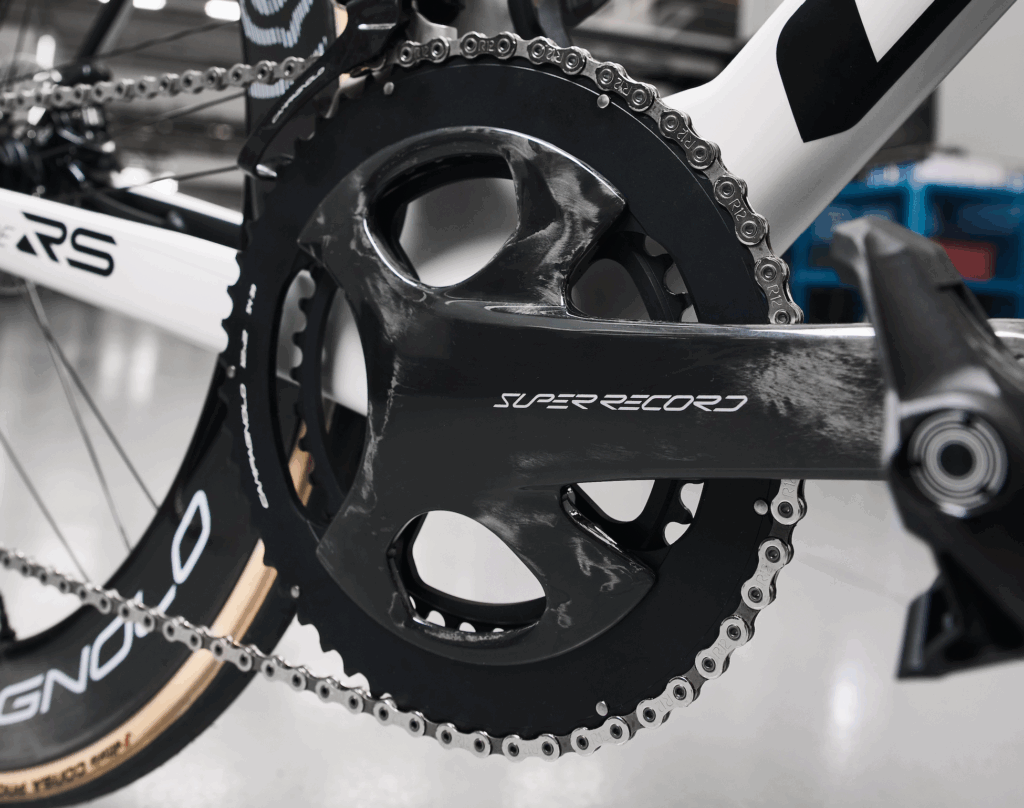

Italian newspaper Il Gazzettino has just reported that Campagnolo is set to make 120 of its 300 Vicenza-based employees redundant as part of a sweeping restructuring following three consecutive years of heavy losses, and that raises an uncomfortable but unavoidable question: where does one of cycling’s most storied brands go from here?
For nearly a century, Campagnolo has been at the heart of cycling. Its innovations helped shape the sport – quick-release skewers, an early (and influential) parallelogram derailleur, and some of the most beautifully engineered components ever to grace a bicycle.
The Tour de France? Campagnolo-equipped bikes have won it over 40 times, beginning with Gino Bartali in 1948. Compare that with Shimano’s first win: 2007 (after Lance Armstrong’s earlier ‘victories’ were voided). And SRAM only joined the yellow jersey club in 2009.
There was a time when, as a road cyclist, if you didn’t own Campagnolo components, you wanted to.
Fast-forward to today and the picture looks very different. How many new bikes come with Campagnolo fitted? Outside Italian brands, high-end custom builders and the occasional halo model, the answer is: not many. Shimano and SRAM utterly dominate OEM spec, and that dominance filters down into consumers’ upgrade paths, mechanics’ familiarity, aftermarket availability, and ultimately brand mindshare. Of course, you can build up a bike with Campagnolo yourself, but of the “big three” groupset brands, Campagnolo is now a distant third in terms of volume.
How come? At one time, Campagnolo offered groupsets at various levels (including mountain bike groupsets for a while), but it has increasingly become a high-end alternative. These days, you have different flavours of Super Record, a sprinkling of Chorus, and that’s it on the road side of things. You get gravel options too, but what’s Campagnolo’s competitor to Shimano’s CUES, for example? There isn’t one. Campagnolo has retreated from the mid-range and budget markets, turning instead toward a “sport-luxury” identity. And crucially, not much volume.
Remember when Campagnolo launched Potenza with a big fanfare back in 2016? It sat below Super Record, Record and Chorus in its range hierarchy, and was designed to be a direct competitor to Shimano Ultegra. It quietly disappeared a few years later. Record, once a proud second-tier option, is gone too.
> Campagnolo unveils new Potenza groupset + First Ride
As an Italian brand that owns and operates a production hub in Romania, Campagnolo struggles to compete on price with brands that focus their production in the Far East (although some Campagnolo components are manufactured in Asia). It has aimed for the high-quality, high-end of the market – the prestige end – a little like Italian brands in other sectors, like Ferrari, say, or Dolce & Gabbana. But with reported losses of over €24 million since 2023, it looks like it’s simply not shifting the units required to support an operation of 300 employees in Vicenza.
There’s no question that Campagnolo still produces excellent equipment. For instance, when we reviewed the Campagnolo Super Record Wireless groupset a couple of years ago, we said that it offered a stunning performance and ergonomics… but it did cost £4,500.
Other component brands’ top-end kit is certainly expensive too – like Shimano Dura-Ace and SRAM Red –but those brands are selling a lot of far cheaper stuff in higher volumes too. That’s a big difference.
Campagnolo’s Fulcrum brand continues to develop impressive wheels and remains a significant player in the global market. In some ways, Campagnolo has quietly become a wheel company with a prestigious but shrinking groupset arm attached. That’s not necessarily a bad thing, unless the identity you’re trying to preserve is built on drivetrain excellence.
So, what’s next?
Campagnolo stands at a crossroads, and we’re not certain where it’s heading.
Will it re-enter the mid-range groupset market, launching a competitively priced alternative to Shimano Ultegra/105 and SRAM Force/Rival? Given production costs, the direction it has been moving over recent years, and the failure of Potenza to turn things around a while back, we really can’t see that happening.
More likely, it’ll double down on luxury: ultra-premium, ultra-exclusive, unapologetically expensive. That might preserve the brand’s mystique, but it risks shrinking its user base even further.
Campagnolo could also pivot more toward wheels. Fulcrum is strong. Campagnolo-branded wheels remain respected. Focusing on this segment could stabilise the company, but it would mean accepting a diminished role in drivetrain history.
Does cycling still need a prestige drivetrain brand? Maybe that’s the real question. Campagnolo’s plight suggests that in a world where Shimano 105 Di2 performs better than top-tier groupsets from a decade ago, where Rival AXS delivers wireless performance at mass-market pricing… perhaps the luxury for luxury’s sake market has evaporated.
A brand worth saving
Campagnolo isn’t just another component manufacturer. It’s part of cycling’s cultural fabric. The sport would be poorer without it. But admiration doesn’t pay wages, and nostalgia doesn’t fill order sheets.
If Campagnolo wants not only to survive but to matter, where do you think it should go from here? We’re interested to hear your opinions.
-300x199.jpg "“He wants bikes in traffic lanes. Give him what he wants”: Cyclists urged to “slow every street down to bicycle speed” and ride in middle of lane amid premier’s war on cycle paths + more on the live blog")









31 thoughts on “Where does Campagnolo go from here?”
I could see a Middle East
I could see a Middle East investor, maybe even the one who owns UAE Team Emirates buying out Campagnolo. There would be an appeal in Pog winning on a Colnago with a Campag groupset again.
A Middle East investor would be drawn to the brand’s history and prestiege. As you say they’d double down on the luxury side of things to the detriment of the everyman, they also wouldn’t be fussed with the company not being self sustaining.
I think the ship has sailed with the idea of Campagnolo being a viable groupset producer due to decisions made several years ago. A lot of the die hards have moved onto other manufacturers and the ones left aren’t going to keep the company afloat, especially with road cycling being a shrinking market.
In a crowded market with viable Chinese alternatives being produced, Campag are never going to win on the value front and when they last tried to get a hold in the OEM market with Centaur and Potenza they got nowhere. The loss of the OEM market is a big deal, not just groupsets but also Fulcrum wheels being specced on bikes. The reality is that most people will never change the groupset on their bike, just buy spares and many won’t change the wheels either.
Joe Totale wrote:
Certainly the ‘halo’ effect from association with elite achievements seems more sustainable than the ‘luxury’ route they seem to be on and which must fade away as the link with elite success withers.
If compagnolo stay on this
If compagnolo stay on this path of the ultra high end only, then they show they do not understand the bike industry anymore.
As you say, China has become a much more visible and a reckonable force in the sector. The L-Twoo group set looks quite impressive. That’s going the exact opposite direction. Carbon wheelsets found on Ali-Express appear to be holding their own too. It isn’t seen as the knock off choice it once was.
On the other hand, if you do want the ultra range topping setup that cost 5 figures it’s there and it’s out of reach to most people. Campagnolo can’t really add anything more to top that. They’ve been done out of their own game.
but for the most people the little bit extra special that Campag brought just isn’t there anymore. Is it better looking, more classy or better functioning that red or Dura-Ace? Looks are subjective but the rest is a flat no! There only other real product in wheelsets are fairly middle if the pack when stacked up against other brands in a similar price range.
But something else which is a symptom of modern bikes which you kind if touch on, there is no need to fettle on a modern bike. No need to look at the stock setup and think about getting deeper rims or upgrade a grouoset a bit at a time. Maybe a new chainset or a different rear derailleur for a wider range. Bikes are pretty much sold in a way that the appetite to upgrade has been removed. For a modest price (by today’s standards at least) you can get a full carbon frame, integrated carbon bars, electronic groupset with hydraulic disc brakes and deep section carbon rims. What is there to ‘upgrade’?
I agree with some of what you
I agree with some of what you say but take great exception to your comments on wheels. As far as road bikes are concerned Campagnolo still make the best wheels you can buy. Don’t believe everything you read in manufacturers claims of how they all make the fastest wheels ever created!
Joe Totale wrote:
Zero chance. Campag arent blingy enough. They have too much class.
Probably the good buyer would
Probably the good buyer would be LVMH, which could leverage the Campagnolo brand and heritage, especially for clothing and “lifestyle” products.
Campag literally just
Campag literally just released a £1000 upgrade kit for Super Record to make it more blingy
Generally thé article sums up
Generally thé article sums up pretty accurately Campag’s situation. One of my bikes has 12 speed Chorus but thé other has 105 di2 and my local bike shop here in France always asks me to bring spare Campag components when servicing my Wilier Cento 10 pro as they find it difficult to get hold of them quickly.
A corkscrew manufacturer with
A corkscrew manufacturer with a minor cycling side-hustle?
Sad to see. But also Shimano
Sad to see. But also Shimano needs to pay close attention because they may be next with Chinese brands undercutting them.
Cycling is no longer the new golf. It seems like running or the gym is the new cycling. So I’m not sure there will be enough ultra high end customers to keep campagnolo going.
Would a bike brand buy them? I can’t see it.
Or a related manufacturer for some efficiencies? The auto industry is hammered, so who? High end plumbing or kitchen aid company? Mobility aids for a campy rollator? Medical might make some sense.
Tell me you dont understand
Tell me you dont understand the groupset industry without telling me…..
Shimano is the 800lb Gorillia in the industry. They’re arent going anywhere soon. They’ve had Chinese manufacturing for 30+ years.
I only like old Campagnolo,
I only like old Campagnolo, but not too old. This means going back to the days before carbon fibre, when everything was shiny. I just find the carbon fibre stuff they make nowadays as meh.
Fundamentally, Campagnolo has always had its flaws. But we like that, to some extent. Peak Campagnolo was the Delta brake, so cool but also a nightmare to set up and maintain. But what price style?
To some extent Campagnolo has to be unobtainable, that has been the niche for at least five decades. Nowadays Campagnolo is overpriced, sub standard functionality, made in Romania and passed off as Italian. It is a joke.
Delta brakes were a coddle to
Delta brakes were a doddle to set up. Functionally Campagnolo has been the equal of anything else available since the introduction of Ergo Levers way back. All in my opinion of course.
It’s a shame, as any non mass
It’s a shame, as any non mass production bike still looks nicest with Campagnolo, and it can be a joy to ride. Engineering decisions over the last 10 years have really killed their groupset business though. My first nice road bike had 10 speed centaur, the carbon crank set and levers looking great with the Ti frame, but it was just rubbish. Even when totally clean, I had to dial in the barrel adjuster to within half a turn to get all the gears running smoothly, and then it’d need fettling again as soon as it got a bit dirty, and the spring in the parallelogram was just too weak. I was always amazed going back to my old alu tarmac with even older 9 speed 105 how it kept working perfectly despite whatever winter riding abuse it got.
Then when the derailleur finally got to wobbly to work well ever, trying to replace it was nearly impossible. It turns out Campag adjusted the action ratio of 10 speed half way through the production run so you had to try and source one from old stock from the right 2 or 3 year period , and of course hardly any bike shops have Campag spares and even fewer can tell you which Campag 10 speed derailleurs are compatible with which Campag 10 speed levers… Add to that they insisted on having a different 10speed cassette spacing and freehub spline than shimano, so you couldn’t swap wheels between bikes or even swap cassettes, and then they downgraded the 10speed crankset from ultra-torque to power torque, which just wasn’t as good or as easy to maintain, and needed a whole new set of tools, and the price starts to feel like only a fraction of the cost of running campag.
I eventually upgraded to chorus 11 speed which I still have and works great, and is as least shimano interchangeable, but then di2 came along and Campagnolo really had no answer for far to long, and even when EPS did arrive it was far too expensive, so that was a huge chunk of the high end groupset market gone for good.
I think there was a chance when di2 came for Campagnolo to make themselves the high end mechanical groupset of choice but with 12 speed 105 now so good it’s hard to see where they go from here except as a niche for people who are happy to pay twice at much for a groupset just because it looks nicer, even if it probably doesn’t work as well.
Eg3ftp1 wrote:
I read that it wasn’t the pull ratio that changed but the spring tension, and that QS/Powershift uses 900g vs Ultrashift 1000g (should be in Newtons I know…). The inferior Powershift plastic ratchets need less tension else they would wear out even quicker, whilst the Ultrashift metal ratchets can cope with the tension needed to precise shifting.
From Campag’s docs I had the impression that when I changed to from 10s QS to Powershift I needed a new RD so bought one. Then I managed to get some NOS 10s Ultrashift shifters so changed back to my old RD. When my old RD broke I put the Powershift one not expecting it to work but to my surprise it works fine. Campag 10sp pull ratio has never changed.
I have vague memories of when
I have vague memories of when I first started cycling 15+ years ago, it was possible to buy Campagnolo-equipped road bikes at basically any bike shop. I don’t think anyone would have said doing so was a “smart” decision – Shimano was considered technically marginally better, but Campagnolo was “nicer” and not a huge amount more expensive than the Shimano alternative.
I don’t know if the business case works anymore, but that’s certainly where I would like to see Campagnolo return to. Not bargain-basement competing with CUES on commuter bikes, but a viable choice for the amateur enthusiast, competing with Shimano Ultegra and up, and equipped as OEM on off-the-shelf bikes at that level.
OnYerBike wrote:
That’s exactly what Campagnolo tried 6-7 years ago with Centaur and Potenza and neither bike manufacturers or home mechanics were interested. I feel this is part of the reason that Campagnolo no longer make anything that could be considered reasonably priced.
I would have said those were
I would have said those were pitched too low and were basically already obsolete before they were released.
They were rim-brake-only and mechanical-only at a time when it was fairly clear that disc brakes and electronic shifting were taking over. There was still a market for rim brakes and mechanical shifting, but at the value -focused end of the market, where Shimano was still the obvious answer.
Potenza was avaliable with
Potenza was avaliable with hydraulic disc brakes, I still have it. The exact same calipers that were used for Super Record in fact
Lemond won on Shimano in ’99.
Lemond won on Shimano in ’99.
No he didn’t.
No he didn’t.
On a number of counts!
On a number of counts!
The days of Campag competing
The days of Campag competing at the bargain basement end of things are over.
But if all they’re going to do is sell Super Record to rich people, they’ll never recoup their R&D costs. They’d be doomed.
By all accounts the latest 13-speed Super Record competes meaningfully with Sram Red and Shimano Dura-Ace in terms of performance and weight. It looks gorgeous and the thumbshifter is back, they’ve regained their mojo.
What they need to do now is release a Chorus version. A little less carbonfibre, and stainless steel instead of titanium. It’ll be 200g heavier than Super Record (a mere trifle). Price it to compete with Force and Ultegra. OK it’ll need to be a little more expensive, but you make it achievable for the large numbers of dedicated riders who aspire to Italian engineering excellence and flair.
It’s a shame Campag didn’t/couldn’t release a new Chorus 13-speed grupetto at the same time as the Super Record, because then they’d have stolen a march. But I fear it’s too late now, Sram and Shimano will beat them to it for affordable 13-speed. A big shame.
What she/he said. …but
What she/he said. …but trickle down Chorus would need to compete with Ultegra / Force on price too, otherwise the majority won’t even try it.
Campy cache is outmoded. They’ve lost that battle. They need to compete on price as well as quality.
GravelIsNothingNew wrote:
Out of curiosity I looked at wholesale prices of the last-generation, 10-speed Veloce. Brifters are about 105 level, but derailleurs are more like Ultegra, cassettes and chains are even more expensive (though much more reliable).
Considering little competion between retailers, aftermarket prices will be MUCH higher than in the case of Shimano. Which means that an outdated 10-speed system would cost you about as much as the current Ultegra – that’s not a way to do business, no matter how hard-wearing the parts are in the long run.
Another problem is that with this kind of prices they will never be common in OEM spec. On the other hand, if you wanted to switch to Campy, you would need to replace everything on your bike, including the wheels. In my view, unless they find a creative way out of this deadlock, they are more or less doomed.
The Italians are brilliant
The Italians are brilliant engineers who also happen to produce beautiful products. I think that the Campagnolo brand and history is it’s greatest asset and that has a significant value. Someone will snap it up and revitalise it whenever that may be.
You only have to look at a company like Ducati. On the verge of disappearing forever so many times, despite racing success and technical excellence. Now owned by Audi, hugely successful, and quietly abandoning their two most recognisable features, the trellis frame and desmodromic valvetrains. The Ducati brand is the big value item, and the same will go for Campagnolo. they will ultimately prosper under the right direction.
dolly wrote:
I don’t know much about motorcycles, but…
The question is: do/did people love Ducati the brand or Ducati the bikes? If it’s the latter, then the omission of key technical features could mean loss of their most devoted customers and turn them into just another motorcycle company like Volkswagen. But will they still be as loveable then?
Predominantly made in
Predominantly made in democracies, not authoritarian communist nasty places.
There is a good business man in the USA trying to combat this, but people don’t care. They would buy from Russia or N Korea if it was cheaper.
nickyburnell wrote:
Which business man? You can’t mean Trump – unless he’s tweeted he’s got a plan to invade Taiwan, Thailand etc to shut down their bike frame and component manufactures to save Campag because “they’re unfair”?
Also can’t be Trump because he’s only trying to get even more for certain US companies he favours. No doubt he wouldn’t mind if that translated into cheaper for US customers but even that doesn’t seem to be the most important goal. He’s happy to hit some US consumers financially if they aren’t showing the expected respect. Why, it almost resembles the behaviour of some kind of thin-skinned autocrat…
At least as much as the UK, the US is now (see recent vast bribe – er, investment, by that bastion of democratic anti-authoritarianism Saudi Arabia) and in fact for a long time has been “intensely relaxed” about how stuff was produced, and usually where it comes from – as long as it was cheap.
Actually – thinking on this,
Actually – thinking on this, perhaps as an admirer of Russian politics and seeing the strong competition from China with its “extended state” model * – perhaps he actually wants the US to work more like that?
* Private companies incentivised to do fully capitalist business … which however are strongly linked to the state. And which will operate in accordance with state directives when required **. That is if they don’t want to lose business and for their executives to end up in prison for “corruption”.
** But can expect help above what is common in the West eg. by provision of industrial intelligence provided through government-promoted espionage.
I really hope Campagnolo
I really hope Campagnolo survives, and against all odds comes out firing on all cylinders. Many of us have used Campag throughout our racing days. It’s so sad that exceptional brands like Campagnolo and the recently demised Veloflex have hit such difficult times. We the riders, are the losers IMO.