



“That’s that. And there was nothing we could do about it.”
Uttered as the villainous Tommy DeVito lies face down and lifeless on a garage floor, the victim of his own frightening excesses, the film that line originates from, Martin Scorsese’s gangster epic Goodfellas, was shot in the spring of 1989. Around the same time, a plucky little channel called Eurosport stuttered somewhat more tepidly onto our screens; a weird, technicolour pan-European blip on the oh so British televisual landscape of the late 1980s.
Two years later, after a temporary shuttering following an anti-competitiveness dispute (plus ça change, and all that), the channel broadcast the Tour de France for the very first time. And the much-vaunted home of cycling was born.
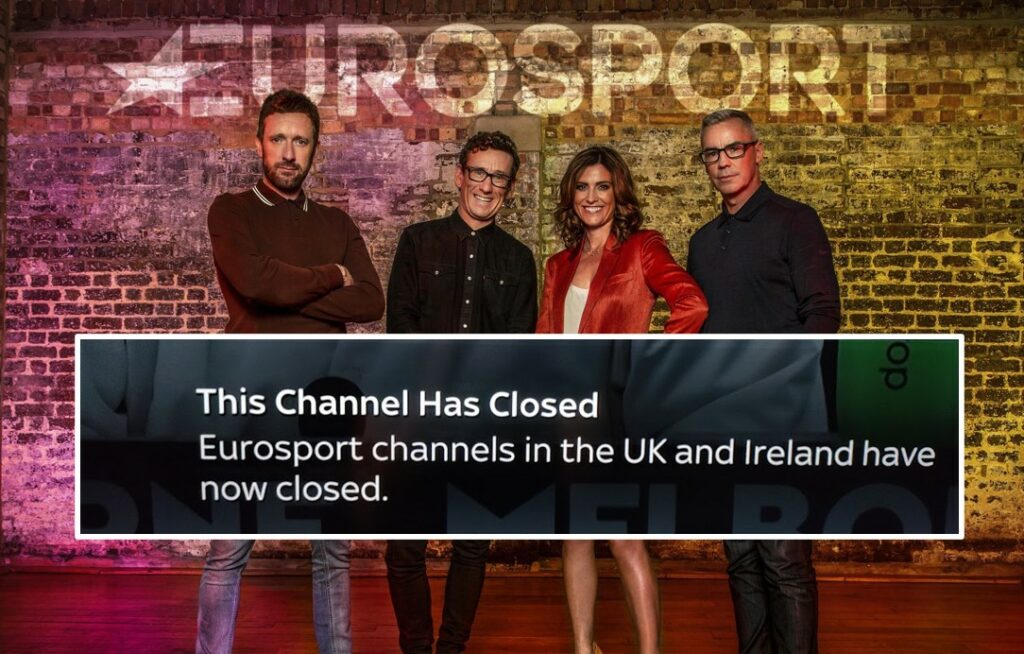
But fast forward three and a half decades, and Eurosport – in the UK and Ireland at least – is no more, the victim of big sporting capitalism, product ‘integration’, and the allure of £30-a-month subscription fees.
If you had flicked over to Sky channel 417 or Virgin Media channel 521 in the early hours of Friday morning – after one final showing of the Nordic world ski championships and Magnus Cort’s second straight stage win at O Gran Camiño – you’d have been greeted by an endless cycle of ads for TNT Sports (your ‘new home of sport’, apparently) and the ominous missive: “This channel has closed”.
By the time you sat down for your morning coffee, Eurosport had completely vanished. That’s that. And there was nothing we could do about it.

> How to watch cycling for less now it’s moving to £30.99-a-month TNT Sports
Of course, unlike Tommy in Goodfellas, professional cycling on British TV isn’t sleeping with the fishes just yet.
As that 2am ad cycle informed us, bike racing has simply been shunted across – or ‘integrated’, as the execs would say – to the shiny, ever-expanding sporting empire that is TNT, where it will sit alongside football, rugby, cricket, and UFC. That first plug for Omloop Het Nieuwsblad during the Liverpool-Newcastle game was jarring, to say the least.
On the surface, not much will really change when it comes to cycling coverage in the UK – if you’re happy to fork out the extra cash, that is. In fact, Warner Bros. Discovery’s head honchos, those behind this integration project, boasted this week that more live cycling than ever before, including every men’s and women’s WorldTour race, will be broadcast as part of this new arrangement (again, if you can afford it).
But for anyone whose formative bike race watching years took place from the 1990s on, something substantial, if intangible, has been lost today.
I became obsessed with pro cycling as a teenager in the mid-2000s. So, naturally, I also became obsessed with Eurosport. It felt like the gateway to the entire weird and wonderful world of bike racing, from the grand tours to the classics and week-long stage races (ah, that 2008 edition of Paris-Nice, bliss).
Even during those three weeks in July, Eurosport was the channel of choice, the noughties commentating duo of Dave Harmon and Sean Kelly lightyears ahead, to my ears anyway, of the basic, ‘say what you see’, Armstrong-scented approach of Liggett and Sherwen on ITV.
(I’ve come to fully appreciate the ITV broadcast’s charms in recent years, particularly its excellent, history-infused highlights package, and will be saddened to see it disappear from our screens after this year’s Tour, another victim of the Discovery land grab.)
But at the time, Eurosport, like cycling itself, represented a whole new world, far removed from my other great sporting obsession of football. Just like pro cycling in those pre-2012 days, Eurosport seemed exotic, eclectic, unconventional, and distinctly European.
Everyone, from the presenters and commentators to the audience, felt like they were part of a community, all in on a little secret that was ours and ours alone, while opening up a whole new world of sporting discovery.
There was also a loveable, ramshackle, almost chaotic quality to the tone and presentation of its output, that set it apart from its more glossy competitors. If the Premier League and Sky Sports represented the gleaming, accessible high street burger chain, Eurosport was the tatty little restaurant down the alleyway, which served the best pasta you’ve ever had.
That almost homespun character was always part of the appeal.
I’ll never forget patiently waiting for the snooker to end so we could catch the final 25km (if we were lucky) of that day’s Tirreno–Adriatico stage.
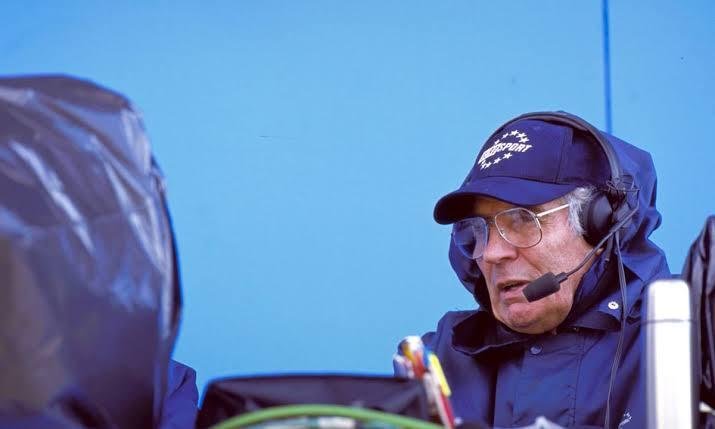
Or David Duffield lambasting the photo-hunting fan who felled Giuseppe Guerini on Alpe d’Huez in 1999.
James Richardson, the Football Italia guy, presenting from a nondescript studio during the Tour de France, as Sean Yates sat stony-faced, plugging his new book at every opportunity.
Stephen Roche having a meltdown as Marco Pantani stopped to put on a jacket at the top of the Galibier during his race-winning move in 1998.
Sean Kelly, in the pre-social media age, providing a daily recap of the biggest stories in the French newspapers.
Harmon shouting “That’s bollocks, JC” on air after being informed by his producer that they weren’t sticking around to cover Cadel Evans’ victorious appearance on the podium at the 2009 world road race championships.
Carlton Kirby chipping in from the ‘dungeons’ in Paris, in what is now the Jonathan Harris-Bass role (and before all the social media derision), to spend 20 minutes cracking us up about the summer when he was 17 spent working in a factory four kilometres from today’s intermediate sprint.
The regular asides to inform viewers of the latest doping scandal during the 2000s, followed by the obligatory ‘Anyway, back to the racing…’
The brilliantly entertaining teetering-on-the-brink-of-chaos on-site presenting duo of Ashley House and Juan Antonio Flecha.
The GCN sofa days.
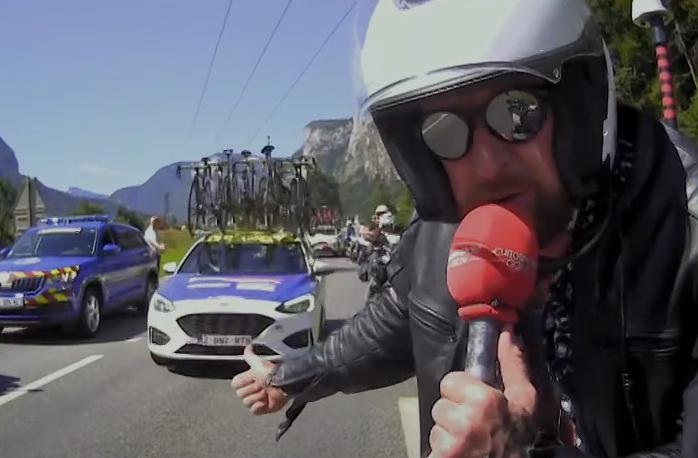
Brad Wiggins calling a group of environmental protesters “imbeciles” from the back of a motorbike at the 2022 Tour de France.
And that advertisement with the cassette on the wrong side of the bike.
Of course, it wasn’t just cycling. Eurosport was the spiritual home of the sporting outsider of every stripe, where you fell down a quirky Belgian or Scandinavian rabbit hole, never to emerge. The punk scene to Sky and BT Sport’s Ed Sheeran and Lewis Capaldi.
And now, to paraphrase yet another Goodfellas line, it’s all over.
From 28 February, cycling – that weird, misunderstood creature – will be part of the slick, cool world of TNT, the home of the Champions League and Rio Ferdinand, of massive studios and big screens, the place that gave Jake Humphrey a platform to kickstart his high-performance empire.
Alright, cycling, biathlon, snooker, and the rest – pack your bags and off you pop, the football promises it’ll look after you. I hope.











14 thoughts on “Goodbye to innocence: So long Eurosport, the TV channel as quirky, chaotic, and exhilarating as cycling itself”
Great piece, thanks.
Great piece, thanks.
Second that.
Second that.
Third that.
Third that.
“Not interested in the other
“Not interested in the other sports we cover? Fuck you, pay us. Oh, you’d struggle to find £31 a month? Fuck you, pay us. ITV’s Tour rights got hit by our ability to outbid them, huh? Fuck you, pay us.“
ITVs TdF coverage is not
ITVs TdF coverage is not disappearing because of a Discovery land grab.
ITV chose not to bid for those rights anymore, that’s important to acknowledge in this, because it shows you the clear problem for UK broadcasters, there’s a lack of audience for cycling even Ned acknowledged that ,which means a lack of advertisers, donkey sanctuaries anyone ? and that the costs to show it far outweigh what they ever can hope to gain from it.
To reuse the restaurant analogy the tatty little restaurant down the alleyway goes out of business if it has no customers, or customers not willing to pay enough for its best pasta in the world.
Even the Goodfellas understood how to run a restaurant for profit
stonojnr wrote:
You’ve repeated this many times but it’s not actually a true reflection of what happened, as far as I understand it and from what has been reported, in its implication that ITV simply didn’t want to broadcast the Tour any longer and so couldn’t even be bothered to bid for the rights. What seems to have happened is that WBD went to ASO and informed them that they wanted exclusive rights and that they were prepared to pay X millions for this. ASO then informed ITV of this and asked them if they were interested in paying more, ITV responded that they couldn’t afford the new price, many times higher than what they had been paying previously, and so that was that. There wasn’t a bidding process that ITV didn’t bother to enter, they were presented with a fait accompli in which the only way they could have retained the rights would have been to buy the exclusive UK rights themselves for more than WBD.
I dont think Ive made a
I dont think Ive made a career out of it, but I fundamentally believe it to the truth of the situation so Ill keep repeating it till anyone can provide much if any evidence to counter that belief.
whilst, for one the ASO actually make the deal with the EBU, then broadcasters like WBD or ITV sublicense from the EBU, so WBD never went to the ASO and demanded exclusivity. it was reported at the time of the deal announcement the EBU were annoyed/disappointed with ITVs position in the bidding process, the EBU’s stated commitment on these deals is to offer the broadest range of sports rights to EBU Member broadcasters and their audiences. They wouldnt accept an exclusive deal on those terms as ITV are an EBU member as well and the EBU managed to settle FTA coverage with 13 other European countries, countries who also have a WBD presence, just not the UK.
ITV have never confirmed or denied they bid or didnt bid, and havent expressed any disappointment in the outcome either, in fact theyve been curiously silent about the whole thing, as if daring to address the elephant in the room will bring the whole misdirection of blame down.
only Ned, whose currently picking balls out of a hat at Butlins in Minehead, who wrote an article on it has hinted that ITVs run had come to end simply because not enough people, ie viewers, cared enough for it. He’s never stated he believed ITV were outbid, ITV were stuck in a position they couldnt win, simply not enough people cared.
whilst WB/Discovery announcement on the new deal simply said theyd be the only place in the UK to watch the coverage.
you translate that as meaning “exclusive”, but they didnt state exclusive, and theyre a publically listed company on a stock exchange, every statement they produce has to be factually correct, because people or bankers invest based on those statements, thats why theyre a total management speak word salad, but theyd never mistake exclusive for only, because the difference in costs to WBD for such a deal would be significant enough to affect investment decisions.
but you believe what you want, Ill believe what I want, if only there was some kind of journalists in a postion to ask the major players on the record, what the truth was. maybe that would be of more use than analogies to Italian mobster films.
stonojnr wrote:
Well let’s go and have a look at the Warner Brothers/Discovery press release of October 25, 2024 (you can read it in full here if you wish)
Looks a little bit like they stated “exclusive” to me…
Decent live stream of Gran
Decent live stream of Gran Camino on Youtube this afternoon. Hoping to find a similar service for Omloop this weekend…
Quote:
One does not necessarily lose one’s principles as one’s net worth increases.
Weirdly living out here in
Weirdly living out here in Switzerland I can still get Eurosport UK along with Eurosport DE / F / ES. The European versions have language switch so you can get same commentary as you get on UK. Its always been so damn confusing on what you can watch/listen to out here. For example we cannot listen to radio 5 football commentaries on BBC Sounds but I can get them through the the radio channels on the TV. It also means that I could watch Eurosport on my iPad in U.K. using my Swiss TV app (just can’t watch “live” but can be just 1 second behind!)
It was never the same after
It was never the same after David Duffield left. With no more “Turn your granny to the wall” it felt too professional. And in the era of big contracts, professional is expensive to the consumer.
My life is more productive
My life is more productive without the random early season Spanish races …but I don’t think I can survive without watching Roubaix and I think they know that.
I know it’s not the same, but
I know it’s not the same, but they are saying Quest will have free highlights.