
[Photography by Steve Thomas]
Feet are funny old things. Tickly, sometimes a bit whiffy, yet most of us very much take them for granted. I have to admit I’ve long been guilty of that, only paying attention to those things at the end of my legs when I have an issue. Painfully, in the past couple of years, I’ve become all too aware of exactly what impact my feet have on the whole of my body.
- Best clipless MTB pedals 2025 – our top pick of the best rated clipless pedals for mountain bikes
- Clipless pedals: the pros and cons of clipping in
- Are flat pedals worth it?
Their importance is especially prominent when riding a bike, when they become that vital and imperceptibly crucial joint between us and the pedals as we rotate each leg around 90 times a minute in one fixed stance, which can literally make or break a ride. My own revelations of late have been a real eye opener in this regard.
A brief history of the bicycle cleat
Four decades ago, we all spun around strapped into the pedals. Not clipped, in but bound to our pedals by toe clips and straps. Toe-strapped pedals could be instruments of fraught torture and danger, yet they had a certain retro class about them, especially when chromed and leathered up to the nines.
The first clipless pedals for bikes actually date way back to 1895, though even I’m not quite old enough to verify this personally. In 1971, the Italian master of steel and chrome, Cinelli, also created a clipless road pedal, which had a release lever on the side. Needless to say, it didn’t exactly take off.
It wasn’t until 1984 that the then-French ski bind manufacturer Look brought its technology to cycling in the form of twist-in and out clipless road pedals. Within a few years, toe clips and strap makers were ‘hanging in’ only by the grace of this new heretic flat bar off-road sport called mountain biking, a place where clipless pedals and shoes didn’t then exist.
Most of us early mountain bikers were riding in trainers, bodged road shoes with tyres stuck to the soles, and in some cases cyclocross shoes – which were sparse things in the UK back then.
The race to create clipless mountain bike shoes and pedals went into full swing in the late ’80s, with Swiss former road racer turned downhill ace and innovator, Philippe Perakis, taking the bold move of approaching Look with some ideas and designs for a clipless MTB pedal.
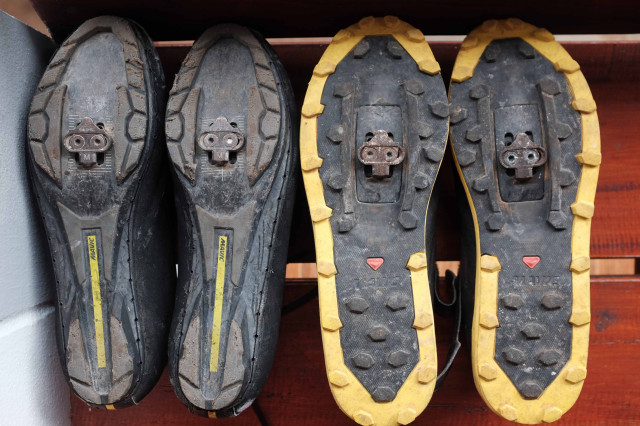
Meanwhile, in Japan, Shimano was one secret step ahead of the French. In 1990, the brand introduced its first mountain bike-specific SPD (Shimano Pedalling Dynamics) shoes and cleats to the market, just pipping Look to the post.
Clipless and capable MTB pedals were a game-changer, and over the years, countless other brands have introduced their own versions of clipless pedals and cleats; though Shimano’s dominance has never really waned. Very little is happening in the way of innovation in the next three decades, but recently, things might be starting to change…
The issues with MTB clipless pedals and cleats
Okay, this is based on my own lifelong experience of riding all kinds of bikes and pedals, and my many frustrations, irritations along the way – and of late, real issues induced, enhanced and restricted by those tiny, fiddly metal blocks beneath our feet.
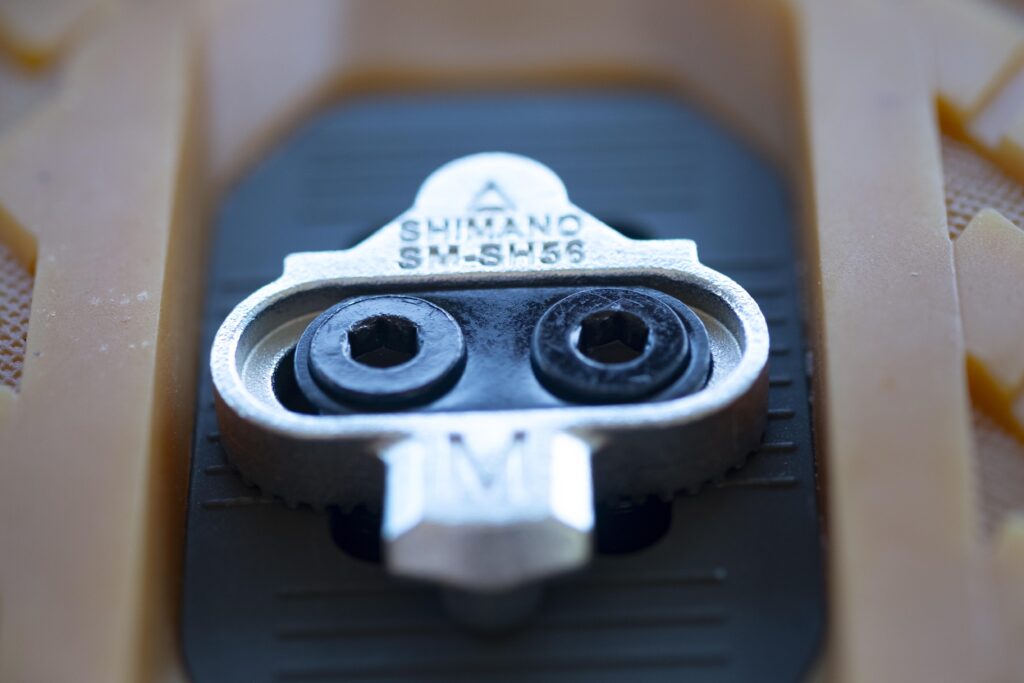
The great thing about small SPD-style pedals and cleats is that they are relatively simple, bombproof, and are usually inexpensive. As they’re much smaller than road cleats, they allow space for some tread and reduce mud clogging, which is essential in off-road riding.
The downside to this design, in my opinion, is that you have a much smaller and less stable contact and grip with the pedal. This means there is less overall foot and pedalling stability, which does impact power transfer to the pedals too; something that’s not a huge issue to many, but it isn’t ideal for high-end performance riding, such as in gravel and XCO racing.
These days, the main XCO World Cup contenders, and also the fast gravel racers, hardly need to dab a toe in the mud, let alone push their bikes through the gloop. This is the main reason why they often use carbon-soled road shoes and road pedals, or MTB/gravel carbon shoes if ground contact is more likely. It saves grams and adds to stability and power transfer, which all add up at this level.
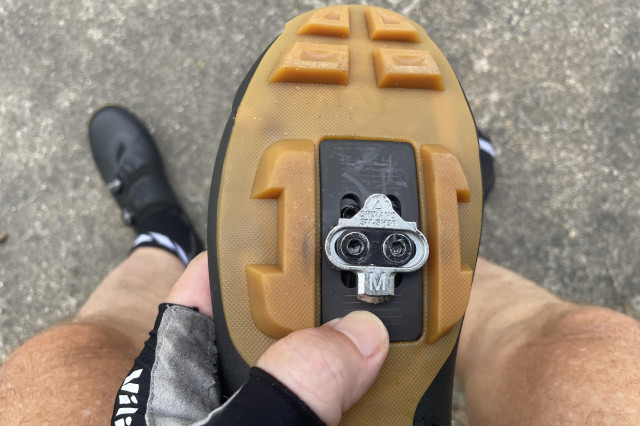
If you look at the larger three-bolt road SPD cleat set-up against the standard two-bolt off-road system, there is a huge size difference. Personally, I can’t help but think that a smaller three-bolt system for both would be a sound move all around.
My own main gripe with the two-bolt system is in the primitive ‘one-shot’ set-up approach. To set the cleats up, you have to tighten them a fair bit to be able to try them in the pedals, and then when you twist out, so do the cleats. This leaves nasty grooves on the soles.
This then makes any minor adjustments a nightmare, and when you do, the cleats tend to slip back into their grooves, forged when tightened the first time around, then your next set of cleats will also follow the groove. Having a bag of cleat shims is a handy thing to have around, not just to raise the cleats from the sole, but to give an extra shot at cleat adjustment.
This is not to mention the number of cleat plates I’ve stripped over the years in trying to get the cleats tight enough to hold fast, especially with shiny carbon cleat beds, which all seem a little unnecessary.
Why the lack of change?
We are indeed bound by manufacturers’ might and marketing when it comes to what we’re served, and how it’s purveyed to us, both in terms of clipless pedals and just about everything else in cycling and life itself.
It’s no secret that Shimano dominates the market in this sector. If it patents and introduces a design, and stands by it, then that will pretty much dictate to the rest of the industry where we’re at for the foreseeable future.
Even for the largest manufacturers, implementing new systems is a huge and lengthy process, and one that costs a pretty penny (or dollar or Yen) to undertake. This is probably why we’ve stuck with what’s worked well enough for 30 years in terms of cleats and pedals for off-road riding. It’s an arena where an evolutionarily underdog stands little chance of getting a foot in the door, so to speak. And to think, we stuck with nail-on shoe plates and toe clips for a century, all because they worked too!
With the introduction of the new Shimano pontoon-style system on its premium performance off-road shoes, it may be that some middle ground is being trodden in the clipless pedal market, and I dare say it will eventually be available in lower-end performance shoes too. Of course, the cleats have been updated recently too, in a bid to offer easier engagement from all angles, but still, this change isn’t huge.
Has Shimano gone far enough with this? Maybe, for certain styles of shoe and riding, but I think it would be nice to see a complete rethink of cleat and pedal design across the board.