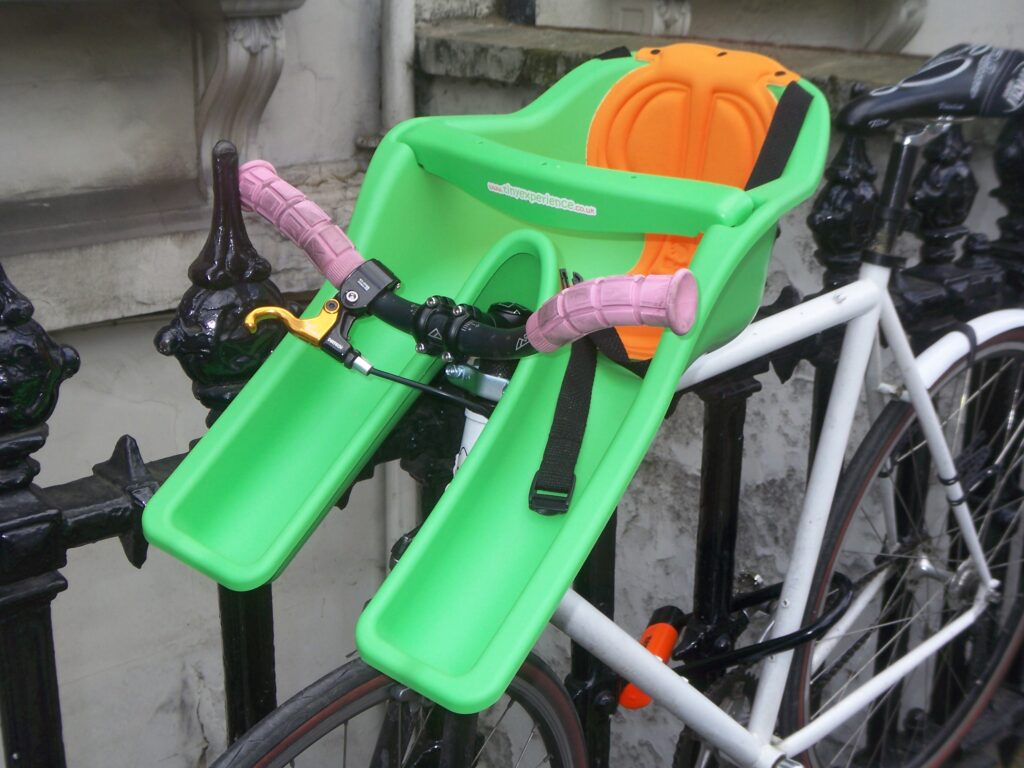
Here’s something you don’t see every day, a fixed gear bike with child seat. This was locked outside the Natural History Museum…. loving the baby pink Oury grips, very retro.
Flo K

Here’s something you don’t see every day, a fixed gear bike with child seat. This was locked outside the Natural History Museum…. loving the baby pink Oury grips, very retro.
Flo K
If you’ve enjoyed this article, then please consider subscribing to road.cc from as little as £2.49. Our mission is to bring you all the news that’s relevant to you as a cyclist, independent reviews, impartial buying advice and more. Your subscription will help us to do more.
@chrisonabike again. What is NEEDED, in THIS case? Spaces? Potentially but not a necessity. I wouldn’t envisage a mass or cyclists suddenly appearing overnight ince the ban is lifted. That’s something that can be reviewed as time goes on. That’s what town planning is about. Not just cycling. And I don't care about your other comment. I didn’t even bother to read most of it since it’s not answering the question I asked.
@SVXY Oh good, the defender of drivers who kill and maim is back. Well down to your usual standard of idiocy, "it was not a criminal manoeuvre". Well yes, it was, because it was a manoeuvre that has resulted in him being convicted of a criminal offence, namely causing serious injury by careless driving. Is there any other sphere of society where one can pretty much destroy another person's life through criminal negligence and idiots will say well they didn't really mean to do it so they shouldn't get more than the tiniest slap on the wrist?
@Smoggysteve "not needed" by whom? Certainly not all infra is "necessary" - and the UK often builds stuff of little utility. Indeed little except for paved surfaces would be needed in the absence of motor traffic - we could bin traffic lights, roundabouts etc. However I note there are plenty of "I cycle what's the problem?" folks in countries like the UK... where very few people *do* cycle. I think having "mass cycling" is a good thing and that ultimately infra plays a significant part **. * Some don't think mass cycling is a good idea, or not possible "here". Or "I'd rather it was just me and my mates". ** FWIW I think it takes lots of things - different "philosophy" of public transport and space, motor traffic reduction, good enough public transport etc The simple "people just need to cycle" and the "encourage / police it better" approaches alone just won't do it, alas - which is why they have't.
@Smoggysteve on the specifics: separate marked spaces might be a good idea, depending on the numbers of cyclists.
@SVXY ah yes, it's a good job that someone has appeared again to remind us that the outcome - equivalent to assault occasioning serious bodily harm is not real crime! Or at least shouldn't be taken so seriously. Of course they weren't also "taking the mick" by eg. being drunk. They didn't mean it! It was an accident! They'll never do it again! (The fact they literally added insult to injury afterwards is just down to shock! Perhaps... but interesting what was on their mind, waiting to come out. Mens rea? Plus see lack of remorse before.) This is by someone who not only should have been driving the car with the alertness and care appropriate to operating dangerous machinery in a public space ... but who might be expected to be able to drive at a high standard. Indeed they are also responsible for training others. There appears to be a lack of the customary plea of remorse here also, you'll note.
@chrisonabike A lot of that isnt needed. why is there a need to add in more infrastructure in this case?
@GMBasix indeed - there are conflicts between "good transport design" and both institional motivations (police making it easier for themselves) but also the overall "criminal safety" brief. In a (much) smaller fashion as there's a fundamental conflict between "freedom to get around by driving" (even in accordance with the licence conditions) and public health and safety (including from "real crime"), to say nothing of costs, ability of non-motorists to get around etc. I would hope that much of "how designing for active travel changes crime patterns" could be resolved by reference to "how it works elsewhere" *. But it's another case of "change *does* mean things do not stay exactly as they are now". * eg the "social safety" design features of non-motor infra elsewhere and how police do police those spaces.
@wtjs He was not on his phone, not drunk, not speeding and it was not an illegal manoeuvre so there were no grounds for an immediate jail sentence. Not least as the government is currently releasing some offenders for all but the worst crimes as there isn't room in prison for them all now. Maybe a longer driving ban and compulsory retest would have been more appropriate for this offence
Opposing this sort of route fits with the "Secure by Design" ethos. Local police teams are frequently consulted on larger planning/transport schemes (as a lot of colloquially dubbed "statutory consultees" are). Secure by Design has a lockdown feel to it. Some of it is good security-conscious design; but some of it is somewhat unsubstantiated but nevertheless prescriptive stuff that needs to be weighed with other considerations using open eyes. They like interwoven cul-de-sacs which limit rat-running escape routes; they don't like interconnecting paths that allow illegal PTWs to escape the feds. You can see why that makes sense to them, but they don't apply their community policing head which should include community cohesion, connectivity and wellbeing. Secure by Design needs binning or overhauling. It is not fit for purpose. If the police think riders are going to escape, they need to equip and train themselves to deal with spaces as they are, not try to dictate a fortress mentality.
@Smoggysteve overall I'm with you here and the stats in from other places show this isn't an issue in the long term (eg. IIRC the Netherlands is the safest country for pedestrians). However to get there is "change". Since we don't all get courses in new infra / rules that certainly means "confusion" and "concern". After all people still make mistakes with car infrastructure, which we've had decades of very bitter experience to learn. The UK is only at the start of a transition (well, a few parts, hopefully...). Not only do people "not expect" cyclists (because few) but UK authorities make this needlessly harder by a) "building" cycle infra by mixing modes (eg. putting up signs on pedestrian infra / directing cyclists into bus lanes) and b) when making the "actual" built cycle infra it's non-standard. (As well as inconvenient and sometimes dangerous for all). Particularly it's not clearly marked. Contrast eg. NL - while not all separated cycle infra there is the same, it is normally pretty standard and clearly marked (red asphalt most places). And their road safety / design system includes the principles of *predictability* and homogeneity. So everyone knows where to expect cyclists. And they aren't likely to design a major cycling through route down the middle of a narrow / busy shopping street.