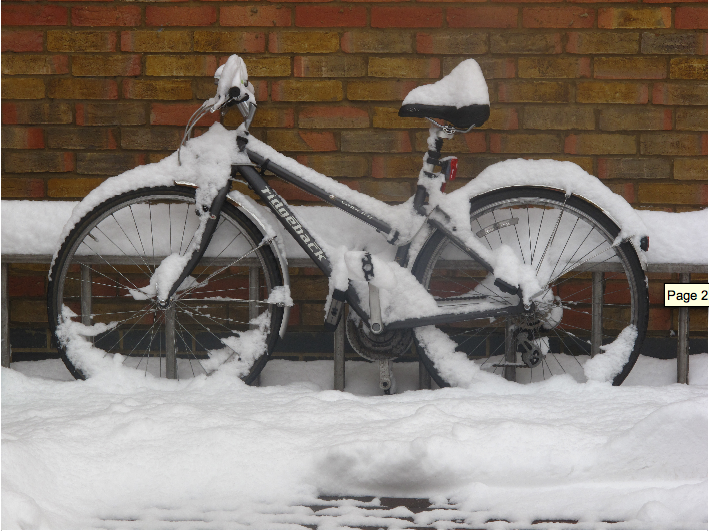
London is snowed in today. Public transport has frozen. The kettle is going to be the only thing working hard today. I’m off to make snow persons.
Help us to bring you the best cycling content
If you’ve enjoyed this article, then please consider subscribing to road.cc from as little as £2.49. Our mission is to bring you all the news that’s relevant to you as a cyclist, independent reviews, impartial buying advice and more. Your subscription will help us to do more.
I don't know what others think but I thought it was a mistake to cancel the event. I live in one of the areas they cycle though and it didn't seem to bad. Even the few accounts I have watched didn't show cancelling weather, waiting under a tree maybe.
@chrisonabike exactly, words are cheap.
They can safely bang the drum knowing that little will or can be done.
OK, some things could be done, but the chance of nobody cocking something up . . ?
Realist or pessimist, take your pick;
but still optimistic enough to hope that things will work out :-)
@ChrisA isn't this story more along the lines of "tobacco company is demanding government crackdown on nasty rolling papers and dangerous pipes?"
Silly of me! How could there be any conflict between and "improving things for their ... definitely not employees ... and the public at large" and these companies' entire business model...?
"Deliveroo has announced a crackdown on modified and ‘dangerous’ e-bikes . . . . . company is calling on the Government to prohibit the sale of unsafe e-bike conversion kits."
Really? Do they not know how difficult it is to legislate for such things, the politicians inability to understand details, the competence of the DoJ in drafting such legislation and what seems to be a widespread disregard of those rules; not to mention the total lack of enforcement.
Just saying.
@Nigel Garage The Mercedes driver drove through the light three seconds after it turned amber. Official government text: "AMBER means STOP. You may go on only if the amber appears after you have crossed the stop line or are so close to it that to pull up might cause an accident." Three seconds is more than enough time to stop safely at the speed the Mercedes was going so the driver was breaking the law and therefore committing a prosecutable offence. Deliberately putting others at risk and breaking the law is not "acceptable" and if you saw a cyclist running a red in those circumstances you would rightly condemn it. Is there anything you can't be completely wrong about?
I see quite a few MAAP items out in the Surrey Hills. The new shop has a cafe and they're from Melbourne so the coffee should be good: I'm looking forward to visiting.
I wasn't saying that nor talking about people who say that. I said it was silly to claim that wearing a helmet indicates acceptance of dangerous driving and poor infrastructure. I choose to wear a helmet; I also regularly report dangerous driving to the police and correspond with councils and road authorities about ways infrastructure could be improved for cyclists. I rather doubt I'm the only helmet wearer who does so.