


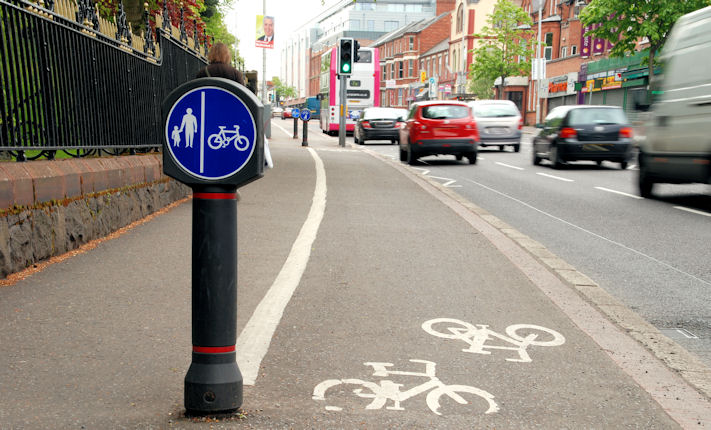

More than four in five residents in Northern Ireland say they are unable, uninterested or afraid to cycle short distances.
The findings, published as part of the Continuous Household Survey of more than 3,500 households by Northern Ireland’s Department for Infrastructure, show satisfaction with local walking and cycling infrastructure has remained static, with 61 per cent of residents happy with walking provisions, and only 51 per cent happy cycling in their area. In the 10 years since the study has been conducted, satisfaction with local cycling has never exceeded 55 per cent.
When asked why they were unhappy, 79 per cent of respondents cited a lack of cycle lanes, including 93 and 92 per cent of respondents in Derry City and Mid & East Antrim respectively. A further 51 and 44 percent of total people surveyed blamed cars driving too fast and excess traffic respectively.
The number of people who said they were willing to cycle for short distances of up to three miles (five kilometres) has increased slightly from 16 to 18 per cent compared to last year, though men remain twice as likely as women to do so. However, responses were divided on what would be most needed to encourage people to cycle.
Rural residents markedly favoured safer roads, whereas people in urban areas were also more split between off-road cycle paths, better road surfaces. The study also shone a light on popular misconceptions around the phrase ‘active travel’, typically defined as fully or partially people-powered transportation, such as walking, wheeling or cycling.

However one in five people surveyed consider motor vehicles to be active travel, highlighting some of the difficulties in politically selling policies that encourage people to walk, wheel and cycle. road.cc has contacted the Department for Infrastructure for comment.
Northern Ireland has historically lagged behind the other nations of the United Kingdom in relation to active travel, with Belfast, as of last year, still having only two miles of protected cycle lanes. In contrast Cardiff, a capital with a similar population size and density, has seven miles of protected Cycleways plus extensive off-road routes.
In 2024, following the death of a cyclist from a collision with a driver, Belfast South MP Claire Hanna said in her experience “I get more abuse, week in, week out, on my bike than I do in my work. I don’t know whether people are jealous that the cyclist is moving faster than them but I have taken really serious abuse from people for what they perceive as minor infractions.
“There is a massive congestion issue here [in Belfast]. Basically we’ve got two choices. We can start knocking down buildings to make the roads wider because the city has a finite space or we can get people as far as possible to travel actively.”
More recently, plans for a 1.5 mile protected cycle lane in the north of the city were fiercely criticised by some local residents, due to the proposed removal of 90 year old trees and of parking spaces.






14 thoughts on “86 per cent of people in Northern Ireland say cycling short distances is not possible or too scary”
The problem is neither traffic nor one’s perception of danger, it’s people. People are lazy, we’re hard wired to save energy because our bodies expect to live in a world in which calories are scarce and/or the product of physical labour. That’s why people will drive half a mile to do shopping but it’s not the world in which most of us now live. Politicians need to sell the benefits of health while making private car use the more difficult, costly or time consuming travel option. But of course there’s presently more money in promotion of the infernal combustion engine.
@jaymack you could see that as an extended form of “resource management” – I could keep doing what I said I’d do when I stood for election … but that is effortful and *everyone* keeps kicking me.
Or … I could just relax, and do what everyone else does!
I could go to these nice dinners with smart people who explain why (traffic in towns / choosing road freight over rail / one more lane / SUVs / Ubers / Teslas …) are good for the economy and ultimately everybody. Plus it’ll be popular with the party higher-ups. And there may be future “partnerships” available after I leave politics.
And they even offer to do the legwork for me!
@jaymack A thoughtful response to the article. Cycle campaigners seem obsessed with ever-improving infrastructure yet pay no attention to what people really think and feel, not what they claim in a survey. A while ago, my local Green party ran a pro-cycling event where they showed a documentary film made by local teenage schoolgirls to ask why hardly any of them cycled to school. The main reason? Not looking stupid in front of their cool friends or boys.
@This Wreckage I think we’ve covered that one. (It’s the what the young (18-20s) adults are doing on social media isn’t it…)
You certainly have to engage with people, but if you ask people about something – like transport cycling in the UK – that they don’t do (and more importantly *others* don’t do) and have probably never thought about doing … you have to take the answers with a large pinch of salt.
Indeed even for things people *do* you might not get immediately helpful answers. Witness people being interviewed in NL about why they cycled to the shops to do the shopping: very few of them mention the infra or motor traffic reduction (or even the bike…).
In that case you’d hear the truth e.g. “it’s the easiest way” / “I like to go with my friends” – but *why* that is the case would need further investigation.
@This Wreckage The other point is the observation that efforts to fix the transport systems which reduce motoring convenience almost always meet with very noisy opposition.
But when a lot of motor (through) traffic has been removed it turns out that people don’t want to go back. They don’t all necessarily say how much nicer it is or connect that to the lack of motor traffic. But this experiment has been run in many different localities in different countries and the results seem to hold.
Caveats as usual – it’s always possible for authorities to bungle things terribly – or even deliberately mess things up with ulterior motives. And people have to have enough time to adapt to the new situation, which is probably nearer a year or two.
A reason many people don’t own a bike is they have nowhere to keep it securely at home. Who likes having a bike in their kitchen or living room? The homes of lower income people are mostly too small and have no garage or outhouse, so where would they store bikes, particularly if there are several people living there?
@This Wreckage And yet – in the poorest parts of where I stay (Edinburgh) it’s not uncommon to see bikes with flat tyres rusting in the closes of flats, or on balconies, and they aren’t all kids’ bikes…
I do agree that storage is an issue. IIRC some places (Edinburgh now) are starting to bring in guidance on having some cycle storage for new flats. Nothing like NL though where for decades it’s been a part of the building regulations.
I think most people who don’t own a bike have simply never considered owning a bike as adults, because they’re not “cyclists” (e.g. not practicing a sport) and transport cycling isn’t “a thing” for most people in the UK currently.
@chrisonabike That’s interesting. I agree; cycling has long been abandoned by most people as an uncool, childish or geeky means to get around. Plus, as Jaymack observed, humans naturally prefer warm, motorised vehicles rather than pedal power.
@chrisonabike Keeping your pride and joy, or at least a tool that you clean, maintain & use regularly, in your home is one thing.
But many people who “have to” use a bike will have an old rusty boneshaker, or better, that they would, by habit, just leave outside (just look at all the shiny new kids bikes that are left lying around, which neither the children or their parents are minded to put away). And if it is still working, rather than your rusty relic, eventually somebody is going to “borrow” it.
It both depresses me that it is necessary and surprises me that people don’t lock up things.
@ChrisA It’s a different universe * but in NL while they have had building regulations requiring bike storage for decades, lots of the historic housing stock won’t have them. As well as some creative solutions ** many people simply store their bikes outside.
And indeed some of the “durability” of Dutch bikes relates to being able to withstand living outdoors in all weathers (heavier frames / more paint – but chaincase / enclosed gears and brakes also feature).
Like so many things it’s hard to imagine in the UK (theft and particularly vandalism). (But the number of “cycle hangers” is growing…)
I hear there’s plenty of theft in NL also – but with the numbers of bikes perhaps it’s just like how people in the UK are used to leaving their cars parked on the street?
* But also – only about half a century away to be recognisable, perhaps – especially in the few UK places where there is some passable cycle infra?
** See e.g. the BicycleDutch article “Home-side bicycle parking” on the Buurtstalling (Neighbourhood Bicycle Parking Facility). Plus of course the practice of many people effectively storing a bike at a train station as part of their commute.
@This Wreckage Whilst I agree of course that for some people bicycle storage is a problem (personally, with four bikes (two mine, two hers) in a one bedroom flat, albeit a rather spacious one, I think bikes as a wall decoration are second only to bookshelves), 78% of dwellings in the UK are houses or bungalows, most of which will have some outside space front or back, so that can’t be a really major factor in the low take up of cycling. The *perception* that there’s not enough room might be quite influential and that’s a bit of a chicken and egg situation, people are only likely to bewilling to readjust their living space or look for innovative storage solutions to keep bikes if they use them regularly and enjoy it, but they are not likely to use them regularly and find out they enjoy it unless they already have a bike at home.
@Rendel Harris How secure is it to keep a bike outside in a yard or front patio, for example? I’m not sure I’d be willing to do so, no matter how good the lock. It would mean covering the bike(s) with a waterproof material and attaching the bike securely to something solid fixed to the ground or the wall. Not ideal, and hardly an attractive prospect for people who aren’t sold on cycling yet.
@This Wreckage I was thinking more of having space to put a bike store, which can be obtained relatively inexpensively these days, although I agree that’s a fairly high level of commitment for someone who isn’t certain cycling is for them. An Oxford ground anchor and a Topeak bike cover only cost £25 together so not an enormous commitment.
@Rendel Harris Yes, but I think it’s easy to underestimate the level of mental “change” and “risk” this represents (as a regular or even irregular adult cyclist).
With e.g. cars, you just go online (was going to say “go to a dealer/garage…”) and a car which will carry you and others around, carry the shopping, keep the weather off, allow you to drive at night and can be secured is not hard to find. And all your friends / relatives / contacts likely done so and are possible points of contact if you need advice (or just reassurance).
Bikes? Much less (although thankfully as easy as riding a bike…). It’s not like most people spent their childhood being carried around by adults on different bikes. Indeed the age most people stopped cycling (if they started) is probably getting lower. Outside of the e-(moto)(-(r)bike) riders.
Of course there’s more paperwork and expense for the car (optional in some areas / counties…) but so many things are familiar or guides are present. It’s even simple to work out how to get to where you need. You just drive wherever you can (ideally on the roadway…). Even less thought using a satnav!