



We may earn affiliate revenue from some of the links on this page
Leaving your bike at the mercy of thieves can be a nerve-racking prospect, but will spending more actually keep your bike any safer? To find out, we rounded up a whole selection of bike locks from £30 all the way up to £290 to see if a premium lock is likely to put off even the most enthusiastic thief (or colleague Dave, for the purposes of this video and feature).
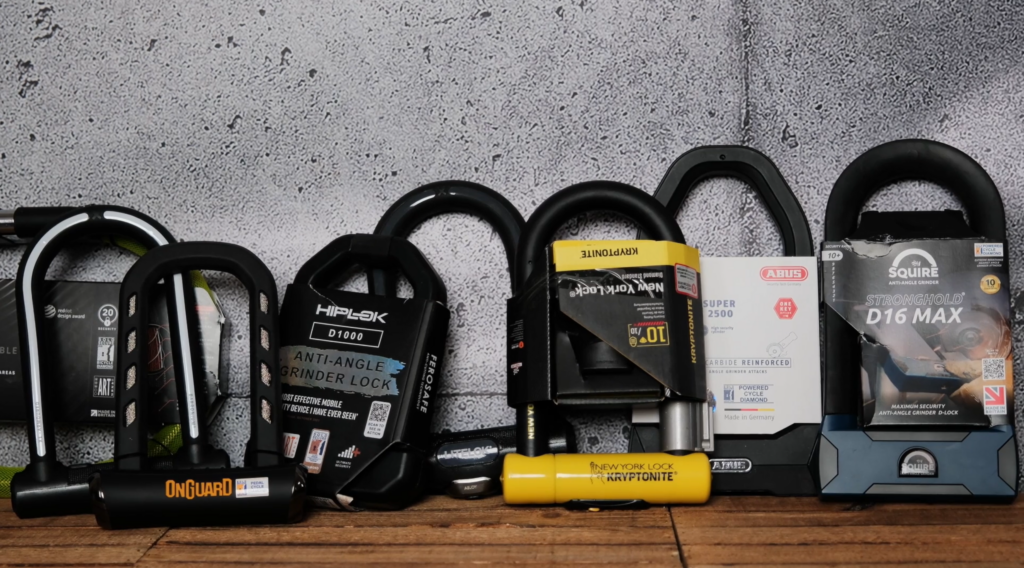
There’s a bewildering number of bike locks out there, all of them promising to keep your bike safe and secure – but where should you be spending your money, and perhaps more importantly, how much do you need to spend to be confident that your bike will remain where you parked it? To make that decision easier, we’ve recently put a whole load of locks to the test to help you choose the best one for you.
Bicycle insurance: compare quotes and find yourself a great deal to get your bike covered
We deploy a similar model for the road.cc bike lights Beam Comparison Engine, in that we’ve assembled a diverse range of locks and tested them at road.cc HQ before sending a duplicate lock out to be reviewed individually by another member of our reviews team.
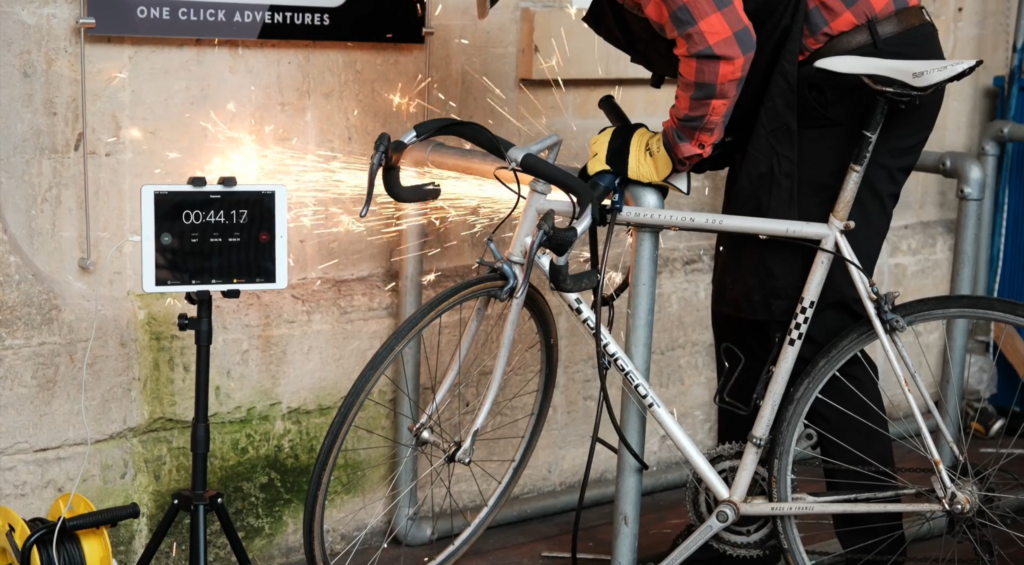
We’ve tested them back-to-back to determine their security credentials, and our reviewers will then take these results into account and also look at other non-security factors that might influence your lock-buying decision, such as ease of use, portability, weight, price, and so on.
Each lock featured here will be getting a full review, so look out for them on the road.cc website over the next few weeks. In the meantime, here’s how they stacked up in the security test…
How we tested the locks
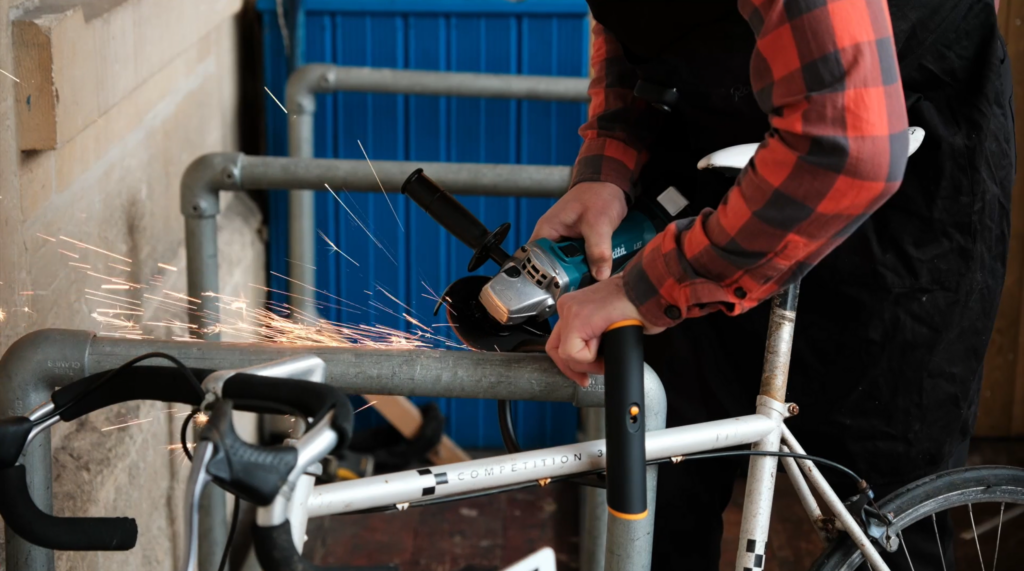
We won’t go into massive depth on the methods we used to test the locks – we don’t want to publish an online manual for would-be bike thieves, but we wanted to put them through a realistic attack from a thief, similar to what they’d (hopefully not) have to withstand in the real world.
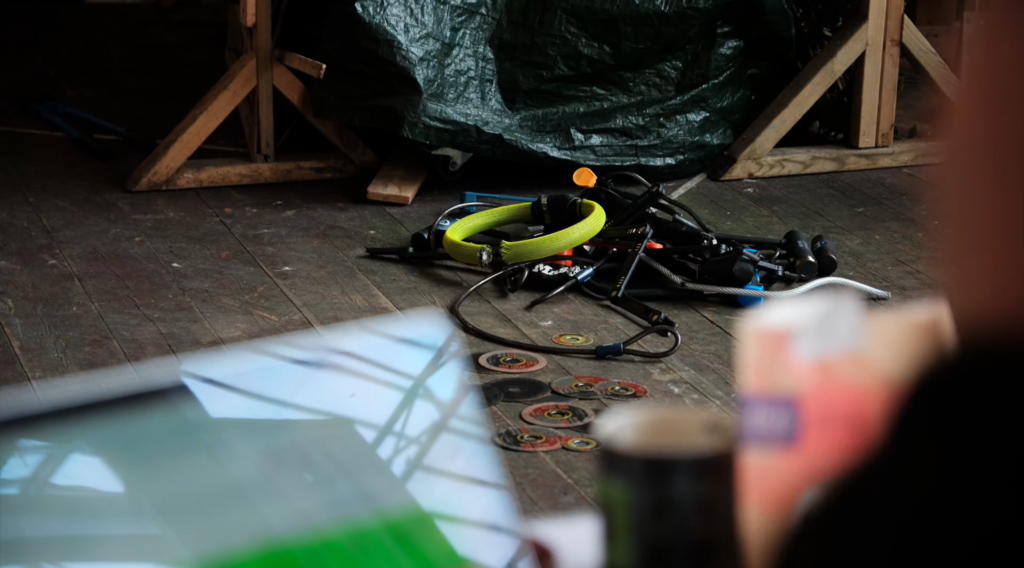
We settled on a two-part assessment consisting of a 60cm bolt cropper attack, followed by some time to get acquainted with a cordless angle grinder if they survived the bolt cropper.
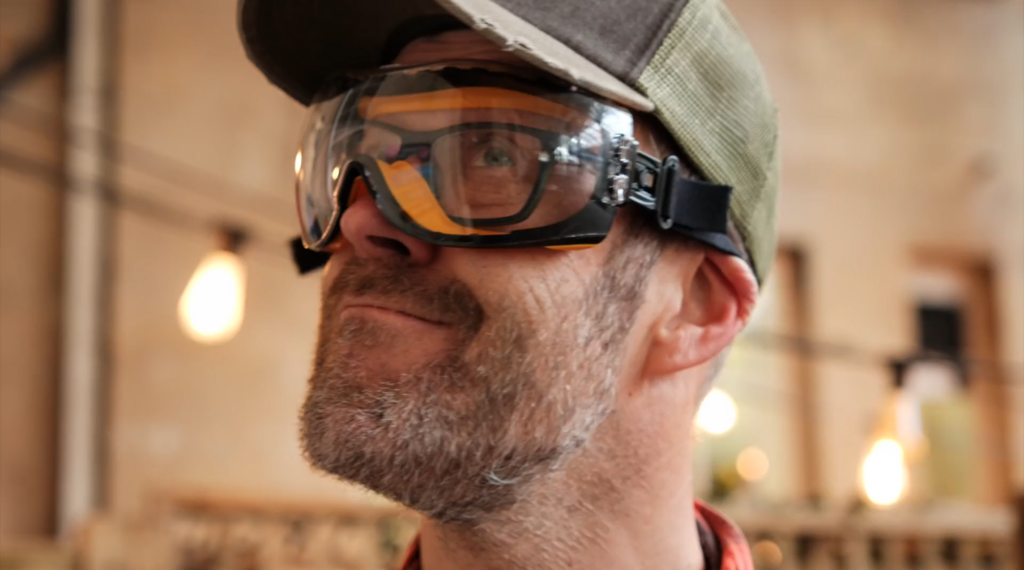
We used the same designated ‘thief’ throughout for consistency, and allowed him to go at the locks any way he felt fit, just like a thief would in the real world. We’re well aware that all locks can be cut through eventually, and a true security expert might be able to achieve this faster than our thief – but in reality, the vast majority of bike thieves are not highly skilled.
Test one: bolt cutters
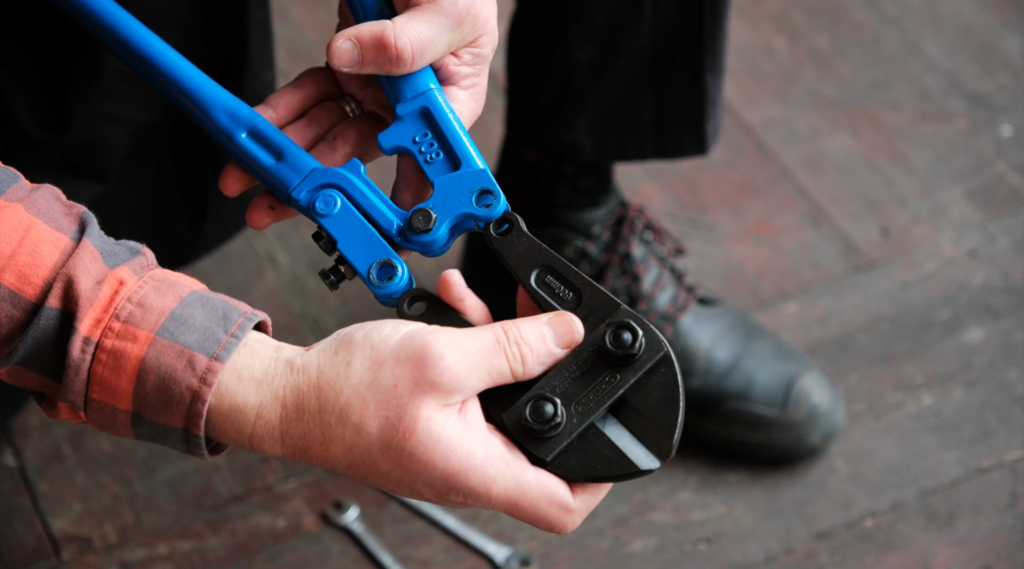
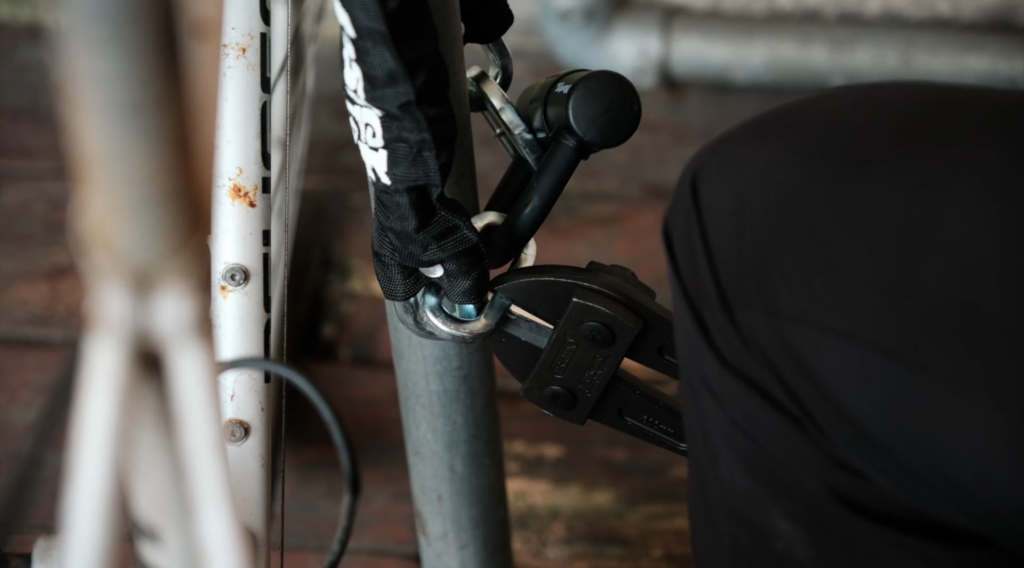
First, we set Dodgy Dave to work with bolt cutters: a readily available model from one of the big brands, nothing specialist or unusual. We used 600mm bolt cutters that a thief could conceal in a large coat and carry about relatively easily.
We used new bolt cutter jaws for each lock, and gave our thief up to a minute to try to cut through each lock, recording the time of its resistance.
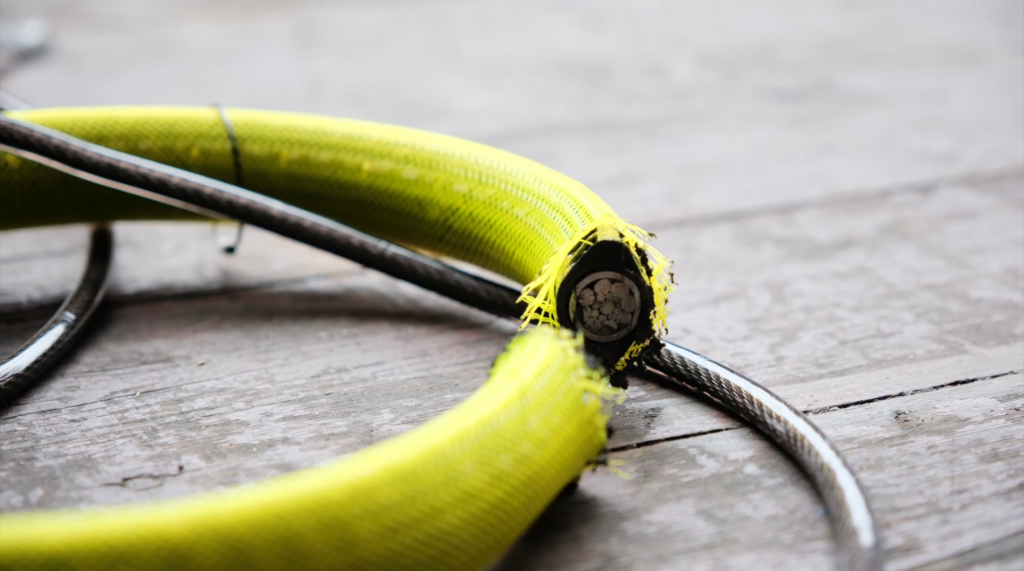
Some locks were too wide to fit into the jaws of our bolt cutters. Where this was the case, we couldn’t used this method of attack and moved straight on to our second test…
Test two: angle grinder
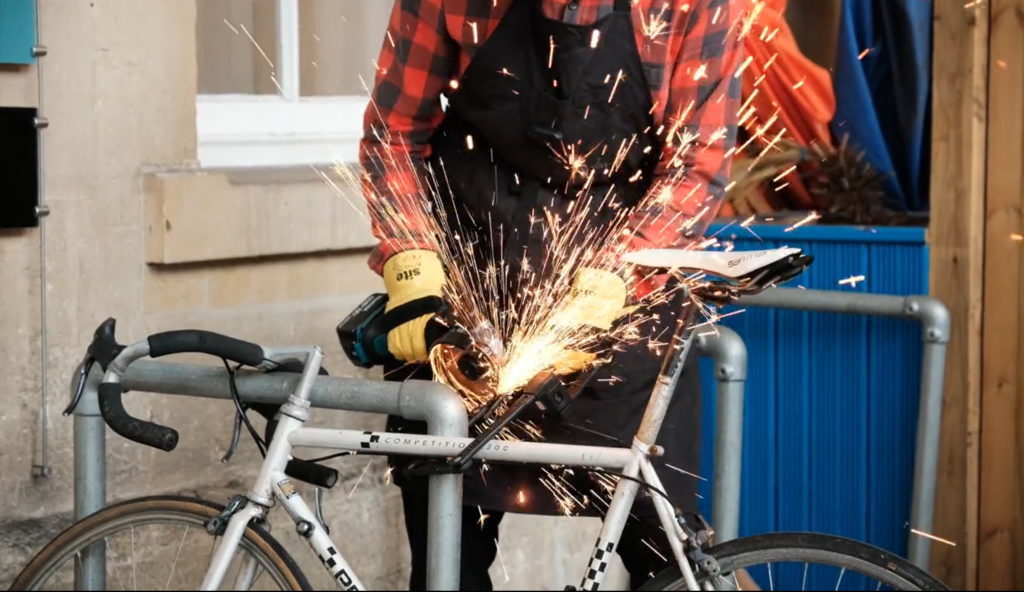
If the lock made it through the bolt cutter test in one piece, we moved onto our angle grinder test.
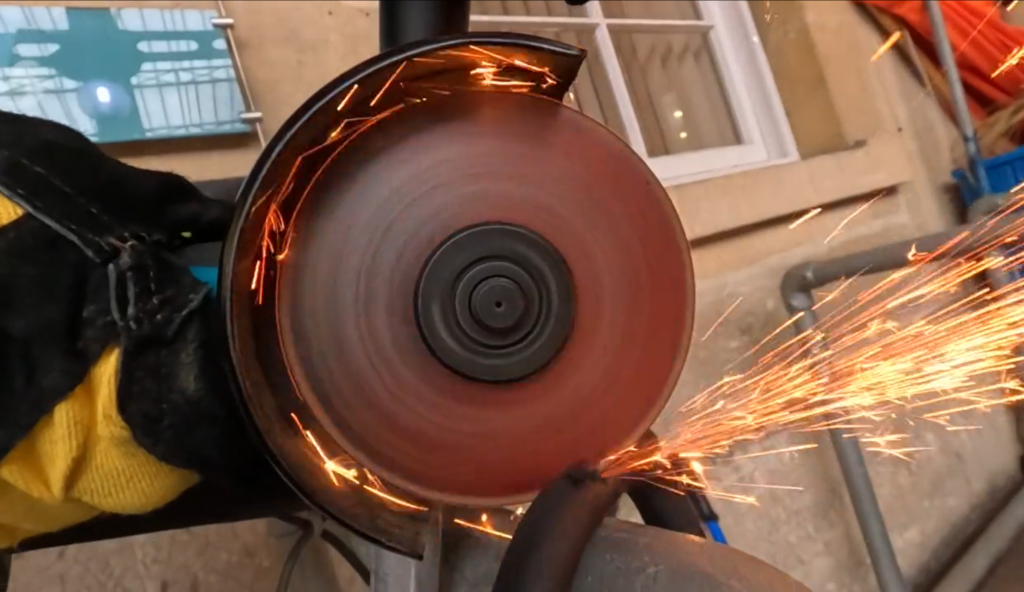
Again, we used an easily obtainable model from one of the big brands. It’s also cordless, because thieves don’t tend to go around with super-long extension leads.
We used the same angle grinder throughout, recharging the battery fully and replacing the cutting disc between attempts for consistency, and gave Dodgy Dave a maximum of two minutes to attack each lock, recording the amount of time it resisted.
With some D-locks, you can cut through one side of the shackle with the angle grinder and then twist the whole thing away to remove the bike. Others hold fairly firm even when one side of the shackle is cut through. For this reason, we didn’t time how long it took us to cut through the shackle. The time given below is how long it took us to remove the bike from our stand.
D-locks with cables: where we had a D-lock with a cable, our times listed below relate to getting through the D-lock section. We’ve put the results of attacking the cable in the ‘Notes’ section at the bottom of each entry.
What we didn’t do, and why…
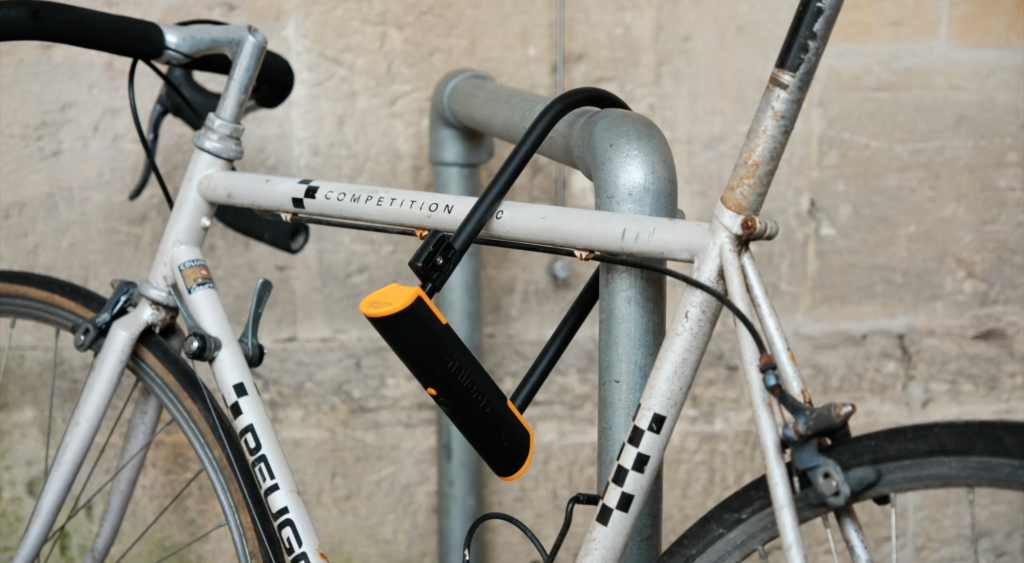
We could have taken our locks to the lab and tested them with specialist equipment. We were tempted to do that to ensure complete consistency, but we decided on real-world testing for greater realism. We wanted to know whether each lock would stand up to the most common methods of attack out in the wild, and there’s none wilder than an attack from Dodgy Dave.
We’re not saying that any lock would put up exactly the same level of resistance to every thief; different people might use different equipment and/or different methods of attack. What we are saying is that this is how each lock performed in our tests outlined above.
One thing we’re not testing here is lock picking. As much as we enjoy watching the LockPickingLawyer’s videos and have huge respect for his expertise, it would be extraordinarily rare for a street thief to possess similar skills. It’s almost unheard of for bikes to be stolen in this way according to numerous police forces we’ve spoken to about bike theft, so the pick-proofness of our locks is not something we’ll be assessing.
You may have heard of various other methods of breaching bike locks. We won’t go into detail because, as mentioned, we don’t want to give people ideas – but we’ve focused our efforts on testing against the most common forms of attack.
Bike lock test results
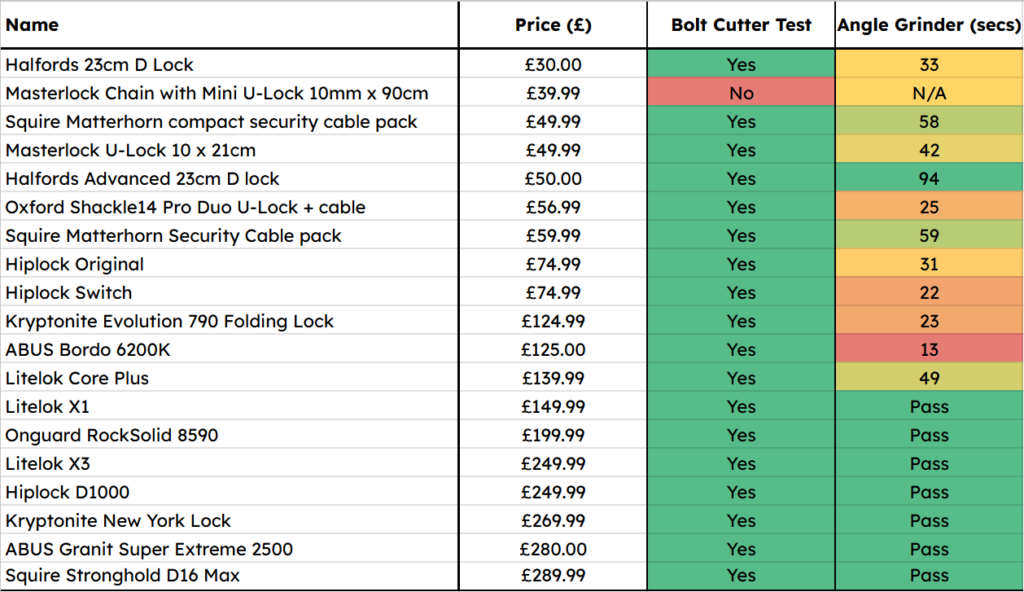
As you’ll see, there’s a sizeable difference in how the locks withstood our attacks, but no one would expect locks of such diverse prices to perform at the same level. Only one lock failed the first test – the Masterlock Chain – succumbing to Dodgy Dave and his bolt croppers.
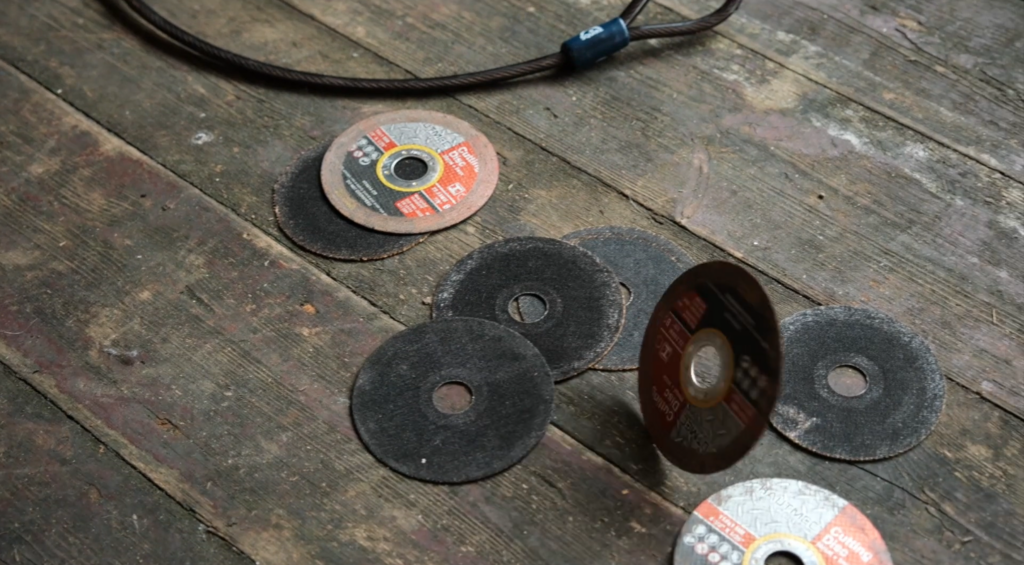
You’ll also notice that some of the most expensive locks survived our attack with the angle grinder. We’re not saying that any lock that survived our testing is necessarily ‘angle grinder-proof’. With enough time and equipment, a thief could get through just about anything. We’re just saying that this is how the various locks performed in our test scenario.
Which locks impressed us the most?
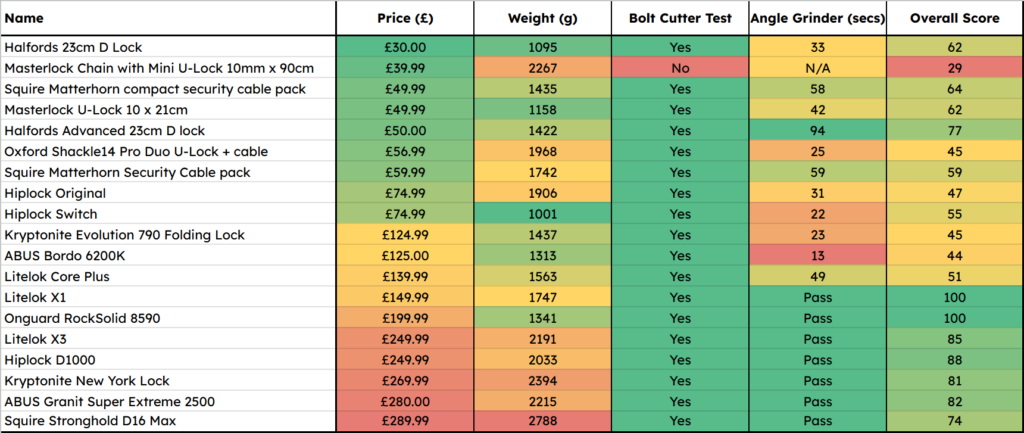
After a lot of discussion, we agreed that it was the Halfords Advanced 23cm D lock and the more expensive locks that had impressed us most, but we wanted a way to quantify this in a way that took other important factors into account, while being as objective as possible. We devised an overall scoring system which factors in the price of the lock, the weight of the lock and its performance in our angle grinder test. We’ve then scaled this result to give scores out of 100.
Please note that this score is weighted towards what we feel is important from a lock, and so the best lock for you may differ. For example, if it’s for your garage then you might not care about how much your lock weighs.
A lock-by-lock account
Halfords 23cm D Lock – Key
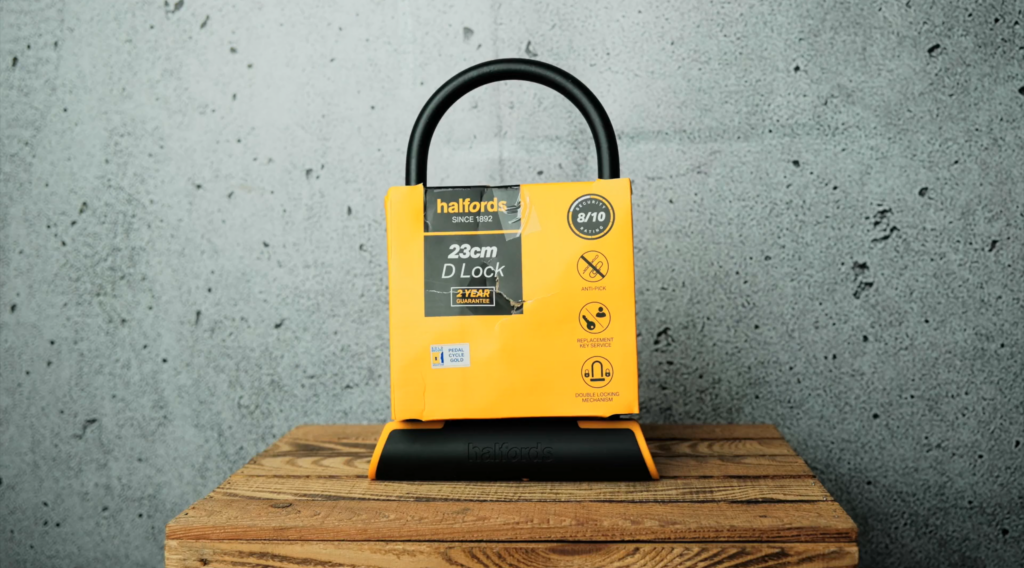
Bolt cutters: Survived
Angle grinder: 33 secs
Overall score: 62
Notes: At just £30 the Halfords 23cm D Lock was the cheapest in the test, but it wasn’t the worst. It’s light, it’s cheap, and it withstood the angle grinder for 33 seconds, giving it an overall score of 62/100.
Master Lock Chain with Mini U-Lock 10mm x 90cm
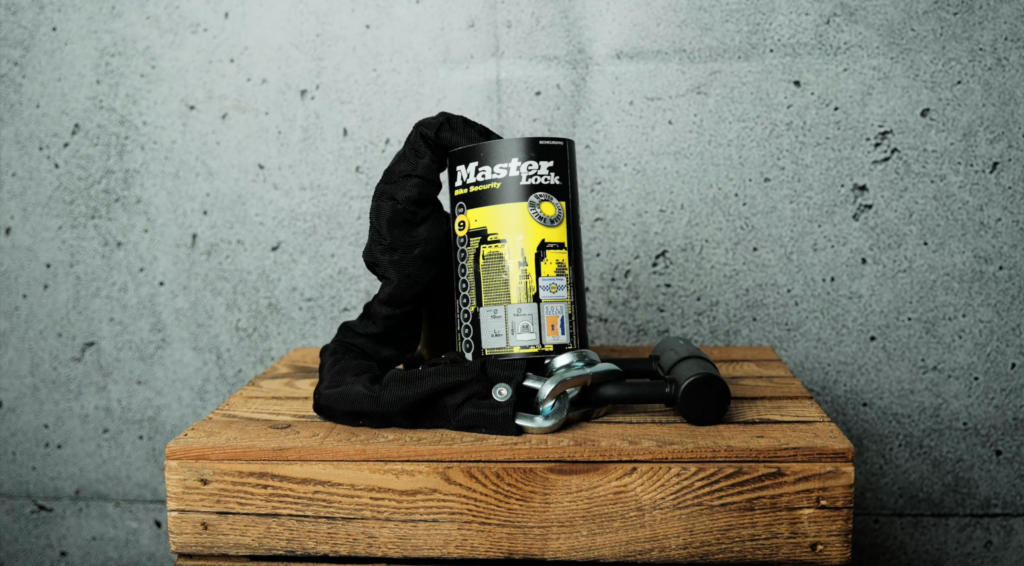
Bolt cutters: 41secs
Angle grinder: N/A
Overall score: 29
Notes: The Masterlock Chain gets the lowest of our scores because despite being cheap, it is heavy and was defeated by the bolt croppers, meaning that it didn’t move on to stage 2 of our testing.
Squire Matterhorn compact security cable pack
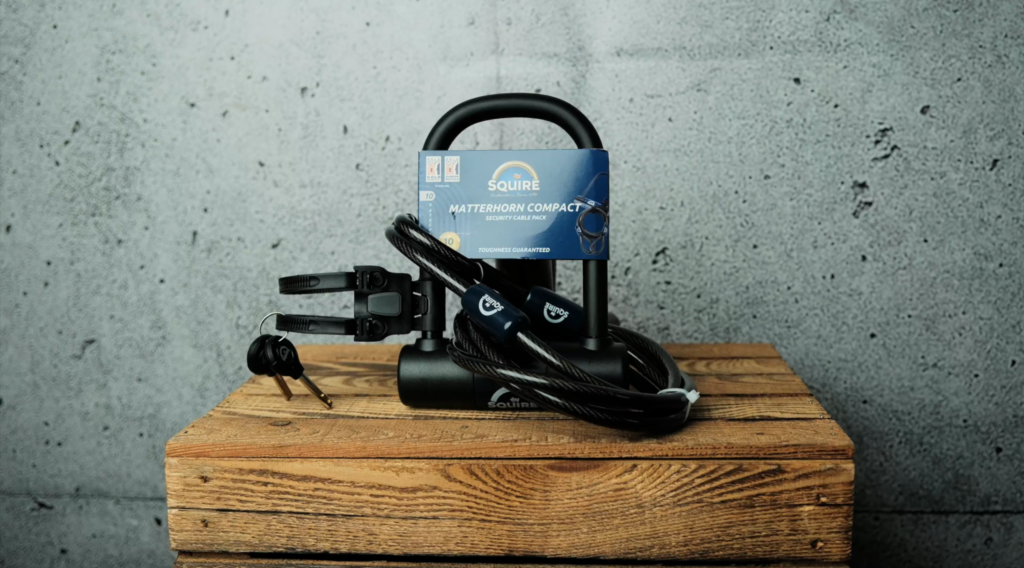
Bolt cutters: Survived
Angle grinder 58 secs (to get through the D-lock section)
Overall score: 64
Notes: It took us 55secs to get through the cable with bolt croppers. We cut through one side of the D-lock allowing us to force the lock over the frame tube and remove the bike.
Master Lock U-Lock 10 x 21cm
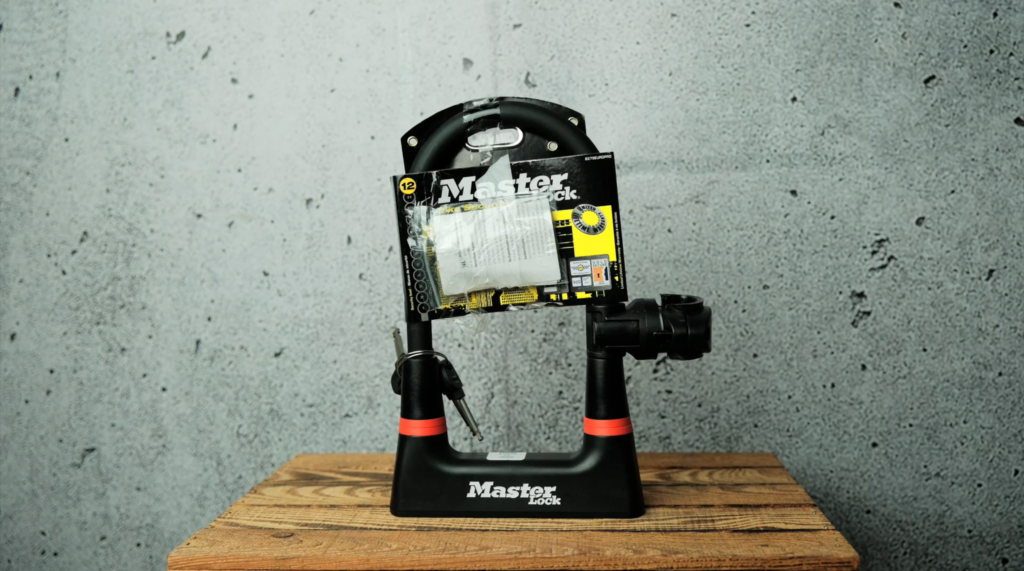
Bolt cutters: Survived
Angle grinder: 42 secs
Overall score: 62
Notes: We cut through one side of the shackle. It’s impressively light.
Halfords Advanced 23cm D lock
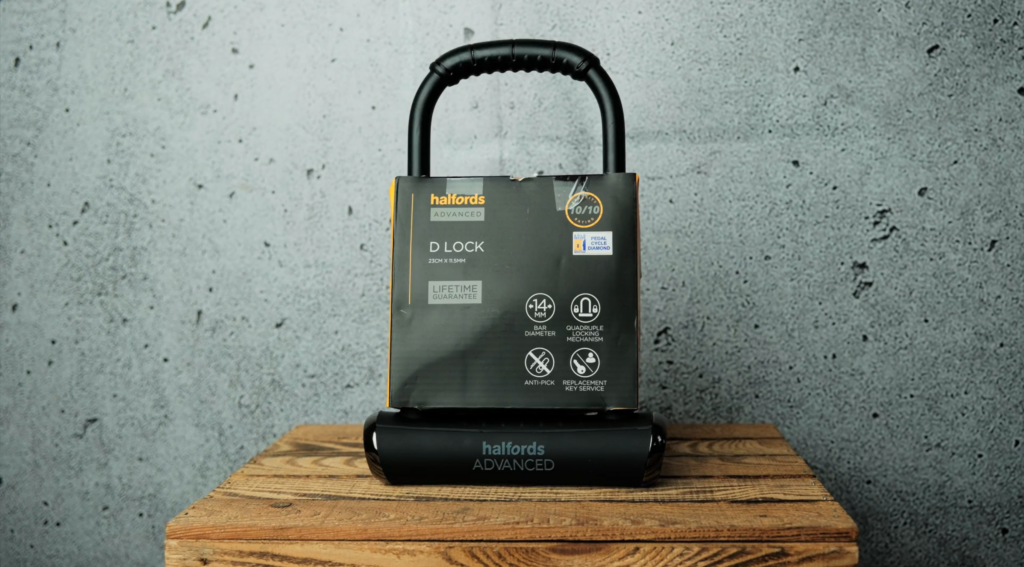
Bolt cutters: Survived
Angle grinder: 1:34 mins
Overall Score: 77
Notes: This was the longest time that it took us to get through any lock priced less than £149.99 – so you’re getting a lot of security for your money. We cut through one side of the lock with the angle grinder in about 50 seconds, but we couldn’t twist the lock out of position due to its tight tolerances, so had to cut the other side too in order to remove it.
Oxford Shackle14 Pro Duo U-Lock 320mm x 177mm + cable
Buy from Winstanleys Bikes for £42.74
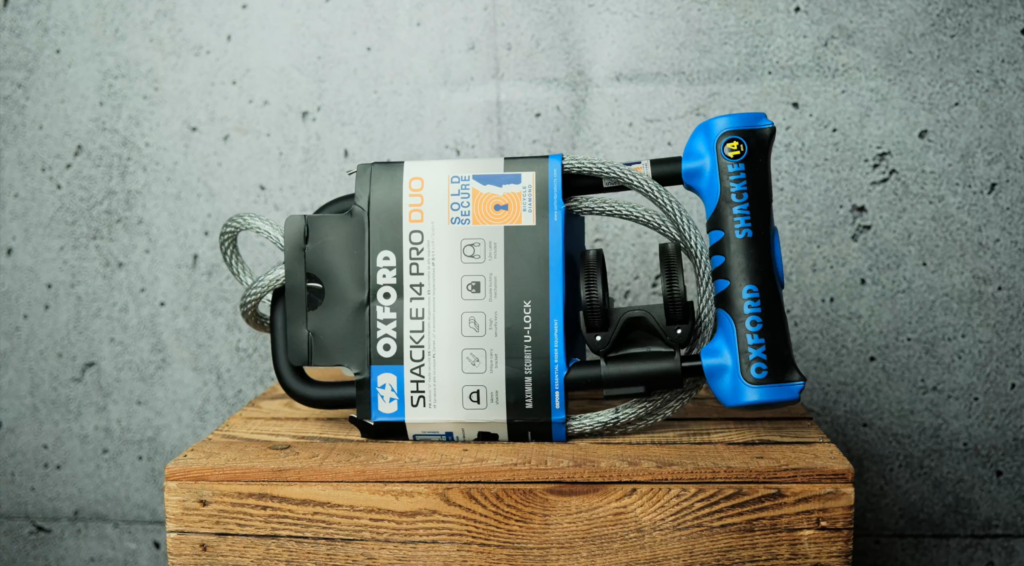
Bolt cutters: Survived
Angle grinder: 25 secs
Overall Score: 45
Notes: The cable was defeated in 53 seconds by the bolt croppers but the D-lock survived. However, the D-lock didn’t put up much resistance to the angle grinder – we cut one side of shackle in just 25 seconds.
Squire Matterhorn Security Cable pack
Buy from Lockshop Warehouse for £49.20
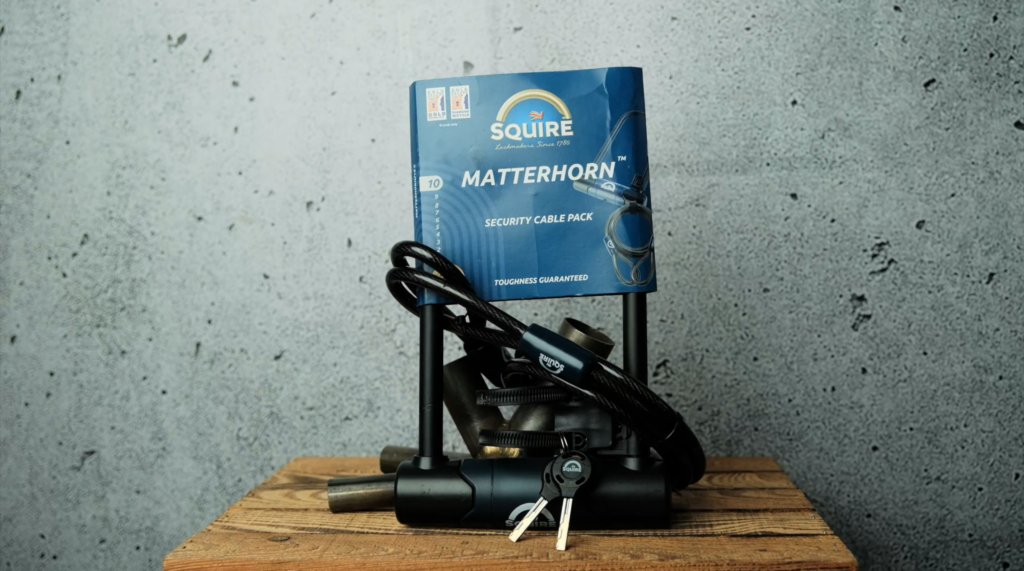
Bolt cutters: Survived
Angle grinder: 59 secs
Overall Score: 59
Notes: It took 60secs to get through the cable. With one side of the shackle cut it was not possible to remove the bike, so the other side needed cutting too.
Hiplok Original
Buy from Cyclestore for £67.49
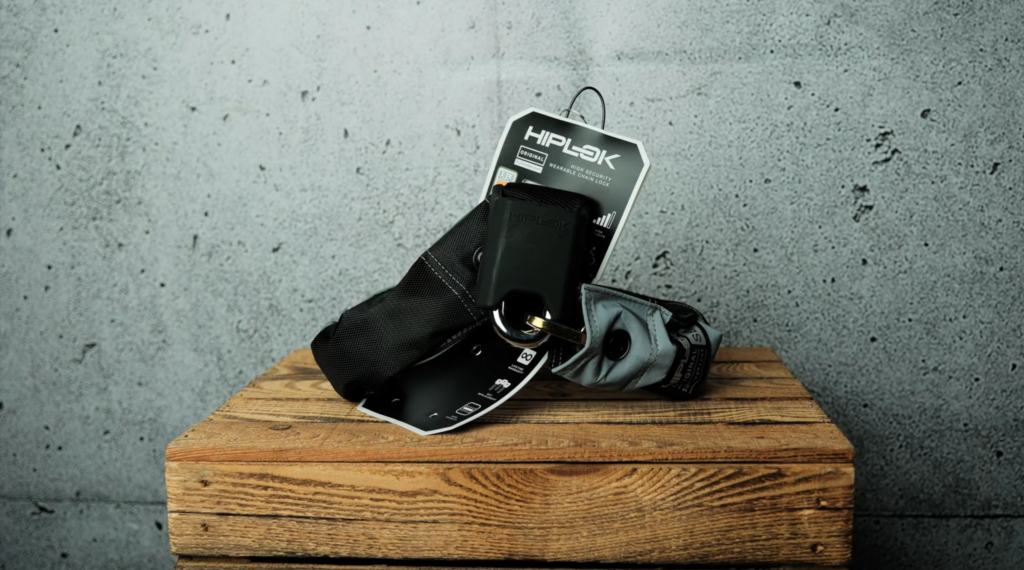
Bolt cutters: Survived
Angle grinder: 31secs
Overall Score: 47
Notes: Dave decided to attack the chain rather than the shackle with the angle grinder. Both sides of the link needed cutting, but this was done in 31 seconds. The overall score has been brought down by a relatively high weight, but this lock is wearable so that might matter less to you.
Hiplok Switch
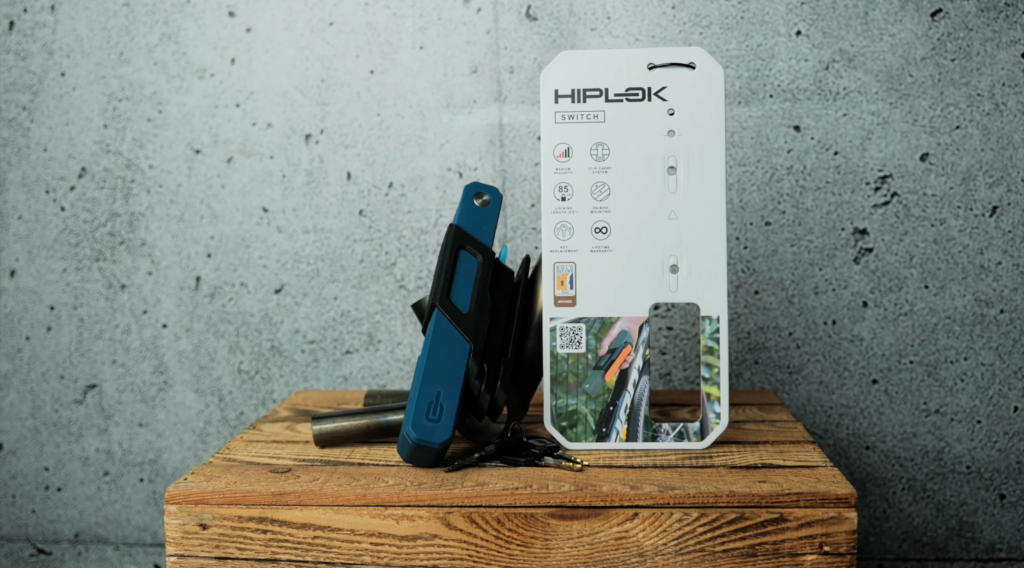
Bolt cutters: Survived
Angle grinder: 22secs
Overall Score: 55
Notes: The Hiplock Switch, like all the folding locks, needed just one cut to remove the bike. It’s score has been brought up by its low weight, and it scored the highest of the folding locks.
Kryptonite Evolution 790 Folding Lock
Buy from Decathlon for £108.16
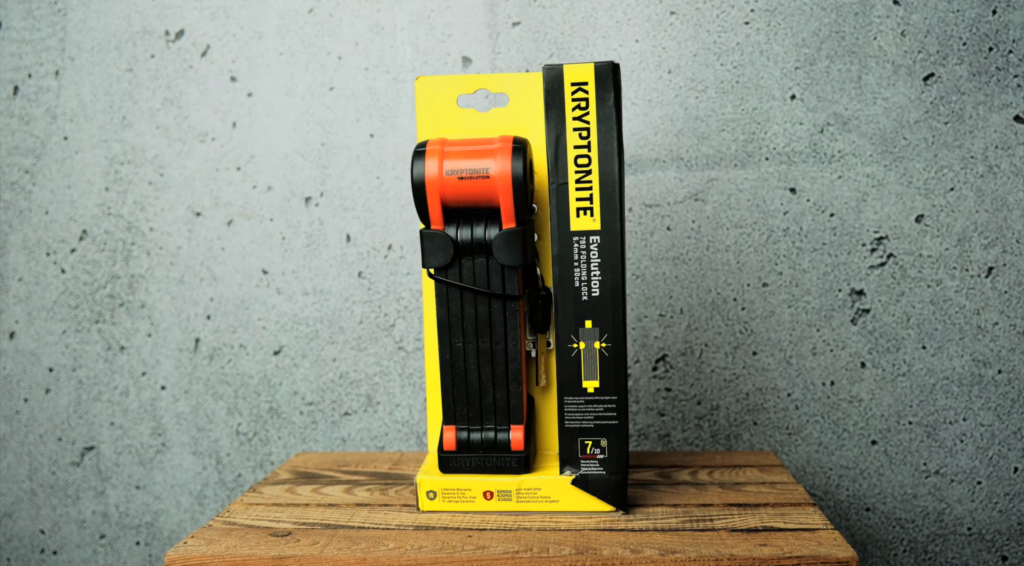
Bolt cutters: Survived
Angle grinder: 23 seconds
Overall Score: 45
Notes: Again, just one cut needed to be made. It lasted a very similar time in the angle grinder test to the Hiplock Switch.
Abus Bordo 6200K
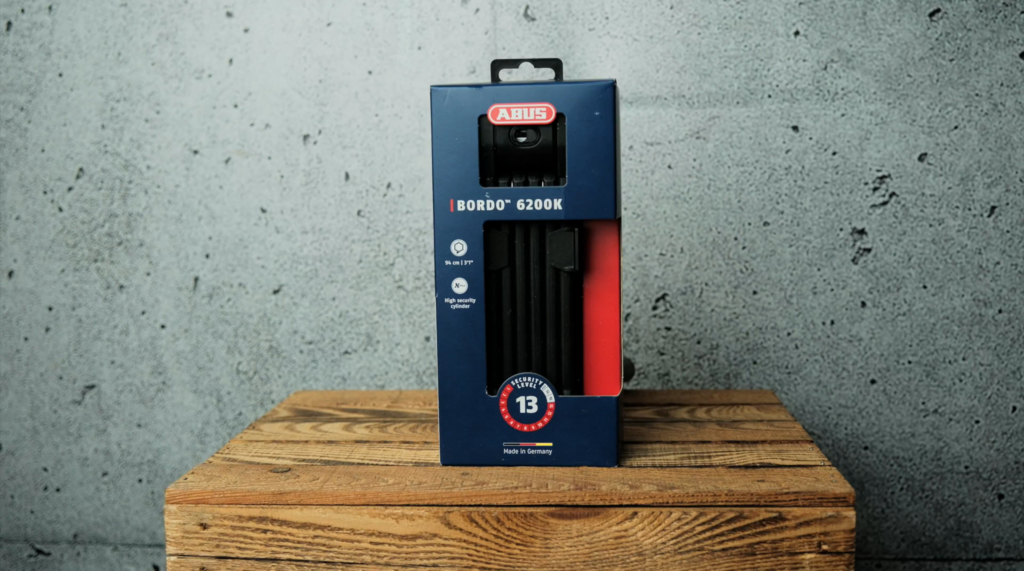
Bolt cutters Survived
Angle grinder 13secs
Overall Score: 44
Notes: It’s light and easy to carry, but was no match for our angle grinder.
Litelok Core Plus
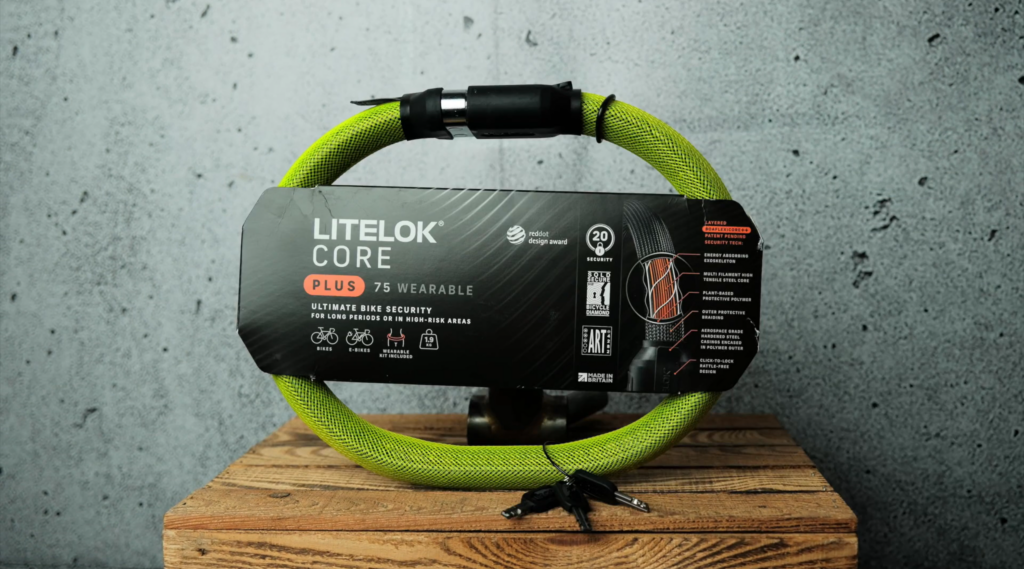
Bolt cutters: Survived
Angle grinder: 49secs
Overall Score: 51
Notes: The Litelok Core Plus put up a good fight against the angle grinder, lasting 49 seconds. This is one of only two wearable locks that we tested.
Litelok X1
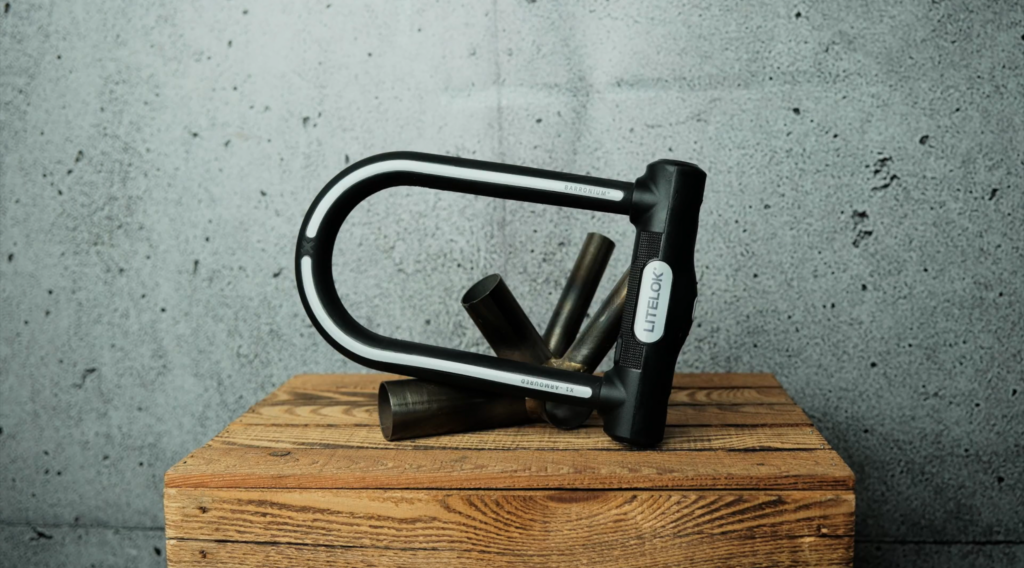
Bolt cutters: Survived
Angle grinder: Survived
Overall Score: 100
Notes: The first – and least expensive – lock to survive our angle grinder test. We certainly made a dent in the lock, but after 1:25 mins the cutting disc was worn out. We were unable to change the cutting disc within the two minute allocated time frame.
Onguard RockSolid 8590
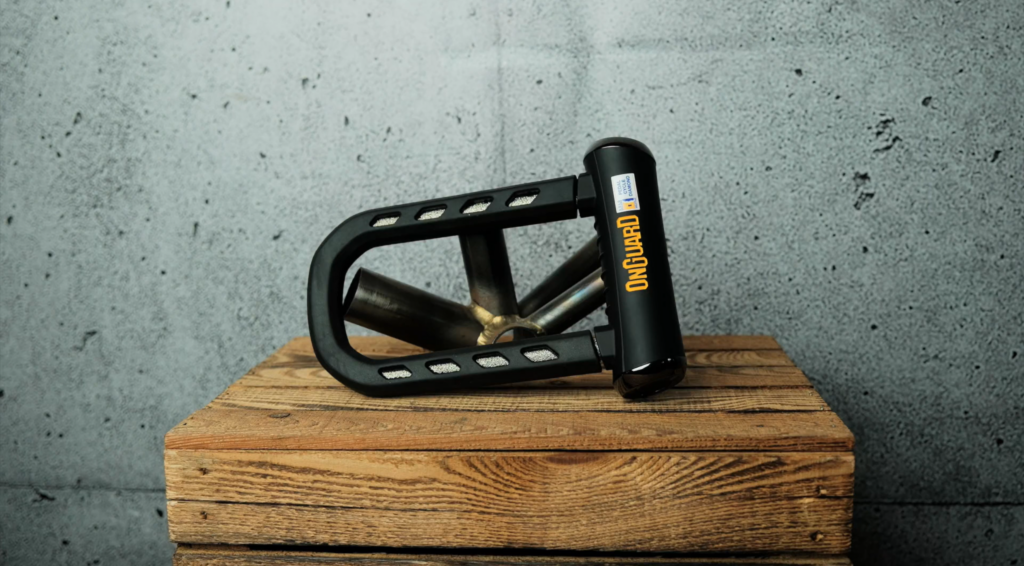
Bolt cutters: Survived
Angle grinder: Survived
Overall Score: 100
Notes: The lock destroyed our angle grinder disc in 30 seconds. Very impressive, especially given the price. We made minimal impact on the metal in that time.
Litelok X3
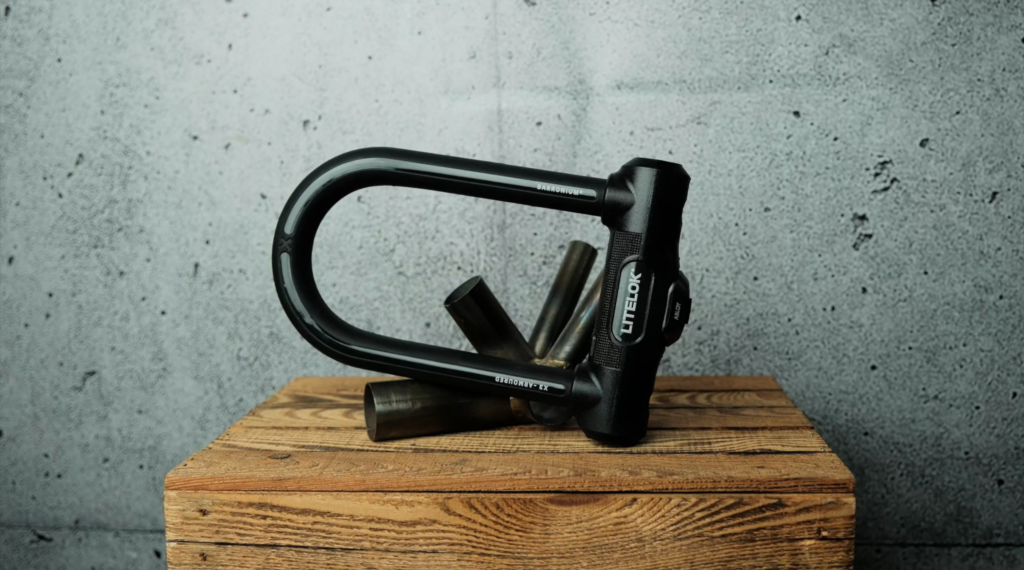
Bolt cutters: Survived
Angle grinder: Survived
Overall Score: 85
Notes: Another impressive lock from Litelok. It didn’t destroy the angle grinder disc to the same degree as some, but wasn’t far off. The angle grinder got through the rubber coating, of course, but we didn’t get through much of the metal in the time allocated. Despite still scoring full marks in the angle grinder test, it’s overall score is less than the locks above due to higher price and weight.
Hiplok D1000
Buy from Helmet City for £224.99
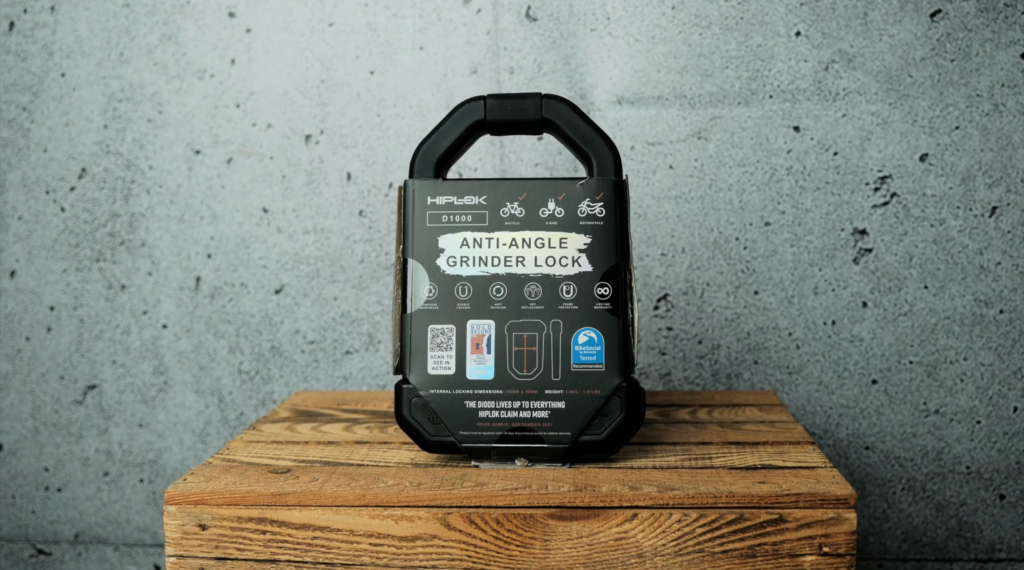
Bolt cutters: Survived
Angle grinder: Survived
Overall Score: 88
Notes: Disc died after 1:15mins of attacking this lock. We were beginning to make an impact… but nowhere near enough. It would have taken us a lot longer to eventually get through it.
Kryptonite New York Diamond
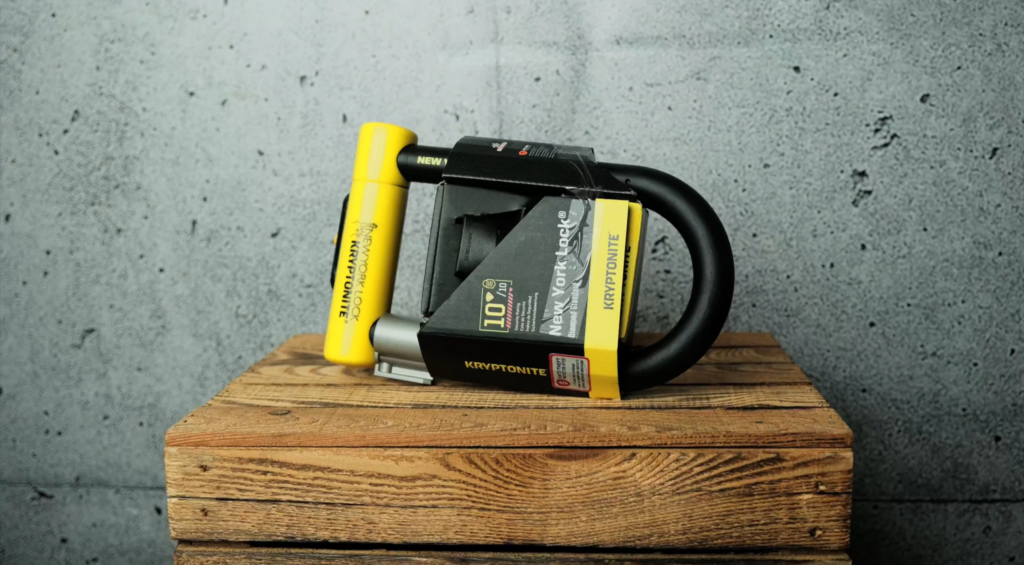
Bolt cutters: Survived
Angle grinder: Survived
Overall Score: 81
Notes: A lock with a reputation for being secure, and it didn’t disappoint. The New York Lock destroyed our angle grinder disc in 34secs. Very impressive, but it is quite weighty.
Abus Granit Super Extreme 2500
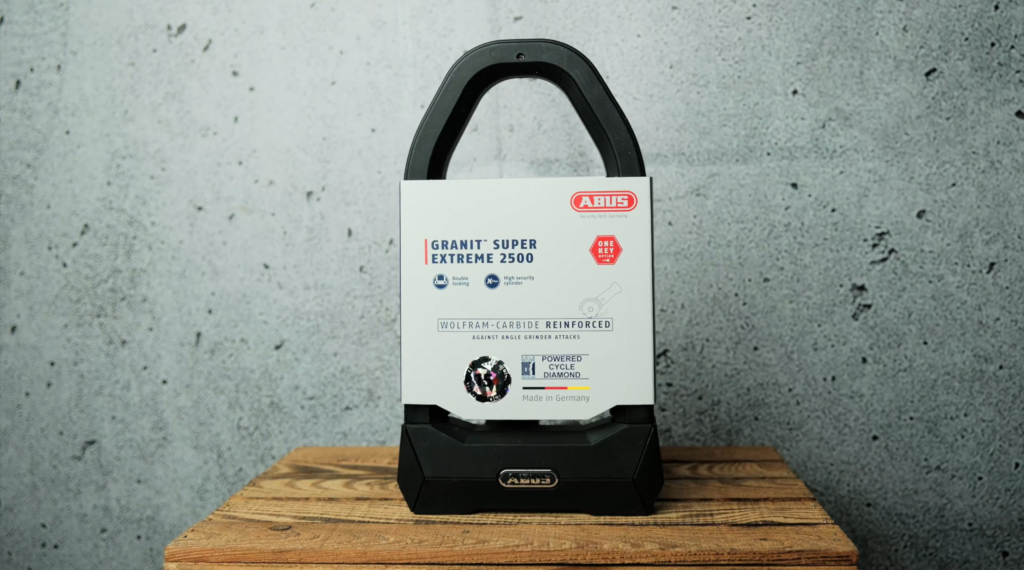
Bolt cutters: Survived
Angle grinder: Survived
Overall Score: 82
Notes: This lock didn’t quite destroy the angle grinder disc, but we didn’t make much of an impact on the internal metal structure. It stood up to our attack well.
Squire Stronghold D16 Max
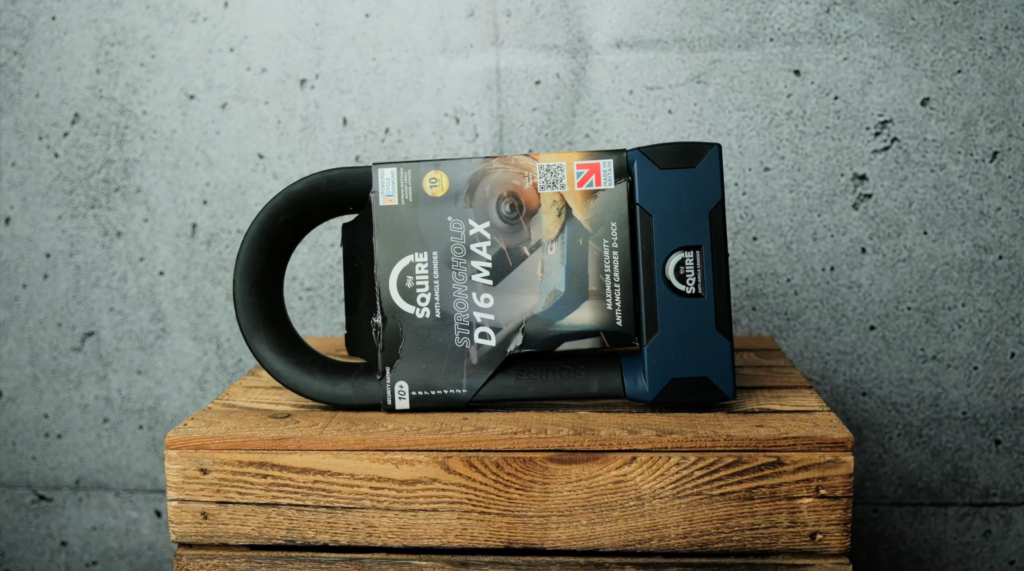
Bolt cutters: Survived
Angle grinder: Survived
Overall Score: 74
Notes: The most expensive lock on test lasted the whole two minutes. Our angle grinder disc survived it, but we didn’t get through a lot of metal.
So… how much should you spend on a bike lock?
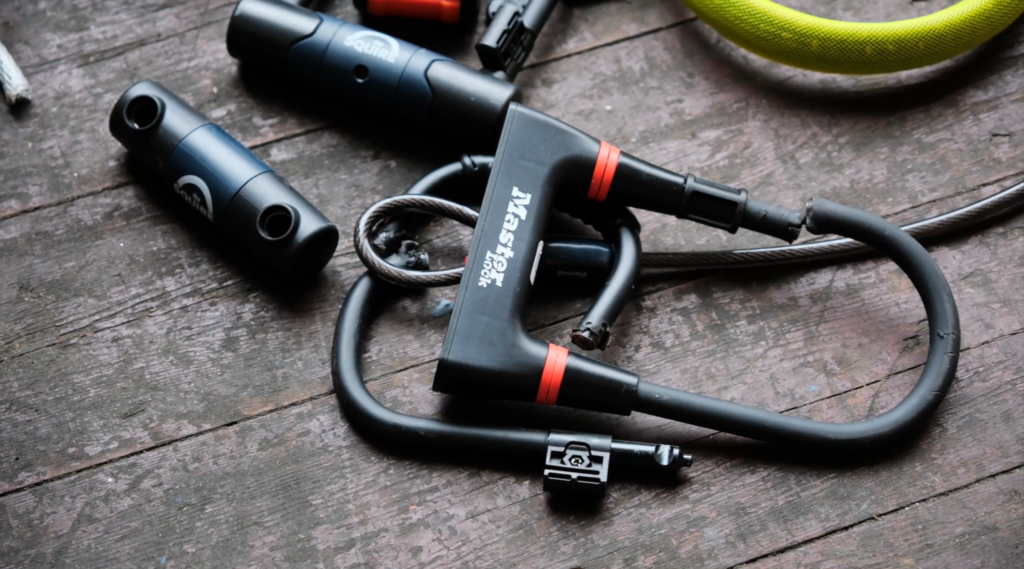
To answer the question in the title: yes, spending more on a bike lock usually means more security for your bike. How much you spend obviously depends on budget, and other factors such as where you usually park your bike. Kryptonite and other brands suggest that you spend 10% of the total cost of your bike on security, but there is no hard and fast rule.
To start with, most UK bike insurers require the use of a Sold Secure-approved lock, and often specify a level depending on your bike’s value. Failing to use a lock of the required rating could invalidate any insurance claim if your bike is stolen, so make sure you read the small print and get this one right.
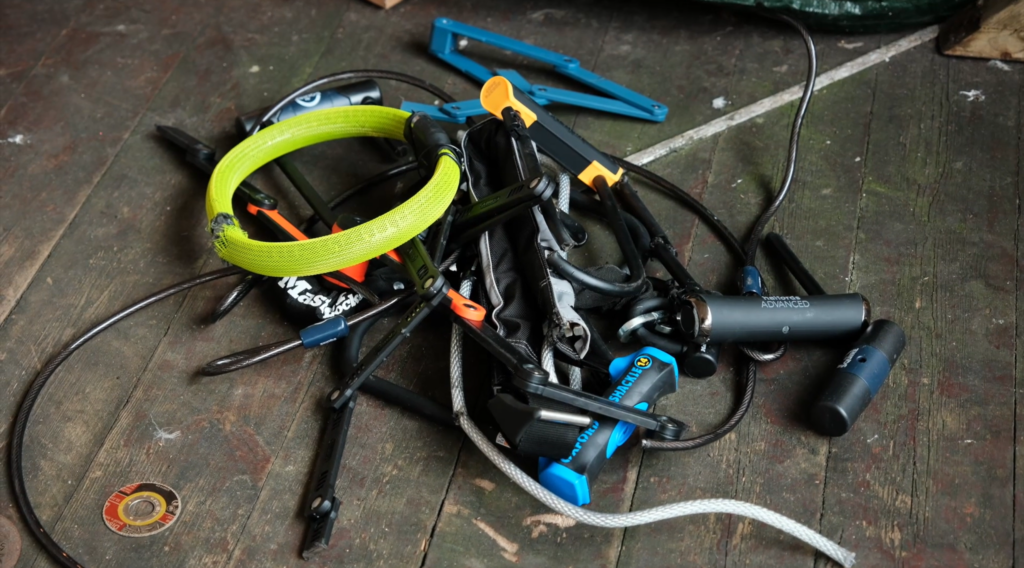
Why wouldn’t you just buy a lock with the highest security rating, then? First, a higher level of security tends to cost you more money (although there are exceptions to that rule).
Second, the most secure locks aren’t always the lightest. If you’re after a lock to stop someone walking off with your bike while your back is turned at your mid-ride coffee stop on a Sunday morning, chances are that you’ll want something lightweight and easy to carry, not a 2kg lump of angle grinder-beating tech.
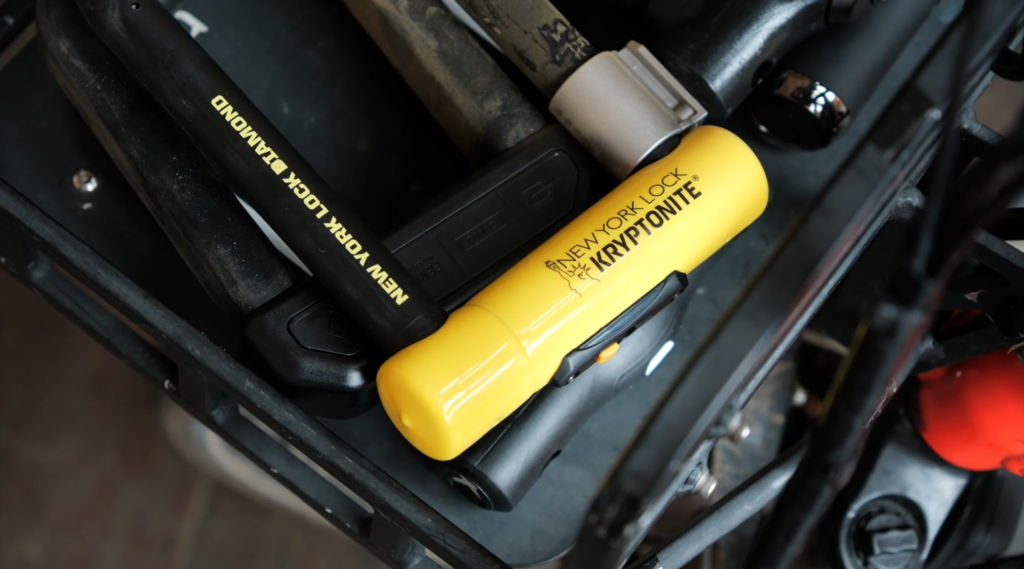
On the other hand, if you’re locking your bike overnight in a garage, weight is unlikely to come into it. You just want the highest level of security. In most other situations, you’ll be balancing security against weight, price, ease of use, and so on.
From our testing, it’s the Halfords Advanced 23cm D lock, Litelok X1 and Onguard Rocksolid 8590 that stand out as the best taking into account weight, price and security – but as we’ve said already, the best lock for you may differ. We tested plenty of impressive locks that might tick your boxes better, and the full reviews that we’ll be publishing in the coming week will likely give a fuller picture of what they all offer. The size and shape of the lock, whether you can mount them to your frame/panniers or not, even how quick and easy it is to lock and unlock them may all matter to you.
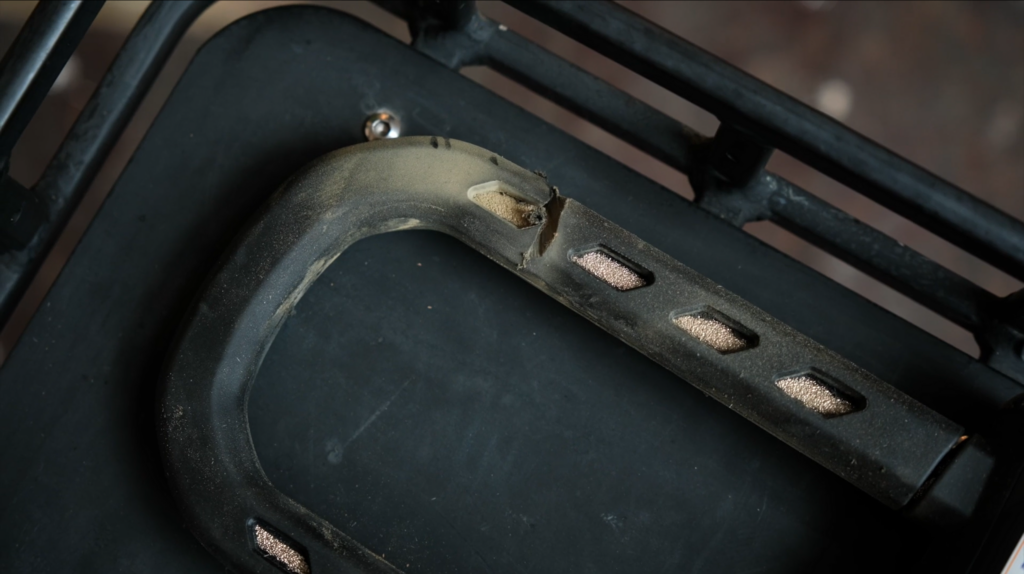
It’s easy for us to say, but we’d suggest that if you’re looking to save money, you bike lock isn’t the place to do it. Seriously! Having your bike stolen is really, really bad news. If you’re tempted to buy a lock based purely on price, consider how you’ll feel if you come back to find your bike gone.
Is there an unbreakable bike lock? Nope, but some are significantly harder to break than others. The more resistant your lock is to attack, the more likely any potential thief is to give up and go elsewhere.
After seeing this test, which lock would you choose to lock up your pride and joy? Let us know in the comments below as well as if we’ve missed your favourite lock…








41 thoughts on “Cheap vs expensive bike locks — will spending more keep your pride and joy safe? We deployed an angle grinder to find out”
I realise the weak chain didn
I realise the weak chain didn’t stand up to much angle grinding, and even my kryptonite fagadabadids won’t, just wondering how you stopped the link from moving about when cutting?
Agreed this would be useful
Agreed this would be useful info, suspect they pin it to the ground with their foot, so arranging the chain so it can’t be pinned to the ground would be good practice.
ktache wrote:
Get your mate Sammy Three Fingers to hold the chain while you cut it.
I’ve often pondered the value
I’ve often pondered the value of locking a very small padlock around the chain, on the assumption that it would be awkward if not impossible to wield an angle grinder or bolt-cutter jaws against it. Yet it would prevent the bike being ridden away. The thief might not even notice until they tried, and ended up with a the drivetrain jammed, then hopefully to give up.
Good luck remembering it’s
Good luck remembering it’s there before you push off though.
That’s basically the “ring
That’s basically the “ring lock” right there *.
Your idea is lighter. But also dirtier / more fiddly. And – depending on your bike – without the hefty bike to discourage someone simply wheeling it round the corner to take time smashing the tiny lock.
And also no use if someone’s going to chuck it in a car / grab it away on a moped.
At that level of security – literally just stopping a “grab and ride away” – I think you might be better with either: a) a ring lock plus plug-in chain (several models offer this) or b) if you want to be light as possible a thin cable / chain lock. Which if really light probably won’t stop cable cutters – which your idea might, but then your idea won’t stop a pick up and walk off. Pros and cons…
* Detailed review of a few here – and e.g. Kryptonite also do one. Locks from all 3 brands here look very similar – perhaps same factory?
After-market ones have a slight down-side in that I’ve not seen one you can ensure stays on the frame without welding it yourself. So even if you’d used a plug in chain someone could just remove the wheel and take the frame (unless you’d remembered to take the chain round the frame also).
OTOH … again these are rather low level security locks and more to “discourage very casual theft”.
I’m a fan of those ring/wheel
I’m a fan of those ring/wheel/nurses locks for utility bikes and have them on a couple of bikes. I have the plug in chains too, but some recent weighing revealed that the chains are heavier than my (smallish) D-lock, so now I go for wheel lock + D lock, hoping that I’m adding an extra job for the thieves to do. Downside is the need to faff around finding the right key for each lock. I wish those keyed-alike systems were easier to get in the UK.
Both of my commuters have a
Both of my commuters have a rear wheel ring lock. They are extremely convenient. I’m on my second plug in chain, which I basically never use. The reason is the shackle you use to make a loop of the chain. Soft as butter. Had to leave one bike chained to a canal railing overnight because something in the lock jammed. The ring through the wheel released, but the chain plug refused to come out. Came back in the morning, borrowed a cordless angle grinder from the LBS, and was through that shackle in maybe 10 seconds.
My partner got herself a new bike from my LBS last year (Bergamont something with Gates carbon belt), owner recommended a proper heavy chain lock instead of the plug in lock over a plug in chain for the same reason. The shackle is a real weak spot.
I would have made more
I would have made more efforts to get one for my main runabout, but for exactly that reason e.g. chain looks way too feeble. Only…
… this is almost certainly not a logical choice by me. Something like that fairly easy-cut chain might be the best overall cost/benefit option for the threat I’m trying to protect against.
First: that same bike was stolen (I got it back, long tale) when double-locked with expensive heavy metal (not the latest angle-grinder-resist, true) in a “secure bike store”. Because the latter wasn’t, it just hid the thieves at work and gave me a false sense of security. So simply “heavier” isn’t always the answer. Plus now I won’t leave it anywhere it’s not likely to be observed for very long so that’s not the main threat.
Logically I just need something to prevent someone nicking my rear wheel (hub gear there so the most expensive part) and prevent someone just walking off with the bike. I’ll aways be carrying the lock so as long as it will stop a silent few-seconds-attack (bolt croppers) lighter is generally better.
But … perhaps I really need a lock that is simply stronger-looking than the bike I’ve parked next to?
Spurted a bit of tea at this
Spurted a bit of tea at this
The problem with angle
The problem with angle-grinder-proof locks is that what they’re attached to usually isn’t angle grinder proof. Admittedly, a thief may go after the lock first and bust their disc, but they’ll soon learn.
I say this as an owner of the Hiplock D1000.
People also don’t give a
People also don’t give a single shit about taking longer than 2 minutes because there is still close to zero chance of them getting in trouble for it. People are absolutely brazen. Broad daylight and not even hiding their faces.
This is where locking
This is where locking technique may help. I always put the lock through the frame and rear wheel, which means even if the thief does cut through the stand, they still can’t simply ride away on the bike.
One thing the article above doesn’t go into is how easy this is, depending on the lock. I have the Litelok X1 and one of the reasons I chose that over the Hiplok D1000 is the larger internal dimensions make locking this way relatively easy.
This is a really excellent
This is a really excellent tip. I generally thought it was a good idea to get as much stuff in the way as possible so that thieves can’t manoeuvre the lock to make it easier for them to attack, but I hadn’t quite figured out this point. I’ve been testing the Litelok X3 as part of this special feature, and I’d also been thinking “this is all well and good, but now it’s often going to be easier to cut the stand than the lock”. I’ll amend my locking technique where possible – thanks!
BTW – there is a table here which has all of the internal dimensions which probably addresses your comment:
and, as above, we’ll be publishing detailed reviews of all of the locks tested here over the coming weeks, which will cover the other “what they’re like to live with” stuff.
Generally never a bad idea to
Generally never a bad idea to lock the bike to part of itself to make it harder to remove (and stop them just nicking your wheels…).
It seems people are getting this idea e.g. in Edinburgh there are often instruction stickers / posters on and around bike lockups encouraging you to lock wheels and frame (and sometimes suggesting you use two locks…)
Leaving less “slop” in the system when locking also is practical for stopping the bike falling over in the wind / if someone bumps into it!
BUT if someone’s moderately determined / has angle grinder that is moot as usual. The cheapness and availability of those focusses us back on “locks are mostly to slow thieves down” e.g. make it obvious and allow someone to intervene. The degree the system is “secure” is the degree that you can expect the latter.
Of course – there’s the “have to cover myself for the insurance” dimension also.
Horses for courses – what’s the threat? It’s good to reduce potential thieves’ room to manouever / get tools in – especially with u-locks. BUT more potential for movement in the system (especially with chains) can make it slightly harder to use an angle grinder…
For double diamond frames,
For double diamond frames, locking technique should be front wheel off, d-lock round both rims, frame (seat tube) and bike stand. It’s a faff and needs a fairly large d-lock.
Sadly observation is that thieves will still strip anything they can from the bike such as forks and components.
https://thebestbikelock.com
https://thebestbikelock.com/how-to-lock-your-bike/ has various suggestions of how to lock your bike. I do think it’s necessary to balance utmost security with convenience and practicality, and the balance may depend on how valuable your bike is, where you’re leaving it, how long you are leaving it for.
I recently got the Hiplock
I recently got the Hiplock DX1000 for the same reason – bigger internal space which is often needed to secure my cargo bike. Suspect it’s still not big enough to catch frame, wheel and stand on that bike, but then I do have an integrated wheel lock too which would further delay them riding off. God is the Hiplock heavy though!
I waited for for the DX1000
I waited for for the DX1000 which is just enough to go through the chain stays at the bb and my 3 inch tyres and 50mm flatish rim. The Rohloff is the most valuable bit of the bike.
I’m disappointed to see the
I’m disappointed to see the Abus Bordo 6200K last all of 13 seconds, I use the Abus Bordo Granit 6500 folding lock paired with Abus Shield wheel lock (matched key) on the commuter e-bike, fingers crossed I don’t lose the bike. I bought mine as Sold Secure Gold rated to satisfy insurance when left outside.
Anyway, thanks for the reviews.
Good stuff for doing this one
Good stuff for doing this one – expensive article perhaps?
As usual with security you need to know what threats you’re faced with and then look at trade-offs. My uses for my bikes (I don’t have a racer or an eBike – though it would still cost me money and be painful to replace – but since 2nd hand they’re perhaps less obviously “bling”):
a) “short-ish stops at low-ish risk places” e.g. securing within sight at a cafe, shopping (out of sight a little longer but more people about). I think something better than a cable lock does here e.g. medium-weight chain or u-lock – basically to prevent simple walk-offs and defeat tin snips / bolt croppers and maybe a bit of jemmying / leverage.
b) Securing at my flat. In theory the place for a heavier but more secure lock … but since I discovered the “secure storage” merely provides a private, secure and dry workplace for thieves I simply don’t trust it with any bike now. They all stay in the flat now – wisely or not I trust the doors so no locks. (If someone has got that far there’s other stuff they’ll probably nick…)
c) Lower-security public places – e.g. securing a bike at a station in Edinburgh. I simply don’t expect anything to secure a bike a thief wants here. So I rely on the (a) type of lock to stop someone opportunistically grabbing it (e.g. breaking a cheap cable lock) but rely on the bike being old and no great financial loss if it does get nicked.
So in my use case I find angle grinder resistant locks are redundant. Either thieves should not have time before I’m there (whether that makes a difference is a question…) or if they would I can’t assume a tougher lock will stop them (or other people would risk themselves). So I only leave something that’s probably not worth stealing.
Nice article, nice tables
Nice article, nice tables with weights. I would be happier to see where my lock stands, but still very good. Really useful stuff, much more than five-digit priced bikes articles.
Not searching actively, but a cheaper knock off version of Litelok X1 would be tempt me.
It would be helpful for you
It would be helpful for you to rate the cycle stands.
There is no point in using a £300 lock that an Angle Grinder can’t cut on a stand that can be cut with a butter knife.
I had to lock my bike to a
I had to lock my bike to a stand like these at twickenham – didnt feel it was that robust.
I did use 2 locks and a cable. Forgot to take my garmin off but it still there after the match !
Steel isn’t going to be
Steel isn’t going to be hardened like a decent lock. In fact it might be tubing and not solid.
(Some of these look like they could be unbolted too. Albeit it looks easier to cut them…)
BUT … given “public place” that is both the threat and your likely defence e.g. someone would notice sparks flying, and possibly there would be security around. Then it’s just down to whether you think anyone would notice and inform police / security and if either would bother to intervene.
Now I wouldn’t leave my better bikes in such places though.
Hirsute wrote:
I cycle to football matches a lot (most recently Wembley last weekend – 3-0, what a day!) and I often get asked about where I lock the bike; aren’t I worried about it getting nicked etc. At the risk of tempting fate, I always feel pretty safe. I’ve got a D1000, which helps. But in any case, who is going to go near a football ground with all the police around with the kit to break a decent lock or cut through a stand?
I wouldn’t leave my garmin on it, though 🙂
davwil wrote:
what, all of them?
The OnGuard Rocksolid is on
The OnGuard Rocksolid is on sale for £149 from Winstanley Bikes right now.
In terms of angle grinder
In terms of angle grinder resistant locks, the Hiplok and Liteloks (anyone else get confused between the two brand names?) have been around for some time, now. As the most real world test, has anyone heard any stories of people having bikes nicked despite using one of them?
Steve K wrote:
The fact that no-one replied to this with any examples (along with the fact I’ve never seen any examples on social media) makes me think they’ve done pretty well in the real world.
My concern is as more and more angle grinder resistant locks come on the market, and they become more prevalent, thieves will find a way round them – while they have been rare, there’s not been enough incentive for the required ingenuity.
It might well be the ‘faster
It might well be the ‘faster than the other guy’ factor coming in to it: your lock doesn’t necessarily need to be thief-proof – it just needs to be more bother to defeat than the lock next to it.
mdavidford wrote:
Which is part of the reason for my concern about the growth in angle grinder resistant locks – I felt safer when mine was the only one around!
The only way I can see is by
The only way I can see is by gluing the keyhole up and giving themselves time overnight. I can’t really see them bringing a generator out so that they can use a mains powered grinder.
Litelok often post e.g.
Litelok often post e.g. doorbell cam footage of people failing to get through their locks on socials. Obviously they wouldn’t be posting the ones who succeed, so this doesn’t answer the question, but quite impressive real world experience nonetheless – although still leaves a hefty bill for a new lock. I’ve just bought a Hiplok DX1000 for my Tern HSD, though my prime defence is not leaving it unattended if I don’t have to!
quiff wrote:
I got a Hiplok D1000 on the original kickstarter (it didn’t really seem a risk as they are an established company) so got it relatively cheaply. On the basis of this article, I’m tempted by the Onguard purely on weight grounds, but I can’t really justify the expense.
(As an aside, I can just about manage to lock my Tern GSD to a stand with it, despite the small size of the lock)
Steve K wrote:
I like leaving my HSD on its kickstand, which is a one-sided affair – meaning the bike often leans away from the sheffield stand and a bit of extra lock length is useful. Prior to that I’d been using an orange level Kryptonite Mini-D, which was a struggle!
So now that we finally have
So now that we finally have angle grinder proof locks. When is the road.cc big street furniture test for us to understand which things are best to lock our angle grinder proof locks to? Not really joking – What’s easier to cut through, Sheffield stand/lamp post/park bench etc etc.
I would assume in most cases,
I would assume in most cases, you can use your best guess and be right most of the time. E.g. I expect a lamppost is harder to cut through than a Sheffield stand, not to mention far less subtle. The security of a park bench probably depends on the age, design and which bit you’re locking to. The corollary is that a good lock and locking technique is still important, and none of the angle-grinder resistant D-locks are going to fit around a standard lamppost. I would opt for a good lock and a Sheffield stand over an easily-cut chain or cable around a lamppost.
As per the discussion elsewhere in these comments, it is strongly recommended that you lock (at least) the rear wheel along with the frame, which would prevent the thief cutting the stand and then riding off on the bike. Yes if they cut the stand they could still carry the bike, put it in a van etc., but you’ve made your bike less attractive.
OnYerBike wrote:
Really? I’d think it would be quite a light job.
OnYerBike wrote:
But there are times one must take a stand.
Good idea.
Good idea. Though the main issue seems to be defective stands which are either hard to effectively lock to or (like the Edinburgh tram ones) simply anchored by faith.
Outside the safety of your own home, and given a bit of metal which won’t come off with a spanner and five minutes or a bit of a shake, I think the calculus of security amounts to the combination of a not-very-expensive-looking bike, a lock that will take more than looking at to open and a busy public place. And the latter is debateable.
But almost any public lockup strategy (for a sufficiently attractive bike) is now limited use against the keener thief. Especially given it’s common knowledge police just there to provide crime ref numbers.
On the other hand … if you locked your bike to a policeman would it still be “we don’t have resources for bike theft” or “an attack on our brave forces – spare no expense to find and punish the disgusting thug”?