


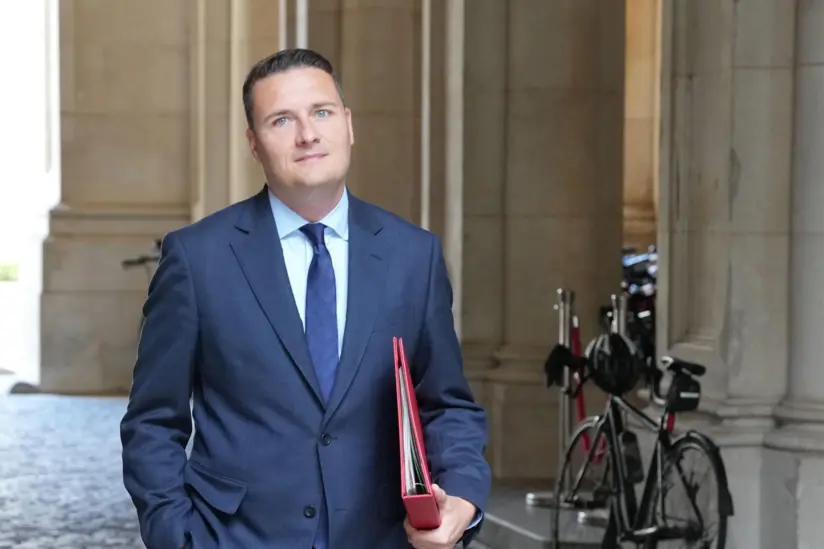

Former health secretary and Labour leadership hopeful Wes Streeting has criticised the timing of the government’s recent pledge to spend £4.5bn on cycling and walking over the next five years, announced on the same day defence secretary John Healey resigned in protest at Labour’s spending plans.
On Thursday, Healey and one of his junior ministers Al Carns quit the government citing concerns that the government’s upcoming defence investment plan was being underfunded, with Healey accusing prime minister Keir Starmer in his resignation letter of failing to provide the money required to “defend the country at a time of rising threats”.
Later that evening, the government officially unveiled the UK’s third Cycling and Walking Investment Strategy – the first to be published under Labour – promising an active travel spend of £4.5bn over the next five years, in a bid to ensure that over half of all short journeys at least partially include cycling or walking by 2035.
In an appearance on the New Statesman’s Politics Show podcast, Streeting – viewed as a likely challenger to Starmer’s premiership in any future Labour leadership contest after resigning as health secretary last month – claimed the timing of the active travel funding announcement represented “bad policy as well as bad politics”.
“There isn’t sufficient grip, direction, or leadership at the heart of the government,” Streeting said. “The problem that comes with that is when there are choices and trade-offs to be made, the prime minister has to make them. They have to be the right choices and they have to be explained clearly to the country.
“And what I find quite extraordinary about [the defence spending crisis] is that two things have become clear. One thing we already knew or expected, which is that the prime minister wasn’t prepared to confront the choices and trade-offs to fund defence.
“But secondly, the plan itself wasn’t right. You have to make sure you have the right plan, which is a plan to invest in and modernise defence to meet the challenges that we’re facing now and into the future.”
He continued: “Then you’ve got to make the right choices. I personally find it extraordinary, both as a matter of policy choice and of political judgment, that here we are, the day after John and Al Carns’ resignation, the government announces £4.5 billion for walking and cycling.
“Now, as a former health secretary, I’m all in favour of walking and cycling. I think these are good things. But would people honestly say, if you’ve got a defence secretary saying there is insufficient funding to keep our country safe, would you the very next day – as a matter of style, let alone substance – have an announcement of £4.5bn for walking and cycling? That’s not a choice I would make.
“I think it’s a really good example of bad judgment as well as bad politics. Bad policy as well as bad politics.”

Later in the episode, when asked whether the government was “sufficiently politically adept” to make changes to allow for increased defence spending, Streeting said: “I think there are always alternatives. As I say, do not tell me when we’ve just committed £4.5bn, the day after the defence secretary told us there isn’t sufficient money for defence, that this a government that is facing up to choices that can be made across government. I don’t believe that’s true.”
Streeting also appeared to criticise the necessity of active travel funding in a post on X on Friday, writing: “The Prime Minister just said defence is ‘a number one priority’. Growth was meant to the number one priority, is it still?
“There’s not enough money for defence, but today the government announced £4.5 BILLION for walking and cycling. Make choices. Decide. Lead.”
Over the weekend, it was also reported that the Ilford North MP will call for licences to be issued to new North Sea oil and gas fields, which Streeting says should be taxed to fund cheaper, cleaner energy, arguing that opponents of new drilling were “opening the door” to Reform UK.
Following the formal publication of the government’s Cycling and Walking Investment Strategy last week, Active Travel England chief Chris Boardman – perhaps contrary to Streeting’s standpoint – argued that every journey made on foot or by bike “delivers value” to the UK.
The new strategy outlines the government’s plans to build 5,000 new cycling, walking, and wheeling routes in England by 2030, as well as 10,000 safer crossings, connecting homes to schools, town centres, and other services.
Those routes around schools form part of Labour’s bid to have at least 60 per cent of all children, aged between five and 16, cycling, walking, or wheeling to class by 2035, and 55 per cent of all short urban journeys to involve active travel for at least part of the trip.
“Every journey made on foot, wheeling, or cycling, delivers value – to the person making it, to the community around them, and to the economy,” Boardman said.
“It keeps money in our pockets, makes us healthier and happier and boosts our local economy. Yet too many of our streets do not yet make those journeys feel safe, easy or inviting. Our Worth Every Step delivery plan will change that. And it starts with where we’ll get the biggest impact: a more active school run and simple zebra crossings to transform local trips.
“It’s time to make the cheapest and healthiest way to travel, the easiest way to travel. When streets work for people, everything else follows.”
However, responding to the strategy’s publication, national active travel charity Cycling UK said more needs to be done, and more funding provided, to unlock cycling’s full social, economic, and environmental benefits.
“The strategy is long-awaited, and we’re pleased to see ambitious targets on journeys to school and a continued focus on short journeys,” Sarah Whitebread, head of Policy and Public Affairs at Cycling UK, said in a statement.
“However, it is disappointing not to see a commitment to closing the gender gap in cycling when we know that women make half as many trips by bike as men. Clear measures to address this would make cycling better for everyone.
“The government has already committed to putting cycling on an equal footing with other transport options. It will now be for government and local authorities across the country to make that ambition a reality.”

















17 thoughts on ““Bad policy as well as bad politics”: Wes Streeting slams “extraordinary” timing of £4.5bn cycling and walking investment after defence secretary’s resignation over funding”
More political BS. It’s not “there’s not enough money for defence” it’s “there’s not enough money for an increase in spending of more than £6bn in one year on defence”. And that follows similar increases in previous years.
Compared to a total active travel budget of £0.9bn per year.
I can’t remember the figures, but I believe there is a significant return on investment when active travel is well funded and good infrastructure is put in place.
Dare I say that, given Streeting’s previous role in the nation’s health, he is using taco-trumpian logic/numbers to justify his current “position”?
I’m not well versed on Streeting’s political positions but I believe he’s seen as more towards the “party of the motorist” (before Starmer piped up that no, Labour was) than many.
Anyhoo, while I suspect he’s just desperate to keep prominence in the political jockeying, it’s still a bit sad to hear.
As to numbers for the benefits of cycling I believe there are European studies which demonstrate investment in cycling delivers a net return, while further investment in driving is overall a net cost.
(Was it this – The Social Cost of Automobility, Cycling and Walking in the European Union – Stefan Gössling, Andy Choi, Kaely Dekker Daniel Metzler?)
Then some years back the UK government commissioned a report on the economic benefits of cycling and concluded that there were indeed benefits.
Fiona Rajé and Andrew Saffrey – The Value of Cycling, DfT / University of Birmingham / Phil Jones Associates
TfL has figures in: Walking and cycling: the economic benefits
@mitsky “I can’t remember the figures, but I believe there is a significant return on investment when active travel is well funded and good infrastructure is put in place.”
Generally taken to be 20:1, and even the Ministry for cars says it’s about 5:1, so way in excess of any other transport investment, and any government spending.
Streeting is a flippin’ embarrassment and needs to stop aping Farage. The best thing he did was resign his cabinet position.
As the Danish government has pointed out nobody can afford to ignore active travel. The extra funding for defence will come from reduced motor traffic road maintenance requirements but Streeting knows that if he has done some “proper” research. (Proper implies reading and understanding research papers produced by transport specialists not watching a couple of YouTube videos and the opinions of the Dog & Duck clientele).
I’ll be surprised & amazed if all of those billions are actually delivered. I expect to hear, in a few years’ time, that only a fraction of that was taken up for various reasons, & the rest was therefore diverted towards other ‘number one issues’.
@alchemilla I can’t see that there is very much real money. Much is expectation that Highway authorities will divert money from the roads maintenance programme, which is unlikely to happen with the state of most roads. The £4.5b also includes money already announced.
The Streeting Rule is, Cycling and Walking tomorrow and Cycling and Walking yesterday, but never Cycling and Walking today.
He is just a careerist we have to remember. He doesn’t give a shite about anything other than his career (like Farage doesn’t care about anything other than making money for himself)
I understand why idiots vote for Reform, (other than because they are racist); they see politicians say anything to play the crowd. The problem is Farage is the epitome of a snake oil salesman.
Streeting’s Daily Mail friendly comment is just a cheap, low and insidious attack on active travel, again. Even if he doesn’t mean it to be – cycle lanes are blamed for closing the high street, causing congestion, increasing pollution, busting the NHS and now, if it wasn’t for active travel, Blighty would still have an armed force to rule the waves. Fkn pathetic
Or more accurately, it’s a cheap, low attack on Starmer – active travel is just catching strays.
“Bad policy as well as bad politics.”
Actually, it’s brilliant policy, but he may have a point about the politics of the timing of the announcement. The fact that he doesn’t know that it’s brilliant policy, and chooses to criticise it, shows that he is either ignorant or just another career politician who will say and do anything for advancement.
Maybe he should move to RefUK: they love that kind of thing.
I am slightly concerned due to the new poles of political attraction to left and right we end up with the worst of all worlds – non-progressive policies which hand over more public goods to megacorps but don’t actually save much money.
I can see roads policy heading towards Reform-lite (hmm… what would change?) because the other pole (Greens) seem less concerned about this kind of thing currently and because the hard-pressed motorist is grumpier than ever (and an increasing number of drivers are older – because more old people – and they tend to vote that way).
Also I wonder if public transport will take a hit – especially the larger projects. Partly because “there’s no money” but also due to fallout from mismanagement of HS2.
@chrisonabike HS2 was merely the biggest in a long line of transport investment failures, just the most spectacular. It was an ego project which never had an economic case, as all the independent analyses showed, but it still went ahead. Just imagine what kind of cycle network we’d have if that £100bn had been used for cycling.
I’m am more at threat from dangerous drivers than I am from russian snipers
If you’re cycling in the UK. But just be careful about picking up discarded perfume bottles, watch who you drink tea with, don’t cycle near Russian warships etc.
Not the best timing, but not the major issue he’s trying to turn it into either. Fitness amongst young people is a problem when it comes to armed forces recruitment, as many are having trouble with the requirements needed to pass the tests because of their inactive lifestyles. This investment will help deal with the problem.