


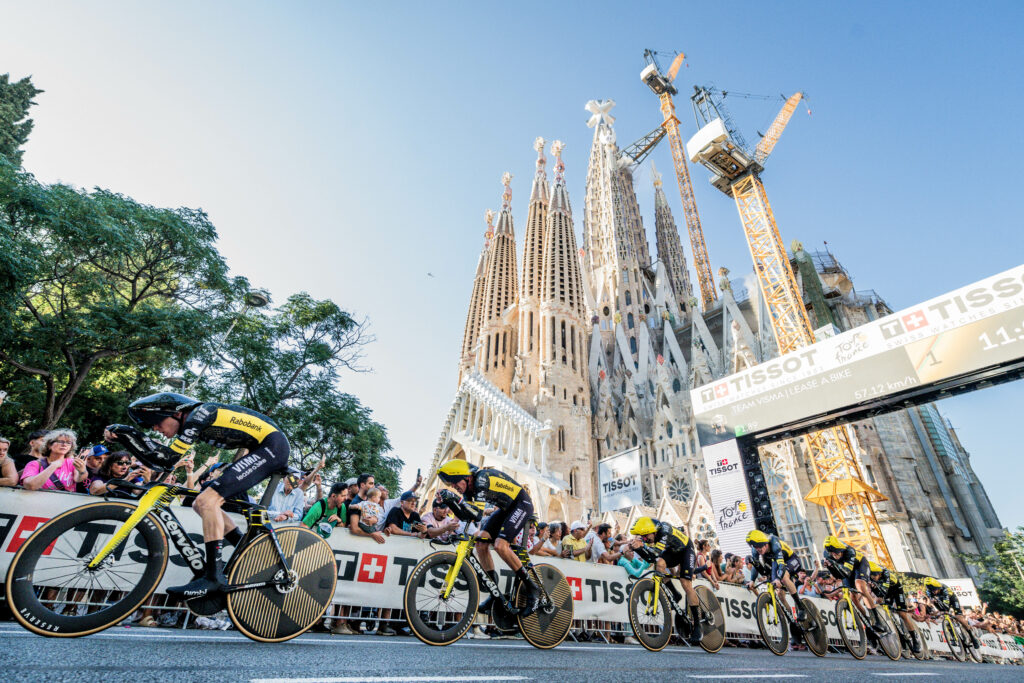

For all its reliance on history and tradition, the Tour de France hasn’t been shy when it comes to searching out innovative ways to spice up cycling’s biggest race. In three weeks’ time, for instance, a new, alternative approach to arguably the sport’s most iconic mountain, Alpe d’Huez, will be tackled by the Tour peloton for the first time.
And this evening, the 2026 race kicked off with another twist to a well-worn racing format: the ‘first past the post’ team time trial. This variation on the TTT, a discipline getting the Tour underway for the first time since 1971, has been trialled by organisers ASO in recent years at Paris-Nice and the Critérium du Dauphiné.
The format differs from traditional team time trials, where a team’s time is taken when the fourth rider crosses the finish line, with all riders finishing together granted the same time in the stage. Under the new system used today in Barcelona, each riders’ time was taken individually at the line, opening up a range of new tactical possibilities.
But did it work, especially as the opening stage to a grand tour?
For the most part, teams opted to use their bulky TT specialists to shepherd their GC contenders along the opening flat and mostly straight section of the 19.6km effort through the centre of Barcelona, with a small group hitting the final climb of Montjuïc.
The team’s main GC contender then, almost invariably, would be piloted into the final few hundred metres by his teammates, before riding to the line alone.
That tactic paid off spectacularly for Visma-Lease a Bike, as Jonas Vingegaard shed Matteo Jorgenson and Davide Piganzoli on the final climb to the Olympic Stadium to pip Filippo Ganna-led Netcompany Ineos by seven seconds and take the first yellow jersey of the 2026 Tour.
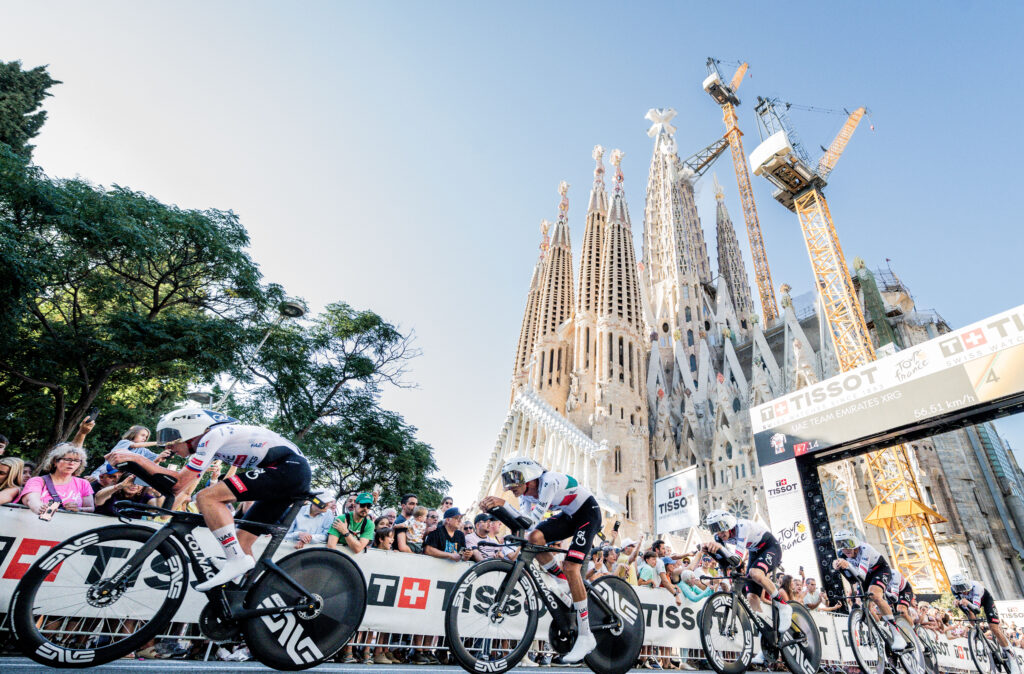
Tadej Pogačar’s UAE Team Emirates overcame a surprisingly shaky start to finish third, 12 seconds down on Visma, the four-time winner dropping his in-form Mexican teammate Isaac Del Toro in the final 500m as he fought to close the deficit to Vingegaard.
The GC-focused nature of the new TTT format means that the first top 10 of this year’s Tour is already packed with riders who will be battling it out for yellow over the next three weeks, with Juan Ayuso already in fourth, Remco Evenepoel fifth, Del Toro sixth, Lipowitz eighth, and Seixas tenth.
The different dynamics of today’s team time trial were highlighted by Pinarello Q36.5, who opted to keep their GC favourite Tom Pidcock tucked away at the back on the opening flat section before teeing him up for the explosive uphill finale, where he was forced to settle for 12th, 57 seconds down on Visma.
“It was a hard final,” Pinarello Q36.5 sports director and long-time Pidcock coach Kurt Bogaerts told road.cc at the finish.
“You want to keep Tom’s best skills intact. I think he’s very explosive and powerful on that kind of finish, and then our strategy was to save as much energy as possible.”
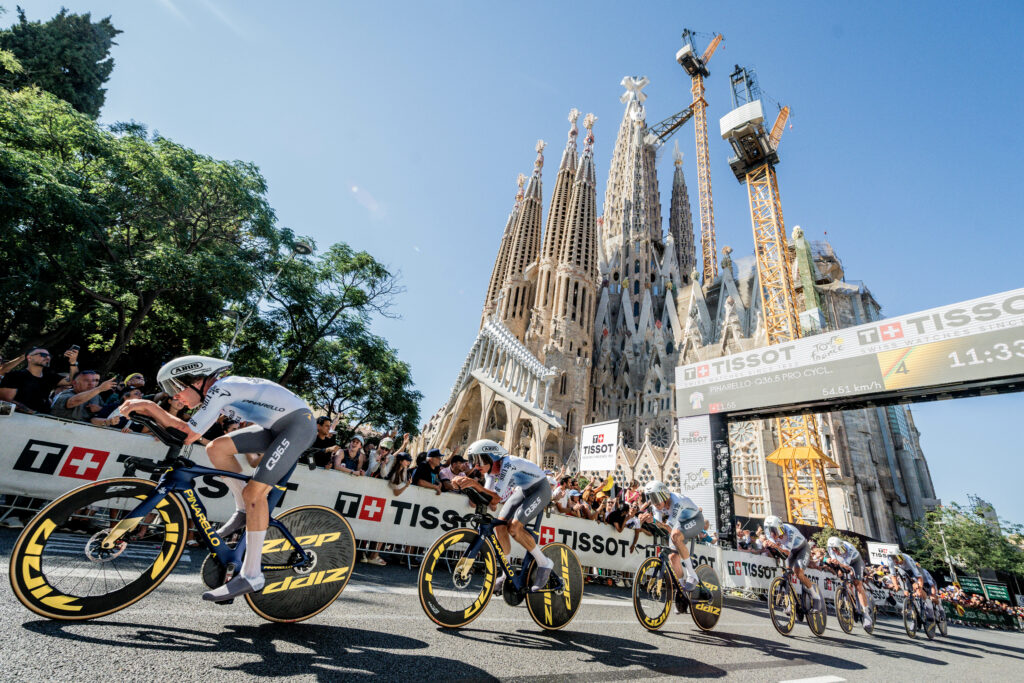
Asked if Pidcock enjoyed the new format, Bogaerts said: “I think this is a discipline that is very difficult to really enjoy because when you sit on the back like Tom, a lot of things go through your head that you want to cooperate and you want to step in. It’s like really seeing your teammates suffer. So I’m not sure that is the biggest enjoyment of the 21 days.”
“It’s one guy who comes today for the result,” the Pinarello DS continued, reflecting on how the team’s approach was altered by the new rules.
“I think it could be strategies that other teams also do, one guy coming to the finish. And then it’s all about how you as a team try to keep the energy intact and there’s a lot of factors that you need to play with. It’s super hot, so cooling is a big thing and we try to put a lot of focus on that. When you really work hard during a TT, you heat up and you lose energy and all these things.
“It’s one guy who did the result today. And for us, I think potentially like Tom wants to keep up there for GC and then the rest, we don’t need to really worry about GC, so that makes it quite easy to make that choice.”
For one of Pidcock’s teammates, newly crowned British road race champion Fred Wright, he was just happy to “tick off” today’s TTT.
“It’s always quite a stressful day, but I think we’re going to be pretty happy with that,” he told road.cc.
“It was maybe a little bit messy, but sometimes these sort of team time trials, if it’s messy, it means you’re going fast and you’re on the limit. It was basically all in to lead Tom into the last kicker. I think we did a good job. We adapted a little bit with just because we were all going flat out and it worked well.”
“It kind of works”
Did Wright enjoy the first opening team time trial at the Tour for 55 years?
“I mean, I love the discipline. I think it’s great fun,” he said. It’s more exciting than an individual time trial. And it’s nice to do, which is a big, big load of work for the team to get it all prepped.
“I think as a rider, doing an effort like that as a team is always good fun, to have the camaraderie between you and to try and execute a plan. I mean, I grew up doing team pursuit at British Cycling, so it’s kind of what I’m used to.”
However, he wasn’t convinced about the new ‘first past the post’ format.
“I quite like that you have to finish with four. I think that adds another sort of team element to it that, which is better for us,” he said.
“But it doesn’t really change so much, to be honest. I think it kind of works. We had seven guys rotating with one guy sat on, so it didn’t really change much.
“We’d also planned who would pull more on the flat, who would get over the first climb, and so it’s nice when you have to sort of tactically work these things out and adapt.
“But a flatter one where you have to make sure four finish together can be exciting too.”
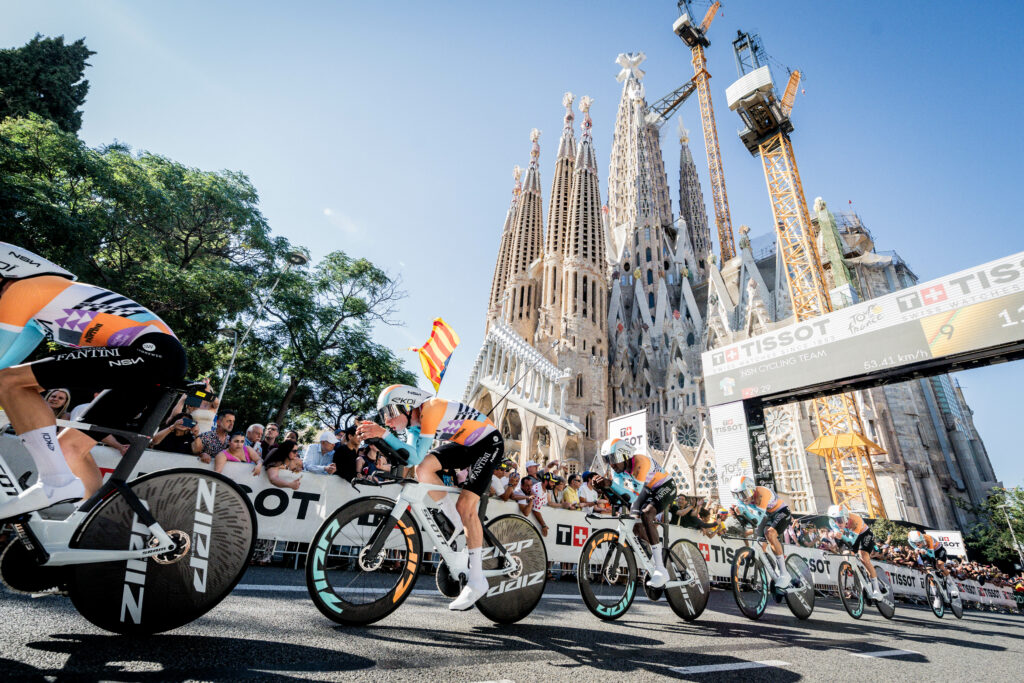
One team that didn’t really have a GC card to play on Saturday was NSN Cycling, a specialist sprint-focused team aiming for success in the bunch kicks and green jersey competition with Biniam Girmay, who ended up 18th on the stage, 1.17 down.
According to NSN’s British rider Jake Stewart – who confessed to be a non-expert on all things TTT – the new format created a different dynamic, centred on the overall classification.
“It’s the first time that I’ve done a team time trial in this kind of environment, but it definitely changes a lot, it makes it a much more GC-focused for the yellow jersey guys,” he told road.cc outside the NSN bus.
“It’s about focusing on your GC guys and getting them to within touching distance of the finish as fast as they can, whilst also kind of keeping some gas in the legs for the final for them.
“So, yeah, it definitely changes the way you ride it, but it’s an interesting format.
“I think it’s a cool format for sure, but at the end of the day, a team time trial is usually the quickest team, whereas here it’s the quickest team and then their GC rider in the finals.
“So it kind of distorts the team time trial element a little bit, but I think it makes for interesting racing, that’s for sure.”
He continued: “We knew that our sprint train that we got here was just to take our climbers to the bottom of the climb and then they kind of look after the climb themselves, but it’s just a real different dynamic to a traditional team time trial.
“I mean, cycling’s all about building the strongest team, so depending on what your objectives are, I think the traditional team time trial suits you to, if that’s your objective, bring the best team that you can aim for a team time trial.
“Whereas here it makes it a bit more balanced and probably lends itself to Grand Tour racing in terms of GC guys, I think.”
Does Stewart reckon the new system has a future in grand tour racing?
“I don’t see why not,” he says. “I mean, I’m not a specialist in team time trials, so I’m not first either way, but yeah, for a team like us, where we’re not going to target it, makes no real difference.
“But yeah, it’s probably a question for the big GC teams.”
And finally, does the ‘first past the post’ format make the traditionally masochistic discipline of team time trialling even tougher?
“Yes, for sure, because you kill each other,” Bogaerts laughs.
“I think it’s a really nice event, but I wouldn’t say I really like it because it’s a stressful day. A lot of factors come together, and that’s the sport, I would say. I think it’s nice, but when you’re working in it, it’s stressful.”





5 thoughts on ““It’s tougher than a normal TTT because you kill each other”: Did the Tour de France’s team time trial experiment work?”
I may be reading far too much into it, but I felt as though Pogacar and UAE weren’t actually that bothered about winning today. Not having yellow to defend and all the extra press etc to do this early in the race is an indisputable advantage; I just got the impression that they were out to lose no more than a handful of seconds but not to bury themselves for the win. With about 2.5kms to go I thought that if Pogacar really wanted it he would have gone from there, but he stayed with Del Toro for nearly another kilometre even though the body language was saying that no way was Del Toro in as good shape as Pogacar. Even after the finish he didn’t seem as wiped out as Ganna (whom I don’t think I’ve ever seen quite so shattered) or Jonas. As I say, might be reading too much into it but I would not be surprised if UAE had played a very clever hand not to lose any meaningful time but to avoid the burden of yellow from the get go.
@Rendel Harris Interestingly, and it sort of supports my theory that UAE were being cunning, Pog has the mountains jersey today because he was the quickest up the final climb, which argues that he hadn’t burnt all his matches when he got to the finish.
Be interesting to see if UAE chase down any breakaway today to ensure that Jonas stays in yellow.
The best thing about the TTT as Stage 1 is that it emphasises the fact that cycling grand tours incl the TDF are a team sport.
Sôme interesting comments from Wright and Stewart about ‘losing’ thé team élément a bit with thé new format