


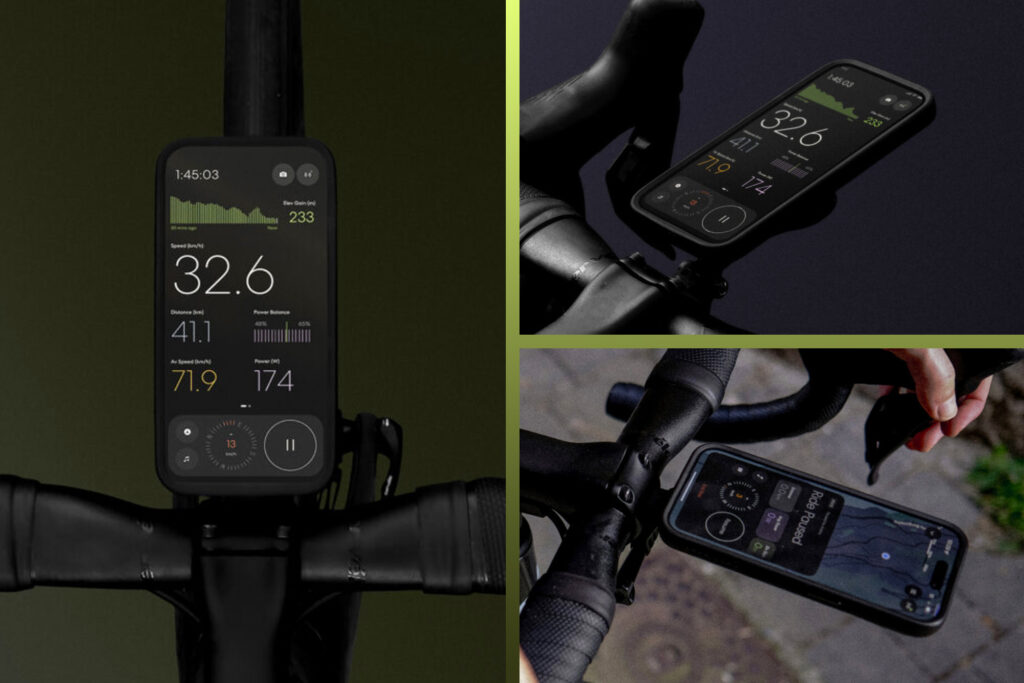

An Australian duo has released a new app that aims to give you a real-time power readout on a smartphone screen with no dedicated power meter required.
You’re sceptical? Of course. It took years for power meters to drop from stratospheric pricing to become anything like affordable to mere mortals, and now you can get power measurement simply using your phone? That sounds far-fetched.
Apps with similar aims already exist – like Virtual Power Meter (designed specifically for use on indoor trainers), Cykelstrom Bicycle Power Meter and Relevate. Accuracy varies; it’s extremely difficult to estimate the precise resistance you’re overcoming (due to the wind speed and direction, your ride position, and so on). For example, Cykelstrom says the average power it gives is within +/-10% of that of a crank-based power meter over the course of a whole ride on smooth surfaces, and typically +/- 25% for mountain biking, depending on trail conditions.
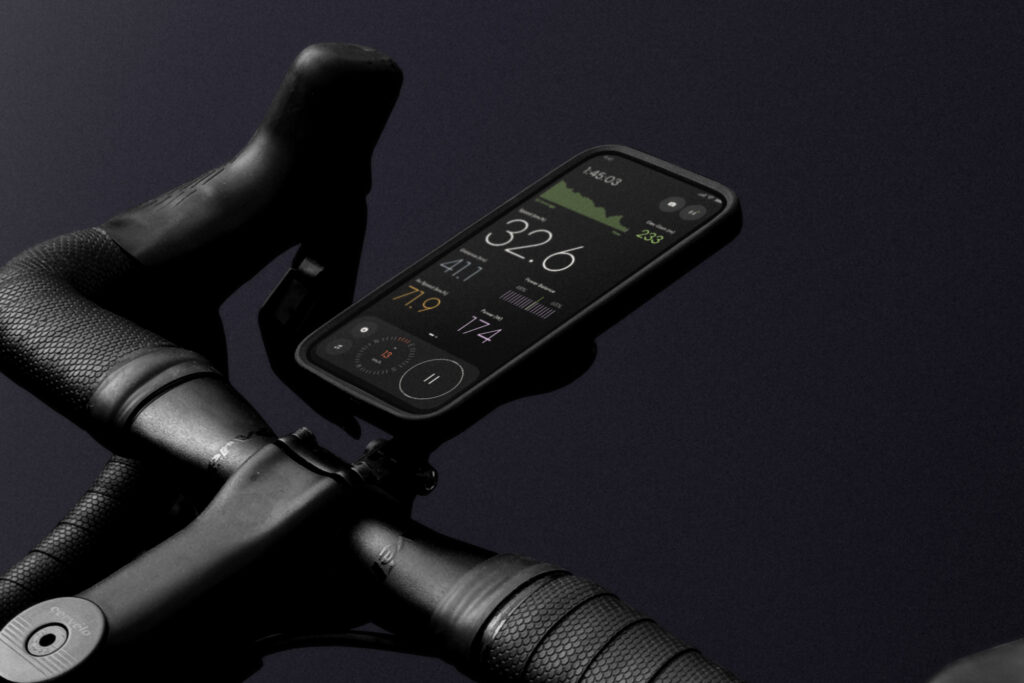
We’ve yet to use the new Ride app so we can’t give you the benefit of any personal experience – not even a first ride – but we can give you the story from the guys behind it.
“The app turns your phone into a full-fledged cycling computer – speed, elevation, energy – but the key feature is Real-Time Power, estimated from the phone’s own sensors rather than a hardware meter on the cranks,” says Dean Lusk, the builder of Ride. He and Ride designer Jono Allison have been friends since childhood.
“The goal is to be the best cycling computer out there. Not so much a Strava alternative, but a Garmin without the need to buy a Garmin – or the expensive pedals. Power accuracy is not quite on the same level as the dedicated hardware solutions, but it’s close enough to train and track with.”
Platforms like Strava already estimate power for a ride using information about your weight, speed and elevation change, but not in real time. Strava only applies its estimated power algorithm after you’ve uploaded your ride, and this calculation relies on your uploaded GPS coordinates, elevation gain, speed, and weight. We tested it out last year and found the results to be variable – pretty good in certain circumstances, but no threat to a dedicated power meter overall.
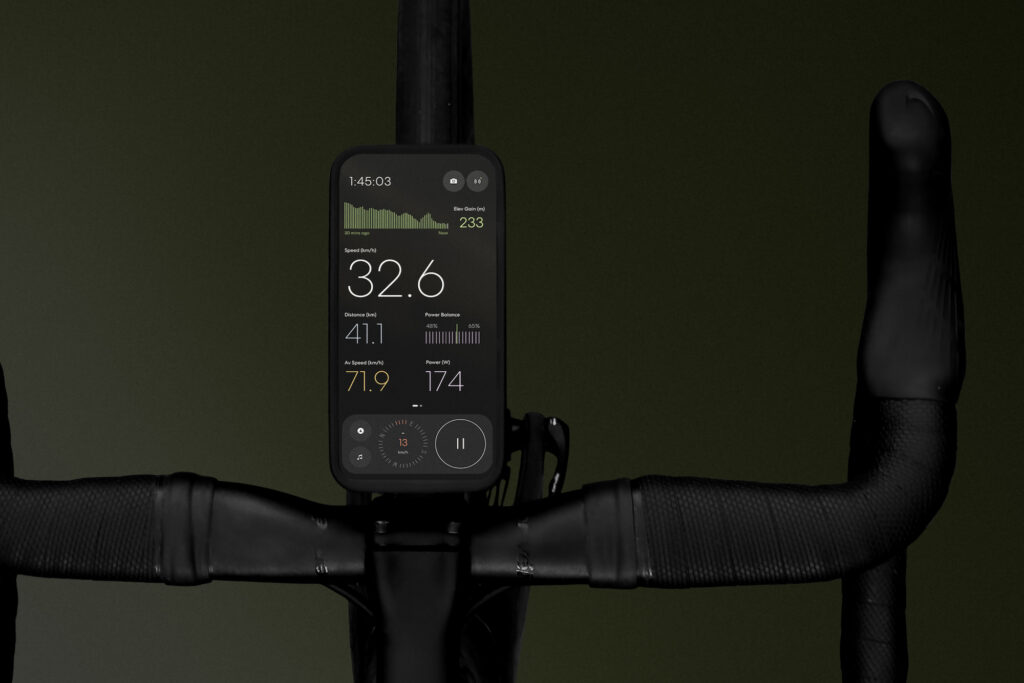
The biggest difference with the Ride app, of course, is that it aims to give you a power figure on your phone screen as you ride.
Big question: how does the Ride app come up with the power figures it displays?
“It’s primarily a second-by-second physics-based approach,” says Dean. “We take GPS data, altitude, weather, rider height and weight, ideally some bike info for best results, and add a bit of special sauce.”
Special sauce? Intriguing, but we’re not privy to all the details. Ride can also provide real-time cadence estimates.
How accurate are Ride’s calculations? Dean has provided graphs comparing Ride figures (shown as Ride Real-Time Power) with measurements from Favero Assioma PRO RS-2 or Assioma DUO pedals.
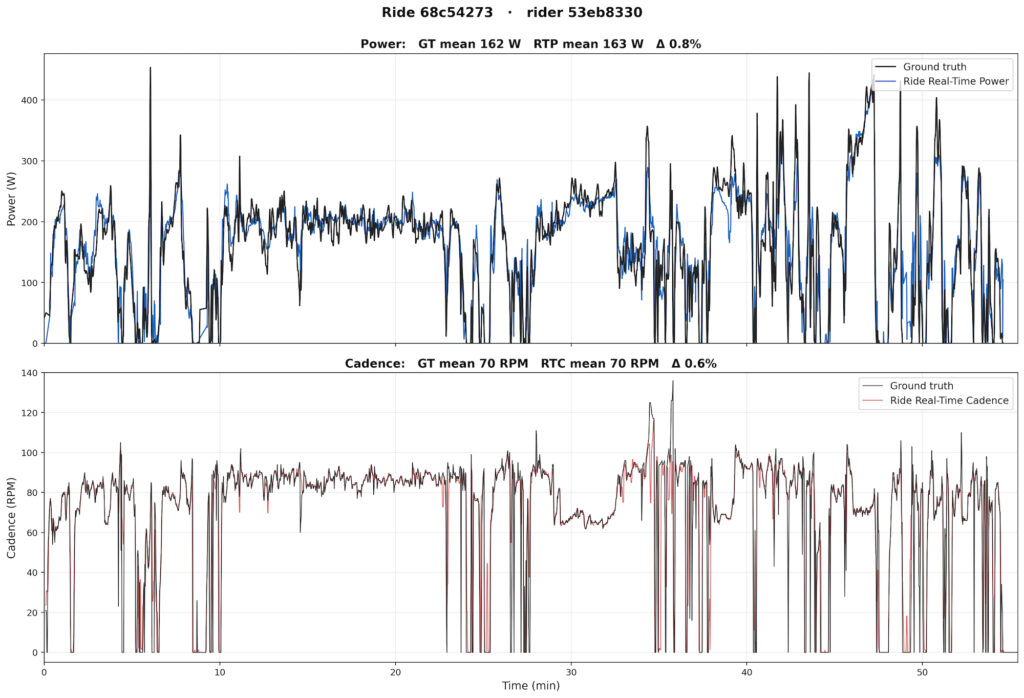
On this ride, for example, the overall average power measurements were within a watt of one another, although the average is only ever a small part of the story when comparing power. The peaks and troughs seem to be greater (generally) with the Favero pedals in this instance.
The average cadence suggested by the Ride app is the same as the figure provided by Favero. Although the figures diverge occasionally, they’re pretty close most of the time.
That’s in no way intended to be a detailed analysis, by the way. We’d want to collect our own data before making any sort of comment on performance, and we’ve not had the chance to do that.
Who is the Ride app aimed at?
Dean says, “I know that in the short term, hardcore roadies will have no interest in mounting their phone on their bike, but the way high-end Garmin devices are trending in size and capabilities, it might not be long until there is little discernible difference between a phone and a Garmin, so I take a long view on that.
“And today, there are lots of serious cyclists who already have a Garmin, Wahoo, etc but don’t currently have a means to measure power, and Ride’s Pocket Power feature lets you transmit real-time power and cadence from Ride to a BLE-enabled [Bluetooth Low Energy] head unit, and have it read on your device as if coming from a traditional power meter. So even for cyclists who don’t like the idea of mounting their phone, I think there is still a broad use case there.
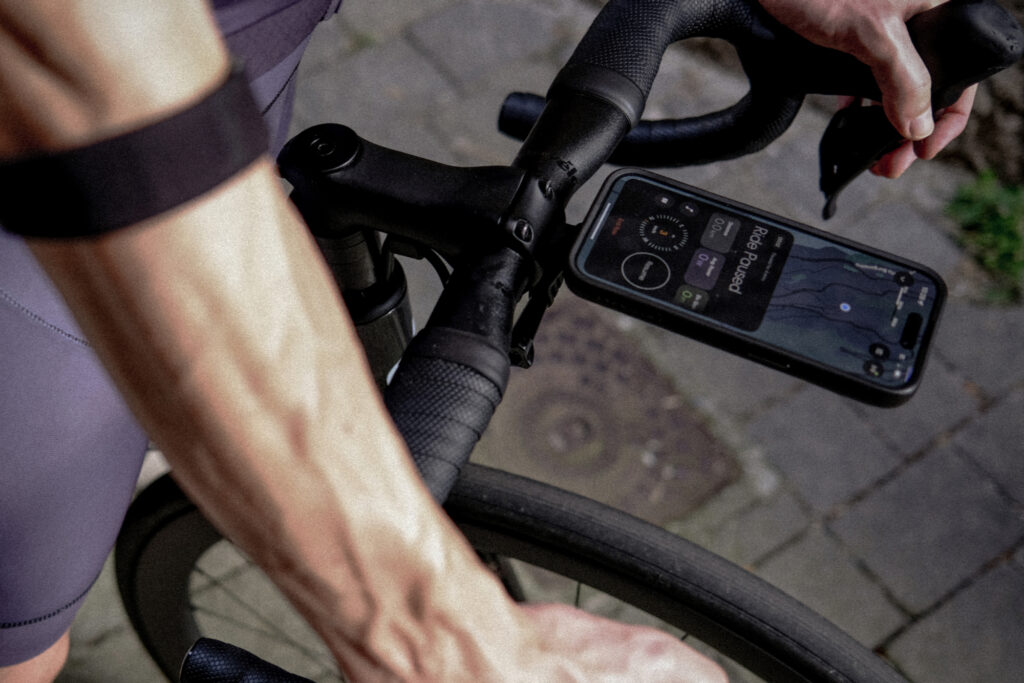
“In the immediate term, I think people most likely to be drawn to Ride are cyclists that are just starting to learn about the value of knowing their power as the key metric of cycling, but maybe aren’t ready to spring for the expensive hardware to get it. The nice thing is that, if they ever do decide to go for the full setup, Ride fully supports BLE power meters like the Assioma range (including Cycling Dynamics on the Pro RS series), so they can keep using Ride if they want to.
“I think it might be a similar story for those who aren’t already invested in a specific ecosystem – Garmin, Wahoo, etc – but see the appeal in a full-featured device, but perhaps not in the £700 or so for a top-end Garmin.
“That said – and I feel like I’m getting a little sales-pitchy – my goal really is for Ride to appeal to cyclists not on the basis of value, but because it is quite literally the best cycling computer you can get.”
Any limitations?
“It is not yet optimised for drafting, so to get realistic results while drafting, there’s a manual toggle to help the algorithm along,” says Dean. “Our test group is quite modest in size, and high-power riders are underrepresented, so we may well find that there is some tweaking required to give folks with an FTP [functional threshold power] of 280W+ optimal results.
> What is FTP? 7 key facts to learn about functional threshold power, a major training metric
“At launch we’re lacking routes and navigation support, as well as workouts, but they are both just around the corner and will be top priority post-launch, and we will be shipping improvements as fast as humanly possible. So hopefully we’re not too far off being able to make that a genuine conversation.”
As mentioned above, we’ve not tried the Ride app for ourselves so we have no input on its accuracy – other than to say that any app of this time has to make a series of estimates and assumptions.
The Ride app is launching now for iPhone, with a beta Android version coming out early August and a full Android launch by the end of the month. It is available as a free trial, but longer-term pricing is £9.99 per month or £59.99 per year. A ‘lifetime option’ is £199.99. It’s 50% off during the Tour de France to celebrate the launch. There’s also another launch promo; lifetime purchases start at $1 via the ride.app website, with the price increasing by $0.50 every time someone purchases.
Head over to ride.app for more info.






12 thoughts on “New Ride app promises real-time power with no power meter required”
Its impossible to do what they are suggesting. There are far too many variables that affect the things they are using to calculate it. The reason Stava and co. can be in the ballpark *sometimes* with their estimates is because sometimes the conditions they base their estimates on are simple or they simply get lucky ie. overestimate the effect of wind by 5% but also underestimate the quality of surface you’re on.
With a strong wind, crappy road, upright position, wrong tyre pressure, putting power down when you shouldn’t or coasting at every chance, the estimates will be wildly wrong.
@mctrials23 Absolutely, I was just thinking of a couple of roads I regularly ride through at Elephant and Castle, where a plethora of new tower blocks has been built: the prevailing wind is south-westerly but due to the wind shear effects of the new buildings it switches to northerly for several blocks and requires very considerable extra effort on windy days, how is an app going to figure that out? How will it know if I’m riding on an open road with nobody about or drafting behind an HGV? I’ll really be surprised if in real world conditions this app can consistently get within 20% of a power meter figure. It’s one of those cases where if it were possible, somebody would’ve done it already.
That said I wouldn’t have minded giving it a free trial but it wants your card number, something I always avoid unless essential, it’s just a trap for the forgetful and poorly organised (like me). If companies are really sure their products are so good that people will subscribe after a free trial, why do they insist on having your card number instead of just genuinely letting you try it for free?
@mctrials23 Yes although it can be done with some accuracy if an on-bike wind sensor is used e.g. PowerPod (see DCR review) but then as you suggest the set-up is/was so complex you might as well buy a direct measurement power meter.
Getting power meter pedals transformed my training for the better so it was worth the investment.
If, as the inventors claim, accuracy is questionable above an FTP of 280, how many truly serious cyclists are going to be interested?
@cmedred Their target audience isn’t serious cyclists so its not that important I would imagine.
replying to @cmedred, but didn’t work for some reason; also tagging usernames doesn’t seem to work when editing…]
In fairness, they’ve been pretty clear that ‘truly serious cyclists’ isn’t their target market – they’re going after the dabblers, and fully expect them to upgrade to proper power measurement if they get more serious.
@mdavidford When they will get a rude awakening and realise that like the people who use an exercise bike in the gym and humblebrag about their FTP of 340w after 6 weeks of cycling, they are just using a junk measuring device.
My favorite quote regarding power accuracy “it’s close enough to train and track with” – unless they are magicians, that is not possible. The only way this could be true is if you’re aiming for an increase in your power from one ride to the next of at least 10%, otherwise the inherent noise in their data sources is going to dominate everything. Good luck with that 10%-per-ride power increase.
But doesn’t rider’s position allone account for about 30% of the power?
I downloaded the app onto my iPhone 12 a week or so ago and have had no success getting it to show me my power. It happily gives me all the info I can already get on my Garmin Edge 830 already. I just wanted to see if I could get a power reading without the expense of buying a power meter. I also don’t seem to have any success linking the app to my Garmin. There is an option to send a message to support via a Contact Us link but so far 3 messages on three different days have elicited no response. Another issue, which could be due to brightness settings on my phone perhaps, is that in bright sunlight I can’t read any of the info on the dark screen. Would love to discuss this with the designers but they haven’t chosen to answer my messages.
The physics principle exploited is that opposing forces equal applied forces. Conventional power meters measure applied forces–very well but admittedly not cheaply. This app appears to measure acceleration and slope to determine two of four important opposing forces. Notice something missing? Wind…the dominant opposing force when riding on the flats or in a pack. This app assumes that wind speed equals bike speed in order to “guess” the critical opposing wind force it does not measure. If you always ride solo and never ride when the wind blows maybe this app will work OK for you. Otherwise you are wasting your money. There is no such thing as free power.
@kyzyl2 I’m extremely sceptical that this app could measure power with any accuracy, but as far as I understand it is not the case that it completely ignores windspeed; as the inventor says, it uses weather as one of the variables. Presumably it takes real-time wind speed and direction from nearby weather stations and factors that into its calculations. Of course this may be wildly inaccurate if you’re climbing up a bare hillside and the nearest weather station is in a sheltered valley half a mile away, but it does make some attempt to account for wind speed and direction.